
Pau d'Arco Inner Bark 500 mg Ingredients & Drug Interactions
What is this page for?
First and foremost: checking Pau d'Arco Inner Bark 500 mg against your medications. The heart of this page is the interaction checker and the full interaction report — how this product’s ingredients may interact with prescription and over-the-counter medicines you may be taking.
Around that, we add a pharmacist’s high-level view of the product as a whole — what’s inside, the evidence for its stated use, how transparent the label is, and what safety data exists — so you can see the full picture in one place. It’s educational information from our licensed clinical databases and the clinical staff at HelloPharmacist — not medical advice — and we don’t sell or endorse products. Our editorial policy
Pau d'Arco Inner Bark 500 mg is a dietary supplement by Wonder Laboratories with 1 active ingredient. Its ingredients are commonly taken for infections (bacterial, fungal, yeast), inflammation, immune support.Based on those ingredients, 122 medications have a known interaction with it, the most serious rated moderate. The ingredients most likely to interact are Pau d'Arco. Use the checker below to test your specific medication, or read the full HelloPharmacist Interaction Report.
Check Your Meds Against Pau d'Arco Inner Bark 500 mg by Wonder Laboratories
Ask about any prescription or over-the-counter medication and we check it for interactions with Pau d'Arco Inner Bark 500 mg by Wonder Laboratories — and tell you which ingredient is responsible.
AI summaries are generated from our interaction database for education only — always confirm with your pharmacist. How we use AI
Ask the Pharmacist
A licensed pharmacist will answer your question by email — free, usually within 24 hours.
Got it — thank you!
A licensed pharmacist will answer within 24 hours. Keep an eye on your email (worth checking spam, just in case).
HelloPharmacist Scorecard of Pau d'Arco Inner Bark 500 mg by Wonder Laboratories
Our pharmacy team’s full take, with four database checks built into the cards below — a summary of what is known, not a grade of the product itself.
What’s inside
Full disclosure
This product contains one active ingredient: pau d'arco inner bark at 500 mg per capsule. Pau d'arco is a botanical extract from the inner bark of a tropical tree; it's been used in traditional medicine for various purposes, though modern evidence for most uses is limited.
The capsule also contains inactive ingredients (gelatin, cellulose, and magnesium stearate) that help form and deliver the supplement.
Does it work?
Couldn't assess
The evidence we hold doesn't establish that pau d'arco works reliably for cancer, peptic ulcers, wound healing, or dysmenorrhea (period pain). For all of these uses, the data is insufficient to make a firm rating.
If you're considering this supplement for a specific health goal, talk with your doctor or pharmacist about what the current evidence actually supports.
How safe is it?
Well-documented data
Pau d'arco is generally well tolerated at typical doses, but human safety data is limited and higher doses (above 1.5 grams daily of its lapachol compound) carry real risks. At those higher doses, it may cause anemia, bleeding, severe nausea, vomiting, and diarrhea.
Avoid pau d'arco during pregnancy — the safety data advises against it due to possible harm to the developing baby. There isn't enough information to know if it's safe while breastfeeding, so avoid it then as well.
Occupational exposure to pau d'arco sawdust can cause asthma and severe skin reactions, though this is unlikely from taking the supplement itself.
Meds to double-check
Moderate interaction found
Before taking pau d'arco, check with your doctor or pharmacist if you take any blood thinners or antiplatelet drugs (like warfarin, aspirin, clopidogrel, or dabigatran) — pau d'arco may increase your bleeding risk through a Moderate interaction.
The bottom line
Scorecard at a glanceFully disclosed formula with no assessable stated purpose. Moderate medication interactions have been identified, and safety information is well characterized.
Pau d'Arco Inner Bark may be worth considering if you've researched it for a specific use and discussed it with your doctor, but the evidence for most claimed benefits isn't solid. The main caution is bleeding risk if you take blood thinners or antiplatelet drugs — check with your own doctor or pharmacist before combining them.
Avoid this supplement if you're pregnant or breastfeeding. At standard doses it's generally tolerated, but don't exceed higher amounts without medical oversight.
Educational only — not medical advice; always confirm with your pharmacist. Our editorial policy · How we use AI
Assessment coverage: 1 of 1 active ingredient matched to our full ingredient reviews (monographs). Based on the product label dated Aug 22, 2024.
This Scorecard evaluates available label information, ingredient evidence, and known medication-safety considerations. It does not independently verify product identity, purity, potency, contamination, or manufacturing quality. How these ratings are computed
General information
Key facts about Pau d'Arco Inner Bark 500 mg, straight from the product label.
| Brand | Wonder Laboratories |
|---|---|
| Barcode (UPC) | 099528326259 |
| Net contents | 250 Capsule(s) |
| Market status | On market |
| Date entered into DSLD | Aug 22, 2024 |
| DSLD ID | 315236 |
| Product type | Botanical |
| Supplement form | Capsule |
| Dietary claims / uses | All Other |
| Intended target group(s) | Adult (18 - 50 Years), Kosher, Gluten Free |
Everything in this section is reproduced from the manufacturer’s own product label — it’s the label speaking, not HelloPharmacist. We show it so you can see exactly what the maker states; we don’t verify or endorse those statements.
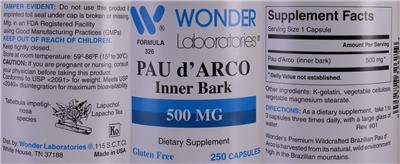
Supplement Facts
The label details for Pau d'Arco Inner Bark 500 mg by Wonder Laboratories, sourced from the NIH Dietary Supplement Label Database.
Supplement Facts
| Ingredient | Amount | % DV |
|---|---|---|
| Pau d'Arco | 500 mg | -- |
Other ingredients: k-Gelatin, Cellulose, Magnesium Stearate
Tap any ingredient to jump to its full detail below.
These statements are the manufacturer’s wording, reproduced from the product label — the label is saying it, not HelloPharmacist. We don’t verify or endorse them.
Precautions
Tamper Evident: Do not use this product if imprinted foil seal under cap is broken or missing.
Keep out of reach of children.
Caution: If you are pregnant or nursing, consult your physician before taking this product.
Formulation
Mfg. in an FDA Registered Facility using Good Manufacturing Practices (GMPs)
Conforms to USP<2091> for weight. Meets USP <2040> disintegration for maximum bioavailability.
Made in USA
Gluten Free
Wonder's Premium Wildcrafted Brazilian Pau d' Arco is harvested from its natural, wild environment high in the Brazilian mountains.
Storage
Keep tightly closed. Store at room temperature: 59 degrees-86 degrees F (15 degrees to 30 degrees C).
Formula
Tabebuia impetiginosa species Lapachol Lapacho Tea
Ko (Kosher Service)
Seals/Symbols
Ko (Kosher Service)
General Statements
Formula 326
FDA Statement of Identity
Dietary Supplement
Suggested/Recommended/Usage/Directions
Directions: As a dietary supplement, take 1 to 3 capsules three times daily, with a large glass of water.
Is this label outdated? Report a formula or label change and our pharmacy team will review it.
Pau d'Arco Inner Bark 500 mg by Wonder Laboratories label
The label scan from the NIH Dietary Supplement Label Database. Tap to enlarge.
Label images are published by the NIH Dietary Supplement Label Database for the version of this product on file. Always read your actual product label.
View the full label (PDF)The Ingredients in Pau d'Arco Inner Bark 500 mg by Wonder Laboratories
This is the 1 active ingredient this product is made of. Select it to open its full monograph.
Serving size1 Capsule(s) Dosage formCapsule Servings per container250 Amounts shown are per serving.
Pau d'Arco
Interacts with122 drugs
Pau d'arco is a South American tree bark traditionally used for infections and inflammation, and it contains compounds like lapachol that show activit...
Pau d'Arco monograph & interactionsOther (inactive) ingredients: K-Gelatin, Cellulose, Magnesium Stearate. These complete the product’s ingredient list but are not active constituents.
Pau d'Arco Inner Bark 500 mg by Wonder Laboratories Drug Interactions
HelloPharmacist Interaction Report
Pau d'Arco Inner Bark 500 mg by Wonder Laboratories interacts with blood thinners and antiplatelet drugs through compounds that may increase your bleeding risk.
The main concern is with anticoagulants (like warfarin) and antiplatelet medications (like aspirin or clopidogrel) — pau d'arco can reduce how your blood clots and may interfere with vitamin K, which your body needs to control bleeding.
Read the full breakdown — every affected drug type, severity by severity
The risk appears most significant if you're taking higher doses of pau d'arco, especially above 1.5 grams daily, but there's not enough data to set a completely safe lower threshold. If you take any blood thinner or antiplatelet drug, check your exact medications with the tool on this page before starting pau d'arco.
Altogether, these interactions span 122 individual medications.
Check your own medications below · Editorial policy · How we use AI
Want to check YOUR meds against Pau d'Arco Inner Bark 500 mg?
Ask about interactions with your drugs in plain English — “Can I take it with lisinopril?” — and we find you the answer in seconds, ingredient by ingredient.
Go to the checkerIngredients driving the most interactions
Individual Drug Interactions
The ingredients in Pau d'Arco Inner Bark 500 mg interact with 122 drugs. Click any drug to see the details.
1 of the 1 ingredient in Pau d'Arco Inner Bark 500 mg interact with drugs. Each result below shows which ingredient is responsible. Pau d'Arco
AbciximabReoPro
How Abciximab interacts with Pau d'Arco Inner Bark 500 mg — through 1 ingredient. Tap an ingredient for the detail:
Pau D'arcoAnticoagulant/antiplatelet Drugs Moderate
Interaction Summary
Theoretically, pau d'arco might increase the risk of bleeding when taken with anticoagulant or antiplatelet drugs.
Read the full Pau D'arco + Abciximab interactionAbrocitinibCibinqo
How Abrocitinib interacts with Pau d'Arco Inner Bark 500 mg — through 1 ingredient. Tap an ingredient for the detail:
Pau D'arcoAnticoagulant/antiplatelet Drugs Moderate
Interaction Summary
Theoretically, pau d'arco might increase the risk of bleeding when taken with anticoagulant or antiplatelet drugs.
Read the full Pau D'arco + Abrocitinib interactionAcenocoumarolSintrom
How Acenocoumarol interacts with Pau d'Arco Inner Bark 500 mg — through 1 ingredient. Tap an ingredient for the detail:
Pau D'arcoAnticoagulant/antiplatelet Drugs Moderate
Interaction Summary
Theoretically, pau d'arco might increase the risk of bleeding when taken with anticoagulant or antiplatelet drugs.
Read the full Pau D'arco + Acenocoumarol interactionAcetaminophen, AspirinGemnisyn
How Acetaminophen, Aspirin interacts with Pau d'Arco Inner Bark 500 mg — through 1 ingredient. Tap an ingredient for the detail:
Pau D'arcoAnticoagulant/antiplatelet Drugs Moderate
Interaction Summary
Theoretically, pau d'arco might increase the risk of bleeding when taken with anticoagulant or antiplatelet drugs.
Read the full Pau D'arco + Acetaminophen, Aspirin interactionAcetaminophen, Aspirin, CaffeineExcedrin, Excedrin Extra Strength, Excedrin Migraine
How Acetaminophen, Aspirin, Caffeine interacts with Pau d'Arco Inner Bark 500 mg — through 1 ingredient. Tap an ingredient for the detail:
Pau D'arcoAnticoagulant/antiplatelet Drugs Moderate
Interaction Summary
Theoretically, pau d'arco might increase the risk of bleeding when taken with anticoagulant or antiplatelet drugs.
Read the full Pau D'arco + Acetaminophen, Aspirin, Caffeine interactionAcetaminophen, IbuprofenCombogesic
How Acetaminophen, Ibuprofen interacts with Pau d'Arco Inner Bark 500 mg — through 1 ingredient. Tap an ingredient for the detail:
Pau D'arcoAnticoagulant/antiplatelet Drugs Moderate
Interaction Summary
Theoretically, pau d'arco might increase the risk of bleeding when taken with anticoagulant or antiplatelet drugs.
Read the full Pau D'arco + Acetaminophen, Ibuprofen interactionAcetylsalicylic AcidEntrophen
How Acetylsalicylic Acid interacts with Pau d'Arco Inner Bark 500 mg — through 1 ingredient. Tap an ingredient for the detail:
Pau D'arcoAnticoagulant/antiplatelet Drugs Moderate
Interaction Summary
Theoretically, pau d'arco might increase the risk of bleeding when taken with anticoagulant or antiplatelet drugs.
Read the full Pau D'arco + Acetylsalicylic Acid interactionAlteplase, TpaActilyse, Activase
How Alteplase, Tpa interacts with Pau d'Arco Inner Bark 500 mg — through 1 ingredient. Tap an ingredient for the detail:
Pau D'arcoAnticoagulant/antiplatelet Drugs Moderate
Interaction Summary
Theoretically, pau d'arco might increase the risk of bleeding when taken with anticoagulant or antiplatelet drugs.
Read the full Pau D'arco + Alteplase, Tpa interactionAluminum Hydroxide, Aspirin, Codeine Phosphate, Magnesium HydroxideAscriptin Codeine #2
How Aluminum Hydroxide, Aspirin, Codeine Phosphate, Magnesium Hydroxide interacts with Pau d'Arco Inner Bark 500 mg — through 1 ingredient. Tap an ingredient for the detail:
Pau D'arcoAnticoagulant/antiplatelet Drugs Moderate
Interaction Summary
Theoretically, pau d'arco might increase the risk of bleeding when taken with anticoagulant or antiplatelet drugs.
Read the full Pau D'arco + Aluminum Hydroxide, Aspirin, Codeine Phosphate, Magnesium Hydroxide interactionAluminum Hydroxide, Aspirin, Magnesium HydroxideAscriptin
How Aluminum Hydroxide, Aspirin, Magnesium Hydroxide interacts with Pau d'Arco Inner Bark 500 mg — through 1 ingredient. Tap an ingredient for the detail:
Pau D'arcoAnticoagulant/antiplatelet Drugs Moderate
Interaction Summary
Theoretically, pau d'arco might increase the risk of bleeding when taken with anticoagulant or antiplatelet drugs.
Read the full Pau D'arco + Aluminum Hydroxide, Aspirin, Magnesium Hydroxide interactionAnacaulase-bcdbNexoBrid
How Anacaulase-bcdb interacts with Pau d'Arco Inner Bark 500 mg — through 1 ingredient. Tap an ingredient for the detail:
Pau D'arcoAnticoagulant/antiplatelet Drugs Moderate
Interaction Summary
Theoretically, pau d'arco might increase the risk of bleeding when taken with anticoagulant or antiplatelet drugs.
Read the full Pau D'arco + Anacaulase-bcdb interactionAnagrelideAgrylin
How Anagrelide interacts with Pau d'Arco Inner Bark 500 mg — through 1 ingredient. Tap an ingredient for the detail:
Pau D'arcoAnticoagulant/antiplatelet Drugs Moderate
Interaction Summary
Theoretically, pau d'arco might increase the risk of bleeding when taken with anticoagulant or antiplatelet drugs.
Read the full Pau D'arco + Anagrelide interactionAnisindioneMiradon
How Anisindione interacts with Pau d'Arco Inner Bark 500 mg — through 1 ingredient. Tap an ingredient for the detail:
Pau D'arcoAnticoagulant/antiplatelet Drugs Moderate
Interaction Summary
Theoretically, pau d'arco might increase the risk of bleeding when taken with anticoagulant or antiplatelet drugs.
Read the full Pau D'arco + Anisindione interactionAntithrombin IiiThrombate III
How Antithrombin Iii interacts with Pau d'Arco Inner Bark 500 mg — through 1 ingredient. Tap an ingredient for the detail:
Pau D'arcoAnticoagulant/antiplatelet Drugs Moderate
Interaction Summary
Theoretically, pau d'arco might increase the risk of bleeding when taken with anticoagulant or antiplatelet drugs.
Read the full Pau D'arco + Antithrombin Iii interactionApixabanEliquis
How Apixaban interacts with Pau d'Arco Inner Bark 500 mg — through 1 ingredient. Tap an ingredient for the detail:
Pau D'arcoAnticoagulant/antiplatelet Drugs Moderate
Interaction Summary
Theoretically, pau d'arco might increase the risk of bleeding when taken with anticoagulant or antiplatelet drugs.
Read the full Pau D'arco + Apixaban interactionArgatrobanArgatroban
How Argatroban interacts with Pau d'Arco Inner Bark 500 mg — through 1 ingredient. Tap an ingredient for the detail:
Pau D'arcoAnticoagulant/antiplatelet Drugs Moderate
Interaction Summary
Theoretically, pau d'arco might increase the risk of bleeding when taken with anticoagulant or antiplatelet drugs.
Read the full Pau D'arco + Argatroban interactionAspirinAngettes 75, ASA, Asaphen, Aspirin, Caprin, Cartia +8 more
How Aspirin interacts with Pau d'Arco Inner Bark 500 mg — through 1 ingredient. Tap an ingredient for the detail:
Pau D'arcoAnticoagulant/antiplatelet Drugs Moderate
Interaction Summary
Theoretically, pau d'arco might increase the risk of bleeding when taken with anticoagulant or antiplatelet drugs.
Read the full Pau D'arco + Aspirin interactionAspirin, Aluminum Hydroxide, Codeine Phosphate, Magnesium HydroxideAscriptin Codeine #3
How Aspirin, Aluminum Hydroxide, Codeine Phosphate, Magnesium Hydroxide interacts with Pau d'Arco Inner Bark 500 mg — through 1 ingredient. Tap an ingredient for the detail:
Pau D'arcoAnticoagulant/antiplatelet Drugs Moderate
Interaction Summary
Theoretically, pau d'arco might increase the risk of bleeding when taken with anticoagulant or antiplatelet drugs.
Read the full Pau D'arco + Aspirin, Aluminum Hydroxide, Codeine Phosphate, Magnesium Hydroxide interactionAspirin, ButalbitalAxotal
How Aspirin, Butalbital interacts with Pau d'Arco Inner Bark 500 mg — through 1 ingredient. Tap an ingredient for the detail:
Pau D'arcoAnticoagulant/antiplatelet Drugs Moderate
Interaction Summary
Theoretically, pau d'arco might increase the risk of bleeding when taken with anticoagulant or antiplatelet drugs.
Read the full Pau D'arco + Aspirin, Butalbital interactionAspirin, Butalbital, CaffeineFiorinal
How Aspirin, Butalbital, Caffeine interacts with Pau d'Arco Inner Bark 500 mg — through 1 ingredient. Tap an ingredient for the detail:
Pau D'arcoAnticoagulant/antiplatelet Drugs Moderate
Interaction Summary
Theoretically, pau d'arco might increase the risk of bleeding when taken with anticoagulant or antiplatelet drugs.
Read the full Pau D'arco + Aspirin, Butalbital, Caffeine interactionAspirin, Butalbital, Caffeine, Codeine PhosphateFiorinal w/ Codeine
How Aspirin, Butalbital, Caffeine, Codeine Phosphate interacts with Pau d'Arco Inner Bark 500 mg — through 1 ingredient. Tap an ingredient for the detail:
Pau D'arcoAnticoagulant/antiplatelet Drugs Moderate
Interaction Summary
Theoretically, pau d'arco might increase the risk of bleeding when taken with anticoagulant or antiplatelet drugs.
Read the full Pau D'arco + Aspirin, Butalbital, Caffeine, Codeine Phosphate interactionAspirin, Butalbital, Caffeine, PhenacetinMarnal
How Aspirin, Butalbital, Caffeine, Phenacetin interacts with Pau d'Arco Inner Bark 500 mg — through 1 ingredient. Tap an ingredient for the detail:
Pau D'arcoAnticoagulant/antiplatelet Drugs Moderate
Interaction Summary
Theoretically, pau d'arco might increase the risk of bleeding when taken with anticoagulant or antiplatelet drugs.
Read the full Pau D'arco + Aspirin, Butalbital, Caffeine, Phenacetin interactionAspirin, CaffeineAnacin
How Aspirin, Caffeine interacts with Pau d'Arco Inner Bark 500 mg — through 1 ingredient. Tap an ingredient for the detail:
Pau D'arcoAnticoagulant/antiplatelet Drugs Moderate
Interaction Summary
Theoretically, pau d'arco might increase the risk of bleeding when taken with anticoagulant or antiplatelet drugs.
Read the full Pau D'arco + Aspirin, Caffeine interactionAspirin, Caffeine, Codeine PhosphateAnacin w/ Codeine
How Aspirin, Caffeine, Codeine Phosphate interacts with Pau d'Arco Inner Bark 500 mg — through 1 ingredient. Tap an ingredient for the detail:
Pau D'arcoAnticoagulant/antiplatelet Drugs Moderate
Interaction Summary
Theoretically, pau d'arco might increase the risk of bleeding when taken with anticoagulant or antiplatelet drugs.
Read the full Pau D'arco + Aspirin, Caffeine, Codeine Phosphate interactionAspirin, Caffeine, Dihydrocodeine BitartrateSynalgos DC
How Aspirin, Caffeine, Dihydrocodeine Bitartrate interacts with Pau d'Arco Inner Bark 500 mg — through 1 ingredient. Tap an ingredient for the detail:
Pau D'arcoAnticoagulant/antiplatelet Drugs Moderate
Interaction Summary
Theoretically, pau d'arco might increase the risk of bleeding when taken with anticoagulant or antiplatelet drugs.
Read the full Pau D'arco + Aspirin, Caffeine, Dihydrocodeine Bitartrate interactionAspirin, Caffeine, Dover's PwdAcedoval, Dovacet
How Aspirin, Caffeine, Dover's Pwd interacts with Pau d'Arco Inner Bark 500 mg — through 1 ingredient. Tap an ingredient for the detail:
Pau D'arcoAnticoagulant/antiplatelet Drugs Moderate
Interaction Summary
Theoretically, pau d'arco might increase the risk of bleeding when taken with anticoagulant or antiplatelet drugs.
Read the full Pau D'arco + Aspirin, Caffeine, Dover's Pwd interactionAspirin, Caffeine, HydrocodoneDamason-P
How Aspirin, Caffeine, Hydrocodone interacts with Pau d'Arco Inner Bark 500 mg — through 1 ingredient. Tap an ingredient for the detail:
Pau D'arcoAnticoagulant/antiplatelet Drugs Moderate
Interaction Summary
Theoretically, pau d'arco might increase the risk of bleeding when taken with anticoagulant or antiplatelet drugs.
Read the full Pau D'arco + Aspirin, Caffeine, Hydrocodone interactionAspirin, Caffeine, Isobutylallylbarbituric Acid, PhenacetinLanorinal
How Aspirin, Caffeine, Isobutylallylbarbituric Acid, Phenacetin interacts with Pau d'Arco Inner Bark 500 mg — through 1 ingredient. Tap an ingredient for the detail:
Pau D'arcoAnticoagulant/antiplatelet Drugs Moderate
Interaction Summary
Theoretically, pau d'arco might increase the risk of bleeding when taken with anticoagulant or antiplatelet drugs.
Read the full Pau D'arco + Aspirin, Caffeine, Isobutylallylbarbituric Acid, Phenacetin interactionAspirin, Caffeine, OrphenadrineInvagesic, Invagesic Forte, Norgesic, Norgesic Forte, Orphengesic, Orphengesic Forte
How Aspirin, Caffeine, Orphenadrine interacts with Pau d'Arco Inner Bark 500 mg — through 1 ingredient. Tap an ingredient for the detail:
Pau D'arcoAnticoagulant/antiplatelet Drugs Moderate
Interaction Summary
Theoretically, pau d'arco might increase the risk of bleeding when taken with anticoagulant or antiplatelet drugs.
Read the full Pau D'arco + Aspirin, Caffeine, Orphenadrine interactionAspirin, Caffeine, Phenacetin, PropoxypheneMargesic Comp. 65
How Aspirin, Caffeine, Phenacetin, Propoxyphene interacts with Pau d'Arco Inner Bark 500 mg — through 1 ingredient. Tap an ingredient for the detail:
Pau D'arcoAnticoagulant/antiplatelet Drugs Moderate
Interaction Summary
Theoretically, pau d'arco might increase the risk of bleeding when taken with anticoagulant or antiplatelet drugs.
Read the full Pau D'arco + Aspirin, Caffeine, Phenacetin, Propoxyphene interactionEach ingredient & the kinds of drugs it affects
For each ingredient in Pau d'Arco Inner Bark 500 mg with known interactions, here are the types of medications it can affect. Open any type for the detail — or search your exact drug in the checker above.
Pau d'Arco
Anticoagulant/Antiplatelet Drugs
Theoretically, pau d'arco might increase the risk of bleeding when taken with anticoagulant or antiplatelet drugs.
In vitro research shows that pau d'arco reduces platelet aggregation and may interfere with vitamin K. One clinical study shows that taking the lapachol constituent of pau d'arco in doses above 1.5 grams daily increases the risk of bleeding. The effects of whole pau d'arco or pau d'arco extract in humans are unclear.
Brand information
Manufacturer and brand details for Pau d'Arco Inner Bark 500 mg, from the product label.
Wonder Laboratories
See all Wonder Laboratories products- Name
- Wonder Laboratories
- Street Address
- 115 S.C.T. Ct.
- City
- White House
- State
- TN
- ZipCode
- 37188
Pau d'Arco Inner Bark 500 mg by Wonder Laboratories: Common Questions
Does Pau d'Arco Inner Bark 500 mg by Wonder Laboratories interact with any medications?
How can one product interact with so many drugs?
Where does this information come from?
What is pau d'arco, and where does it come from?
Can I take pau d'arco if I'm pregnant or breastfeeding?
Does pau d'arco actually work for cancer, ulcers, or wound healing?
What side effects might I get from pau d'arco?
Can I take this with my blood thinner or aspirin?
Written and reviewed by the HelloPharmacist editorial staff. Our editorial policy
Not sure if Pau d'Arco Inner Bark 500 mg is safe with your meds?
Our pharmacists answer your medication & supplement questions — free.
Label information is sourced from the NIH Dietary Supplement Label Database and reflects the product version on file; always read your actual product label. This page is for education only and is not a substitute for professional medical advice. Confirm with your pharmacist or doctor before combining supplements and medications.
The Full Monographs Behind Pau d'Arco Inner Bark 500 mg’s Ingredients
Every ingredient we hold a full HelloPharmacist monograph for — uses, evidence, safety, and the complete interaction list.
Sources & How We Checked
Pau d'Arco Inner Bark 500 mg's label data comes from the NIH Dietary Supplement Label Database; the ingredient interaction data is from the Natural Medicines database, reviewed by our pharmacists.
- NIH Dietary Supplement Label Database (DSLD) — The official product label on file for this supplement.
- Natural Medicines (Therapeutic Research Center) — Evidence-graded clinical reference behind the ingredient interaction data.
Content is written and reviewed by licensed HelloPharmacist pharmacists. See our data sources and editorial standards for how this information is built and checked.
The 6 references behind this product’s interaction data
Every citation that drives the interaction findings for this product’s ingredients, from the evidence-graded Natural Medicines (TRC Healthcare) database. Open an ingredient to browse its citations — links open the study on PubMed or the publisher’s site.
Pau D'arco 6 references
- Gómez Castellanos JR, Prieto JM, Heinrich M. Red Lapacho (Tabebuia impetiginosa)--a global ethnopharmacological commodity? J Ethnopharmacol 2009;121:1-13. PubMed
- Guerra, Mde O., Mazoni, A. S., Brandao, M. A., and Peters, V. M. Toxicology of Lapachol in rats: embryolethality. Braz.J Biol. 2001;61(1):171-174. PubMed
- Felicio, A. C., Chang, C. V., Brandao, M. A., Peters, V. M., and Guerra, Mde O. Fetal growth in rats treated with lapachol. Contraception 2002;66(4):289-293. PubMed
- Son, D. J., Lim, Y., Park, Y. H., Chang, S. K., Yun, Y. P., Hong, J. T., Takeoka, G. R., Lee, K. G., Lee, S. E., Kim, M. R., Kim, J. H., and Park, B. S. Inhibitory effects of Tabebuia impetiginosa inner bark extract on platelet aggregation and vascular s
- Block JB, Serpick AA, Miller W, Wiernik PH. Early clinical studies with lapachol (NSC-11905). Cancer Chemother Rep 2. 1974;4(4):27-8.
- Algranti E, Mendonça EM, Ali SA, Kokron CM, Raile V. Occupational asthma caused by Ipe (Tabebuia spp) dust. J Investig Allergol Clin Immunol 2005;15(1):81-3.
Parts of this content are provided by the Therapeutic Research Center, LLC.
DISCLAIMER: Currently this does not check for drug-drug interactions. This is not an all-inclusive comprehensive list of potential interactions and is for informational purposes only. Not all interactions are known or well-reported in the scientific literature, and new interactions are continually being reported. Input is needed from a qualified healthcare provider including a pharmacist before starting any therapy. Application of clinical judgment is necessary.
© 2021 Therapeutic Research Center, LLC