
Pe Min Kan Wan Ingredients & Drug Interactions
by Plum Flower
What is this page for?
First and foremost: checking Pe Min Kan Wan against your medications. The heart of this page is the interaction checker and the full interaction report — how this product’s ingredients may interact with prescription and over-the-counter medicines you may be taking.
Around that, we add a pharmacist’s high-level view of the product as a whole — what’s inside, the evidence for its stated use, how transparent the label is, and what safety data exists — so you can see the full picture in one place. It’s educational information from our licensed clinical databases and the clinical staff at HelloPharmacist — not medical advice — and we don’t sell or endorse products. Our editorial policy
Pe Min Kan Wan is a dietary supplement by Plum Flower with 9 active ingredients. Its ingredients are commonly taken for eye irritation and tired eyes, cooling and 'heat-clearing' in traditional chinese medicine, cold and flu symptoms.Based on those ingredients, 909 medications have a known interaction with it, the most serious rated major. The ingredients most likely to interact are Xanthium sibiricum Fruit Extract, Magnolia biondii Flower Extract. Use the checker below to test your specific medication, or read the full HelloPharmacist Interaction Report.
Check Your Meds Against Pe Min Kan Wan by Plum Flower
Ask about any prescription or over-the-counter medication and we check it for interactions with Pe Min Kan Wan by Plum Flower — and tell you which ingredient is responsible.
AI summaries are generated from our interaction database for education only — always confirm with your pharmacist. How we use AI
Ask the Pharmacist
A licensed pharmacist will answer your question by email — free, usually within 24 hours.
Got it — thank you!
A licensed pharmacist will answer within 24 hours. Keep an eye on your email (worth checking spam, just in case).
HelloPharmacist Scorecard of Pe Min Kan Wan by Plum Flower
Our pharmacy team’s full take, with four database checks built into the cards below — a summary of what is known, not a grade of the product itself.
What’s inside
Low disclosure
Pe Min Kan Wan is a 9-ingredient blend that combines traditional herbal extracts. The active ingredients include Magnolia biondii, Xanthium sibiricum, Isatis indigotica, Chrysanthemum morifolium, Mentha haplocalyx (Japanese mint), Perilla frutescens, and extracts of Pogostemon cablin, Saposhnikovia divaricata, and Centipeda minima.
The tablet also contains inactive ingredients — maltose, microcrystalline cellulose, magnesium silicate, activated charcoal, and china wax — which serve as fillers and binders.
Does it work?
Moderate evidence
The evidence for most of these ingredients is limited. Magnolia is possibly effective for gingivitis, but for its other uses — including hay fever and anxiety — the data isn't established enough to rate.
Isatis shows possibly effective evidence for psoriasis. For the remaining ingredients' uses — Chrysanthemum for angina, headache, common cold, diabetes, and HIV/AIDS; Japanese mint for bronchitis, cancer, headache, cold, and cough; and Perilla for cognitive decline, hay fever, asthma, bone health, cancer, and headache — we hold insufficient reliable evidence to rate any of them.
We have no effectiveness data on file for Xanthium sibiricum, Pogostemon cablin, Saposhnikovia divaricata, or Centipeda minima.
How safe is it?
Well-documented data
Xanthium sibiricum is the biggest safety concern in this product. The fruit contains toxic compounds and has caused serious poisoning; it's regarded as generally unsafe for use.
It must be avoided during pregnancy and breastfeeding. Chrysanthemum is generally well tolerated as a tea but can cause allergic reactions — an estimated 60% of Europeans are allergic — and safety during pregnancy and breastfeeding has not been established.
Japanese mint in small amounts is fine, but the concentrated oil can be irritating or toxic; it should be avoided while breastfeeding. Perilla seems well tolerated orally as food but supplement amounts are not well studied; medicinal doses should be avoided in pregnancy and breastfeeding because anaphylaxis has been reported with perilla seeds.
Magnolia is generally well tolerated short-term, but safety data in humans are limited, and it should be avoided in pregnancy and breastfeeding. We hold no adverse-effect data for Isatis, Pogostemon cablin, Saposhnikovia divaricata, or Centipeda minima.
Meds to double-check
Major interaction found
Before you take this, double-check with your pharmacist if you're on diabetes medications (blood sugar can drop dangerously), kidney-harming drugs, liver-harming drugs, blood thinners or aspirin-type drugs (bleeding risk), or sedating medications like sleep aids or anxiety drugs. No interactions are documented for the three ingredients we could not check.
The bottom line
Scorecard at a glanceFormula with limited ingredient disclosure with some supporting evidence behind its ingredients' uses. Major medication interactions have been identified, and safety information is well characterized.
This product carries serious safety and interaction concerns, particularly because of Xanthium sibiricum. If you take any blood sugar medications, blood thinners, sedating drugs, or drugs that stress your kidneys or liver, you must check with your pharmacist first — these combinations could cause real harm.
Pregnant or breastfeeding people should avoid it. If you're allergic to chrysanthemums or ragweed family plants, this may not be for you.
Educational only — not medical advice; always confirm with your pharmacist. Our editorial policy · How we use AI
Assessment coverage: 6 of 9 active ingredients matched to our full ingredient reviews (monographs). Based on the product label dated May 21, 2025.
This Scorecard evaluates available label information, ingredient evidence, and known medication-safety considerations. It does not independently verify product identity, purity, potency, contamination, or manufacturing quality. How these ratings are computed
General information
Key facts about Pe Min Kan Wan, straight from the product label.
| Brand | Plum Flower |
|---|---|
| Barcode (UPC) | 739934839614 |
| Net contents | 500 Pill(s); 4.41 Ounce(s); 125 Gram(s) |
| Market status | On market |
| Date entered into DSLD | May 21, 2025 |
| DSLD ID | 331236 |
| Product type | Botanical |
| Supplement form | Tablet Or Pill |
| Dietary claims / uses | All Other |
| Intended target group(s) | Adult (18 - 50 Years) |
Everything in this section is reproduced from the manufacturer’s own product label — it’s the label speaking, not HelloPharmacist. We show it so you can see exactly what the maker states; we don’t verify or endorse those statements.
Supplement Facts
The label details for Pe Min Kan Wan by Plum Flower, sourced from the NIH Dietary Supplement Label Database.
Supplement Facts
| Ingredient | Amount | % DV |
|---|---|---|
| Proprietary Extract Blend | 1500 mg | -- |
| Pogostemon cablin Herb Extract | 0 NP | -- |
| Chrysanthemum morifolium Flower Extract | 0 NP | -- |
| Mentha haplocalyx herb extract | 0 NP | -- |
| Perilla frutescens leaf extract | 0 NP | -- |
| Saposhnikovia divaricata Root Extract | 0 NP | -- |
| Magnolia biondii Flower Extract | 0 NP | -- |
| Xanthium sibiricum Fruit Extract | 0 NP | -- |
| Isatis indigotica Root Extract | 0 NP | -- |
| Centipeda minima Herb Extract | 0 NP | -- |
Other ingredients: Maltose, Microcrystalline Cellulose, Magnesium Silicate, Carbon, Activated, China Wax
Tap any ingredient to jump to its full detail below.
These statements are the manufacturer’s wording, reproduced from the product label — the label is saying it, not HelloPharmacist. We don’t verify or endorse them.
Formulation
GMP Quality
Plum Flower Guarantee
US owned & operated since 1969 Made in China
General Statements
Economy size
FDA Statement of Identity
Herbal Supplement
Suggested/Recommended/Usage/Directions
Take 6 pills 3 times daily or as directed by your health care practitioner
Precautions
Caution during pregnancy
Keep out of reach of children
Seals/Symbols
Sourced Sustainably FDA Registered cGMP Compliant Made at a cGMP Certified Facility Lab Tested Quality Verified Species Verified
Is this label outdated? Report a formula or label change and our pharmacy team will review it.
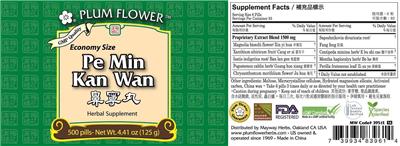
Pe Min Kan Wan by Plum Flower label
The label scan from the NIH Dietary Supplement Label Database. Tap to enlarge.
Label images are published by the NIH Dietary Supplement Label Database for the version of this product on file. Always read your actual product label.
View the full label (PDF)The Ingredients in Pe Min Kan Wan by Plum Flower
These are the 9 active ingredients this product is made of. Select any to open its full monograph.
Serving size6 Pill(s) Dosage formTablet Or Pill Servings per container83 Amounts shown are per serving.
Most supplement products combine several ingredients, and a medication can interact with the product through any one of them. Each ingredient below shows whether it has known drug interactions.
Proprietary Extract Blend
- › Pogostemon cablin Herb Extract
- › Chrysanthemum morifolium Flower Extract
- › Mentha haplocalyx herb extract
- › Perilla frutescens leaf extract
- › Saposhnikovia divaricata Root Extract
- › Magnolia biondii Flower Extract
- › Xanthium sibiricum Fruit Extract
- › Isatis indigotica Root Extract
- › Centipeda minima Herb Extract
Other (inactive) ingredients: Maltose, Microcrystalline Cellulose, Magnesium Silicate, Carbon, Activated, China Wax. These complete the product’s ingredient list but are not active constituents.
Pe Min Kan Wan by Plum Flower Drug Interactions
HelloPharmacist Interaction Report
Pe Min Kan Wan by Plum Flower contains one ingredient — Xanthium sibiricum (Siberian cocklebur) — that carries serious interactions we need to talk about.
This ingredient can harm your kidneys and liver on its own, and combining it with drugs that do the same increases that risk significantly. It also lowers blood sugar and can cause severe low blood sugar (hypoglycemia), so it must not be used with diabetes medications.
Read the full breakdown — every affected drug type, severity by severity
Additionally, Magnolia biondii in this product may add to the effects of sedating drugs like sleeping pills, anxiety medications, and pain relievers — potentially making you too drowsy. It can also theoretically increase bleeding risk when paired with blood thinners or aspirin-type drugs.
Chryanthemum and Japanese mint extract show no documented interactions, though both can trigger allergic reactions and Japanese mint oil can cause breathing problems if misused or inhaled in concentrated form. We could not check three other ingredients — Pogostemon cablin, Saposhnikovia divaricata, and Centipeda minima — because we hold no monograph data for them.
Altogether, these interactions span 892 individual medications. Please run your exact prescriptions through the checker on this page before you start.
Check your own medications below · Editorial policy · How we use AI
Want to check YOUR meds against Pe Min Kan Wan?
Ask about interactions with your drugs in plain English — “Can I take it with lisinopril?” — and we find you the answer in seconds, ingredient by ingredient.
Go to the checkerIngredients driving the most interactions
Individual Drug Interactions
The ingredients in Pe Min Kan Wan interact with 909 drugs. Click any drug to see the details.
2 of the 9 ingredients in Pe Min Kan Wan interact with drugs. Each result below shows which ingredient is responsible. Xanthium sibiricum Fruit Extract Magnolia biondii Flower Extract
6-mercaptopurinePurinethol
How 6-mercaptopurine interacts with Pe Min Kan Wan — through 1 ingredient. Tap an ingredient for the detail:
Xanthium Sibiricum Fruit ExtractHepatotoxic Drugs Major
Interaction Summary
Siberian cocklebur can adversely affect the liver.
Read the full Xanthium Sibiricum Fruit Extract + 6-mercaptopurine interactionAbacavir Sulfate, Dolutegravir, LamivudineTriumeq
How Abacavir Sulfate, Dolutegravir, Lamivudine interacts with Pe Min Kan Wan — through 1 ingredient. Tap an ingredient for the detail:
Xanthium Sibiricum Fruit ExtractHepatotoxic Drugs Major
Interaction Summary
Siberian cocklebur can adversely affect the liver.
Read the full Xanthium Sibiricum Fruit Extract + Abacavir Sulfate, Dolutegravir, Lamivudine interactionAbacavir, LamivudineEpzicom
How Abacavir, Lamivudine interacts with Pe Min Kan Wan — through 1 ingredient. Tap an ingredient for the detail:
Xanthium Sibiricum Fruit ExtractHepatotoxic Drugs Major
Interaction Summary
Siberian cocklebur can adversely affect the liver.
Read the full Xanthium Sibiricum Fruit Extract + Abacavir, Lamivudine interactionAbiraterone
How Abiraterone interacts with Pe Min Kan Wan — through 1 ingredient. Tap an ingredient for the detail:
Xanthium Sibiricum Fruit ExtractHepatotoxic Drugs Major
Interaction Summary
Siberian cocklebur can adversely affect the liver.
Read the full Xanthium Sibiricum Fruit Extract + Abiraterone interactionAbiraterone AcetateYonsa, Zytiga
How Abiraterone Acetate interacts with Pe Min Kan Wan — through 1 ingredient. Tap an ingredient for the detail:
Xanthium Sibiricum Fruit ExtractHepatotoxic Drugs Major
Interaction Summary
Siberian cocklebur can adversely affect the liver.
Read the full Xanthium Sibiricum Fruit Extract + Abiraterone Acetate interactionAcarboseGlucobay, Prandase, Precose
How Acarbose interacts with Pe Min Kan Wan — through 1 ingredient. Tap an ingredient for the detail:
Xanthium Sibiricum Fruit ExtractAntidiabetes Drugs, Hepatotoxic Drugs Major
Interaction Summary
Siberian cocklebur seedlings and seeds have caused severe hypoglycemia in humans.
Read the full Xanthium Sibiricum Fruit Extract + Acarbose interactionAcebutololRhotral, Sectral
How Acebutolol interacts with Pe Min Kan Wan — through 1 ingredient. Tap an ingredient for the detail:
Xanthium Sibiricum Fruit ExtractHepatotoxic Drugs Major
Interaction Summary
Siberian cocklebur can adversely affect the liver.
Read the full Xanthium Sibiricum Fruit Extract + Acebutolol interactionAcetaminophenChildren's Tylenol, Children's Tylenol Meltaways, Tylenol, Tylenol Ex Strength
How Acetaminophen interacts with Pe Min Kan Wan — through 1 ingredient. Tap an ingredient for the detail:
Xanthium Sibiricum Fruit ExtractNephrotoxic Drugs, Hepatotoxic Drugs Major
Interaction Summary
Siberian cocklebur can adversely affect the kidney.
Read the full Xanthium Sibiricum Fruit Extract + Acetaminophen interactionAcetaminophen, AspirinGemnisyn
How Acetaminophen, Aspirin interacts with Pe Min Kan Wan — through 2 ingredients. Tap an ingredient for the detail:
Xanthium Sibiricum Fruit ExtractHepatotoxic Drugs, Nephrotoxic Drugs Major
Interaction Summary
Siberian cocklebur can adversely affect the liver.
Read the full Xanthium Sibiricum Fruit Extract + Acetaminophen, Aspirin interactionMagnolia Biondii Flower ExtractAnticoagulant/antiplatelet Drugs Moderate
Interaction Summary
Theoretically, magnolia might have additive effects and increase the risk of bleeding when used with anticoagulant or antiplatelet drugs.
Read the full Magnolia Biondii Flower Extract + Acetaminophen, Aspirin interactionAcetaminophen, Aspirin, CaffeineExcedrin, Excedrin Extra Strength, Excedrin Migraine
How Acetaminophen, Aspirin, Caffeine interacts with Pe Min Kan Wan — through 2 ingredients. Tap an ingredient for the detail:
Xanthium Sibiricum Fruit ExtractNephrotoxic Drugs, Hepatotoxic Drugs Major
Interaction Summary
Siberian cocklebur can adversely affect the kidney.
Read the full Xanthium Sibiricum Fruit Extract + Acetaminophen, Aspirin, Caffeine interactionMagnolia Biondii Flower ExtractAnticoagulant/antiplatelet Drugs Moderate
Interaction Summary
Theoretically, magnolia might have additive effects and increase the risk of bleeding when used with anticoagulant or antiplatelet drugs.
Read the full Magnolia Biondii Flower Extract + Acetaminophen, Aspirin, Caffeine interactionAcetaminophen, Brompheniramine, PhenylpropanolamineDimetapp Cold and Flu
How Acetaminophen, Brompheniramine, Phenylpropanolamine interacts with Pe Min Kan Wan — through 1 ingredient. Tap an ingredient for the detail:
Xanthium Sibiricum Fruit ExtractHepatotoxic Drugs, Nephrotoxic Drugs Major
Interaction Summary
Siberian cocklebur can adversely affect the liver.
Read the full Xanthium Sibiricum Fruit Extract + Acetaminophen, Brompheniramine, Phenylpropanolamine interactionAcetaminophen, ButalbitalAxocet, Bancap, Bucet, Butex Forte, Esgic CF, Orbivan CF +5 more
How Acetaminophen, Butalbital interacts with Pe Min Kan Wan — through 1 ingredient. Tap an ingredient for the detail:
Xanthium Sibiricum Fruit ExtractNephrotoxic Drugs, Hepatotoxic Drugs Major
Interaction Summary
Siberian cocklebur can adversely affect the kidney.
Read the full Xanthium Sibiricum Fruit Extract + Acetaminophen, Butalbital interactionAcetaminophen, Butalbital, CaffeineEsgic, Esgic Plus, Fiogesic, Fioricet, Repan, Tecnal +1 more
How Acetaminophen, Butalbital, Caffeine interacts with Pe Min Kan Wan — through 1 ingredient. Tap an ingredient for the detail:
Xanthium Sibiricum Fruit ExtractHepatotoxic Drugs, Nephrotoxic Drugs Major
Interaction Summary
Siberian cocklebur can adversely affect the liver.
Read the full Xanthium Sibiricum Fruit Extract + Acetaminophen, Butalbital, Caffeine interactionAcetaminophen, Butalbital, Caffeine, CodeineEsgic with Codeine, Fioricet w/ Codeine
How Acetaminophen, Butalbital, Caffeine, Codeine interacts with Pe Min Kan Wan — through 2 ingredients. Tap an ingredient for the detail:
Xanthium Sibiricum Fruit ExtractHepatotoxic Drugs, Nephrotoxic Drugs Major
Interaction Summary
Siberian cocklebur can adversely affect the liver.
Read the full Xanthium Sibiricum Fruit Extract + Acetaminophen, Butalbital, Caffeine, Codeine interactionMagnolia Biondii Flower ExtractCns Depressants Moderate
Interaction Summary
Theoretically, concomitant use of large doses of magnolia bark and CNS depressants might have additive effects.
Read the full Magnolia Biondii Flower Extract + Acetaminophen, Butalbital, Caffeine, Codeine interactionAcetaminophen, Butalbital, CodeineBancap w/ Codeine
How Acetaminophen, Butalbital, Codeine interacts with Pe Min Kan Wan — through 2 ingredients. Tap an ingredient for the detail:
Xanthium Sibiricum Fruit ExtractHepatotoxic Drugs, Nephrotoxic Drugs Major
Interaction Summary
Siberian cocklebur can adversely affect the liver.
Read the full Xanthium Sibiricum Fruit Extract + Acetaminophen, Butalbital, Codeine interactionMagnolia Biondii Flower ExtractCns Depressants Moderate
Interaction Summary
Theoretically, concomitant use of large doses of magnolia bark and CNS depressants might have additive effects.
Read the full Magnolia Biondii Flower Extract + Acetaminophen, Butalbital, Codeine interactionAcetaminophen, Butalbital, Codeine PhosphatePhrenilin #3
How Acetaminophen, Butalbital, Codeine Phosphate interacts with Pe Min Kan Wan — through 2 ingredients. Tap an ingredient for the detail:
Xanthium Sibiricum Fruit ExtractHepatotoxic Drugs, Nephrotoxic Drugs Major
Interaction Summary
Siberian cocklebur can adversely affect the liver.
Read the full Xanthium Sibiricum Fruit Extract + Acetaminophen, Butalbital, Codeine Phosphate interactionMagnolia Biondii Flower ExtractCns Depressants Moderate
Interaction Summary
Theoretically, concomitant use of large doses of magnolia bark and CNS depressants might have additive effects.
Read the full Magnolia Biondii Flower Extract + Acetaminophen, Butalbital, Codeine Phosphate interactionAcetaminophen, Caffeine, Chlorpheniramine, Hydrocodone, PhenylephrineHycomine Compound
How Acetaminophen, Caffeine, Chlorpheniramine, Hydrocodone, Phenylephrine interacts with Pe Min Kan Wan — through 2 ingredients. Tap an ingredient for the detail:
Xanthium Sibiricum Fruit ExtractHepatotoxic Drugs, Nephrotoxic Drugs Major
Interaction Summary
Siberian cocklebur can adversely affect the liver.
Read the full Xanthium Sibiricum Fruit Extract + Acetaminophen, Caffeine, Chlorpheniramine, Hydrocodone, Phenylephrine interactionMagnolia Biondii Flower ExtractCns Depressants Moderate
Interaction Summary
Theoretically, concomitant use of large doses of magnolia bark and CNS depressants might have additive effects.
Read the full Magnolia Biondii Flower Extract + Acetaminophen, Caffeine, Chlorpheniramine, Hydrocodone, Phenylephrine interactionAcetaminophen, Caffeine, CodeineGesic C15, Gesic C30, Gesic C8, Lenoltec 1, Lenoltec 2, Lenoltec 3 +1 more
How Acetaminophen, Caffeine, Codeine interacts with Pe Min Kan Wan — through 2 ingredients. Tap an ingredient for the detail:
Xanthium Sibiricum Fruit ExtractNephrotoxic Drugs, Hepatotoxic Drugs Major
Interaction Summary
Siberian cocklebur can adversely affect the kidney.
Read the full Xanthium Sibiricum Fruit Extract + Acetaminophen, Caffeine, Codeine interactionMagnolia Biondii Flower ExtractCns Depressants Moderate
Interaction Summary
Theoretically, concomitant use of large doses of magnolia bark and CNS depressants might have additive effects.
Read the full Magnolia Biondii Flower Extract + Acetaminophen, Caffeine, Codeine interactionAcetaminophen, Caffeine, Codeine, SalicylamideCodalan No.1, Codalan No.2, Codalan No.3
How Acetaminophen, Caffeine, Codeine, Salicylamide interacts with Pe Min Kan Wan — through 2 ingredients. Tap an ingredient for the detail:
Xanthium Sibiricum Fruit ExtractNephrotoxic Drugs, Hepatotoxic Drugs Major
Interaction Summary
Siberian cocklebur can adversely affect the kidney.
Read the full Xanthium Sibiricum Fruit Extract + Acetaminophen, Caffeine, Codeine, Salicylamide interactionMagnolia Biondii Flower ExtractCns Depressants Moderate
Interaction Summary
Theoretically, concomitant use of large doses of magnolia bark and CNS depressants might have additive effects.
Read the full Magnolia Biondii Flower Extract + Acetaminophen, Caffeine, Codeine, Salicylamide interactionAcetaminophen, Caffeine, DihydrocodeineDHC Plus, Panlor DC, Panlor SS
How Acetaminophen, Caffeine, Dihydrocodeine interacts with Pe Min Kan Wan — through 2 ingredients. Tap an ingredient for the detail:
Xanthium Sibiricum Fruit ExtractHepatotoxic Drugs, Nephrotoxic Drugs Major
Interaction Summary
Siberian cocklebur can adversely affect the liver.
Read the full Xanthium Sibiricum Fruit Extract + Acetaminophen, Caffeine, Dihydrocodeine interactionMagnolia Biondii Flower ExtractCns Depressants Moderate
Interaction Summary
Theoretically, concomitant use of large doses of magnolia bark and CNS depressants might have additive effects.
Read the full Magnolia Biondii Flower Extract + Acetaminophen, Caffeine, Dihydrocodeine interactionAcetaminophen, Caffeine, IsomethepteneMigralam
How Acetaminophen, Caffeine, Isometheptene interacts with Pe Min Kan Wan — through 1 ingredient. Tap an ingredient for the detail:
Xanthium Sibiricum Fruit ExtractNephrotoxic Drugs, Hepatotoxic Drugs Major
Interaction Summary
Siberian cocklebur can adversely affect the kidney.
Read the full Xanthium Sibiricum Fruit Extract + Acetaminophen, Caffeine, Isometheptene interactionAcetaminophen, Caffeine, PyrilamineMidol Max Strength Menstrual
How Acetaminophen, Caffeine, Pyrilamine interacts with Pe Min Kan Wan — through 1 ingredient. Tap an ingredient for the detail:
Xanthium Sibiricum Fruit ExtractHepatotoxic Drugs, Nephrotoxic Drugs Major
Interaction Summary
Siberian cocklebur can adversely affect the liver.
Read the full Xanthium Sibiricum Fruit Extract + Acetaminophen, Caffeine, Pyrilamine interactionAcetaminophen, Chlorpheniramine Maleate, Dextromethorphan HbrVicks Formula 44M Cough, Cold & Flu Relief
How Acetaminophen, Chlorpheniramine Maleate, Dextromethorphan Hbr interacts with Pe Min Kan Wan — through 1 ingredient. Tap an ingredient for the detail:
Xanthium Sibiricum Fruit ExtractHepatotoxic Drugs, Nephrotoxic Drugs Major
Interaction Summary
Siberian cocklebur can adversely affect the liver.
Read the full Xanthium Sibiricum Fruit Extract + Acetaminophen, Chlorpheniramine Maleate, Dextromethorphan Hbr interactionAcetaminophen, Chlorpheniramine, Codeine, PhenylephrineColrex
How Acetaminophen, Chlorpheniramine, Codeine, Phenylephrine interacts with Pe Min Kan Wan — through 2 ingredients. Tap an ingredient for the detail:
Xanthium Sibiricum Fruit ExtractNephrotoxic Drugs, Hepatotoxic Drugs Major
Interaction Summary
Siberian cocklebur can adversely affect the kidney.
Read the full Xanthium Sibiricum Fruit Extract + Acetaminophen, Chlorpheniramine, Codeine, Phenylephrine interactionMagnolia Biondii Flower ExtractCns Depressants Moderate
Interaction Summary
Theoretically, concomitant use of large doses of magnolia bark and CNS depressants might have additive effects.
Read the full Magnolia Biondii Flower Extract + Acetaminophen, Chlorpheniramine, Codeine, Phenylephrine interactionAcetaminophen, Chlorpheniramine, DextromethorphanCoricidin II Extra Strength Cold and Flu
How Acetaminophen, Chlorpheniramine, Dextromethorphan interacts with Pe Min Kan Wan — through 1 ingredient. Tap an ingredient for the detail:
Xanthium Sibiricum Fruit ExtractNephrotoxic Drugs, Hepatotoxic Drugs Major
Interaction Summary
Siberian cocklebur can adversely affect the kidney.
Read the full Xanthium Sibiricum Fruit Extract + Acetaminophen, Chlorpheniramine, Dextromethorphan interactionAcetaminophen, Chlorpheniramine, Dextromethorphan HydrobromideCoricidin HBP Maximum Strength Flu
How Acetaminophen, Chlorpheniramine, Dextromethorphan Hydrobromide interacts with Pe Min Kan Wan — through 1 ingredient. Tap an ingredient for the detail:
Xanthium Sibiricum Fruit ExtractHepatotoxic Drugs, Nephrotoxic Drugs Major
Interaction Summary
Siberian cocklebur can adversely affect the liver.
Read the full Xanthium Sibiricum Fruit Extract + Acetaminophen, Chlorpheniramine, Dextromethorphan Hydrobromide interactionAcetaminophen, Chlorpheniramine, Dextromethorphan, PhenylpropanolamineMulti Symptom Cold Relief
How Acetaminophen, Chlorpheniramine, Dextromethorphan, Phenylpropanolamine interacts with Pe Min Kan Wan — through 1 ingredient. Tap an ingredient for the detail:
Xanthium Sibiricum Fruit ExtractHepatotoxic Drugs, Nephrotoxic Drugs Major
Interaction Summary
Siberian cocklebur can adversely affect the liver.
Read the full Xanthium Sibiricum Fruit Extract + Acetaminophen, Chlorpheniramine, Dextromethorphan, Phenylpropanolamine interactionAcetaminophen, Chlorpheniramine, Dextromethorphan, PseudoephedrineChildren's Tylenol Cold Plus Cough, Tylenol Cold Ex Strength
How Acetaminophen, Chlorpheniramine, Dextromethorphan, Pseudoephedrine interacts with Pe Min Kan Wan — through 1 ingredient. Tap an ingredient for the detail:
Xanthium Sibiricum Fruit ExtractNephrotoxic Drugs, Hepatotoxic Drugs Major
Interaction Summary
Siberian cocklebur can adversely affect the kidney.
Read the full Xanthium Sibiricum Fruit Extract + Acetaminophen, Chlorpheniramine, Dextromethorphan, Pseudoephedrine interactionAcetaminophen, Chlorpheniramine, Guaifenesin, Phenylephrine, SalicylamideRhinogesic GG
How Acetaminophen, Chlorpheniramine, Guaifenesin, Phenylephrine, Salicylamide interacts with Pe Min Kan Wan — through 1 ingredient. Tap an ingredient for the detail:
Xanthium Sibiricum Fruit ExtractHepatotoxic Drugs, Nephrotoxic Drugs Major
Interaction Summary
Siberian cocklebur can adversely affect the liver.
Read the full Xanthium Sibiricum Fruit Extract + Acetaminophen, Chlorpheniramine, Guaifenesin, Phenylephrine, Salicylamide interactionAcetaminophen, Chlorpheniramine, PhenylephrineAlka-Seltzer PLUS, Histex SR, Protid
How Acetaminophen, Chlorpheniramine, Phenylephrine interacts with Pe Min Kan Wan — through 1 ingredient. Tap an ingredient for the detail:
Xanthium Sibiricum Fruit ExtractHepatotoxic Drugs, Nephrotoxic Drugs Major
Interaction Summary
Siberian cocklebur can adversely affect the liver.
Read the full Xanthium Sibiricum Fruit Extract + Acetaminophen, Chlorpheniramine, Phenylephrine interactionEach ingredient & the kinds of drugs it affects
For each ingredient in Pe Min Kan Wan with known interactions, here are the types of medications they can affect. Open any type for the detail — or search your exact drug in the checker above.
Xanthium sibiricum Fruit Extract
Antidiabetes Drugs
Siberian cocklebur seedlings and seeds have caused severe hypoglycemia in humans. Hypoglycemia occurs soon after consumption and worsens with time in most cases. Do not use Siberian cocklebur in people taking medications that also lower blood glucose.
Some antidiabetes drugs include glimepiride (Amaryl), glyburide (DiaBeta, Glynase PresTab, Micronase), insulin, pioglitazone (Actos), rosiglitazone (Avandia), and others.
Hepatotoxic Drugs
Siberian cocklebur can adversely affect the liver. It has been linked to many cases of hepatotoxicity and some cases of liver failure. Theoretically, concomitant use with other potentially hepatotoxic drugs might increase the risk of developing liver damage. Some of these drugs include acarbose (Precose, Prandase), amiodarone (Cordarone), atorvastatin (Lipitor), azathioprine (Imuran), carbamazepine (Tegretol), cerivastatin (Baycol), diclofenac (Voltaren), felbamate (Felbatol), fenofibrate (TriCor), fluvastatin (Lescol), gemfibrozil (Lopid), isoniazid, itraconazole, (Sporanox), ketoconazole (Nizoral), leflunomide (Arava), lovastatin (Mevacor), methotrexate (Rheumatrex), nevirapine (Viramune), niacin, nitrofurantoin (Macrodantin), pioglitazone (Actos), pravastatin (Pravachol), pyrazinamide, rifampin (Rifadin), ritonavir (Norvir), rosiglitazone (Avandia), simvastatin (Zocor), tacrine (Cognex), tamoxifen, terbinafine (Lamisil), valproic acid, and zileuton (Zyflo).
Nephrotoxic Drugs
Siberian cocklebur can adversely affect the kidney. Theoretically, combining Siberian cocklebur with potentially nephrotoxic drugs might have additive harmful effects on kidney function.
Some potentially nephrotoxic drugs include cyclosporine (Neoral, Sandimmune); aminoglycosides including amikacin (Amikin), gentamicin (Garamycin, Gentak, others), and tobramycin (Nebcin, others); nonsteroidal anti-inflammatory drugs (NSAIDs) including ibuprofen (Advil, Motrin, Nuprin, others), indomethacin (Indocin), naproxen (Aleve, Anaprox, Naprelan, Naprosyn), piroxicam (Feldene); and numerous others.
Magnolia biondii Flower Extract
Anticoagulant/Antiplatelet Drugs
Theoretically, magnolia might have additive effects and increase the risk of bleeding when used with anticoagulant or antiplatelet drugs.
In vitro research shows that the chemicals magnolol and honokiol, isolated from magnolia bark, inhibit platelet aggregation that is experimentally induced by collagen and arachidonic acid. However, they do not inhibit platelet aggregation that is induced by adenosine diphosphate, platelet-activating factor, or thrombin. This interaction has not been reported in humans.
Cns Depressants
Theoretically, concomitant use of large doses of magnolia bark and CNS depressants might have additive effects.
In vitro and animal research shows that constituents extracted from magnolia bark, especially honokiol and magnolol, have sedative effects. These effects may be due to the inhibition of catecholamine release and modulation of gamma-aminobutyric acid-A (GABA-A) receptors.
Brand information
Manufacturer and brand details for Pe Min Kan Wan, from the product label.
Plum Flower
- Name
- Mayway Herbs
- City
- Oakland
- State
- CA
- Web Address
- plumflowerherbs.com
Pe Min Kan Wan by Plum Flower: Common Questions
Does Pe Min Kan Wan by Plum Flower interact with any medications?
How can one product interact with so many drugs?
Where does this information come from?
Is this safe to take if I'm pregnant?
Can I use this while breastfeeding?
What's Xanthium sibiricum, and why is it concerning?
Can Japanese mint extract cause breathing problems?
What does Magnolia do in this formula?
Are there any fillers or additives I should know about?
Written and reviewed by the HelloPharmacist editorial staff. Our editorial policy
Not sure if Pe Min Kan Wan is safe with your meds?
Our pharmacists answer your medication & supplement questions — free.
Label information is sourced from the NIH Dietary Supplement Label Database and reflects the product version on file; always read your actual product label. This page is for education only and is not a substitute for professional medical advice. Confirm with your pharmacist or doctor before combining supplements and medications.
The Full Monographs Behind Pe Min Kan Wan’s Ingredients
Every ingredient we hold a full HelloPharmacist monograph for — uses, evidence, safety, and the complete interaction list.
Chrysanthemum
Chrysanthemum flowers are most often used as a soothing tea in traditional Chinese medicine and as a folk remedy for eye irritation, colds, and minor inflammation. Solid human evidence for t...
Read the full Chrysanthemum monograph → Herb & supplement monographJapanese Mint
Japanese mint is a menthol-rich plant used mainly for its essential oil in topical rubs, inhalants, and digestive remedies. There is some support for menthol's soothing and cooling effects,...
Read the full Japanese Mint monograph → Herb & supplement monographPerilla
Perilla is an Asian mint-family plant used in cooking and traditional medicine, mainly for allergy, breathing, and digestive complaints. Most human evidence is limited or preliminary, so it...
Read the full Perilla monograph → Herb & supplement monographMagnolia
Interacts with 351 drugsMagnolia bark and flower buds have a long history in traditional Chinese and Japanese medicine, often for stress, sleep, and digestion. Modern human research is still limited, so we can't be...
Read the full Magnolia monograph → Herb & supplement monographSiberian Cocklebur
Interacts with 662 drugsSiberian cocklebur is a fruit used in traditional Chinese and other Asian herbal medicine, mainly for nasal congestion, sinus issues, and allergies. Human evidence is very limited, and the p...
Read the full Siberian Cocklebur monograph → Herb & supplement monographIsatis
Isatis is a plant long used in traditional Chinese medicine, mainly for sore throats, fevers, and colds. Modern evidence in people is very limited, so its benefits are not well proven. Talk...
Read the full Isatis monograph →Sources & How We Checked
Pe Min Kan Wan's label data comes from the NIH Dietary Supplement Label Database; the ingredient interaction data is from the Natural Medicines database, reviewed by our pharmacists.
- NIH Dietary Supplement Label Database (DSLD) — The official product label on file for this supplement.
- Natural Medicines (Therapeutic Research Center) — Evidence-graded clinical reference behind the ingredient interaction data.
Content is written and reviewed by licensed HelloPharmacist pharmacists. See our data sources and editorial standards for how this information is built and checked.
The 47 references behind this product’s interaction data
Every citation that drives the interaction findings for this product’s ingredients, from the evidence-graded Natural Medicines (TRC Healthcare) database. Open an ingredient to browse its citations — links open the study on PubMed or the publisher’s site.
Chrysanthemum 25 references
- Kuno Y, Kawabe Y, Sakakibara S. Allergic contact dermatitis associated with photosensitivity, from alantolactone in a chrysanthemum farmer. Contact Dermatitis 1999;40:224-5. PubMed
- deJong NW, Vermeulen AM, van Wijik RG, deGroot H. Occupational allergy caused by flowers. Allergy 1998;53:204-9. PubMed
- Camplimi P, Sertoli A, Fabbri P, Panconesi E. Alantolactone sensitivity in chrysanthemum contact dermatitis. Contact Dermatitis 1978;4:93-102. PubMed
- Bleumink E, Mitchell JC, Geismann TA, Towers GH. Contact hypersensitivity to sesquiterpene lactones in Chrysanthemum dermatitis. Contact Dermatitis 1976;2:81-8.
- Lamminpaa A, Estlander T, Jolanki R, Kanerva L. Occupational allergic contact dermatitis caused by decorative plants. Contact Dermatitis 1996;34:330-5. PubMed
- Hausen BM. The sensitizing capacity of Compositae plants. III. Test results and cross-reactions in Compositae-sensitive patients. Dermatologica 1979;159:1-11. DOI
- Kuno, Y., Kawabe, Y., and Sakakibara, S. Allergic contact dermatitis associated with photosensitivity, from alantolactone in a chrysanthemum farmer. Contact Dermatitis 1999;40(4):224-225. PubMed
- Schulz, K. H., Hausen, B. M., Wallhofer, L., and Schmidt-Loffler, P. Chrysanthemum allergy. Pt. II: Experimental studies on the causative agents. Arch.Dermatol.Forsch. 1975;251(3):235-244.
- Singhal, V. and Reddy, B. S. Common contact sensitizers in Delhi. J Dermatol 2000;27(7):440-445. PubMed
- Kuroume, T., Todokoro, M., Tomidokoro, H., Kanbe, Y., and Matsumura, T. Chrysanthemum pollinosis in Japan. Int.Arch.Allergy Appl.Immunol. 1975;48(6):800-811.
- Groenewoud, G. C., de Jong, N. W., Burdorf, A., de Groot, H., and van Wyk, R. G. Prevalence of occupational allergy to Chrysanthemum pollen in greenhouses in the Netherlands. Allergy 2002;57(9):835-840.
- Jovanovic, M. and Poljacki, M. [Compositae dermatitis]. Med Pregl. 2003;56(1-2):43-49. PubMed
- Hashimoto, Y., Kawada, A., Aragane, Y., and Tezuka, T. Occupational contact dermatitis from chrysanthemum in a mortician. Contact Dermatitis 2003;49(2):106-107. PubMed
- Groenewoud, G. C., de Groot, H., and van Wijk, R. G. Impact of occupational and inhalant allergy on rhinitis-specific quality of life in employees of bell pepper greenhouses in the Netherlands. Ann Allergy Asthma Immunol 2006;96(1):92-97. PubMed
- Sharma, S. C. and Kaur, S. Airborne contact dermatitis from Compositae plants in northern India. Contact Dermatitis 1989;21(1):1-5. PubMed
- Sharma, S. C., Tanwar, R. C., and Kaur, S. Contact dermatitis from chrysanthemums in India. Contact Dermatitis 1989;21(2):69-71. PubMed
- Tanaka, T., Moriwaki, S. I., and Horio, T. Occupational dermatitis with simultaneous immediate and delayed allergy to chrysanthemum. Contact Dermatitis 1987;16(3):152-154. PubMed
- Frain-Bell, W., Hetherington, A., and Johnson, B. E. Contact allergic sensitivity to chrysanthemum and the photosensitivity dermatitis and actinic reticuloid syndrome. Br.J.Dermatol. 1979;101(5):491-501. PubMed
- Diener, C., Schlenvoigt, G., Jager, L., Prater, E., and Schubert, H. Allergens of chrysanthemum pollen. Allergol.Immunopathol.(Madr.) 1986;14(1):49-53.
- Zeller, W., de Gols, M., and Hausen, B. M. The sensitizing capacity of Compositae plants. VI. Guinea pig sensitization experiments with ornamental plants and weeds using different methods. Arch Dermatol.Res 1985;277(1):28-35. PubMed
- Schmidt, R. J. When is a chrysanthemum dermatitis not a chrysanthemum dermatitis? The case for describing florists' chrysanthemums as Dendranthema cultivars. Contact Dermatitis 1985;13(2):115-119.
- Schmidt, R. J. and Kingston, T. Chrysanthemum dermatitis in South Wales; diagnosis by patch testing with feverfew (Tanacetum parthenium) extract. Contact Dermatitis 1985;13(2):120-121.
- Mitchell, J. C., Geissman, T. A., Dupuis, G., and Towers, G. H. Allergic contact dermatitis caused by Artemisia and Chrysanthemum species. The role of sesquiterpene lactones. J.Invest Dermatol. 1971;56(2):98-101. PubMed
- Sugai, T., Takahashi, Y., and Okuno, F. Chrysanthemum dermatitis in Japan. Contact Dermatitis 1980;6(2):155. PubMed
- Wakelin, S. H., Marren, P., Young, E., and Shaw, S. Compositae sensitivity and chronic hand dermatitis in a seven-year-old boy. Br J Dermatol 1997;137(2):289-291. PubMed
Japanese Mint 2 references
- Leung AY, Foster S. Encyclopedia of Common Natural Ingredients Used in Food, Drugs and Cosmetics. 2nd ed. New York, NY: John Wiley & Sons, 1996.
- Gruenwald J, Brendler T, Jaenicke C. PDR for Herbal Medicines. 1st ed. Montvale, NJ: Medical Economics Company, Inc., 1998.
Perilla 4 references
- The Review of Natural Products by Facts and Comparisons. St. Louis, MO: Wolters Kluwer Co., 1999.
- Kanzaki, T. and Kimura, S. Occupational allergic contact dermatitis from Perilla frutescens (shiso). Contact Dermatitis 1992;26(1):55-56.
- Yu H, Qiu JF, Ma LJ, Hu YJ, Li P, Wan JB. Phytochemical and phytopharmacological review of Perilla frutescens L. (Labiatae), a traditional edible-medicinal herb in China. Food Chem Toxicol 2017;108(Pt B):375-91. PubMed
- Jeong K, Lee SY, Jeon SA, et al. Clinical and immunological characterization of perilla seed allergy in children. J Investig Allergol Clin Immunol 2021. PubMed
Magnolia 9 references
- Kuribara H, Kishi E, Hattori N, et al. The anxiolytic effect of two oriental herbal drugs in Japan attributed to honokiol from magnolia bark. J Pharm Pharmacol 2000;52:1425-9. PubMed
- Tachikawa E, Takahashi M, Kashimoto T. Effects of extract and ingredients isolated from Magnolia obovata thunberg on catecholamine secretion from bovine adrenal chromaffin cells. Biochem Pharmacol 2000;60:433-40. PubMed
- Jung KY, Kim DS, Oh SR, et al. Magnone A and B, novel anti-PAF tetrahydrofuran lignans from the flower buds of Magnolia fargesii. J Nat Prod 1998;61:808-11.
- Garrison R, Chambliss WG. Effect of a proprietary Magnolia and Phellodendron extract on weight management: a pilot, double-blind, placebo-controlled clinical trial. Altern Ther Health Med 2006;12:50-4.
- Teng CM, Chen CC, Ko FN, et al. Two antiplatelet agents from Magnolia officinalis. Thromb Res 1988;50:757-65. PubMed
- Ghys K, De Palma A, Vandevenne A, Werbrouck J, Goossens A. Magnolia officinalis bark extract, a recently identified contact allergen in 'anti-ageing' cosmetics. Contact Dermatitis. 2015 Aug;73(2):130-2.
- Raison-Peyron N, Césaire A, Du-Thanh A, Dereure O. Allergic contact dermatitis caused by Magnolia officinalis bark extract in a facial anti-ageing cream. Contact Dermatitis. 2015 Jun;72(6):416-7.
- Nilausen TD, Johansen JD, Thyssen JP. Allergic contact dermatitis of the face caused by Magnolia officinalis bark extract. Contact Dermatitis. 2016;75(6):385-87.
- Amat-Samaranch V, López-Sánchez C, Tubau C, Puig L, Serra-Baldrich E. Vulvar allergic contact dermatitis caused by Magnolia officinalis bark extract. Contact Dermatitis 2022;87(1):96-97.
Siberian Cocklebur 4 references
- Wu, M. L., Wang, C. P., and Deng, J. F. Fatal hepatic failure due to fructus xanthii in a child. Abstracts of the 2005 North American Congress of Clinical Toxicology Annual Meeting. Clin Toxicol 2005;43:639. DOI
- Gurley ES, Rahman M, Hossain MJ, et al. Fatal outbreak from consuming Xanthium strumarium seedlings during time of food scarcity in northeastern Bangladesh. PLoS One 2010 Mar 18;5(3):e9756. PubMed
- Turgut M, Alhan CC, Gurgoze M, et al. Carboxyatractyloside poisoning in humans. Ann Trop Paediatr 2005;25(2):125-34. PubMed
- Karabiber H, Almis H, Selimoglu MA, Yakinci C, Yilmaz S. Xanthium strumarium poisoning requiring liver transplantation. J Pediatr Gastroenterol Nutr. 2014;58(1):e6-9.
Parts of this content are provided by the Therapeutic Research Center, LLC.
DISCLAIMER: Currently this does not check for drug-drug interactions. This is not an all-inclusive comprehensive list of potential interactions and is for informational purposes only. Not all interactions are known or well-reported in the scientific literature, and new interactions are continually being reported. Input is needed from a qualified healthcare provider including a pharmacist before starting any therapy. Application of clinical judgment is necessary.
© 2021 Therapeutic Research Center, LLC