
PEA Ingredients & Drug Interactions
What is this page for?
First and foremost: checking PEA against your medications. The heart of this page is the interaction checker and the full interaction report — how this product’s ingredients may interact with prescription and over-the-counter medicines you may be taking.
Around that, we add a pharmacist’s high-level view of the product as a whole — what’s inside, the evidence for its stated use, how transparent the label is, and what safety data exists — so you can see the full picture in one place. It’s educational information from our licensed clinical databases and the clinical staff at HelloPharmacist — not medical advice — and we don’t sell or endorse products. Our editorial policy
PEA is a dietary supplement by Harvest Naturals with 1 active ingredient. Its ingredients are commonly taken for chronic pain, nerve (neuropathic) pain, inflammation.We don’t currently list a known drug interaction for its mapped ingredients — but that doesn’t guarantee none exist, so always confirm with your pharmacist.
HelloPharmacist Scorecard of PEA by Harvest Naturals
Our pharmacy team’s full take, with four database checks built into the cards below — a summary of what is known, not a grade of the product itself.
What’s inside
Full disclosure
This product contains one active ingredient: palmitoylethanolamide (PEA), a compound your body makes naturally. It's been studied for joint pain, nerve injury, neurological conditions, and headache.
Does it work?
Moderate evidence
The evidence for PEA is mixed and depends on what you're taking it for. For osteoarthritis, the data suggests it may help — though the evidence is called "possibly effective", which means the research is promising but not definitive.
For spinal cord injury, the evidence points the other way and suggests it's possibly ineffective. For autism spectrum disorder, migraine, carpal tunnel syndrome, and cannabis use disorder, we don't have enough reliable evidence yet to say whether it works.
How safe is it?
Well-documented data
PEA is generally well tolerated when taken by mouth or applied to skin in studies, though long-term safety data are sparse. The most common side effect taken orally is nausea, which is mild and uncommon.
When applied topically as a lotion twice daily, a small number of participants with dry skin experienced itching, stinging, scaling, or reddening — but these happened at similar rates in people using the inactive vehicle alone. Because there isn't enough safety information, the data advises against use during pregnancy and while breastfeeding; talk with your doctor or pharmacist for personalized guidance if either applies to you.
Meds to double-check
No known interactions
No interactions are documented in our data for the ingredients we could check.
The bottom line
Scorecard at a glanceFully disclosed formula with some supporting evidence for its stated purpose. No medication interactions are currently documented, and safety information is well characterized.
PEA may be worth considering if you have osteoarthritis and want to explore natural options, though the evidence is still emerging. If you're pregnant, breastfeeding, or managing a long-term condition, check with your pharmacist first.
No interactions are documented with medications we could check, but your individual drugs should still be verified on this page.
Educational only — not medical advice; always confirm with your pharmacist. Our editorial policy · How we use AI
Assessment coverage: 1 of 1 active ingredient matched to our full ingredient reviews (monographs). Based on the product label dated Jan 23, 2025.
This Scorecard evaluates available label information, ingredient evidence, and known medication-safety considerations. It does not independently verify product identity, purity, potency, contamination, or manufacturing quality. How these ratings are computed
General information
Key facts about PEA, straight from the product label.
| Brand | Harvest Naturals |
|---|---|
| Barcode (UPC) | 810039266212 |
| Net contents | 30 Gram(s); 1.05 Ounce(s) |
| Market status | On market |
| Date entered into DSLD | Jan 23, 2025 |
| DSLD ID | 321622 |
| Product type | Non-nutrient/non-botanical |
| Supplement form | Powder |
| Dietary claims / uses | All Other, Structure/Function |
| Intended target group(s) | Adult (18 - 50 Years), Women (not pregnant or lactating) |
Everything in this section is reproduced from the manufacturer’s own product label — it’s the label speaking, not HelloPharmacist. We show it so you can see exactly what the maker states; we don’t verify or endorse those statements.
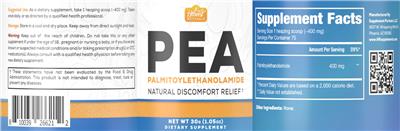
Supplement Facts
The label details for PEA by Harvest Naturals, sourced from the NIH Dietary Supplement Label Database.
Supplement Facts
| Ingredient | Amount | % DV |
|---|---|---|
| Palmitoylethanolamide | 400 mg | -- |
Tap any ingredient to jump to its full detail below.
These statements are the manufacturer’s wording, reproduced from the product label — the label is saying it, not HelloPharmacist. We don’t verify or endorse them.
Suggested/Recommended/Usage/Directions
Suggested use: As a dietary supplement, take 1 heaping scoop (~400 mg). Taken once daily, or as directed by a qualified health professional.
Storage
Storage: Store in a cool and dry place. Keep away from direct sunlight and heat.
Precautions
Warning: Keep out of the reach of children. Do not take this or any other supplement if under the age of 18, pregnant or nursing a baby, or if you have any known or suspected medical conditions and/or taking prescription drug(s) or OTC medication(s).
Do not take this or any other supplement if under the age of 18, pregnant or nursing a baby, or if you have any known or suspected medical conditions and/or taking prescription drug(s) or OTC medication(s).
Always consult with a qualified health physician before taking any new dietary supplement.
FDA Disclaimer Statement
These statements have not been evaluated by the Food and Drug Administration. This product is not intended to diagnose, treat, cure or prevent any disease.
Formulation
Natural discomfort relief
FDA Statement of Identity
Dietary Supplement
Formula
Palmitoylethanolamide
Is this label outdated? Report a formula or label change and our pharmacy team will review it.
PEA by Harvest Naturals label
The label scan from the NIH Dietary Supplement Label Database. Tap to enlarge.
Label images are published by the NIH Dietary Supplement Label Database for the version of this product on file. Always read your actual product label.
View the full label (PDF)The Ingredients in PEA by Harvest Naturals
This is the 1 active ingredient this product is made of. Select it to open its full monograph.
Serving size400 Milligram(s) Dosage formPowder Servings per container75 Amounts shown are per serving.
Palmitoylethanolamide
No knowninteractions
Palmitoylethanolamide (PEA) is a fat-like molecule made naturally in the body and studied mainly for pain and inflammation. Some research suggests it...
Palmitoylethanolamide monograph & interactionsPEA by Harvest Naturals Drug Interactions
We don’t currently list any known drug interactions for the mapped ingredients in PEA. This doesn’t guarantee none exist — always confirm with your pharmacist before combining a supplement with your medications.
Brand information
Manufacturer and brand details for PEA, from the product label.
Harvest Naturals
See all Harvest Naturals products- Name
- Supplement Partners, LLC
- Street Address
- 1607 W. Whispering Wind Dr.
- City
- Phoenix
- State
- AZ
- ZipCode
- 85085
- Web Address
- www.HRsupplements.com
PEA by Harvest Naturals: Common Questions
Does PEA by Harvest Naturals interact with any medications?
How can one product interact with so many drugs?
Where does this information come from?
What is PEA and what's it supposed to do?
Does PEA actually work?
What side effects should I watch for?
Is PEA safe to take during pregnancy or while breastfeeding?
Is this product just PEA, or does it have fillers?
Written and reviewed by the HelloPharmacist editorial staff. Our editorial policy
Not sure if PEA is safe with your meds?
Our pharmacists answer your medication & supplement questions — free.
Label information is sourced from the NIH Dietary Supplement Label Database and reflects the product version on file; always read your actual product label. This page is for education only and is not a substitute for professional medical advice. Confirm with your pharmacist or doctor before combining supplements and medications.
The Full Monographs Behind PEA’s Ingredients
Every ingredient we hold a full HelloPharmacist monograph for — uses, evidence, safety, and the complete interaction list.
Sources & How We Checked
PEA's label data comes from the NIH Dietary Supplement Label Database; the ingredient interaction data is from the Natural Medicines database, reviewed by our pharmacists.
- NIH Dietary Supplement Label Database (DSLD) — The official product label on file for this supplement.
- Natural Medicines (Therapeutic Research Center) — Evidence-graded clinical reference behind the ingredient interaction data.
Content is written and reviewed by licensed HelloPharmacist pharmacists. See our data sources and editorial standards for how this information is built and checked.
The 4 references behind this product’s interaction data
Every citation that drives the interaction findings for this product’s ingredients, from the evidence-graded Natural Medicines (TRC Healthcare) database. Open an ingredient to browse its citations — links open the study on PubMed or the publisher’s site.
Palmitoylethanolamide (pea) 4 references
- Indraccolo U, Barbieri F. Effect of palmitoylethanolamide-polydatin combination on chronic pelvic pain associated with endometriosis: preliminary observations. Eur J Obstet Gynecol Reprod Biol. 2010 May;150(1):76-9. PubMed
- Murina F, Graziottin A, Felice R, Radici G, Tognocchi C. Vestibulodynia: synergy between palmitoylethanolamide + transpolydatin and transcutaneous electrical nerve stimulation. J Low Genit Tract Dis. 2013 Apr;17(2):111-6.
- Papetti L, Sforza G, Tullo G, et al. Tolerability of palmitoylethanolamide in a pediatric population suffering from migraine: A pilot study. Pain Res Manag 2020;2020:3938640. PubMed
- Visse K, Blome C, Phan NQ, Augustin M, Ständer S. Efficacy of body lotion containing N-palmitoylethanolamine in subjects with chronic pruritus due to dry skin: A dermatocosmetic study. Acta Derm Venereol. 2017;97(5):639-641. PubMed
See these in context on the Palmitoylethanolamide (pea) monograph →
Parts of this content are provided by the Therapeutic Research Center, LLC.
DISCLAIMER: Currently this does not check for drug-drug interactions. This is not an all-inclusive comprehensive list of potential interactions and is for informational purposes only. Not all interactions are known or well-reported in the scientific literature, and new interactions are continually being reported. Input is needed from a qualified healthcare provider including a pharmacist before starting any therapy. Application of clinical judgment is necessary.
© 2021 Therapeutic Research Center, LLC