
Premier Digest Ingredients & Drug Interactions
What is this page for?
First and foremost: checking Premier Digest against your medications. The heart of this page is the interaction checker and the full interaction report — how this product’s ingredients may interact with prescription and over-the-counter medicines you may be taking.
Around that, we add a pharmacist’s high-level view of the product as a whole — what’s inside, the evidence for its stated use, how transparent the label is, and what safety data exists — so you can see the full picture in one place. It’s educational information from our licensed clinical databases and the clinical staff at HelloPharmacist — not medical advice — and we don’t sell or endorse products. Our editorial policy
Premier Digest is a dietary supplement by Premier Research Labs with 13 active ingredients. Its ingredients are commonly taken for digestion and bloating, muscle soreness and exercise recovery, inflammation and swelling.Based on those ingredients, 755 medications have a known interaction with it, the most serious rated moderate. The ingredients most likely to interact are Noni, Plant-source Fulvic {Acids}. Use the checker below to test your specific medication, or read the full HelloPharmacist Interaction Report.
Check Your Meds Against Premier Digest by Premier Research Labs
Ask about any prescription or over-the-counter medication and we check it for interactions with Premier Digest by Premier Research Labs — and tell you which ingredient is responsible.
AI summaries are generated from our interaction database for education only — always confirm with your pharmacist. How we use AI
Ask the Pharmacist
A licensed pharmacist will answer your question by email — free, usually within 24 hours.
Got it — thank you!
A licensed pharmacist will answer within 24 hours. Keep an eye on your email (worth checking spam, just in case).
HelloPharmacist Scorecard of Premier Digest by Premier Research Labs
Four independent checks of what is known — a summary of the available information, not a grade of the product itself.
By FDA rules, dietary supplements can’t claim to treat, cure, or prevent disease — so labels speak in careful marketing language. We discern each product’s intended use from its name, label claims, and label statements, then grade the clinical evidence for that use. How these ratings are computed
The stated purpose hasn't been mapped to our evidence data yet.
Why this rating?
- We haven't mapped this product's purpose to our evidence data yet — it'll be graded on the next content refresh.
Most active ingredients list an amount, but at least one is hidden in a blend or missing.
Why this rating?
- The label discloses an exact amount for 9 of its 13 active ingredients.
- “Nano-Zyme” is listed as a grouped ingredient — the label gives one combined amount (382 mg) without saying how much of each component you get.
- “Nano-Gest Support” is listed as a grouped ingredient — the label gives one combined amount (190 mg) without saying how much of each component you get.
The most serious documented interaction for these ingredients is Moderate. Check your medications for a personalized result.
Why this rating?
- 2 of the 6 matched ingredients can interact with medications — Noni, Fulvic Acid.
- The most serious interaction on file is rated Moderate.
- Some involve high-stakes drug classes: anticoagulant / antiplatelet drugs; immunosuppressants / transplant drugs.
- For scale: 756 individual medications appear in the full list. A big number alone doesn't make a product dangerous — what matters is whether YOUR medication is on it, so run yours through the interaction checker on this page.
Adverse-effect, pregnancy, and general safety data are on file for most of these ingredients.
Why this rating?
- We hold adverse-effect (side-effect) data for 5 of the 6 matched ingredients.
- Pregnancy & breastfeeding safety ratings cover 5 of 6.
- General safety write-ups exist for 6 of 6.
- Remember: this measures how much safety information exists. Thin data is not the same as being safe.
HelloPharmacist summaryPartially disclosed formula with no assessable stated purpose. Moderate medication interactions have been identified, and safety information is well characterized.
Assessment coverage: 8 of 13 active ingredients matched to our full ingredient reviews (monographs). Based on the product label dated Oct 25, 2013.
This Scorecard evaluates available label information, ingredient evidence, and known medication-safety considerations. It does not independently verify product identity, purity, potency, contamination, or manufacturing quality. How these ratings are computed
General information
Key facts about Premier Digest, straight from the product label.
| Brand | Premier Research Labs |
|---|---|
| Net contents | 60 Capsule(s) |
| Market status | Off market |
| Date entered into DSLD | Oct 25, 2013 |
| DSLD ID | 26071 |
| Product type | Other Combinations |
| Supplement form | Capsule |
| Dietary claims / uses | All Other, Structure/Function |
| Intended target group(s) | Vegan, Vegetarian, Adult (18 - 50 Years) |
Everything in this section is reproduced from the manufacturer’s own product label — it’s the label speaking, not HelloPharmacist. We show it so you can see exactly what the maker states; we don’t verify or endorse those statements.
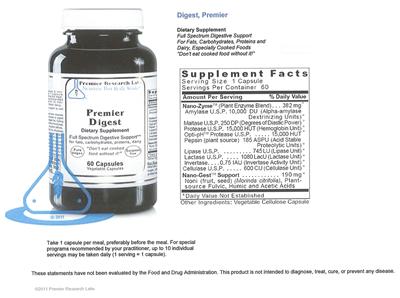
Supplement Facts
The label details for Premier Digest by Premier Research Labs, sourced from the NIH Dietary Supplement Label Database.
Supplement Facts
| Ingredient | Amount | % DV |
|---|---|---|
| Amylase | 10000 DU | -- |
| Protease | 15000 HUT | -- |
| Lipase | 745 LU | -- |
| Lactase | 1080 LACU | -- |
| Cellulase | 600 CU | -- |
| Invertase | 0.75 IAU | -- |
| Maltase | 250 DP | -- |
| Pepsin | 185 ASPU | -- |
| Noni | 0 NP | -- |
| Protease V | 15000 HUT | -- |
| Nano-Zyme | 382 mg | -- |
| Nano-Gest Support | 190 mg | -- |
| Plant-source Fulvic {Acids} | 0 NP | -- |
| Humic {Acids} | 0 NP | -- |
| Acetic Acids | 0 NP | -- |
Other ingredients: Vegetable Cellulose Capsule
Tap any ingredient to jump to its full detail below.
These statements are the manufacturer’s wording, reproduced from the product label — the label is saying it, not HelloPharmacist. We don’t verify or endorse them.
General Statements
Digest, Premier
Full Spectrum Digestive, Support For Fats, Carbohydrates, Proteins and Dairy, Especially Cooked Foods "Don't eat cooked food without it!"
Vegetable Capsules
FDA Statement of Identity
Dietary Supplement
Seals/Symbols
{beaker}(TM)
{beaker}(C)2011
Brand IP Statement(s)
Nutrition That Really Works(TM)
(C)2011 Premier Research Labs
Formulation
Pure Vegan
Excipient Free
Suggested/Recommended/Usage/Directions
Take 1 capsule per meal, preferably before the meal. For special programs recommended by your practitioner, up to 10 individual servings may be taken daily (1 serving = 1 capsule).
FDA Disclaimer Statement
These statements have not been evaluated by the Food and Drug Administration. This product is not intended to diagnose, treat, cure, or prevent any disease.
Is this label outdated? Report a formula or label change and our pharmacy team will review it.
Premier Digest by Premier Research Labs label
The label scan from the NIH Dietary Supplement Label Database. Tap to enlarge.
Label images are published by the NIH Dietary Supplement Label Database for the version of this product on file. Always read your actual product label.
View the full label (PDF)The Ingredients in Premier Digest by Premier Research Labs
These are the 13 active ingredients this product is made of. Select any to open its full monograph.
Serving size1 Capsule(s) Dosage formCapsule Servings per container60 Amounts shown are per serving.
Most supplement products combine several ingredients, and a medication can interact with the product through any one of them. Each ingredient below shows whether it has known drug interactions.
Nano-Zyme
- › Amylase
- › Protease
- › Lipase
- › Lactase
- › Cellulase
- › Invertase
- › Maltase
- › Pepsin
- › Protease V
Nano-Gest Support
- › Noni
- › Plant-source Fulvic {Acids}
- › Humic {Acids}
- › Acetic Acids
Other (inactive) ingredients: Vegetable Cellulose Capsule. These complete the product’s ingredient list but are not active constituents.
Premier Digest by Premier Research Labs Drug Interactions
Premier Digest contains 13 ingredients, and 2 of them have known drug interactions. Altogether they interact with 755 medications. Here’s the picture, then you can look up your own drug.
Want to check YOUR meds against Premier Digest?
Ask about interactions with your drugs in plain English — “Can I take it with lisinopril?” — and we find you the answer in seconds, ingredient by ingredient.
Go to the checkerIngredients driving the most interactions
Individual Drug Interactions
The ingredients in Premier Digest interact with 755 drugs. Click any drug to see the details.
2 of the 13 ingredients in Premier Digest interact with drugs. Each result below shows which ingredient is responsible. Noni Plant-source Fulvic {Acids}
6-mercaptopurinePurinethol
How 6-mercaptopurine interacts with Premier Digest — through 2 ingredients. Tap an ingredient for the detail:
Plant-source Fulvic {acids}Immunosuppressants Moderate
Interaction Summary
Theoretically, taking fulvic acid might decrease the effects of immunosuppressive therapy.
Read the full Plant-source Fulvic {acids} + 6-mercaptopurine interactionNoniHepatotoxic Drugs Moderate
Interaction Summary
Theoretically, taking noni with hepatotoxic drugs might increase the risk of liver damage.
Read the full Noni + 6-mercaptopurine interactionAbacavir Sulfate, Dolutegravir, LamivudineTriumeq
How Abacavir Sulfate, Dolutegravir, Lamivudine interacts with Premier Digest — through 1 ingredient. Tap an ingredient for the detail:
NoniHepatotoxic Drugs Moderate
Interaction Summary
Theoretically, taking noni with hepatotoxic drugs might increase the risk of liver damage.
Read the full Noni + Abacavir Sulfate, Dolutegravir, Lamivudine interactionAbacavir, LamivudineEpzicom
How Abacavir, Lamivudine interacts with Premier Digest — through 1 ingredient. Tap an ingredient for the detail:
NoniHepatotoxic Drugs Moderate
Interaction Summary
Theoretically, taking noni with hepatotoxic drugs might increase the risk of liver damage.
Read the full Noni + Abacavir, Lamivudine interactionAbciximabReoPro
How Abciximab interacts with Premier Digest — through 1 ingredient. Tap an ingredient for the detail:
Plant-source Fulvic {acids}Anticoagulant/antiplatelet Drugs Moderate
Interaction Summary
Theoretically, taking fulvic acid may decrease the effectiveness of anticoagulant and antiplatelet drugs.
Read the full Plant-source Fulvic {acids} + Abciximab interactionAbiraterone
How Abiraterone interacts with Premier Digest — through 1 ingredient. Tap an ingredient for the detail:
NoniHepatotoxic Drugs Moderate
Interaction Summary
Theoretically, taking noni with hepatotoxic drugs might increase the risk of liver damage.
Read the full Noni + Abiraterone interactionAbiraterone AcetateYonsa, Zytiga
How Abiraterone Acetate interacts with Premier Digest — through 1 ingredient. Tap an ingredient for the detail:
NoniHepatotoxic Drugs Moderate
Interaction Summary
Theoretically, taking noni with hepatotoxic drugs might increase the risk of liver damage.
Read the full Noni + Abiraterone Acetate interactionAbrocitinibCibinqo
How Abrocitinib interacts with Premier Digest — through 1 ingredient. Tap an ingredient for the detail:
Plant-source Fulvic {acids}Anticoagulant/antiplatelet Drugs, Immunosuppressants Moderate
Interaction Summary
Theoretically, taking fulvic acid may decrease the effectiveness of anticoagulant and antiplatelet drugs.
Read the full Plant-source Fulvic {acids} + Abrocitinib interactionAcarboseGlucobay, Prandase, Precose
How Acarbose interacts with Premier Digest — through 1 ingredient. Tap an ingredient for the detail:
NoniHepatotoxic Drugs Moderate
Interaction Summary
Theoretically, taking noni with hepatotoxic drugs might increase the risk of liver damage.
Read the full Noni + Acarbose interactionAcebutololRhotral, Sectral
How Acebutolol interacts with Premier Digest — through 1 ingredient. Tap an ingredient for the detail:
NoniAntihypertensive Drugs, Hepatotoxic Drugs Moderate
Interaction Summary
Theoretically, noni may increase the risk of hypotension when used in combination with antihypertensive drugs.
Read the full Noni + Acebutolol interactionAcenocoumarolSintrom
How Acenocoumarol interacts with Premier Digest — through 1 ingredient. Tap an ingredient for the detail:
Plant-source Fulvic {acids}Anticoagulant/antiplatelet Drugs Moderate
Interaction Summary
Theoretically, taking fulvic acid may decrease the effectiveness of anticoagulant and antiplatelet drugs.
Read the full Plant-source Fulvic {acids} + Acenocoumarol interactionAcetaminophenChildren's Tylenol, Children's Tylenol Meltaways, Tylenol, Tylenol Ex Strength
How Acetaminophen interacts with Premier Digest — through 1 ingredient. Tap an ingredient for the detail:
NoniHepatotoxic Drugs Moderate
Interaction Summary
Theoretically, taking noni with hepatotoxic drugs might increase the risk of liver damage.
Read the full Noni + Acetaminophen interactionAcetaminophen, AspirinGemnisyn
How Acetaminophen, Aspirin interacts with Premier Digest — through 2 ingredients. Tap an ingredient for the detail:
NoniHepatotoxic Drugs Moderate
Interaction Summary
Theoretically, taking noni with hepatotoxic drugs might increase the risk of liver damage.
Read the full Noni + Acetaminophen, Aspirin interactionPlant-source Fulvic {acids}Anticoagulant/antiplatelet Drugs Moderate
Interaction Summary
Theoretically, taking fulvic acid may decrease the effectiveness of anticoagulant and antiplatelet drugs.
Read the full Plant-source Fulvic {acids} + Acetaminophen, Aspirin interactionAcetaminophen, Aspirin, CaffeineExcedrin, Excedrin Extra Strength, Excedrin Migraine
How Acetaminophen, Aspirin, Caffeine interacts with Premier Digest — through 2 ingredients. Tap an ingredient for the detail:
Plant-source Fulvic {acids}Anticoagulant/antiplatelet Drugs Moderate
Interaction Summary
Theoretically, taking fulvic acid may decrease the effectiveness of anticoagulant and antiplatelet drugs.
Read the full Plant-source Fulvic {acids} + Acetaminophen, Aspirin, Caffeine interactionNoniHepatotoxic Drugs Moderate
Interaction Summary
Theoretically, taking noni with hepatotoxic drugs might increase the risk of liver damage.
Read the full Noni + Acetaminophen, Aspirin, Caffeine interactionAcetaminophen, Brompheniramine, PhenylpropanolamineDimetapp Cold and Flu
How Acetaminophen, Brompheniramine, Phenylpropanolamine interacts with Premier Digest — through 1 ingredient. Tap an ingredient for the detail:
NoniHepatotoxic Drugs Moderate
Interaction Summary
Theoretically, taking noni with hepatotoxic drugs might increase the risk of liver damage.
Read the full Noni + Acetaminophen, Brompheniramine, Phenylpropanolamine interactionAcetaminophen, ButalbitalAxocet, Bancap, Bucet, Butex Forte, Esgic CF, Orbivan CF +5 more
How Acetaminophen, Butalbital interacts with Premier Digest — through 1 ingredient. Tap an ingredient for the detail:
NoniHepatotoxic Drugs Moderate
Interaction Summary
Theoretically, taking noni with hepatotoxic drugs might increase the risk of liver damage.
Read the full Noni + Acetaminophen, Butalbital interactionAcetaminophen, Butalbital, CaffeineEsgic, Esgic Plus, Fiogesic, Fioricet, Repan, Tecnal +1 more
How Acetaminophen, Butalbital, Caffeine interacts with Premier Digest — through 1 ingredient. Tap an ingredient for the detail:
NoniHepatotoxic Drugs Moderate
Interaction Summary
Theoretically, taking noni with hepatotoxic drugs might increase the risk of liver damage.
Read the full Noni + Acetaminophen, Butalbital, Caffeine interactionAcetaminophen, Butalbital, Caffeine, CodeineEsgic with Codeine, Fioricet w/ Codeine
How Acetaminophen, Butalbital, Caffeine, Codeine interacts with Premier Digest — through 1 ingredient. Tap an ingredient for the detail:
NoniHepatotoxic Drugs Moderate
Interaction Summary
Theoretically, taking noni with hepatotoxic drugs might increase the risk of liver damage.
Read the full Noni + Acetaminophen, Butalbital, Caffeine, Codeine interactionAcetaminophen, Butalbital, CodeineBancap w/ Codeine
How Acetaminophen, Butalbital, Codeine interacts with Premier Digest — through 1 ingredient. Tap an ingredient for the detail:
NoniHepatotoxic Drugs Moderate
Interaction Summary
Theoretically, taking noni with hepatotoxic drugs might increase the risk of liver damage.
Read the full Noni + Acetaminophen, Butalbital, Codeine interactionAcetaminophen, Butalbital, Codeine PhosphatePhrenilin #3
How Acetaminophen, Butalbital, Codeine Phosphate interacts with Premier Digest — through 1 ingredient. Tap an ingredient for the detail:
NoniHepatotoxic Drugs Moderate
Interaction Summary
Theoretically, taking noni with hepatotoxic drugs might increase the risk of liver damage.
Read the full Noni + Acetaminophen, Butalbital, Codeine Phosphate interactionAcetaminophen, Caffeine, Chlorpheniramine, Hydrocodone, PhenylephrineHycomine Compound
How Acetaminophen, Caffeine, Chlorpheniramine, Hydrocodone, Phenylephrine interacts with Premier Digest — through 1 ingredient. Tap an ingredient for the detail:
NoniHepatotoxic Drugs Moderate
Interaction Summary
Theoretically, taking noni with hepatotoxic drugs might increase the risk of liver damage.
Read the full Noni + Acetaminophen, Caffeine, Chlorpheniramine, Hydrocodone, Phenylephrine interactionAcetaminophen, Caffeine, CodeineGesic C15, Gesic C30, Gesic C8, Lenoltec 1, Lenoltec 2, Lenoltec 3 +1 more
How Acetaminophen, Caffeine, Codeine interacts with Premier Digest — through 1 ingredient. Tap an ingredient for the detail:
NoniHepatotoxic Drugs Moderate
Interaction Summary
Theoretically, taking noni with hepatotoxic drugs might increase the risk of liver damage.
Read the full Noni + Acetaminophen, Caffeine, Codeine interactionAcetaminophen, Caffeine, Codeine, SalicylamideCodalan No.1, Codalan No.2, Codalan No.3
How Acetaminophen, Caffeine, Codeine, Salicylamide interacts with Premier Digest — through 1 ingredient. Tap an ingredient for the detail:
NoniHepatotoxic Drugs Moderate
Interaction Summary
Theoretically, taking noni with hepatotoxic drugs might increase the risk of liver damage.
Read the full Noni + Acetaminophen, Caffeine, Codeine, Salicylamide interactionAcetaminophen, Caffeine, DihydrocodeineDHC Plus, Panlor DC, Panlor SS
How Acetaminophen, Caffeine, Dihydrocodeine interacts with Premier Digest — through 1 ingredient. Tap an ingredient for the detail:
NoniHepatotoxic Drugs Moderate
Interaction Summary
Theoretically, taking noni with hepatotoxic drugs might increase the risk of liver damage.
Read the full Noni + Acetaminophen, Caffeine, Dihydrocodeine interactionAcetaminophen, Caffeine, IsomethepteneMigralam
How Acetaminophen, Caffeine, Isometheptene interacts with Premier Digest — through 1 ingredient. Tap an ingredient for the detail:
NoniHepatotoxic Drugs Moderate
Interaction Summary
Theoretically, taking noni with hepatotoxic drugs might increase the risk of liver damage.
Read the full Noni + Acetaminophen, Caffeine, Isometheptene interactionAcetaminophen, Caffeine, PyrilamineMidol Max Strength Menstrual
How Acetaminophen, Caffeine, Pyrilamine interacts with Premier Digest — through 1 ingredient. Tap an ingredient for the detail:
NoniHepatotoxic Drugs Moderate
Interaction Summary
Theoretically, taking noni with hepatotoxic drugs might increase the risk of liver damage.
Read the full Noni + Acetaminophen, Caffeine, Pyrilamine interactionAcetaminophen, Chlorpheniramine Maleate, Dextromethorphan HbrVicks Formula 44M Cough, Cold & Flu Relief
How Acetaminophen, Chlorpheniramine Maleate, Dextromethorphan Hbr interacts with Premier Digest — through 1 ingredient. Tap an ingredient for the detail:
NoniHepatotoxic Drugs Moderate
Interaction Summary
Theoretically, taking noni with hepatotoxic drugs might increase the risk of liver damage.
Read the full Noni + Acetaminophen, Chlorpheniramine Maleate, Dextromethorphan Hbr interactionAcetaminophen, Chlorpheniramine, Codeine, PhenylephrineColrex
How Acetaminophen, Chlorpheniramine, Codeine, Phenylephrine interacts with Premier Digest — through 1 ingredient. Tap an ingredient for the detail:
NoniHepatotoxic Drugs Moderate
Interaction Summary
Theoretically, taking noni with hepatotoxic drugs might increase the risk of liver damage.
Read the full Noni + Acetaminophen, Chlorpheniramine, Codeine, Phenylephrine interactionAcetaminophen, Chlorpheniramine, DextromethorphanCoricidin II Extra Strength Cold and Flu
How Acetaminophen, Chlorpheniramine, Dextromethorphan interacts with Premier Digest — through 1 ingredient. Tap an ingredient for the detail:
NoniHepatotoxic Drugs Moderate
Interaction Summary
Theoretically, taking noni with hepatotoxic drugs might increase the risk of liver damage.
Read the full Noni + Acetaminophen, Chlorpheniramine, Dextromethorphan interactionAcetaminophen, Chlorpheniramine, Dextromethorphan HydrobromideCoricidin HBP Maximum Strength Flu
How Acetaminophen, Chlorpheniramine, Dextromethorphan Hydrobromide interacts with Premier Digest — through 1 ingredient. Tap an ingredient for the detail:
NoniHepatotoxic Drugs Moderate
Interaction Summary
Theoretically, taking noni with hepatotoxic drugs might increase the risk of liver damage.
Read the full Noni + Acetaminophen, Chlorpheniramine, Dextromethorphan Hydrobromide interactionAcetaminophen, Chlorpheniramine, Dextromethorphan, PhenylpropanolamineMulti Symptom Cold Relief
How Acetaminophen, Chlorpheniramine, Dextromethorphan, Phenylpropanolamine interacts with Premier Digest — through 1 ingredient. Tap an ingredient for the detail:
NoniHepatotoxic Drugs Moderate
Interaction Summary
Theoretically, taking noni with hepatotoxic drugs might increase the risk of liver damage.
Read the full Noni + Acetaminophen, Chlorpheniramine, Dextromethorphan, Phenylpropanolamine interactionEach ingredient & the kinds of drugs it affects
For each ingredient in Premier Digest with known interactions, here are the types of medications they can affect. Open any type for the detail — or search your exact drug in the checker above.
Noni
Ace Inhibitors (Aceis)
Theoretically, combining noni and ACE inhibitors might increase the risk of hyperkalemia.
Noni juice contains significant amounts of potassium, about 6 mEq/100 mL juice. This may increase the risk for hyperkalemia when used in conjunction with ACE inhibitors, which can also increase potassium levels.
Angiotensin Receptor Blockers (Arbs)
Theoretically, combining noni and ARBs might increase the risk of hyperkalemia.
Noni juice contains significant amounts of potassium, about 6 mEq/100 mL juice. This may increase the risk for hyperkalemia when used in conjunction with ARBs, which can also increase potassium levels.
Antihypertensive Drugs
Theoretically, noni may increase the risk of hypotension when used in combination with antihypertensive drugs.
Preliminary clinical research suggests that drinking noni juice can reduce blood pressure in individuals with hypertension.
Hepatotoxic Drugs
Theoretically, taking noni with hepatotoxic drugs might increase the risk of liver damage.
There is concern that noni might cause hepatotoxicity in some patients. Advise patients against combining noni with potentially hepatotoxic drugs.
Phenytoin (Dilantin)
Theoretically, taking noni fruit juice concomitantly with phenytoin may lower phenytoin levels and increase the risk of seizures.
In one case report, an adult taking phenytoin for partial seizures experienced low serum phenytoin levels while taking noni juice 90-200 mL daily. Serum phenytoin levels increased after decreasing noni juice consumption; similarly, serum phenytoin levels decreased after increasing noni juice consumption. Some researchers believe noni juice may induce cytochrome P450 2C9 enzymes, which would decrease phenytoin levels, but this has not been well studied. Patients may need additional monitoring when starting or stopping noni juice supplementation.
Potassium-Sparing Diuretics
Theoretically, combing noni and a potassium-sparing diuretic might increase the risk of hyperkalemia.
Noni juice contains significant amounts of potassium, about 6 mEq/100 mL juice. This may increase the risk for hyperkalemia when used in conjunction with potassium-sparing diuretics, which can also increase potassium levels.
Warfarin (Coumadin)
Theoretically, taking noni juice concomitantly with warfarin might decrease the effectiveness of warfarin.
In one case, a 41-year-old patient stabilized on warfarin had a decreased international normalized ratio (INR) following consumption of a specific commercial noni juice product (Noni juice 4 Everything). While the patient was still taking noni juice, an increase in warfarin dose did not produce an increase in INR. However, it should be noted that this particular product contained extracts and derivatives from more than 115 components, many of which contained vitamin K. Furthermore, vitamin K was listed as a separate ingredient of the product, suggesting that the product was possibly fortified with vitamin K. It has not been verified that noni fruit alone contains a significant amount of vitamin K or interacts with warfarin.
Ranitidine (Zantac)
Taking noni fruit with ranitidine might increase the levels and clinical effects of ranitidine.
Clinical evidence shows that taking an aqueous extract of noni fruit 30 minutes prior to taking a single oral dose of ranitidine can increase the rate of absorption and plasma concentration of ranitidine.
Plant-source Fulvic {Acids}
Anticoagulant/Antiplatelet Drugs
Theoretically, taking fulvic acid may decrease the effectiveness of anticoagulant and antiplatelet drugs.
In vitro evidence shows that fulvic acid, formed from the oxidation and polymerization of protocatechuic acid, can shorten prothrombin time in human plasma, increasing the risk of clot formation.
Immunosuppressants
Theoretically, taking fulvic acid might decrease the effects of immunosuppressive therapy.
Animal research shows that fulvic acid stimulates immune function.
Thyroid Hormone
Theoretically, taking fulvic acid with thyroid hormone therapy might interfere with the ability to normalize thyroid function.
Animal research shows that fulvic acid increases the plasma level of thyroid-stimulating hormone (TSH) and decreases the thyroxine (T4):triiodothyronine (T3) ratio.
Brand information
Manufacturer and brand details for Premier Digest, from the product label.
Premier Digest by Premier Research Labs: Common Questions
Does Premier Digest by Premier Research Labs interact with any medications?
How can one product interact with so many drugs?
Where does this information come from?
Written and reviewed by the HelloPharmacist editorial staff. Our editorial policy
Not sure if Premier Digest is safe with your meds?
Our pharmacists answer your medication & supplement questions — free.
Label information is sourced from the NIH Dietary Supplement Label Database and reflects the product version on file; always read your actual product label. This page is for education only and is not a substitute for professional medical advice. Confirm with your pharmacist or doctor before combining supplements and medications.
The Full Monographs Behind Premier Digest’s Ingredients
Every ingredient we hold a full HelloPharmacist monograph for — uses, evidence, safety, and the complete interaction list.
Proteolytic Enzymes (proteases)
Proteolytic enzymes are proteins that help break down other proteins, and common examples include bromelain (from pineapple), papain (from papaya), trypsin, chymotrypsin, and pancreatin. Peo...
Read the full Proteolytic Enzymes (proteases) monograph → Herb & supplement monographLipase
Lipase is a digestive enzyme that helps your body break down dietary fats. It is well established as part of prescription pancreatic enzyme therapy for people who cannot make enough of their...
Read the full Lipase monograph → Herb & supplement monographLactase
Lactase is a digestive enzyme supplement that helps people who lack enough natural lactase break down lactose, the sugar in milk and dairy. It can reduce gas, bloating, cramping, and diarrhe...
Read the full Lactase monograph → Herb & supplement monographNoni
Interacts with 542 drugsNoni is a tropical fruit used widely in folk medicine and sold mostly as a juice or supplement, but solid human evidence for its many claimed benefits is limited. While moderate juice intake...
Read the full Noni monograph → Herb & supplement monographFulvic Acid
Interacts with 257 drugsFulvic acid is a natural compound formed when plants and microbes break down in soil, and it is sold as a supplement for energy, gut, and overall wellness. Human research is very limited, so...
Read the full Fulvic Acid monograph → Herb & supplement monographHumic Acid
Humic acid is a natural substance formed when plant and animal matter break down in soil, peat, and coal-like deposits, and it is sold as a supplement marketed for immune, gut, and 'detox' s...
Read the full Humic Acid monograph →Sources & How We Checked
Premier Digest's label data comes from the NIH Dietary Supplement Label Database; the ingredient interaction data is from the Natural Medicines database, reviewed by our pharmacists.
- NIH Dietary Supplement Label Database (DSLD) — The official product label on file for this supplement.
- Natural Medicines (Therapeutic Research Center) — Evidence-graded clinical reference behind the ingredient interaction data.
Content is written and reviewed by licensed HelloPharmacist pharmacists. See our data sources and editorial standards for how this information is built and checked.
The 27 references behind this product’s interaction data
Every citation that drives the interaction findings for this product’s ingredients, from the evidence-graded Natural Medicines (TRC Healthcare) database. Open an ingredient to browse its citations — links open the study on PubMed or the publisher’s site.
Proteolytic Enzymes (proteases) 3 references
- Weeks JA, Harper RA, Simon RA, Burdick JD. Assessment of sensitization risk of a laundry pre-spotter containing protease. Cutan Ocul Toxicol. 2011;30(4):272-9. PubMed
- Marquès LI, Lara S, Abós T, Bartolomé B. Occupational rhinitis due to pepsin. J Investig Allergol Clin Immunol. 2006;16(2):136-7. DOI
- Cartier A, Malo JL, Pineau L, Dolovich J. Occupational asthma due to pepsin. J Allergy Clin Immunol. 1984;73(5 Pt 1):574-7. PubMed
See these in context on the Proteolytic Enzymes (proteases) monograph →
Lipase 1 reference
- Casper C, Hascoet JM, Ertl T, et al. Recombinant bile salt-stimulated lipase in preterm infant feeding: A randomized phase 3 study. PLoS One. 2016;11(5):e0156071. PubMed
Lactase 1 reference
- Laukkanen A, Ruoppi P, Remes S, Koistinen T, Mäkinen-Kiljunen S. Lactase-induced occupational protein contact dermatitis and allergic rhinoconjunctivitis. Contact Dermatitis. 2007;57(2):89-93. PubMed
Noni 16 references
- Mueller BA, Scott MK, Sowinski KM, Prag KA. Noni juice (Morinda citrifolia): hidden potential for hyperkalemia? Am J Kidney Dis 2000;35:310-2. PubMed
- Millonig G, Stadlmann S, Vogel W. Herbal hepatotoxicity: acute hepatitis caused by a Noni preparation (Morinda citrifolia). Eur J Gastroenterol Hepatol 2005;17:445-7. PubMed
- Stadlbauer V, Fickert P, Lackner C, et al. Hepatotoxicity of NONI juice: report of two cases. World J Gastroenterol 2005;11:4758-60. PubMed
- Carr ME, Klotz J, Bergeron M. Coumadin resistance and the vitamin supplement "Noni". Am J Hematol 2004;77:103. PubMed
- Jensen CJ, Westendorf J, Wang MY, Wadsworth DP. Noni juice protects the liver. Eur J Gastroenterol Hepatol 2006;18:575-7. PubMed
- Yuce B, Gulberg V, Diebold J, Gerbes AL. Hepatitis induced by noni juice from morinda citrifolia: a rare cause of hepatotoxicity or the tip of the iceberg? Digestion 2006;73:167-70.
- Koch E, Biber A. Treatment of rats with the Pelargonium sidoides extract EPs 7630 has no effect on blood coagulation parameters or on the pharmacokinetics of warfarin. Phytomedicine 2007;14 Suppl 6:40-5. PubMed
- Yu EL, Sivagnanam M, Ellis L, Huang JS. Acute hepatotoxicity after ingestion of Morinda citrifolia (noni berry) juice in a 14-year-old boy. J Pediatr Gastroenterol Nutr 2011;52:222-4.
- Stadlbauer V, Weiss S, Payer F, Stauber RE. Herbal does not at all mean innocuous: the sixth case of hepatotoxicity associated with morinda citrifolia (noni). Am J Gastroenterol 2008;103:2406-7. PubMed
- López-Cepero Andrada JM, Lerma Castilla S, Fernández Olvera MD, Amaya Vidal A. [Hepatotoxicity caused by a noni (Morinda citrifolia) preparation]. [Article in Spanish] Rev Esp Enferm Dig 2007;99:179-81.
- Nima S, Kasiwong S, Ridtitid W, et al. Gastrokinetic activity of Morinda citrifolia aqueous fruit extract and its possible mechanism of action in human and rat models. J Ethnopharmacol. 2012;142(2):354-61. PubMed
- Issell, B. F., Gotay, C. C., Pagano, I., and Franke, A. A. Using quality of life measures in a Phase I clinical trial of noni in patients with advanced cancer to select a Phase II dose. J.Diet.Suppl 2009;6(4):347-359. PubMed
- Palu AK, Santiago RA West B Kaluhiokalani N Jensen J. The Effects of Morillda citrifolia L. Noni on High Blood Pressure: A Mechanistic Investigation and Case Study. ACS SYMPOSIUM SERIES 993 2008;
- Jiménez-Encarnación E, Ríos G, Muñoz-Mirabal A, Vilá LM. Euforia-induced acute hepatitis in a patient with scleroderma. BMJ Case Rep 2012;2012. PubMed
- Bussmann RW, Hennig L, Giannis A, Ortwein J, Kutchan TM, Feng X. Anthraquinone Content in Noni (Morinda citrifolia L.). Evid Based Complement Alternat Med. 2013;2013:208378.
- Yu-Chan Kang, Ming-Hong Chen, Shung-Lon Lai. Potentially Unsafe Herb-drug Interactions Between a Commercial Product of Noni Juice and Phenytoin- A Case Report. Acta Neurol Taiwan. 2015 Jun;24(2):43-6.
Fulvic Acid 3 references
- Lu, FJ. Arsenic as a promoter in the effect of humic substances on plasma prothrombin time in vitro. Thromb Res 6-15-1990;58(6):537-541. PubMed
- Vucskits, AV, Hullar, I, Bersenyi, A, Andrasofszky, E, Kulcsar, M, Szabo, J. Effect of fulvic and humic acids on performance, immune response and thyroid function in rats. J Anim Physiol Anim Nutr (Berl) 2010;94(6):721-728. PubMed
- Gandy JJ, Meeding JP, Snyman JR, et al. Phase 1 clinical study of the acute and subacute safety and proof-of-concept efficacy of carbohydrate-derived fulvic acid. Clin Pharmacol. 2012;4:7-11. PubMed
Parts of this content are provided by the Therapeutic Research Center, LLC.
DISCLAIMER: Currently this does not check for drug-drug interactions. This is not an all-inclusive comprehensive list of potential interactions and is for informational purposes only. Not all interactions are known or well-reported in the scientific literature, and new interactions are continually being reported. Input is needed from a qualified healthcare provider including a pharmacist before starting any therapy. Application of clinical judgment is necessary.
© 2021 Therapeutic Research Center, LLC