
Rosehip Extract Powder 500 mg Ingredients & Drug Interactions
What is this page for?
First and foremost: checking Rosehip Extract Powder 500 mg against your medications. The heart of this page is the interaction checker and the full interaction report — how this product’s ingredients may interact with prescription and over-the-counter medicines you may be taking.
Around that, we add a pharmacist’s high-level view of the product as a whole — what’s inside, the evidence for its stated use, how transparent the label is, and what safety data exists — so you can see the full picture in one place. It’s educational information from our licensed clinical databases and the clinical staff at HelloPharmacist — not medical advice — and we don’t sell or endorse products. Our editorial policy
Rosehip Extract Powder 500 mg is a dietary supplement by BulkSupplements.com with 1 active ingredient. Its ingredients are commonly taken for joint pain and osteoarthritis, colds and flu, source of vitamin c.Based on those ingredients, 213 medications have a known interaction with it, the most serious rated moderate. The ingredients most likely to interact are Rosehip Fruit Extract. Use the checker below to test your specific medication, or read the full HelloPharmacist Interaction Report.
Check Your Meds Against Rosehip Extract Powder 500 mg by BulkSupplements.com
Ask about any prescription or over-the-counter medication and we check it for interactions with Rosehip Extract Powder 500 mg by BulkSupplements.com — and tell you which ingredient is responsible.
AI summaries are generated from our interaction database for education only — always confirm with your pharmacist. How we use AI
Ask the Pharmacist
A licensed pharmacist will answer your question by email — free, usually within 24 hours.
Got it — thank you!
A licensed pharmacist will answer within 24 hours. Keep an eye on your email (worth checking spam, just in case).
HelloPharmacist Scorecard of Rosehip Extract Powder 500 mg by BulkSupplements.com
Our pharmacy team’s full take, with four database checks built into the cards below — a summary of what is known, not a grade of the product itself.
What’s inside
Full disclosure
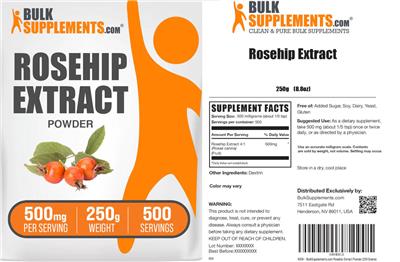
This product contains one active ingredient: Rosehip Fruit Extract, 500 mg per serving. Rosehip is the fruit of the Rosa canina and Rosa damascena plants, traditionally used in herbal medicine.
The only other ingredient is dextrin, an inactive filler used to give the powder its bulk and consistency.
Does it work?
Moderate evidence
Rosehip extract is possibly effective for postoperative pain (pain after surgery) and possibly effective for osteoarthritis. The evidence for high cholesterol (hyperlipidemia) is insufficient — we don't have enough reliable data to say whether it works for that.
If you're considering this for pain or joint issues, talk with your doctor about whether the evidence fits your situation.
How safe is it?
Well-documented data
Rosehip from Rosa canina and Rosa damascena species is generally well tolerated when taken orally. The most common side effects are flatulence and loose stools.
Vertigo and headache have been reported rarely. Gastrointestinal symptoms like nausea, diarrhea, heartburn, and stomach cramps can occur, but in most studies these happened at about the same rate in people taking placebo, so they may not be from the rosehip itself.
That said, supplement safety at concentrated doses is less well studied than food amounts — the safety notes advise caution with concentrated supplements unless your doctor has approved them.
Meds to double-check
Moderate interaction found
Before taking this product, double-check with your pharmacist if you're on blood thinners or antiplatelet drugs (warfarin, aspirin), estrogen-based medications (oral contraceptives, hormone replacement therapy), or lithium. Moderate interactions exist for all of these.
If you're undergoing chemotherapy with alkylating agents or antitumor antibiotics, talk to your oncology team first — rosehip's antioxidant effects might theoretically affect how these drugs work.
The bottom line
Scorecard at a glanceFully disclosed formula with some supporting evidence behind its ingredients' uses. Moderate medication interactions have been identified, and safety information is well characterized.
Rosehip extract is a single-ingredient supplement possibly effective for postoperative pain and osteoarthritis. It's generally well tolerated, though digestive upset (loose stools, flatulence) is the most common side effect.
If you take blood thinners, estrogen-based medications, lithium, or chemotherapy drugs, check with your pharmacist before starting this — the interactions are moderate concerns. Otherwise, a good choice to discuss with your doctor for pain or joint support.
Educational only — not medical advice; always confirm with your pharmacist. Our editorial policy · How we use AI
Assessment coverage: 1 of 1 active ingredient matched to our full ingredient reviews (monographs). Based on the product label dated May 21, 2025.
This Scorecard evaluates available label information, ingredient evidence, and known medication-safety considerations. It does not independently verify product identity, purity, potency, contamination, or manufacturing quality. How these ratings are computed
General information
Key facts about Rosehip Extract Powder 500 mg, straight from the product label.
| Brand | BulkSupplements.com |
|---|---|
| Barcode (UPC) | X0014EBCJ5 |
| Net contents | 250 Gram(s); 8.8 Ounce(s) |
| Market status | On market |
| Date entered into DSLD | May 21, 2025 |
| DSLD ID | 330597 |
| Product type | Botanical |
| Supplement form | Powder |
| Dietary claims / uses | All Other, Structure/Function |
| Intended target group(s) | Adult (18 - 50 Years), Gluten Free, Dairy Free |
Everything in this section is reproduced from the manufacturer’s own product label — it’s the label speaking, not HelloPharmacist. We show it so you can see exactly what the maker states; we don’t verify or endorse those statements.
Supplement Facts
The label details for Rosehip Extract Powder 500 mg by BulkSupplements.com, sourced from the NIH Dietary Supplement Label Database.
Tap any ingredient to jump to its full detail below.
These statements are the manufacturer’s wording, reproduced from the product label — the label is saying it, not HelloPharmacist. We don’t verify or endorse them.
Formula
Rosehip Extract 500 mg per serving
Brand IP Statement(s)
BulkSupplements.com Clean & pure bulk supplements
Formulation
Color may vary
Free of: added sugar, soy, dairy, yeast, gluten
FDA Disclaimer Statement
Warning: This product is not intended to diagnose, treat, cure, or prevent any disease.
Precautions
Always consult a physician before taking any dietary supplement.
Keep out of reach of children.
Suggested/Recommended/Usage/Directions
Suggested use: As a dietary supplement, take 500 mg (about 1/5 tsp) once or twice daily, or as directed by a physician.
Storage
Contents are sold by weight, not volume. Settling may occur. Store in a dry, cool place
General Statements
Use an accurate milligram scale. New
Is this label outdated? Report a formula or label change and our pharmacy team will review it.
Rosehip Extract Powder 500 mg by BulkSupplements.com label
The label scan from the NIH Dietary Supplement Label Database. Tap to enlarge.
Label images are published by the NIH Dietary Supplement Label Database for the version of this product on file. Always read your actual product label.
View the full label (PDF)The Ingredients in Rosehip Extract Powder 500 mg by BulkSupplements.com
This is the 1 active ingredient this product is made of. Select it to open its full monograph.
Serving size500 Milligram(s) Dosage formPowder Servings per container500 Amounts shown are per serving.
Rosehip Fruit Extract
Interacts with213 drugs
Rose hip is the vitamin C–rich fruit of the wild rose, used traditionally for colds and joint pain. A standardized rose hip powder has some research s...
Rosehip Fruit Extract monograph & interactionsOther (inactive) ingredients: Dextrin. These complete the product’s ingredient list but are not active constituents.
Rosehip Extract Powder 500 mg by BulkSupplements.com Drug Interactions
HelloPharmacist Interaction Report
Rosehip Extract Powder 500 mg by BulkSupplements.com does interact with a number of medications.
The main concern is with blood thinners and antiplatelet drugs like warfarin and aspirin — rosehip's vitamin C content may theoretically reduce how well these work, though the amount of vitamin C in this product is likely too low for major clinical effects. Still worth a conversation with your pharmacist, especially if you're on a blood thinner.
Read the full breakdown — every affected drug type, severity by severity
Estrogens (oral contraceptives and hormone replacement therapy) are a moderate interaction; vitamin C in rosehip may boost estrogen blood levels. Lithium, used for mood disorders, is another moderate concern — rosehip's diuretic properties might increase lithium levels and require a dose adjustment.
Additionally, rosehip's antioxidant effects might theoretically interfere with certain chemotherapy drugs, including alkylating agents and antitumor antibiotics, though the research here is mixed. Aluminum-containing compounds could also be absorbed more readily if taken with rosehip.
Altogether, these interactions span 213 individual medications. Since rosehip is just one ingredient, we've checked it thoroughly.
Before you start this product, run your exact medications through the interaction checker on this page.
Check your own medications below · Editorial policy · How we use AI
Want to check YOUR meds against Rosehip Extract Powder 500 mg?
Ask about interactions with your drugs in plain English — “Can I take it with lisinopril?” — and we find you the answer in seconds, ingredient by ingredient.
Go to the checkerIngredients driving the most interactions
Individual Drug Interactions
The ingredients in Rosehip Extract Powder 500 mg interact with 213 drugs. Click any drug to see the details.
1 of the 1 ingredient in Rosehip Extract Powder 500 mg interact with drugs. Each result below shows which ingredient is responsible. Rosehip Fruit Extract
AbciximabReoPro
How Abciximab interacts with Rosehip Extract Powder 500 mg — through 1 ingredient. Tap an ingredient for the detail:
Rosehip Fruit ExtractAnticoagulant/antiplatelet Drugs Moderate
Interaction Summary
Theoretically, rose hip might reduce the effectiveness of anticoagulant or antiplatelet drugs.
Read the full Rosehip Fruit Extract + Abciximab interactionAbrocitinibCibinqo
How Abrocitinib interacts with Rosehip Extract Powder 500 mg — through 1 ingredient. Tap an ingredient for the detail:
Rosehip Fruit ExtractAnticoagulant/antiplatelet Drugs Moderate
Interaction Summary
Theoretically, rose hip might reduce the effectiveness of anticoagulant or antiplatelet drugs.
Read the full Rosehip Fruit Extract + Abrocitinib interactionAcenocoumarolSintrom
How Acenocoumarol interacts with Rosehip Extract Powder 500 mg — through 1 ingredient. Tap an ingredient for the detail:
Rosehip Fruit ExtractAnticoagulant/antiplatelet Drugs Moderate
Interaction Summary
Theoretically, rose hip might reduce the effectiveness of anticoagulant or antiplatelet drugs.
Read the full Rosehip Fruit Extract + Acenocoumarol interactionAcetaminophen, AspirinGemnisyn
How Acetaminophen, Aspirin interacts with Rosehip Extract Powder 500 mg — through 1 ingredient. Tap an ingredient for the detail:
Rosehip Fruit ExtractAnticoagulant/antiplatelet Drugs, Aspirin Moderate
Interaction Summary
Theoretically, rose hip might reduce the effectiveness of anticoagulant or antiplatelet drugs.
Read the full Rosehip Fruit Extract + Acetaminophen, Aspirin interactionAcetaminophen, Aspirin, CaffeineExcedrin, Excedrin Extra Strength, Excedrin Migraine
How Acetaminophen, Aspirin, Caffeine interacts with Rosehip Extract Powder 500 mg — through 1 ingredient. Tap an ingredient for the detail:
Rosehip Fruit ExtractAnticoagulant/antiplatelet Drugs, Aspirin Moderate
Interaction Summary
Theoretically, rose hip might reduce the effectiveness of anticoagulant or antiplatelet drugs.
Read the full Rosehip Fruit Extract + Acetaminophen, Aspirin, Caffeine interactionAcetaminophen, IbuprofenCombogesic
How Acetaminophen, Ibuprofen interacts with Rosehip Extract Powder 500 mg — through 1 ingredient. Tap an ingredient for the detail:
Rosehip Fruit ExtractAnticoagulant/antiplatelet Drugs Moderate
Interaction Summary
Theoretically, rose hip might reduce the effectiveness of anticoagulant or antiplatelet drugs.
Read the full Rosehip Fruit Extract + Acetaminophen, Ibuprofen interactionAcetylsalicylic AcidEntrophen
How Acetylsalicylic Acid interacts with Rosehip Extract Powder 500 mg — through 1 ingredient. Tap an ingredient for the detail:
Rosehip Fruit ExtractAnticoagulant/antiplatelet Drugs, Aspirin Moderate
Interaction Summary
Theoretically, rose hip might reduce the effectiveness of anticoagulant or antiplatelet drugs.
Read the full Rosehip Fruit Extract + Acetylsalicylic Acid interactionAlginic Acid, Aluminum HydroxideRafton
How Alginic Acid, Aluminum Hydroxide interacts with Rosehip Extract Powder 500 mg — through 1 ingredient. Tap an ingredient for the detail:
Rosehip Fruit ExtractAluminum Moderate
Interaction Summary
Theoretically, rose hip might increase the amount of aluminum absorbed from aluminum compounds.
Read the full Rosehip Fruit Extract + Alginic Acid, Aluminum Hydroxide interactionAlteplase, TpaActilyse, Activase
How Alteplase, Tpa interacts with Rosehip Extract Powder 500 mg — through 1 ingredient. Tap an ingredient for the detail:
Rosehip Fruit ExtractAnticoagulant/antiplatelet Drugs Moderate
Interaction Summary
Theoretically, rose hip might reduce the effectiveness of anticoagulant or antiplatelet drugs.
Read the full Rosehip Fruit Extract + Alteplase, Tpa interactionAltretamineHexalen
How Altretamine interacts with Rosehip Extract Powder 500 mg — through 1 ingredient. Tap an ingredient for the detail:
Rosehip Fruit ExtractAlkylating Agents Moderate
Interaction Summary
Theoretically, the antioxidant effects of rose hip might reduce the effectiveness of alkylating agents but might also reduce the oxidative damage caused by certain alkylating agents.
Read the full Rosehip Fruit Extract + Altretamine interactionAluminum Acetate, Benzethonium ChlorideBuro-Sol Otic Solution
How Aluminum Acetate, Benzethonium Chloride interacts with Rosehip Extract Powder 500 mg — through 1 ingredient. Tap an ingredient for the detail:
Rosehip Fruit ExtractAluminum Moderate
Interaction Summary
Theoretically, rose hip might increase the amount of aluminum absorbed from aluminum compounds.
Read the full Rosehip Fruit Extract + Aluminum Acetate, Benzethonium Chloride interactionAluminum ChlorideAluminum Chloride, Anhydrol Forte, Driclor, Drysol
How Aluminum Chloride interacts with Rosehip Extract Powder 500 mg — through 1 ingredient. Tap an ingredient for the detail:
Rosehip Fruit ExtractAluminum Moderate
Interaction Summary
Theoretically, rose hip might increase the amount of aluminum absorbed from aluminum compounds.
Read the full Rosehip Fruit Extract + Aluminum Chloride interactionAluminum HydroxideAlu-Cap, Amphojel, Gaviscon
How Aluminum Hydroxide interacts with Rosehip Extract Powder 500 mg — through 1 ingredient. Tap an ingredient for the detail:
Rosehip Fruit ExtractAluminum Moderate
Interaction Summary
Theoretically, rose hip might increase the amount of aluminum absorbed from aluminum compounds.
Read the full Rosehip Fruit Extract + Aluminum Hydroxide interactionAluminum Hydroxide, Aspirin, Codeine Phosphate, Magnesium HydroxideAscriptin Codeine #2
How Aluminum Hydroxide, Aspirin, Codeine Phosphate, Magnesium Hydroxide interacts with Rosehip Extract Powder 500 mg — through 1 ingredient. Tap an ingredient for the detail:
Rosehip Fruit ExtractAnticoagulant/antiplatelet Drugs, Aspirin +1 Moderate
Interaction Summary
Theoretically, rose hip might reduce the effectiveness of anticoagulant or antiplatelet drugs.
Read the full Rosehip Fruit Extract + Aluminum Hydroxide, Aspirin, Codeine Phosphate, Magnesium Hydroxide interactionAluminum Hydroxide, Aspirin, Magnesium HydroxideAscriptin
How Aluminum Hydroxide, Aspirin, Magnesium Hydroxide interacts with Rosehip Extract Powder 500 mg — through 1 ingredient. Tap an ingredient for the detail:
Rosehip Fruit ExtractAnticoagulant/antiplatelet Drugs, Aspirin +1 Moderate
Interaction Summary
Theoretically, rose hip might reduce the effectiveness of anticoagulant or antiplatelet drugs.
Read the full Rosehip Fruit Extract + Aluminum Hydroxide, Aspirin, Magnesium Hydroxide interactionAluminum Hydroxide, Magnesium Hydroxide (otc Drug)Maalox, Mucogel
How Aluminum Hydroxide, Magnesium Hydroxide (otc Drug) interacts with Rosehip Extract Powder 500 mg — through 1 ingredient. Tap an ingredient for the detail:
Rosehip Fruit ExtractAluminum Moderate
Interaction Summary
Theoretically, rose hip might increase the amount of aluminum absorbed from aluminum compounds.
Read the full Rosehip Fruit Extract + Aluminum Hydroxide, Magnesium Hydroxide (otc Drug) interactionAluminum Hydroxide, Magnesium Hydroxide, Simethicone (otc Drug)Mylanta
How Aluminum Hydroxide, Magnesium Hydroxide, Simethicone (otc Drug) interacts with Rosehip Extract Powder 500 mg — through 1 ingredient. Tap an ingredient for the detail:
Rosehip Fruit ExtractAluminum Moderate
Interaction Summary
Theoretically, rose hip might increase the amount of aluminum absorbed from aluminum compounds.
Read the full Rosehip Fruit Extract + Aluminum Hydroxide, Magnesium Hydroxide, Simethicone (otc Drug) interactionAluminum, CalciumDomeboro
How Aluminum, Calcium interacts with Rosehip Extract Powder 500 mg — through 1 ingredient. Tap an ingredient for the detail:
Rosehip Fruit ExtractAluminum Moderate
Interaction Summary
Theoretically, rose hip might increase the amount of aluminum absorbed from aluminum compounds.
Read the full Rosehip Fruit Extract + Aluminum, Calcium interactionAluminum, Magnesium (otc Drug)Almagel
How Aluminum, Magnesium (otc Drug) interacts with Rosehip Extract Powder 500 mg — through 1 ingredient. Tap an ingredient for the detail:
Rosehip Fruit ExtractAluminum Moderate
Interaction Summary
Theoretically, rose hip might increase the amount of aluminum absorbed from aluminum compounds.
Read the full Rosehip Fruit Extract + Aluminum, Magnesium (otc Drug) interactionAluminum, Magnesium Hydroxide (otc Drug)Wingel
How Aluminum, Magnesium Hydroxide (otc Drug) interacts with Rosehip Extract Powder 500 mg — through 1 ingredient. Tap an ingredient for the detail:
Rosehip Fruit ExtractAluminum Moderate
Interaction Summary
Theoretically, rose hip might increase the amount of aluminum absorbed from aluminum compounds.
Read the full Rosehip Fruit Extract + Aluminum, Magnesium Hydroxide (otc Drug) interactionAnacaulase-bcdbNexoBrid
How Anacaulase-bcdb interacts with Rosehip Extract Powder 500 mg — through 1 ingredient. Tap an ingredient for the detail:
Rosehip Fruit ExtractAnticoagulant/antiplatelet Drugs Moderate
Interaction Summary
Theoretically, rose hip might reduce the effectiveness of anticoagulant or antiplatelet drugs.
Read the full Rosehip Fruit Extract + Anacaulase-bcdb interactionAnagrelideAgrylin
How Anagrelide interacts with Rosehip Extract Powder 500 mg — through 1 ingredient. Tap an ingredient for the detail:
Rosehip Fruit ExtractAnticoagulant/antiplatelet Drugs Moderate
Interaction Summary
Theoretically, rose hip might reduce the effectiveness of anticoagulant or antiplatelet drugs.
Read the full Rosehip Fruit Extract + Anagrelide interactionAnisindioneMiradon
How Anisindione interacts with Rosehip Extract Powder 500 mg — through 1 ingredient. Tap an ingredient for the detail:
Rosehip Fruit ExtractAnticoagulant/antiplatelet Drugs Moderate
Interaction Summary
Theoretically, rose hip might reduce the effectiveness of anticoagulant or antiplatelet drugs.
Read the full Rosehip Fruit Extract + Anisindione interactionAntithrombin IiiThrombate III
How Antithrombin Iii interacts with Rosehip Extract Powder 500 mg — through 1 ingredient. Tap an ingredient for the detail:
Rosehip Fruit ExtractAnticoagulant/antiplatelet Drugs Moderate
Interaction Summary
Theoretically, rose hip might reduce the effectiveness of anticoagulant or antiplatelet drugs.
Read the full Rosehip Fruit Extract + Antithrombin Iii interactionApixabanEliquis
How Apixaban interacts with Rosehip Extract Powder 500 mg — through 1 ingredient. Tap an ingredient for the detail:
Rosehip Fruit ExtractAnticoagulant/antiplatelet Drugs Moderate
Interaction Summary
Theoretically, rose hip might reduce the effectiveness of anticoagulant or antiplatelet drugs.
Read the full Rosehip Fruit Extract + Apixaban interactionArgatrobanArgatroban
How Argatroban interacts with Rosehip Extract Powder 500 mg — through 1 ingredient. Tap an ingredient for the detail:
Rosehip Fruit ExtractAnticoagulant/antiplatelet Drugs Moderate
Interaction Summary
Theoretically, rose hip might reduce the effectiveness of anticoagulant or antiplatelet drugs.
Read the full Rosehip Fruit Extract + Argatroban interactionAspirinAngettes 75, ASA, Asaphen, Aspirin, Caprin, Cartia +8 more
How Aspirin interacts with Rosehip Extract Powder 500 mg — through 1 ingredient. Tap an ingredient for the detail:
Rosehip Fruit ExtractAnticoagulant/antiplatelet Drugs, Aspirin Moderate
Interaction Summary
Theoretically, rose hip might reduce the effectiveness of anticoagulant or antiplatelet drugs.
Read the full Rosehip Fruit Extract + Aspirin interactionAspirin, Aluminum Hydroxide, Codeine Phosphate, Magnesium HydroxideAscriptin Codeine #3
How Aspirin, Aluminum Hydroxide, Codeine Phosphate, Magnesium Hydroxide interacts with Rosehip Extract Powder 500 mg — through 1 ingredient. Tap an ingredient for the detail:
Rosehip Fruit ExtractAnticoagulant/antiplatelet Drugs, Aspirin +1 Moderate
Interaction Summary
Theoretically, rose hip might reduce the effectiveness of anticoagulant or antiplatelet drugs.
Read the full Rosehip Fruit Extract + Aspirin, Aluminum Hydroxide, Codeine Phosphate, Magnesium Hydroxide interactionAspirin, ButalbitalAxotal
How Aspirin, Butalbital interacts with Rosehip Extract Powder 500 mg — through 1 ingredient. Tap an ingredient for the detail:
Rosehip Fruit ExtractAnticoagulant/antiplatelet Drugs, Aspirin Moderate
Interaction Summary
Theoretically, rose hip might reduce the effectiveness of anticoagulant or antiplatelet drugs.
Read the full Rosehip Fruit Extract + Aspirin, Butalbital interactionAspirin, Butalbital, CaffeineFiorinal
How Aspirin, Butalbital, Caffeine interacts with Rosehip Extract Powder 500 mg — through 1 ingredient. Tap an ingredient for the detail:
Rosehip Fruit ExtractAnticoagulant/antiplatelet Drugs, Aspirin Moderate
Interaction Summary
Theoretically, rose hip might reduce the effectiveness of anticoagulant or antiplatelet drugs.
Read the full Rosehip Fruit Extract + Aspirin, Butalbital, Caffeine interactionEach ingredient & the kinds of drugs it affects
For each ingredient in Rosehip Extract Powder 500 mg with known interactions, here are the types of medications it can affect. Open any type for the detail — or search your exact drug in the checker above.
Rosehip Fruit Extract
Alkylating Agents
Theoretically, the antioxidant effects of rose hip might reduce the effectiveness of alkylating agents but might also reduce the oxidative damage caused by certain alkylating agents.
Rose hip contains vitamin C. The use of antioxidants like vitamin C during chemotherapy is controversial. There is concern that antioxidants could reduce the activity of chemotherapy drugs that generate free radicals, such as cyclophosphamide, chlorambucil, carmustine, busulfan, and thiotepa. In contrast, some researchers theorize that antioxidants might make chemotherapy more effective by reducing oxidative stress that could interfere with apoptosis (cell death) of cancer cells. Further, some animal research suggests that the antioxidant effects of rose hip might attenuate cyclophosphamide-induced testicular toxicity. More evidence is needed to determine what effect, if any, antioxidants found in rose hip, such as vitamin C, have on the effectiveness and adverse effects of chemotherapy.
Aluminum
Theoretically, rose hip might increase the amount of aluminum absorbed from aluminum compounds.
Rose hip contains vitamin C. Theoretically, vitamin C increases the absorption of aluminum. Concomitant use might increase aluminum absorption, but the clinical significance of this is unknown. Administer rose hip two hours before or four hours after antacids.
Anticoagulant/Antiplatelet Drugs
Theoretically, rose hip might reduce the effectiveness of anticoagulant or antiplatelet drugs.
In vitro and animal research suggests that a constituent of rose hip, rugosin E, can induce platelet aggregation. This has not been shown in humans. Theoretically, concomitant use of rose hip might reduce the effectiveness of antiplatelet or anticoagulant drugs.
Antitumor Antibiotics
Theoretically, the antioxidant effects of rose hip might reduce the effectiveness of antitumor antibiotics.
Rose hip contains the antioxidant vitamin C. There is concern that antioxidants might reduce the activity of chemotherapy drugs that generate free radicals, such as antitumor antibiotics. In contrast, other researchers theorize that antioxidants might make antitumor antibiotic chemotherapy more effective by reducing oxidative stress that could interfere with apoptosis (cell death) of cancer cells. More evidence is needed to determine what effects, if any, antioxidants such as vitamin C have on antitumor antibiotic chemotherapy.
Estrogens
Theoretically, rose hip might increase blood levels of estrogens.
Rose hip contains vitamin C. Increases in plasma estrogen levels of up to 55% have occured under some circumstances when vitamin C is taken concurrently with oral contraceptives or hormone replacement therapy, including topical products. It is suggested that vitamin C prevents oxidation of estrogen in the tissues, regenerates oxidized estrogen, and reduces sulfate conjugation of estrogen in the gut wall. When tissue levels of vitamin C are high, these processes are already maximized and supplemental vitamin C does not have any effect on estrogen levels. However, increases in plasma estrogen levels may occur when women who are deficient in vitamin C take supplements.
Lithium
Theoretically, rose hip might increase blood levels of lithium.
Rose hip is thought to have diuretic properties. Theoretically, due to these potential diuretic effects, rose hip might reduce excretion and increase levels of lithium. The dose of lithium might need to be decreased.
Aspirin
Theoretically, rose hip might reduce the clearance of aspirin; however, its vitamin C content is likely too low to produce clinically significant effects.
Rose hip contains vitamin C. It has been suggested that acidification of the urine by vitamin C can decrease the urinary excretion of salicylates, increasing plasma salicylate levels. However, short-term use of up to 6 grams daily of vitamin C does not seem to affect urinary pH or salicylate excretion. The vitamin C content of rose hip is typically about 500 mg per 100 grams. Thus, a clinically significant interaction between rose hip and aspirin is unlikely.
Warfarin (Coumadin)
Theoretically, rose hip might reduce the effectiveness of warfarin; however, its vitamin C content is likely too low to produce clinically significant effects.
Rose hip contains vitamin C. High doses of vitamin C may reduce the response to warfarin, possibly by causing diarrhea and reducing warfarin absorption. This occurred in two people who took up to 16 grams daily of vitamin C, and resulted in decreased prothrombin time. Lower doses of 5-10 grams daily of vitamin C can also reduce warfarin absorption, but this does not seem to be clinically significant. The vitamin C content of rose hip is typically about 500 mg per 100 grams. Thus, a clinically significant interaction between rose hip and warfarin is unlikely.
Brand information
Manufacturer and brand details for Rosehip Extract Powder 500 mg, from the product label.
BulkSupplements.com
See all BulkSupplements.com products- Name
- BulkSupplements.com
- Street Address
- 7511 Eastgate Rd
- City
- Henderson
- State
- NV
- ZipCode
- 89011
- Web Address
- BulkSupplements.com
Rosehip Extract Powder 500 mg by BulkSupplements.com: Common Questions
Does Rosehip Extract Powder 500 mg by BulkSupplements.com interact with any medications?
How can one product interact with so many drugs?
Where does this information come from?
What's the most common side effect I should expect?
Does rosehip actually help with arthritis pain?
Is this safe to take long-term?
Can I take this if I'm pregnant or breastfeeding?
What is rosehip, exactly?
Written and reviewed by the HelloPharmacist editorial staff. Our editorial policy
Not sure if Rosehip Extract Powder 500 mg is safe with your meds?
Our pharmacists answer your medication & supplement questions — free.
Label information is sourced from the NIH Dietary Supplement Label Database and reflects the product version on file; always read your actual product label. This page is for education only and is not a substitute for professional medical advice. Confirm with your pharmacist or doctor before combining supplements and medications.
The Full Monographs Behind Rosehip Extract Powder 500 mg’s Ingredients
Every ingredient we hold a full HelloPharmacist monograph for — uses, evidence, safety, and the complete interaction list.
Sources & How We Checked
Rosehip Extract Powder 500 mg's label data comes from the NIH Dietary Supplement Label Database; the ingredient interaction data is from the Natural Medicines database, reviewed by our pharmacists.
- NIH Dietary Supplement Label Database (DSLD) — The official product label on file for this supplement.
- Natural Medicines (Therapeutic Research Center) — Evidence-graded clinical reference behind the ingredient interaction data.
Content is written and reviewed by licensed HelloPharmacist pharmacists. See our data sources and editorial standards for how this information is built and checked.
The 24 references behind this product’s interaction data
Every citation that drives the interaction findings for this product’s ingredients, from the evidence-graded Natural Medicines (TRC Healthcare) database. Open an ingredient to browse its citations — links open the study on PubMed or the publisher’s site.
Rose Hip 24 references
- Foster S, Tyler VE. Tyler's Honest Herbal: A Sensible Guide to the Use of Herbs and Related Remedies. 3rd ed., Binghamton, NY: Haworth Herbal Press, 1993.
- McEvoy GK, ed. AHFS Drug Information. Bethesda, MD: American Society of Health-System Pharmacists, 1998.
- Gruenwald J, Brendler T, Jaenicke C. PDR for Herbal Medicines. 1st ed. Montvale, NJ: Medical Economics Company, Inc., 1998.
- Back DJ, Breckenridge AM, MacIver M, et al. Interaction of ethinyloestradiol with ascorbic acid in man. Br Med J (Clin Res Ed) 1981;282:1516.
- Morris JC, Beeley L, Ballantine N. Interaction of ethinyloestradiol with ascorbic acid in man [letter]. Br Med J (Clin Res Ed) 1981;283:503.
- Labriola D, Livingston R. Possible interactions between dietary antioxidants and chemotherapy. Oncology 1999;13:1003-8.
- Hansten PD, Horn JR. Drug Interactions Analysis and Management. Vancouver, WA: Applied Therapeutics Inc., 1997 and updates.
- Food and Nutrition Board, Institute of Medicine. Dietary Reference Intakes for Vitamin C, Vitamin E, Selenium, and Carotenoids. Washington, DC: National Academy Press, 2000. Available at: http://www.nap.edu/books/0309069351/html/.
- Rosenthal G. Interaction of ascorbic acid and warfarin. JAMA 1971;215:1671. DOI
- Hume R, Johnstone JM, Weyers E. Interaction of ascorbic acid and warfarin. JAMA 1972;219:1479. DOI
- Smith EC, Skalski RJ, Johnson GC, Rossi GV. Interaction of ascorbic acid and warfarin. JAMA 1972;221:1166. DOI
- Mc Leod DC, Nahata MC. Inefficacy of ascorbic acid as a urinary acidifier (letter). N Engl J Med 1977;296:1413. DOI
- Hansten PD, Hayton WL. Effect of antacid and ascorbic acid on serum salicylate concentration. J Clin Pharmacol 1980;20:326-31. PubMed
- Vihtamaki T, Parantainen J, Koivisto AM, et al. Oral ascorbic acid increases plasma oestradiol during postmenopausal hormone replacement therapy. Maturitas 2002;42:129-35. PubMed
- Feetam CL, Leach RH, Meynell MJ. Lack of a clinically important interaction between warfarin and ascorbic acid. Toxicol Appl Pharmacol 1975;31:544-7. PubMed
- Weintraub M, Griner PF. Warfarin and ascorbic acid: lack of evidence for a drug interaction. Toxicol Appl Pharmacol 1974;28:53-6. PubMed
- Prasad KN. Rationale for using high-dose multiple dietary antioxidants as an adjunct to radiation therapy and chemotherapy. J Nutr 2004;134:3182S-3S. PubMed
- Conklin KA. Cancer chemotherapy and antioxidants. J Nutr 2004;134:3201S-3204S. PubMed
- Andersson U, Berger K, Hogberg A, et al. Effects of rose hip intake on risk markers of type 2 diabetes and cardiovascular disease: a randomized, double-blind, cross-over investigation in obese persons. Eur J Clin Nutr 2012;66:585-90. PubMed
- Rein, E., Kharazmi, A., and Winther, K. A herbal remedy, Hyben Vital (stand. powder of a subspecies of Rosa canina fruits), reduces pain and improves general wellbeing in patients with osteoarthritis--a double-blind, placebo-controlled, randomised trial. PubMed
- Winther, K., Apel, K., and Thamsborg, G. A powder made from seeds and shells of a rose-hip subspecies (Rosa canina) reduces symptoms of knee and hip osteoarthritis: a randomized, double-blind, placebo-controlled clinical trial. Scand J Rheumatol. 2005;34
- Teng, C. M., Kang, Y. F., Chang, Y. L., Ko, F. N., Yang, S. C., and Hsu, F. L. ADP-mimicking platelet aggregation caused by rugosin E, an ellagitannin isolated from Rosa rugosa Thunb. Thromb.Haemost. 1997;77(3):555-561. DOI
- Seifi M, Abbasalizadeh S, Mohammad-Alizadeh-Charandabi S, Khodaie L, Mirghafourvand M. The effect of Rosa (L. Rosa canina) on the incidence of urinary tract infection in the puerperium: a randomized placebo-controlled trial. Phytother Res 2018;32(1):76-83
- Parandin R, Ghowsi M, Dadbod A. Protective effects of hydroalcoholic extract of Rosa canina L. fruit on cyclophosphamide-induced testicular toxicity in mice. Avicenna J Phytomed 2023;13(1):7-17.
Parts of this content are provided by the Therapeutic Research Center, LLC.
DISCLAIMER: Currently this does not check for drug-drug interactions. This is not an all-inclusive comprehensive list of potential interactions and is for informational purposes only. Not all interactions are known or well-reported in the scientific literature, and new interactions are continually being reported. Input is needed from a qualified healthcare provider including a pharmacist before starting any therapy. Application of clinical judgment is necessary.
© 2021 Therapeutic Research Center, LLC