
Sambong Ingredients & Drug Interactions
by Volcana Life
What is this page for?
First and foremost: checking Sambong against your medications. The heart of this page is the interaction checker and the full interaction report — how this product’s ingredients may interact with prescription and over-the-counter medicines you may be taking.
Around that, we add a pharmacist’s high-level view of the product as a whole — what’s inside, the evidence for its stated use, how transparent the label is, and what safety data exists — so you can see the full picture in one place. It’s educational information from our licensed clinical databases and the clinical staff at HelloPharmacist — not medical advice — and we don’t sell or endorse products. Our editorial policy
Sambong is a dietary supplement by Volcana Life with 3 active ingredients. Its ingredients are commonly taken for stress and anxiety, blood sugar support, respiratory complaints.Based on those ingredients, 743 medications have a known interaction with it, the most serious rated moderate. The ingredients most likely to interact are Yerba Buena, Ngai Camphor tree, Holy Basil. Use the checker below to test your specific medication, or read the full HelloPharmacist Interaction Report.
Check Your Meds Against Sambong by Volcana Life
Ask about any prescription or over-the-counter medication and we check it for interactions with Sambong by Volcana Life — and tell you which ingredient is responsible.
AI summaries are generated from our interaction database for education only — always confirm with your pharmacist. How we use AI
Ask the Pharmacist
A licensed pharmacist will answer your question by email — free, usually within 24 hours.
Got it — thank you!
A licensed pharmacist will answer within 24 hours. Keep an eye on your email (worth checking spam, just in case).
HelloPharmacist Scorecard of Sambong by Volcana Life
Our pharmacy team’s full take, with four database checks built into the cards below — a summary of what is known, not a grade of the product itself.
What’s inside
Low disclosure
Sambong capsules contain three active ingredients. Holy basil is a traditional herb used in various wellness applications.
Ngai camphor tree, commonly known as camphor, is included for its topical and aromatic properties. Yerba buena—also known as spearmint—rounds out the formula.
The capsules themselves are made from vegetable gelatin, with cellulose, magnesium stearate, and silica as inactive ingredients to hold everything together.
Does it work?
Strong evidence
The evidence for these ingredients is limited. Camphor (ngai camphor tree) is likely effective for cough, acute pain, and itching when used topically.
Holy basil and yerba buena both show insufficient reliable evidence in our data for the conditions they're traditionally used for—including anxiety, asthma, headache, respiratory infections, dental plaque, diabetes, cognitive decline, flatulence, and irritable bowel syndrome. That doesn't mean they don't work; it means high-quality clinical studies backing their use aren't yet available in our database.
How safe is it?
Well-documented data
Holy basil is generally well tolerated short-term in adults, though long-term safety data are limited. The most common side effects are loose stools and nausea; in one study, two out of 24 people taking holy basil capsules experienced these.
Camphor is generally safe for short-term topical use in regulated amounts, but it's toxic if swallowed or overused—oral ingestion can cause serious gastrointestinal, neurological, and heart problems. Topically, it may cause skin irritation or dermatitis.
Yerba buena (spearmint) is well tolerated as food or tea; concentrated supplements carry more caution. Topical contact can rarely cause allergic dermatitis or lip swelling in sensitive individuals.
One person in a trial reported anxiety after taking spearmint extract, though it's unclear if the supplement caused it. Avoid Sambong during pregnancy—holy basil animal data raise concerns, camphor is rated unsafe, and yerba buena has conflicting safety information.
Avoid while breastfeeding; safety data for all three ingredients during lactation are either absent or insufficient.
Meds to double-check
Moderate interaction found
Before taking Sambong, double-check with your doctor or pharmacist if you're on anticoagulants or antiplatelet drugs (blood thinners like warfarin or aspirin)—holy basil may increase bleeding risk. If you take diabetes medications, holy basil may lower your blood sugar further.
Avoid this product if you're taking drugs that damage the liver or CNS depressants (sedatives, sleep aids, anxiety medications). Do not take it with pentobarbital specifically.
The bottom line
Scorecard at a glanceFormula with limited ingredient disclosure with strong clinical evidence behind its ingredients' uses. Moderate medication interactions have been identified, and safety information is well characterized.
Sambong is a traditional herbal blend, but the clinical evidence supporting its effectiveness for most uses is weak. The bigger concern is the moderate interactions documented between its ingredients and anticoagulants, diabetes drugs, liver-damaging medications, and sedatives.
If you take any prescription medications—especially blood thinners, diabetes drugs, or drugs that affect the liver or brain—check with your own doctor or pharmacist before starting this product. Pregnant and breastfeeding individuals should avoid it.
Educational only — not medical advice; always confirm with your pharmacist. Our editorial policy · How we use AI
Assessment coverage: 3 of 3 active ingredients matched to our full ingredient reviews (monographs). Based on the product label dated Sep 25, 2013.
This Scorecard evaluates available label information, ingredient evidence, and known medication-safety considerations. It does not independently verify product identity, purity, potency, contamination, or manufacturing quality. How these ratings are computed
General information
Key facts about Sambong, straight from the product label.
| Brand | Volcana Life |
|---|---|
| Net contents | 120 Veggie Capsule(s) |
| Market status | On market |
| Date entered into DSLD | Sep 25, 2013 |
| DSLD ID | 25399 |
| Product type | Botanical |
| Supplement form | Capsule |
| Dietary claims / uses | All Other |
| Intended target group(s) | Adult (18 - 50 Years) |
Everything in this section is reproduced from the manufacturer’s own product label — it’s the label speaking, not HelloPharmacist. We show it so you can see exactly what the maker states; we don’t verify or endorse those statements.
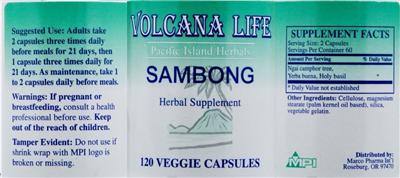
Supplement Facts
The label details for Sambong by Volcana Life, sourced from the NIH Dietary Supplement Label Database.
Supplement Facts
| Ingredient | Amount | % DV |
|---|---|---|
| Holy Basil | 0 NP | -- |
| Ngai Camphor tree | 0 NP | -- |
| Yerba Buena | 0 NP | -- |
Other ingredients: Cellulose, Magnesium Stearate, Silica, Vegetable Gelatin
Tap any ingredient to jump to its full detail below.
These statements are the manufacturer’s wording, reproduced from the product label — the label is saying it, not HelloPharmacist. We don’t verify or endorse them.
Suggested/Recommended/Usage/Directions
Suggested Use: Adults take 2 capsules three times daily before meals for 21 days, then 1 capsule three times daily for 21 days. As maintenance, take 1 to 2 capsules daily before meals.
Precautions
Warnings: If pregnant or breastfeeding, consult a health professional before use.
Keep out of the reach of children.
Tamper Evident: Do not use if shrink wrap with MPI logo is broken or missing.
General Statements
Pacific Island Herbals
FDA Statement of Identity
Herbal Supplement
Seals/Symbols
MPI
Is this label outdated? Report a formula or label change and our pharmacy team will review it.
Sambong by Volcana Life label
The label scan from the NIH Dietary Supplement Label Database. Tap to enlarge.
Label images are published by the NIH Dietary Supplement Label Database for the version of this product on file. Always read your actual product label.
View the full label (PDF)The Ingredients in Sambong by Volcana Life
These are the 3 active ingredients this product is made of. Select any to open its full monograph.
Serving size1 Capsule(s) Dosage formCapsule Servings per container60 Amounts shown are per serving.
Most supplement products combine several ingredients, and a medication can interact with the product through any one of them. Each ingredient below shows whether it has known drug interactions.
Holy Basil
Interacts with212 drugs
Holy basil (tulsi) is a traditional Ayurvedic herb most often used today for stress and general wellness, but the human evidence is mostly small and p...
Holy Basil monograph & interactionsNgai Camphor tree
Interacts with370 drugs
Camphor is a strong-smelling compound from the camphor tree (or made synthetically) that is used in many topical rub-on products for muscle aches, itc...
Ngai Camphor tree monograph & interactionsYerba Buena
Interacts with579 drugs
Spearmint is a common culinary mint that is generally safe in food and tea amounts. Early research suggests possible benefits for digestion, mild horm...
Yerba Buena monograph & interactionsOther (inactive) ingredients: Cellulose, Magnesium Stearate, Silica, Vegetable Gelatin. These complete the product’s ingredient list but are not active constituents.
Sambong by Volcana Life Drug Interactions
HelloPharmacist Interaction Report
Sambong by Volcana Life contains three active ingredients—holy basil, ngai camphor tree, and yerba buena—that together interact with a range of medications.
The most serious concern involves holy basil with anticoagulant and antiplatelet drugs (blood thinners and antiplatelet medications): animal studies show it may prolong bleeding time, though this hasn't been confirmed in humans. Altogether, these interactions span 744 individual medications.
Read the full breakdown — every affected drug type, severity by severity
Holy basil also raises moderate concerns with diabetes medications—small clinical studies suggest it can lower fasting blood glucose, which could increase the risk of low blood sugar (hypoglycemia) if combined with diabetes drugs. There's also a theoretical risk with pentobarbital (a sedative barbiturate), where holy basil seed oil may enhance its sleep-inducing effects in animal models, though human data are absent.
Ngai camphor tree carries a moderate interaction with drugs that damage the liver (hepatotoxic drugs): case reports show temporary liver enzyme elevations after camphor use, and one infant developed liver damage after topical application. Yerba buena similarly has a moderate interaction with liver-damaging drugs at high doses, based on animal research showing liver injury markers after prolonged use.
It also has a documented moderate interaction with CNS depressants—medications that slow brain activity—though human evidence is limited and conflicting (animal studies suggest sedation, but human gum-chewing studies showed arousal).
Check your exact medications with the search tool on this page before starting Sambong.
Check your own medications below · Editorial policy · How we use AI
Want to check YOUR meds against Sambong?
Ask about interactions with your drugs in plain English — “Can I take it with lisinopril?” — and we find you the answer in seconds, ingredient by ingredient.
Go to the checkerIngredients driving the most interactions
Individual Drug Interactions
The ingredients in Sambong interact with 743 drugs. Click any drug to see the details.
3 of the 3 ingredients in Sambong interact with drugs. Each result below shows which ingredient is responsible. Yerba Buena Ngai Camphor tree Holy Basil
6-mercaptopurinePurinethol
How 6-mercaptopurine interacts with Sambong — through 2 ingredients. Tap an ingredient for the detail:
Yerba BuenaHepatotoxic Drugs Moderate
Interaction Summary
Theoretically, high doses of spearmint might increase the risk of liver damage when taken with hepatotoxic drugs.
Read the full Yerba Buena + 6-mercaptopurine interactionNgai Camphor TreeHepatotoxic Drugs Moderate
Interaction Summary
Theoretically, concomitant use of camphor with other hepatotoxic drugs might increase the risk of liver damage.
Read the full Ngai Camphor Tree + 6-mercaptopurine interactionAbacavir Sulfate, Dolutegravir, LamivudineTriumeq
How Abacavir Sulfate, Dolutegravir, Lamivudine interacts with Sambong — through 2 ingredients. Tap an ingredient for the detail:
Yerba BuenaHepatotoxic Drugs Moderate
Interaction Summary
Theoretically, high doses of spearmint might increase the risk of liver damage when taken with hepatotoxic drugs.
Read the full Yerba Buena + Abacavir Sulfate, Dolutegravir, Lamivudine interactionNgai Camphor TreeHepatotoxic Drugs Moderate
Interaction Summary
Theoretically, concomitant use of camphor with other hepatotoxic drugs might increase the risk of liver damage.
Read the full Ngai Camphor Tree + Abacavir Sulfate, Dolutegravir, Lamivudine interactionAbacavir, LamivudineEpzicom
How Abacavir, Lamivudine interacts with Sambong — through 2 ingredients. Tap an ingredient for the detail:
Yerba BuenaHepatotoxic Drugs Moderate
Interaction Summary
Theoretically, high doses of spearmint might increase the risk of liver damage when taken with hepatotoxic drugs.
Read the full Yerba Buena + Abacavir, Lamivudine interactionNgai Camphor TreeHepatotoxic Drugs Moderate
Interaction Summary
Theoretically, concomitant use of camphor with other hepatotoxic drugs might increase the risk of liver damage.
Read the full Ngai Camphor Tree + Abacavir, Lamivudine interactionAbciximabReoPro
How Abciximab interacts with Sambong — through 1 ingredient. Tap an ingredient for the detail:
Holy BasilAnticoagulant/antiplatelet Drugs Moderate
Interaction Summary
Theoretically, holy basil seed oil might increase the risk of bleeding when used with anticoagulant or antiplatelet drugs.
Read the full Holy Basil + Abciximab interactionAbiraterone
How Abiraterone interacts with Sambong — through 2 ingredients. Tap an ingredient for the detail:
Yerba BuenaHepatotoxic Drugs Moderate
Interaction Summary
Theoretically, high doses of spearmint might increase the risk of liver damage when taken with hepatotoxic drugs.
Read the full Yerba Buena + Abiraterone interactionNgai Camphor TreeHepatotoxic Drugs Moderate
Interaction Summary
Theoretically, concomitant use of camphor with other hepatotoxic drugs might increase the risk of liver damage.
Read the full Ngai Camphor Tree + Abiraterone interactionAbiraterone AcetateYonsa, Zytiga
How Abiraterone Acetate interacts with Sambong — through 2 ingredients. Tap an ingredient for the detail:
Ngai Camphor TreeHepatotoxic Drugs Moderate
Interaction Summary
Theoretically, concomitant use of camphor with other hepatotoxic drugs might increase the risk of liver damage.
Read the full Ngai Camphor Tree + Abiraterone Acetate interactionYerba BuenaHepatotoxic Drugs Moderate
Interaction Summary
Theoretically, high doses of spearmint might increase the risk of liver damage when taken with hepatotoxic drugs.
Read the full Yerba Buena + Abiraterone Acetate interactionAbrocitinibCibinqo
How Abrocitinib interacts with Sambong — through 1 ingredient. Tap an ingredient for the detail:
Holy BasilAnticoagulant/antiplatelet Drugs Moderate
Interaction Summary
Theoretically, holy basil seed oil might increase the risk of bleeding when used with anticoagulant or antiplatelet drugs.
Read the full Holy Basil + Abrocitinib interactionAcarboseGlucobay, Prandase, Precose
How Acarbose interacts with Sambong — through 3 ingredients. Tap an ingredient for the detail:
Holy BasilAntidiabetes Drugs Moderate
Interaction Summary
Theoretically, holy basil might increase the risk of hypoglycemia when taken with antidiabetes drugs.
Read the full Holy Basil + Acarbose interactionNgai Camphor TreeHepatotoxic Drugs Moderate
Interaction Summary
Theoretically, concomitant use of camphor with other hepatotoxic drugs might increase the risk of liver damage.
Read the full Ngai Camphor Tree + Acarbose interactionYerba BuenaHepatotoxic Drugs Moderate
Interaction Summary
Theoretically, high doses of spearmint might increase the risk of liver damage when taken with hepatotoxic drugs.
Read the full Yerba Buena + Acarbose interactionAcebutololRhotral, Sectral
How Acebutolol interacts with Sambong — through 2 ingredients. Tap an ingredient for the detail:
Yerba BuenaHepatotoxic Drugs Moderate
Interaction Summary
Theoretically, high doses of spearmint might increase the risk of liver damage when taken with hepatotoxic drugs.
Read the full Yerba Buena + Acebutolol interactionNgai Camphor TreeHepatotoxic Drugs Moderate
Interaction Summary
Theoretically, concomitant use of camphor with other hepatotoxic drugs might increase the risk of liver damage.
Read the full Ngai Camphor Tree + Acebutolol interactionAcenocoumarolSintrom
How Acenocoumarol interacts with Sambong — through 1 ingredient. Tap an ingredient for the detail:
Holy BasilAnticoagulant/antiplatelet Drugs Moderate
Interaction Summary
Theoretically, holy basil seed oil might increase the risk of bleeding when used with anticoagulant or antiplatelet drugs.
Read the full Holy Basil + Acenocoumarol interactionAcepromazineAtravet
How Acepromazine interacts with Sambong — through 1 ingredient. Tap an ingredient for the detail:
Yerba BuenaCns Depressants Moderate
Interaction Summary
Theoretically, spearmint might alter the sedative effects of CNS depressants.
Read the full Yerba Buena + Acepromazine interactionAcetaminophenChildren's Tylenol, Children's Tylenol Meltaways, Tylenol, Tylenol Ex Strength
How Acetaminophen interacts with Sambong — through 2 ingredients. Tap an ingredient for the detail:
Ngai Camphor TreeHepatotoxic Drugs Moderate
Interaction Summary
Theoretically, concomitant use of camphor with other hepatotoxic drugs might increase the risk of liver damage.
Read the full Ngai Camphor Tree + Acetaminophen interactionYerba BuenaHepatotoxic Drugs Moderate
Interaction Summary
Theoretically, high doses of spearmint might increase the risk of liver damage when taken with hepatotoxic drugs.
Read the full Yerba Buena + Acetaminophen interactionAcetaminophen, AspirinGemnisyn
How Acetaminophen, Aspirin interacts with Sambong — through 3 ingredients. Tap an ingredient for the detail:
Holy BasilAnticoagulant/antiplatelet Drugs Moderate
Interaction Summary
Theoretically, holy basil seed oil might increase the risk of bleeding when used with anticoagulant or antiplatelet drugs.
Read the full Holy Basil + Acetaminophen, Aspirin interactionYerba BuenaHepatotoxic Drugs Moderate
Interaction Summary
Theoretically, high doses of spearmint might increase the risk of liver damage when taken with hepatotoxic drugs.
Read the full Yerba Buena + Acetaminophen, Aspirin interactionNgai Camphor TreeHepatotoxic Drugs Moderate
Interaction Summary
Theoretically, concomitant use of camphor with other hepatotoxic drugs might increase the risk of liver damage.
Read the full Ngai Camphor Tree + Acetaminophen, Aspirin interactionAcetaminophen, Aspirin, CaffeineExcedrin, Excedrin Extra Strength, Excedrin Migraine
How Acetaminophen, Aspirin, Caffeine interacts with Sambong — through 3 ingredients. Tap an ingredient for the detail:
Ngai Camphor TreeHepatotoxic Drugs Moderate
Interaction Summary
Theoretically, concomitant use of camphor with other hepatotoxic drugs might increase the risk of liver damage.
Read the full Ngai Camphor Tree + Acetaminophen, Aspirin, Caffeine interactionHoly BasilAnticoagulant/antiplatelet Drugs Moderate
Interaction Summary
Theoretically, holy basil seed oil might increase the risk of bleeding when used with anticoagulant or antiplatelet drugs.
Read the full Holy Basil + Acetaminophen, Aspirin, Caffeine interactionYerba BuenaHepatotoxic Drugs Moderate
Interaction Summary
Theoretically, high doses of spearmint might increase the risk of liver damage when taken with hepatotoxic drugs.
Read the full Yerba Buena + Acetaminophen, Aspirin, Caffeine interactionAcetaminophen, Brompheniramine, PhenylpropanolamineDimetapp Cold and Flu
How Acetaminophen, Brompheniramine, Phenylpropanolamine interacts with Sambong — through 2 ingredients. Tap an ingredient for the detail:
Yerba BuenaHepatotoxic Drugs Moderate
Interaction Summary
Theoretically, high doses of spearmint might increase the risk of liver damage when taken with hepatotoxic drugs.
Read the full Yerba Buena + Acetaminophen, Brompheniramine, Phenylpropanolamine interactionNgai Camphor TreeHepatotoxic Drugs Moderate
Interaction Summary
Theoretically, concomitant use of camphor with other hepatotoxic drugs might increase the risk of liver damage.
Read the full Ngai Camphor Tree + Acetaminophen, Brompheniramine, Phenylpropanolamine interactionAcetaminophen, ButalbitalAxocet, Bancap, Bucet, Butex Forte, Esgic CF, Orbivan CF +5 more
How Acetaminophen, Butalbital interacts with Sambong — through 2 ingredients. Tap an ingredient for the detail:
Ngai Camphor TreeHepatotoxic Drugs Moderate
Interaction Summary
Theoretically, concomitant use of camphor with other hepatotoxic drugs might increase the risk of liver damage.
Read the full Ngai Camphor Tree + Acetaminophen, Butalbital interactionYerba BuenaHepatotoxic Drugs Moderate
Interaction Summary
Theoretically, high doses of spearmint might increase the risk of liver damage when taken with hepatotoxic drugs.
Read the full Yerba Buena + Acetaminophen, Butalbital interactionAcetaminophen, Butalbital, CaffeineEsgic, Esgic Plus, Fiogesic, Fioricet, Repan, Tecnal +1 more
How Acetaminophen, Butalbital, Caffeine interacts with Sambong — through 2 ingredients. Tap an ingredient for the detail:
Yerba BuenaHepatotoxic Drugs Moderate
Interaction Summary
Theoretically, high doses of spearmint might increase the risk of liver damage when taken with hepatotoxic drugs.
Read the full Yerba Buena + Acetaminophen, Butalbital, Caffeine interactionNgai Camphor TreeHepatotoxic Drugs Moderate
Interaction Summary
Theoretically, concomitant use of camphor with other hepatotoxic drugs might increase the risk of liver damage.
Read the full Ngai Camphor Tree + Acetaminophen, Butalbital, Caffeine interactionAcetaminophen, Butalbital, Caffeine, CodeineEsgic with Codeine, Fioricet w/ Codeine
How Acetaminophen, Butalbital, Caffeine, Codeine interacts with Sambong — through 2 ingredients. Tap an ingredient for the detail:
Ngai Camphor TreeHepatotoxic Drugs Moderate
Interaction Summary
Theoretically, concomitant use of camphor with other hepatotoxic drugs might increase the risk of liver damage.
Read the full Ngai Camphor Tree + Acetaminophen, Butalbital, Caffeine, Codeine interactionYerba BuenaCns Depressants, Hepatotoxic Drugs Moderate
Interaction Summary
Theoretically, spearmint might alter the sedative effects of CNS depressants.
Read the full Yerba Buena + Acetaminophen, Butalbital, Caffeine, Codeine interactionAcetaminophen, Butalbital, CodeineBancap w/ Codeine
How Acetaminophen, Butalbital, Codeine interacts with Sambong — through 2 ingredients. Tap an ingredient for the detail:
Ngai Camphor TreeHepatotoxic Drugs Moderate
Interaction Summary
Theoretically, concomitant use of camphor with other hepatotoxic drugs might increase the risk of liver damage.
Read the full Ngai Camphor Tree + Acetaminophen, Butalbital, Codeine interactionYerba BuenaHepatotoxic Drugs, Cns Depressants Moderate
Interaction Summary
Theoretically, high doses of spearmint might increase the risk of liver damage when taken with hepatotoxic drugs.
Read the full Yerba Buena + Acetaminophen, Butalbital, Codeine interactionAcetaminophen, Butalbital, Codeine PhosphatePhrenilin #3
How Acetaminophen, Butalbital, Codeine Phosphate interacts with Sambong — through 2 ingredients. Tap an ingredient for the detail:
Yerba BuenaCns Depressants, Hepatotoxic Drugs Moderate
Interaction Summary
Theoretically, spearmint might alter the sedative effects of CNS depressants.
Read the full Yerba Buena + Acetaminophen, Butalbital, Codeine Phosphate interactionNgai Camphor TreeHepatotoxic Drugs Moderate
Interaction Summary
Theoretically, concomitant use of camphor with other hepatotoxic drugs might increase the risk of liver damage.
Read the full Ngai Camphor Tree + Acetaminophen, Butalbital, Codeine Phosphate interactionAcetaminophen, Caffeine, Chlorpheniramine, Hydrocodone, PhenylephrineHycomine Compound
How Acetaminophen, Caffeine, Chlorpheniramine, Hydrocodone, Phenylephrine interacts with Sambong — through 2 ingredients. Tap an ingredient for the detail:
Ngai Camphor TreeHepatotoxic Drugs Moderate
Interaction Summary
Theoretically, concomitant use of camphor with other hepatotoxic drugs might increase the risk of liver damage.
Read the full Ngai Camphor Tree + Acetaminophen, Caffeine, Chlorpheniramine, Hydrocodone, Phenylephrine interactionYerba BuenaCns Depressants, Hepatotoxic Drugs Moderate
Interaction Summary
Theoretically, spearmint might alter the sedative effects of CNS depressants.
Read the full Yerba Buena + Acetaminophen, Caffeine, Chlorpheniramine, Hydrocodone, Phenylephrine interactionAcetaminophen, Caffeine, CodeineGesic C15, Gesic C30, Gesic C8, Lenoltec 1, Lenoltec 2, Lenoltec 3 +1 more
How Acetaminophen, Caffeine, Codeine interacts with Sambong — through 2 ingredients. Tap an ingredient for the detail:
Yerba BuenaHepatotoxic Drugs, Cns Depressants Moderate
Interaction Summary
Theoretically, high doses of spearmint might increase the risk of liver damage when taken with hepatotoxic drugs.
Read the full Yerba Buena + Acetaminophen, Caffeine, Codeine interactionNgai Camphor TreeHepatotoxic Drugs Moderate
Interaction Summary
Theoretically, concomitant use of camphor with other hepatotoxic drugs might increase the risk of liver damage.
Read the full Ngai Camphor Tree + Acetaminophen, Caffeine, Codeine interactionAcetaminophen, Caffeine, Codeine, SalicylamideCodalan No.1, Codalan No.2, Codalan No.3
How Acetaminophen, Caffeine, Codeine, Salicylamide interacts with Sambong — through 2 ingredients. Tap an ingredient for the detail:
Yerba BuenaCns Depressants, Hepatotoxic Drugs Moderate
Interaction Summary
Theoretically, spearmint might alter the sedative effects of CNS depressants.
Read the full Yerba Buena + Acetaminophen, Caffeine, Codeine, Salicylamide interactionNgai Camphor TreeHepatotoxic Drugs Moderate
Interaction Summary
Theoretically, concomitant use of camphor with other hepatotoxic drugs might increase the risk of liver damage.
Read the full Ngai Camphor Tree + Acetaminophen, Caffeine, Codeine, Salicylamide interactionAcetaminophen, Caffeine, DihydrocodeineDHC Plus, Panlor DC, Panlor SS
How Acetaminophen, Caffeine, Dihydrocodeine interacts with Sambong — through 2 ingredients. Tap an ingredient for the detail:
Ngai Camphor TreeHepatotoxic Drugs Moderate
Interaction Summary
Theoretically, concomitant use of camphor with other hepatotoxic drugs might increase the risk of liver damage.
Read the full Ngai Camphor Tree + Acetaminophen, Caffeine, Dihydrocodeine interactionYerba BuenaCns Depressants, Hepatotoxic Drugs Moderate
Interaction Summary
Theoretically, spearmint might alter the sedative effects of CNS depressants.
Read the full Yerba Buena + Acetaminophen, Caffeine, Dihydrocodeine interactionAcetaminophen, Caffeine, IsomethepteneMigralam
How Acetaminophen, Caffeine, Isometheptene interacts with Sambong — through 2 ingredients. Tap an ingredient for the detail:
Yerba BuenaHepatotoxic Drugs Moderate
Interaction Summary
Theoretically, high doses of spearmint might increase the risk of liver damage when taken with hepatotoxic drugs.
Read the full Yerba Buena + Acetaminophen, Caffeine, Isometheptene interactionNgai Camphor TreeHepatotoxic Drugs Moderate
Interaction Summary
Theoretically, concomitant use of camphor with other hepatotoxic drugs might increase the risk of liver damage.
Read the full Ngai Camphor Tree + Acetaminophen, Caffeine, Isometheptene interactionAcetaminophen, Caffeine, PyrilamineMidol Max Strength Menstrual
How Acetaminophen, Caffeine, Pyrilamine interacts with Sambong — through 2 ingredients. Tap an ingredient for the detail:
Ngai Camphor TreeHepatotoxic Drugs Moderate
Interaction Summary
Theoretically, concomitant use of camphor with other hepatotoxic drugs might increase the risk of liver damage.
Read the full Ngai Camphor Tree + Acetaminophen, Caffeine, Pyrilamine interactionYerba BuenaHepatotoxic Drugs Moderate
Interaction Summary
Theoretically, high doses of spearmint might increase the risk of liver damage when taken with hepatotoxic drugs.
Read the full Yerba Buena + Acetaminophen, Caffeine, Pyrilamine interactionAcetaminophen, Chlorpheniramine Maleate, Dextromethorphan HbrVicks Formula 44M Cough, Cold & Flu Relief
How Acetaminophen, Chlorpheniramine Maleate, Dextromethorphan Hbr interacts with Sambong — through 2 ingredients. Tap an ingredient for the detail:
Ngai Camphor TreeHepatotoxic Drugs Moderate
Interaction Summary
Theoretically, concomitant use of camphor with other hepatotoxic drugs might increase the risk of liver damage.
Read the full Ngai Camphor Tree + Acetaminophen, Chlorpheniramine Maleate, Dextromethorphan Hbr interactionYerba BuenaHepatotoxic Drugs Moderate
Interaction Summary
Theoretically, high doses of spearmint might increase the risk of liver damage when taken with hepatotoxic drugs.
Read the full Yerba Buena + Acetaminophen, Chlorpheniramine Maleate, Dextromethorphan Hbr interactionAcetaminophen, Chlorpheniramine, Codeine, PhenylephrineColrex
How Acetaminophen, Chlorpheniramine, Codeine, Phenylephrine interacts with Sambong — through 2 ingredients. Tap an ingredient for the detail:
Yerba BuenaHepatotoxic Drugs, Cns Depressants Moderate
Interaction Summary
Theoretically, high doses of spearmint might increase the risk of liver damage when taken with hepatotoxic drugs.
Read the full Yerba Buena + Acetaminophen, Chlorpheniramine, Codeine, Phenylephrine interactionNgai Camphor TreeHepatotoxic Drugs Moderate
Interaction Summary
Theoretically, concomitant use of camphor with other hepatotoxic drugs might increase the risk of liver damage.
Read the full Ngai Camphor Tree + Acetaminophen, Chlorpheniramine, Codeine, Phenylephrine interactionAcetaminophen, Chlorpheniramine, DextromethorphanCoricidin II Extra Strength Cold and Flu
How Acetaminophen, Chlorpheniramine, Dextromethorphan interacts with Sambong — through 2 ingredients. Tap an ingredient for the detail:
Ngai Camphor TreeHepatotoxic Drugs Moderate
Interaction Summary
Theoretically, concomitant use of camphor with other hepatotoxic drugs might increase the risk of liver damage.
Read the full Ngai Camphor Tree + Acetaminophen, Chlorpheniramine, Dextromethorphan interactionYerba BuenaHepatotoxic Drugs Moderate
Interaction Summary
Theoretically, high doses of spearmint might increase the risk of liver damage when taken with hepatotoxic drugs.
Read the full Yerba Buena + Acetaminophen, Chlorpheniramine, Dextromethorphan interactionAcetaminophen, Chlorpheniramine, Dextromethorphan HydrobromideCoricidin HBP Maximum Strength Flu
How Acetaminophen, Chlorpheniramine, Dextromethorphan Hydrobromide interacts with Sambong — through 2 ingredients. Tap an ingredient for the detail:
Yerba BuenaHepatotoxic Drugs Moderate
Interaction Summary
Theoretically, high doses of spearmint might increase the risk of liver damage when taken with hepatotoxic drugs.
Read the full Yerba Buena + Acetaminophen, Chlorpheniramine, Dextromethorphan Hydrobromide interactionNgai Camphor TreeHepatotoxic Drugs Moderate
Interaction Summary
Theoretically, concomitant use of camphor with other hepatotoxic drugs might increase the risk of liver damage.
Read the full Ngai Camphor Tree + Acetaminophen, Chlorpheniramine, Dextromethorphan Hydrobromide interactionEach ingredient & the kinds of drugs it affects
For each ingredient in Sambong with known interactions, here are the types of medications they can affect. Open any type for the detail — or search your exact drug in the checker above.
Yerba Buena
Cns Depressants
Theoretically, spearmint might alter the sedative effects of CNS depressants.
Animal research suggests that (-)-carvone, a major constituent of spearmint, has sedative effects. However, in humans, chewing spearmint-flavored gum induced arousal effects.
Hepatotoxic Drugs
Theoretically, high doses of spearmint might increase the risk of liver damage when taken with hepatotoxic drugs.
Animal research suggests that drinking spearmint tea for 30 days can increase markers of liver damage, including aspartate aminotransferase (AST) and alanine aminotransferase (ALT), and cause liver degeneration and necrosis, in a dose-dependent manner. This effect has not been reported in humans.
Ngai Camphor tree
Hepatotoxic Drugs
Theoretically, concomitant use of camphor with other hepatotoxic drugs might increase the risk of liver damage.
There have been a few case reports of transient elevations in liver enzymes in adults after oral or topical use of camphor. There has also been one case of hepatotoxicity in an infant after topical camphor use.
Holy Basil
Anticoagulant/Antiplatelet Drugs
Theoretically, holy basil seed oil might increase the risk of bleeding when used with anticoagulant or antiplatelet drugs.
Animal research shows that holy basil seed oil can prolong bleeding time, possibly due to inhibition of platelet aggregation. However, it is not known if this occurs in humans.
Antidiabetes Drugs
Theoretically, holy basil might increase the risk of hypoglycemia when taken with antidiabetes drugs.
Small clinical studies show that taking holy basil can decrease fasting blood glucose and other measures of glycemic control in patients with type 2 diabetes.
Pentobarbital (Nembutal)
Theoretically, holy basil seed oil might increase the sedative effects of pentobarbital.
Animal research shows that holy basil seed oil increases pentobarbitone-induced sleeping time. However, it is not known if this occurs in humans or if this applies to other barbiturates or sedatives.
Brand information
Manufacturer and brand details for Sambong, from the product label.
Volcana Life
See all Volcana Life products- Name
- Marco Pharma Int'l
- City
- Roseburg
- State
- OR
- ZipCode
- 97470
Sambong by Volcana Life: Common Questions
Does Sambong by Volcana Life interact with any medications?
How can one product interact with so many drugs?
Where does this information come from?
Can I take Sambong if I'm pregnant or breastfeeding?
What are the most common side effects?
Is Sambong proven to work for anything?
What is camphor and why is it in here?
Why does this product interact with so many medications?
Written and reviewed by the HelloPharmacist editorial staff. Our editorial policy
Not sure if Sambong is safe with your meds?
Our pharmacists answer your medication & supplement questions — free.
Label information is sourced from the NIH Dietary Supplement Label Database and reflects the product version on file; always read your actual product label. This page is for education only and is not a substitute for professional medical advice. Confirm with your pharmacist or doctor before combining supplements and medications.
The Full Monographs Behind Sambong’s Ingredients
Every ingredient we hold a full HelloPharmacist monograph for — uses, evidence, safety, and the complete interaction list.
Holy Basil
Interacts with 212 drugsHoly basil (tulsi) is a traditional Ayurvedic herb most often used today for stress and general wellness, but the human evidence is mostly small and preliminary. It is generally well tolerat...
Read the full Holy Basil monograph → Herb & supplement monographCamphor
Interacts with 370 drugsCamphor is a strong-smelling compound from the camphor tree (or made synthetically) that is used in many topical rub-on products for muscle aches, itching, and chest congestion. It can be he...
Read the full Camphor monograph → Herb & supplement monographSpearmint
Interacts with 579 drugsSpearmint is a common culinary mint that is generally safe in food and tea amounts. Early research suggests possible benefits for digestion, mild hormone-related issues (such as excess facia...
Read the full Spearmint monograph →Sources & How We Checked
Sambong's label data comes from the NIH Dietary Supplement Label Database; the ingredient interaction data is from the Natural Medicines database, reviewed by our pharmacists.
- NIH Dietary Supplement Label Database (DSLD) — The official product label on file for this supplement.
- Natural Medicines (Therapeutic Research Center) — Evidence-graded clinical reference behind the ingredient interaction data.
Content is written and reviewed by licensed HelloPharmacist pharmacists. See our data sources and editorial standards for how this information is built and checked.
The 48 references behind this product’s interaction data
Every citation that drives the interaction findings for this product’s ingredients, from the evidence-graded Natural Medicines (TRC Healthcare) database. Open an ingredient to browse its citations — links open the study on PubMed or the publisher’s site.
Holy Basil 8 references
- Agrawal P, Rai V, Singh RB. Randomized placebo-controlled, single blind trial of holy basil leaves in patients with noninsulin-dependent diabetes mellitus. Int J Clin Pharmacol Ther 1996;34:406-9.
- Sakina MR, Dandiya PC, Hamdard ME, Hameed A. Preliminary psychopharmacological evaluation of Ocimum sanctum leaf extract. J Ethnopharmacol 1990;28:143-50. PubMed
- Singh S, Rehan HM, Majumdar DK. Effect of Ocimum sanctum fixed oil on blood pressure, blood clotting time and pentobarbitone-induced sleeping time. J Ethnopharmacol 2001;78:139-43. PubMed
- Mondal, S., Varma, S., Bamola, V. D., Naik, S. N., Mirdha, B. R., Padhi, M. M., Mehta, N., and Mahapatra, S. C. Double-blinded randomized controlled trial for immunomodulatory effects of Tulsi (Ocimum sanctum Linn.) leaf extract on healthy volunteers. J PubMed
- Agarwal, P. and Nagesh, L. Comparative evaluation of efficacy of 0.2% Chlorhexidine, Listerine and Tulsi extract mouth rinses on salivary Streptococcus mutans count of high school children--RCT. Contemp.Clin Trials 2011;32(6):802-808. PubMed
- Vohora, S. B., Garg, S. K., and Chaudhury, R. R. Antifertility screening of plants. 3. Effect of six indigenous plants on early pregnancy in albino rats. Indian J Med Res 1969;57(5):893-899.
- Khanna S, Gupta SR, Grover JK. Effect of long term feeding of tulsi (Ocimum sanctum Linn) on reproductive performance of adult albino rats. Indian J Exp Biol 1986;24(5):302-4.
- Somasundaram G, Manimekalai K, Salwe KJ, Pandiamunian J. Evaluation of the antidiabetic effect of Ocimum sanctum in type 2 diabetes patients. Int J Life Sci Pharma Res 2012;2(3):75-81.
Camphor 20 references
- Uc A, Bishop WP, Sanders KD. Camphor hepatotoxicity. South Med J 2000;93:596-8. DOI
- Love JN, Sammon M, Smereck J. Are one or two dangerous? Camphor exposure in toddlers. J Emerg Med 2004;27:49-54.. PubMed
- Ruha AM, Graeme KA, Field A. Late seizure following ingestion of Vicks VapoRub. Acad Emerg Med 2003;10:691. . PubMed
- Gouin S, Patel H. Unusual cause of seizure. Pediatr Emerg Care 1996;12:298-300. DOI
- Ernst E. Adverse effects of herbal drugs in dermatology. Br J Dermatol 2000;143:923-9. PubMed
- Fung AE, Oxford KW. Microwave-superheated Vics Vapo Rub: an ocular public health danger. Am J Ophthalmol 2004;137:379-80. PubMed
- Emery, D. P. and Corban, J. G. Camphor toxicity. J.Paediatr.Child Health 1999;35(1):105-106.
- Rampini, S. K., Schneemann, M., Rentsch, K., and Bachli, E. B. Camphor intoxication after cao gio (coin rubbing). JAMA 7-3-2002;288(1):45.
- SMITH, A. G. and MARGOLIS, G. Camphor poisoning; anatomical and pharmacologic study; report of a fatal case; experimental investigation of protective action of barbiturate. Am.J.Pathol. 1954;30(5):857-869.
- Ragucci, K. R., Trangmar, P. R., Bigby, J. G., and Detar, T. D. Camphor ingestion in a 10-year-old male. South.Med.J. 2007;100(2):204-207. PubMed
- Agarwal, A. and Malhotra, H. S. Camphor ingestion: an unusual cause of seizure. J.Assoc.Physicians India 2008;56:123-124.
- Weiss, J. and Catalano, P. Camphorated oil intoxication during pregnancy. Pediatrics 1973;52(5):713-714. DOI
- Vasey, R. H. and Karayannopoulos, S. J. Camphorated oil. Br.Med.J. 1-8-1972;1(5792):112.
- Mascie-Taylor, B. H., Widdop, B., and Davison, A. M. Camphor intoxication treated by charcoal haemoperfusion. Postgrad.Med.J. 1981;57(673):725-726. PubMed
- Theis, J. G. and Koren, G. Camphorated oil: still endangering the lives of Canadian children. CMAJ. 6-1-1995;152(11):1821-1824.
- Skoglund, R. R., Ware, L. L., Jr., and Schanberger, J. E. Prolonged seizures due to contact and inhalation exposure to camphor. A case report. Clin.Pediatr.(Phila) 1977;16(10):901-902. PubMed
- Cordoba Torres IT, Marino-Nieto J, Barkin HB, Fort AC, Cobas M. Vicks VapoRub intoxication: an unusual presentation of multiorgan failure. J Clin Anesth 2018;48:46-7. PubMed
- Rahimi M, Shokri F, Hassanian-Moghaddam H, et al. Severe camphor poisoning, a seven-year observational study. Environ Toxicol Pharmacol 2017;52:8-13. PubMed
- Mathew T, John SK, Kamath V, et al. Essential oil related seizures (EORS): A multi-center prospective study on essential oils and seizures in adults. Epilepsy Res. 2021;173:106626. PubMed
- Camphor (synthetic): Immediately Dangerous to Life or Health Concentrations (IDLH). National Institute for Occupational Safety and Health. 1994. https://www.cdc.gov/niosh/idlh/76222.html. Assessed 5/6/2021.
Spearmint 20 references
- Electronic Code of Federal Regulations. Title 21. Part 182 -- Substances Generally Recognized As Safe. Available at: https://www.accessdata.fda.gov/scripts/cdrh/cfdocs/cfcfr/CFRSearch.cfm?CFRPart=182
- Akdogan M, Ozguner M, Aydin G, Gokalp O. Investigation of biochemical and histopathological effects of Mentha piperita Labiatae and Mentha spicata Labiatae on liver tissue in rats. Hum Exp Toxicol 2004;23:21-8.
- Poon, T. S. and Freeman, S. Cheilitis caused by contact allergy to anethole in spearmint flavoured toothpaste. Australas.J Dermatol. 2006;47(4):300-301. PubMed
- Andersen, K. E. Contact allergy to toothpaste flavors. Contact Dermatitis 1978;4(4):195-198. PubMed
- de Sousa, D. P., Farias Nobrega, F. F., and de Almeida, R. N. Influence of the chirality of (R)-(-)- and (S)-(+)-carvone in the central nervous system: a comparative study. Chirality 5-5-2007;19(4):264-268.
- Larsen, W., Nakayama, H., Fischer, T., Elsner, P., Frosch, P., Burrows, D., Jordan, W., Shaw, S., Wilkinson, J., Marks, J., Jr., Sugawara, M., Nethercott, M., and Nethercott, J. Fragrance contact dermatitis: a worldwide multicenter investigation (Part II PubMed
- Guney, M., Oral, B., Karahanli, N., Mungan, T., and Akdogan, M. The effect of Mentha spicata Labiatae on uterine tissue in rats. Toxicol.Ind.Health 2006;22(8):343-348.
- Masumoto, Y., Morinushi, T., Kawasaki, H., Ogura, T., and Takigawa, M. Effects of three principal constituents in chewing gum on electroencephalographic activity. Psychiatry Clin.Neurosci. 1999;53(1):17-23. PubMed
- Bulat, R., Fachnie, E., Chauhan, U., Chen, Y., and Tougas, G. Lack of effect of spearmint on lower oesophageal sphincter function and acid reflux in healthy volunteers. Aliment.Pharmacol Ther. 1999;13(6):805-812. PubMed
- Francalanci, S., Sertoli, A., Giorgini, S., Pigatto, P., Santucci, B., and Valsecchi, R. Multicentre study of allergic contact cheilitis from toothpastes. Contact Dermatitis 2000;43(4):216-222. PubMed
- Bonamonte, D., Mundo, L., Daddabbo, M., and Foti, C. Allergic contact dermatitis from Mentha spicata (spearmint). Contact Dermatitis 2001;45(5):298.
- Tomson, N., Murdoch, S., and Finch, T. M. The dangers of making mint sauce. Contact Dermatitis 2004;51(2):92-93. PubMed
- Clayton, R. and Orton, D. Contact allergy to spearmint oil in a patient with oral lichen planus. Contact Dermatitis 2004;51(5-6):314-315. PubMed
- Dal Sacco, D., Gibelli, D., and Gallo, R. Contact allergy in the burning mouth syndrome: a retrospective study on 38 patients. Acta Derm.Venereol. 2005;85(1):63-64. PubMed
- Goncalves, J. C., Oliveira, Fde S., Benedito, R. B., de Sousa, D. P., de Almeida, R. N., and de Araujo, D. A. Antinociceptive activity of (-)-carvone: evidence of association with decreased peripheral nerve excitability. Biol Pharm Bull. 2008;31(5):1017- PubMed
- Ormerod, A. D. and Main, R. A. Sensitisation to "sensitive teeth" toothpaste. Contact Dermatitis 1985;13(3):192-193. PubMed
- Skrebova, N., Brocks, K., and Karlsmark, T. Allergic contact cheilitis from spearmint oil. Contact Dermatitis 1998;39(1):35. PubMed
- Damiani E, Aloia AM, Priore MG, et al. Allergy to mint (Mentha spicata). J Investig Allergol Clin Immunol 2012;22:309-10.
- Connelly AE, Tucker AJ, Tulk H, et al. High-rosmarinic acid spearmint tea in the management of knee osteoarthritis symptoms. J Med Food 2014;17:1361-7. PubMed
- Lasrado JA, Nieman KM, Fonseca BA, et al. Safety and tolerability of a dried aqueous spearmint extract. Regul Toxicol Pharmacol 2017;86:167-176. PubMed
Parts of this content are provided by the Therapeutic Research Center, LLC.
DISCLAIMER: Currently this does not check for drug-drug interactions. This is not an all-inclusive comprehensive list of potential interactions and is for informational purposes only. Not all interactions are known or well-reported in the scientific literature, and new interactions are continually being reported. Input is needed from a qualified healthcare provider including a pharmacist before starting any therapy. Application of clinical judgment is necessary.
© 2021 Therapeutic Research Center, LLC