
Tape Parakil 7 Oil Blend Ingredients & Drug Interactions
What is this page for?
First and foremost: checking Tape Parakil 7 Oil Blend against your medications. The heart of this page is the interaction checker and the full interaction report — how this product’s ingredients may interact with prescription and over-the-counter medicines you may be taking.
Around that, we add a pharmacist’s high-level view of the product as a whole — what’s inside, the evidence for its stated use, how transparent the label is, and what safety data exists — so you can see the full picture in one place. It’s educational information from our licensed clinical databases and the clinical staff at HelloPharmacist — not medical advice — and we don’t sell or endorse products. Our editorial policy
Tape Parakil 7 Oil Blend is a dietary supplement by Dr. Clark Store with 7 active ingredients. Its ingredients are commonly taken for digestive upset, diarrhea, sleep and relaxation.Based on those ingredients, 1,193 medications have a known interaction with it, the most serious rated moderate. The ingredients most likely to interact are Fennel, Nutmeg, Caraway. Use the checker below to test your specific medication, or read the full HelloPharmacist Interaction Report.
Check Your Meds Against Tape Parakil 7 Oil Blend by Dr. Clark Store
Ask about any prescription or over-the-counter medication and we check it for interactions with Tape Parakil 7 Oil Blend by Dr. Clark Store — and tell you which ingredient is responsible.
AI summaries are generated from our interaction database for education only — always confirm with your pharmacist. How we use AI
Ask the Pharmacist
A licensed pharmacist will answer your question by email — free, usually within 24 hours.
Got it — thank you!
A licensed pharmacist will answer within 24 hours. Keep an eye on your email (worth checking spam, just in case).
HelloPharmacist Scorecard of Tape Parakil 7 Oil Blend by Dr. Clark Store
Our pharmacy team’s full take, with four database checks built into the cards below — a summary of what is known, not a grade of the product itself.
What’s inside
Low disclosure
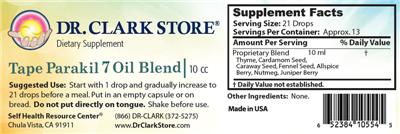
Tape Parakil 7 Oil Blend contains seven active ingredients: nutmeg, thyme, juniper, fennel, cardamom, caraway, and allspice. Each is a culinary and traditional herbal spice — they're the kinds of ingredients you might use in cooking.
The product contains no inactive ingredients (fillers or binders).
Does it work?
Moderate evidence
The evidence for what this blend does is limited. For nutmeg, thyme, juniper, cardamom, and allspice, we have insufficient reliable evidence to rate their effectiveness for any health purpose in our data.
Fennel shows possibly effective evidence for dysmenorrhea (menstrual cramping), and caraway shows possibly effective evidence for dyspepsia (indigestion). Beyond those two, we don't have established effectiveness ratings for the conditions these herbs are traditionally used for.
How safe is it?
Well-documented data
When used in food amounts, these spices are generally well tolerated. However, the product delivers them as a concentrated oil blend — not food spices — and safety data for medicinal or concentrated doses is limited or absent.
Nutmeg is the biggest concern: large doses are unsafe and have been linked to serious poisoning, including cardiovascular, neurological, and psychiatric effects; death from overdose has been reported. High-dose nutmeg can cause hallucinations, dizziness, drowsiness, confusion, and at extreme doses, coma.
Thyme, fennel, and caraway are generally well tolerated in food, but concentrated forms lack thorough safety testing. Common side effects reported with these herbs include allergic reactions, dizziness, headache, heartburn, nausea, and skin irritation.
Juniper may irritate the kidneys and shouldn't be used long-term. Pregnancy safety varies: nutmeg is rated possibly unsafe; juniper is unsafe; fennel and caraway are possibly unsafe; thyme, cardamom, and allspice are likely safe.
For breastfeeding, juniper should be avoided; fennel and caraway lack sufficient data; thyme and cardamom are likely safe.
Meds to double-check
Moderate interaction found
Check your medications against this blend if you take blood thinners or antiplatelet drugs (anticoagulants like warfarin or apixaban, or antiplatelet agents); CNS depressants (sleeping pills, opioids, anxiety medications); diabetes medications; estrogen-based drugs (birth control, hormone replacement); diuretics or lithium; or ciprofloxacin, tamoxifen, or isoniazid. No interactions are documented for cardamom in our data.
The bottom line
Scorecard at a glanceFormula with limited ingredient disclosure with some supporting evidence behind its ingredients' uses. Moderate medication interactions have been identified, and safety information is well characterized.
This seven-ingredient oil blend has interactions to check before taking it with any prescription medication — particularly blood thinners, diabetes drugs, heart or psychiatric medications, and estrogen-containing drugs. The evidence for what it does is weak, and safety data for concentrated herbal oils is limited.
Talk to your pharmacist before starting, especially if you're pregnant, nursing, or take any regular medications.
Educational only — not medical advice; always confirm with your pharmacist. Our editorial policy · How we use AI
Assessment coverage: 7 of 7 active ingredients matched to our full ingredient reviews (monographs). Based on the product label dated Jun 20, 2024.
This Scorecard evaluates available label information, ingredient evidence, and known medication-safety considerations. It does not independently verify product identity, purity, potency, contamination, or manufacturing quality. How these ratings are computed
General information
Key facts about Tape Parakil 7 Oil Blend, straight from the product label.
| Brand | Dr. Clark Store |
|---|---|
| Barcode (UPC) | 652384105545 |
| Net contents | 10 cc(s) |
| Market status | On market |
| Date entered into DSLD | Jun 20, 2024 |
| DSLD ID | 313180 |
| Product type | Botanical |
| Supplement form | Liquid |
| Dietary claims / uses | All Other |
| Intended target group(s) | Adult (18 - 50 Years) |
Everything in this section is reproduced from the manufacturer’s own product label — it’s the label speaking, not HelloPharmacist. We show it so you can see exactly what the maker states; we don’t verify or endorse those statements.
Supplement Facts
The label details for Tape Parakil 7 Oil Blend by Dr. Clark Store, sourced from the NIH Dietary Supplement Label Database.
Supplement Facts
| Ingredient | Amount | % DV |
|---|---|---|
| Proprietary Blend | 10 mL | -- |
| Nutmeg | 0 NP | -- |
| Thyme | 0 NP | -- |
| Juniper | 0 NP | -- |
| Fennel | 0 NP | -- |
| Cardamom | 0 NP | -- |
| Caraway | 0 NP | -- |
| Allspice | 0 NP | -- |
Tap any ingredient to jump to its full detail below.
These statements are the manufacturer’s wording, reproduced from the product label — the label is saying it, not HelloPharmacist. We don’t verify or endorse them.
FDA Statement of Identity
Dietary Supplement
Suggested/Recommended/Usage/Directions
Suggested use: Start with 1 drop and gradually increase to 21 drops before a meal. Put in an empty capsule or on bread.
Shake before use.
Precautions
Do not put directly on tongue.
Formulation
Made in USA
Is this label outdated? Report a formula or label change and our pharmacy team will review it.
Tape Parakil 7 Oil Blend by Dr. Clark Store label
The label scan from the NIH Dietary Supplement Label Database. Tap to enlarge.
Label images are published by the NIH Dietary Supplement Label Database for the version of this product on file. Always read your actual product label.
View the full label (PDF)The Ingredients in Tape Parakil 7 Oil Blend by Dr. Clark Store
These are the 7 active ingredients this product is made of. Select any to open its full monograph.
Serving size1 Drop(s) Dosage formLiquid Servings per container13 Amounts shown are per serving.
Most supplement products combine several ingredients, and a medication can interact with the product through any one of them. Each ingredient below shows whether it has known drug interactions.
Tape Parakil 7 Oil Blend by Dr. Clark Store Drug Interactions
HelloPharmacist Interaction Report
Tape Parakil 7 Oil Blend by Dr.
Clark Store contains seven herbal ingredients, six of which have documented interactions with medications. The most serious concern is nutmeg's Moderate-severity interaction with CNS depressants (drugs that slow the brain and nervous system, like sedatives and painkillers) — nutmeg may add to their sedating effects.
Animal studies suggest nutmeg has sedative compounds, though human evidence is limited.
Read the full breakdown — every affected drug type, severity by severity
Nutmeg also interacts Moderately with CYP1A2 substrates (certain drugs your liver breaks down), anticholinergic drugs (medications for urinary or bowel issues), cholinergic drugs (used for myasthenia gravis or Alzheimer's), and phenobarbital. Thyme carries Moderate interactions with estrogens, blood thinners (anticoagulants/antiplatelets), and both anticholinergic and cholinergic drugs.
Fennel has Moderate interactions with contraceptives, estrogen replacement therapy, CYP3A4 substrates (a broad enzyme group), blood thinners, and ciprofloxacin and tamoxifen specifically.
Juniper, caraway, and allspice also carry interactions — juniper with diabetes drugs, diuretics, and lithium (Minor and Moderate); caraway with CNS depressants, diabetes drugs, diuretics, lithium, and three tuberculosis medications (Minor and Moderate); allspice Moderately with blood thinners. Cardamom was not checked for interactions — we hold no data for it.
Altogether, these interactions span 1,179 individual medications. Use the medication checker on this page to verify your exact prescriptions before starting this product.
Check your own medications below · Editorial policy · How we use AI
Want to check YOUR meds against Tape Parakil 7 Oil Blend?
Ask about interactions with your drugs in plain English — “Can I take it with lisinopril?” — and we find you the answer in seconds, ingredient by ingredient.
Go to the checkerIngredients driving the most interactions
Individual Drug Interactions
The ingredients in Tape Parakil 7 Oil Blend interact with 1,193 drugs. Click any drug to see the details.
6 of the 7 ingredients in Tape Parakil 7 Oil Blend interact with drugs. Each result below shows which ingredient is responsible. Fennel Nutmeg Caraway Thyme Juniper Allspice
Ado-trastuzumab EmtansineKadcyla
How Ado-trastuzumab Emtansine interacts with Tape Parakil 7 Oil Blend — through 1 ingredient. Tap an ingredient for the detail:
FennelCytochrome P450 3a4 (cyp3a4) Substrates Moderate
Interaction Summary
Theoretically, fennel might increase levels of drugs metabolized by CYP3A4.
Read the full Fennel + Ado-trastuzumab Emtansine interactionAbciximabReoPro
How Abciximab interacts with Tape Parakil 7 Oil Blend — through 3 ingredients. Tap an ingredient for the detail:
ThymeAnticoagulant/antiplatelet Drugs Moderate
Interaction Summary
Theoretically, thyme leaf extract might have additive effects with anticoagulant or antiplatelet drugs.
Read the full Thyme + Abciximab interactionFennelAnticoagulant/antiplatelet Drugs Moderate
Interaction Summary
Theoretically, fennel might increase the risk of bleeding when used with antiplatelet or anticoagulant drugs.
Read the full Fennel + Abciximab interactionAllspiceAnticoagulant/antiplatelet Drugs Moderate
Interaction Summary
Theoretically, combining allspice with an antiplatelet or anticoagulant drug might increase the risk of bleeding.
Read the full Allspice + Abciximab interactionAbemaciclibVerzenio
How Abemaciclib interacts with Tape Parakil 7 Oil Blend — through 1 ingredient. Tap an ingredient for the detail:
FennelCytochrome P450 3a4 (cyp3a4) Substrates Moderate
Interaction Summary
Theoretically, fennel might increase levels of drugs metabolized by CYP3A4.
Read the full Fennel + Abemaciclib interactionAbiraterone
How Abiraterone interacts with Tape Parakil 7 Oil Blend — through 1 ingredient. Tap an ingredient for the detail:
FennelCytochrome P450 3a4 (cyp3a4) Substrates Moderate
Interaction Summary
Theoretically, fennel might increase levels of drugs metabolized by CYP3A4.
Read the full Fennel + Abiraterone interactionAbiraterone AcetateYonsa, Zytiga
How Abiraterone Acetate interacts with Tape Parakil 7 Oil Blend — through 1 ingredient. Tap an ingredient for the detail:
FennelCytochrome P450 3a4 (cyp3a4) Substrates Moderate
Interaction Summary
Theoretically, fennel might increase levels of drugs metabolized by CYP3A4.
Read the full Fennel + Abiraterone Acetate interactionAbrocitinibCibinqo
How Abrocitinib interacts with Tape Parakil 7 Oil Blend — through 3 ingredients. Tap an ingredient for the detail:
AllspiceAnticoagulant/antiplatelet Drugs Moderate
Interaction Summary
Theoretically, combining allspice with an antiplatelet or anticoagulant drug might increase the risk of bleeding.
Read the full Allspice + Abrocitinib interactionThymeAnticoagulant/antiplatelet Drugs Moderate
Interaction Summary
Theoretically, thyme leaf extract might have additive effects with anticoagulant or antiplatelet drugs.
Read the full Thyme + Abrocitinib interactionFennelAnticoagulant/antiplatelet Drugs Moderate
Interaction Summary
Theoretically, fennel might increase the risk of bleeding when used with antiplatelet or anticoagulant drugs.
Read the full Fennel + Abrocitinib interactionAcalabrutinibCalquence
How Acalabrutinib interacts with Tape Parakil 7 Oil Blend — through 1 ingredient. Tap an ingredient for the detail:
FennelCytochrome P450 3a4 (cyp3a4) Substrates Moderate
Interaction Summary
Theoretically, fennel might increase levels of drugs metabolized by CYP3A4.
Read the full Fennel + Acalabrutinib interactionAcarboseGlucobay, Prandase, Precose
How Acarbose interacts with Tape Parakil 7 Oil Blend — through 2 ingredients. Tap an ingredient for the detail:
JuniperAntidiabetes Drugs Moderate
Interaction Summary
Theoretically, taking juniper berry with antidiabetes medications might cause additive hypoglycemia.
Read the full Juniper + Acarbose interactionCarawayAntidiabetes Drugs Moderate
Interaction Summary
Theoretically, caraway might increase the risk of hypoglycemia when used with antidiabetes drugs.
Read the full Caraway + Acarbose interactionAcenocoumarolSintrom
How Acenocoumarol interacts with Tape Parakil 7 Oil Blend — through 3 ingredients. Tap an ingredient for the detail:
AllspiceAnticoagulant/antiplatelet Drugs Moderate
Interaction Summary
Theoretically, combining allspice with an antiplatelet or anticoagulant drug might increase the risk of bleeding.
Read the full Allspice + Acenocoumarol interactionThymeAnticoagulant/antiplatelet Drugs Moderate
Interaction Summary
Theoretically, thyme leaf extract might have additive effects with anticoagulant or antiplatelet drugs.
Read the full Thyme + Acenocoumarol interactionFennelAnticoagulant/antiplatelet Drugs Moderate
Interaction Summary
Theoretically, fennel might increase the risk of bleeding when used with antiplatelet or anticoagulant drugs.
Read the full Fennel + Acenocoumarol interactionAcepromazineAtravet
How Acepromazine interacts with Tape Parakil 7 Oil Blend — through 3 ingredients. Tap an ingredient for the detail:
NutmegAnticholinergic Drugs, Cns Depressants Moderate
Interaction Summary
Theoretically, concomitant use of nutmeg and anticholinergic drugs might decrease the effectiveness of either agent.
Read the full Nutmeg + Acepromazine interactionThymeAnticholinergic Drugs Moderate
Interaction Summary
Theoretically, concurrent use of anticholinergic drugs and thyme essential oil might reduce the effects of anticholinergic drugs.
Read the full Thyme + Acepromazine interactionCarawayCns Depressants Moderate
Interaction Summary
Theoretically, caraway might increase the effects and adverse effects of CNS depressants.
Read the full Caraway + Acepromazine interactionAcetaminophenChildren's Tylenol, Children's Tylenol Meltaways, Tylenol, Tylenol Ex Strength
How Acetaminophen interacts with Tape Parakil 7 Oil Blend — through 1 ingredient. Tap an ingredient for the detail:
NutmegCytochrome P450 1a2 (cyp1a2) Substrates Moderate
Interaction Summary
Theoretically, nutmeg might decrease levels of drugs metabolized by CYP1A2.
Read the full Nutmeg + Acetaminophen interactionAcetaminophen, AspirinGemnisyn
How Acetaminophen, Aspirin interacts with Tape Parakil 7 Oil Blend — through 4 ingredients. Tap an ingredient for the detail:
AllspiceAnticoagulant/antiplatelet Drugs Moderate
Interaction Summary
Theoretically, combining allspice with an antiplatelet or anticoagulant drug might increase the risk of bleeding.
Read the full Allspice + Acetaminophen, Aspirin interactionNutmegCytochrome P450 1a2 (cyp1a2) Substrates Moderate
Interaction Summary
Theoretically, nutmeg might decrease levels of drugs metabolized by CYP1A2.
Read the full Nutmeg + Acetaminophen, Aspirin interactionFennelAnticoagulant/antiplatelet Drugs Moderate
Interaction Summary
Theoretically, fennel might increase the risk of bleeding when used with antiplatelet or anticoagulant drugs.
Read the full Fennel + Acetaminophen, Aspirin interactionThymeAnticoagulant/antiplatelet Drugs Moderate
Interaction Summary
Theoretically, thyme leaf extract might have additive effects with anticoagulant or antiplatelet drugs.
Read the full Thyme + Acetaminophen, Aspirin interactionAcetaminophen, Aspirin, CaffeineExcedrin, Excedrin Extra Strength, Excedrin Migraine
How Acetaminophen, Aspirin, Caffeine interacts with Tape Parakil 7 Oil Blend — through 4 ingredients. Tap an ingredient for the detail:
ThymeAnticoagulant/antiplatelet Drugs Moderate
Interaction Summary
Theoretically, thyme leaf extract might have additive effects with anticoagulant or antiplatelet drugs.
Read the full Thyme + Acetaminophen, Aspirin, Caffeine interactionNutmegCytochrome P450 1a2 (cyp1a2) Substrates Moderate
Interaction Summary
Theoretically, nutmeg might decrease levels of drugs metabolized by CYP1A2.
Read the full Nutmeg + Acetaminophen, Aspirin, Caffeine interactionAllspiceAnticoagulant/antiplatelet Drugs Moderate
Interaction Summary
Theoretically, combining allspice with an antiplatelet or anticoagulant drug might increase the risk of bleeding.
Read the full Allspice + Acetaminophen, Aspirin, Caffeine interactionFennelAnticoagulant/antiplatelet Drugs, Cytochrome P450 3a4 (cyp3a4) Substrates Moderate
Interaction Summary
Theoretically, fennel might increase the risk of bleeding when used with antiplatelet or anticoagulant drugs.
Read the full Fennel + Acetaminophen, Aspirin, Caffeine interactionAcetaminophen, Brompheniramine, PhenylpropanolamineDimetapp Cold and Flu
How Acetaminophen, Brompheniramine, Phenylpropanolamine interacts with Tape Parakil 7 Oil Blend — through 1 ingredient. Tap an ingredient for the detail:
NutmegCytochrome P450 1a2 (cyp1a2) Substrates Moderate
Interaction Summary
Theoretically, nutmeg might decrease levels of drugs metabolized by CYP1A2.
Read the full Nutmeg + Acetaminophen, Brompheniramine, Phenylpropanolamine interactionAcetaminophen, ButalbitalAxocet, Bancap, Bucet, Butex Forte, Esgic CF, Orbivan CF +5 more
How Acetaminophen, Butalbital interacts with Tape Parakil 7 Oil Blend — through 1 ingredient. Tap an ingredient for the detail:
NutmegCytochrome P450 1a2 (cyp1a2) Substrates Moderate
Interaction Summary
Theoretically, nutmeg might decrease levels of drugs metabolized by CYP1A2.
Read the full Nutmeg + Acetaminophen, Butalbital interactionAcetaminophen, Butalbital, CaffeineEsgic, Esgic Plus, Fiogesic, Fioricet, Repan, Tecnal +1 more
How Acetaminophen, Butalbital, Caffeine interacts with Tape Parakil 7 Oil Blend — through 2 ingredients. Tap an ingredient for the detail:
NutmegCytochrome P450 1a2 (cyp1a2) Substrates Moderate
Interaction Summary
Theoretically, nutmeg might decrease levels of drugs metabolized by CYP1A2.
Read the full Nutmeg + Acetaminophen, Butalbital, Caffeine interactionFennelCytochrome P450 3a4 (cyp3a4) Substrates Moderate
Interaction Summary
Theoretically, fennel might increase levels of drugs metabolized by CYP3A4.
Read the full Fennel + Acetaminophen, Butalbital, Caffeine interactionAcetaminophen, Butalbital, Caffeine, CodeineEsgic with Codeine, Fioricet w/ Codeine
How Acetaminophen, Butalbital, Caffeine, Codeine interacts with Tape Parakil 7 Oil Blend — through 3 ingredients. Tap an ingredient for the detail:
FennelCytochrome P450 3a4 (cyp3a4) Substrates Moderate
Interaction Summary
Theoretically, fennel might increase levels of drugs metabolized by CYP3A4.
Read the full Fennel + Acetaminophen, Butalbital, Caffeine, Codeine interactionNutmegCytochrome P450 1a2 (cyp1a2) Substrates, Cns Depressants Moderate
Interaction Summary
Theoretically, nutmeg might decrease levels of drugs metabolized by CYP1A2.
Read the full Nutmeg + Acetaminophen, Butalbital, Caffeine, Codeine interactionCarawayCns Depressants Moderate
Interaction Summary
Theoretically, caraway might increase the effects and adverse effects of CNS depressants.
Read the full Caraway + Acetaminophen, Butalbital, Caffeine, Codeine interactionAcetaminophen, Butalbital, CodeineBancap w/ Codeine
How Acetaminophen, Butalbital, Codeine interacts with Tape Parakil 7 Oil Blend — through 2 ingredients. Tap an ingredient for the detail:
CarawayCns Depressants Moderate
Interaction Summary
Theoretically, caraway might increase the effects and adverse effects of CNS depressants.
Read the full Caraway + Acetaminophen, Butalbital, Codeine interactionNutmegCytochrome P450 1a2 (cyp1a2) Substrates, Cns Depressants Moderate
Interaction Summary
Theoretically, nutmeg might decrease levels of drugs metabolized by CYP1A2.
Read the full Nutmeg + Acetaminophen, Butalbital, Codeine interactionAcetaminophen, Butalbital, Codeine PhosphatePhrenilin #3
How Acetaminophen, Butalbital, Codeine Phosphate interacts with Tape Parakil 7 Oil Blend — through 2 ingredients. Tap an ingredient for the detail:
CarawayCns Depressants Moderate
Interaction Summary
Theoretically, caraway might increase the effects and adverse effects of CNS depressants.
Read the full Caraway + Acetaminophen, Butalbital, Codeine Phosphate interactionNutmegCytochrome P450 1a2 (cyp1a2) Substrates, Cns Depressants Moderate
Interaction Summary
Theoretically, nutmeg might decrease levels of drugs metabolized by CYP1A2.
Read the full Nutmeg + Acetaminophen, Butalbital, Codeine Phosphate interactionAcetaminophen, Caffeine, Chlorpheniramine, Hydrocodone, PhenylephrineHycomine Compound
How Acetaminophen, Caffeine, Chlorpheniramine, Hydrocodone, Phenylephrine interacts with Tape Parakil 7 Oil Blend — through 4 ingredients. Tap an ingredient for the detail:
NutmegCytochrome P450 1a2 (cyp1a2) Substrates, Cns Depressants +1 Moderate
Interaction Summary
Theoretically, nutmeg might decrease levels of drugs metabolized by CYP1A2.
Read the full Nutmeg + Acetaminophen, Caffeine, Chlorpheniramine, Hydrocodone, Phenylephrine interactionFennelCytochrome P450 3a4 (cyp3a4) Substrates Moderate
Interaction Summary
Theoretically, fennel might increase levels of drugs metabolized by CYP3A4.
Read the full Fennel + Acetaminophen, Caffeine, Chlorpheniramine, Hydrocodone, Phenylephrine interactionThymeAnticholinergic Drugs Moderate
Interaction Summary
Theoretically, concurrent use of anticholinergic drugs and thyme essential oil might reduce the effects of anticholinergic drugs.
Read the full Thyme + Acetaminophen, Caffeine, Chlorpheniramine, Hydrocodone, Phenylephrine interactionCarawayCns Depressants Moderate
Interaction Summary
Theoretically, caraway might increase the effects and adverse effects of CNS depressants.
Read the full Caraway + Acetaminophen, Caffeine, Chlorpheniramine, Hydrocodone, Phenylephrine interactionAcetaminophen, Caffeine, CodeineGesic C15, Gesic C30, Gesic C8, Lenoltec 1, Lenoltec 2, Lenoltec 3 +1 more
How Acetaminophen, Caffeine, Codeine interacts with Tape Parakil 7 Oil Blend — through 3 ingredients. Tap an ingredient for the detail:
CarawayCns Depressants Moderate
Interaction Summary
Theoretically, caraway might increase the effects and adverse effects of CNS depressants.
Read the full Caraway + Acetaminophen, Caffeine, Codeine interactionFennelCytochrome P450 3a4 (cyp3a4) Substrates Moderate
Interaction Summary
Theoretically, fennel might increase levels of drugs metabolized by CYP3A4.
Read the full Fennel + Acetaminophen, Caffeine, Codeine interactionNutmegCytochrome P450 1a2 (cyp1a2) Substrates, Cns Depressants Moderate
Interaction Summary
Theoretically, nutmeg might decrease levels of drugs metabolized by CYP1A2.
Read the full Nutmeg + Acetaminophen, Caffeine, Codeine interactionAcetaminophen, Caffeine, Codeine, SalicylamideCodalan No.1, Codalan No.2, Codalan No.3
How Acetaminophen, Caffeine, Codeine, Salicylamide interacts with Tape Parakil 7 Oil Blend — through 3 ingredients. Tap an ingredient for the detail:
NutmegCns Depressants, Cytochrome P450 1a2 (cyp1a2) Substrates Moderate
Interaction Summary
Theoretically, nutmeg might increase the risk of additive sedation when taken with CNS depressants.
Read the full Nutmeg + Acetaminophen, Caffeine, Codeine, Salicylamide interactionCarawayCns Depressants Moderate
Interaction Summary
Theoretically, caraway might increase the effects and adverse effects of CNS depressants.
Read the full Caraway + Acetaminophen, Caffeine, Codeine, Salicylamide interactionFennelCytochrome P450 3a4 (cyp3a4) Substrates Moderate
Interaction Summary
Theoretically, fennel might increase levels of drugs metabolized by CYP3A4.
Read the full Fennel + Acetaminophen, Caffeine, Codeine, Salicylamide interactionAcetaminophen, Caffeine, DihydrocodeineDHC Plus, Panlor DC, Panlor SS
How Acetaminophen, Caffeine, Dihydrocodeine interacts with Tape Parakil 7 Oil Blend — through 3 ingredients. Tap an ingredient for the detail:
NutmegCytochrome P450 1a2 (cyp1a2) Substrates, Cns Depressants Moderate
Interaction Summary
Theoretically, nutmeg might decrease levels of drugs metabolized by CYP1A2.
Read the full Nutmeg + Acetaminophen, Caffeine, Dihydrocodeine interactionCarawayCns Depressants Moderate
Interaction Summary
Theoretically, caraway might increase the effects and adverse effects of CNS depressants.
Read the full Caraway + Acetaminophen, Caffeine, Dihydrocodeine interactionFennelCytochrome P450 3a4 (cyp3a4) Substrates Moderate
Interaction Summary
Theoretically, fennel might increase levels of drugs metabolized by CYP3A4.
Read the full Fennel + Acetaminophen, Caffeine, Dihydrocodeine interactionAcetaminophen, Caffeine, IsomethepteneMigralam
How Acetaminophen, Caffeine, Isometheptene interacts with Tape Parakil 7 Oil Blend — through 2 ingredients. Tap an ingredient for the detail:
FennelCytochrome P450 3a4 (cyp3a4) Substrates Moderate
Interaction Summary
Theoretically, fennel might increase levels of drugs metabolized by CYP3A4.
Read the full Fennel + Acetaminophen, Caffeine, Isometheptene interactionNutmegCytochrome P450 1a2 (cyp1a2) Substrates Moderate
Interaction Summary
Theoretically, nutmeg might decrease levels of drugs metabolized by CYP1A2.
Read the full Nutmeg + Acetaminophen, Caffeine, Isometheptene interactionAcetaminophen, Caffeine, PyrilamineMidol Max Strength Menstrual
How Acetaminophen, Caffeine, Pyrilamine interacts with Tape Parakil 7 Oil Blend — through 5 ingredients. Tap an ingredient for the detail:
NutmegCytochrome P450 1a2 (cyp1a2) Substrates, Anticholinergic Drugs Moderate
Interaction Summary
Theoretically, nutmeg might decrease levels of drugs metabolized by CYP1A2.
Read the full Nutmeg + Acetaminophen, Caffeine, Pyrilamine interactionCarawayDiuretic Drugs Moderate
Interaction Summary
Theoretically, caraway might increase the risk of hypokalemia when used with diuretics that deplete potassium.
Read the full Caraway + Acetaminophen, Caffeine, Pyrilamine interactionFennelCytochrome P450 3a4 (cyp3a4) Substrates Moderate
Interaction Summary
Theoretically, fennel might increase levels of drugs metabolized by CYP3A4.
Read the full Fennel + Acetaminophen, Caffeine, Pyrilamine interactionThymeAnticholinergic Drugs Moderate
Interaction Summary
Theoretically, concurrent use of anticholinergic drugs and thyme essential oil might reduce the effects of anticholinergic drugs.
Read the full Thyme + Acetaminophen, Caffeine, Pyrilamine interactionJuniperDiuretic Drugs Minor
Interaction Summary
Theoretically, juniper berry might increase the risk of adverse effects from diuretic drugs.
Read the full Juniper + Acetaminophen, Caffeine, Pyrilamine interactionAcetaminophen, Chlorpheniramine Maleate, Dextromethorphan HbrVicks Formula 44M Cough, Cold & Flu Relief
How Acetaminophen, Chlorpheniramine Maleate, Dextromethorphan Hbr interacts with Tape Parakil 7 Oil Blend — through 3 ingredients. Tap an ingredient for the detail:
NutmegCytochrome P450 1a2 (cyp1a2) Substrates, Anticholinergic Drugs Moderate
Interaction Summary
Theoretically, nutmeg might decrease levels of drugs metabolized by CYP1A2.
Read the full Nutmeg + Acetaminophen, Chlorpheniramine Maleate, Dextromethorphan Hbr interactionThymeAnticholinergic Drugs Moderate
Interaction Summary
Theoretically, concurrent use of anticholinergic drugs and thyme essential oil might reduce the effects of anticholinergic drugs.
Read the full Thyme + Acetaminophen, Chlorpheniramine Maleate, Dextromethorphan Hbr interactionFennelCytochrome P450 3a4 (cyp3a4) Substrates Moderate
Interaction Summary
Theoretically, fennel might increase levels of drugs metabolized by CYP3A4.
Read the full Fennel + Acetaminophen, Chlorpheniramine Maleate, Dextromethorphan Hbr interactionAcetaminophen, Chlorpheniramine, Codeine, PhenylephrineColrex
How Acetaminophen, Chlorpheniramine, Codeine, Phenylephrine interacts with Tape Parakil 7 Oil Blend — through 4 ingredients. Tap an ingredient for the detail:
NutmegCytochrome P450 1a2 (cyp1a2) Substrates, Anticholinergic Drugs +1 Moderate
Interaction Summary
Theoretically, nutmeg might decrease levels of drugs metabolized by CYP1A2.
Read the full Nutmeg + Acetaminophen, Chlorpheniramine, Codeine, Phenylephrine interactionFennelCytochrome P450 3a4 (cyp3a4) Substrates Moderate
Interaction Summary
Theoretically, fennel might increase levels of drugs metabolized by CYP3A4.
Read the full Fennel + Acetaminophen, Chlorpheniramine, Codeine, Phenylephrine interactionThymeAnticholinergic Drugs Moderate
Interaction Summary
Theoretically, concurrent use of anticholinergic drugs and thyme essential oil might reduce the effects of anticholinergic drugs.
Read the full Thyme + Acetaminophen, Chlorpheniramine, Codeine, Phenylephrine interactionCarawayCns Depressants Moderate
Interaction Summary
Theoretically, caraway might increase the effects and adverse effects of CNS depressants.
Read the full Caraway + Acetaminophen, Chlorpheniramine, Codeine, Phenylephrine interactionAcetaminophen, Chlorpheniramine, DextromethorphanCoricidin II Extra Strength Cold and Flu
How Acetaminophen, Chlorpheniramine, Dextromethorphan interacts with Tape Parakil 7 Oil Blend — through 3 ingredients. Tap an ingredient for the detail:
FennelCytochrome P450 3a4 (cyp3a4) Substrates Moderate
Interaction Summary
Theoretically, fennel might increase levels of drugs metabolized by CYP3A4.
Read the full Fennel + Acetaminophen, Chlorpheniramine, Dextromethorphan interactionNutmegCytochrome P450 1a2 (cyp1a2) Substrates, Anticholinergic Drugs Moderate
Interaction Summary
Theoretically, nutmeg might decrease levels of drugs metabolized by CYP1A2.
Read the full Nutmeg + Acetaminophen, Chlorpheniramine, Dextromethorphan interactionThymeAnticholinergic Drugs Moderate
Interaction Summary
Theoretically, concurrent use of anticholinergic drugs and thyme essential oil might reduce the effects of anticholinergic drugs.
Read the full Thyme + Acetaminophen, Chlorpheniramine, Dextromethorphan interactionAcetaminophen, Chlorpheniramine, Dextromethorphan HydrobromideCoricidin HBP Maximum Strength Flu
How Acetaminophen, Chlorpheniramine, Dextromethorphan Hydrobromide interacts with Tape Parakil 7 Oil Blend — through 3 ingredients. Tap an ingredient for the detail:
NutmegAnticholinergic Drugs, Cytochrome P450 1a2 (cyp1a2) Substrates Moderate
Interaction Summary
Theoretically, concomitant use of nutmeg and anticholinergic drugs might decrease the effectiveness of either agent.
Read the full Nutmeg + Acetaminophen, Chlorpheniramine, Dextromethorphan Hydrobromide interactionFennelCytochrome P450 3a4 (cyp3a4) Substrates Moderate
Interaction Summary
Theoretically, fennel might increase levels of drugs metabolized by CYP3A4.
Read the full Fennel + Acetaminophen, Chlorpheniramine, Dextromethorphan Hydrobromide interactionThymeAnticholinergic Drugs Moderate
Interaction Summary
Theoretically, concurrent use of anticholinergic drugs and thyme essential oil might reduce the effects of anticholinergic drugs.
Read the full Thyme + Acetaminophen, Chlorpheniramine, Dextromethorphan Hydrobromide interactionAcetaminophen, Chlorpheniramine, Dextromethorphan, PhenylpropanolamineMulti Symptom Cold Relief
How Acetaminophen, Chlorpheniramine, Dextromethorphan, Phenylpropanolamine interacts with Tape Parakil 7 Oil Blend — through 3 ingredients. Tap an ingredient for the detail:
NutmegCytochrome P450 1a2 (cyp1a2) Substrates, Anticholinergic Drugs Moderate
Interaction Summary
Theoretically, nutmeg might decrease levels of drugs metabolized by CYP1A2.
Read the full Nutmeg + Acetaminophen, Chlorpheniramine, Dextromethorphan, Phenylpropanolamine interactionThymeAnticholinergic Drugs Moderate
Interaction Summary
Theoretically, concurrent use of anticholinergic drugs and thyme essential oil might reduce the effects of anticholinergic drugs.
Read the full Thyme + Acetaminophen, Chlorpheniramine, Dextromethorphan, Phenylpropanolamine interactionFennelCytochrome P450 3a4 (cyp3a4) Substrates Moderate
Interaction Summary
Theoretically, fennel might increase levels of drugs metabolized by CYP3A4.
Read the full Fennel + Acetaminophen, Chlorpheniramine, Dextromethorphan, Phenylpropanolamine interactionEach ingredient & the kinds of drugs it affects
For each ingredient in Tape Parakil 7 Oil Blend with known interactions, here are the types of medications they can affect. Open any type for the detail — or search your exact drug in the checker above.
Fennel
Anticoagulant/Antiplatelet Drugs
Theoretically, fennel might increase the risk of bleeding when used with antiplatelet or anticoagulant drugs.
Animal research suggests that fennel oil has antithrombotic and antiplatelet effects.
Ciprofloxacin (Cipro)
Theoretically, fennel might decrease the levels and clinical effects of ciprofloxacin.
Animal research shows that fennel reduces ciprofloxacin bioavailability by nearly 50%, possibly due to the metal cations such as calcium, iron, and magnesium contained in fennel. This study also found that fennel increased tissue distribution and slowed elimination of ciprofloxacin.
Contraceptive Drugs
Theoretically, taking large amounts of fennel might decrease the effects of contraceptive drugs due to competition for estrogen receptors.
Some constituents of fennel have estrogenic activity.
Cytochrome P450 3A4 (Cyp3A4) Substrates
Theoretically, fennel might increase levels of drugs metabolized by CYP3A4.
In vitro research suggests that fennel inhibits CYP3A4 enzyme activity. This effect has not been reported in humans.
Estrogens
Theoretically, taking large amounts of fennel might interfere with hormone replacement therapy due to competition for estrogen receptors.
Some constituents of fennel have estrogenic activity.
Tamoxifen (Nolvadex)
Theoretically, taking large amounts of fennel might decrease the antiestrogenic effect of tamoxifen.
Some constituents of fennel have estrogenic activity, which may interfere with the antiestrogenic activity of tamoxifen.
Nutmeg
Anticholinergic Drugs
Theoretically, concomitant use of nutmeg and anticholinergic drugs might decrease the effectiveness of either agent.
Animal research suggests that nutmeg extract can inhibit acetylcholinesterase and might increase acetylcholine levels.
Cholinergic Drugs
Theoretically, concomitant use of nutmeg with other cholinergic drugs might have additive effects and increase the risk of cholinergic side effects.
Animal research suggests that nutmeg extract can inhibit acetylcholinesterase and might increase acetylcholine levels.
Cns Depressants
Theoretically, nutmeg might increase the risk of additive sedation when taken with CNS depressants.
Animal studies suggest that nutmeg extracts and several volatile oils in nutmeg, such as methyleugenol, isoeugenol, safrole, myristicin, trimyristin, 1,8-cineole, and geranyl acetate, have sedative effects. One animal study shows that petroleum ether extracts of nutmeg can potentiate the effects of pentobarbital or phenobarbital. However, evidence from other animal research suggests that the nutmeg constituent myristicin can actually reduce sleeping time in rats pretreated with phenobarbital.
Cytochrome P450 1A2 (Cyp1A2) Substrates
Theoretically, nutmeg might decrease levels of drugs metabolized by CYP1A2.
Animal research suggests that intraperitoneal injections of myristicin, a constituent of nutmeg, can induce CYP1A2.
Phenobarbital (Luminal)
Theoretically, nutmeg might increase or decrease the effects and adverse effects of phenobarbital.
Some animal research suggests that myristicin, a constituent of nutmeg, can reduce sleeping time in rats pretreated with phenobarbital. However, other animal research suggests that petroleum ether extract of nutmeg can potentiate the effects of phenobarbital.
Caraway
Antidiabetes Drugs
Theoretically, caraway might increase the risk of hypoglycemia when used with antidiabetes drugs.
Animal research suggests that caraway can reduce blood glucose levels. Monitor blood glucose levels closely. Medication dose adjustments may be necessary.
Cns Depressants
Theoretically, caraway might increase the effects and adverse effects of CNS depressants.
Animal research suggests that (S)-(+)-carvone, a major constituent of caraway seed extract, has sedative effects.
Diuretic Drugs
Theoretically, caraway might increase the risk of hypokalemia when used with diuretics that deplete potassium.
Animal research suggests that a single dose of caraway fruit extract can promote diuresis and increase the urinary excretion of sodium and potassium. However, sub-chronic use of caraway fruit extract does not seem to significantly increase potassium excretion, although urine output continues to be increased for up to 6 days.
Lithium
Theoretically, caraway might reduce excretion and increase levels of lithium due to diuretic effects.
Animal research suggests that caraway fruit extract has diuretic properties.
Isoniazid
Theoretically, caraway might increase the effects and adverse effects of isoniazid.
Animal research suggests that a specific fraction of caraway seed extract (CC-1a) can increase plasma levels of isoniazid when administered concomitantly. This interaction has not been reported in humans.
Pyrazinamide
Theoretically, caraway might increase the effects and adverse effects of pyrazinamide.
Animal research suggests that a specific fraction of caraway seed extract (CC-1a) can increase plasma levels of pyrazinamide when administered concomitantly. This interaction has not been reported in humans.
Rifampin (Rifadin)
Theoretically, caraway might increase the effects and adverse effects of rifampin.
Animal research suggests that a specific fraction of caraway seed extract (CC-1a) can increase plasma levels of rifampin when administered concomitantly. This interaction has not been reported in humans.
Thyme
Anticholinergic Drugs
Theoretically, concurrent use of anticholinergic drugs and thyme essential oil might reduce the effects of anticholinergic drugs.
In vitro evidence suggests that thyme essential oil and specific essential oil constituents like thymohydroquinone and carvacrol can inhibit acetylcholinesterase (AChE). However, this effect has not been observed in humans.
Anticoagulant/Antiplatelet Drugs
Theoretically, thyme leaf extract might have additive effects with anticoagulant or antiplatelet drugs.
In vitro and animal research suggests that thyme leaf extract has antiplatelet effects. However, this effect has not been observed in humans.
Cholinergic Drugs
Theoretically, concurrent use of cholinergic drugs and thyme essential oil might cause additive cholinergic effects.
In vitro evidence suggests that thyme essential oil and specific essential oil constituents like thymohydroquinone and carvacrol can inhibit acetylcholinesterase (AChE). However, this effect has not been observed in humans.
Estrogens
Theoretically, thyme might competitively inhibit the effects of estrogen replacement therapy.
In vitro research shows that thyme has estrogen receptor-binding activity and phytoestrogen content. However, this effect has not been observed in humans.
Juniper
Antidiabetes Drugs
Theoretically, taking juniper berry with antidiabetes medications might cause additive hypoglycemia.
Animal research shows that juniper berry can lower blood glucose.
Diuretic Drugs
Theoretically, juniper berry might increase the risk of adverse effects from diuretic drugs.
Juniper berry is thought to have mild diuretic effects.
Lithium
Theoretically, juniper berry might reduce lithium excretion and increase serum levels of lithium.
Juniper berry is thought to have mild diuretic effects.
Allspice
Anticoagulant/Antiplatelet Drugs
Theoretically, combining allspice with an antiplatelet or anticoagulant drug might increase the risk of bleeding.
Eugenol, a constituent of allspice, is reported to have antiplatelet activity. However, this interaction has yet not been reported in humans.
Brand information
Manufacturer and brand details for Tape Parakil 7 Oil Blend, from the product label.
Dr. Clark Store
See all Dr. Clark Store products- Name
- Self Health Resource Center
- City
- Chula Vista
- State
- CA
- ZipCode
- 91911
- Phone Number
- (866) 372-5275
- Web Address
- www.DrClarkStore.com
Tape Parakil 7 Oil Blend by Dr. Clark Store: Common Questions
Does Tape Parakil 7 Oil Blend by Dr. Clark Store interact with any medications?
How can one product interact with so many drugs?
Where does this information come from?
Is this blend safe if I'm pregnant?
What does fennel do in this blend?
What about caraway — what is it used for?
Can I use this if I take blood thinners?
Is nutmeg in here safe?
What inactive ingredients does this have?
Written and reviewed by the HelloPharmacist editorial staff. Our editorial policy
Not sure if Tape Parakil 7 Oil Blend is safe with your meds?
Our pharmacists answer your medication & supplement questions — free.
Label information is sourced from the NIH Dietary Supplement Label Database and reflects the product version on file; always read your actual product label. This page is for education only and is not a substitute for professional medical advice. Confirm with your pharmacist or doctor before combining supplements and medications.
The Full Monographs Behind Tape Parakil 7 Oil Blend’s Ingredients
Every ingredient we hold a full HelloPharmacist monograph for — uses, evidence, safety, and the complete interaction list.
Nutmeg
Interacts with 528 drugsNutmeg is a popular cooking spice that has long been used in traditional medicine for digestion and other complaints, but there is little solid human research to support its medicinal use. I...
Read the full Nutmeg monograph → Herb & supplement monographThyme
Interacts with 379 drugsThyme is a common kitchen herb that has long been used for coughs, sore throats, and digestive complaints. It is generally safe in the amounts found in food, and some cough products that com...
Read the full Thyme monograph → Herb & supplement monographJuniper
Interacts with 162 drugsJuniper berry is a traditional herb best known for flavoring gin and for its folk use as a diuretic and digestive aid. Solid human evidence for its health benefits is limited, and it can irr...
Read the full Juniper monograph → Herb & supplement monographFennel
Interacts with 742 drugsFennel is a Mediterranean herb widely used as a food and spice, and traditionally taken for digestive complaints, colic, and menstrual cramps. Some small studies suggest possible benefit for...
Read the full Fennel monograph → Herb & supplement monographCardamom
Cardamom is a popular cooking spice that has long been used in traditional medicine for digestion and fresh breath. As a food, it is generally safe for most people, but high-dose supplements...
Read the full Cardamom monograph → Herb & supplement monographCaraway
Interacts with 413 drugsCaraway is a common cooking spice that has long been used to ease gas, bloating, and indigestion. Some evidence suggests caraway oil—often combined with peppermint oil—may help with indigest...
Read the full Caraway monograph → Herb & supplement monographAllspice
Interacts with 122 drugsAllspice is a popular cooking spice from a Caribbean evergreen tree that has long been used in folk medicine for digestion, pain, and infections. There is very little high-quality human rese...
Read the full Allspice monograph →Sources & How We Checked
Tape Parakil 7 Oil Blend's label data comes from the NIH Dietary Supplement Label Database; the ingredient interaction data is from the Natural Medicines database, reviewed by our pharmacists.
- NIH Dietary Supplement Label Database (DSLD) — The official product label on file for this supplement.
- Natural Medicines (Therapeutic Research Center) — Evidence-graded clinical reference behind the ingredient interaction data.
Content is written and reviewed by licensed HelloPharmacist pharmacists. See our data sources and editorial standards for how this information is built and checked.
The 89 references behind this product’s interaction data
Every citation that drives the interaction findings for this product’s ingredients, from the evidence-graded Natural Medicines (TRC Healthcare) database. Open an ingredient to browse its citations — links open the study on PubMed or the publisher’s site.
Nutmeg 29 references
- McGuffin M, Hobbs C, Upton R, Goldberg A, eds. American Herbal Products Association's Botanical Safety Handbook. Boca Raton, FL: CRC Press, LLC 1997.
- Sangalli BC, Chiang W. Toxicology of nutmeg abuse. Clin Toxicol 2000;38:671-8. PubMed
- Hallstrom H, Thuvander A. Toxicological evaluation of myristicin. Nat Toxins 1997;5:186-92. DOI
- Jeong HG, Yun CH. Induction of rat hepatic cytochrome P450 enzymes by myristicin. Biochem Biophys Res Commun 1995;217:966-71. PubMed
- Dinakar HS. Acute psychosis associated with nutmeg toxicity. Med Times 1977;105:63-4.
- McKenna A, Nordt SP, Ryan J. Acute nutmeg poisoning. Eur J Emerg Med 2004;11:240-1. PubMed
- Panayotopoulos DJ, Chisholm DD. Hallucinogenic effect of nutmeg. Br Med J 1970;1:754. PubMed
- Demetriades AK, Wallman PD, McGuiness A, Gavalas MC. Low cost, high risk: accidental nutmeg intoxication. Emerg Med J 2005;22:223-5. PubMed
- Forrester MB. Nutmeg intoxication in Texas, 1998-2004. Hum Exp Toxicol 2005;24:563-6. PubMed
- Stein U, Greyer H, Hentschel H. Nutmeg (myristicin) poisoning-report on a fatal case and a series of cases recorded by a poison information centre. Forensic Sci Int 2001;118:87-90. PubMed
- Venables GS, Evered D, Hall R. Letter: Nutmeg poisoning. Br Med J 1976;1:96. PubMed
- Shah AM, Calello DP, Quintero-Solivan J, Osterhoudt KC. The not-so-nice spice: a teenage girl with palpitations and dry mouth. Pediatr Emerg Care 2011;27:1205-7. PubMed
- Carstairs SD, Cantrell FL. The spice of life: an analysis of nutmeg exposures in California. Clin Toxicol (Phila) 2011;49:177-80. PubMed
- Williams EY, West F. The use of nutmeg as a psychotropic drug. Report of two cases. J Natl Med Assoc 1968;60:289-90.
- Abernethy MK, Becker LB. Acute nutmeg intoxication. Am J Emerg Med 1992;10:429-30. PubMed
- Sell AB, Carlini EA. Anesthetic action of methyleugenol and other eugenol derivatives. Pharmacology. 1976;14(4):367-77. PubMed
- Fundarò A, Cassone MC. [Action of essential oils of chamomile, cinnamon, absinthium, mace and origanum on operant conditioning behavior of the rat]. Boll Soc Ital Biol Sper. 1980;56(22):2375-80.
- Grover JK, Khandkar S, Vats V, Dhunnoo Y, Das D. Pharmacological studies on Myristica fragrans--antidiarrheal, hypnotic, analgesic and hemodynamic (blood pressure) parameters. Methods Find Exp Clin Pharmacol. 2002;24(10):675-80. PubMed
- Sherry CJ, Ray LE, Herron RE. The pharmacological effects of the ligroin extract of nutmeg (Myristica fragrans). J Ethnopharmacol. 1982;6(1):61-6.
- Mukherjee PK, Kumar V, Houghton PJ. Screening of Indian medicinal plants for acetylcholinesterase inhibitory activity. Phytother Res. 2007;21(12):1142-5. PubMed
- Van Gils C, Cox PA. Ethnobotany of nutmeg in the Spice Islands. J Ethnopharmacol. 1994;42(2):117-24. PubMed
- Barceloux DG. Nutmeg (Myristica fragrans Houtt.). Dis Mon. 2009;55(6):373-9. PubMed
- Futrell JM, Rietschel RL. Spice allergy evaluated by results of patch tests. Cutis. 1993;52(5):288-90.
- van den Akker TW, Roesyanto-Mahadi ID, van Toorenenbergen AW, van Joost T. Contact allergy to spices. Contact Dermatitis. 1990;22(5):267-72. PubMed
- Beattie RT. Nutmeg as a psychoactive agent. Br J Addict Alcohol Other Drugs. 1968;63(1):105-9. PubMed
- Beckerman B, Persaud H. Nutmeg overdose: Spice not so nice. Complement Ther Med. 2019;46:44-46. PubMed
- Reynoard J, Torrents R, Domange B, Glaizal M, de Haro L, Simon N. Nutmeg poisoning: Ten years (2008-2018) of experience from the Marseille Poison Control Center. Presse Med. 2019;48(9):994-996. PubMed
- Atherton RR. The 'Nutmeg Challenge': a dangerous social media trend. Arch Dis Child. 2020:archdischild-2020-319407. PubMed
- Medagoda K. A family with nutmeg poisoning due to a home-made 'Covid treatment syrup'. Natl Med J India 2022;35(3):187. PubMed
Thyme 18 references
- Zava DT, Dollbaum CM, Blen M. Estrogen and progestin bioactivity of foods, herbs, and spices. Proc Soc Exp Biol Med 1998;217:369-78. PubMed
- Electronic Code of Federal Regulations. Title 21. Part 182 -- Substances Generally Recognized As Safe. Available at: https://www.accessdata.fda.gov/scripts/cdrh/cfdocs/cfcfr/CFRSearch.cfm?CFRPart=182
- Okazaki K, Kawazoe K, Takaishi Y. Human platelet aggregation inhibitors from thyme (Thymus vulgaris L.). Phytother Res 2002;16:398-9. .
- Spiewak R, Skorska C, Dutkiewicz J. Occupational airborne contact dermatitis caused by thyme dust. Contact Dermatitis 2001;44:235-9. . PubMed
- Ernst E, Marz R, Sieder C. A controlled multi-centre study of herbal versus synthetic secretolytic drugs for acute bronchitis. Phytomedicine 1997;4:287-93. PubMed
- Yamamoto J, Yamada K, Naemura A, et al. Testing various herbs for antithrombotic effect. Nutrition 2005;21(5):580-7. PubMed
- Tognolini, M., Barocelli, E., Ballabeni, V., Bruni, R., Bianchi, A., Chiavarini, M., and Impicciatore, M. Comparative screening of plant essential oils: phenylpropanoid moiety as basic core for antiplatelet activity. Life Sci. 2-23-2006;78(13):1419-1432. PubMed
- Mackiewicz, B., Skorska, C., Dutkiewicz, J., Michnar, M., Milanowski, J., Prazmo, Z., Krysinska-Traczyk, E., and Cisak, E. Allergic alveolitis due to herb dust exposure. Ann Agric Environ Med 1999;6(2):167-170.
- Martinez-Gonzalez, M. C., Goday Bujan, J. J., Martinez, Gomez W., and Fonseca, Capdevila E. Concomitant allergic contact dermatitis due to Rosmarinus officinalis (rosemary) and Thymus vulgaris (thyme). Contact Dermatitis 2007;56(1):49-50.
- Jukic, M., Politeo, O., Maksimovic, M., Milos, M., and Milos, M. In vitro acetylcholinesterase inhibitory properties of thymol, carvacrol and their derivatives thymoquinone and thymohydroquinone. Phytother.Res 2007;21(3):259-261.
- Marzian, O. [Treatment of acute bronchitis in children and adolescents. Non-interventional postmarketing surveillance study confirms the benefit and safety of a syrup made of extracts from thyme and ivy leaves]. MMW.Fortschr.Med 6-28-2007;149(27-28 Suppl
- Cuzzolin, L. and Benoni, G. Attitudes and knowledge toward natural products safety in the pharmacy setting: an Italian study. Phytother.Res 2009;23(7):1018-1023. PubMed
- Berova, N., Stransky, L., and Krasteva, M. Studies on contact dermatitis in stomatological staff. Dermatol.Monatsschr. 1990;176(1):15-18.
- Smeenk, G., Kerckhoffs, H. P., and Schreurs, P. H. Contact allergy to a reaction product in Hirudoid cream: an example of compound allergy. Br.J Dermatol. 1987;116(2):223-231.
- Le Roy, R., Grosshans, E., and Foussereau, J. [Investigation of contact allergies in 100 cases of ulcus cruris (author's transl)]. Derm.Beruf.Umwelt. 1981;29(6):168-170.
- Lorenzi, S., Placucci, F., Vincenzi, C., Bardazzi, F., and Tosti, A. Allergic contact dermatitis due to thymol. Contact Dermatitis 1995;33(6):439-440. PubMed
- Bahadoran P, Rokni FK, Fahami F. Investigating the therapeutic effect of vaginal cream containing garlic and thyme compared to clotrimazole cream for the treatment of mycotic vaginitis. Iran J Nurs Midwifery Res 2010;15(Suppl 1):343-9.
- Erol S, Aydin B, Dilli D, Okumus N, Zenciroglu A, Gündüz M. An interesting newborn case of fructose 1-6 diphosphatase deficiency triggered after thyme juice ingestion. Clin Lab. 2014;60(1):151-3. PubMed
Juniper 7 references
- Newall CA, Anderson LA, Philpson JD. Herbal Medicine: A Guide for Healthcare Professionals. London, UK: The Pharmaceutical Press, 1996.
- The Review of Natural Products by Facts and Comparisons. St. Louis, MO: Wolters Kluwer Co., 1999.
- Brinker F. Herb Contraindications and Drug Interactions. 2nd ed. Sandy, OR: Eclectic Medical Publications, 1998.
- Robbers JE, Tyler VE. Tyler's Herbs of Choice: The Therapeutic Use of Phytomedicinals. New York, NY: The Haworth Herbal Press, 1999.
- Sanchez de Medina F, Gamez MJ, Jimenez I, et al. Hypoglycemic activity of juniper "berries." Planta Med 1994;60:197-200. PubMed
- Swanston-Flatt SK, Day C, Bailey CJ, Flatt PR. Traditional plant treatments for diabetes. Studies in normal and streptozotocin diabetic mice. Diabetologia 1990;33:462-4. PubMed
- Tammaro A, Adebanjo GAR, Chello C, et al. Bullous dermatitis caused by common juniper. Contact Dermatitis. 2020. PubMed
Fennel 17 references
- Leung AY, Foster S. Encyclopedia of Common Natural Ingredients Used in Food, Drugs and Cosmetics. 2nd ed. New York, NY: John Wiley & Sons, 1996.
- Brinker F. Herb Contraindications and Drug Interactions. 2nd ed. Sandy, OR: Eclectic Medical Publications, 1998.
- Zhu M, Wong PY, Li RC. Effect of oral administration of fennel (Foeniculum vulgare) on ciprofloxacin absorption and disposition in the rat. J Pharm Pharmacol 1999;51:1391-6.
- Gral N, Beani JC, Bonnot D, et al. [Plasma levels of psoralens after celery ingestion]. Ann Dermatol Venereol 1993;120:599-603.
- Burkhard PR, Burkhardt K, Haenggeli CA, Landis T. Plant-induced seizures: reappearance of an old problem. J Neurol 1999;246:667-70. PubMed
- Rosti L, Nardini A, Bettinelli ME, Rosti D. Toxic effects of a herbal tea mixture in two newborns. Acta Paediatrica 1994;83:683. PubMed
- Cuzzolin L, Zaffani S, and Benoni G. Safety implications regarding use of phytomedicines. Eur.J Clin Pharmacol. 2006;62:37-42. PubMed
- Tognolini, M., Ballabeni, V., Bertoni, S., Bruni, R., Impicciatore, M., and Barocelli, E. Protective effect of Foeniculum vulgare essential oil and anethole in an experimental model of thrombosis. Pharmacol.Res 2007;56(3):254-260. PubMed
- Subehan, Usia, T., Iwata, H., Kadota, S., and Tezuka, Y. Mechanism-based inhibition of CYP3A4 and CYP2D6 by Indonesian medicinal plants. J Ethnopharmacol. 5-24-2006;105(3):449-455. PubMed
- Tognolini, M., Barocelli, E., Ballabeni, V., Bruni, R., Bianchi, A., Chiavarini, M., and Impicciatore, M. Comparative screening of plant essential oils: phenylpropanoid moiety as basic core for antiplatelet activity. Life Sci. 2-23-2006;78(13):1419-1432. PubMed
- Subehan, Zaidi, S. F., Kadota, S., and Tezuka, Y. Inhibition on human liver cytochrome P450 3A4 by constituents of fennel (Foeniculum vulgare): identification and characterization of a mechanism-based inactivator. J Agric.Food Chem. 12-12-2007;55(25):101 PubMed
- LEVY, S. B. Bronchial asthma due to ingestion of fennel and fennel seed. Ann.Allergy 1948;6(4):415.
- Ottolenghi, A., De Chiara, A., Arrigoni, S., Terracciano, L., and De Amici, M. [Diagnosis of food allergy caused by fruit and vegetables in children with atopic dermatitis]. Pediatr Med Chir 1995;17(6):525-530.
- Trabace L, Tucci P, Ciuffreda L, et al. "Natural" relief of pregnancy-related symptoms and neonatal outcomes: above all do no harm. J Ethnopharmacol. 2015;174:396-402. PubMed
- Denaxa D, Arkwright PD. Fennel as a cause of immediate hypersensitivity to toothpaste. Ann Allergy Asthma Immunol. 2020;125(1):99-100. PubMed
- Lee HW, Ang L, Lee MS, Alimoradi Z, Kim E. Fennel for reducing pain in primary dysmenorrhea: a systematic review and meta-analysis of randomized controlled trials. Nutrients 2020;12(11):3438. PubMed
- Mathew T, John SK, Javali M, Vasireddy M, Nadig R, Sarma GRK. Substance use related cluster headache: A case series. Headache 2022;62(7):908-910. PubMed
Cardamom 2 references
- Mobacken, H. and Fregert, S. Allergic contact dermatitis from cardamom. Contact Dermatitis 1975;1(3):175-176. PubMed
- Aghasi M, Koohdani F, Qorbani M, et al. Beneficial effects of green cardamom on serum SIRT1, glycemic indices and triglyceride levels in patients with type 2 diabetes mellitus: a randomized double-blind placebo controlled clinical trial. J Sci Food Agri PubMed
Caraway 11 references
- Electronic Code of Federal Regulations. Title 21. Part 182 -- Substances Generally Recognized As Safe. Available at: https://www.accessdata.fda.gov/scripts/cdrh/cfdocs/cfcfr/CFRSearch.cfm?CFRPart=182
- May B, Kuntz HD, Kieser M, Kohler S. Efficacy of a fixed peppermint oil/caraway oil combination in non-ulcer dyspepsia. Arzneimittelforschung 1996;46:1149-53.
- Micklefield GH, Greving I, May B. Effects of peppermint oil and caraway oil on gastroduodenal motility. Phytother Res 2000;14:20-3. DOI
- Herb Info Canada. Caraway website. www.herb.plant.org/caraway.htm (Accessed 11 September 2000).
- May B, Kohler S, Schneider B. Efficacy and tolerability of a fixed combination of peppermint oil and caraway oil in patients suffering from functional dyspepsia. Aliment Pharmacol Ther 2000;14:1671-7. PubMed
- Eddouks M, Lemhardri A, Michel JB. Caraway and caper: potential anti-hyperglycaemic plants in diabetic rats. J Ethnopharmacol 2004;94:143-8. PubMed
- Sachin BS, Monica P, Sharma SC, et al. Pharmacokinetic interaction of some antitubercular drugs with caraway: implications in the enhancement of drug bioavailability. Hum Exp Toxicol. 2009;28(4):175-84. PubMed
- Lahlou, S., Tahraoui, A., Israili, Z., and Lyoussi, B. Diuretic activity of the aqueous extracts of Carum carvi and Tanacetum vulgare in normal rats. J Ethnopharmacol. 4-4-2007;110(3):458-463. PubMed
- de Sousa, D. P., Farias Nobrega, F. F., and de Almeida, R. N. Influence of the chirality of (R)-(-)- and (S)-(+)-carvone in the central nervous system: a comparative study. Chirality 5-5-2007;19(4):264-268.
- Modu S, Gohla K Umar IA. The hypoglycaemic and hypocholrsterolaemic properties of black caraway (Carum carvi L.) oil in alloxan diabetic rats. Biokemistri (Nigeria) 1997;7:91-97.
- Rich G, Shah A, Koloski N, et al. A randomized placebo-controlled trial on the effects of Menthacarin, a proprietary peppermint- and caraway-oil-preparation, on symptoms and quality of life in patients with functional dyspepsia. Neurogastroenterol Motil 2 PubMed
Allspice 5 references
- Electronic Code of Federal Regulations. Title 21. Part 182 -- Substances Generally Recognized As Safe. Available at: https://www.accessdata.fda.gov/scripts/cdrh/cfdocs/cfcfr/CFRSearch.cfm?CFRPart=182
- Kanerva L, Estlander T, Jolanki R. Occupational allergic contact dermatitis from spices. Contact Dermatitis 1996;35:157-62. PubMed
- Chen SJ, Wang MH, Chen IJ. Antiplatelet and calcium inhibitory properties of eugenol and sodium eugenol acetate. Gen Pharmacol 1996;27:629-33. PubMed
- Niinimaki, A. Delayed-type allergy to spices. Contact Dermatitis 1984;11(1):34-40. PubMed
- Regula P, Edelman D, Ferastraoaru D, Ramesh M, Hudes G. Severe allergic reaction to allspice, a hidden food allergen. Ann Allergy Asthma Immunol. 2022;129(2):241-2. PubMed
Parts of this content are provided by the Therapeutic Research Center, LLC.
DISCLAIMER: Currently this does not check for drug-drug interactions. This is not an all-inclusive comprehensive list of potential interactions and is for informational purposes only. Not all interactions are known or well-reported in the scientific literature, and new interactions are continually being reported. Input is needed from a qualified healthcare provider including a pharmacist before starting any therapy. Application of clinical judgment is necessary.
© 2021 Therapeutic Research Center, LLC