
Upper Chamber Teapills Ingredients & Drug Interactions
by Plum Flower
What is this page for?
First and foremost: checking Upper Chamber Teapills against your medications. The heart of this page is the interaction checker and the full interaction report — how this product’s ingredients may interact with prescription and over-the-counter medicines you may be taking.
Around that, we add a pharmacist’s high-level view of the product as a whole — what’s inside, the evidence for its stated use, how transparent the label is, and what safety data exists — so you can see the full picture in one place. It’s educational information from our licensed clinical databases and the clinical staff at HelloPharmacist — not medical advice — and we don’t sell or endorse products. Our editorial policy
Upper Chamber Teapills is a dietary supplement by Plum Flower with 4 active ingredients. Its ingredients are commonly taken for general wellness and longevity, antioxidant support, heart and cholesterol health.Based on those ingredients, 964 medications have a known interaction with it, the most serious rated major. The ingredients most likely to interact are Xanthium sibiricum Fruit Extract, Magnolia biondii Flower Extract, Angelica dahurica Root Extract. Use the checker below to test your specific medication, or read the full HelloPharmacist Interaction Report.
Check Your Meds Against Upper Chamber Teapills by Plum Flower
Ask about any prescription or over-the-counter medication and we check it for interactions with Upper Chamber Teapills by Plum Flower — and tell you which ingredient is responsible.
AI summaries are generated from our interaction database for education only — always confirm with your pharmacist. How we use AI
Ask the Pharmacist
A licensed pharmacist will answer your question by email — free, usually within 24 hours.
Got it — thank you!
A licensed pharmacist will answer within 24 hours. Keep an eye on your email (worth checking spam, just in case).
HelloPharmacist Scorecard of Upper Chamber Teapills by Plum Flower
Our pharmacy team’s full take, with four database checks built into the cards below — a summary of what is known, not a grade of the product itself.
What’s inside
Low disclosure
Upper Chamber Teapills contains four active ingredients. Angelica dahurica root extract, Mentha haplocalyx herb extract (Japanese mint), Magnolia biondii flower extract, and Xanthium sibiricum fruit extract (Siberian cocklebur) are the components listed.
These are combined in a proprietary extract blend. The product also contains several inactive ingredients—magnesium silicate, dextrin, activated carbon, and china wax—which are binders, fillers, and capsule materials.
Does it work?
Moderate evidence
The evidence for what this product actually does is very limited. Magnolia is rated possibly effective for gingivitis, but for its other claimed uses—hay fever, anxiety, and dental plaque—the evidence is insufficient to rate.
Angelica dahurica, Japanese mint, and Siberian cocklebur have either insufficient evidence or no established effectiveness ratings in the data we hold. This product's actual benefit is not well established.
How safe is it?
Well-documented data
Siberian cocklebur is a major safety concern. It is regarded as generally unsafe—it has caused serious poisoning, including severe low blood sugar, liver and kidney damage, irregular heartbeat, and bleeding.
It requires careful professional processing and oversight. Angelica dahurica is likely safe as food but supplement safety hasn't been well studied.
Magnolia is generally well tolerated when taken by mouth, though long-term human safety data is limited. Japanese mint in food amounts is fine, but the concentrated oil can irritate or become toxic if misused.
All four ingredients carry warnings against use in pregnancy and breastfeeding due to insufficient safety data or potential harm.
Meds to double-check
Major interaction found
Before taking this product, check with your pharmacist if you take any medication for diabetes or blood sugar control, any drug that affects the kidneys or liver, any blood thinner (anticoagulant) or antiplatelet drug, or any medication that makes you drowsy (CNS depressant). Siberian cocklebur carries Major-severity interactions with kidney drugs, liver drugs, and diabetes medications.
Magnolia and Angelica dahurica have Moderate interactions that could change how several other drugs work in your body.
The bottom line
Scorecard at a glanceFormula with limited ingredient disclosure with some supporting evidence behind its ingredients' uses. Major medication interactions have been identified, and safety information is well characterized.
We cannot recommend this product without serious reservation. The presence of Siberian cocklebur—which is known to be toxic and to cause liver damage, kidney damage, severe low blood sugar, and heart problems—makes it a high-risk choice.
If you take any medication for blood sugar, kidney function, or liver function, or any blood thinner, you absolutely must talk to your pharmacist before considering this product. Even then, the safety profile and limited evidence of benefit make it hard to justify.
Educational only — not medical advice; always confirm with your pharmacist. Our editorial policy · How we use AI
Assessment coverage: 4 of 4 active ingredients matched to our full ingredient reviews (monographs). Based on the product label dated Jun 25, 2025.
This Scorecard evaluates available label information, ingredient evidence, and known medication-safety considerations. It does not independently verify product identity, purity, potency, contamination, or manufacturing quality. How these ratings are computed
General information
Key facts about Upper Chamber Teapills, straight from the product label.
| Brand | Plum Flower |
|---|---|
| Barcode (UPC) | 739934820162 |
| Net contents | 1.2 Ounce(s); 34 Gram(s); 200 Pill(s) |
| Market status | On market |
| Date entered into DSLD | Jun 25, 2025 |
| DSLD ID | 331291 |
| Product type | Botanical |
| Supplement form | Tablet Or Pill |
| Dietary claims / uses | All Other |
| Intended target group(s) | Adult (18 - 50 Years) |
Everything in this section is reproduced from the manufacturer’s own product label — it’s the label speaking, not HelloPharmacist. We show it so you can see exactly what the maker states; we don’t verify or endorse those statements.
Supplement Facts
The label details for Upper Chamber Teapills by Plum Flower, sourced from the NIH Dietary Supplement Label Database.
Supplement Facts
| Ingredient | Amount | % DV |
|---|---|---|
| Proprietary Extract Blend | 1360 mg | -- |
| Angelica dahurica Root Extract | 0 NP | -- |
| Mentha haplocalyx herb extract | 0 NP | -- |
| Magnolia biondii Flower Extract | 0 NP | -- |
| Xanthium sibiricum Fruit Extract | 0 NP | -- |
Other ingredients: Magnesium Silicate, Hydrated, Dextrin, Carbon, Activated, China Wax
Tap any ingredient to jump to its full detail below.
These statements are the manufacturer’s wording, reproduced from the product label — the label is saying it, not HelloPharmacist. We don’t verify or endorse them.
FDA Statement of Identity
Herbal Supplement
Suggested/Recommended/Usage/Directions
Take 8 pills 3 times daily or as directed by your health care practitioner
Precautions
Caution during pregnancy
Keep out of reach of children
Brand IP Statement(s)
US owned & operated since 1969. Made in China in partnership with the award-winning Lanzhou Foci Pharmaceutical Co. Ltd. Plum Flower Quality Guarantee
Formulation
No pharmaceuticals or dyes Unsulfured, preservative-free herbs when available Microbial and heavy metal tested
Scientifically authenticated herbs Produced at a Good Manufacturing Practices (GMP) certified factory
General Statements
Foci Pharmaceutical 1929 Foci Pharmaceutical
Is this label outdated? Report a formula or label change and our pharmacy team will review it.
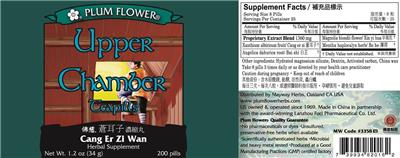
Upper Chamber Teapills by Plum Flower label
The label scan from the NIH Dietary Supplement Label Database. Tap to enlarge.
Label images are published by the NIH Dietary Supplement Label Database for the version of this product on file. Always read your actual product label.
View the full label (PDF)The Ingredients in Upper Chamber Teapills by Plum Flower
These are the 4 active ingredients this product is made of. Select any to open its full monograph.
Serving size8 Pill(s) Dosage formTablet Or Pill Servings per container25 Amounts shown are per serving.
Most supplement products combine several ingredients, and a medication can interact with the product through any one of them. Each ingredient below shows whether it has known drug interactions.
Proprietary Extract Blend
Other (inactive) ingredients: Magnesium Silicate, Hydrated, Dextrin, Carbon, Activated, China Wax. These complete the product’s ingredient list but are not active constituents.
Upper Chamber Teapills by Plum Flower Drug Interactions
HelloPharmacist Interaction Report
Upper Chamber Teapills by Plum Flower contains four active ingredients, and we've identified significant interactions with a large number of medications.
The most serious concern is Siberian cocklebur fruit extract, which carries Major-severity interactions with three drug categories: drugs that can harm the kidneys (nephrotoxic drugs), drugs that can harm the liver (hepatotoxic drugs), and diabetes medications. Siberian cocklebur itself can damage both organs and has caused severe low blood sugar (hypoglycemia) in people who've consumed it—sometimes within hours.
Do not use this product if you take any medication for blood sugar control, kidney disease, or liver disease without talking to your pharmacist first.
Read the full breakdown — every affected drug type, severity by severity
Angelica dahurica root extract carries a Moderate interaction with a group of drugs processed through a liver enzyme called CYP1A2. This means the extract may slow how your body clears certain medications, potentially raising their levels.
Magnolia biondii flower extract also has Moderate interactions: it may add to the sedating effects of drugs that depress the central nervous system (CNS depressants), and it may increase bleeding risk when combined with blood thinners (anticoagulants) or antiplatelet drugs.
We could not check Japanese mint herb extract against medication databases, so we hold no interaction data for it. Altogether, these interactions span 946 individual medications.
Use the medication checker on this page to look up your exact prescriptions and over-the-counter drugs before starting this product.
Check your own medications below · Editorial policy · How we use AI
Want to check YOUR meds against Upper Chamber Teapills?
Ask about interactions with your drugs in plain English — “Can I take it with lisinopril?” — and we find you the answer in seconds, ingredient by ingredient.
Go to the checkerIngredients driving the most interactions
Individual Drug Interactions
The ingredients in Upper Chamber Teapills interact with 964 drugs. Click any drug to see the details.
3 of the 4 ingredients in Upper Chamber Teapills interact with drugs. Each result below shows which ingredient is responsible. Xanthium sibiricum Fruit Extract Magnolia biondii Flower Extract Angelica dahurica Root Extract
6-mercaptopurinePurinethol
How 6-mercaptopurine interacts with Upper Chamber Teapills — through 1 ingredient. Tap an ingredient for the detail:
Xanthium Sibiricum Fruit ExtractHepatotoxic Drugs Major
Interaction Summary
Siberian cocklebur can adversely affect the liver.
Read the full Xanthium Sibiricum Fruit Extract + 6-mercaptopurine interactionAbacavir Sulfate, Dolutegravir, LamivudineTriumeq
How Abacavir Sulfate, Dolutegravir, Lamivudine interacts with Upper Chamber Teapills — through 1 ingredient. Tap an ingredient for the detail:
Xanthium Sibiricum Fruit ExtractHepatotoxic Drugs Major
Interaction Summary
Siberian cocklebur can adversely affect the liver.
Read the full Xanthium Sibiricum Fruit Extract + Abacavir Sulfate, Dolutegravir, Lamivudine interactionAbacavir, LamivudineEpzicom
How Abacavir, Lamivudine interacts with Upper Chamber Teapills — through 1 ingredient. Tap an ingredient for the detail:
Xanthium Sibiricum Fruit ExtractHepatotoxic Drugs Major
Interaction Summary
Siberian cocklebur can adversely affect the liver.
Read the full Xanthium Sibiricum Fruit Extract + Abacavir, Lamivudine interactionAbiraterone
How Abiraterone interacts with Upper Chamber Teapills — through 1 ingredient. Tap an ingredient for the detail:
Xanthium Sibiricum Fruit ExtractHepatotoxic Drugs Major
Interaction Summary
Siberian cocklebur can adversely affect the liver.
Read the full Xanthium Sibiricum Fruit Extract + Abiraterone interactionAbiraterone AcetateYonsa, Zytiga
How Abiraterone Acetate interacts with Upper Chamber Teapills — through 1 ingredient. Tap an ingredient for the detail:
Xanthium Sibiricum Fruit ExtractHepatotoxic Drugs Major
Interaction Summary
Siberian cocklebur can adversely affect the liver.
Read the full Xanthium Sibiricum Fruit Extract + Abiraterone Acetate interactionAcarboseGlucobay, Prandase, Precose
How Acarbose interacts with Upper Chamber Teapills — through 1 ingredient. Tap an ingredient for the detail:
Xanthium Sibiricum Fruit ExtractAntidiabetes Drugs, Hepatotoxic Drugs Major
Interaction Summary
Siberian cocklebur seedlings and seeds have caused severe hypoglycemia in humans.
Read the full Xanthium Sibiricum Fruit Extract + Acarbose interactionAcebutololRhotral, Sectral
How Acebutolol interacts with Upper Chamber Teapills — through 1 ingredient. Tap an ingredient for the detail:
Xanthium Sibiricum Fruit ExtractHepatotoxic Drugs Major
Interaction Summary
Siberian cocklebur can adversely affect the liver.
Read the full Xanthium Sibiricum Fruit Extract + Acebutolol interactionAcetaminophenChildren's Tylenol, Children's Tylenol Meltaways, Tylenol, Tylenol Ex Strength
How Acetaminophen interacts with Upper Chamber Teapills — through 2 ingredients. Tap an ingredient for the detail:
Xanthium Sibiricum Fruit ExtractHepatotoxic Drugs, Nephrotoxic Drugs Major
Interaction Summary
Siberian cocklebur can adversely affect the liver.
Read the full Xanthium Sibiricum Fruit Extract + Acetaminophen interactionAngelica Dahurica Root ExtractCytochrome P450 1a2 (cyp1a2) Substrates Moderate
Interaction Summary
In vitro research shows that ashitaba extract inhibits cytochrome P450 (CYP) 1A2.
Read the full Angelica Dahurica Root Extract + Acetaminophen interactionAcetaminophen, AspirinGemnisyn
How Acetaminophen, Aspirin interacts with Upper Chamber Teapills — through 3 ingredients. Tap an ingredient for the detail:
Xanthium Sibiricum Fruit ExtractNephrotoxic Drugs, Hepatotoxic Drugs Major
Interaction Summary
Siberian cocklebur can adversely affect the kidney.
Read the full Xanthium Sibiricum Fruit Extract + Acetaminophen, Aspirin interactionMagnolia Biondii Flower ExtractAnticoagulant/antiplatelet Drugs Moderate
Interaction Summary
Theoretically, magnolia might have additive effects and increase the risk of bleeding when used with anticoagulant or antiplatelet drugs.
Read the full Magnolia Biondii Flower Extract + Acetaminophen, Aspirin interactionAngelica Dahurica Root ExtractCytochrome P450 1a2 (cyp1a2) Substrates Moderate
Interaction Summary
In vitro research shows that ashitaba extract inhibits cytochrome P450 (CYP) 1A2.
Read the full Angelica Dahurica Root Extract + Acetaminophen, Aspirin interactionAcetaminophen, Aspirin, CaffeineExcedrin, Excedrin Extra Strength, Excedrin Migraine
How Acetaminophen, Aspirin, Caffeine interacts with Upper Chamber Teapills — through 3 ingredients. Tap an ingredient for the detail:
Xanthium Sibiricum Fruit ExtractHepatotoxic Drugs, Nephrotoxic Drugs Major
Interaction Summary
Siberian cocklebur can adversely affect the liver.
Read the full Xanthium Sibiricum Fruit Extract + Acetaminophen, Aspirin, Caffeine interactionMagnolia Biondii Flower ExtractAnticoagulant/antiplatelet Drugs Moderate
Interaction Summary
Theoretically, magnolia might have additive effects and increase the risk of bleeding when used with anticoagulant or antiplatelet drugs.
Read the full Magnolia Biondii Flower Extract + Acetaminophen, Aspirin, Caffeine interactionAngelica Dahurica Root ExtractCytochrome P450 1a2 (cyp1a2) Substrates Moderate
Interaction Summary
In vitro research shows that ashitaba extract inhibits cytochrome P450 (CYP) 1A2.
Read the full Angelica Dahurica Root Extract + Acetaminophen, Aspirin, Caffeine interactionAcetaminophen, Brompheniramine, PhenylpropanolamineDimetapp Cold and Flu
How Acetaminophen, Brompheniramine, Phenylpropanolamine interacts with Upper Chamber Teapills — through 2 ingredients. Tap an ingredient for the detail:
Xanthium Sibiricum Fruit ExtractHepatotoxic Drugs, Nephrotoxic Drugs Major
Interaction Summary
Siberian cocklebur can adversely affect the liver.
Read the full Xanthium Sibiricum Fruit Extract + Acetaminophen, Brompheniramine, Phenylpropanolamine interactionAngelica Dahurica Root ExtractCytochrome P450 1a2 (cyp1a2) Substrates Moderate
Interaction Summary
In vitro research shows that ashitaba extract inhibits cytochrome P450 (CYP) 1A2.
Read the full Angelica Dahurica Root Extract + Acetaminophen, Brompheniramine, Phenylpropanolamine interactionAcetaminophen, ButalbitalAxocet, Bancap, Bucet, Butex Forte, Esgic CF, Orbivan CF +5 more
How Acetaminophen, Butalbital interacts with Upper Chamber Teapills — through 2 ingredients. Tap an ingredient for the detail:
Xanthium Sibiricum Fruit ExtractNephrotoxic Drugs, Hepatotoxic Drugs Major
Interaction Summary
Siberian cocklebur can adversely affect the kidney.
Read the full Xanthium Sibiricum Fruit Extract + Acetaminophen, Butalbital interactionAngelica Dahurica Root ExtractCytochrome P450 1a2 (cyp1a2) Substrates Moderate
Interaction Summary
In vitro research shows that ashitaba extract inhibits cytochrome P450 (CYP) 1A2.
Read the full Angelica Dahurica Root Extract + Acetaminophen, Butalbital interactionAcetaminophen, Butalbital, CaffeineEsgic, Esgic Plus, Fiogesic, Fioricet, Repan, Tecnal +1 more
How Acetaminophen, Butalbital, Caffeine interacts with Upper Chamber Teapills — through 2 ingredients. Tap an ingredient for the detail:
Xanthium Sibiricum Fruit ExtractHepatotoxic Drugs, Nephrotoxic Drugs Major
Interaction Summary
Siberian cocklebur can adversely affect the liver.
Read the full Xanthium Sibiricum Fruit Extract + Acetaminophen, Butalbital, Caffeine interactionAngelica Dahurica Root ExtractCytochrome P450 1a2 (cyp1a2) Substrates Moderate
Interaction Summary
In vitro research shows that ashitaba extract inhibits cytochrome P450 (CYP) 1A2.
Read the full Angelica Dahurica Root Extract + Acetaminophen, Butalbital, Caffeine interactionAcetaminophen, Butalbital, Caffeine, CodeineEsgic with Codeine, Fioricet w/ Codeine
How Acetaminophen, Butalbital, Caffeine, Codeine interacts with Upper Chamber Teapills — through 3 ingredients. Tap an ingredient for the detail:
Xanthium Sibiricum Fruit ExtractHepatotoxic Drugs, Nephrotoxic Drugs Major
Interaction Summary
Siberian cocklebur can adversely affect the liver.
Read the full Xanthium Sibiricum Fruit Extract + Acetaminophen, Butalbital, Caffeine, Codeine interactionAngelica Dahurica Root ExtractCytochrome P450 1a2 (cyp1a2) Substrates Moderate
Interaction Summary
In vitro research shows that ashitaba extract inhibits cytochrome P450 (CYP) 1A2.
Read the full Angelica Dahurica Root Extract + Acetaminophen, Butalbital, Caffeine, Codeine interactionMagnolia Biondii Flower ExtractCns Depressants Moderate
Interaction Summary
Theoretically, concomitant use of large doses of magnolia bark and CNS depressants might have additive effects.
Read the full Magnolia Biondii Flower Extract + Acetaminophen, Butalbital, Caffeine, Codeine interactionAcetaminophen, Butalbital, CodeineBancap w/ Codeine
How Acetaminophen, Butalbital, Codeine interacts with Upper Chamber Teapills — through 3 ingredients. Tap an ingredient for the detail:
Xanthium Sibiricum Fruit ExtractNephrotoxic Drugs, Hepatotoxic Drugs Major
Interaction Summary
Siberian cocklebur can adversely affect the kidney.
Read the full Xanthium Sibiricum Fruit Extract + Acetaminophen, Butalbital, Codeine interactionAngelica Dahurica Root ExtractCytochrome P450 1a2 (cyp1a2) Substrates Moderate
Interaction Summary
In vitro research shows that ashitaba extract inhibits cytochrome P450 (CYP) 1A2.
Read the full Angelica Dahurica Root Extract + Acetaminophen, Butalbital, Codeine interactionMagnolia Biondii Flower ExtractCns Depressants Moderate
Interaction Summary
Theoretically, concomitant use of large doses of magnolia bark and CNS depressants might have additive effects.
Read the full Magnolia Biondii Flower Extract + Acetaminophen, Butalbital, Codeine interactionAcetaminophen, Butalbital, Codeine PhosphatePhrenilin #3
How Acetaminophen, Butalbital, Codeine Phosphate interacts with Upper Chamber Teapills — through 3 ingredients. Tap an ingredient for the detail:
Xanthium Sibiricum Fruit ExtractHepatotoxic Drugs, Nephrotoxic Drugs Major
Interaction Summary
Siberian cocklebur can adversely affect the liver.
Read the full Xanthium Sibiricum Fruit Extract + Acetaminophen, Butalbital, Codeine Phosphate interactionMagnolia Biondii Flower ExtractCns Depressants Moderate
Interaction Summary
Theoretically, concomitant use of large doses of magnolia bark and CNS depressants might have additive effects.
Read the full Magnolia Biondii Flower Extract + Acetaminophen, Butalbital, Codeine Phosphate interactionAngelica Dahurica Root ExtractCytochrome P450 1a2 (cyp1a2) Substrates Moderate
Interaction Summary
In vitro research shows that ashitaba extract inhibits cytochrome P450 (CYP) 1A2.
Read the full Angelica Dahurica Root Extract + Acetaminophen, Butalbital, Codeine Phosphate interactionAcetaminophen, Caffeine, Chlorpheniramine, Hydrocodone, PhenylephrineHycomine Compound
How Acetaminophen, Caffeine, Chlorpheniramine, Hydrocodone, Phenylephrine interacts with Upper Chamber Teapills — through 3 ingredients. Tap an ingredient for the detail:
Xanthium Sibiricum Fruit ExtractHepatotoxic Drugs, Nephrotoxic Drugs Major
Interaction Summary
Siberian cocklebur can adversely affect the liver.
Read the full Xanthium Sibiricum Fruit Extract + Acetaminophen, Caffeine, Chlorpheniramine, Hydrocodone, Phenylephrine interactionAngelica Dahurica Root ExtractCytochrome P450 1a2 (cyp1a2) Substrates Moderate
Interaction Summary
In vitro research shows that ashitaba extract inhibits cytochrome P450 (CYP) 1A2.
Read the full Angelica Dahurica Root Extract + Acetaminophen, Caffeine, Chlorpheniramine, Hydrocodone, Phenylephrine interactionMagnolia Biondii Flower ExtractCns Depressants Moderate
Interaction Summary
Theoretically, concomitant use of large doses of magnolia bark and CNS depressants might have additive effects.
Read the full Magnolia Biondii Flower Extract + Acetaminophen, Caffeine, Chlorpheniramine, Hydrocodone, Phenylephrine interactionAcetaminophen, Caffeine, CodeineGesic C15, Gesic C30, Gesic C8, Lenoltec 1, Lenoltec 2, Lenoltec 3 +1 more
How Acetaminophen, Caffeine, Codeine interacts with Upper Chamber Teapills — through 3 ingredients. Tap an ingredient for the detail:
Xanthium Sibiricum Fruit ExtractNephrotoxic Drugs, Hepatotoxic Drugs Major
Interaction Summary
Siberian cocklebur can adversely affect the kidney.
Read the full Xanthium Sibiricum Fruit Extract + Acetaminophen, Caffeine, Codeine interactionAngelica Dahurica Root ExtractCytochrome P450 1a2 (cyp1a2) Substrates Moderate
Interaction Summary
In vitro research shows that ashitaba extract inhibits cytochrome P450 (CYP) 1A2.
Read the full Angelica Dahurica Root Extract + Acetaminophen, Caffeine, Codeine interactionMagnolia Biondii Flower ExtractCns Depressants Moderate
Interaction Summary
Theoretically, concomitant use of large doses of magnolia bark and CNS depressants might have additive effects.
Read the full Magnolia Biondii Flower Extract + Acetaminophen, Caffeine, Codeine interactionAcetaminophen, Caffeine, Codeine, SalicylamideCodalan No.1, Codalan No.2, Codalan No.3
How Acetaminophen, Caffeine, Codeine, Salicylamide interacts with Upper Chamber Teapills — through 3 ingredients. Tap an ingredient for the detail:
Xanthium Sibiricum Fruit ExtractHepatotoxic Drugs, Nephrotoxic Drugs Major
Interaction Summary
Siberian cocklebur can adversely affect the liver.
Read the full Xanthium Sibiricum Fruit Extract + Acetaminophen, Caffeine, Codeine, Salicylamide interactionMagnolia Biondii Flower ExtractCns Depressants Moderate
Interaction Summary
Theoretically, concomitant use of large doses of magnolia bark and CNS depressants might have additive effects.
Read the full Magnolia Biondii Flower Extract + Acetaminophen, Caffeine, Codeine, Salicylamide interactionAngelica Dahurica Root ExtractCytochrome P450 1a2 (cyp1a2) Substrates Moderate
Interaction Summary
In vitro research shows that ashitaba extract inhibits cytochrome P450 (CYP) 1A2.
Read the full Angelica Dahurica Root Extract + Acetaminophen, Caffeine, Codeine, Salicylamide interactionAcetaminophen, Caffeine, DihydrocodeineDHC Plus, Panlor DC, Panlor SS
How Acetaminophen, Caffeine, Dihydrocodeine interacts with Upper Chamber Teapills — through 3 ingredients. Tap an ingredient for the detail:
Xanthium Sibiricum Fruit ExtractNephrotoxic Drugs, Hepatotoxic Drugs Major
Interaction Summary
Siberian cocklebur can adversely affect the kidney.
Read the full Xanthium Sibiricum Fruit Extract + Acetaminophen, Caffeine, Dihydrocodeine interactionMagnolia Biondii Flower ExtractCns Depressants Moderate
Interaction Summary
Theoretically, concomitant use of large doses of magnolia bark and CNS depressants might have additive effects.
Read the full Magnolia Biondii Flower Extract + Acetaminophen, Caffeine, Dihydrocodeine interactionAngelica Dahurica Root ExtractCytochrome P450 1a2 (cyp1a2) Substrates Moderate
Interaction Summary
In vitro research shows that ashitaba extract inhibits cytochrome P450 (CYP) 1A2.
Read the full Angelica Dahurica Root Extract + Acetaminophen, Caffeine, Dihydrocodeine interactionAcetaminophen, Caffeine, IsomethepteneMigralam
How Acetaminophen, Caffeine, Isometheptene interacts with Upper Chamber Teapills — through 2 ingredients. Tap an ingredient for the detail:
Xanthium Sibiricum Fruit ExtractNephrotoxic Drugs, Hepatotoxic Drugs Major
Interaction Summary
Siberian cocklebur can adversely affect the kidney.
Read the full Xanthium Sibiricum Fruit Extract + Acetaminophen, Caffeine, Isometheptene interactionAngelica Dahurica Root ExtractCytochrome P450 1a2 (cyp1a2) Substrates Moderate
Interaction Summary
In vitro research shows that ashitaba extract inhibits cytochrome P450 (CYP) 1A2.
Read the full Angelica Dahurica Root Extract + Acetaminophen, Caffeine, Isometheptene interactionAcetaminophen, Caffeine, PyrilamineMidol Max Strength Menstrual
How Acetaminophen, Caffeine, Pyrilamine interacts with Upper Chamber Teapills — through 2 ingredients. Tap an ingredient for the detail:
Xanthium Sibiricum Fruit ExtractHepatotoxic Drugs, Nephrotoxic Drugs Major
Interaction Summary
Siberian cocklebur can adversely affect the liver.
Read the full Xanthium Sibiricum Fruit Extract + Acetaminophen, Caffeine, Pyrilamine interactionAngelica Dahurica Root ExtractCytochrome P450 1a2 (cyp1a2) Substrates Moderate
Interaction Summary
In vitro research shows that ashitaba extract inhibits cytochrome P450 (CYP) 1A2.
Read the full Angelica Dahurica Root Extract + Acetaminophen, Caffeine, Pyrilamine interactionAcetaminophen, Chlorpheniramine Maleate, Dextromethorphan HbrVicks Formula 44M Cough, Cold & Flu Relief
How Acetaminophen, Chlorpheniramine Maleate, Dextromethorphan Hbr interacts with Upper Chamber Teapills — through 2 ingredients. Tap an ingredient for the detail:
Xanthium Sibiricum Fruit ExtractNephrotoxic Drugs, Hepatotoxic Drugs Major
Interaction Summary
Siberian cocklebur can adversely affect the kidney.
Read the full Xanthium Sibiricum Fruit Extract + Acetaminophen, Chlorpheniramine Maleate, Dextromethorphan Hbr interactionAngelica Dahurica Root ExtractCytochrome P450 1a2 (cyp1a2) Substrates Moderate
Interaction Summary
In vitro research shows that ashitaba extract inhibits cytochrome P450 (CYP) 1A2.
Read the full Angelica Dahurica Root Extract + Acetaminophen, Chlorpheniramine Maleate, Dextromethorphan Hbr interactionAcetaminophen, Chlorpheniramine, Codeine, PhenylephrineColrex
How Acetaminophen, Chlorpheniramine, Codeine, Phenylephrine interacts with Upper Chamber Teapills — through 3 ingredients. Tap an ingredient for the detail:
Xanthium Sibiricum Fruit ExtractNephrotoxic Drugs, Hepatotoxic Drugs Major
Interaction Summary
Siberian cocklebur can adversely affect the kidney.
Read the full Xanthium Sibiricum Fruit Extract + Acetaminophen, Chlorpheniramine, Codeine, Phenylephrine interactionMagnolia Biondii Flower ExtractCns Depressants Moderate
Interaction Summary
Theoretically, concomitant use of large doses of magnolia bark and CNS depressants might have additive effects.
Read the full Magnolia Biondii Flower Extract + Acetaminophen, Chlorpheniramine, Codeine, Phenylephrine interactionAngelica Dahurica Root ExtractCytochrome P450 1a2 (cyp1a2) Substrates Moderate
Interaction Summary
In vitro research shows that ashitaba extract inhibits cytochrome P450 (CYP) 1A2.
Read the full Angelica Dahurica Root Extract + Acetaminophen, Chlorpheniramine, Codeine, Phenylephrine interactionAcetaminophen, Chlorpheniramine, DextromethorphanCoricidin II Extra Strength Cold and Flu
How Acetaminophen, Chlorpheniramine, Dextromethorphan interacts with Upper Chamber Teapills — through 2 ingredients. Tap an ingredient for the detail:
Xanthium Sibiricum Fruit ExtractHepatotoxic Drugs, Nephrotoxic Drugs Major
Interaction Summary
Siberian cocklebur can adversely affect the liver.
Read the full Xanthium Sibiricum Fruit Extract + Acetaminophen, Chlorpheniramine, Dextromethorphan interactionAngelica Dahurica Root ExtractCytochrome P450 1a2 (cyp1a2) Substrates Moderate
Interaction Summary
In vitro research shows that ashitaba extract inhibits cytochrome P450 (CYP) 1A2.
Read the full Angelica Dahurica Root Extract + Acetaminophen, Chlorpheniramine, Dextromethorphan interactionAcetaminophen, Chlorpheniramine, Dextromethorphan HydrobromideCoricidin HBP Maximum Strength Flu
How Acetaminophen, Chlorpheniramine, Dextromethorphan Hydrobromide interacts with Upper Chamber Teapills — through 2 ingredients. Tap an ingredient for the detail:
Xanthium Sibiricum Fruit ExtractNephrotoxic Drugs, Hepatotoxic Drugs Major
Interaction Summary
Siberian cocklebur can adversely affect the kidney.
Read the full Xanthium Sibiricum Fruit Extract + Acetaminophen, Chlorpheniramine, Dextromethorphan Hydrobromide interactionAngelica Dahurica Root ExtractCytochrome P450 1a2 (cyp1a2) Substrates Moderate
Interaction Summary
In vitro research shows that ashitaba extract inhibits cytochrome P450 (CYP) 1A2.
Read the full Angelica Dahurica Root Extract + Acetaminophen, Chlorpheniramine, Dextromethorphan Hydrobromide interactionAcetaminophen, Chlorpheniramine, Dextromethorphan, PhenylpropanolamineMulti Symptom Cold Relief
How Acetaminophen, Chlorpheniramine, Dextromethorphan, Phenylpropanolamine interacts with Upper Chamber Teapills — through 2 ingredients. Tap an ingredient for the detail:
Xanthium Sibiricum Fruit ExtractNephrotoxic Drugs, Hepatotoxic Drugs Major
Interaction Summary
Siberian cocklebur can adversely affect the kidney.
Read the full Xanthium Sibiricum Fruit Extract + Acetaminophen, Chlorpheniramine, Dextromethorphan, Phenylpropanolamine interactionAngelica Dahurica Root ExtractCytochrome P450 1a2 (cyp1a2) Substrates Moderate
Interaction Summary
In vitro research shows that ashitaba extract inhibits cytochrome P450 (CYP) 1A2.
Read the full Angelica Dahurica Root Extract + Acetaminophen, Chlorpheniramine, Dextromethorphan, Phenylpropanolamine interactionAcetaminophen, Chlorpheniramine, Dextromethorphan, PseudoephedrineChildren's Tylenol Cold Plus Cough, Tylenol Cold Ex Strength
How Acetaminophen, Chlorpheniramine, Dextromethorphan, Pseudoephedrine interacts with Upper Chamber Teapills — through 2 ingredients. Tap an ingredient for the detail:
Xanthium Sibiricum Fruit ExtractHepatotoxic Drugs, Nephrotoxic Drugs Major
Interaction Summary
Siberian cocklebur can adversely affect the liver.
Read the full Xanthium Sibiricum Fruit Extract + Acetaminophen, Chlorpheniramine, Dextromethorphan, Pseudoephedrine interactionAngelica Dahurica Root ExtractCytochrome P450 1a2 (cyp1a2) Substrates Moderate
Interaction Summary
In vitro research shows that ashitaba extract inhibits cytochrome P450 (CYP) 1A2.
Read the full Angelica Dahurica Root Extract + Acetaminophen, Chlorpheniramine, Dextromethorphan, Pseudoephedrine interactionAcetaminophen, Chlorpheniramine, Guaifenesin, Phenylephrine, SalicylamideRhinogesic GG
How Acetaminophen, Chlorpheniramine, Guaifenesin, Phenylephrine, Salicylamide interacts with Upper Chamber Teapills — through 2 ingredients. Tap an ingredient for the detail:
Xanthium Sibiricum Fruit ExtractHepatotoxic Drugs, Nephrotoxic Drugs Major
Interaction Summary
Siberian cocklebur can adversely affect the liver.
Read the full Xanthium Sibiricum Fruit Extract + Acetaminophen, Chlorpheniramine, Guaifenesin, Phenylephrine, Salicylamide interactionAngelica Dahurica Root ExtractCytochrome P450 1a2 (cyp1a2) Substrates Moderate
Interaction Summary
In vitro research shows that ashitaba extract inhibits cytochrome P450 (CYP) 1A2.
Read the full Angelica Dahurica Root Extract + Acetaminophen, Chlorpheniramine, Guaifenesin, Phenylephrine, Salicylamide interactionAcetaminophen, Chlorpheniramine, PhenylephrineAlka-Seltzer PLUS, Histex SR, Protid
How Acetaminophen, Chlorpheniramine, Phenylephrine interacts with Upper Chamber Teapills — through 2 ingredients. Tap an ingredient for the detail:
Xanthium Sibiricum Fruit ExtractHepatotoxic Drugs, Nephrotoxic Drugs Major
Interaction Summary
Siberian cocklebur can adversely affect the liver.
Read the full Xanthium Sibiricum Fruit Extract + Acetaminophen, Chlorpheniramine, Phenylephrine interactionAngelica Dahurica Root ExtractCytochrome P450 1a2 (cyp1a2) Substrates Moderate
Interaction Summary
In vitro research shows that ashitaba extract inhibits cytochrome P450 (CYP) 1A2.
Read the full Angelica Dahurica Root Extract + Acetaminophen, Chlorpheniramine, Phenylephrine interactionEach ingredient & the kinds of drugs it affects
For each ingredient in Upper Chamber Teapills with known interactions, here are the types of medications they can affect. Open any type for the detail — or search your exact drug in the checker above.
Xanthium sibiricum Fruit Extract
Antidiabetes Drugs
Siberian cocklebur seedlings and seeds have caused severe hypoglycemia in humans. Hypoglycemia occurs soon after consumption and worsens with time in most cases. Do not use Siberian cocklebur in people taking medications that also lower blood glucose.
Some antidiabetes drugs include glimepiride (Amaryl), glyburide (DiaBeta, Glynase PresTab, Micronase), insulin, pioglitazone (Actos), rosiglitazone (Avandia), and others.
Hepatotoxic Drugs
Siberian cocklebur can adversely affect the liver. It has been linked to many cases of hepatotoxicity and some cases of liver failure. Theoretically, concomitant use with other potentially hepatotoxic drugs might increase the risk of developing liver damage. Some of these drugs include acarbose (Precose, Prandase), amiodarone (Cordarone), atorvastatin (Lipitor), azathioprine (Imuran), carbamazepine (Tegretol), cerivastatin (Baycol), diclofenac (Voltaren), felbamate (Felbatol), fenofibrate (TriCor), fluvastatin (Lescol), gemfibrozil (Lopid), isoniazid, itraconazole, (Sporanox), ketoconazole (Nizoral), leflunomide (Arava), lovastatin (Mevacor), methotrexate (Rheumatrex), nevirapine (Viramune), niacin, nitrofurantoin (Macrodantin), pioglitazone (Actos), pravastatin (Pravachol), pyrazinamide, rifampin (Rifadin), ritonavir (Norvir), rosiglitazone (Avandia), simvastatin (Zocor), tacrine (Cognex), tamoxifen, terbinafine (Lamisil), valproic acid, and zileuton (Zyflo).
Nephrotoxic Drugs
Siberian cocklebur can adversely affect the kidney. Theoretically, combining Siberian cocklebur with potentially nephrotoxic drugs might have additive harmful effects on kidney function.
Some potentially nephrotoxic drugs include cyclosporine (Neoral, Sandimmune); aminoglycosides including amikacin (Amikin), gentamicin (Garamycin, Gentak, others), and tobramycin (Nebcin, others); nonsteroidal anti-inflammatory drugs (NSAIDs) including ibuprofen (Advil, Motrin, Nuprin, others), indomethacin (Indocin), naproxen (Aleve, Anaprox, Naprelan, Naprosyn), piroxicam (Feldene); and numerous others.
Magnolia biondii Flower Extract
Anticoagulant/Antiplatelet Drugs
Theoretically, magnolia might have additive effects and increase the risk of bleeding when used with anticoagulant or antiplatelet drugs.
In vitro research shows that the chemicals magnolol and honokiol, isolated from magnolia bark, inhibit platelet aggregation that is experimentally induced by collagen and arachidonic acid. However, they do not inhibit platelet aggregation that is induced by adenosine diphosphate, platelet-activating factor, or thrombin. This interaction has not been reported in humans.
Cns Depressants
Theoretically, concomitant use of large doses of magnolia bark and CNS depressants might have additive effects.
In vitro and animal research shows that constituents extracted from magnolia bark, especially honokiol and magnolol, have sedative effects. These effects may be due to the inhibition of catecholamine release and modulation of gamma-aminobutyric acid-A (GABA-A) receptors.
Angelica dahurica Root Extract
Cytochrome P450 1A2 (Cyp1A2) Substrates
In vitro research shows that ashitaba extract inhibits cytochrome P450 (CYP) 1A2. Theoretically, concomitant use of ashitaba with CYP1A2 substrates might decrease the clearance of these substrates and increase the risk for adverse effects. However, this interaction has yet to be reported in humans. Until more is known, use with caution.
Brand information
Manufacturer and brand details for Upper Chamber Teapills, from the product label.
Plum Flower
- Name
- Mayway Herbs
- City
- Oakland
- State
- CA
- Web Address
- www.plumflowerherbs.com
Upper Chamber Teapills by Plum Flower: Common Questions
Does Upper Chamber Teapills by Plum Flower interact with any medications?
How can one product interact with so many drugs?
Where does this information come from?
Is this safe to take if I'm pregnant or breastfeeding?
What is Siberian cocklebur, and why is it in this product?
Does this product actually work?
Can I take this with my diabetes medication?
What side effects has this product reported?
What if I'm taking a blood thinner—is this safe?
Written and reviewed by the HelloPharmacist editorial staff. Our editorial policy
Not sure if Upper Chamber Teapills is safe with your meds?
Our pharmacists answer your medication & supplement questions — free.
Label information is sourced from the NIH Dietary Supplement Label Database and reflects the product version on file; always read your actual product label. This page is for education only and is not a substitute for professional medical advice. Confirm with your pharmacist or doctor before combining supplements and medications.
The Full Monographs Behind Upper Chamber Teapills’s Ingredients
Every ingredient we hold a full HelloPharmacist monograph for — uses, evidence, safety, and the complete interaction list.
Ashitaba
Interacts with 186 drugsAshitaba is a leafy plant from Japan that is eaten as a vegetable and taken as a supplement for general health, antioxidant, and heart benefits. Most of the supporting research comes from la...
Read the full Ashitaba monograph → Herb & supplement monographJapanese Mint
Japanese mint is a menthol-rich plant used mainly for its essential oil in topical rubs, inhalants, and digestive remedies. There is some support for menthol's soothing and cooling effects,...
Read the full Japanese Mint monograph → Herb & supplement monographMagnolia
Interacts with 351 drugsMagnolia bark and flower buds have a long history in traditional Chinese and Japanese medicine, often for stress, sleep, and digestion. Modern human research is still limited, so we can't be...
Read the full Magnolia monograph → Herb & supplement monographSiberian Cocklebur
Interacts with 664 drugsSiberian cocklebur is a fruit used in traditional Chinese and other Asian herbal medicine, mainly for nasal congestion, sinus issues, and allergies. Human evidence is very limited, and the p...
Read the full Siberian Cocklebur monograph →Sources & How We Checked
Upper Chamber Teapills's label data comes from the NIH Dietary Supplement Label Database; the ingredient interaction data is from the Natural Medicines database, reviewed by our pharmacists.
- NIH Dietary Supplement Label Database (DSLD) — The official product label on file for this supplement.
- Natural Medicines (Therapeutic Research Center) — Evidence-graded clinical reference behind the ingredient interaction data.
Content is written and reviewed by licensed HelloPharmacist pharmacists. See our data sources and editorial standards for how this information is built and checked.
The 17 references behind this product’s interaction data
Every citation that drives the interaction findings for this product’s ingredients, from the evidence-graded Natural Medicines (TRC Healthcare) database. Open an ingredient to browse its citations — links open the study on PubMed or the publisher’s site.
Ashitaba 2 references
- Kwon D, Yoon S, Carter O, Bailey GS, Dashwood RH. Antioxidant and antigenotoxic activities of Angelica keiskei, Oenanthe javanica and Brassica oleracea in the Salmonella mutagenicity assay and in HCT116 human colon cancer cells. Biofactors. 2006;26(4):231
- Noh HM, Ahn EM, Yun JM, Cho BL, Paek YJ. Angelica keiskei Koidzumi extracts improve some markers of liver function in habitual alcohol drinkers: a randomized double-blind clinical trial. J Med Food. 2015;18(2):166-72.
Japanese Mint 2 references
- Leung AY, Foster S. Encyclopedia of Common Natural Ingredients Used in Food, Drugs and Cosmetics. 2nd ed. New York, NY: John Wiley & Sons, 1996.
- Gruenwald J, Brendler T, Jaenicke C. PDR for Herbal Medicines. 1st ed. Montvale, NJ: Medical Economics Company, Inc., 1998.
Magnolia 9 references
- Kuribara H, Kishi E, Hattori N, et al. The anxiolytic effect of two oriental herbal drugs in Japan attributed to honokiol from magnolia bark. J Pharm Pharmacol 2000;52:1425-9. PubMed
- Tachikawa E, Takahashi M, Kashimoto T. Effects of extract and ingredients isolated from Magnolia obovata thunberg on catecholamine secretion from bovine adrenal chromaffin cells. Biochem Pharmacol 2000;60:433-40. PubMed
- Jung KY, Kim DS, Oh SR, et al. Magnone A and B, novel anti-PAF tetrahydrofuran lignans from the flower buds of Magnolia fargesii. J Nat Prod 1998;61:808-11.
- Garrison R, Chambliss WG. Effect of a proprietary Magnolia and Phellodendron extract on weight management: a pilot, double-blind, placebo-controlled clinical trial. Altern Ther Health Med 2006;12:50-4.
- Teng CM, Chen CC, Ko FN, et al. Two antiplatelet agents from Magnolia officinalis. Thromb Res 1988;50:757-65. PubMed
- Ghys K, De Palma A, Vandevenne A, Werbrouck J, Goossens A. Magnolia officinalis bark extract, a recently identified contact allergen in 'anti-ageing' cosmetics. Contact Dermatitis. 2015 Aug;73(2):130-2.
- Raison-Peyron N, Césaire A, Du-Thanh A, Dereure O. Allergic contact dermatitis caused by Magnolia officinalis bark extract in a facial anti-ageing cream. Contact Dermatitis. 2015 Jun;72(6):416-7.
- Nilausen TD, Johansen JD, Thyssen JP. Allergic contact dermatitis of the face caused by Magnolia officinalis bark extract. Contact Dermatitis. 2016;75(6):385-87.
- Amat-Samaranch V, López-Sánchez C, Tubau C, Puig L, Serra-Baldrich E. Vulvar allergic contact dermatitis caused by Magnolia officinalis bark extract. Contact Dermatitis 2022;87(1):96-97.
Siberian Cocklebur 4 references
- Wu, M. L., Wang, C. P., and Deng, J. F. Fatal hepatic failure due to fructus xanthii in a child. Abstracts of the 2005 North American Congress of Clinical Toxicology Annual Meeting. Clin Toxicol 2005;43:639. DOI
- Gurley ES, Rahman M, Hossain MJ, et al. Fatal outbreak from consuming Xanthium strumarium seedlings during time of food scarcity in northeastern Bangladesh. PLoS One 2010 Mar 18;5(3):e9756. PubMed
- Turgut M, Alhan CC, Gurgoze M, et al. Carboxyatractyloside poisoning in humans. Ann Trop Paediatr 2005;25(2):125-34. PubMed
- Karabiber H, Almis H, Selimoglu MA, Yakinci C, Yilmaz S. Xanthium strumarium poisoning requiring liver transplantation. J Pediatr Gastroenterol Nutr. 2014;58(1):e6-9.
Parts of this content are provided by the Therapeutic Research Center, LLC.
DISCLAIMER: Currently this does not check for drug-drug interactions. This is not an all-inclusive comprehensive list of potential interactions and is for informational purposes only. Not all interactions are known or well-reported in the scientific literature, and new interactions are continually being reported. Input is needed from a qualified healthcare provider including a pharmacist before starting any therapy. Application of clinical judgment is necessary.
© 2021 Therapeutic Research Center, LLC