
VeinHelp Ingredients & Drug Interactions
by Herbs SRA
What is this page for?
First and foremost: checking VeinHelp against your medications. The heart of this page is the interaction checker and the full interaction report — how this product’s ingredients may interact with prescription and over-the-counter medicines you may be taking.
Around that, we add a pharmacist’s high-level view of the product as a whole — what’s inside, the evidence for its stated use, how transparent the label is, and what safety data exists — so you can see the full picture in one place. It’s educational information from our licensed clinical databases and the clinical staff at HelloPharmacist — not medical advice — and we don’t sell or endorse products. Our editorial policy
VeinHelp is a dietary supplement by Herbs SRA with 3 active ingredients. Its ingredients are commonly taken for circulation and vein health, antioxidant support, skin health and aging.Based on those ingredients, 483 medications have a known interaction with it, the most serious rated moderate. The ingredients most likely to interact are Pine Bark Extract, Butcher's Broom Extract, Blueberry Extract. Use the checker below to test your specific medication, or read the full HelloPharmacist Interaction Report.
Check Your Meds Against VeinHelp by Herbs SRA
Ask about any prescription or over-the-counter medication and we check it for interactions with VeinHelp by Herbs SRA — and tell you which ingredient is responsible.
AI summaries are generated from our interaction database for education only — always confirm with your pharmacist. How we use AI
Ask the Pharmacist
A licensed pharmacist will answer your question by email — free, usually within 24 hours.
Got it — thank you!
A licensed pharmacist will answer within 24 hours. Keep an eye on your email (worth checking spam, just in case).
HelloPharmacist Scorecard of VeinHelp by Herbs SRA
Our pharmacy team’s full take, with four database checks built into the cards below — a summary of what is known, not a grade of the product itself.
What’s inside
Full disclosure
VeinHelp contains three active herbal extracts. Pine bark extract is used for joint and circulatory health.
Blueberry extract is included for its antioxidant properties. Butcher's broom extract is traditionally used to support vein function.
The product also contains cellulose as an inactive ingredient (a capsule filler).
Does it work?
Moderate evidence
For the reason this product is marketed—chronic venous insufficiency—both pine bark extract and butcher's broom extract are rated Possibly Effective based on available evidence. Pine bark extract is also Possibly Effective for osteoarthritis and asthma, though evidence for asthma is limited.
Blueberry extract's effectiveness for specific health goals is not yet established in the data we hold; claims about cardiovascular health, cognitive function, and anxiety lack sufficient evidence to rate.
How safe is it?
Well-documented data
Pine bark extract and blueberry extract are generally well tolerated, though pine bark may cause gastrointestinal upset, dizziness, or vertigo in some people, and freeze-dried blueberries can trigger constipation, diarrhea, nausea, or vomiting—a small number of trial participants stopped taking freeze-dried blueberries in the first week due to stomach complaints. Butcher's broom is generally well tolerated short-term but may cause nausea, vomiting, diarrhea, or heartburn.
Long-term safety for all three ingredients is not fully established. During pregnancy, the safety data advises against pine bark extract and butcher's broom extract; blueberry extract is rated Likely Safe.
While breastfeeding, the safety data advises against pine bark extract and butcher's broom extract; concentrated blueberry extracts have not been well studied in nursing.
Meds to double-check
Moderate interaction found
Before taking VeinHelp, double-check with your doctor or pharmacist if you take blood thinners or antiplatelet drugs (Moderate risk of bleeding), diabetes medications (Moderate risk of low blood sugar), blood pressure drugs that work on alpha-adrenergic pathways (Moderate risk of reduced or increased effect), immunosuppressants (Moderate risk of reduced effectiveness), or specific drugs like flurbiprofen or buspirone (Minor risk of higher blood levels).
The bottom line
Scorecard at a glanceFully disclosed formula with some supporting evidence for its stated purpose. Moderate medication interactions have been identified, and safety information is well characterized.
VeinHelp may be worth considering if you're looking to support vein and circulatory health and don't take blood thinners, diabetes medications, or certain blood pressure drugs. If you take any prescription medication—especially anticoagulants, antiplatelet agents, diabetes drugs, immunosuppressants, or alpha-adrenergic medications—check with your doctor or pharmacist before starting, as the interactions are documented and some are significant.
Pregnant or nursing? Talk with your pharmacist about whether this product is right for you.
Educational only — not medical advice; always confirm with your pharmacist. Our editorial policy · How we use AI
Assessment coverage: 3 of 3 active ingredients matched to our full ingredient reviews (monographs). Based on the product label dated Aug 22, 2024.
This Scorecard evaluates available label information, ingredient evidence, and known medication-safety considerations. It does not independently verify product identity, purity, potency, contamination, or manufacturing quality. How these ratings are computed
General information
Key facts about VeinHelp, straight from the product label.
Everything in this section is reproduced from the manufacturer’s own product label — it’s the label speaking, not HelloPharmacist. We show it so you can see exactly what the maker states; we don’t verify or endorse those statements.
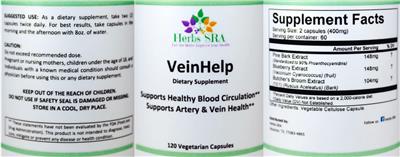
Supplement Facts
The label details for VeinHelp by Herbs SRA, sourced from the NIH Dietary Supplement Label Database.
Supplement Facts
| Ingredient | Amount | % DV |
|---|---|---|
| Pine Bark Extract | 148 mg | -- |
| Blueberry Extract | 148 mg | -- |
| Butcher's Broom Extract | 104 mg | -- |
Other ingredients: Cellulose
Tap any ingredient to jump to its full detail below.
These statements are the manufacturer’s wording, reproduced from the product label — the label is saying it, not HelloPharmacist. We don’t verify or endorse them.
Suggested/Recommended/Usage/Directions
Suggested use: As a dietary supplement, take two (2) capsules twice daily. For best results, take capsules in the morning and the afternoon with 8 oz. of water.
Precautions
Caution: Do not exceed recommended dose. Do not use if safety seal is damaged or missing.
Pregnant or nursing mothers, children under the age of 18, and individuals with a known medical condition should consult a physician before using this or any dietary supplement.
Pregnant or nursing mothers, children under the age of 18, and individuals with a known medical condition should consult a physician before using this or any dietary supplement. Keep out of the reach of children.
Storage
Store in a cool, dry place.
FDA Disclaimer Statement
These statements have not been evaluated by the FDA (Food and Drug Administration). This product is not intended to diagnose, treat, cure, mitigate or prevent any disease or health condition.
General Statements
Let the herbs improve your health
Follow us: Facebook Herbs SRA
FDA Statement of Identity
Dietary Supplement
Formulation
Supports healthy blood circulation Supports artery & vein health
Is this label outdated? Report a formula or label change and our pharmacy team will review it.
VeinHelp by Herbs SRA label
The label scan from the NIH Dietary Supplement Label Database. Tap to enlarge.
Label images are published by the NIH Dietary Supplement Label Database for the version of this product on file. Always read your actual product label.
View the full label (PDF)The Ingredients in VeinHelp by Herbs SRA
These are the 3 active ingredients this product is made of. Select any to open its full monograph.
Serving size2 Capsule(s) Dosage formCapsule Servings per container60 Amounts shown are per serving.
Most supplement products combine several ingredients, and a medication can interact with the product through any one of them. Each ingredient below shows whether it has known drug interactions.
Pine Bark Extract
Interacts with327 drugs
Maritime pine bark extract (often sold as Pycnogenol) is a plant-based antioxidant most studied for circulation, vein, and skin health. Some research...
Pine Bark Extract monograph & interactionsBlueberry Extract
Interacts with88 drugs
Blueberries are a nutritious fruit rich in antioxidants called anthocyanins, and eating them as part of a balanced diet is healthy and safe for most p...
Blueberry Extract monograph & interactionsButcher's Broom Extract
Interacts with158 drugs
Butcher's broom is a plant extract most often used for circulation problems in the legs, such as chronic venous insufficiency, where some evidence sug...
Butcher's Broom Extract monograph & interactionsOther (inactive) ingredients: Cellulose. These complete the product’s ingredient list but are not active constituents.
VeinHelp by Herbs SRA Drug Interactions
HelloPharmacist Interaction Report
VeinHelp by Herbs SRA contains three active ingredients—pine bark extract, blueberry extract, and butcher's broom extract—that together interact with a number of medications.
The most serious concern is a Moderate-severity risk: pine bark extract may increase bleeding risk when combined with blood thinners or antiplatelet drugs like warfarin, aspirin, or clopidogrel.
Read the full breakdown — every affected drug type, severity by severity
Pine bark extract also carries Moderate-severity risks with diabetes medications (it may lower blood sugar further) and immunosuppressants (it might reduce their effectiveness). Blueberry extract poses Minor-severity interactions with diabetes drugs and with specific medications including flurbiprofen and buspirone, though human evidence for these is limited.
Butcher's broom extract has Moderate-severity interactions with blood pressure drugs that work on alpha-adrenergic pathways—it may reduce the effects of some (alpha-blockers) or increase the effects and side effects of others (alpha-agonists).
Altogether, these interactions span 483 individual medications. If you take any prescription medication—especially blood thinners, diabetes drugs, heart or blood pressure medications, or immunosuppressants—use the interaction checker below with your exact medication names before starting VeinHelp.
Check your own medications below · Editorial policy · How we use AI
Want to check YOUR meds against VeinHelp?
Ask about interactions with your drugs in plain English — “Can I take it with lisinopril?” — and we find you the answer in seconds, ingredient by ingredient.
Go to the checkerIngredients driving the most interactions
Individual Drug Interactions
The ingredients in VeinHelp interact with 483 drugs. Click any drug to see the details.
3 of the 3 ingredients in VeinHelp interact with drugs. Each result below shows which ingredient is responsible. Pine Bark Extract Butcher's Broom Extract Blueberry Extract
"phentolamineOraVerse, Rogitine, Ryzumvi
How "phentolamine interacts with VeinHelp — through 1 ingredient. Tap an ingredient for the detail:
Butcher's Broom ExtractAlpha-adrenergic Antagonists Moderate
Interaction Summary
Theoretically, butcher's broom might reduce the effects of alpha-adrenergic antagonists.
Read the full Butcher's Broom Extract + "phentolamine interaction6-mercaptopurinePurinethol
How 6-mercaptopurine interacts with VeinHelp — through 1 ingredient. Tap an ingredient for the detail:
Pine Bark ExtractImmunosuppressants Moderate
Interaction Summary
Theoretically, maritime pine bark extract might decrease the effectiveness of immunosuppressant therapy.
Read the full Pine Bark Extract + 6-mercaptopurine interactionAbciximabReoPro
How Abciximab interacts with VeinHelp — through 1 ingredient. Tap an ingredient for the detail:
Pine Bark ExtractAnticoagulant/antiplatelet Drugs Moderate
Interaction Summary
Theoretically, maritime pine bark extract might increase the risk of bleeding when used with antiplatelet or anticoagulant drugs.
Read the full Pine Bark Extract + Abciximab interactionAbrocitinibCibinqo
How Abrocitinib interacts with VeinHelp — through 1 ingredient. Tap an ingredient for the detail:
Pine Bark ExtractAnticoagulant/antiplatelet Drugs, Immunosuppressants Moderate
Interaction Summary
Theoretically, maritime pine bark extract might increase the risk of bleeding when used with antiplatelet or anticoagulant drugs.
Read the full Pine Bark Extract + Abrocitinib interactionAcarboseGlucobay, Prandase, Precose
How Acarbose interacts with VeinHelp — through 2 ingredients. Tap an ingredient for the detail:
Pine Bark ExtractAntidiabetes Drugs Moderate
Interaction Summary
Theoretically, maritime pine bark extract might increase the risk of hypoglycemia when used with antidiabetes drugs.
Read the full Pine Bark Extract + Acarbose interactionBlueberry ExtractAntidiabetes Drugs Minor
Interaction Summary
Theoretically, blueberries or blueberry leaf extracts might increase the risk of hypoglycemia when taken with antidiabetes drugs.
Read the full Blueberry Extract + Acarbose interactionAcenocoumarolSintrom
How Acenocoumarol interacts with VeinHelp — through 1 ingredient. Tap an ingredient for the detail:
Pine Bark ExtractAnticoagulant/antiplatelet Drugs Moderate
Interaction Summary
Theoretically, maritime pine bark extract might increase the risk of bleeding when used with antiplatelet or anticoagulant drugs.
Read the full Pine Bark Extract + Acenocoumarol interactionAcetaminophen, AspirinGemnisyn
How Acetaminophen, Aspirin interacts with VeinHelp — through 1 ingredient. Tap an ingredient for the detail:
Pine Bark ExtractAnticoagulant/antiplatelet Drugs Moderate
Interaction Summary
Theoretically, maritime pine bark extract might increase the risk of bleeding when used with antiplatelet or anticoagulant drugs.
Read the full Pine Bark Extract + Acetaminophen, Aspirin interactionAcetaminophen, Aspirin, CaffeineExcedrin, Excedrin Extra Strength, Excedrin Migraine
How Acetaminophen, Aspirin, Caffeine interacts with VeinHelp — through 1 ingredient. Tap an ingredient for the detail:
Pine Bark ExtractAnticoagulant/antiplatelet Drugs Moderate
Interaction Summary
Theoretically, maritime pine bark extract might increase the risk of bleeding when used with antiplatelet or anticoagulant drugs.
Read the full Pine Bark Extract + Acetaminophen, Aspirin, Caffeine interactionAcetaminophen, Brompheniramine, PhenylpropanolamineDimetapp Cold and Flu
How Acetaminophen, Brompheniramine, Phenylpropanolamine interacts with VeinHelp — through 1 ingredient. Tap an ingredient for the detail:
Butcher's Broom ExtractAlpha-adrenergic Agonists Moderate
Interaction Summary
Theoretically, butcher's broom might increase the effects and adverse effects of alpha-adrenergic agonists.
Read the full Butcher's Broom Extract + Acetaminophen, Brompheniramine, Phenylpropanolamine interactionAcetaminophen, Caffeine, Chlorpheniramine, Hydrocodone, PhenylephrineHycomine Compound
How Acetaminophen, Caffeine, Chlorpheniramine, Hydrocodone, Phenylephrine interacts with VeinHelp — through 1 ingredient. Tap an ingredient for the detail:
Butcher's Broom ExtractAlpha-adrenergic Agonists Moderate
Interaction Summary
Theoretically, butcher's broom might increase the effects and adverse effects of alpha-adrenergic agonists.
Read the full Butcher's Broom Extract + Acetaminophen, Caffeine, Chlorpheniramine, Hydrocodone, Phenylephrine interactionAcetaminophen, Chlorpheniramine, Codeine, PhenylephrineColrex
How Acetaminophen, Chlorpheniramine, Codeine, Phenylephrine interacts with VeinHelp — through 1 ingredient. Tap an ingredient for the detail:
Butcher's Broom ExtractAlpha-adrenergic Agonists Moderate
Interaction Summary
Theoretically, butcher's broom might increase the effects and adverse effects of alpha-adrenergic agonists.
Read the full Butcher's Broom Extract + Acetaminophen, Chlorpheniramine, Codeine, Phenylephrine interactionAcetaminophen, Chlorpheniramine, Dextromethorphan, PhenylpropanolamineMulti Symptom Cold Relief
How Acetaminophen, Chlorpheniramine, Dextromethorphan, Phenylpropanolamine interacts with VeinHelp — through 1 ingredient. Tap an ingredient for the detail:
Butcher's Broom ExtractAlpha-adrenergic Agonists Moderate
Interaction Summary
Theoretically, butcher's broom might increase the effects and adverse effects of alpha-adrenergic agonists.
Read the full Butcher's Broom Extract + Acetaminophen, Chlorpheniramine, Dextromethorphan, Phenylpropanolamine interactionAcetaminophen, Chlorpheniramine, Dextromethorphan, PseudoephedrineChildren's Tylenol Cold Plus Cough, Tylenol Cold Ex Strength
How Acetaminophen, Chlorpheniramine, Dextromethorphan, Pseudoephedrine interacts with VeinHelp — through 1 ingredient. Tap an ingredient for the detail:
Butcher's Broom ExtractAlpha-adrenergic Agonists Moderate
Interaction Summary
Theoretically, butcher's broom might increase the effects and adverse effects of alpha-adrenergic agonists.
Read the full Butcher's Broom Extract + Acetaminophen, Chlorpheniramine, Dextromethorphan, Pseudoephedrine interactionAcetaminophen, Chlorpheniramine, Guaifenesin, Phenylephrine, SalicylamideRhinogesic GG
How Acetaminophen, Chlorpheniramine, Guaifenesin, Phenylephrine, Salicylamide interacts with VeinHelp — through 1 ingredient. Tap an ingredient for the detail:
Butcher's Broom ExtractAlpha-adrenergic Agonists Moderate
Interaction Summary
Theoretically, butcher's broom might increase the effects and adverse effects of alpha-adrenergic agonists.
Read the full Butcher's Broom Extract + Acetaminophen, Chlorpheniramine, Guaifenesin, Phenylephrine, Salicylamide interactionAcetaminophen, Chlorpheniramine, PhenylephrineAlka-Seltzer PLUS, Histex SR, Protid
How Acetaminophen, Chlorpheniramine, Phenylephrine interacts with VeinHelp — through 1 ingredient. Tap an ingredient for the detail:
Butcher's Broom ExtractAlpha-adrenergic Agonists Moderate
Interaction Summary
Theoretically, butcher's broom might increase the effects and adverse effects of alpha-adrenergic agonists.
Read the full Butcher's Broom Extract + Acetaminophen, Chlorpheniramine, Phenylephrine interactionAcetaminophen, Chlorpheniramine, Phenylephrine, SalicylamideRhinogesic, Rhinogesic JR
How Acetaminophen, Chlorpheniramine, Phenylephrine, Salicylamide interacts with VeinHelp — through 1 ingredient. Tap an ingredient for the detail:
Butcher's Broom ExtractAlpha-adrenergic Agonists Moderate
Interaction Summary
Theoretically, butcher's broom might increase the effects and adverse effects of alpha-adrenergic agonists.
Read the full Butcher's Broom Extract + Acetaminophen, Chlorpheniramine, Phenylephrine, Salicylamide interactionAcetaminophen, Chlorpheniramine, PhenylpropanolamineAlumadrine, Conex, Sinadrin Max Strength, Sinulin
How Acetaminophen, Chlorpheniramine, Phenylpropanolamine interacts with VeinHelp — through 1 ingredient. Tap an ingredient for the detail:
Butcher's Broom ExtractAlpha-adrenergic Agonists Moderate
Interaction Summary
Theoretically, butcher's broom might increase the effects and adverse effects of alpha-adrenergic agonists.
Read the full Butcher's Broom Extract + Acetaminophen, Chlorpheniramine, Phenylpropanolamine interactionAcetaminophen, Chlorpheniramine, Phenylpropanolamine, OpiumHista-Derfule
How Acetaminophen, Chlorpheniramine, Phenylpropanolamine, Opium interacts with VeinHelp — through 1 ingredient. Tap an ingredient for the detail:
Butcher's Broom ExtractAlpha-adrenergic Agonists Moderate
Interaction Summary
Theoretically, butcher's broom might increase the effects and adverse effects of alpha-adrenergic agonists.
Read the full Butcher's Broom Extract + Acetaminophen, Chlorpheniramine, Phenylpropanolamine, Opium interactionAcetaminophen, Chlorpheniramine, Phenylpropanolamine, PhenyltoloxamineNorel Plus
How Acetaminophen, Chlorpheniramine, Phenylpropanolamine, Phenyltoloxamine interacts with VeinHelp — through 1 ingredient. Tap an ingredient for the detail:
Butcher's Broom ExtractAlpha-adrenergic Agonists Moderate
Interaction Summary
Theoretically, butcher's broom might increase the effects and adverse effects of alpha-adrenergic agonists.
Read the full Butcher's Broom Extract + Acetaminophen, Chlorpheniramine, Phenylpropanolamine, Phenyltoloxamine interactionAcetaminophen, Chlorpheniramine, PseudoephedrineAlka-Seltzer PLUS Liquid Gels, Children's Tylenol Cold, Codimal, Comtrex, Extra Strength Tylenol Allergy Sinus, Lorsin +3 more
How Acetaminophen, Chlorpheniramine, Pseudoephedrine interacts with VeinHelp — through 1 ingredient. Tap an ingredient for the detail:
Butcher's Broom ExtractAlpha-adrenergic Agonists Moderate
Interaction Summary
Theoretically, butcher's broom might increase the effects and adverse effects of alpha-adrenergic agonists.
Read the full Butcher's Broom Extract + Acetaminophen, Chlorpheniramine, Pseudoephedrine interactionAcetaminophen, Dexbrompheniramine, PseudoephedrineSinadrin Plus
How Acetaminophen, Dexbrompheniramine, Pseudoephedrine interacts with VeinHelp — through 1 ingredient. Tap an ingredient for the detail:
Butcher's Broom ExtractAlpha-adrenergic Agonists Moderate
Interaction Summary
Theoretically, butcher's broom might increase the effects and adverse effects of alpha-adrenergic agonists.
Read the full Butcher's Broom Extract + Acetaminophen, Dexbrompheniramine, Pseudoephedrine interactionAcetaminophen, Dextromethorphan, Doxylamine, PseudoephedrineVicks NyQuil
How Acetaminophen, Dextromethorphan, Doxylamine, Pseudoephedrine interacts with VeinHelp — through 1 ingredient. Tap an ingredient for the detail:
Butcher's Broom ExtractAlpha-adrenergic Agonists Moderate
Interaction Summary
Theoretically, butcher's broom might increase the effects and adverse effects of alpha-adrenergic agonists.
Read the full Butcher's Broom Extract + Acetaminophen, Dextromethorphan, Doxylamine, Pseudoephedrine interactionAcetaminophen, Dextromethorphan, Guaifenesin, PhenylephrineConar-A
How Acetaminophen, Dextromethorphan, Guaifenesin, Phenylephrine interacts with VeinHelp — through 1 ingredient. Tap an ingredient for the detail:
Butcher's Broom ExtractAlpha-adrenergic Agonists Moderate
Interaction Summary
Theoretically, butcher's broom might increase the effects and adverse effects of alpha-adrenergic agonists.
Read the full Butcher's Broom Extract + Acetaminophen, Dextromethorphan, Guaifenesin, Phenylephrine interactionAcetaminophen, Dextromethorphan, Guaifenesin, PhenylpropanolamineAnatuss
How Acetaminophen, Dextromethorphan, Guaifenesin, Phenylpropanolamine interacts with VeinHelp — through 1 ingredient. Tap an ingredient for the detail:
Butcher's Broom ExtractAlpha-adrenergic Agonists Moderate
Interaction Summary
Theoretically, butcher's broom might increase the effects and adverse effects of alpha-adrenergic agonists.
Read the full Butcher's Broom Extract + Acetaminophen, Dextromethorphan, Guaifenesin, Phenylpropanolamine interactionAcetaminophen, Dextromethorphan, Guaifenesin, PseudoephedrineRobitussin Cold, Severe Cold, Suphedrine Cold/Cough
How Acetaminophen, Dextromethorphan, Guaifenesin, Pseudoephedrine interacts with VeinHelp — through 1 ingredient. Tap an ingredient for the detail:
Butcher's Broom ExtractAlpha-adrenergic Agonists Moderate
Interaction Summary
Theoretically, butcher's broom might increase the effects and adverse effects of alpha-adrenergic agonists.
Read the full Butcher's Broom Extract + Acetaminophen, Dextromethorphan, Guaifenesin, Pseudoephedrine interactionAcetaminophen, Dextromethorphan, Phenylpropanolamine, PyrilamineTheracaps
How Acetaminophen, Dextromethorphan, Phenylpropanolamine, Pyrilamine interacts with VeinHelp — through 1 ingredient. Tap an ingredient for the detail:
Butcher's Broom ExtractAlpha-adrenergic Agonists Moderate
Interaction Summary
Theoretically, butcher's broom might increase the effects and adverse effects of alpha-adrenergic agonists.
Read the full Butcher's Broom Extract + Acetaminophen, Dextromethorphan, Phenylpropanolamine, Pyrilamine interactionAcetaminophen, Dextromethorphan, PseudoephedrineAlka-Seltzer PLUS Flu Liquid Gels, Non Aspirin Cold Caps, Tylenol Cold, Tylenol Flu Daytime Ex Strength, Tylenol Flu Ex Strength
How Acetaminophen, Dextromethorphan, Pseudoephedrine interacts with VeinHelp — through 1 ingredient. Tap an ingredient for the detail:
Butcher's Broom ExtractAlpha-adrenergic Agonists Moderate
Interaction Summary
Theoretically, butcher's broom might increase the effects and adverse effects of alpha-adrenergic agonists.
Read the full Butcher's Broom Extract + Acetaminophen, Dextromethorphan, Pseudoephedrine interactionAcetaminophen, Diphenhydramine, PseudoephedrineChildren's Tylenol Allergy, Cold Control, Contac Night Allergy Relief
How Acetaminophen, Diphenhydramine, Pseudoephedrine interacts with VeinHelp — through 1 ingredient. Tap an ingredient for the detail:
Butcher's Broom ExtractAlpha-adrenergic Agonists Moderate
Interaction Summary
Theoretically, butcher's broom might increase the effects and adverse effects of alpha-adrenergic agonists.
Read the full Butcher's Broom Extract + Acetaminophen, Diphenhydramine, Pseudoephedrine interactionAcetaminophen, Doxylamine, PseudoephedrineEx Strength Tylenol Sinus Nighttime
How Acetaminophen, Doxylamine, Pseudoephedrine interacts with VeinHelp — through 1 ingredient. Tap an ingredient for the detail:
Butcher's Broom ExtractAlpha-adrenergic Agonists Moderate
Interaction Summary
Theoretically, butcher's broom might increase the effects and adverse effects of alpha-adrenergic agonists.
Read the full Butcher's Broom Extract + Acetaminophen, Doxylamine, Pseudoephedrine interactionAcetaminophen, IbuprofenCombogesic
How Acetaminophen, Ibuprofen interacts with VeinHelp — through 1 ingredient. Tap an ingredient for the detail:
Pine Bark ExtractAnticoagulant/antiplatelet Drugs Moderate
Interaction Summary
Theoretically, maritime pine bark extract might increase the risk of bleeding when used with antiplatelet or anticoagulant drugs.
Read the full Pine Bark Extract + Acetaminophen, Ibuprofen interactionEach ingredient & the kinds of drugs it affects
For each ingredient in VeinHelp with known interactions, here are the types of medications they can affect. Open any type for the detail — or search your exact drug in the checker above.
Pine Bark Extract
Anticoagulant/Antiplatelet Drugs
Theoretically, maritime pine bark extract might increase the risk of bleeding when used with antiplatelet or anticoagulant drugs.
Clinical research suggests that maritime pine bark extract inhibits platelet aggregation. However, the clinical significance of this effect is unclear.
Antidiabetes Drugs
Theoretically, maritime pine bark extract might increase the risk of hypoglycemia when used with antidiabetes drugs.
One clinical study shows that maritime pine bark extract decreases blood sugar in patients with diabetes being treated with antidiabetes agents. Monitor blood glucose levels closely. Dose adjustments might be necessary.
Immunosuppressants
Theoretically, maritime pine bark extract might decrease the effectiveness of immunosuppressant therapy.
In vitro and animal research suggests that maritime pine bark extract has immunostimulant activity. This effect has not been reported in humans.
Butcher's Broom Extract
Alpha-Adrenergic Agonists
Theoretically, butcher's broom might increase the effects and adverse effects of alpha-adrenergic agonists.
Animal and in vitro studies show that butcher's broom has alpha-adrenergic agonist effects.
Alpha-Adrenergic Antagonists
Theoretically, butcher's broom might reduce the effects of alpha-adrenergic antagonists.
Animal and in vitro studies show that butcher's broom has alpha-adrenergic agonist effects.
Blueberry Extract
Antidiabetes Drugs
Theoretically, blueberries or blueberry leaf extracts might increase the risk of hypoglycemia when taken with antidiabetes drugs.
Animal and in vitro research suggests that blueberry and/or blueberry leaf extracts can lower blood glucose levels.
Buspirone (Buspar)
Theoretically, blueberry juice might increase blood levels of buspirone.
In vitro research shows that blueberry juice can inhibit the metabolism of buspirone, possibly by inhibiting cytochrome P450 3A (CYP3A) enzymes. However, pharmacokinetic research in humans shows that drinking 300 mL of blueberry juice 30 minutes before taking buspirone hydrochloride 10 mg does not significantly affect the concentration or clearance of buspirone.
Flurbiprofen (Ansaid, Others)
Theoretically, blueberry juice might increase blood levels of flurbiprofen.
In vitro research shows that blueberry juice can inhibit the metabolism of flurbiprofen, possibly by inhibiting cytochrome P450 2C9 (CYP2C9) enzymes. However, pharmacokinetic research in humans shows that drinking 300 mL of blueberry juice 30 minutes before taking flurbiprofen 100 mg does not significantly affect the concentration or clearance of flurbiprofen.
Brand information
Manufacturer and brand details for VeinHelp, from the product label.
VeinHelp by Herbs SRA: Common Questions
Does VeinHelp by Herbs SRA interact with any medications?
How can one product interact with so many drugs?
Where does this information come from?
What are these three ingredients supposed to do?
Can I take VeinHelp if I'm on a blood thinner like warfarin?
What side effects might I experience?
Is VeinHelp safe during pregnancy?
Is it safe while breastfeeding?
If I take diabetes medication, can I use this?
Written and reviewed by the HelloPharmacist editorial staff. Our editorial policy
Not sure if VeinHelp is safe with your meds?
Our pharmacists answer your medication & supplement questions — free.
Label information is sourced from the NIH Dietary Supplement Label Database and reflects the product version on file; always read your actual product label. This page is for education only and is not a substitute for professional medical advice. Confirm with your pharmacist or doctor before combining supplements and medications.
The Full Monographs Behind VeinHelp’s Ingredients
Every ingredient we hold a full HelloPharmacist monograph for — uses, evidence, safety, and the complete interaction list.
Maritime Pine
Interacts with 327 drugsMaritime pine bark extract (often sold as Pycnogenol) is a plant-based antioxidant most studied for circulation, vein, and skin health. Some research is promising, but many studies are small...
Read the full Maritime Pine monograph → Herb & supplement monographBlueberry
Interacts with 88 drugsBlueberries are a nutritious fruit rich in antioxidants called anthocyanins, and eating them as part of a balanced diet is healthy and safe for most people. Concentrated supplements are mark...
Read the full Blueberry monograph → Herb & supplement monographButcher's Broom
Interacts with 158 drugsButcher's broom is a plant extract most often used for circulation problems in the legs, such as chronic venous insufficiency, where some evidence suggests it may help reduce swelling and di...
Read the full Butcher's Broom monograph →Sources & How We Checked
VeinHelp's label data comes from the NIH Dietary Supplement Label Database; the ingredient interaction data is from the Natural Medicines database, reviewed by our pharmacists.
- NIH Dietary Supplement Label Database (DSLD) — The official product label on file for this supplement.
- Natural Medicines (Therapeutic Research Center) — Evidence-graded clinical reference behind the ingredient interaction data.
Content is written and reviewed by licensed HelloPharmacist pharmacists. See our data sources and editorial standards for how this information is built and checked.
The 29 references behind this product’s interaction data
Every citation that drives the interaction findings for this product’s ingredients, from the evidence-graded Natural Medicines (TRC Healthcare) database. Open an ingredient to browse its citations — links open the study on PubMed or the publisher’s site.
Maritime Pine 14 references
- Rice-Evans CA, Packer L, eds. Flavonoids in Health and Disease. Manhattan, NY: Marcel Dekker, Inc., 1998.
- Liu FJ, Zhang YX, Lau BH. Pycnogenol enhances immune and haemopoietic functions in senescence-accelerated mice. Cell Mol Life Sci 1998;54:1168-72. PubMed
- Putter M, Grotemeyer KH, Wurthwein G, et al. Inhibition of smoking-induced platelet aggregation by aspirin and pycnogenol. Thromb Res 1999;95:155-61. PubMed
- Kohama T, Inoue M. Pycnogenol alleviates pain associated with pregnancy. Phytother Res 2006;20:232-4.
- Liu X, Zhou HJ, Rohdewald P. French maritime pine bark extract pycnogenol dose-dependently lowers glucose in type 2 diabetic patients (letter). Diabetes Care 2004;27:839. PubMed
- Liu X, Wei J, Tan F, et al. Antidiabetic effect of Pycnogenol French maritime pine bark extract in patients with diabetes type II. Life Sci 2004;75:2505-13. PubMed
- Wilson D, Evans M, Guthrie N et al. A randomized, double-blind, placebo-controlled exploratory study to evaluate the potential of pycnogenol for improving allergic rhinitis symptoms. Phytother Res 2010;24:1115-9.
- Araghi-Niknam, M., Hosseini, S., Larson, D., Rohdewald, P., and Watson, R. R. Pine bark extract reduces platelet aggregation. Integr.Med. 3-21-2000;2(2):73-77. PubMed
- Trebaticka, J., Kopasova, S., Hradecna, Z., Cinovsky, K., Skodacek, I., Suba, J., Muchova, J., Zitnanova, I., Waczulikova, I., Rohdewald, P., and Durackova, Z. Treatment of ADHD with French maritime pine bark extract, Pycnogenol. Eur.Child Adolesc.Psychi PubMed
- Suzuki, N., Uebaba, K., Kohama, T., Moniwa, N., Kanayama, N., and Koike, K. French maritime pine bark extract significantly lowers the requirement for analgesic medication in dysmenorrhea: a multicenter, randomized, double-blind, placebo-controlled study
- Cisar, P., Jany, R., Waczulikova, I., Sumegova, K., Muchova, J., Vojtassak, J., Durackova, Z., Lisy, M., and Rohdewald, P. Effect of pine bark extract (Pycnogenol) on symptoms of knee osteoarthritis. Phytother.Res. 2008;22(8):1087-1092.
- Enseleit, F., Sudano, I., Periat, D., Winnik, S., Wolfrum, M., Flammer, A. J., Frohlich, G. M., Kaiser, P., Hirt, A., Haile, S. R., Krasniqi, N., Matter, C. M., Uhlenhut, K., Hogger, P., Neidhart, M., Luscher, T. F., Ruschitzka, F., and Noll, G. Effects
- Schoonees, A., Visser, J., Musekiwa, A., and Volmink, J. Pycnogenol(R) (extract of French maritime pine bark) for the treatment of chronic disorders. Cochrane.Database.Syst.Rev. 2012;4:CD008294.
- Wang S, Tan D Zhao Y et al. The effect of pycnogenol on the microcirculation, platelet function and ischemic myocardium in patients with coronary artery diseases. Eur Bull Drug Res 1999;7:19-25.
Blueberry 7 references
- Cignarella A, Nastasi M, Cavalli E, Puglisi L. Novel lipid-lowering properties of Vaccinium myrtillus L. leaves, a traditional antidiabetic treatment, in several models of rat dyslipidaemia: a comparison with ciprofibrate. Thromb Res 1996;84:311-22. PubMed
- Wang SY, Lin HS. Antioxidant activity in fruits and leaves of blackberry, raspberry, and strawberry varies with cultivar and developmental stage. J Agric Food Chem 2000;48:140-6.. PubMed
- Martineau, L. C., Couture, A., Spoor, D., Benhaddou-Andaloussi, A., Harris, C., Meddah, B., Leduc, C., Burt, A., Vuong, T., Mai, Le P., Prentki, M., Bennett, S. A., Arnason, J. T., and Haddad, P. S. Anti-diabetic properties of the Canadian lowbush bluebe
- Vuong, T., Martineau, L. C., Ramassamy, C., Matar, C., and Haddad, P. S. Fermented Canadian lowbush blueberry juice stimulates glucose uptake and AMP-activated protein kinase in insulin-sensitive cultured muscle cells and adipocytes. Can J Physiol Pharma
- Hanley MJ, Masse G, Harmatz JS, Cancalon PF, Dolnikowski GG, Court MH, Greenblatt DJ. Effect of blueberry juice on clearance of buspirone and flurbiprofen in human volunteers. Br J Clin Pharmacol. 2013 Apr;75(4):1041-52. PubMed
- Basu A, Du M, Leyva MJ, et al. Blueberries decrease cardiovascular risk factors in obese men and women with metabolic syndrome. J Nutr 2010;140(9):1582-7. PubMed
- Basu A, Feng D, Planinic P, Ebersole JL, Lyons TJ, Alexander JM. Dietary blueberry and soluble fiber supplementation reduces risk of gestational diabetes in women with obesity in a randomized controlled trial. J Nutr 2021;151(5):1128-38. PubMed
Butcher's Broom 8 references
- Beltramino R, Penenory A, Buceta AM. An open-label, randomized multicenter study comparing the efficacy and safety of Cyclo 3 Fort versus hydroxyethyl rutoside in chronic venous lymphatic insufficiency. Angiology 2000;51:535-44.. PubMed
- Redman DA. Ruscus aculeatus (butcher's broom) as a potential treatment for orthostatic hypotension, with a case report. J Altern Complement Med 2000;6:539-49..
- Landa, N., Aguirre, A., Goday, J., Raton, J. A., and Diaz-Perez, J. L. Allergic contact dermatitis from a vasoconstrictor cream. Contact Dermatitis 1990;22(5):290-291. PubMed
- Cluzan, R. V., Alliot, F., Ghabboun, S., and Pascot, M. Treatment of secondary lymphedema of the upper limb with CYCLO 3 FORT. Lymphology 1996;29(1):29-35.
- Parrado F, Buzzi A. A study of the efficacy and tolerability of a preparation containing Ruscus aculeatus in the treatment of chronic venous insufficiency of the lower limbs. Clin Drug Invest 1999;18(4):255-61. DOI
- Sadarmin PP, Timperley J. An unusual case of Butcher's Broom precipitating diabetic ketoacidosis. J Emerg Med 2013;45(3):e63-e65. PubMed
- Ramirez-Hernandez M, Garcia-Selles J, Merida-Fernandez C, Martinez-Escribano JA. Allergic contact dermatitis to ruscogenins. Contact Dermatitis 2006;54(1):60. PubMed
- European Medicines Agency. Assessment report on Ruscus Aculeatus L rhizome. EMEA/HMPC/261939/2007. London, September 4, 2008. Available at: http://www.ema.europa.eu/docs/en_GB/document_library/Herbal_-_HMPC_assessment_report/2009/12/WC500018288.pdf. Acces
Parts of this content are provided by the Therapeutic Research Center, LLC.
DISCLAIMER: Currently this does not check for drug-drug interactions. This is not an all-inclusive comprehensive list of potential interactions and is for informational purposes only. Not all interactions are known or well-reported in the scientific literature, and new interactions are continually being reported. Input is needed from a qualified healthcare provider including a pharmacist before starting any therapy. Application of clinical judgment is necessary.
© 2021 Therapeutic Research Center, LLC