
Vitamin K-Max Ingredients & Drug Interactions
by Maxi Health
What is this page for?
First and foremost: checking Vitamin K-Max against your medications. The heart of this page is the interaction checker and the full interaction report — how this product’s ingredients may interact with prescription and over-the-counter medicines you may be taking.
Around that, we add a pharmacist’s high-level view of the product as a whole — what’s inside, the evidence for its stated use, how transparent the label is, and what safety data exists — so you can see the full picture in one place. It’s educational information from our licensed clinical databases and the clinical staff at HelloPharmacist — not medical advice — and we don’t sell or endorse products. Our editorial policy
Vitamin K-Max is a dietary supplement by Maxi Health with 2 active ingredients. Its ingredients are commonly taken for high cholesterol, heart health support, blood sugar support.Based on those ingredients, 3 medications have a known interaction with it, the most serious rated major. The ingredients most likely to interact are VitaMK-7, Barley Grass, Powder. Use the checker below to test your specific medication, or read the full HelloPharmacist Interaction Report.
Check Your Meds Against Vitamin K-Max by Maxi Health
Ask about any prescription or over-the-counter medication and we check it for interactions with Vitamin K-Max by Maxi Health — and tell you which ingredient is responsible.
AI summaries are generated from our interaction database for education only — always confirm with your pharmacist. How we use AI
Ask the Pharmacist
A licensed pharmacist will answer your question by email — free, usually within 24 hours.
Got it — thank you!
A licensed pharmacist will answer within 24 hours. Keep an eye on your email (worth checking spam, just in case).
HelloPharmacist Scorecard of Vitamin K-Max by Maxi Health
Our pharmacy team’s full take, with four database checks built into the cards below — a summary of what is known, not a grade of the product itself.
What’s inside
Full disclosure
Vitamin K-Max contains two active ingredients: Barley Grass Powder and VitaMK-7 (a form of vitamin K). Barley Grass is the whole plant in powder form; VitaMK-7 is a bioavailable type of vitamin K, also called menaquinone-7.
The product also contains several inactive ingredients — microcrystalline cellulose, cellulose, magnesium stearate, calcium carbonate, bromelain, papain, lipase, amylase, protease, and silica — which serve as binders, fillers, and digestive enzymes.
Does it work?
Strong evidence
For barley grass, the evidence shows it's likely effective for high cholesterol (hypercholesterolemia) and coronary heart disease. For the vitamin K component, the data shows it's effective for correcting vitamin K deficiency and its complications — low clotting factors (hypoprothrombinemia), vitamin K-dependent clotting factor deficiency, and hemorrhagic disease.
Vitamin K is also possibly effective for osteoporosis, though the evidence is not as strong.
How safe is it?
Well-documented data
Barley grass is generally well tolerated when eaten as food, but it contains gluten, so it's not suitable if you have celiac disease or gluten sensitivity. Concentrated barley supplements haven't been well studied in pregnancy or while breastfeeding — there isn't enough data to know whether it's safe, so check with your doctor or pharmacist for personalized advice.
Vitamin K is generally safe in food amounts and most supplements for healthy people, though your doctor should give the okay before you take supplements if you're on any medications. Common side effects from barley grass include bloating, gas, and an unpleasant taste.
Allergic reactions are possible in sensitive people. Vitamin K commonly causes mild stomach upset, nausea, and diarrhea.
Severe allergic reactions are very rare but have been reported with intravenous vitamin K.
Meds to double-check
Major interaction found
If you take warfarin (Coumadin) or any blood thinner (anticoagulant), double-check with your pharmacist before starting — vitamin K in this product can reduce its effectiveness and you may need dose adjustments. If you take triclabendazole (Egaten) for parasites, mention this product to your doctor as well.
The bottom line
Scorecard at a glanceFully disclosed formula with clinical evidence supporting its stated purpose. Major medication interactions have been identified, and safety information is well characterized.
Vitamin K-Max may be worth considering if you're looking to support cholesterol levels or bone health and don't have a gluten sensitivity. If you take warfarin or any blood thinner, or if you're on triclabendazole, check with your pharmacist before you start — this product could interfere.
Talk to your pharmacist about whether it fits your health plan.
Educational only — not medical advice; always confirm with your pharmacist. Our editorial policy · How we use AI
Assessment coverage: 2 of 2 active ingredients matched to our full ingredient reviews (monographs). Based on the product label dated Jan 23, 2025.
This Scorecard evaluates available label information, ingredient evidence, and known medication-safety considerations. It does not independently verify product identity, purity, potency, contamination, or manufacturing quality. How these ratings are computed
General information
Key facts about Vitamin K-Max, straight from the product label.
| Brand | Maxi Health |
|---|---|
| Barcode (UPC) | 753406271122 |
| Net contents | 120 Maxicap(s) |
| Market status | On market |
| Date entered into DSLD | Jan 23, 2025 |
| DSLD ID | 323816 |
| Product type | Botanical With Nutrients |
| Supplement form | Capsule |
| Dietary claims / uses | Nutrient, All Other, Structure/Function |
| Intended target group(s) | Vegan, Vegetarian, Adult (18 - 50 Years), Kosher, Gluten Free, Dairy Free |
Everything in this section is reproduced from the manufacturer’s own product label — it’s the label speaking, not HelloPharmacist. We show it so you can see exactly what the maker states; we don’t verify or endorse those statements.
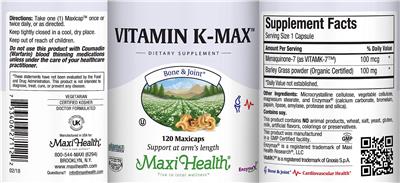
Supplement Facts
The label details for Vitamin K-Max by Maxi Health, sourced from the NIH Dietary Supplement Label Database.
Supplement Facts
| Ingredient | Amount | % DV |
|---|---|---|
| Barley Grass, Powder | 100 mg | -- |
| VitaMK-7 | 100 mcg | -- |
Other ingredients: Microcrystalline Cellulose, Cellulose, Magnesium Stearate, Calcium Carbonate, Bromelain, Papain, Lipase, Amylase, Protease, Silica
Tap any ingredient to jump to its full detail below.
These statements are the manufacturer’s wording, reproduced from the product label — the label is saying it, not HelloPharmacist. We don’t verify or endorse them.
Suggested/Recommended/Usage/Directions
Directions: Take one (1) Maxicap once or twice daily, or as directed.
Storage
Keep tightly closed in a cool, dry place.
Precautions
Keep out of reach of children.
Do not use this product with Coumadin (Warfarin) blood thinning medications unless under the care of your healthcare practitioner.
Contains soy.
FDA Disclaimer Statement
These statements have not been evaluated by the Food and Drug Administration. This product is not intended to diagnose, treat, cure, or prevent any disease.
Formulation
Vegetarian
Bone & joint
This product contains no animal products, wheat, salt, yeast, gluten, milk, artificial flavors, colorings or preservatives.
This product was manufactured in a GMP Certified facility.
Cardiovascular health
Formula
Certified Kosher UK (Rav Shmuel Dovid Krausz (Udvarer Rav)) (Kosher) BDZ Edah Charedis - Orthodox Council of Jerusalem (Kosher) OU (Kosher)
VitamK7 Natural Vitamin K2 as MK7
Enzymax Base
General Statements
Doctor Formulated
Support at arm's length
Seals/Symbols
UK (Rav Shmuel Dovid Krausz (Udvarer Rav)) (Kosher) BDZ Edah Charedis - Orthodox Council of Jerusalem (Kosher)
OU (Kosher)
Manufactured in a Certified GMP facility
FDA Statement of Identity
Dietary Supplement
Brand IP Statement(s)
MaxiHealth True to total wellness
Enzymax, a vital digestive enzyme complex, is a registered trademark of Maxi Health Research LLC. VitaMK7 is a registered trademark of Gnosis S.p.A.
Is this label outdated? Report a formula or label change and our pharmacy team will review it.
Vitamin K-Max by Maxi Health label
The label scan from the NIH Dietary Supplement Label Database. Tap to enlarge.
Label images are published by the NIH Dietary Supplement Label Database for the version of this product on file. Always read your actual product label.
View the full label (PDF)The Ingredients in Vitamin K-Max by Maxi Health
These are the 2 active ingredients this product is made of. Select any to open its full monograph.
Serving size1 Capsule(s) Dosage formCapsule Servings per container120 Amounts shown are per serving.
Most supplement products combine several ingredients, and a medication can interact with the product through any one of them. Each ingredient below shows whether it has known drug interactions.
Barley Grass, Powder
Interacts with1 drug
Barley is a nutritious whole grain that is a good source of soluble fiber called beta-glucan, which has solid evidence for modestly lowering LDL ('bad...
Barley Grass, Powder monograph & interactionsVitaMK-7
Interacts with2 drugs
Vitamin K is an essential nutrient your body needs for normal blood clotting and to support healthy bones. Most people get enough from food, but suppl...
VitaMK-7 monograph & interactionsOther (inactive) ingredients: Microcrystalline Cellulose, Cellulose, Magnesium Stearate, Calcium Carbonate, Bromelain, Papain, Lipase, Amylase, Protease, Silica. These complete the product’s ingredient list but are not active constituents.
Vitamin K-Max by Maxi Health Drug Interactions
HelloPharmacist Interaction Report
Vitamin K-Max by Maxi Health contains two active ingredients, and one of them — the Vitamin K (VitaMK-7) — has a significant interaction to know about.
If you take warfarin (Coumadin), a blood thinner (anticoagulant), vitamin K can work against it and reduce how well it prevents clots. Vitamin K is what your body uses to make clotting factors, so extra vitamin K from supplements can undo warfarin's effects.
You'd need your doctor to adjust your warfarin dose or monitor your blood clotting more closely if you add this product.
Read the full breakdown — every affected drug type, severity by severity
Barley Grass, the other active ingredient, may theoretically decrease how well triclabendazole (Egaten), a parasite medication, works — though this has only been shown in animals, not humans yet.
Otherwise, no interactions are documented in our data for the other medication types we could check. That said, absence of documented interactions is not a guarantee none exist.
Run your exact medications through the checker on this page to be sure.
Additionally, if you're on warfarin or triclabendazole, talk to your pharmacist or doctor before starting.
Check your own medications below · Editorial policy · How we use AI
Want to check YOUR meds against Vitamin K-Max?
Ask about interactions with your drugs in plain English — “Can I take it with lisinopril?” — and we find you the answer in seconds, ingredient by ingredient.
Go to the checkerIngredients driving the most interactions
Individual Drug Interactions
The ingredients in Vitamin K-Max interact with 3 drugs. Click any drug to see the details.
2 of the 2 ingredients in Vitamin K-Max interact with drugs. Each result below shows which ingredient is responsible. VitaMK-7 Barley Grass, Powder
WarfarinWarfarin
How Warfarin interacts with Vitamin K-Max — through 1 ingredient. Tap an ingredient for the detail:
Vitamk-7Warfarin (coumadin) Major
Interaction Summary
Vitamin K can antagonize and reverse the therapeutic effects of warfarin.
Read the full Vitamk-7 + Warfarin interactionWarfarin SodiumCoumadin, Panwarfin, Sofarin
How Warfarin Sodium interacts with Vitamin K-Max — through 1 ingredient. Tap an ingredient for the detail:
Vitamk-7Warfarin (coumadin) Major
Interaction Summary
Vitamin K can antagonize and reverse the therapeutic effects of warfarin.
Read the full Vitamk-7 + Warfarin Sodium interactionTriclabendazoleEgaten
How Triclabendazole interacts with Vitamin K-Max — through 1 ingredient. Tap an ingredient for the detail:
Barley Grass, PowderTriclabendazole (egaten) Moderate
Interaction Summary
Theoretically, barley might decrease the clinical effects of triclabendazole.
Read the full Barley Grass, Powder + Triclabendazole interactionEach ingredient & the kinds of drugs it affects
For each ingredient in Vitamin K-Max with known interactions, here are the types of medications they can affect. Open any type for the detail — or search your exact drug in the checker above.
VitaMK-7
Warfarin (Coumadin)
Vitamin K can antagonize and reverse the therapeutic effects of warfarin.
Vitamin K antagonizes the effects of warfarin. Excessive vitamin K intake, either from supplements or from changes in the diet, can reduce the anticoagulant effect of warfarin.
Barley Grass, Powder
Triclabendazole (Egaten)
Theoretically, barley might decrease the clinical effects of triclabendazole.
Animal research suggests that a diet supplemented with barley can reduce the bioavailability of triclabendazole when taken concomitantly. This effect has not been shown in humans.
Brand information
Manufacturer and brand details for Vitamin K-Max, from the product label.
Maxi Health
See all Maxi Health products- Name
- Maxi Health
- City
- Brooklyn
- State
- N.Y.
- Phone Number
- 800-544-6294
- Web Address
- www.maxihealth.com
Vitamin K-Max by Maxi Health: Common Questions
Does Vitamin K-Max by Maxi Health interact with any medications?
How can one product interact with so many drugs?
Where does this information come from?
Does barley grass have gluten?
Is it safe to take this while I'm pregnant or breastfeeding?
What side effects might I notice?
What is VitaMK-7 and why is it in this product?
Will this help my cholesterol or bones?
Written and reviewed by the HelloPharmacist editorial staff. Our editorial policy
Not sure if Vitamin K-Max is safe with your meds?
Our pharmacists answer your medication & supplement questions — free.
Label information is sourced from the NIH Dietary Supplement Label Database and reflects the product version on file; always read your actual product label. This page is for education only and is not a substitute for professional medical advice. Confirm with your pharmacist or doctor before combining supplements and medications.
The Full Monographs Behind Vitamin K-Max’s Ingredients
Every ingredient we hold a full HelloPharmacist monograph for — uses, evidence, safety, and the complete interaction list.
Barley
Interacts with 1 drugBarley is a nutritious whole grain that is a good source of soluble fiber called beta-glucan, which has solid evidence for modestly lowering LDL ('bad') cholesterol when eaten regularly. It...
Read the full Barley monograph → Herb & supplement monographVitamin K
Interacts with 2 drugsVitamin K is an essential nutrient your body needs for normal blood clotting and to support healthy bones. Most people get enough from food, but supplements are sometimes used for deficiency...
Read the full Vitamin K monograph →Sources & How We Checked
Vitamin K-Max's label data comes from the NIH Dietary Supplement Label Database; the ingredient interaction data is from the Natural Medicines database, reviewed by our pharmacists.
- NIH Dietary Supplement Label Database (DSLD) — The official product label on file for this supplement.
- Natural Medicines (Therapeutic Research Center) — Evidence-graded clinical reference behind the ingredient interaction data.
Content is written and reviewed by licensed HelloPharmacist pharmacists. See our data sources and editorial standards for how this information is built and checked.
The 26 references behind this product’s interaction data
Every citation that drives the interaction findings for this product’s ingredients, from the evidence-graded Natural Medicines (TRC Healthcare) database. Open an ingredient to browse its citations — links open the study on PubMed or the publisher’s site.
Barley 15 references
- Brinker F. Herb Contraindications and Drug Interactions. 2nd ed. Sandy, OR: Eclectic Medical Publications, 1998.
- Fernandez-Anaya S, Crespo JF, Rodriguez JR, et al. Beer anaphylaxis. J Allergy Clin Immunol 1999;103:959-60.
- Lembo A, Camilleri M. Chronic constipation. N Engl J Med 2003;349:1360-8. . PubMed
- Ferre, I., Giraldez, F. J., Alvarez-Bujidos, M. L., and Mantecon, A. R. Influence of barley supplement on plasma concentration of triclabendazole metabolites in sheep. Vet.Rec. 11-22-1997;141(21):549-551. PubMed
- Curioni, A., Santucci, B., Cristaudo, A., Canistraci, C., Pietravalle, M., Simonato, B., and Giannattasio, M. Urticaria from beer: an immediate hypersensitivity reaction due to a 10- kDa protein derived from barley. Clin Exp Allergy 1999;29(3):407-413. PubMed
- Fernandez-Anaya, S., Crespo, J. F., Rodriguez, J. R., Daroca, P., Carmona, E., Herraez, L., and Lopez-Rubio, A. Beer anaphylaxis. J Allergy Clin Immunol. 1999;103(5 Pt 1):959-960.
- Cronin, E. Contact dermatitis from barley dust. Contact Dermatitis 1979;5(3):196. PubMed
- Block, G., Tse, K. S., Kijek, K., Chan, H., and Chan-Yeung, M. Baker's asthma. Studies of the cross-antigenicity between different cereal grains. Clin Allergy 1984;14(2):177-185.
- van Ketel, W. G. Immediate type allergy to malt in beer. Contact Dermatitis 1980;6(4):297-298. PubMed
- Ellis, H. J., Doyle, A. P., Day, P., Wieser, H., and Ciclitira, P. J. Demonstration of the presence of coeliac-activating gliadin-like epitopes in malted barley. Int Arch Allergy Immunol. 1994;104(3):308-310. PubMed
- Vidal, C. and Gonzalez-Quintela, A. Food-induced and occupational asthma due to barley flour. Ann Allergy Asthma Immunol. 1995;75(2):121-124.
- Gutgesell, C. and Fuchs, T. Contact urticaria from beer. Contact Dermatitis 1995;33(6):436-437. PubMed
- Baker, P. G. and Read, A. E. Oats and barley toxicity in coeliac patients. Postgrad.Med J 1976;52(607):264-268. PubMed
- Nakase, M., Usui, Y., Alvarez-Nakase, A. M., Adachi, T., Urisu, A., Nakamura, R., Aoki, N., Kitajima, K., and Matsuda, T. Cereal allergens: rice-seed allergens with structural similarity to wheat and barley allergens. Allergy 1998;53(46 Suppl):55-57. PubMed
- Pereira, F., Rafael, M., and Lacerda, M. H. Contact dermatitis from barley. Contact Dermatitis 1998;39(5):261-262. PubMed
Vitamin K 11 references
- McEvoy GK, ed. AHFS Drug Information. Bethesda, MD: American Society of Health-System Pharmacists, 1998.
- Food and Nutrition Board, Institute of Medicine. Dietary Reference Intakes for Vitamin A, Vitamin K, Arsenic, Boron, Chromium, Copper, Iodine, Iron, Manganese, Molybdenum, Nickel, Silicon, Vanadium, and Zinc. Washington, DC: National Academy Press, 2002.
- Crowther MA, Ageno W, Garcia D, et al. Oral vitamin K versus placebo to correct excessive anticoagulation in patients receiving warfarin: a randomized trial. Ann Intern Med. 2009;150(5):293-300. PubMed
- Dietary vitamin K guidance: an effective strategy for stable control of oral anticoagulation? Nutr Rev. 2010;68(3):178-81. PubMed
- Kim JS, Nafziger AN, Gaedigk A, et al. Effects of oral vitamin K on S- and R-warfarin pharmacokinetics and pharmacodynamics: enhanced safety of warfarin as a CYP2C9 probe. J Clin Pharmacol. 2001 Jul;41(7):715-22. PubMed
- Riegert-Johnson, D. L. and Volcheck, G. W. The incidence of anaphylaxis following intravenous phytonadione (vitamin K1): a 5-year retrospective review. Ann.Allergy Asthma Immunol. 2002;89(4):400-406. PubMed
- Dezee, K. J., Shimeall, W. T., Douglas, K. M., Shumway, N. M., and O'malley, P. G. Treatment of excessive anticoagulation with phytonadione (vitamin K): a meta-analysis. Arch.Intern.Med. 2-27-2006;166(4):391-397. DOI
- Dentali, F., Ageno, W., and Crowther, M. Treatment of coumarin-associated coagulopathy: a systematic review and proposed treatment algorithms. J.Thromb.Haemost. 2006;4(9):1853-1863. PubMed
- Caluwé R, Vandecasteele S, Van Vlem B, Vermeer C, De Vriese AS. Vitamin K2 supplementation in haemodialysis patients: a randomized dose-finding study. Nephrol Dial Transplant. 2014;29(7):1385-90.
- Huang ZB, Wan SL, Lu YJ, Ning L, Liu C, Fan SW. Does vitamin K2 play a role in the prevention and treatment of osteoporosis for postmenopausal women: a meta-analysis of randomized controlled trials. Osteoporos Int. 2015;26(3):1175-86. PubMed
- Hunnali CR, Devi U, Kitchanan S, Sethuraman G. Three Different Regimens for Vitamin K Birth Prophylaxis in Infants Born Preterm: A Randomized Clinical Trial. J Pediatr 2023;255:98-104. PubMed
Parts of this content are provided by the Therapeutic Research Center, LLC.
DISCLAIMER: Currently this does not check for drug-drug interactions. This is not an all-inclusive comprehensive list of potential interactions and is for informational purposes only. Not all interactions are known or well-reported in the scientific literature, and new interactions are continually being reported. Input is needed from a qualified healthcare provider including a pharmacist before starting any therapy. Application of clinical judgment is necessary.
© 2021 Therapeutic Research Center, LLC