
Wild Cherry Bark Syrup Ingredients & Drug Interactions
What is this page for?
First and foremost: checking Wild Cherry Bark Syrup against your medications. The heart of this page is the interaction checker and the full interaction report — how this product’s ingredients may interact with prescription and over-the-counter medicines you may be taking.
Around that, we add a pharmacist’s high-level view of the product as a whole — what’s inside, the evidence for its stated use, how transparent the label is, and what safety data exists — so you can see the full picture in one place. It’s educational information from our licensed clinical databases and the clinical staff at HelloPharmacist — not medical advice — and we don’t sell or endorse products. Our editorial policy
Wild Cherry Bark Syrup is a dietary supplement by Red Moon Herbs with 4 active ingredients. Its ingredients are commonly taken for cough and bronchitis, asthma symptoms, loosening mucus (expectorant).Based on those ingredients, 2,087 medications have a known interaction with it, the most serious rated moderate. The ingredients most likely to interact are Slippery Elm, Wild Cherry, Elecampane. Use the checker below to test your specific medication, or read the full HelloPharmacist Interaction Report.
Check Your Meds Against Wild Cherry Bark Syrup by Red Moon Herbs
Ask about any prescription or over-the-counter medication and we check it for interactions with Wild Cherry Bark Syrup by Red Moon Herbs — and tell you which ingredient is responsible.
AI summaries are generated from our interaction database for education only — always confirm with your pharmacist. How we use AI
Ask the Pharmacist
A licensed pharmacist will answer your question by email — free, usually within 24 hours.
Got it — thank you!
A licensed pharmacist will answer within 24 hours. Keep an eye on your email (worth checking spam, just in case).
HelloPharmacist Scorecard of Wild Cherry Bark Syrup by Red Moon Herbs
Our pharmacy team’s full take, with four database checks built into the cards below — a summary of what is known, not a grade of the product itself.
What’s inside
Low disclosure
This liquid syrup has four active ingredients. Elecampane is included for respiratory support.
Slippery elm, the inner bark of the elm tree, is meant to soothe the throat and digestive tract. Wild cherry is the namesake ingredient, traditionally used in cough remedies.
Violet rounds out the blend, though we don't have details on its specific role in this product. The syrup is made with water, alcohol, and raw mountain honey as inactive ingredients (the base and sweetener).
Does it work?
Insufficient evidence
The evidence for these ingredients is limited. Elecampane and wild cherry are both rated insufficient reliable evidence for cough, which is typically what you'd use this syrup for.
Slippery elm is also rated insufficient reliable evidence for cough, as well as for constipation, diarrhea, and inflammatory bowel disease. In short, we don't have solid trial data showing these ingredients work for their traditional uses.
How safe is it?
Well-documented data
Elecampane is generally used in small amounts and is usually well tolerated, but it can cause allergic reactions and stomach upset in some people — especially if you're sensitive to the ragweed/daisy family of plants. At high doses, it may cause vomiting, diarrhea, and spasms.
Slippery elm is generally well tolerated for short-term use, though high-quality safety data are limited; it may rarely cause contact dermatitis or allergic reactions. Wild cherry is considered safe in the small amounts found in commercial cough products, but the plant contains cyanide-forming compounds.
Large amounts can lead to cyanide toxicity, which is serious.
Meds to double-check
Moderate interaction found
Before you start, double-check any oral medications you take — slippery elm may slow their absorption. Also flag any CNS depressants (sedatives, some pain relievers) because of elecampane's potential additive effect, and any drugs your liver metabolizes via the CYP3A4 pathway because wild cherry may raise their levels.
Use the medication checker on this page with your exact drug names.
The bottom line
Scorecard at a glanceFormula with limited ingredient disclosure with insufficient evidence for its stated purpose. Moderate medication interactions have been identified, and safety information is well characterized.
This is a traditional herbal cough syrup, but the evidence that it actually works is sparse. If you take oral medications, CNS depressants, or drugs metabolized by your liver's CYP3A4 system, check your specific medications with the tool on this page before starting.
Talk to your pharmacist if you have allergies to ragweed or related plants, are pregnant or breastfeeding, or take prescription medications.
Educational only — not medical advice; always confirm with your pharmacist. Our editorial policy · How we use AI
Assessment coverage: 3 of 4 active ingredients matched to our full ingredient reviews (monographs). Based on the product label dated Nov 22, 2024.
This Scorecard evaluates available label information, ingredient evidence, and known medication-safety considerations. It does not independently verify product identity, purity, potency, contamination, or manufacturing quality. How these ratings are computed
General information
Key facts about Wild Cherry Bark Syrup, straight from the product label.
| Brand | Red Moon Herbs |
|---|---|
| Barcode (UPC) | 857999002757 |
| Net contents | 1 Fluid Ounce(s); 30 mL |
| Market status | On market |
| Date entered into DSLD | Nov 22, 2024 |
| DSLD ID | 319335 |
| Product type | Botanical |
| Supplement form | Liquid |
| Dietary claims / uses | All Other |
| Intended target group(s) | Adult (18 - 50 Years), Children (All), Infants/Baby (0 - 1 Year), Seniors/Mature (>50 Years) |
Everything in this section is reproduced from the manufacturer’s own product label — it’s the label speaking, not HelloPharmacist. We show it so you can see exactly what the maker states; we don’t verify or endorse those statements.
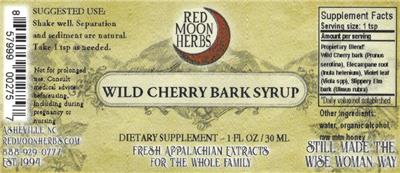
Supplement Facts
The label details for Wild Cherry Bark Syrup by Red Moon Herbs, sourced from the NIH Dietary Supplement Label Database.
Supplement Facts
| Ingredient | Amount | % DV |
|---|---|---|
| Proprietary Blend | 0 NP | -- |
| Elecampane | 0 NP | -- |
| Slippery Elm | 0 NP | -- |
| Wild Cherry | 0 NP | -- |
| Violet | 0 NP | -- |
Other ingredients: Water, Alcohol, Mountain Honey, Raw
Tap any ingredient to jump to its full detail below.
These statements are the manufacturer’s wording, reproduced from the product label — the label is saying it, not HelloPharmacist. We don’t verify or endorse them.
Suggested/Recommended/Usage/Directions
Suggested use: Shake well. Take 1 tsp as needed.
Formulation
Separation and sediment are natural.
Precautions
Not for prolonged use.
Consult medical advice before using, including during pregnancy or nursing.
General Statements
Red Moon Herbs Est. 1994
Still made the wise woman way
FDA Statement of Identity
Dietary Supplement
Formula
Fresh Appalachian Extracts for the whole family
Is this label outdated? Report a formula or label change and our pharmacy team will review it.
Wild Cherry Bark Syrup by Red Moon Herbs label
The label scan from the NIH Dietary Supplement Label Database. Tap to enlarge.
Label images are published by the NIH Dietary Supplement Label Database for the version of this product on file. Always read your actual product label.
View the full label (PDF)The Ingredients in Wild Cherry Bark Syrup by Red Moon Herbs
These are the 4 active ingredients this product is made of. Select any to open its full monograph.
Serving size1 Teaspoon(s) Dosage formLiquid Amounts shown are per serving.
Most supplement products combine several ingredients, and a medication can interact with the product through any one of them. Each ingredient below shows whether it has known drug interactions.
Proprietary Blend
- › Elecampane
- › Slippery Elm
- › Wild Cherry
- › Violet
Other (inactive) ingredients: Water, Alcohol, Mountain Honey, Raw. These complete the product’s ingredient list but are not active constituents.
Wild Cherry Bark Syrup by Red Moon Herbs Drug Interactions
HelloPharmacist Interaction Report
Red Moon Herbs Wild Cherry Bark Syrup contains four ingredients, three of which we've checked for interactions.
Two drugs are affected overall, though the interactions span different medication types.
Read the full breakdown — every affected drug type, severity by severity
Elecampane may add to the sedative effects of CNS depressants (drugs that slow your brain and nervous system, like sedatives and some pain relievers). The effect is theoretical based on elecampane's own sedative properties, but it's a Moderate concern.
Slippery elm may slow how your body absorbs oral drugs taken by mouth. Its mucilage content can get in the way of absorption, potentially lowering the levels of certain medications in your bloodstream — a Moderate interaction with oral drugs generally.
Wild cherry theoretically may raise levels of drugs metabolized by CYP3A4 enzymes (a liver system that breaks down many medications), though this hasn't been reported in actual patients. This is also Moderate.
Violet, one of the four ingredients, we could not check — we hold no data for it. Run your exact medications through the checker on this page to see if any are affected.
Check your own medications below · Editorial policy · How we use AI
Want to check YOUR meds against Wild Cherry Bark Syrup?
Ask about interactions with your drugs in plain English — “Can I take it with lisinopril?” — and we find you the answer in seconds, ingredient by ingredient.
Go to the checkerIngredients driving the most interactions
Individual Drug Interactions
The ingredients in Wild Cherry Bark Syrup interact with 2,087 drugs. Click any drug to see the details.
3 of the 4 ingredients in Wild Cherry Bark Syrup interact with drugs. Each result below shows which ingredient is responsible. Slippery Elm Wild Cherry Elecampane
"phentolamineOraVerse, Rogitine, Ryzumvi
How "phentolamine interacts with Wild Cherry Bark Syrup — through 1 ingredient. Tap an ingredient for the detail:
Slippery ElmOral Drugs Moderate
Interaction Summary
Theoretically, slippery elm may slow the absorption and reduce serum levels of oral drugs.
Read the full Slippery Elm + "phentolamine interaction6-mercaptopurinePurinethol
How 6-mercaptopurine interacts with Wild Cherry Bark Syrup — through 1 ingredient. Tap an ingredient for the detail:
Slippery ElmOral Drugs Moderate
Interaction Summary
Theoretically, slippery elm may slow the absorption and reduce serum levels of oral drugs.
Read the full Slippery Elm + 6-mercaptopurine interactionAdo-trastuzumab EmtansineKadcyla
How Ado-trastuzumab Emtansine interacts with Wild Cherry Bark Syrup — through 1 ingredient. Tap an ingredient for the detail:
Wild CherryCytochrome P450 3a4 (cyp3a4) Substrates Moderate
Interaction Summary
In vitro research suggests that wild cherry can inhibit cytochrome P450 3A4 (CYP3A4) enzymes.
Read the full Wild Cherry + Ado-trastuzumab Emtansine interactionAbacavirZiagen
How Abacavir interacts with Wild Cherry Bark Syrup — through 1 ingredient. Tap an ingredient for the detail:
Slippery ElmOral Drugs Moderate
Interaction Summary
Theoretically, slippery elm may slow the absorption and reduce serum levels of oral drugs.
Read the full Slippery Elm + Abacavir interactionAbacavir Sulfate, Dolutegravir, LamivudineTriumeq
How Abacavir Sulfate, Dolutegravir, Lamivudine interacts with Wild Cherry Bark Syrup — through 1 ingredient. Tap an ingredient for the detail:
Slippery ElmOral Drugs Moderate
Interaction Summary
Theoretically, slippery elm may slow the absorption and reduce serum levels of oral drugs.
Read the full Slippery Elm + Abacavir Sulfate, Dolutegravir, Lamivudine interactionAbacavir, LamivudineEpzicom
How Abacavir, Lamivudine interacts with Wild Cherry Bark Syrup — through 1 ingredient. Tap an ingredient for the detail:
Slippery ElmOral Drugs Moderate
Interaction Summary
Theoretically, slippery elm may slow the absorption and reduce serum levels of oral drugs.
Read the full Slippery Elm + Abacavir, Lamivudine interactionAbciximabReoPro
How Abciximab interacts with Wild Cherry Bark Syrup — through 1 ingredient. Tap an ingredient for the detail:
Slippery ElmOral Drugs Moderate
Interaction Summary
Theoretically, slippery elm may slow the absorption and reduce serum levels of oral drugs.
Read the full Slippery Elm + Abciximab interactionAbemaciclibVerzenio
How Abemaciclib interacts with Wild Cherry Bark Syrup — through 2 ingredients. Tap an ingredient for the detail:
Wild CherryCytochrome P450 3a4 (cyp3a4) Substrates Moderate
Interaction Summary
In vitro research suggests that wild cherry can inhibit cytochrome P450 3A4 (CYP3A4) enzymes.
Read the full Wild Cherry + Abemaciclib interactionSlippery ElmOral Drugs Moderate
Interaction Summary
Theoretically, slippery elm may slow the absorption and reduce serum levels of oral drugs.
Read the full Slippery Elm + Abemaciclib interactionAbiraterone
How Abiraterone interacts with Wild Cherry Bark Syrup — through 2 ingredients. Tap an ingredient for the detail:
Wild CherryCytochrome P450 3a4 (cyp3a4) Substrates Moderate
Interaction Summary
In vitro research suggests that wild cherry can inhibit cytochrome P450 3A4 (CYP3A4) enzymes.
Read the full Wild Cherry + Abiraterone interactionSlippery ElmOral Drugs Moderate
Interaction Summary
Theoretically, slippery elm may slow the absorption and reduce serum levels of oral drugs.
Read the full Slippery Elm + Abiraterone interactionAbiraterone AcetateYonsa, Zytiga
How Abiraterone Acetate interacts with Wild Cherry Bark Syrup — through 2 ingredients. Tap an ingredient for the detail:
Wild CherryCytochrome P450 3a4 (cyp3a4) Substrates Moderate
Interaction Summary
In vitro research suggests that wild cherry can inhibit cytochrome P450 3A4 (CYP3A4) enzymes.
Read the full Wild Cherry + Abiraterone Acetate interactionSlippery ElmOral Drugs Moderate
Interaction Summary
Theoretically, slippery elm may slow the absorption and reduce serum levels of oral drugs.
Read the full Slippery Elm + Abiraterone Acetate interactionAbrocitinibCibinqo
How Abrocitinib interacts with Wild Cherry Bark Syrup — through 1 ingredient. Tap an ingredient for the detail:
Slippery ElmOral Drugs Moderate
Interaction Summary
Theoretically, slippery elm may slow the absorption and reduce serum levels of oral drugs.
Read the full Slippery Elm + Abrocitinib interactionAcalabrutinibCalquence
How Acalabrutinib interacts with Wild Cherry Bark Syrup — through 2 ingredients. Tap an ingredient for the detail:
Wild CherryCytochrome P450 3a4 (cyp3a4) Substrates Moderate
Interaction Summary
In vitro research suggests that wild cherry can inhibit cytochrome P450 3A4 (CYP3A4) enzymes.
Read the full Wild Cherry + Acalabrutinib interactionSlippery ElmOral Drugs Moderate
Interaction Summary
Theoretically, slippery elm may slow the absorption and reduce serum levels of oral drugs.
Read the full Slippery Elm + Acalabrutinib interactionAcamprosateCampral
How Acamprosate interacts with Wild Cherry Bark Syrup — through 1 ingredient. Tap an ingredient for the detail:
Slippery ElmOral Drugs Moderate
Interaction Summary
Theoretically, slippery elm may slow the absorption and reduce serum levels of oral drugs.
Read the full Slippery Elm + Acamprosate interactionAcarboseGlucobay, Prandase, Precose
How Acarbose interacts with Wild Cherry Bark Syrup — through 1 ingredient. Tap an ingredient for the detail:
Slippery ElmOral Drugs Moderate
Interaction Summary
Theoretically, slippery elm may slow the absorption and reduce serum levels of oral drugs.
Read the full Slippery Elm + Acarbose interactionAcebutololRhotral, Sectral
How Acebutolol interacts with Wild Cherry Bark Syrup — through 1 ingredient. Tap an ingredient for the detail:
Slippery ElmOral Drugs Moderate
Interaction Summary
Theoretically, slippery elm may slow the absorption and reduce serum levels of oral drugs.
Read the full Slippery Elm + Acebutolol interactionAcenocoumarolSintrom
How Acenocoumarol interacts with Wild Cherry Bark Syrup — through 1 ingredient. Tap an ingredient for the detail:
Slippery ElmOral Drugs Moderate
Interaction Summary
Theoretically, slippery elm may slow the absorption and reduce serum levels of oral drugs.
Read the full Slippery Elm + Acenocoumarol interactionAcepromazineAtravet
How Acepromazine interacts with Wild Cherry Bark Syrup — through 2 ingredients. Tap an ingredient for the detail:
ElecampaneCns Depressants Moderate
Interaction Summary
Theoretically, elecampane may cause additive sedative effects when taken with CNS depressants.
Read the full Elecampane + Acepromazine interactionSlippery ElmOral Drugs Moderate
Interaction Summary
Theoretically, slippery elm may slow the absorption and reduce serum levels of oral drugs.
Read the full Slippery Elm + Acepromazine interactionAcetaminophenChildren's Tylenol, Children's Tylenol Meltaways, Tylenol, Tylenol Ex Strength
How Acetaminophen interacts with Wild Cherry Bark Syrup — through 1 ingredient. Tap an ingredient for the detail:
Slippery ElmOral Drugs Moderate
Interaction Summary
Theoretically, slippery elm may slow the absorption and reduce serum levels of oral drugs.
Read the full Slippery Elm + Acetaminophen interactionAcetaminophen, AspirinGemnisyn
How Acetaminophen, Aspirin interacts with Wild Cherry Bark Syrup — through 1 ingredient. Tap an ingredient for the detail:
Slippery ElmOral Drugs Moderate
Interaction Summary
Theoretically, slippery elm may slow the absorption and reduce serum levels of oral drugs.
Read the full Slippery Elm + Acetaminophen, Aspirin interactionAcetaminophen, Aspirin, CaffeineExcedrin, Excedrin Extra Strength, Excedrin Migraine
How Acetaminophen, Aspirin, Caffeine interacts with Wild Cherry Bark Syrup — through 2 ingredients. Tap an ingredient for the detail:
Wild CherryCytochrome P450 3a4 (cyp3a4) Substrates Moderate
Interaction Summary
In vitro research suggests that wild cherry can inhibit cytochrome P450 3A4 (CYP3A4) enzymes.
Read the full Wild Cherry + Acetaminophen, Aspirin, Caffeine interactionSlippery ElmOral Drugs Moderate
Interaction Summary
Theoretically, slippery elm may slow the absorption and reduce serum levels of oral drugs.
Read the full Slippery Elm + Acetaminophen, Aspirin, Caffeine interactionAcetaminophen, Brompheniramine, PhenylpropanolamineDimetapp Cold and Flu
How Acetaminophen, Brompheniramine, Phenylpropanolamine interacts with Wild Cherry Bark Syrup — through 1 ingredient. Tap an ingredient for the detail:
Slippery ElmOral Drugs Moderate
Interaction Summary
Theoretically, slippery elm may slow the absorption and reduce serum levels of oral drugs.
Read the full Slippery Elm + Acetaminophen, Brompheniramine, Phenylpropanolamine interactionAcetaminophen, ButalbitalAxocet, Bancap, Bucet, Butex Forte, Esgic CF, Orbivan CF +5 more
How Acetaminophen, Butalbital interacts with Wild Cherry Bark Syrup — through 1 ingredient. Tap an ingredient for the detail:
Slippery ElmOral Drugs Moderate
Interaction Summary
Theoretically, slippery elm may slow the absorption and reduce serum levels of oral drugs.
Read the full Slippery Elm + Acetaminophen, Butalbital interactionAcetaminophen, Butalbital, CaffeineEsgic, Esgic Plus, Fiogesic, Fioricet, Repan, Tecnal +1 more
How Acetaminophen, Butalbital, Caffeine interacts with Wild Cherry Bark Syrup — through 2 ingredients. Tap an ingredient for the detail:
Slippery ElmOral Drugs Moderate
Interaction Summary
Theoretically, slippery elm may slow the absorption and reduce serum levels of oral drugs.
Read the full Slippery Elm + Acetaminophen, Butalbital, Caffeine interactionWild CherryCytochrome P450 3a4 (cyp3a4) Substrates Moderate
Interaction Summary
In vitro research suggests that wild cherry can inhibit cytochrome P450 3A4 (CYP3A4) enzymes.
Read the full Wild Cherry + Acetaminophen, Butalbital, Caffeine interactionAcetaminophen, Butalbital, Caffeine, CodeineEsgic with Codeine, Fioricet w/ Codeine
How Acetaminophen, Butalbital, Caffeine, Codeine interacts with Wild Cherry Bark Syrup — through 3 ingredients. Tap an ingredient for the detail:
Wild CherryCytochrome P450 3a4 (cyp3a4) Substrates Moderate
Interaction Summary
In vitro research suggests that wild cherry can inhibit cytochrome P450 3A4 (CYP3A4) enzymes.
Read the full Wild Cherry + Acetaminophen, Butalbital, Caffeine, Codeine interactionSlippery ElmOral Drugs Moderate
Interaction Summary
Theoretically, slippery elm may slow the absorption and reduce serum levels of oral drugs.
Read the full Slippery Elm + Acetaminophen, Butalbital, Caffeine, Codeine interactionElecampaneCns Depressants Moderate
Interaction Summary
Theoretically, elecampane may cause additive sedative effects when taken with CNS depressants.
Read the full Elecampane + Acetaminophen, Butalbital, Caffeine, Codeine interactionAcetaminophen, Butalbital, CodeineBancap w/ Codeine
How Acetaminophen, Butalbital, Codeine interacts with Wild Cherry Bark Syrup — through 2 ingredients. Tap an ingredient for the detail:
ElecampaneCns Depressants Moderate
Interaction Summary
Theoretically, elecampane may cause additive sedative effects when taken with CNS depressants.
Read the full Elecampane + Acetaminophen, Butalbital, Codeine interactionSlippery ElmOral Drugs Moderate
Interaction Summary
Theoretically, slippery elm may slow the absorption and reduce serum levels of oral drugs.
Read the full Slippery Elm + Acetaminophen, Butalbital, Codeine interactionAcetaminophen, Butalbital, Codeine PhosphatePhrenilin #3
How Acetaminophen, Butalbital, Codeine Phosphate interacts with Wild Cherry Bark Syrup — through 2 ingredients. Tap an ingredient for the detail:
ElecampaneCns Depressants Moderate
Interaction Summary
Theoretically, elecampane may cause additive sedative effects when taken with CNS depressants.
Read the full Elecampane + Acetaminophen, Butalbital, Codeine Phosphate interactionSlippery ElmOral Drugs Moderate
Interaction Summary
Theoretically, slippery elm may slow the absorption and reduce serum levels of oral drugs.
Read the full Slippery Elm + Acetaminophen, Butalbital, Codeine Phosphate interactionAcetaminophen, Caffeine, Chlorpheniramine, Hydrocodone, PhenylephrineHycomine Compound
How Acetaminophen, Caffeine, Chlorpheniramine, Hydrocodone, Phenylephrine interacts with Wild Cherry Bark Syrup — through 3 ingredients. Tap an ingredient for the detail:
Wild CherryCytochrome P450 3a4 (cyp3a4) Substrates Moderate
Interaction Summary
In vitro research suggests that wild cherry can inhibit cytochrome P450 3A4 (CYP3A4) enzymes.
Read the full Wild Cherry + Acetaminophen, Caffeine, Chlorpheniramine, Hydrocodone, Phenylephrine interactionElecampaneCns Depressants Moderate
Interaction Summary
Theoretically, elecampane may cause additive sedative effects when taken with CNS depressants.
Read the full Elecampane + Acetaminophen, Caffeine, Chlorpheniramine, Hydrocodone, Phenylephrine interactionSlippery ElmOral Drugs Moderate
Interaction Summary
Theoretically, slippery elm may slow the absorption and reduce serum levels of oral drugs.
Read the full Slippery Elm + Acetaminophen, Caffeine, Chlorpheniramine, Hydrocodone, Phenylephrine interactionAcetaminophen, Caffeine, CodeineGesic C15, Gesic C30, Gesic C8, Lenoltec 1, Lenoltec 2, Lenoltec 3 +1 more
How Acetaminophen, Caffeine, Codeine interacts with Wild Cherry Bark Syrup — through 3 ingredients. Tap an ingredient for the detail:
Slippery ElmOral Drugs Moderate
Interaction Summary
Theoretically, slippery elm may slow the absorption and reduce serum levels of oral drugs.
Read the full Slippery Elm + Acetaminophen, Caffeine, Codeine interactionElecampaneCns Depressants Moderate
Interaction Summary
Theoretically, elecampane may cause additive sedative effects when taken with CNS depressants.
Read the full Elecampane + Acetaminophen, Caffeine, Codeine interactionWild CherryCytochrome P450 3a4 (cyp3a4) Substrates Moderate
Interaction Summary
In vitro research suggests that wild cherry can inhibit cytochrome P450 3A4 (CYP3A4) enzymes.
Read the full Wild Cherry + Acetaminophen, Caffeine, Codeine interactionAcetaminophen, Caffeine, Codeine, SalicylamideCodalan No.1, Codalan No.2, Codalan No.3
How Acetaminophen, Caffeine, Codeine, Salicylamide interacts with Wild Cherry Bark Syrup — through 3 ingredients. Tap an ingredient for the detail:
Wild CherryCytochrome P450 3a4 (cyp3a4) Substrates Moderate
Interaction Summary
In vitro research suggests that wild cherry can inhibit cytochrome P450 3A4 (CYP3A4) enzymes.
Read the full Wild Cherry + Acetaminophen, Caffeine, Codeine, Salicylamide interactionSlippery ElmOral Drugs Moderate
Interaction Summary
Theoretically, slippery elm may slow the absorption and reduce serum levels of oral drugs.
Read the full Slippery Elm + Acetaminophen, Caffeine, Codeine, Salicylamide interactionElecampaneCns Depressants Moderate
Interaction Summary
Theoretically, elecampane may cause additive sedative effects when taken with CNS depressants.
Read the full Elecampane + Acetaminophen, Caffeine, Codeine, Salicylamide interactionAcetaminophen, Caffeine, DihydrocodeineDHC Plus, Panlor DC, Panlor SS
How Acetaminophen, Caffeine, Dihydrocodeine interacts with Wild Cherry Bark Syrup — through 3 ingredients. Tap an ingredient for the detail:
ElecampaneCns Depressants Moderate
Interaction Summary
Theoretically, elecampane may cause additive sedative effects when taken with CNS depressants.
Read the full Elecampane + Acetaminophen, Caffeine, Dihydrocodeine interactionWild CherryCytochrome P450 3a4 (cyp3a4) Substrates Moderate
Interaction Summary
In vitro research suggests that wild cherry can inhibit cytochrome P450 3A4 (CYP3A4) enzymes.
Read the full Wild Cherry + Acetaminophen, Caffeine, Dihydrocodeine interactionSlippery ElmOral Drugs Moderate
Interaction Summary
Theoretically, slippery elm may slow the absorption and reduce serum levels of oral drugs.
Read the full Slippery Elm + Acetaminophen, Caffeine, Dihydrocodeine interactionEach ingredient & the kinds of drugs it affects
For each ingredient in Wild Cherry Bark Syrup with known interactions, here are the types of medications they can affect. Open any type for the detail — or search your exact drug in the checker above.
Slippery Elm
Oral Drugs
Theoretically, slippery elm may slow the absorption and reduce serum levels of oral drugs.
Slippery elm inner bark contains mucilage, which may interfere with the absorption of orally administered drugs.
Wild Cherry
Cytochrome P450 3A4 (Cyp3A4) Substrates
In vitro research suggests that wild cherry can inhibit cytochrome P450 3A4 (CYP3A4) enzymes. Theoretically, wild cherry might increase levels of drugs metabolized by CYP3A4. However, so far, this interaction has not been reported in humans.
Some drugs metabolized by CYP3A4 include lovastatin (Mevacor), ketoconazole (Nizoral), itraconazole (Sporanox), fexofenadine (Allegra), triazolam (Halcion), and others.
Elecampane
Cns Depressants
Theoretically, elecampane may cause additive sedative effects when taken with CNS depressants.
Elecampane might have sedative effects.
Brand information
Manufacturer and brand details for Wild Cherry Bark Syrup, from the product label.
Red Moon Herbs
See all Red Moon Herbs products- Name
- Red Moon Herbs
- City
- Asheville
- State
- NC
- Phone Number
- 888-929-0777
- Web Address
- redmoonherbs.com
Wild Cherry Bark Syrup by Red Moon Herbs: Common Questions
Does Wild Cherry Bark Syrup by Red Moon Herbs interact with any medications?
How can one product interact with so many drugs?
Where does this information come from?
Can I take this if I'm pregnant?
Can I take this while breastfeeding?
Does this actually help with cough?
What are the side effects?
Is this safe if I'm allergic to ragweed or daisies?
What's in this syrup besides the herbs?
Written and reviewed by the HelloPharmacist editorial staff. Our editorial policy
Not sure if Wild Cherry Bark Syrup is safe with your meds?
Our pharmacists answer your medication & supplement questions — free.
Label information is sourced from the NIH Dietary Supplement Label Database and reflects the product version on file; always read your actual product label. This page is for education only and is not a substitute for professional medical advice. Confirm with your pharmacist or doctor before combining supplements and medications.
The Full Monographs Behind Wild Cherry Bark Syrup’s Ingredients
Every ingredient we hold a full HelloPharmacist monograph for — uses, evidence, safety, and the complete interaction list.
Elecampane
Interacts with 248 drugsElecampane is a traditional herb used mainly for coughs and other respiratory complaints, and as a bitter for digestion. Modern human evidence is very limited, so it should be seen as a folk...
Read the full Elecampane monograph → Herb & supplement monographSlippery Elm
Interacts with 2,022 drugsSlippery elm is a traditional herbal remedy made from the inner bark of a North American elm tree, used mainly to soothe sore throats and irritated digestive tracts. Its mucilage can coat an...
Read the full Slippery Elm monograph → Herb & supplement monographWild Cherry
Interacts with 645 drugsWild cherry bark is a traditional cough remedy found in many old-fashioned cough syrups and lozenges, but there is little modern scientific evidence proving it works. The bark, leaves, and s...
Read the full Wild Cherry monograph →Sources & How We Checked
Wild Cherry Bark Syrup's label data comes from the NIH Dietary Supplement Label Database; the ingredient interaction data is from the Natural Medicines database, reviewed by our pharmacists.
- NIH Dietary Supplement Label Database (DSLD) — The official product label on file for this supplement.
- Natural Medicines (Therapeutic Research Center) — Evidence-graded clinical reference behind the ingredient interaction data.
Content is written and reviewed by licensed HelloPharmacist pharmacists. See our data sources and editorial standards for how this information is built and checked.
The 12 references behind this product’s interaction data
Every citation that drives the interaction findings for this product’s ingredients, from the evidence-graded Natural Medicines (TRC Healthcare) database. Open an ingredient to browse its citations — links open the study on PubMed or the publisher’s site.
Elecampane 5 references
- Newall CA, Anderson LA, Philpson JD. Herbal Medicine: A Guide for Healthcare Professionals. London, UK: The Pharmaceutical Press, 1996.
- McGuffin M, Hobbs C, Upton R, Goldberg A, eds. American Herbal Products Association's Botanical Safety Handbook. Boca Raton, FL: CRC Press, LLC 1997.
- Lamminpaa A, Estlander T, Jolanki R, Kanerva L. Occupational allergic contact dermatitis caused by decorative plants. Contact Dermatitis 1996;34:330-5. PubMed
- Pazzaglia, M., Venturo, N., Borda, G., and Tosti, A. Contact dermatitis due to a massage liniment containing Inula helenium extract. Contact Dermatitis 1995;33(4):267.
- Aalto-Korte, K., Alanko, K., Kuuliala, O., and Jolanki, R. Late reactions in patch tests: a 4-year review from a clinic of occupational dermatology. Contact Dermatitis 2007;56(2):81-86. PubMed
Slippery Elm 3 references
- The Review of Natural Products by Facts and Comparisons. St. Louis, MO: Wolters Kluwer Co., 1999.
- Brinker F. Herb Contraindications and Drug Interactions. 2nd ed. Sandy, OR: Eclectic Medical Publications, 1998.
- Czarnecki D, Nixon R, Bekhor P, and et al. Delayed prolonged contact urticaria from the elm tree. Contact Dermatitis 1993;28:196-197. PubMed
Wild Cherry 4 references
- Gruenwald J, Brendler T, Jaenicke C. PDR for Herbal Medicines. 1st ed. Montvale, NJ: Medical Economics Company, Inc., 1998.
- Brinker F. Herb Contraindications and Drug Interactions. 2nd ed. Sandy, OR: Eclectic Medical Publications, 1998.
- Budzinski JW, Foster BC, Vandenhoek S, Arnason JT. An in vitro evaluation of human cytochrome P450 3A4 inhibition by selected commercial herbal extracts and tinctures. Phytomedicine 2000;7:273-82. PubMed
- Pentore, R., Venneri, A., and Nichelli, P. Accidental choke-cherry poisoning: early symptoms and neurological sequelae of an unusual case of cyanide intoxication. Ital.J Neurol.Sci. 1996;17(3):233-235. PubMed
Parts of this content are provided by the Therapeutic Research Center, LLC.
DISCLAIMER: Currently this does not check for drug-drug interactions. This is not an all-inclusive comprehensive list of potential interactions and is for informational purposes only. Not all interactions are known or well-reported in the scientific literature, and new interactions are continually being reported. Input is needed from a qualified healthcare provider including a pharmacist before starting any therapy. Application of clinical judgment is necessary.
© 2021 Therapeutic Research Center, LLC