
SODIUM CHLORIDE .9 mg/mL Injection — NDC 0019-1188-27 (Billing 00019-1188-27)
This is a package of SODIUM CHLORIDE .9 mg/mL Injection from Liebel-Flarsheim Company LLC, marketed since Sep 2012 and currently FDA-listed. It is the main listing for this product, which comes in 2 package sizes.
NDC database record
One package, one record: these facts belong to NDC 0019-1188-27 alone.
- Record
- FDA NDC Directory package listing · Human prescription drug
- Code segments
- 0019 labeler · 1188 product · 27 package
- Package marketed since
- Sep 1, 2012
- Sample package
- No — commercial package
- Listing certified through
- Dec 31, 2026
- Barcode (UPC)
- 0300191188816
- FDA record last changed
- Jul 24, 2026
Other active recalls for Sodium Chloride (different manufacturers) — 6 · tap to view
Identity & classification
Regulatory identifiers FDA, NLM and CMS codes for this package
Drug-database identifiers Medi-Span GPI and First Databank GCN / HICL / AHFS classification
- GSN (GCN sequence number): 001218
- GCN: 03020
- GPI-14 (Medi-Span): 79750010102024
- HICL (First Databank): 045574
- AHFS class code: 40:36.00.00
Where does this data come from?
- FDA openFDA NDC Directory · synced Oct 8, 2026
- FDA label on DailyMed · label index refreshed Oct 8, 2026
- RxNorm (NLM RxNav) · catalog refreshed Oct 8, 2026
- Medi-Span GPI (licensed)
- First Databank (licensed) · refreshed Oct 8, 2026
Clinical
- It depends on the product. IV forms replace fluid and salt, while injection diluents dissolve other drugs. Other forms are used for rinsing, nasal congestion and nasal care, or to...
- Follow the directions on your product. Many are used as often as needed by adults and children 4 and over. Do not share the bottle, because that can spread infection.
- Some people get fever, irritation or infection at the IV site, or too much fluid in the body. Tell your nurse right away if the IV site hurts or looks red.
- What side effects should I expect with IV sodium chloride?
Patient education
Supplement & herbal interactions
Some supplements/herbs that may interact with Sodium Chloride — tap one for details:
Where does this data come from?
- MedlinePlus (NLM) · refreshed Oct 8, 2026
- FDA label on DailyMed · label index refreshed Oct 8, 2026
Ask a licensed pharmacist directly — free, answered by our team.
Pricing
A drug doesn't have one price. Each row is a different public payment system, and none is what you'd pay at the counter — that depends on your insurance. The ⓘ on each row explains what it measures.
| Price system | Per each | Per package |
|---|---|---|
| Retail pharmacies payNADAC · weekly | Not in the retail survey — common for institutional, discontinued, or low-volume packs. | |
| Medicaid paysCMS SDUD · 12 mo | No recent Medicaid claims on file for this NDC — rare and low-volume NDCs are suppressed in the public data. | |
| Medicare drug plans payPart D · quarterly | No Part D plan price is available for this NDC in our data. | |
| Medicare Part B allowsASP · A4217 | No ASP payment limit on file for A4217 this quarter. | |
Where does this data come from?
- CMS NADAC weekly file
- CMS ASP pricing files · refreshed Sep 20, 2026
- CMS Medicaid State Drug Utilization Data · refreshed Oct 9, 2026
- CMS Part D plan pricing files · refreshed Sep 24, 2026
- VA National Acquisition Center price file
Billing & reimbursement
Where does this data come from?
- CMS ASP NDC-HCPCS crosswalk · refreshed Sep 22, 2026
- DMEPDAC NDC-HCPCS crosswalk
- openFDA NSDE billing units · refreshed Oct 7, 2026
Packaging — all sizes for this product
| Package NDC | Description | Marketing start | Marketing end | Status |
|---|---|---|---|---|
| 00019-1188-27 You're viewing this Main listing | 20 BOX in 1 CARTON / 1 SYRINGE, PLASTIC in 1 BOX / 125 mL in 1 SYRINGE, PLASTIC | 2012-09-01 | — | Active |
| 00019-1188-81 0019-1188-81 | 20 BOX in 1 CARTON / 1 SYRINGE, PLASTIC in 1 BOX / 125 mL in 1 SYRINGE, PLASTIC | 2012-09-01 | — | Active |
Pack size FAQ
What quantity is in this package?
What NDC number is used to bill for this package of SODIUM CHLORIDE .9 mg/mL Injection?
Therapeutic equivalents
| Product | Labeler | Pack | NADAC/unit | TE | Status | Price vs. this |
|---|---|---|---|---|---|---|
| Sodium Chloride .9 mg/mLthis 00019-1188-27 | Liebel-Flarsheim | 1 syringe | — | — | FDA listed | — |
Where does this data come from?
- FDA openFDA NDC Directory · synced Oct 8, 2026
- FDA Orange Book · refreshed Oct 9, 2026
- CMS NADAC weekly file
Availability & generic status
We did not find an FDA-approved generic match for this exact strength, form and route.
Where does this data come from?
- FDA Orange Book · refreshed Oct 9, 2026
Inactive Ingredients / Excipients
Inactive ingredients, also called excipients, are components of the drug product other than the active ingredient. They may include fillers, dyes, coatings, preservatives, flavors, or other formulation ingredients.
🧪 Avoiding an ingredient? See Sodium Chloride inactive ingredients by manufacturer: every current product's list side by side, so you can ask your pharmacy for the version that does not list it.
💡 Tap an ingredient (hover on desktop) to see what it is and why it’s used.
-
UNII 059QF0KO0R
Water is a liquid solvent that dissolves and mixes ingredients together in liquid medicines, syrups, and injections. It helps distribute the active drug evenly throughout the product.
1 inactive ingredient listed in the exact product block matched to this NDC.
Where does this data come from?
ingredient classCode="IACT" elements from the exact product block matched by this NDC. Label-section narrative from DailyMed / the openFDA label index is shown separately when available.- FDA label on DailyMed · label index refreshed Oct 8, 2026
- FDA openFDA NDC Directory · synced Oct 8, 2026
Inactive ingredient FAQ
Are inactive ingredients the same for every manufacturer?
Why might an inactive ingredient be missing?
Can inactive ingredients matter?
Manufacturer & labeler
More NDCs from Liebel-Flarsheim Company LLC labeler code 00019
- Cysto-Conray II Iothalamate meglumine 172 mg/mL Injection NDC 0019-0862-50
- Conray iothalamate meglumine 600 mg/mL Injection NDC 0019-0953-05
- Optiray 320 Ioversol 678 mg/mL Injection NDC 0019-1323-00
- Optiray 300 Ioversol 636 mg/mL Injection NDC 0019-1332-00
- Optiray 350 Ioversol 741 mg/mL Injection NDC 0019-1333-00
- MD GASTROVIEW diatrizoate meglumine and diatrizoate sodium 600 mg/mL; 100 mg/mL Solution NDC 0019-4816-04
Where does this data come from?
- FDA openFDA NDC Directory · synced Oct 8, 2026
- Drugs@FDA
Full prescribing information FDA SPL
🎯 Indications and Usage ▾
1 INDICATIONS AND USAGE 125 mL Syringe: Sodium Chloride Injection USP 0.9% is indicated for use in flushing compatible contrast agents through Liebel-Flarsheim intravenous administration sets into indwelling intravascular access devices only when delivered by the following Liebel-Flarsheim power injectors: Angiomat ® , Illumena ® , Illumena ® Néo, CT9000 ® , CT9000 ® ADV, Optistat ® , Optivantage ® and Optistar Elite. For use in flushing compatible contrast agents through Liebel-Flarsheim intravenous administration sets into indwelling intravascular access devices ( 1 )
⏱️ Dosage and Administration ▾
2 DOSAGE AND ADMINISTRATION The 125 mL syringe are for single patient use only. Determine the volume of the saline flush for each patient individually based, in part, on the imaging procedure, the location of the vascular access device, the length of tubing between the Liebel-Flarsheim contrast agent power injector and the vascular access device and the recommendations made on the package insert for the contrast agent. Typical Sodium Chloride Injection USP 0.9% flush volumes following contrast agent administration in adults are 10 to 25 mL per injection at rates not to exceed 10 mL/sec.
Use of some Liebel-Flarsheim contrast agent power injectors allows for additional infusion of Sodium Chloride Injection USP 0.9% to maintain the patency of vascular access. Typical infusion rates used for this purpose are in the range of 0.5 to 1 mL per minute. Individualize infusion rates and flush volumes for each patient based on their body weight, fluid status and concomitant medical conditions.
Consult the Liebel-Flarsheim contrast agent power injector manual for proper use. For single patient use only. ( 2 ) Determine the volume of flush based on the imaging procedure, location of the vascular access device, length of tubing between power injector and vascular access device, and the contrast agent package insert.
( 2 ) Individualize the volume of flush based on body weight, fluid status and concomitant medical conditions. ( 2 ) Typical flush volumes for adults are 10 to 25 mL per injection at rates not to exceed 10 mL/sec. ( 2 ) May be used for additional infusion to maintain the patency of vascular access at a typical infusion rate of 0.5 to 1 mL per minute.
( 2 ) Do not use if packaging is damaged, wet, or not intact, if syringe or its tip cap shows signs of damage, leakage or displacement. Do not use if solution is hazy, cloudy, discolored, or contains particulate matter. ( 2 ) Use aseptic technique.
( 2 ) Expel residual air from the syringe and tubing prior to connection with the patient’s vascular access. ( 2 )
2.1Drug Handling Inspect the syringe for signs of break in sterility. Do not use if the syringe or its tip cap shows signs of damage, leakage or displacement. Do not use if the solution is hazy, cloudy, discolored or contains particulate matter.
Use aseptic technique. Expel residual air in both the syringe and tubing prior to connection with the patient’s vascular access. Instructions for assembly and inspection of the Sodium Chloride Injection USP 0.9% syringes prior to use are printed on this sheet.
2.2125 mL Syringe Assembly and Inspection NOTE: Exterior of syringe is not sterile. Contents of syringe and area under tip cap and piston ribs are sterile and should be treated accordingly. Remove syringe from carton and inspect the area around the tip cap and outside of piston for signs of leakage.
Do not use if leakage is observed. Load syringe into power injector. To remove tip cap from syringe, push in and twist off, then discard.
The area under the cap is sterile. Caution should now be used when handling. Next remove cap from luer locknut dust cover by twisting to break tamper evident seal.
Discard cap. Attach luer locknut to syringe by holding dust cover and screwing to the stop. Remove and discard dust cover when ready to attach sterile connector tubing.
Inspecting the 125 mL syringe Twisting off the 125 mL syringe cap Luer locknut detail Removing cap from luer locknut Attaching luer locknut to syringe
💊 Dosage Forms and Strengths ▾
3 DOSAGE FORMS AND STRENGTHS Sodium Chloride Injection USP (0.9%) a clear, colorless, odorless solution supplied in 125 mL prefilled syringes contents are sterile Supplied as a clear, colorless, odorless, sterile solution of Sodium Chloride 0.9% for intravenous administration ( 3 ) Supplied in 125 mL prefilled syringes ( 3 )
⛔ Contraindications ▾
4 CONTRAINDICATIONS None None ( 4 )
⚠️ Warnings and Cautions ▾
5 WARNINGS AND PRECAUTIONS Remove all air from the syringe and associated tubing prior to injection. ( 5.1 ) May cause fluid overload in patients with congestive heart failure, severe renal insufficiency, and in clinical states with edema, sodium retention, or hypernatremia. ( 5.3 ) Establish intravascular catheter patency prior to administration. ( 5.4 )
5.1Air Embolism Remove all air from the syringe and associated tubing prior to injection to avoid air embolus with the associated risk of stroke, organ ischemia and/or infarction, and death.
5.2Infectious Complications Use of a damaged syringe or failure to maintain aseptic technique may result in infection, sepsis and death [ see Dosage and Administration (2) ].
5.3Fluid Overload Sodium Chloride Injection USP 0.9% may cause fluid overload in patients with congestive heart failure, severe renal insufficiency, and in clinical states with edema, sodium retention, or hypernatremia. Consider each patient’s age, body weight, fluid status, concomitant medical conditions and planned radiological procedure to determine if use of Sodium Chloride Injection USP 0.9% is appropriate.
5.4Extravasation Extravasation of the Sodium Chloride Injection USP 0.9% may cause mechanical compression of neurovascular structures. Extravasation of contrast agent may result in tissue injury by osmolar and direct cytotoxicity (see package inserts of specific contrast agents). Establish intravascular catheter patency prior to the administration of Sodium Chloride Injection USP 0.9%.
🤒 Adverse Reactions ▾
6 ADVERSE REACTIONS Reported adverse reactions include: air embolization with stroke, chest pain, and dyspnea arrhythmia hypotension myocardial infarction sepsis febrile response local tenderness infection at the site of injection venous thrombosis or phlebitis extending from injection site extravasation fluid overload hypervolemia Adverse reactions due to solution or administration technique may include: air embolism with stroke, chest pain, and dyspnea, arrhythmia, hypotension, myocardial infarction, sepsis, febrile response, local tenderness, infection at the site of injection, venous thrombosis or phlebitis extending from injection site, extravasation, fluid overload and hypervolemia.
( 6 ) To report SUSPECTED ADVERSE REACTIONS, contact Liebel-Flarsheim Company LLC at 1-855-266-5037 or FDA at 1-800-FDA-1088 or www.fda.gov/medwatch.
👥 Use in Specific Populations ▾
8 USE IN SPECIFIC POPULATIONS Pregnancy: It is not known whether Sodium Chloride Injection USP 0.9% can cause fetal harm. ( 8.1 ) Pediatrics: Safety and effectiveness have not been established in pediatric patients. ( 8.4 ) Geriatrics: Dosing for an elderly patient should be cautious, reflecting the greater frequency of decreased hepatic, renal, or cardiac function, and of concomitant disease or other drug therapy. ( 8.5 )
8.1Pregnancy Risk Summary Administration of Sodium Chloride Injection USP 0.9% is not known to cause major birth defects, miscarriage or adverse maternal or fetal outcomes. Animal reproduction studies have not been conducted with Sodium Chloride Injection USP 0.9.% All pregnancies have a background risk of birth defect, loss, or other adverse outcomes. In the U.S. general population, the estimated background risk of major birth defects and miscarriage in clinically recognized pregnancies is 2-4% and 15-20%, respectively.
8.2Lactation Risk Summary Appropriate administration of Sodium Chloride Injection USP 0.9% is not known to cause harm to a breastfed infant.
8.4Pediatric Use Safety and effectiveness of Sodium Chloride Injection USP 0.9% administered by power injection in pediatric patients have not been established. Administration of Sodium Chloride Injection USP 0.9% to pediatric patients by power injection is not recommended. When performing manual injection of Sodium Chloride Injection USP 0.9% to pediatric patients, take into account the patient’s weight, fluid status, and concomitant medical conditions to determine if use of Sodium Chloride Injection USP 0.9% is appropriate.
The safety of manual injection of Sodium Chloride Injection USP 0.9% in pediatric patients is supported by reported clinical experience with intravenous infusion and flush of sodium chloride injection in pediatric patients. To minimize the risk of fluid overload, use the smallest dose of Sodium Chloride Injection USP 0.9% necessary for manually flushing contrast agent through the vascular access line.
8.5Geriatric Use No clinical studies of Sodium Chloride Injection USP 0.9% were conducted. Other reported clinical experience with sodium chloride injection has not identified differences in responses between the elderly and younger patients. In general, dose selection for an elderly patient should be cautious, usually starting at the low end of the dosing range, reflecting the greater frequency of decreased hepatic, renal, or cardiac function, and of concomitant disease or other drug therapy.
🤰 Pregnancy ▾
8.1Pregnancy Risk Summary Administration of Sodium Chloride Injection USP 0.9% is not known to cause major birth defects, miscarriage or adverse maternal or fetal outcomes. Animal reproduction studies have not been conducted with Sodium Chloride Injection USP 0.9.% All pregnancies have a background risk of birth defect, loss, or other adverse outcomes. In the U.S. general population, the estimated background risk of major birth defects and miscarriage in clinically recognized pregnancies is 2-4% and 15-20%, respectively.
🧒 Pediatric Use ▾
8.4Pediatric Use Safety and effectiveness of Sodium Chloride Injection USP 0.9% administered by power injection in pediatric patients have not been established. Administration of Sodium Chloride Injection USP 0.9% to pediatric patients by power injection is not recommended. When performing manual injection of Sodium Chloride Injection USP 0.9% to pediatric patients, take into account the patient’s weight, fluid status, and concomitant medical conditions to determine if use of Sodium Chloride Injection USP 0.9% is appropriate.
The safety of manual injection of Sodium Chloride Injection USP 0.9% in pediatric patients is supported by reported clinical experience with intravenous infusion and flush of sodium chloride injection in pediatric patients. To minimize the risk of fluid overload, use the smallest dose of Sodium Chloride Injection USP 0.9% necessary for manually flushing contrast agent through the vascular access line.
🧓 Geriatric Use ▾
8.5Geriatric Use No clinical studies of Sodium Chloride Injection USP 0.9% were conducted. Other reported clinical experience with sodium chloride injection has not identified differences in responses between the elderly and younger patients. In general, dose selection for an elderly patient should be cautious, usually starting at the low end of the dosing range, reflecting the greater frequency of decreased hepatic, renal, or cardiac function, and of concomitant disease or other drug therapy.
🆘 Overdosage ▾
10 OVERDOSAGE Use of Sodium Chloride Injection USP 0.9% may pose a threat of overdose marked by electrolyte disturbance and/or fluid overload, particularly in pediatric patients and patients with compromised renal or cardiac function. In the event of overdosage, discontinue the infusion, reevaluate the patient and institute appropriate corrective action.
🧬 Clinical Pharmacology ▾
12 CLINICAL PHARMACOLOGY Sodium Chloride Injection USP 0.9% has an osmotic pressure similar to plasma.
📦 How Supplied / Storage and Handling ▾
16 HOW SUPPLIED/STORAGE AND HANDLING Sodium Chloride Injection USP 0.9% is a clear, colorless, odorless solution containing 9 mg/mL of sodium chloride. Sodium Chloride Injection USP 0.9% is supplied in 125 mL prefilled syringes containing 125 mL of solution. Each syringe is sealed with rubber closures and the contents are sterile.
The 125 mL syringe is supplied with a luer locknut adapter which is cleared for manufacture and distribution as a device under 510(K) number 862653. The syringes are contained in shipping cartons with the following configurations: Volume Packaging NDC 125 mL in plastic syringes 20 syringes per carton 0019-1188-81 125 mL in plastic RFID-Tagged Syringes* 20 syringes per carton 0019-1188-27 *Radio Frequency Identification (RFID) Technology RFID-Tagged Syringe Description This information is for Ultraject ® syringes containing Sodium Chloride Injection USP 0.9% that has been labeled with a Radio Frequency Identification (RFID) tag.
When used with an RFID-enabled Optivantage Injector, this tag allows for the exchange of product information such as lot number, expiration, concentration, and identification of the syringe as being unused prior to use and used after product administration. Patient information is not utilized in any form with this RFID technology. Sodium Chloride Injection USP 0.9% product quality is not impacted with the use of this RFID tag.
Sodium Chloride Injection USP 0.9% RFID syringes require no special handling and should be stored at the conditions listed for the drug product. RFID-Tagged Syringe Directions for Use For the RFID technology to function, the syringe must be used with an Optivantage Injector with RFID technology. Function of the RFID technology is not dependent on syringe orientation as it is placed in the injector.
Instructions for use of the injector are provided on the injector interface screens and operator’s manual. If the RFID tag is damaged or otherwise non-functional, the injector will notify the user. Should this occur, the Sodium Chloride Injection USP 0.9% syringe with the non-functional RFID tag may still be used but no data will be transferred to the injector.
Regarding interference with medical devices, the RFID tag and injector system meet the IEC 60601-1-2 requirements for emission and immunity standards for medical devices. Follow all manufacturers’ guidelines and do not operate any part of the Optivantage Injector System and RFID-tagged syringes within 6 inches (15 cm) of a pacemaker and/or defibrillator. Storage Store Sodium Chloride Injection USP 0.9% syringes and RFID-tagged syringes at 25°C (77°F); excursions permitted to 15° to 30°C (59° to 86°F) [see USP Controlled Room Temperature].
PROTECT FROM FREEZING Manufactured by: Liebel-Flarsheim Company LLC Raleigh, NC 27616 Made in USA GBT 11880919 Issued: 9/19 Guerbet
📋 Description ▾
11 DESCRIPTION Sodium Chloride Injection USP 0.9% is a formulation of sodium chloride in Water for Intravascular Injection. No preservative, antimicrobial agent or buffer is added. Sodium Chloride Injection USP 0.9% is provided as a sterile, nonpyrogenic, clear, colorless, odorless solution. Molecular formula = NaCl MW =
58.44Each mL of Sodium Chloride Injection USP 0.9% contains 9 mg of sodium chloride. The pH is 4.5 to 7.0. The osmolarity is 308 mOsm/L (calc.). Sodium Chloride Injection USP 0.9% is provided in a 125 mL syringe with a 125 mL fill. The syringes are for single patient use and are disposable and not meant for reuse.
📄 Package Label / Principal Display Panel ▾
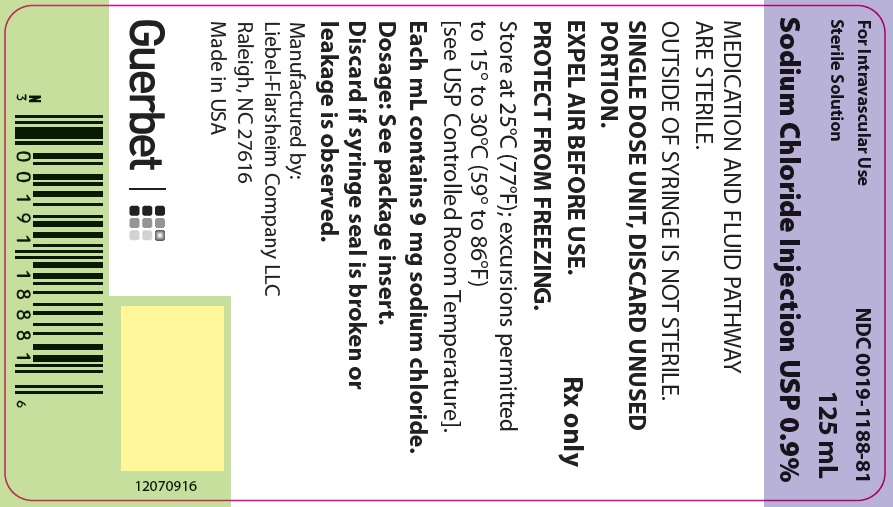
PACKAGE LABEL - PRINCIPAL DISPLAY PANEL - 125 mL Syringe For Intravascular Use Sterile Solution NDC 0019-1188-81 125 mL Sodium Chloride Injection USP 0.9% MEDICATION AND FLUID PATHWAY ARE STERILE. OUTSIDE OF SYRINGE IS NOT STERILE. SINGLE DOSE UNIT, DISCARD UNUSED PORTION.
EXPEL AIR BEFORE USE. PROTECT FROM FREEZING. Rx only Store at 25°C (77°F); excursions permitted to 15° to 30°C (59° to 86°F) [see USP Controlled Room Temperature].
Each mL contains 9 mg sodium chloride. Dosage: See package insert. Discard if syringe seal is broken or leakage is observed.
Manufactured by: Liebel-Flarsheim Company LLC Raleigh, NC 27616 Made in USA Guerbet 12070916 Principal Display Panel Carton
Medicare Part D spend CMS · PART D · 2026 (Q1)
About this NDC listing & data coverage
What data is (and isn’t) available for this NDC — tap to expand
| NDC identity (package / product / labeler codes) | ✓ Available |
| Labeler | ✓ Available |
| Product & package description | ✓ Available |
| Marketing category & status | ✓ Available |
| Active ingredient / dosage form / route | ✓ Available |
| FDA label (SPL via DailyMed) | ✓ Available |
| Package photos | ✓ Available |
| Inactive ingredients (structured) | ✓ Available |
| NADAC pharmacy acquisition price (CMS) | — Not published for this NDC CMS publishes NADAC only for NDCs reported in its retail-pharmacy survey. |
| Orange Book / therapeutic-equivalence data | — Not published for this NDC Applies only to products approved under an NDA/ANDA; many listings are out of scope. |
| HCPCS J-code billing crosswalk | ✓ Available |
| Medicaid utilization (CMS SDUD) | — Not published for this NDC CMS reports utilization only for NDCs with Medicaid claims above its privacy threshold. |