
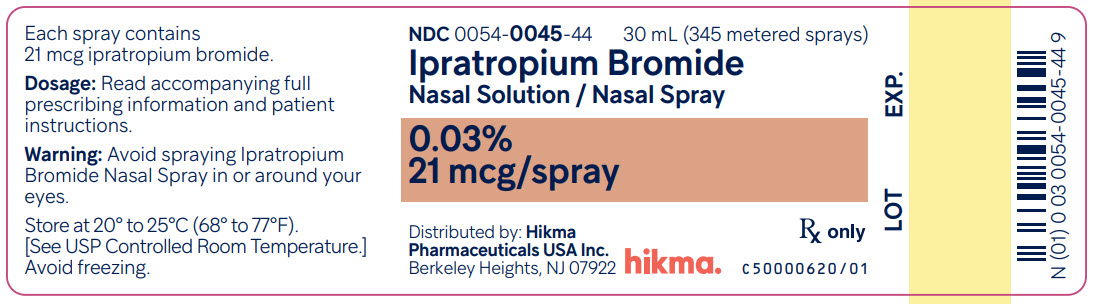
Ipratropium Bromide 21 ug Spray — NDC 0054-0045-44 (Billing 00054-0045-44)
This is a package of Ipratropium Bromide 21 ug Spray from Hikma Pharmaceuticals USA Inc., marketed since Nov 2003 and currently FDA-listed; retail pharmacies pay about $0.3678 per mL (NADAC). It is this product's only package size.
NDC database record
One package, one record: these facts belong to NDC 0054-0045-44 alone.
- Record
- FDA NDC Directory package listing · Human prescription drug
- Code segments
- 0054 labeler · 0045 product · 44 package
- Package marketed since
- Nov 5, 2003
- Sample package
- No — commercial package
- Listing certified through
- Dec 31, 2026
- Barcode (UPC-A, from the NDC)
- 3 0054004544 9
- Medicaid fills, this package
- 28,414 prescriptions in the last four reported quarters
- FDA record last changed
- Jul 24, 2026
Identity & classification
Regulatory identifiers FDA, NLM and CMS codes for this package
Drug-database identifiers Medi-Span GPI and First Databank GCN / HICL / AHFS classification
- GSN (GCN sequence number): 024457
- GCN: 42239
- GPI-14 (Medi-Span): 42300040102010
- HICL (First Databank): 000057
- AHFS class code: 52:92.00.00
- RxCUI (RxNorm): 1797833
Where does this data come from?
- FDA openFDA NDC Directory · synced Oct 8, 2026
- FDA label on DailyMed · label index refreshed Oct 8, 2026
- RxNorm (NLM RxNav) · catalog refreshed Oct 8, 2026
- Medi-Span GPI (licensed)
- First Databank (licensed) · refreshed Oct 8, 2026
RxNorm drug class
This medicine belongs to the Anticholinergic class.
Where does this data come from?
- RxClass (NLM) · catalog refreshed Oct 8, 2026
Clinical
- No, the ipratropium inhaler (like Atrovent HFA) is a maintenance medicine — it's meant to be used regularly every day to keep your airways open, not as a rescue inhaler during a su...
- My doctor gave me an ipratropium inhaler — can I use it when I have a sudden asthma attack?
- It depends on why you're using it. For a common cold, safety and effectiveness have only been established for up to 4 days. For seasonal allergies (hay fever), it's been studied fo...
- The nasal spray helps my runny nose, but can I keep using it past a week?
Patient education
Supplement & herbal interactions
Where does this data come from?
- MedlinePlus (NLM) · refreshed Oct 8, 2026
- FDA label on DailyMed · label index refreshed Oct 8, 2026
Ask a licensed pharmacist directly — free, answered by our team.
Pricing
A drug doesn't have one price. Each row is a different public payment system, and none is what you'd pay at the counter — that depends on your insurance. The ⓘ on each row explains what it measures.
| Price system | Per mL | Per package |
|---|---|---|
| Retail pharmacies payNADAC · weekly | $0.368 | — |
| Medicaid paysCMS SDUD · 12 mo | $0.7995 | — |
| Medicare drug plans payPart D · Q2 2026 | $0.6490 | — |
Where does this data come from?
- CMS NADAC weekly file · file of Oct 7, 2026
- CMS ASP pricing files · refreshed Sep 20, 2026
- CMS Medicaid State Drug Utilization Data · through Q1 2026
- CMS Part D plan pricing files · refreshed Sep 24, 2026
- VA National Acquisition Center price file
Packaging — all sizes for this product
| Package NDC | Description | Marketing start | Marketing end | Status |
|---|---|---|---|---|
| 00054-0045-44 You're viewing this Main listing | 1 BOTTLE, SPRAY in 1 CARTON / 345 SPRAY in 1 BOTTLE, SPRAY | 2003-11-05 | — | Active |
Therapeutic equivalents
| Product | Labeler | Pack | NADAC/unit | TE | Status | Price vs. this |
|---|---|---|---|---|---|---|
| Ipratropium Bromide 21 ugthis 00054-0045-44 | Hikma | 1 bottle | $0.368 | AB | Availability likely | — |
| Ipratropium Bromide 21 ug 16714-0526-01 | NORTHSTAR | 1 bottle | $0.368 | AB | Availability likely | — |
| Ipratropium Bromide 21 ug 60505-0826-01 | Apotex | 1 bottle | $0.368 | AB | Availability likely | — |
| Ipratropium Bromide 21 ug 69238-2016-03 | Amneal | 1 bottle | $0.368 | AB | Availability likely | — |
| Ipratropium Bromide 21 ug 70748-0336-01 | Lupin | 1 bottle | $0.368 | AB | Availability likely | — |
| Ipratropium Bromide 21 ug 72888-0149-38 | Advagen | 1 bottle | $0.368 | AB | Availability likely | — |
| Ipratropium bromide 21 ug 24208-0398-30 | Bausch | 1 bottle | $0.420 | AB | FDA listed | +14% |
| Ipratroprium Bromide 21 ug 68682-0398-30 | Oceanside | 1 bottle | — | AB | FDA listed | — |
| Ipratropium Bromide 21 ug 72162-2143-03 | Bryant | 1 bottle | — | AB | FDA listed | — |
Where does this data come from?
- FDA openFDA NDC Directory · synced Oct 8, 2026
- FDA Orange Book · refreshed Oct 9, 2026
- CMS NADAC weekly file · file of Oct 7, 2026
Availability & generic status
This product is an FDA-approved generic. Other versions of the same drug are listed under Therapeutic equivalents, least expensive first.
Where does this data come from?
- FDA Orange Book · refreshed Oct 9, 2026
Inactive Ingredients / Excipients
Inactive ingredients, also called excipients, are components of the drug product other than the active ingredient. They may include fillers, dyes, coatings, preservatives, flavors, or other formulation ingredients.
🧪 Avoiding an ingredient? See Ipratropium inactive ingredients by manufacturer: every current product's list side by side, so you can ask your pharmacy for the version that does not list it.
💡 Tap an ingredient (hover on desktop) to see what it is and why it’s used.
-
UNII F5UM2KM3W7
Benzalkonium chloride is a chemical compound that works as a preservative and antimicrobial agent in medications. It prevents bacterial and fungal growth in liquid formulations to keep the product safe during storage and use.
-
UNII 25IH6R4SGF
Edetate calcium disodium is a chelating agent, a chemical that binds to metal ions. It's used in some medications to prevent unwanted metals from interfering with the drug's stability and effectiveness.
-
UNII QTT17582CB
A strong acid used to adjust and maintain the proper pH level in liquid medicines, ensuring stability and preventing breakdown of active ingredients.
-
UNII 8136Y38GY5
A plant-derived thickening agent made from cellulose. It increases the thickness and consistency of liquid medicines, helping them coat surfaces and flow smoothly.
-
UNII 451W47IQ8X
Sodium chloride is common table salt. It's used in medicines as a buffer to maintain proper pH, as a filler to add bulk, or to adjust the osmotic balance in liquid formulations.
-
UNII 55X04QC32I
A strong alkaline chemical used to adjust and maintain the pH balance of liquid medicines. It helps keep the medicine stable and ensures it stays effective during storage.
-
UNII 059QF0KO0R
Water is a liquid solvent that dissolves and mixes ingredients together in liquid medicines, syrups, and injections. It helps distribute the active drug evenly throughout the product.
7 inactive ingredients listed in the exact product block matched to this NDC.
Where does this data come from?
ingredient classCode="IACT" elements from the exact product block matched by this NDC. Label-section narrative from DailyMed / the openFDA label index is shown separately when available.- FDA label on DailyMed · label index refreshed Oct 8, 2026
- FDA openFDA NDC Directory · synced Oct 8, 2026
Inactive ingredient FAQ
Are inactive ingredients the same for every manufacturer?
Why might an inactive ingredient be missing?
Can inactive ingredients matter?
Manufacturer & labeler
More NDCs from Hikma Pharmaceuticals USA Inc. labeler code 00054
- Flecainide Acetate 150 mg Tablet NDC 0054-0012-20
- PredniSONE 10 mg Tablet NDC 0054-0017-20
- PredniSONE 20 mg Tablet NDC 0054-0018-20
- PredniSONE 50 mg Tablet NDC 0054-0019-20
- Lithium Carbonate 450 mg Tablet, Extended Release NDC 0054-0020-25
- Lithium Carbonate 300 mg Tablet, Extended Release NDC 0054-0021-25
- Ipratropium Bromide 42 ug Spray NDC 0054-0046-41
- Digoxin .05 mg/mL Solution NDC 0054-0057-46
- Citalopram 10 mg/5mL Solution NDC 0054-0062-58
- Ondansetron Hydrochloride 4 mg/5mL Solution NDC 0054-0064-47
- Torsemide 20 mg Tablet NDC 0054-0077-25
- Balsalazide Disodium 750 mg Capsule NDC 0054-0079-28
Where does this data come from?
- FDA openFDA NDC Directory · synced Oct 8, 2026
- Drugs@FDA
Full prescribing information FDA SPL
💬 Information for Patients ▾
PATIENT’S INSTRUCTIONS FOR USE Ipratropium Bromide Nasal Solution, 0.03% Nasal Spray, 21mcg/spray Read complete instructions carefully before using. In order to ensure proper dosing, do not attempt to change the size of the spray opening. Ipratropium bromide nasal solution, 0.03% is indicated for the symptomatic relief of rhinorrhea (runny nose) associated with allergic and nonallergic perennial rhinitis in adults and children age 6 years and older.
Ipratropium bromide nasal solution, 0.03% does not relieve nasal congestion, sneezing, or postnasal drip associated with allergic or nonallergic perennial rhinitis. Read complete instructions carefully and use only as directed. To Use: 1.
Remove the clear plastic dust cap and the green safety clip from the nasal spray pump ( Figure 1 ). The safety clip prevents the accidental discharge of the spray in your pocket or purse. Figure 1 Figure 1 2.
The nasal spray pump must be primed before ipratropium bromide nasal solution, 0.03% is used for the first time. To prime the pump, hold the bottle with your thumb at the base and your index and middle fingers on the white shoulder area. Make sure the bottle points upright and away from your eyes.
Press your thumb firmly and quickly against the bottle seven times ( Figure 2 ). The pump is now primed and can be used. Your pump should not have to be reprimed unless you have not used the medication for more than 24 hours; repriming the pump will only require two sprays.
If you have not used your nasal spray for more than seven days, repriming the pump will require seven sprays. Figure 2 Figure 2 3. Before using ipratropium bromide nasal solution, 0.03%, blow your nose gently to clear your nostrils if necessary.
4. Close one nostril by gently placing your finger against the side of your nose, tilt your head slightly forward and, keeping the bottle upright, insert the nasal tip into the other nostril ( Figure 3 ). Point the tip toward the back and outer side of the nose.
Figure 3 Figure 3 5. Press firmly and quickly upwards with the thumb at the base while holding the white shoulder portion of the pump between your index and middle fingers. Following each spray, sniff deeply and breathe out through your mouth.
6. After spraying the nostril and removing the unit, tilt your head backwards for a few seconds to let the spray spread over the back of the nose. 7.
Repeat steps 4 through 6 in the same nostril. 8. Repeat steps 4 through 7 in the other nostril (i.e., two sprays per nostril).
9. Replace the clear plastic dust cap and safety clip. 10.
At some time before the medication is completely used up, you should consult your physician or pharmacist to determine whether a refill is needed. You should not take extra doses or stop using ipratropium bromide nasal solution, 0.03% without consulting your physician. To Clean: If the nasal tip becomes clogged, remove the clear plastic dust cap and safety clip.
Hold the nasal tip under running, warm tap water ( Figure 4 ) for about a minute. Dry the nasal tip, reprime the nasal spray pump (step 2 above), and replace the plastic dust cap and safety clip. Figure 4 Figure 4 Caution: Ipratropium bromide nasal solution, 0.03% is intended to relieve your rhinorrhea (runny nose) with regular use.
It is therefore important that you use ipratropium bromide nasal solution, 0.03% as prescribed by your physician. For most patients, some improvement in runny nose is usually apparent during the first full day of treatment with ipratropium bromide nasal solution, 0.03% Some patients may require up to two weeks of treatment to obtain maximum benefit. Do not spray ipratropium bromide nasal solution, 0.03% in your eyes.
Should this occur, immediately flush your eye with cool tap water for several minutes. If you accidentally spray ipratropium bromide nasal solution, 0.03% in your eyes, you may experience a temporary blurring of vision, visual halos or colored images in association with red eyes from conjunctival and corneal cong… [Excerpted — this section continues on DailyMed.]
📄 Package Label / Principal Display Panel ▾
PACKAGE/LABEL PRINCIPAL DISPLAY PANEL NDC 0054- 0045 -44 30 mL (345 metered sprays) Ipratropium Bromide Nasal Solution / Nasal Spray 0.03% 21 mcg/spray Rx only 0.03% bottle label
PACKAGE/LABEL PRINCIPAL DISPLAY PANEL NDC 0054- 0045 -44 30 mL (345 metered sprays) Ipratropium Bromide Nasal Solution 0.03% Nasal Spray 21 mcg/spray Rx only 0.03% folding carton