
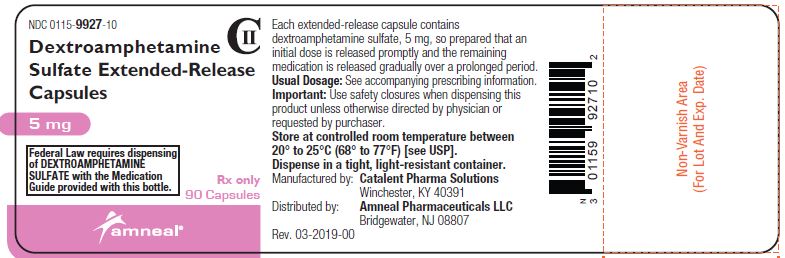
Dextroamphetamine Sulfate Extended-Release 5 mg Capsule, Extended Release, 90-count — NDC 0115-9927-10 (Billing 00115-9927-10)
This is a package of 90 capsules of Dextroamphetamine Sulfate Extended-Release 5 mg Capsule, Extended Release from Amneal Pharmaceuticals of New York LLC, marketed since Aug 1976 and currently FDA-listed; retail pharmacies pay about $0.8223 per capsule (NADAC). It is this product's only package size.
NDC database record
One package, one record: these facts belong to NDC 0115-9927-10 alone.
- Record
- FDA NDC Directory package listing · Human prescription drug
- Code segments
- 0115 labeler · 9927 product · 10 package
- Package marketed since
- Aug 2, 1976
- Sample package
- No — commercial package
- Listing certified through
- Dec 31, 2026
- Billing quantity
- 90 EA per package
- Barcode (UPC-A, from the NDC)
- 3 0115992710 2
- FDA record last changed
- Jul 24, 2026
Identity & classification
Regulatory identifiers FDA, NLM and CMS codes for this package
Drug-database identifiers Medi-Span GPI and First Databank GCN / HICL / AHFS classification
- GSN (GCN sequence number): 005007
- GCN: 19852
- GPI-14 (Medi-Span): 61100020107005
- HICL (First Databank): 002065
- AHFS class code: 28:20.04.00
- RxCUI (RxNorm): 884520
Where does this data come from?
- FDA openFDA NDC Directory · synced Oct 1, 2026
- FDA label on DailyMed · label index refreshed Oct 6, 2026
- RxNorm (NLM RxNav) · catalog refreshed Oct 1, 2026
- Medi-Span GPI (licensed)
- First Databank (licensed) · refreshed Oct 1, 2026
RxNorm drug class
This medicine belongs to the Central Nervous System Stimulant class.
Where does this data come from?
- RxClass (NLM) · catalog refreshed Oct 1, 2026
Clinical
Dextroamphetamine is used to control symptoms of attention deficit hyperactivity disorder (ADHD; more difficulty focusing, controlling actions, and remaining still or quiet than other people who are the same age) and to treat narcolepsy (a sleep disorder that causes excessive daytime sleepiness and sudden attacks of sleep). Dextroamphetamine is in a class of medications called central nervous system stimulants. It works by changing the amounts of certain natural substances in the brain.
Read the full MedlinePlus article ↗- It treats ADHD, and some oral forms are also used for narcolepsy. Which use and age range applies depends on the product you have. Your prescriber decides if it fits you or your ch...
- Take it exactly as prescribed, usually at the lowest dose that works. Avoid late-evening doses because they can keep you awake. If you use the Xelstrym patch, put it on about 2 hou...
- Common ones are reduced appetite, trouble sleeping, headache, stomach upset and irritability. Kids may lose weight, so we watch growth. Call your doctor for chest pain, a racing he...
- Check with me first. MAO inhibitors are a serious problem, and antidepressants, triptans, tramadol and St. John’s Wort can raise the risk of serotonin syndrome. Vitamin C and fruit...
Patient education
Supplement & herbal interactions
Where does this data come from?
- MedlinePlus (NLM) · refreshed Oct 1, 2026
- FDA label on DailyMed · label index refreshed Oct 6, 2026
Ask a licensed pharmacist directly — free, answered by our team.
Pricing
A drug doesn't have one price. Each row is a different public payment system, and none is what you'd pay at the counter — that depends on your insurance. The ⓘ on each row explains what it measures.
| Price system | Per ea | Per package |
|---|---|---|
| Retail pharmacies payNADAC · weekly | $0.822 | $74.01 / 90 capsules |
| Medicaid paysCMS SDUD · 12 mo | No recent Medicaid claims on file for this NDC — rare and low-volume NDCs are suppressed in the public data. | |
| Medicare drug plans payPart D · Q2 2026 | $1.43 | $128.71 / 90 capsules |
Where does this data come from?
- CMS NADAC weekly file · file of Nov 23, 2022
- CMS ASP pricing files · refreshed Sep 20, 2026
- CMS Medicaid State Drug Utilization Data · refreshed Oct 6, 2026
- CMS Part D plan pricing files · refreshed Sep 24, 2026
- VA National Acquisition Center price file
Packaging — all sizes for this product
| Package NDC | Description | Marketing start | Marketing end | Status |
|---|---|---|---|---|
| 00115-9927-10 You're viewing this Main listing | 90 CAPSULE, EXTENDED RELEASE in 1 BOTTLE | 1976-08-02 | — | Active |
Therapeutic equivalents
| Product | Labeler | Pack | NADAC/unit | TE | Status | Price vs. this |
|---|---|---|---|---|---|---|
| Dextroamphetamine Sulfate Extended-Release 5 mgthis 00115-9927-10 | Amneal | 90 capsules | $0.822 | AB | FDA listed | — |
| Dextroamphetamine Sulfate Extended-Release 5 mg 00406-8960-01 | SpecGx | 100 capsules | $1.101 | AB | Availability likely | +34% |
| dextroamphetamine sulfate 5 mg 45963-0303-09 | Actavis | 90 capsules | $1.101 | AB | Availability likely | +34% |
| Dexedrine Spansule 5 mg 64896-0673-10 | Amneal | 90 capsules | — | AB | FDA listed | — |
Where does this data come from?
- FDA openFDA NDC Directory · synced Oct 1, 2026
- FDA Orange Book · refreshed Oct 3, 2026
- CMS NADAC weekly file · file of Nov 23, 2022
Availability & generic status
FDA-approved generic versions are listed, and recent pricing/market data suggests they may be available — see Therapeutic equivalents.
Where does this data come from?
- FDA Orange Book · refreshed Oct 3, 2026
What it looks like
Where does this data come from?
- FDA label on DailyMed · label index refreshed Oct 6, 2026
Inactive Ingredients / Excipients
Inactive ingredients, also called excipients, are components of the drug product other than the active ingredient. They may include fillers, dyes, coatings, preservatives, flavors, or other formulation ingredients.
🧪 Avoiding an ingredient? See Dextroamphetamine inactive ingredients by manufacturer: every current product's list side by side, so you can ask your pharmacy for the version that does not list it.
💡 Tap an ingredient (hover on desktop) to see what it is and why it’s used.
-
UNII 936JST6JCN
Cetyl alcohol is a waxy, fatty substance derived from plant or animal sources. It acts as an emulsifier and thickener in medicines, helping blend oil and water components and giving products a smooth, creamy texture.
-
UNII 35SW5USQ3G
A synthetic yellow dye used to color medicines. It helps make tablets, capsules, and liquids visually distinct so patients can easily identify their medication.
-
UNII 4W5IH7FLNY
A clear, oily liquid derived from sebacic acid and butanol. It works as a plasticizer and solvent in pharmaceutical coatings and films, helping them stay flexible and smooth.
-
UNII 47MLB0F1MV
Ethylcellulose is a plant-based thickening agent made from cellulose. It slows how fast the medicine dissolves, helping control drug release in the stomach and intestines.
-
UNII H3R47K3TBD
FD&C Blue No. 1 is a synthetic blue dye approved for use in foods and medicines. It serves as a colorant to give the medication its distinctive appearance and help with product identification.
-
UNII WZB9127XOA
A synthetic red dye used to color medications and make them easier to identify. It serves as a colorant in tablets, capsules, and liquid formulations.
-
UNII H77VEI93A8
A synthetic yellow dye used to color medications. It helps identify the drug and make it visually distinctive, with no effect on how the medicine works.
-
UNII 2G86QN327L
Gelatin is a protein derived from animal collagen, commonly used in medicines as a gelling agent and capsule material. It helps create soft or hard capsule shells that hold and release medication, and can also thicken liquid formulations.
-
UNII 3NXW29V3WO
Hypromellose is a plant-based thickener made from cellulose. It's used in medicines as a binder to hold ingredients together, a coating for tablets, and a thickener for liquids.
-
UNII 3WJQ0SDW1A
Polyethylene glycol is a synthetic liquid or solid polymer used in medicines as a solvent, lubricant, and humectant. It helps dissolve active ingredients, reduces friction during manufacturing, and retains moisture in the final product.
-
UNII FZ989GH94E
Povidone is a synthetic polymer made from a plastic-like material. It acts as a binder to hold tablet ingredients together and as a disintegrant to help the tablet break apart in your stomach so the medicine can be absorbed.
-
UNII 368GB5141J
A detergent and foaming agent derived from coconut or palm oil. In medications, it helps break down and mix oil and water-based ingredients, aids in tablet disintegration, and improves how the drug dissolves and spreads in the mouth or digestive system.
12 inactive ingredients listed in the exact product block matched to this NDC.
Where does this data come from?
ingredient classCode="IACT" elements from the exact product block matched by this NDC. Label-section narrative from DailyMed / the openFDA label index is shown separately when available.- FDA label on DailyMed · label index refreshed Oct 6, 2026
- FDA openFDA NDC Directory · synced Oct 1, 2026
Inactive ingredient FAQ
Are inactive ingredients the same for every manufacturer?
Why might an inactive ingredient be missing?
Can inactive ingredients matter?
Manufacturer & labeler
More NDCs from Amneal Pharmaceuticals of New York LLC labeler code 00115
- Digoxin 250 ug Tablet NDC 0115-9822-01
- Dexmethylphenidate hydrochloride 5 mg Capsule, Extended Release NDC 0115-9918-01
- Dexmethylphenidate hydrochloride 10 mg Capsule, Extended Release NDC 0115-9919-01
- Dexmethylphenidate hydrochloride 15 mg Capsule, Extended Release NDC 0115-9920-01
- Dexmethylphenidate hydrochloride 20 mg Capsule, Extended Release NDC 0115-9921-01
- Dexmethylphenidate hydrochloride 30 mg Capsule, Extended Release NDC 0115-9922-01
- Dextroamphetamine Sulfate Extended-Release 10 mg Capsule, Extended Release NDC 0115-9928-10
- Dextroamphetamine Sulfate Extended-Release 15 mg Capsule, Extended Release NDC 0115-9929-10
- Levalbuterol .31 mg/3mL Solution NDC 0115-9930-78
- Levalbuterol .63 mg/3mL Solution NDC 0115-9931-78
- Levalbuterol 1.25 mg/3mL Solution NDC 0115-9932-78
- Lamotrigine 25 mg Tablet, Orally Disintegrating NDC 0115-9939-01
Where does this data come from?
- FDA openFDA NDC Directory · synced Oct 1, 2026
- Drugs@FDA
Full prescribing information FDA SPL
🚨 Boxed Warning ▾
WARNING AMPHETAMINES HAVE A HIGH POTENTIAL FOR ABUSE. ADMINISTRATION OF AMPHETAMINES FOR PROLONGED PERIODS OF TIME MAY LEAD TO DRUG DEPENDENCE AND MUST BE AVOIDED. PARTICULAR ATTENTION SHOULD BE PAID TO THE POSSIBILITY OF SUBJECTS OBTAINING AMPHETAMINES FOR NON-THERAPEUTIC USE OR DISTRIBUTION TO OTHERS, AND THE DRUGS SHOULD BE PRESCRIBED OR DISPENSED SPARINGLY. MISUSE OF AMPHETAMINES MAY CAUSE SUDDEN DEATH AND SERIOUS CARDIOVASCULAR ADVERSE EVENTS.
🎯 Indications and Usage ▾
INDICATIONS AND USAGE Dextroamphetamine sulfate is indicated in: Narcolepsy Attention Deficit Disorder with Hyperactivity As an integral part of a total treatment program that typically includes other measures (psychological, educational, social) for patients (ages 6 years to 16 years) with this syndrome. A diagnosis of Attention Deficit Hyperactivity Disorder (ADHD; DSM-IV) implies the presence of hyperactive-impulsive or inattentive symptoms that caused impairment and were present before age 7 years. The symptoms must cause clinically significant impairment, e.g., in social, academic, or occupational functioning, and be present in 2 or more settings, e.g., school (or work) and at home.
The symptoms must not be better accounted for by another mental disorder. For the Inattentive Type, at least 6 of the following symptoms must have persisted for at least 6 months: lack of attention to details/careless mistakes; lack of sustained attention; poor listener; failure to follow through on tasks; poor organization; avoids tasks requiring sustained mental effort; loses things; easily distracted; forgetful. For the Hyperactive-Impulsive Type, at least 6 of the following symptoms must have persisted for at least 6 months: fidgeting/squirming; leaving seat; inappropriate running/climbing; difficulty with quiet activities; “on the go”; excessive talking; blurting answers; can’t wait turn; intrusive.
The Combined Type requires both inattentive and hyperactive-impulsive criteria to be met. Special Diagnostic Considerations Specific etiology of this syndrome is unknown, and there is no single diagnostic test. Adequate diagnosis requires the use of medical and special psychological, educational, and social resources.
Learning may or may not be impaired. The diagnosis must be based upon a complete history and evaluation of the patient and not solely on the presences of the required number of DSM-IV characteristics. Need for Comprehensive Treatment Program Dextroamphetamine sulfate is indicated as an integral part of a total treatment program for ADHD that may include other measures (psychological, educational, social) for patients with this syndrome.
Drug treatment may not be indicated for all patients with this syndrome. Stimulants are not intended for use in patients who exhibit symptoms secondary to environmental factors and/or other primary psychiatric disorders, including psychosis. Appropriate educational placement is essential and psychosocial intervention is often helpful.
When remedial measures alone are insufficient, the decision to prescribe stimulant medication will depend upon the physician’s assessment of the chronicity and severity of the patient’s symptoms.
⏱️ Dosage and Administration ▾
DOSAGE AND ADMINISTRATION Amphetamines should be administered at the lowest effective dosage and dosage should be individually adjusted. Late evening doses should be avoided because of the resulting insomnia. Narcolepsy Usual dose is 5 to 60 mg per day in divided doses, depending on the individual patient response.
Narcolepsy seldom occurs in children under 12 years of age; however, when it does, dextroamphetamine sulfate may be used. The suggested initial dose for patients aged 6 to 12 is 5 mg daily; daily dose may be raised in increments of 5 mg at weekly intervals until an optimal response is obtained. In patients 12 years of age and older, start with 10 mg daily; daily dosage may be raised in increments of 10 mg at weekly intervals until an optimal response is obtained.
If bothersome adverse reactions appear (e.g., insomnia or anorexia), dosage should be reduced. Extended-release capsules may be used for once-a-day dosage wherever appropriate. Attention Deficit Disorder with Hyperactivity The extended-release capsule formulation is not recommended for pediatric patients younger than 6 years of age.
In pediatric patients 6 years of age and older, start with 5 mg once or twice daily; daily dosage may be raised in increments of 5 mg at weekly intervals until optimal response is obtained. Only in rare cases will it be necessary to exceed a total of 40 mg per day. Extended-release capsules may be used for once-a-day dosage wherever appropriate.
Where possible, drug administration should be interrupted occasionally to determine if there is a recurrence of behavioral symptoms sufficient to require continued therapy.
⛔ Contraindications ▾
CONTRAINDICATIONS Advanced arteriosclerosis, symptomatic cardiovascular disease, moderate to severe hypertension, hyperthyroidism, known hypersensitivity or idiosyncrasy to the sympathomimetic amines, glaucoma. Agitated states. Patients with a history of drug abuse.
Known hypersensitivity or idiosyncrasy to amphetamine. In patients known to be hypersensitive to amphetamine, or other components of dextroamphetamine sulfate. Hypersensitivity reactions such as angioedema and anaphylactic reactions have been reported in patients treated with other amphetamine products [see Adverse Reactions ].
Patients taking monoamine oxidase inhibitors (MAOIs), or within 14 days of stopping MAOIs (including MAOIs such as linezolid or intravenous methylene blue), because of an increased risk of hypertensive crisis [see Warnings and Drug Interactions ].
⚠️ Warnings ▾
WARNINGS Serious Cardiovascular Events Sudden Death in Patients with Pre-existing Structural Cardiac Abnormalities or Other Serious Heart Problems Children and Adolescents Sudden death has been reported in association with CNS stimulant treatment at usual doses in children and adolescents with structural cardiac abnormalities or other serious heart problems. Although some serious heart problems alone carry an increased risk of sudden death, stimulant products generally should not be used in children or adolescents with known serious structural cardiac abnormalities, cardiomyopathy, serious heart rhythm abnormalities, or other serious cardiac problems that may place them at increased vulnerability to the sympathomimetic effects of a stimulant drug.
Adults Sudden deaths, stroke, and myocardial infarction have been reported in adults taking stimulant drugs at usual doses for ADHD. Although the role of stimulants in these adult cases is also unknown, adults have a greater likelihood than children of having serious structural cardiac abnormalities, cardiomyopathy, serious heart rhythm abnormalities, coronary artery disease, or other serious cardiac problems. Adults with such abnormalities should also generally not be treated with stimulant drugs [see Contraindications ].
Hypertension and Other Cardiovascular Conditions Stimulant medications cause a modest increase in average blood pressure (about 2 mmHg to 4 mmHg) and average heart rate (about 3 bpm to 6 bpm), and individuals may have larger increases. While the mean changes alone would not be expected to have short-term consequences, all patients should be monitored for larger changes in heart rate and blood pressure. Caution is indicated in treating patients whose underlying medical conditions might be compromised by increases in blood pressure or heart rate, e.g., those with pre-existing hypertension, heart failure, recent myocardial infarction, or ventricular arrhythmia [see Contraindications ].
Assessing Cardiovascular Status in Patients Being Treated with Stimulant Medications Children, adolescents, or adults who are being considered for treatment with stimulant medications should have a careful history (including assessment for a family history of sudden death or ventricular arrhythmia) and physical exam to assess for the presence of cardiac disease, and should receive further cardiac evaluation if findings suggest such disease (e.g., electrocardiogram and echocardiogram). Patients who develop symptoms such as exertional chest pain, unexplained syncope, or other symptoms suggestive of cardiac disease during stimulant treatment should undergo a prompt cardiac evaluation.
Psychiatric Adverse Events Pre-Existing Psychosis Administration of stimulants may exacerbate symptoms of behavior disturbance and thought disorder in patients with a pre-existing psychotic disorder. Bipolar Illness Particular care should be taken in using stimulants to treat ADHD in patients with comorbid bipolar disorder because of concern for possible induction of a mixed/manic episode in such patients. Prior to initiating treatment with a stimulant, patients with comorbid depressive symptoms should be adequately screened to determine if they are at risk for bipolar disorder; such screening should include a detailed psychiatric history, including a family history of suicide, bipolar disorder, and depression.
Emergence of New Psychotic or Manic Symptoms Treatment emergent psychotic or manic symptoms, e.g., hallucinations, delusional thinking, or mania in children and adolescents without a prior history of psychotic illness or mania can be caused by stimulants at usual doses. If such symptoms occur, consideration should be given to a possible causal role of the stimulant, and discontinuation of treatment may be appropriate. In a pooled analysis of multiple short-term, placebo-controlled studies, such symptoms occurred in about 0.1% (4 patients with events out of 3,482 exposed to methylphenidate or amphetamin… [Excerpted — this section continues on DailyMed.]
🤒 Adverse Reactions ▾
ADVERSE REACTIONS Cardiovascular Palpitations, tachycardia, elevation of blood pressure. There have been isolated reports of cardiomyopathy associated with chronic amphetamine use. Central Nervous System Psychotic episodes at recommended doses (rare), overstimulation, restlessness, dizziness, insomnia, euphoria, dyskinesia, dysphoria, tremor, headache, exacerbation of motor and phonic tics, and Tourette’s syndrome.
Gastrointestinal Dryness of the mouth, unpleasant taste, diarrhea, constipation, other gastrointestinal disturbances. Anorexia and weight loss may occur as undesirable effects. Allergic Urticaria.
Endocrine Impotence, changes in libido, frequent or prolonged erections. Musculoskeletal Rhabdomyolysis. Skin and Subcutaneous Tissue Disorders Alopecia.
To report SUSPECTED ADVERSE REACTIONS, contact Amneal Pharmaceuticals at 1-877-835-5472 or FDA at 1-800-FDA-1088 or www.fda.gov/medwatch.
🔄 Drug Interactions ▾
Drug Interactions Acidifying Agents Lower blood levels and efficacy of amphetamines. Increase dose based on clinical response. Examples of acidifying agents include gastrointestinal acidifying agents (e.g., guanethidine, reserpine, glutamic acid hydrochloride, ascorbic acid) and urinary acidifying agents (e.g., ammonium chloride, sodium acid phosphate, methenamine salts).
Adrenergic Blockers Adrenergic blockers are inhibited by amphetamines. Alkalinizing Agents Increase blood levels and potentiate the action of amphetamine. Co-administration of dextroamphetamine sulfate and gastrointestinal alkalinizing agents should be avoided.
Examples of alkalinizing agents include gastrointestinal alkalinizing agents (e.g., sodium bicarbonate) and urinary alkalinizing agents (e.g. acetazolamide, some thiazides). Tricyclic Antidepressants May enhance the activity of tricyclic or sympathomimetic agents causing striking and sustained increases in the concentration of d-amphetamine in the brain; cardiovascular effects can be potentiated. Monitor frequently and adjust or use alternative therapy based on clinical response.
Examples of tricyclic antidepressants include desipramine, protriptyline. CYP2D6 Inhibitors The concomitant use of dextroamphetamine sulfate and CYP2D6 inhibitors may increase the exposure of dextroamphetamine sulfate compared to the use of the drug alone and increase the risk of serotonin syndrome. Initiate with lower doses and monitor patients for signs and symptoms of serotonin syndrome particularly during dextroamphetamine sulfate initiation and after a dosage increase.
If serotonin syndrome occurs, discontinue dextroamphetamine sulfate and the CYP2D6 inhibitor [see Warnings , Overdosage ]. Examples of CYP2D6 Inhibitors include paroxetine and fluoxetine (also serotonergic drugs), quinidine, ritonavir. Serotonergic Drugs The concomitant use of dextroamphetamine sulfate and serotonergic drugs increases the risk of serotonin syndrome.
Initiate with lower doses and monitor patients for signs and symptoms of serotonin syndrome, particularly during dextroamphetamine sulfate initiation or dosage increase. If serotonin syndrome occurs, discontinue dextroamphetamine sulfate and the concomitant serotonergic drug(s) [see Warnings and Precautions ]. Examples of serotonergic drugs include selective serotonin reuptake inhibitors (SSRI), serotonin norepinephrine reuptake inhibitors (SNRI), triptans, tricyclic antidepressants, fentanyl, lithium, tramadol, tryptophan, buspirone, St.
John’s Wort. MAO Inhibitors Concomitant use of MAOIs and CNS stimulants can cause hypertensive crisis. Potential outcomes include death, stroke, myocardial infarction, aortic dissection, ophthalmological complications, eclampsia, pulmonary edema, and renal failure.
Do not administer dextroamphetamine sulfate concomitantly or within 14 days after discontinuing MAOI [see Contraindications and Warnings ]. Examples of MAOIs include selegiline, tranylcypromine, isocarboxazid, phenelzine, linezolid, methylene blue. Proton Pump Inhibitors Time to maximum concentration (T max ) of amphetamine is decreased compared to when administered alone.
Monitor patients for changes in clinical effect and adjust therapy based on clinical response. An example of a proton pump inhibitor is omeprazole. Antihistamines Amphetamines may counteract the sedative effect of antihistamines.
Antihypertensives Amphetamines may antagonize the hypotensive effects of antihypertensives. Chlorpromazine Chlorpromazine blocks dopamine and norepinephrine reuptake, thus inhibiting the central stimulant effects of amphetamines, and can be used to treat amphetamine poisoning. Ethosuximide Amphetamines may delay intestinal absorption of ethosuximide.
Haloperidol Haloperidol blocks dopamine and norepinephrine reuptake, thus inhibiting the central stimulant effects of amphetamines. Lithium Carbonate The stimulatory effects of amphetamines may be inhibited by lithium carbonate. Meperidine Amphetamines potenti… [Excerpted — this section continues on DailyMed.]
🆘 Overdosage ▾
OVERDOSAGE Manifestations of amphetamine overdose include restlessness, tremor, hyperreflexia, rapid respiration, confusion, assaultiveness, hallucinations, panic states, hyperpyrexia and rhabdomyolysis. Fatigue and depression usually follow the central nervous system stimulation. Serotonin syndrome has also been reported.
Cardiovascular effects include arrhythmias, hypertension or hypotension and circulatory collapse. Gastrointestinal symptoms include nausea, vomiting, diarrhea and abdominal cramps. Fatal poisoning is usually preceded by convulsions and coma.
Treatment Consult with a Certified Poison Control Center for up to date guidance and advice.
🧬 Clinical Pharmacology ▾
CLINICAL PHARMACOLOGY Amphetamines are noncatecholamine, sympathomimetic amines with CNS stimulant activity. Peripheral actions include elevations of systolic and diastolic blood pressures and weak bronchodilator and respiratory stimulant action. There is neither specific evidence that clearly establishes the mechanism whereby amphetamines produce mental and behavioral effects in children, nor conclusive evidence regarding how these effects relate to the condition of the central nervous system.
Dextroamphetamine sulfate extended-release capsules are formulated to release the active drug substance in vivo in a more gradual fashion than the standard formulation, as demonstrated by blood levels. The formulation has not been shown superior in effectiveness over the same dosage of the standard, non-controlled-release formulations given in divided doses. Pharmacokinetics The pharmacokinetics of the tablet and extended-release capsule were compared in 12 healthy subjects.
The extent of bioavailability of the extended-release capsule was similar compared to the immediate-release tablet. Following administration of three 5-mg tablets, average maximal dextroamphetamine plasma concentrations (C max ) of 36.6 ng/mL were achieved at approximately 3 hours. Following administration of one 15-mg extended-release capsule, maximal dextroamphetamine plasma concentrations were obtained approximately 8 hours after dosing.
The average C max was 23.5 ng/mL. The average plasma T ½ was similar for both the tablet and extended-release capsule and was approximately 12 hours. In 12 healthy subjects, the rate and extent of dextroamphetamine absorption were similar following administration of the extended-release capsule formulation in the fed (58 g to 75 g fat) and fasted state.
📦 How Supplied / Storage and Handling ▾
HOW SUPPLIED Dextroamphetamine Sulfate Extended-Release Capsules are supplied as follows: Dextroamphetamine Sulfate Extended-Release Capsules, 5 mg: Each capsule, with brown cap and natural body, contains dextroamphetamine sulfate. The 5 mg capsule is imprinted in white with IX and 5 mg on the brown cap and is imprinted in white with 673 and 5 mg on the natural body. They are available as: Bottles of 90: NDC 0115-9927-10 Dextroamphetamine Sulfate Extended-Release Capsules, 10 mg: Each capsule, with brown cap and natural body, contains dextroamphetamine sulfate.
The 10 mg capsule is imprinted in white with IX and 10 mg on the brown cap and is imprinted in white with 674 and 10 mg on the natural body. They are available as: Bottles of 90: NDC 0115-9928-10 Dextroamphetamine Sulfate Extended-Release Capsules, 15 mg: Each capsule, with brown cap and natural body, contains dextroamphetamine sulfate. The 15 mg capsule is imprinted in white with IX and 15 mg on the brown cap and is imprinted in white with 675 and 15 mg on the natural body.
They are available as: Bottles of 90: NDC 0115-9929-10 Store at controlled room temperature between 20° to 25°C (68° to 77°F) [See USP]. Dispense in a tight, light-resistant container. Manufactured by: Catalent Pharma Solutions Winchester, KY 40391 Distributed by: Amneal Pharmaceuticals LLC Bridgewater, NJ 08807 Rev.
03-2019-00 For additional copies of the printed medication guide, please visit www.amneal.com or contact us at 1-877-835-5472.
📋 Description ▾
DESCRIPTION Dextroamphetamine sulfate is the dextro isomer of the compound d,l -amphetamine sulfate, a sympathomimetic amine of the amphetamine group. Chemically, dextroamphetamine is d -alpha-methylphenethylamine, and is present in all forms of dextroamphetamine sulfate as the neutral sulfate. Structural formula: Each extended-release capsule is so prepared that an initial dose is released promptly and the remaining medication is released gradually over a prolonged period.
Each capsule, with brown cap and natural body, contains 5 mg, 10 mg or 15 mg dextroamphetamine sulfate. The 5 mg capsule is imprinted in white with IX and 5 mg on the brown cap and is imprinted in white with 673 and 5 mg on the natural body. The 10 mg capsule is imprinted in white with IX and 10 mg on the brown cap and is imprinted in white with 674 and 10 mg on the natural body.
The 15 mg capsule is imprinted in white with IX and 15 mg on the brown cap and is imprinted in white with 675 and 15 mg on the natural body. Product reformulation in 1996 has caused a minor change in the color of the time-released pellets within each capsule. Inactive ingredients now consist of cetyl alcohol, D&C Yellow No.
10, dibutyl sebacate, ethylcellulose, FD&C Blue No. 1, FD&C Red No. 40, FD&C Yellow No.
6, gelatin, hypromellose, polyethylene glycol, povidone, sodium lauryl sulfate, sugar spheres, and trace amounts of other inactive ingredients. structural formula for amphetamine sulfate
💬 Medication Guide ▾
MEDICATION GUIDE Dextroamphetamine Sulfate (dex” troe am fet’ a meen sul’ fate) Extended-Release Capsules, CII Read the Medication Guide that comes with dextroamphetamine sulfate extended-release capsules before you or your child starts taking it and each time you get a refill. There may be new information. This Medication Guide does not take the place of talking to your doctor about your or your child’s treatment with dextroamphetamine sulfate extended-release capsules.
What is the most important information I should know about dextroamphetamine sulfate extended-release capsules? The following have been reported with use of dextroamphetamine sulfate extended-release capsules and other stimulant medicines. 1.
Heart-related problems: Sudden death in patients who have heart problems or heart defects Stroke and heart attack in adults Increased blood pressure and heart rate Tell your doctor if you or your child has any heart problems, heart defects, high blood pressure, or a family history of these problems. Your doctor should check you or your child carefully for heart problems before starting dextroamphetamine sulfate extended-release capsules. Your doctor should check your or your child’s blood pressure and heart rate regularly during treatment with dextroamphetamine sulfate extended-release capsules.
Call your doctor right away if you or your child has any signs of heart problems such as chest pain, shortness of breath, or fainting while taking dextroamphetamine sulfate extended-release capsules. 2. Mental (Psychiatric) problems: All Patients new or worse behavior and thought problems new or worse bipolar illness new or worse aggressive behavior or hostility Children and Teenagers new psychotic symptoms (such as hearing voices, believing things that are not true, are suspicious) or new manic symptoms Tell your doctor about any mental problems you or your child have, or about a family history of suicide, bipolar illness, or depression.
Call your doctor right away if you or your child has any new or worsening mental symptoms or problems while taking dextroamphetamine sulfate extended-release capsules, especially seeing or hearing things that are not real, believing things that are not real, or are suspicious. 3. Circulation problems in fingers and toes [Peripheral vasculopathy, including Raynaud’s phenomenon] : fingers or toes may feel numb, cool, painful fingers or toes may change color from pale, to blue, to red Tell your doctor if you have or your child has numbness, pain, skin color change, or sensitivity to temperature in your fingers or toes.
Call your doctor right away if you have or your child has any signs of unexplained wounds appearing on fingers or toes while taking dextroamphetamine sulfate. What are dextroamphetamine sulfate extended-release capsules? Dextroamphetamine sulfate extended-release capsules are a central nervous system stimulant prescription medicine.
It is used for the treatment of Attention-Deficit Hyperactivity Disorder (ADHD). Dextroamphetamine sulfate extended-release capsules may help increase attention and decrease impulsiveness and hyperactivity in patients with ADHD. Dextroamphetamine sulfate extended-release capsules should be used as a part of a total treatment program for ADHD that may include counselling or other therapies.
Dextroamphetamine sulfate extended-release capsules are also used in the treatment of a sleep disorder called narcolepsy. Dextroamphetamine sulfate is a federally controlled substance (CII) because it can be abused or lead to dependence. Keep dextroamphetamine sulfate extended-release capsules in a safe place to prevent misuse and abuse.
Selling or giving away dextroamphetamine sulfate extended-release capsules may harm others and is against the law. Tell your doctor if you or your child have (or have a family history of) ever abused or been dependent on alcohol, prescription medicines or street drugs. Who should not take dextroamphetamine sulfate extended-release capsul… [Excerpted — this section continues on DailyMed.]
⚠️ Precautions ▾
PRECAUTIONS General The least amount feasible should be prescribed or dispensed at 1 time in order to minimize the possibility of overdosage. Information for Patients Amphetamines may impair the ability of the patient to engage in potentially hazardous activities such as operating machinery or vehicles; the patient should therefore be cautioned accordingly. Prescribers or other health professionals should inform patients, their families, and their caregivers about the benefits and risks associated with treatment with dextroamphetamine and should counsel them in its appropriate use.
A patient Medication Guide is available for dextroamphetamine sulfate extended-release capsules. The prescriber or health professional should instruct patients, their families, and their caregivers to read the Medication Guide and should assist them in understanding its contents. Patients should be given the opportunity to discuss the contents of the Medication Guide and to obtain answers to any questions they may have.
The complete text of the Medication Guide is reprinted at the end of this document. Circulation problems in fingers and toes [Peripheral vasculopathy, including Raynaud’s phenomenon] Instruct patients beginning treatment with dextroamphetamine sulfate about the risk of peripheral vasculopathy, including Raynaud’s phenomenon, and associated signs and symptoms: fingers or toes may feel numb, cool, painful, and/or may change color from pale, to blue, to red. Instruct patients to report to their physician any new numbness, pain, skin color change, or sensitivity to temperature in fingers or toes.
Instruct patients to call their physician immediately with any signs of unexplained wounds appearing on fingers or toes while taking dextroamphetamine sulfate. Further clinical evaluation (e.g., rheumatology referral) may be appropriate for certain patients. Drug Interactions Acidifying Agents Lower blood levels and efficacy of amphetamines.
Increase dose based on clinical response. Examples of acidifying agents include gastrointestinal acidifying agents (e.g., guanethidine, reserpine, glutamic acid hydrochloride, ascorbic acid) and urinary acidifying agents (e.g., ammonium chloride, sodium acid phosphate, methenamine salts). Adrenergic Blockers Adrenergic blockers are inhibited by amphetamines.
Alkalinizing Agents Increase blood levels and potentiate the action of amphetamine. Co-administration of dextroamphetamine sulfate and gastrointestinal alkalinizing agents should be avoided. Examples of alkalinizing agents include gastrointestinal alkalinizing agents (e.g., sodium bicarbonate) and urinary alkalinizing agents (e.g. acetazolamide, some thiazides).
Tricyclic Antidepressants May enhance the activity of tricyclic or sympathomimetic agents causing striking and sustained increases in the concentration of d-amphetamine in the brain; cardiovascular effects can be potentiated. Monitor frequently and adjust or use alternative therapy based on clinical response. Examples of tricyclic antidepressants include desipramine, protriptyline.
CYP2D6 Inhibitors The concomitant use of dextroamphetamine sulfate and CYP2D6 inhibitors may increase the exposure of dextroamphetamine sulfate compared to the use of the drug alone and increase the risk of serotonin syndrome. Initiate with lower doses and monitor patients for signs and symptoms of serotonin syndrome particularly during dextroamphetamine sulfate initiation and after a dosage increase. If serotonin syndrome occurs, discontinue dextroamphetamine sulfate and the CYP2D6 inhibitor [see Warnings , Overdosage ].
Examples of CYP2D6 Inhibitors include paroxetine and fluoxetine (also serotonergic drugs), quinidine, ritonavir. Serotonergic Drugs The concomitant use of dextroamphetamine sulfate and serotonergic drugs increases the risk of serotonin syndrome. Initiate with lower doses and monitor patients for signs and symptoms of serotonin syndrome, particularly during dextroamphetamine sulfate initiation or dosag… [Excerpted — this section continues on DailyMed.]
🔒 Drug Abuse and Dependence ▾
DRUG ABUSE AND DEPENDENCE Dextroamphetamine sulfate is a Schedule II controlled substance. Amphetamines have been extensively abused. Tolerance, extreme psychological dependence and severe social disability have occurred.
There are reports of patients who have increased the dosage to many times that recommended. Abrupt cessation following prolonged high dosage administration results in extreme fatigue and mental depression; changes are also noted on the sleep EEG. Manifestations of chronic intoxication with amphetamines include severe dermatoses, marked insomnia, irritability, hyperactivity, and personality changes.
The most severe manifestation of chronic intoxication is psychosis, often clinically indistinguishable from schizophrenia. This is rare with oral amphetamines.
📄 Package Label / Principal Display Panel ▾
PRINCIPAL DISPLAY PANEL - 5 mg BOTTLE LABEL 1
PRINCIPAL DISPLAY PANEL - 10 mg BOTTLE LABEL \ 1
PRINCIPAL DISPLAY PANEL - 15 mg BOTTLE LABEL 1