
Home › NDC Lookup › Ingredients › Semaglutide › 00169-4772-12
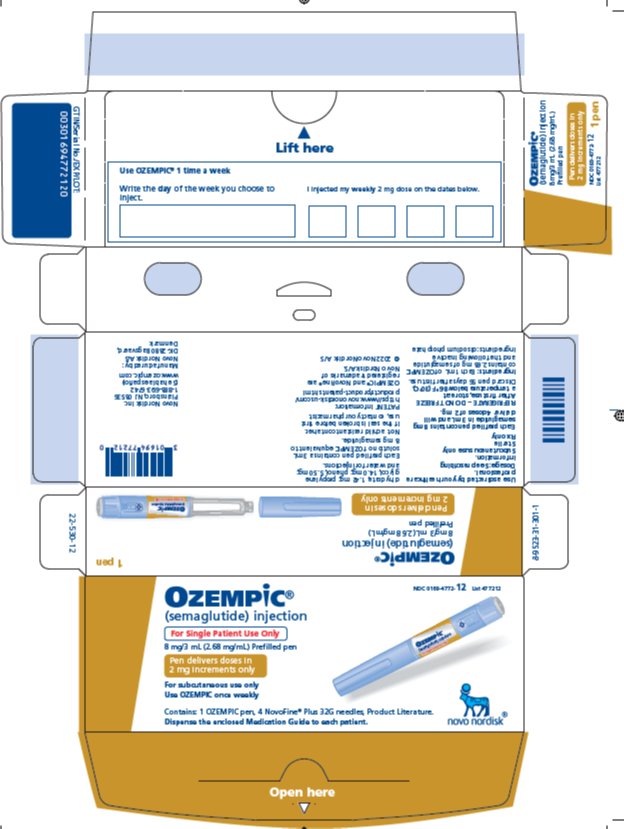
Ozempic semaglutide 2.68 mg/mL Injection, Solution — NDC 00169-4772-12 package photo
Label image from the product's FDA listing (DailyMed) — may show a different pack size or an older label revision.

Ozempic semaglutide 2.68 mg/mL Injection, Solution — NDC 0169-4772-12 (Billing 00169-4772-12)

by Novo Nordisk Pharmaceutical Industries, LP · 1 SYRINGE, PLASTIC in 1 CARTON / 3 mL in 1 SYRINGE, PLASTIC

This is a package of Ozempic semaglutide 2.68 mg/mL Injection, Solution from Novo Nordisk Pharmaceutical Industries, LP, marketed since Apr 2022 and currently FDA-listed; retail pharmacies pay about $331.97 per mL (NADAC). It is the main listing for this product, which comes in 2 package sizes.

NDC 00169-4772-12
🏷️ FDA NDC (as labeled) 0169-4772-12 billing pads the labeler segment with a zero
This package
Contains3 mL in 1 syringe, plastic Cost per mL$331.97 NADAC Per package$995.92 / 3 ml Pack sizes2 compare ↓
Also priced by: Medicaid pays $323.18/unit · Part D plans $328.45/unit — full pricing hub ↓
Main listing for product 0169-4772 · Also comes in: 3 mL 0169-4772-97
Rx only Brand On market Non-controlled ⇄ Compare with another NDC
🗂️ FDA directory synced Oct 8, 2026 · this listing last changed Oct 8, 2026 · sources: openFDA · FDA label (DailyMed) · FDA Orange & Purple Book · First Databank · CMS NADAC, ASP, Medicare & Medicaid · RxNorm
📋 All sources & update times →

NDC database record

One package, one record: these facts belong to NDC 0169-4772-12 alone.

Record
FDA NDC Directory package listing · Human prescription drug
Code segments
0169 labeler · 4772 product · 12 package
Package marketed since
Apr 25, 2022
Sample package
No — commercial package
Listing certified through
Dec 31, 2027
Barcode (UPC-A, from the NDC)
3 0169477212 0
Medicaid fills, this package
1,249,971 prescriptions in the last four reported quarters
FDA record last changed
Oct 8, 2026

Identity & classification

Regulatory identifiers FDA, NLM and CMS codes for this package

FDA NDC (as labeled) 0169-4772-12
Product NDC 0169-4772
11-digit billing NDC 00169477212
NCPDP billing unit ML — per mL (volume)
Application # NDA209637
SPL Set ID 5e1477c5-c1b8-4fc5-af2a-83e5d356a77d
Established class (EPC) GLP-1 Receptor Agonist
Mechanism of action Glucagon-like Peptide-1 (GLP-1) Agonists
Chemical class Glucagon-Like Peptide 1
DEA schedule Non-controlled
Marketing category NDA
Marketing status On market
FDA listing status Listed (active directory)
Marketing start 2022-04-25
Route SUBCUTANEOUS
Dosage form INJECTION, SOLUTION
Substance SEMAGLUTIDE

Drug-database identifiers Medi-Span GPI and First Databank GCN / HICL / AHFS classification

GCN Seq No 083225
GCN 52125
HICL code 044675
Ingredient (HICL) Semaglutide
HIC1 code C
Therapeutic class — broad (HIC1) Electrolyte Balance/Metabolism/Nutrition
HIC2 code C4
Therapeutic class — intermediate (HIC2) Antihyperglycemics
HIC3 code C4I
Therapeutic class — specific (HIC3) Antihypergly,Incretin Mimetic(Glp-1 Recep.agonist)
AHFS code 28:20.08.92
AHFS class Anorexigenic Agents, Miscellaneous
FDB label name OZEMPIC 2 MG/DOSE (8 MG/3 ML)
FDB brand name Ozempic
Legend status F — Federal legend — prescription drug or device
Quick answers
  • GSN (GCN sequence number): 083225
  • GCN: 52125
  • HICL (First Databank): 044675
  • AHFS class code: 28:20.08.92
Why two NDCs? The FDA registers this code as 0169-4772-12 — a 4-4-2 layout, and that's what's printed on the package and shown on DailyMed. For insurance claims, every NDC is standardized to a uniform 11-digit 5-4-2 format by adding a zero to the labeler segment → 00169-4772-12. Same drug, same package — only the format differs.
Where does this data come from?
Identifiers from the FDA openFDA NDC Directory and Structured Product Labeling; RxCUI from RxNorm (NLM); GPI from Medi-Span; GCN / HIC / AHFS / legend from First Databank.

Clinical

Label name OZEMPIC 2 MG/DOSE (8 MG/3 ML) Ingredient Semaglutide
📖 What it is MedlinePlus · NLM

Semaglutide injection is used for the following: to control blood sugar levels in certain patients with type 2 diabetes (condition in which blood sugar is too high because the body does not make or use insulin normally). to reduce the risk of a heart attack, stroke, or death in adults with type 2 diabetes and heart and blood vessel disease. to reduce the risk of a heart attack, stroke, or death in adults who are obese or overweight and have heart and blood vessel disease. to reduce the risk of worsening of kidney disease and death in certain adults with type 2 diabetes and kidney diseas...

Read the full MedlinePlus article ↗
📗 Our plain-language guide HelloPharmacist
  • It depends on the product. Wegovy is used for weight management and to lower heart risks in adults with heart disease plus obesity or overweight. Wegovy injection is also used for...
  • Wegovy injection and Ozempic are weekly shots under the skin, any time of day, with or without food. Wegovy tablets are taken once daily on an empty stomach with plain water, then...
  • Nausea, diarrhea, vomiting, constipation, and stomach pain are the most common, especially early on or after a dose increase. Headache and tiredness are also common. Call your doct...
  • Call for severe stomach pain that won't go away, swelling of the face or throat, trouble breathing, a lump in your neck, trouble swallowing, or hoarseness that persists. Also call...
📖 Read our full Semaglutide guide →
1
Nutrient depletion considerations

Semaglutide may be associated with lower levels of 1 nutrient — worth a chat with your pharmacist, not a cause for alarm.

An association is not a deficiency. Educational only — don't start or stop anything without professional guidance.
Where does this data come from?
Plain-language summary from MedlinePlus (U.S. National Library of Medicine); supplement & herbal interactions and nutrient depletion data from the Natural Medicines database; our full guide is HelloPharmacist editorial content.

Pricing

A drug doesn't have one price. Each row is a different public payment system, and none is what you'd pay at the counter — that depends on your insurance. The ⓘ on each row explains what it measures.

Price systemPer mLPer package
Retail pharmacies payNADAC · weekly $331.972 $995.92 / 3 ml
Medicaid paysCMS SDUD · 12 mo $323.18 $969.53 / 3 ml
Medicare drug plans payPart D · Q2 2026 $328.45 $985.36 / 3 ml
NADAC price history (per mL) — tap or hover for the price & month
Jul 2022 Jan 2024 Jun 2026 Sep 2026 $331.975 $285.847
▲ Up 16% over the last 9 months.
Where does this data come from?
NADAC (National Average Drug Acquisition Cost) is the CMS weekly pharmacy-acquisition-cost survey — what pharmacies pay. ASP (Average Sales Price) is the CMS Medicare Part B drug-payment file, published quarterly. Medicaid pays is computed by us from CMS State Drug Utilization Data (total reimbursed ÷ units, trailing 12 months) — gross of rebates and inclusive of dispensing fees, so it reflects what Medicaid paid, not an acquisition cost. Medicare drug plans pay is the median negotiated point-of-sale unit cost across plans listing this NDC in the CMS quarterly Prescription Drug Plan pricing files, before rebates. The VA pays is the federal contract price (FSS, and the statutory Big 4 ceiling where listed) from the VA National Acquisition Center pharmaceutical price file. All are free public government data; each measures a different payer, so the figures are not directly comparable.

Packaging — all sizes for this product

Package NDCDescription Per unit Per pack Marketing startMarketing endStatus
00169-4772-12 You're viewing this Main listing 1 SYRINGE, PLASTIC in 1 CARTON / 3 mL in 1 SYRINGE, PLASTIC $331.97 / mL $995.92 2022-04-25 — Active
00169-4772-97 0169-4772-97 1 SYRINGE, PLASTIC in 1 CARTON / 3 mL in 1 SYRINGE, PLASTIC Sample — — 2022-04-25 — Active

In Medicaid, this is the most-dispensed pack of this product — about 100% of fills over the last four reported quarters. See all packs ↓

Pack size FAQ

What quantity is in this package?
This package is listed by the FDA — 1 syringe, plastic in 1 carton / 3 ml in 1 syringe, plastic.
What NDC number is used to bill for this package of Ozempic semaglutide 2.68 mg/mL Injection, Solution?
Use the 11-digit billing form listed in the identifiers section of this page. Pharmacy and medical claims use the 11-digit form; the FDA label may print a shorter form of the same code.

Prices are the latest CMS NADAC pharmacy acquisition cost per NDC; per-pack figures are per-unit × pack quantity, shown only when the pack is denominated in the same measure NADAC prices.

Therapeutic equivalents

ProductLabelerPackNADAC/unitTEStatusPrice vs. this
Ozempic 2.68 mg/mLthis 00169-4772-12 Novo 1 syringe $331.972 — Availability likely —
Ozempic 2.68 mg/mL 50090-6051-00 A-S 1 syringe — — FDA listed —
About this product: this is the brand-name version. We did not find an FDA-approved generic match for this exact strength, form and route.
Where does this data come from?
Equivalents are other NDCs of the same ingredient, form and route from the openFDA NDC Directory, ranked least-expensive-first by NADAC. Therapeutic-equivalence (AB) ratings come from the FDA Orange Book; biologics use the FDA Purple Book for biosimilar & interchangeable status.

Availability & generic status

🏛️
2026
First FDA approval
May 2026
📍
2026
Currently FDA-listed
listed with the FDA
🛡️
2041
Latest patent/protection listed
not a guaranteed launch date
🔒No FDA-approved generic found

We did not find an FDA-approved generic match for this exact strength, form and route. Patent/protection dates below may affect future generic timing.

🛡️ Latest patent/protection date listed: FDA patent/protection data lists protections through Feb 2041. This may affect when a full generic version becomes widely available, but it is not a guaranteed launch date.
📅 FDA approved May 5, 2026 RLD RS ⏳ ~14.4 yr to latest listed protection

Why the date isn’t exact: Generic timing can change because patents may be challenged, settled, licensed, added, removed, or worked around with a narrower label — and FDA approval does not always mean a pharmacy can get the generic today.

Patents & exclusivity — FDA Orange Book
US 8129343 — drug substance (U-2202)
US 8536122 — drug substance (U-3355)
US 8129343 — drug substance (U-3355)
US 12295988 — method of use (U-2628)
US 12569543 — method of use (U-4446)
US 10335462 — method of use (U-2580)
US 8129343 — drug substance (U-3469)
US 8536122 — drug substance (U-3469)
US 8536122 — drug substance (U-2202)
US 10335462 — method of use (U-2580)
US 8129343 — drug substance (U-2202)
US 8536122 — drug substance (U-2202)
US 11318191 — method of use (U-1852)
US 11318191 — method of use (U-4561)
US 11318191 — method of use (U-1852)
US 11318191 — method of use (U-4561)
US 11318191 — method of use (U-1852)
US 11318191 — method of use (U-4561)
US 12569543 — method of use (U-4446)
US 12295988 — method of use (U-1852)
US 12214017 — method of use (U-1852)
US 11752198 — method of use (U-1852)
US 10888605 — method of use (U-1852)
US 10335462 — method of use (U-1852)
US 8129343 — drug substance (U-3355)
US 10357616 — drug product
US 9108002 — drug product
US 11097063 — drug product
US 9775953 — drug product
US 10376652 — drug product
US 9687611 — drug product
US 9775953 — drug product
US 8920383 — drug product
US 10357616 — drug product
US 10376652 — drug product
US 9861757 — drug product
US 9616180 — drug product
US 9861757 — drug product
US 9616180 — drug product
US 10357616 — drug product
US RE46363 — drug product
US 9457154 — drug product
US 9861757 — drug product
US 9687611 — drug product
US 9616180 — drug product
US 9457154 — drug product
US 8920383 — drug product
US 10376652 — drug product
US 9108002 — drug product
US 9687611 — drug product
US 9775953 — drug product
US 10220155 — drug product
US 10376652 — drug product
US 9775953 — drug product
US 9616180 — drug product
US RE46363 — drug product
US 9457154 — drug product
US 8920383 — drug product
US 11097063 — drug product
US RE46363 — drug product
US 9108002 — drug product
US 10220155 — drug product
US 9687611 — drug product
US 9132239 — drug product
US RE46363 — drug product
US 10220155 — drug product
US 9132239 — drug product
US 9457154 — drug product
US 10220155 — drug product
US 11097063 — drug product
US 9132239 — drug product
US 9861757 — drug product
US 9108002 — drug product
US 10357616 — drug product
Exclusivity I-961
Exclusivity I-961
Exclusivity I-961
Exclusivity I-961
2026 2028 2030 2032 2034 2036 2038 2040
Today
LOE
Substance patent Formulation patent Method-of-use patent Exclusivity Pediatric +6mo
🏛️FDA exclusivity
FDA-granted marketing protection. It’s separate from patents and may be shorter than patent protection.
🧪Product / substance patents
Patents covering the active ingredient, product, formulation, or related drug features.
🎯Method-of-use patents
Patents covering specific approved uses. These can sometimes be carved out with a “skinny label,” but not always.
🛈 What do these terms mean?
Patent
Legal protection listed in the Orange Book that may delay generic approval or launch. Issued by the U.S. Patent & Trademark Office.
Substance patent
Covers the active drug molecule itself — the hardest to design around. A generic generally can’t launch until it expires.
Formulation (product) patent
Covers a specific formulation or dosage form. A generic can sometimes work around it with a different formulation.
Method-of-use patent
A patent covering one specific approved use of the drug — not necessarily the whole molecule. A generic can sometimes launch with a “skinny label” that carves out the protected use and keeps the others.
Skinny label
A generic label that omits a still-patented use when the FDA allows it — letting a generic reach the market for the unprotected uses.
Exclusivity
FDA-granted marketing protection, separate from patents — e.g. 5-yr new chemical entity, 7-yr orphan drug, or a +6-month pediatric extension.
Paragraph IV
A generic applicant’s formal challenge to a listed patent. It can potentially lead to earlier generic entry, but often involves litigation or a settlement.
RLD / RS
Reference Listed Drug — the brand product the FDA uses as the reference for generic applications. Reference Standard — the product the FDA expects generics to compare against in bioequivalence testing.
TE / AB rating
FDA therapeutic-equivalence rating. An AB rating generally means the FDA considers a generic therapeutically equivalent to — and substitutable for — the brand.
LOE (loss of exclusivity)
The latest patent or exclusivity currently listed — the loss-of-exclusivity / latest-listed-protection date shown on this page. Paragraph-IV challenges and settlements can move the real date earlier; FDA approval and a manufacturer’s decision to market can move it later.

Built from the FDA Orange Book. The bars above are scaled to each protection’s expiry; the red LOE marker is the last one to lapse.

Listed patents (92)
PatentTypeUse codeExpires
US 8129343 ↗ Drug substance U-2202 Dec 5, 2031
US 8536122 ↗ Drug substance U-3355 Mar 20, 2026
US 8129343 ↗ Drug substance U-3355 Dec 5, 2031
US 12295988 ↗ Method of use U-2628 Oct 10, 2038
US 12569543 ↗ Method of use U-4446 Apr 28, 2037
US 10335462 ↗ Method of use U-2580 Jun 21, 2033
US 8129343 ↗ Drug substance U-3469 Dec 5, 2031
US 8536122 ↗ Drug substance U-3469 Mar 20, 2026
US 8536122 ↗ Drug substance U-2202 Mar 20, 2026
US 10335462 ↗ Method of use U-2580 Jun 21, 2033
US 8129343 ↗ Drug substance U-2202 Dec 5, 2031
US 8536122 ↗ Drug substance U-2202 Mar 20, 2026
US 11318191 ↗ Method of use U-1852 Feb 17, 2041
US 11318191 ↗ Method of use U-4561 Feb 17, 2041
US 11318191 ↗ Method of use U-1852 Feb 17, 2041
US 11318191 ↗ Method of use U-4561 Feb 17, 2041
US 11318191 ↗ Method of use U-1852 Feb 17, 2041
US 11318191 ↗ Method of use U-4561 Feb 17, 2041
US 12569543 ↗ Method of use U-4446 Apr 28, 2037
US 12295988 ↗ Method of use U-1852 Oct 10, 2038
US 12214017 ↗ Method of use U-1852 Aug 24, 2038
US 11752198 ↗ Method of use U-1852 Aug 24, 2038
US 10888605 ↗ Method of use U-1852 Aug 24, 2038
US 10335462 ↗ Method of use U-1852 Jun 21, 2033
US 8129343 ↗ Drug substance U-3355 Dec 5, 2031
US 10357616 ↗ delist req. Drug product — Jan 20, 2026
US 9108002 ↗ delist req. Drug product — Jan 20, 2026
US 11097063 ↗ delist req. Drug product — Jul 17, 2026
US 9775953 ↗ delist req. Drug product — Jul 17, 2026
US 10376652 ↗ delist req. Drug product — Jan 20, 2026
US 9687611 ↗ delist req. Drug product — Feb 27, 2027
US 9775953 ↗ delist req. Drug product — Jul 17, 2026
US 8920383 ↗ delist req. Drug product — Jul 17, 2026
US 10357616 ↗ delist req. Drug product — Jan 20, 2026
US 10376652 ↗ delist req. Drug product — Jan 20, 2026
US 9861757 ↗ delist req. Drug product — Jan 20, 2026
US 9616180 ↗ delist req. Drug product — Jan 20, 2026
US 9861757 ↗ delist req. Drug product — Jan 20, 2026
US 9616180 ↗ delist req. Drug product — Jan 20, 2026
US 10357616 ↗ delist req. Drug product — Jan 20, 2026
US RE46363 ↗ delist req. Drug product — Aug 3, 2026
US 9457154 ↗ delist req. Drug product — Sep 29, 2027
US 9861757 ↗ delist req. Drug product — Jan 20, 2026
US 9687611 ↗ delist req. Drug product — Feb 27, 2027
US 9616180 ↗ delist req. Drug product — Jan 20, 2026
US 9457154 ↗ delist req. Drug product — Sep 29, 2027
US 8920383 ↗ delist req. Drug product — Jul 17, 2026
US 10376652 ↗ delist req. Drug product — Jan 20, 2026
US 9108002 ↗ delist req. Drug product — Jan 20, 2026
US 9687611 ↗ delist req. Drug product — Feb 27, 2027
US 9775953 ↗ delist req. Drug product — Jul 17, 2026
US 10220155 ↗ delist req. Drug product — Jul 17, 2026
US 10376652 ↗ delist req. Drug product — Jan 20, 2026
US 9775953 ↗ delist req. Drug product — Jul 17, 2026
US 9616180 ↗ delist req. Drug product — Jan 20, 2026
US RE46363 ↗ delist req. Drug product — Aug 3, 2026
US 9457154 ↗ delist req. Drug product — Sep 29, 2027
US 8920383 ↗ delist req. Drug product — Jul 17, 2026
US 11097063 ↗ delist req. Drug product — Jul 17, 2026
US RE46363 ↗ delist req. Drug product — Aug 3, 2026
US 9108002 ↗ delist req. Drug product — Jan 20, 2026
US 10220155 ↗ delist req. Drug product — Jul 17, 2026
US 9687611 ↗ delist req. Drug product — Feb 27, 2027
US 9132239 ↗ delist req. Drug product — Feb 1, 2032
US RE46363 ↗ delist req. Drug product — Aug 3, 2026
US 10220155 ↗ delist req. Drug product — Jul 17, 2026
US 9132239 ↗ delist req. Drug product — Feb 1, 2032
US 9457154 ↗ delist req. Drug product — Sep 29, 2027
US 10220155 ↗ delist req. Drug product — Jul 17, 2026
US 11097063 ↗ delist req. Drug product — Jul 17, 2026
US 9132239 ↗ delist req. Drug product — Feb 1, 2032
US 9861757 ↗ delist req. Drug product — Jan 20, 2026
US 9108002 ↗ delist req. Drug product — Jan 20, 2026
US 10357616 ↗ delist req. Drug product — Jan 20, 2026
FDA exclusivity
CodeWhat it grantsExpires
I-961New indication (3-year)Jan 28, 2028
Common questions
Is there a generic version of OZEMPIC 2 MG/DOSE (8 MG/3 ML)?
No FDA-approved generic equivalent is currently listed in the FDA Orange Book for OZEMPIC 2 MG/DOSE (8 MG/3 ML). Based on the patents and exclusivity currently listed, the Orange Book estimate is that full-label generic entry may be delayed until Feb 2041 — an estimate, not a guaranteed launch date.
The FDA approved a generic — why can’t I get it at my pharmacy yet?
FDA approval and pharmacy availability are two different things. The FDA can approve a generic years before it actually reaches pharmacies, because the brand company may still hold patents or have a settlement that delays the launch. A manufacturer also has to choose to make and sell it, and have supply ready. So a drug can be “FDA-approved generic exists” and still be brand-only at the counter today.
Why do different websites show different generic release dates?
Generic availability is not based on one single date. Some sources use the first exclusivity expiration, some use the last product patent, and others use the latest method-of-use patent. Patent challenges, settlements, licenses, and label carve-outs can also change the real-world launch date. This page shows the underlying Orange Book dates so you can see why estimates may differ.
What does “FDA listed” mean?
It means the product appears in the FDA’s official NDC directory. That’s a good sign a product exists and is intended for the U.S. market, but on its own it does not confirm a pharmacy can fill it today. Where we have recent retail pricing data (NADAC) for a product, we label it “Availability likely” instead.
What does a patent or protection date mean here?
It’s the latest date currently listed in the FDA Orange Book for a patent or exclusivity on the brand product. It can affect when a full generic version becomes widely available — but it is not a guaranteed generic launch date. Generics sometimes arrive earlier (through a settlement or patent challenge) or later (a manufacturer still has to make and sell one).
What does “current Orange Book estimate” mean?
It means we are using the latest patent and exclusivity dates currently listed in the FDA Orange Book. It is not a guaranteed launch date.
Can a generic come out before the last patent expires?
Sometimes. A generic company may challenge a patent, settle with the brand manufacturer, receive a license, or obtain approval with a narrower label that avoids a patented use. In other cases, the last listed protection may delay full-label generic competition.
Can a generic come out after the listed dates?
Yes. Even after patents or exclusivity expire, a generic still needs FDA approval and a manufacturer must choose to market it. Supply, litigation, business decisions, or regulatory issues can delay actual availability.
What is the difference between patents and exclusivity?
Patents are legal protections usually issued by the U.S. Patent and Trademark Office. FDA exclusivity is marketing protection granted by the FDA. They are separate, and either one can affect generic timing.
Why are there multiple patent dates?
One drug can have several patents covering different things: the active ingredient, a formulation, a manufacturing process, or a specific approved use. That is why a page may show several expiration dates instead of one simple generic date.
Built from FDA Orange Book patent and exclusivity data. Dates are refreshed from public FDA data when available; the marker is max(latest patent expiry, latest exclusivity expiry). Paragraph-IV settlements and first-filer 180-day exclusivity can shift the real date; a method-of-use patent may allow an earlier skinny-label generic for non-protected indications. Generic launch timing is an estimate, not a guarantee.
Where does this data come from?
Patents and exclusivity from the FDA Orange Book (small-molecule drugs), refreshed from public FDA data. Generic launch timing is an estimate, not a guarantee.

Inactive Ingredients / Excipients

Inactive ingredients, also called excipients, are components of the drug product other than the active ingredient. They may include fillers, dyes, coatings, preservatives, flavors, or other formulation ingredients.

🧪 Avoiding an ingredient? See Semaglutide inactive ingredients by manufacturer: every current product's list side by side, so you can ask your pharmacy for the version that does not list it.

💡 Tap an ingredient (hover on desktop) to see what it is and why it’s used.

  • 5.50 mg / 1 mL UNII 339NCG44TV
    Phenol is a chemical compound derived from coal tar or petroleum. It serves as a preservative and antimicrobial agent in medicines, helping prevent bacterial and fungal growth to keep the product stable and safe during storage.
  • 14.0 mg / 1 mL UNII 6DC9Q167V3
    Propylene glycol is a clear liquid derived from petroleum or vegetable sources. It acts as a solvent, humectant, and preservative in medicines, helping dissolve active ingredients and maintain product stability.
  • 1.42 mg / 1 mL UNII 94255I6E2T
    Sodium phosphate dibasic dihydrate is a salt that helps control the acidity level of a medicine. It acts as a buffer and pH regulator to keep the medication stable and effective.
  • UNII 059QF0KO0R
    Water is a liquid solvent that dissolves and mixes ingredients together in liquid medicines, syrups, and injections. It helps distribute the active drug evenly throughout the product.

4 inactive ingredients listed in the exact product block matched to this NDC.

Where does this data come from?
Data sourced from official FDA Structured Product Labeling (SPL) via DailyMed — ingredient classCode="IACT" elements from the exact product block matched by this NDC. Label-section narrative from DailyMed / the openFDA label index is shown separately when available.

Inactive ingredient FAQ

Are inactive ingredients the same for every manufacturer?
No. Inactive ingredients can differ by manufacturer, dosage form, strength, and package / product version.
Why might an inactive ingredient be missing?
Some SPLs do not provide a complete structured inactive-ingredient list, and older or unusual labels may only include the information in narrative text.
Can inactive ingredients matter?
Yes. They can matter for allergies, intolerances, dyes, gluten / lactose concerns, preservatives, and formulation differences — but confirm with a pharmacist or the manufacturer when it’s clinically important.

Manufacturer & labeler

LabelerNovo Nordisk Pharmaceutical Industries, LP
Application holderNOVO NORDISK INC
FDA applicationNDA209637 (NDA)
Labeler code00169
First marketedApr 2022
Product typeHuman Prescription Drug
Portfolio39 products on file
The labeler markets the product; the application holder owns the FDA approval. They’re often the same company but can differ (e.g. a repackager or an authorized generic). A mailing address / phone appears here when the manufacturer includes it in the product’s FDA label (not all do).
Where does this data come from?
Labeler, application holder and registered establishment from the FDA openFDA NDC Directory and Drugs@FDA; address/contact from the product’s FDA label.

Full prescribing information FDA SPL

The complete FDA label for this product — the official prescribing information, verbatim, section by section. Jump with a chip, search within the label, or expand everything.
📄 FDA label 19 words ▾

No FDA label is on file for this product yet. Labels load from openFDA / DailyMed and refresh weekly.

Source: FDA Structured Product Labeling, mirrored from DailyMed / openFDA. Prefer the government’s original formatting? View this label on DailyMed ↗

Medicaid utilization & spend

📍 This exact package only: Medicaid data is reported per full 11-digit NDC — labeler, product and pack size — so every number here is for this package alone, not the drug overall. Other pack sizes report separately.
💊 Pharmacy benefit only: These are Medicaid outpatient pharmacy claims, billed by NDC. They exclude the medical benefit — clinic- or hospital-administered drugs billed under HCPCS J-codes — so drugs used mostly that way (e.g. Avastin, Lucentis, Keytruda) can look low or missing here. That’s expected, not an error.
📅 Q1 2025 – Q1 2026 · 5 quarters of data
ⓘ The newest quarter is usually incomplete when first published; states restate recent quarters in later CMS releases, so the latest figures typically revise upward. State coverage-policy changes can also shift quarter-to-quarter totals.
Prescriptions last 4 qtrs
1.2M
Units reimbursed last 4 qtrs
4M
Gross reimbursed last 4 qtrs
$1,297.71M
Avg / prescription
$1,038.19
Avg / unit
$323.18
Latest quarter Q1 2026
305.7KRx
Medicaid pays / mL
$323.18
gross reimbursed
vs
NADAC / mL
$331.97
acquisition cost
=
Spread
−$8.7969
-3% vs cost
What Medicaid paid per mL (before rebates; includes the pharmacy’s dispensing fee) compared with NADAC — the average price pharmacies pay to buy the drug. A positive spread means Medicaid reimbursed more than the purchase price, before manufacturer rebates.
Fee-for-service vs managed care ⓘ
52% FFS 48% MCO
Fee-for-service · 648,524 Rx Managed care · 601,447 Rx
State Medicaid map
Alaska: 19,047 units · 2,598 per 100k residents AK Maine: 13,065 units · 937 per 100k residents ME Washington: 39,034 units · 500 per 100k residents WA Idaho: 30,992 units · 1,578 per 100k residents ID Montana: 17,859 units · 1,578 per 100k residents MT North Dakota: 1,989 units · 254 per 100k residents ND Minnesota: 87,325 units · 1,522 per 100k residents MN Wisconsin: 32,990 units · 558 per 100k residents WI Michigan: 101,739 units · 1,014 per 100k residents MI New York: 485,835 units · 2,482 per 100k residents NY Vermont: 14,442 units · 2,232 per 100k residents VT New Hampshire: 10,515 units · 750 per 100k residents NH Oregon: 41,232 units · 974 per 100k residents OR Nevada: 49,510 units · 1,550 per 100k residents NV Wyoming: 855 units · 146 per 100k residents WY South Dakota: 7,029 units · 765 per 100k residents SD Iowa: 55,867 units · 1,742 per 100k residents IA Illinois: 36,183 units · 288 per 100k residents IL Indiana: 166,958 units · 2,433 per 100k residents IN Ohio: 23,358 units · 198 per 100k residents OH Pennsylvania: 238,641 units · 1,841 per 100k residents PA New Jersey: 64,638 units · 696 per 100k residents NJ Massachusetts: 44,367 units · 634 per 100k residents MA California: 978,504 units · 2,511 per 100k residents CA Utah: 12,796 units · 374 per 100k residents UT Colorado: 25,876 units · 440 per 100k residents CO Nebraska: 26,050 units · 1,317 per 100k residents NE Missouri: 68,226 units · 1,101 per 100k residents MO Kentucky: 155,928 units · 3,445 per 100k residents KY West Virginia: 85,416 units · 4,826 per 100k residents WV Virginia: 36,657 units · 421 per 100k residents VA Maryland: 108,018 units · 1,748 per 100k residents MD Connecticut: 111,816 units · 3,091 per 100k residents CT Rhode Island: 23,778 units · 2,172 per 100k residents RI Arizona: 9,189 units · 124 per 100k residents AZ New Mexico: 37,948 units · 1,795 per 100k residents NM Kansas: 6,048 units · 206 per 100k residents KS Arkansas: 5,676 units · 185 per 100k residents AR Tennessee: 63,264 units · 888 per 100k residents TN North Carolina: 206,387 units · 1,905 per 100k residents NC South Carolina: 33,285 units · 619 per 100k residents SC Delaware: 19,580 units · 1,899 per 100k residents DE Oklahoma: 28,219 units · 696 per 100k residents OK Louisiana: 97,398 units · 2,129 per 100k residents LA Mississippi: 3,936 units · 134 per 100k residents MS Alabama: 33,288 units · 652 per 100k residents AL Georgia: 32,025 units · 290 per 100k residents GA D.C.: 17,681 units · 2,604 per 100k residents DC Hawaii: 27,103 units · 1,889 per 100k residents HI Texas: 100,755 units · 330 per 100k residents TX Florida: 77,031 units · 341 per 100k residents FL
Units reimbursed · per 100k residents
1244,826
gray = no data reported ⓘ
Colors are per 100,000 residents, so big states don’t automatically dominate. Tap or hover a state for its actual totals.
Tap or hover a state
…for its Medicaid breakdown
🏆 Top states by units · per 100k residents
1 West Virginia 4,826 /100k
2 Kentucky 3,445 /100k
3 Connecticut 3,091 /100k
4 D.C. 2,604 /100k
5 Alaska 2,598 /100k
6 California 2,511 /100k
7 New York 2,482 /100k
8 Indiana 2,433 /100k
National units — by quarter
💵 About the dollar figures: “reimbursed” is what Medicaid paid pharmacies before confidential manufacturer rebates, so the program’s real net cost is lower than these numbers. Fee-for-service and managed-care claims are combined unless split above. Source: CMS State Drug Utilization Data; per-100k rates use 2023 Census population estimates.

Medicaid utilization by pack size

Medicaid (SDUD) totals over the four most recent reported quarters for every package size of this drug — handy when a specific package (e.g. a starter/titration pack) carries little or no Medicaid volume on its own.
1 syringe this page00169-4772-12 1,249,971 Rx · $1,297,706,960
1 syringe00169-4772-97 No Medicaid data
Drug total (last 4 qtrs): 1,249,971 Rx · 4,015,492 units · $1,297,706,960 gross reimbursed
Tap a pack size to open its page. Source: CMS State Drug Utilization Data, last 4 quarters.

Medicare Part D spend CMS · PART D · 2026 (Q1)

Medicare Part D (outpatient prescription) spending for Ozempic — the program that covers self-administered drugs. 1 manufacturer.
⚠️ Drug-level data: CMS publishes Part D spending by drug, not by NDC — these figures combine every manufacturer, strength and package size sold under the name Ozempic. That’s a different level of aggregation than the Medicaid card above, which is specific to this exact 11-digit NDC (pack size included), so the two aren’t directly comparable.
Period
Total Part D spend
$3.96B
Claims incl. refills
2.9M
Beneficiaries
1.5M
Spend / beneficiary
$2,716.05
Spend / claim
$1,387.09
Trend by period
💵 About the dollar figures: spending is what Part D plans paid before confidential manufacturer rebates, so the program’s real net cost is lower. A blank patient count means fewer than 11 people — CMS hides counts that small to protect privacy. Source: CMS Medicare Quarterly Part D Spending by Drug (data.cms.gov), updated quarterly.

Reported adverse events (FAERS)

Read carefully: FAERS reports are voluntary and unverified. Counts are not incidence, do not establish causation, are subject to reporting bias, and cannot be used to compare one drug to another. Shown for signal context only. Reports for Ozempic (this brand).

Top reported reactions

Nausea9,744
Vomiting6,336
Diarrhoea5,976
Decreased Appetite4,503
Constipation4,403
Weight Decreased4,151
Impaired Gastric Emptying3,430

Reporter sex

66,038 reports

Serious outcomes

Disabling1,345
Life-threatening1,194
Reports over time (by year) — tap or hover for the count & year
2019 2021 2023 2026 11,258 0
Most recent year is provisional (FAERS lags ~3 months).
Where does this data come from?
Adverse-event reports from the FDA Adverse Event Reporting System (FAERS) via openFDA. FAERS reports are voluntary and unverified — counts are not incidence and don’t establish causation.
For educational and professional reference only — not medical advice. Pricing reflects published NADAC and CMS ASP (free public data) and may differ from your acquisition cost; always verify before billing or dispensing.