
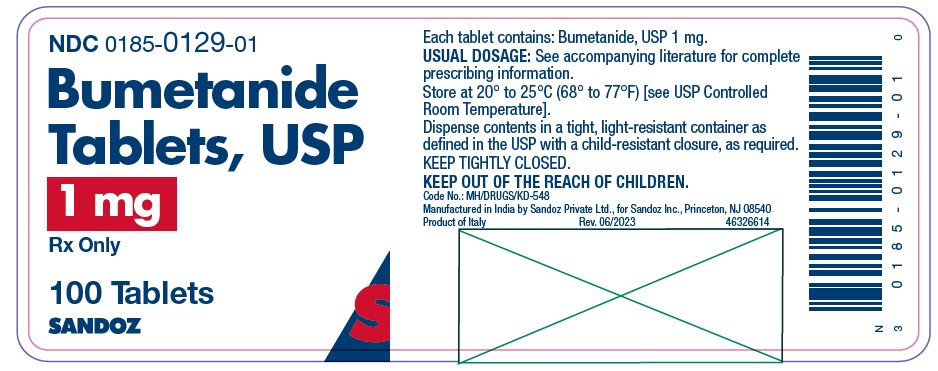
Bumetanide 1 mg Tablet, 100-count — NDC 0185-0129-01 (Billing 00185-0129-01)
This is a package of 100 tablets of Bumetanide 1 mg Tablet from Sandoz Inc, marketed since Nov 1996 and currently FDA-listed; retail pharmacies pay about $0.1079 per tablet (NADAC). It is the main listing for this product, which comes in 2 package sizes.
Identity & classification
Regulatory identifiers FDA, NLM and CMS codes for this package
Drug-database identifiers Medi-Span GPI and First Databank GCN / HICL / AHFS classification
- GSN (GCN sequence number): 008222
- GCN: 35021
- GPI-14 (Medi-Span): 37200010000310
- HICL (First Databank): 003664
- AHFS class code: 24:36.08.00
- RxCUI (RxNorm): 197417
Where does this data come from?
- FDA openFDA NDC Directory · synced Oct 1, 2026
- FDA label on DailyMed · label index refreshed Oct 1, 2026
- RxNorm (NLM RxNav) · catalog refreshed Oct 1, 2026
- Medi-Span GPI (licensed)
- First Databank (licensed) · refreshed Oct 1, 2026
RxNorm drug class
This medicine belongs to the Loop Diuretic class.
Where does this data come from?
- RxClass (NLM) · catalog refreshed Oct 1, 2026
Clinical
- It is a water pill that helps your body get rid of extra fluid. It treats swelling from heart failure, liver disease and kidney disease. It comes as tablets, an injection and a nas...
- Follow your prescriber’s directions and the label. Tablets are usually taken once a day, and some people use an every-other-day schedule. Enbumyst is only for the nose and is meant...
- Muscle cramps, dizziness, low blood pressure, headache and nausea are the most common. Call your doctor if you feel very weak, confused or dehydrated, or notice ringing in your ear...
- Some medicines need extra care. Tell me if you take lithium, probenecid, indomethacin, aminoglycoside antibiotics, or blood pressure medicines. Always check with me before adding a...
Patient education
Supplement & herbal interactions
Some supplements/herbs that may interact with Bumetanide — tap one for details:
Bumetanide may be associated with lower levels of 8 nutrients — worth a chat with your pharmacist, not a cause for alarm.
Where does this data come from?
- MedlinePlus (NLM) · refreshed Oct 1, 2026
- FDA label on DailyMed · label index refreshed Oct 1, 2026
Ask a licensed pharmacist directly — free, answered by our team.
Pricing
A drug doesn't have one price. Each row is a different public payment system, and none is what you'd pay at the counter — that depends on your insurance. The ⓘ on each row explains what it measures.
| Price system | Per ea | Per package |
|---|---|---|
| Retail pharmacies payNADAC · weekly | $0.108 | $10.79 / 100 tablets |
| Medicaid paysCMS SDUD · 12 mo | $0.3072 | $30.72 / 100 tablets |
| Medicare drug plans payPart D · Q2 2026 | $0.4554 | $45.54 / 100 tablets |
Where does this data come from?
- CMS NADAC weekly file · file of Sep 30, 2026
- CMS ASP pricing files · refreshed Sep 20, 2026
- CMS Medicaid State Drug Utilization Data · through Q1 2026
- CMS Part D plan pricing files · refreshed Sep 24, 2026
- VA National Acquisition Center price file
Packaging — all sizes for this product
| Package NDC | Description | Per unit | Per pack | Marketing start | Marketing end | Status |
|---|---|---|---|---|---|---|
| 00185-0129-01 You're viewing this Main listing | 100 TABLET in 1 BOTTLE | $0.1079 / ea | $10.79 | 1996-11-21 | — | Active |
| 00185-0129-05 0185-0129-05 | 500 TABLET in 1 BOTTLE | $0.1079 / ea | $53.95 | 1996-11-21 | — | Active |
You're viewing the smallest of 2 pack sizes for this product.
This pack has the lowest per-ea cost of the 2 priced pack sizes ($0.1079 NADAC).
This pack accounts for about 46% of this product's recent Medicaid fills; most go to the 500 tablets pack. See all packs ↓
Pack size FAQ
What quantity is in this package?
How does this package differ from NDC 00185-0129-05?
What NDC number is used to bill for this package of Bumetanide 1 mg Tablet?
Prices are the latest CMS NADAC pharmacy acquisition cost per NDC; per-pack figures are per-unit × pack quantity, shown only when the pack is denominated in the same measure NADAC prices.
Therapeutic equivalents
| Product | Labeler | Pack | NADAC/unit | TE | Status | Price vs. this |
|---|---|---|---|---|---|---|
| Bumetanide 1 mgthis 00185-0129-01 | Sandoz | 100 tablets | $0.108 | AB | Availability likely | — |
| Bumetanide 1 mg 00904-7016-04 | Major | 30 tablets | $0.108 | AB | Availability likely | — |
| Bumetanide 1 mg 16571-0678-01 | Rising | 100 tablets | $0.108 | AB | Availability likely | — |
| bumetanide 1 mg 23155-0901-01 | Heritage | 100 tablets | $0.108 | AB | Availability likely | — |
| Bumetanide 1 mg 42799-0120-01 | Edenbridge | 100 tablets | $0.108 | AB | Availability likely | — |
| Bumetanide 1 mg 43547-0897-10 | Solco | 100 tablets | $0.108 | AB | Availability likely | — |
| Bumetanide 1 mg 50268-0131-15 | AvPAK | 50 tablets | $0.108 | AB | Availability likely | — |
| Bumetanide 1 mg 51672-4224-01 | Sun | 100 tablets | $0.108 | AB | Availability likely | — |
| Bumetanide 1 mg 60687-0384-01 | American | 100 tablets | $0.108 | AB | Availability likely | — |
| Bumetanide 1 mg 69238-1490-01 | Amneal | 100 tablets | $0.108 | AB | Availability likely | — |
| Bumetanide 1 mg 70756-0080-11 | Lifestar | 100 tablets | $0.108 | AB | Availability likely | — |
| Bumetanide 1 mg 72603-0900-01 | NorthStar | 100 tablets | $0.108 | AB | Availability likely | — |
| Bumetanide 1 mg 72888-0020-01 | Advagen | 100 tablets | $0.108 | AB | Availability likely | — |
| Bumetanide 1 mg 76282-0798-01 | Exelan | 100 tablets | $0.108 | AB | Availability likely | — |
| bumetanide 1 mg 68382-0526-01 | Zydus | 100 tablets | $0.177 | AB | FDA listed | +64% |
| Bumetanide 1 mg 00615-8615-05 | NCS | 15 tablets | — | AB | FDA listed | — |
| Bumetanide 1 mg 00781-8113-01 | Sandoz | 100 tablets | — | AB | FDA listed | — |
| Bumetanide 1 mg 00832-0541-10 | Upsher-Smith | 1000 tablets | — | AB | Discontinued | — |
| Bumex 1 mg 30698-0631-01 | Validus | 100 tablets | — | AB | FDA listed | — |
| Bumetanide 1 mg 43353-0288-09 | Aphena | 9000 tablets | — | AB | FDA listed | — |
| Bumetanide 1 mg 50090-5666-00 | A-S | 30 tablets | — | AB | FDA listed | — |
| bumetanide 1 mg 50090-6138-02 | A-S | 90 tablets | — | AB | FDA listed | — |
| Bumetanide 1 mg 50090-6345-02 | A-S | 90 tablets | — | AB | FDA listed | — |
| Bumetanide 1 mg 50090-7965-02 | A-S | 90 tablets | — | AB | FDA listed | — |
| Bumetanide 1 mg 55154-3572-00 | Cardinal | 10 tablets | — | AB | FDA listed | — |
| Bumetanide 1 mg 55154-4345-00 | Cardinal | 10 tablets | — | AB | FDA listed | — |
| Bumetanide 1 mg 63629-4968-01 | Bryant | 30 tablets | — | AB | FDA listed | — |
| Bumetanide 1 mg 70518-4385-00 | REMEDYREPACK | 90 tablets | — | AB | FDA listed | — |
| bumetanide 1 mg 70771-1025-00 | Zydus | 1000 tablets | — | AB | FDA listed | — |
| bumetanide 1 mg 71335-1692-01 | Bryant | 30 tablets | — | AB | FDA listed | — |
| Bumetanide 1 mg 71335-2670-01 | Bryant | 500 tablets | — | AB | FDA listed | — |
| Bumetanide 1 mg 71335-2920-01 | Bryant | 500 tablets | — | AB | FDA listed | — |
| Bumetanide 1 mg 72162-2196-05 | Bryant | 500 tablets | — | AB | FDA listed | — |
| Bumetanide 1 mg 72205-0057-05 | Novadoz | 500 tablets | — | AB | FDA listed | — |
| bumetanide 1 mg 72603-0298-01 | NorthStar | 100 tablets | — | AB | FDA listed | — |
| Bumetanide 1 mg 81469-0222-01 | First | 100 tablets | — | AB | FDA listed | — |
| Bumetanide 1 mg 82804-0119-90 | Proficient | 90 tablets | — | AB | FDA listed | — |
| Bumetanide 1 mg 82804-0287-30 | Proficient | 30 tablets | — | AB | FDA listed | — |
Where does this data come from?
- FDA openFDA NDC Directory · synced Oct 1, 2026
- FDA Orange Book · refreshed Sep 3, 2026
- CMS NADAC weekly file · file of Sep 30, 2026
Availability & generic status
This product is an FDA-approved generic. Other versions of the same drug are listed under Therapeutic equivalents, least expensive first.
Where does this data come from?
- FDA Orange Book · refreshed Sep 3, 2026
What it looks like
Where does this data come from?
- FDA label on DailyMed · label index refreshed Oct 1, 2026
Inactive Ingredients / Excipients
Inactive ingredients, also called excipients, are components of the drug product other than the active ingredient. They may include fillers, dyes, coatings, preservatives, flavors, or other formulation ingredients.
💡 Tap an ingredient (hover on desktop) to see what it is and why it’s used.
-
UNII 3SY5LH9PMK
Anhydrous lactose is a milk sugar with no water content. It acts as a filler and binder in tablets and capsules, adding bulk and helping ingredients stick together.
-
UNII 35SW5USQ3G
A synthetic yellow dye used to color medicines. It helps make tablets, capsules, and liquids visually distinct so patients can easily identify their medication.
-
UNII 70097M6I30
Magnesium stearate is a salt made from magnesium and stearic acid, a fatty substance. It's used in tablets and capsules as a lubricant and glidant to help ingredients flow smoothly during manufacturing and prevent sticking.
-
UNII OP1R32D61U
Microcrystalline cellulose is a purified form of cellulose, a natural fiber from plant sources. It acts as a binder and filler in tablets and capsules, helping hold ingredients together and give the medicine its shape and size.
-
UNII O8232NY3SJ
A plant-based carbohydrate derived from corn kernels. It acts as a filler to add bulk, a binder to hold ingredients together, and a disintegrant to help the tablet break apart in your stomach for absorption.
-
UNII 7SEV7J4R1U
A powder made from a naturally occurring mineral. In medicines, talc works as a glidant and anti-caking agent, helping tablets and capsules flow smoothly during manufacturing and preventing clumping.
6 inactive ingredients listed in the exact product block matched to this NDC.
Where does this data come from?
ingredient classCode="IACT" elements from the exact product block matched by this NDC. Label-section narrative from DailyMed / the openFDA label index is shown separately when available.- FDA label on DailyMed · label index refreshed Oct 1, 2026
- FDA openFDA NDC Directory · synced Oct 1, 2026
Inactive ingredient FAQ
Are inactive ingredients the same for every manufacturer?
Why might an inactive ingredient be missing?
Can inactive ingredients matter?
Manufacturer & labeler
Where does this data come from?
- FDA openFDA NDC Directory · synced Oct 1, 2026
- Drugs@FDA
Full prescribing information FDA SPL
🚨 Boxed Warning ▾
WARNING Bumetanide is a potent diuretic which, if given in excessive amounts, can lead to a profound diuresis with water and electrolyte depletion. Therefore, careful medical supervision is required, and dose and dosage schedule have to be adjusted to the individual patient’s needs (see DOSAGE AND ADMINISTRATION ) .
🎯 Indications and Usage ▾
INDICATIONS AND USAGE Bumetanide tablets, USP are indicated for the treatment of edema associated with congestive heart failure, hepatic and renal disease, including the nephrotic syndrome. Almost equal diuretic response occurs after oral and parenteral administration of bumetanide. Therefore, if impaired gastrointestinal absorption is suspected or oral administration is not practical, bumetanide should be given by the intramuscular or intravenous route.
Successful treatment with bumetanide tablets, USP following instances of allergic reactions to furosemide suggests a lack of cross-sensitivity.
⏱️ Dosage and Administration ▾
DOSAGE AND ADMINISTRATION Individualize dosage with careful monitoring of patient response. Oral Administration The usual total daily dosage of bumetanide tablets is 0.5 mg to 2 mg and in most patients is given as a single dose. If the diuretic response to an initial dose of bumetanide tablets is not adequate, in view of its rapid onset and short duration of action, a second or third dose may be given at 4- to 5- hour intervals up to a maximum daily dose of 10 mg.
An intermittent dose schedule, whereby bumetanide tablets are given on alternate days or for 3 to 4 days with rest periods of 1 to 2 days in between, is recommended as the safest and most effective method for the continued control of edema. In patients with hepatic failure, keep the dosage to a minimum. Because cross-sensitivity with furosemide has rarely been observed, bumetanide can be substituted at approximately a 1:40 ratio of bumetanide in proportion to furosemide in patients allergic to furosemide.
Parenteral Administration Bumetanide injection may be administered parenterally (intravenously and intramuscularly) to patients in whom gastrointestinal absorption may be impaired or in whom oral administration is not practical. Terminate parenteral treatment and institute oral treatment as soon as possible.
⛔ Contraindications ▾
CONTRAINDICATIONS Bumetanide is contraindicated in anuria. Although bumetanide can be used to induce diuresis in renal insufficiency, any marked increase in blood urea nitrogen or creatinine, or the development of oliguria during therapy of patients with progressive renal disease, is an indication for discontinuation of treatment with bumetanide. Bumetanide is also contraindicated in patients in hepatic coma or in states of severe electrolyte depletion until the condition is improved or corrected.
Bumetanide is contraindicated in patients hypersensitive to this drug.
⚠️ Warnings ▾
WARNINGS Volume and Electrolyte Depletion The dose of bumetanide should be adjusted to the patient’s need. Excessive doses or too frequent administration can lead to profound water loss, electrolyte depletion, dehydration, reduction in blood volume and circulatory collapse with the possibility of vascular thrombosis and embolism, particularly in elderly patients. Hypokalemia Hypokalemia can occur as a consequence of bumetanide administration.
Prevention of hypokalemia requires particular attention in the following conditions: patients receiving digitalis and diuretics for congestive heart failure, hepatic cirrhosis and ascites, states of aldosterone excess with normal renal function, potassium-losing nephropathy, certain diarrheal states, or other states where hypokalemia is thought to represent particular added risks to the patient, i.e., history of ventricular arrhythmias. In patients with hepatic cirrhosis and ascites, sudden alterations of electrolyte balance may precipitate hepatic encephalopathy and coma.
Treatment in such patients is best initiated in the hospital with small doses and careful monitoring of the patient’s clinical status and electrolyte balance. Supplemental potassium and/or spironolactone may prevent hypokalemia and metabolic alkalosis in these patients. Ototoxicity In cats, dogs and guinea pigs, bumetanide has been shown to produce ototoxicity.
In these test animals bumetanide was 5 to 6 times more potent than furosemide and, since the diuretic potency of bumetanide is about 40 to 60 times furosemide, it is anticipated that blood levels necessary to produce ototoxicity will rarely be achieved. The potential exists, however, and must be considered a risk of intravenous therapy, especially at high doses, repeated frequently in the face of renal excretory function impairment. Potentiation of aminoglycoside ototoxicity has not been tested for bumetanide.
Like other members of this class of diuretics, bumetanide probably shares this risk. Allergy to Sulfonamides Patients allergic to sulfonamides may show hypersensitivity to bumetanide. Thrombocytopenia Since there have been rare spontaneous reports of thrombocytopenia from postmarketing experience, patients should be observed regularly for possible occurrence of thrombocytopenia.
🤒 Adverse Reactions ▾
ADVERSE REACTIONS The most frequent clinical adverse reactions considered probably or possibly related to bumetanide are muscle cramps (seen in 1.1% of treated patients), dizziness (1.1%), hypotension (0.8%), headache (0.6%), nausea (0.6%) and encephalopathy (in patients with pre-existing liver disease) (0.6%). One or more of these adverse reactions have been reported in approximately 4.1% of patients treated with bumetanide. Serious skin reactions (i.e., Stevens-Johnson syndrome, toxic epidermal necrolysis) have been reported in association with bumetanide use.
Less frequent clinical adverse reactions to bumetanide are impaired hearing (0.5%), pruritus (0.4%), electrocardiogram changes (0.4%), weakness (0.2%), hives (0.2%), abdominal pain (0.2%), arthritic pain (0.2%), musculoskeletal pain (0.2%), rash (0.2%) and vomiting (0.2%). One or more of these adverse reactions have been reported in approximately 2.9% of patients treated with bumetanide. Other clinical adverse reactions, which have each occurred in approximately 0.1% of patients, are vertigo, chest pain, ear discomfort, fatigue, dehydration, sweating, hyperventilation, dry mouth, upset stomach, renal failure, asterixis, itching, nipple tenderness, diarrhea, premature ejaculation and difficulty maintaining an erection.
Laboratory abnormalities reported have included hyperuricemia (in 18.4% of patients tested), hypochloremia (14.9%), hypokalemia (14.7%), azotemia (10.6%), hyponatremia (9.2%), increased serum creatinine (7.4%), hyperglycemia (6.6%), and variations in phosphorus (4.5%), CO content (4.3%), bicarbonate (3.1%) and calcium (2.4%). Although manifestations of the pharmacologic action of bumetanide, these conditions may become more pronounced by intensive therapy. Also reported have been thrombocytopenia (0.2%) and deviations in hemoglobin (0.8%), prothrombin time (0.8%), hematocrit (0.6%), WBC (0.3%) and differential counts (0.1%).
There have been rare spontaneous reports of thrombocytopenia from postmarketing experience. Diuresis induced by bumetanide may also rarely be accompanied by changes in LDH (1.0%), total serum bilirubin (0.8%), serum proteins (0.7%), SGOT (0.6%), SGPT (0.5%), alkaline phosphatase (0.4%), cholesterol (0.4%) and creatinine clearance (0.3%). Increases in urinary glucose (0.7%) and urinary protein (0.3%) have also been seen.
To report SUSPECTED ADVERSE REACTIONS, contact Sandoz Inc. at 1-800-525-8747 or FDA at 1-800-FDA-1088 or www.fda.gov/medwatch.
🤰 Pregnancy ▾
Pregnancy Teratogenic Effects Bumetanide is neither teratogenic nor embryocidal in mice when given in doses up to 3400 times the maximum human therapeutic dose. Bumetanide has been shown to be nonteratogenic, but it has a slight embryocidal effect in rats when given in doses of 3400 times the maximum human therapeutic dose and in rabbits at doses of 3.4 times the maximum human therapeutic dose. In one study, moderate growth retardation and increased incidence of delayed ossification of sternebrae were observed in rats at oral doses of 100 mg/kg/day, 3400 times the maximum human therapeutic dose.
These effects were associated with maternal weight reductions noted during dosing. No such adverse effects were observed at 30 mg/kg/day (1000 times the maximum human therapeutic dose). No fetotoxicity was observed at 1000 to 2000 times the human therapeutic dose.
In rabbits, a dose-related decrease in litter size and an increase in resorption rate were noted at oral doses of 0.1 mg/kg/day and 0.3 mg/kg/day (3.4 and 10 times the maximum human therapeutic dose). A slightly increased incidence of delayed ossification of sternebrae occurred at 0.3 mg/kg/day; however, no such adverse effects were observed at the dose of 0.03 mg/kg/day. The sensitivity of the rabbit to bumetanide parallels the marked pharmacologic and toxicologic effects of the drug in this species.
Bumetanide was not teratogenic in the hamster at an oral dose of 0.5 mg/kg/day (17 times the maximum human therapeutic dose). Bumetanide was not teratogenic when given intravenously to mice and rats at doses up to 140 times the maximum human therapeutic dose. There are no adequate and well-controlled studies in pregnant women.
A small investigational experience in the United States and marketing experience in other countries to date have not indicated any evidence of adverse effects on the fetus, but these data do not rule out the possibility of harmful effects. Bumetanide should be given to a pregnant woman only if the potential benefit justifies the potential risk to the fetus.
🧒 Pediatric Use ▾
Pediatric Use Safety and effectiveness in pediatric patients below the age of 18 have not been established. In vitro studies using pooled sera from critically ill neonates have shown bumetanide to be a potent displacer of bilirubin (see CLINICAL PHARMACOLOGY: Pediatric Pharmacology ) . The administration of bumetanide could present a particular concern if given to critically ill or jaundiced neonates at risk for kernicterus.
🧓 Geriatric Use ▾
Geriatric Use Clinical studies of bumetanide did not include sufficient numbers of subjects aged 65 and over to determine whether they responded differently from younger subjects. Other reported clinical experience has not identified differences in responses between the elderly and younger patients. In general, dose selection for an elderly patient should be cautious, usually starting at the low end of the dosing range, reflecting the greater frequency of decreased hepatic, renal or cardiac function, and of concomitant disease or other drug therapy.
This drug is known to be substantially excreted by the kidney, and the risk of toxic reactions to this drug may be greater in patients with impaired renal function. Because elderly patients are more likely to have decreased renal function, care should be taken in dose selection, and it may be useful to monitor renal function.
🧬 Clinical Pharmacology ▾
CLINICAL PHARMACOLOGY Bumetanide is a loop diuretic with a rapid onset and short duration of action. Pharmacological and clinical studies have shown that 1 mg bumetanide has a diuretic potency equivalent to approximately 40 mg furosemide. The major site of bumetanide action is the ascending limb of the loop of Henle.
The mode of action has been determined through various clearance studies in both humans and experimental animals. Bumetanide inhibits sodium reabsorption in the ascending limb of the loop of Henle, as shown by marked reduction of free-water clearance (CH 2 O) during hydration and tubular free-water reabsorption (T C H 2 O) during hydropenia. Reabsorption of chloride in the ascending limb is also blocked by bumetanide, and bumetanide is somewhat more chloruretic than natriuretic.
Potassium excretion is also increased by bumetanide, in a dose-related fashion. Bumetanide may have an additional action in the proximal tubule. Since phosphate reabsorption takes place largely in the proximal tubule, phosphaturia during bumetanide induced diuresis is indicative of this additional action.
This is further supported by the reduction in the renal clearance of bumetanide by probenecid, associated with diminution in the natriuretic response. This proximal tubular activity does not seem to be related to an inhibition of carbonic anhydrase. Bumetanide does not appear to have a noticeable action on the distal tubule.
Bumetanide decreases uric acid excretion and increases serum uric acid. Following oral administration of bumetanide the onset of diuresis occurs in 30 to 60 minutes. Peak activity is reached between 1 and 2 hours.
At usual doses (1 mg to 2 mg) diuresis is largely complete within 4 hours; with higher doses, the diuretic action lasts for 4 to 6 hours. Diuresis starts within minutes following an intravenous injection and reaches maximum levels within 15 to 30 minutes. Several pharmacokinetic studies have shown that bumetanide, administered orally or parenterally, is eliminated rapidly in humans, with a half-life of between 1 and 1½ hours.
Plasma protein-binding is in the range of 94% to 96%. Oral administration of carbon-14 labeled bumetanide to human volunteers revealed that 81% of the administered radioactivity was excreted in the urine, 45% of it as unchanged drug. Urinary and biliary metabolites identified in this study were formed by oxidation of the N-butyl side chain.
Biliary excretion of bumetanide amounted to only 2% of the administered dose. Pediatric Pharmacology Elimination of bumetanide appears to be considerably slower in neonatal patients compared with adults, possibly because of immature renal and hepatobiliary function in this population. Small pharmacokinetic studies of intravenous bumetanide in preterm and full-term neonates with respiratory disorders have reported an apparent half-life of approximately 6 hours, with a range up to 15 hours and a serum clearance ranging from 0.2 mL/min/kg to 1.1 mL/min/kg.
In a population of neonates receiving bumetanide for volume overload, mean serum clearance rates were 2.2 mL/min/kg in patients less than 2 months of age and 3.8 mL/min/kg in patients aged 2 to 6 months. Mean serum half-life of bumetanide was 2.5 hours and 1.5 hours in patients aged less than 2 months and those aged 2 to 6 months, respectively. Elimination half-life decreased considerably during the first month of life, from a mean of approximately 6 hours at birth to approximately 2.4 hours at 1 month of age.
In preterm neonates, mean serum concentrations following a single 0.05 mg/kg dose ranged from 126 mcg/L at 1 hour to 57 mcg/L at 8 hours. In another study, mean serum concentrations following a single 0.05 mg/kg dose were 338 ng/mL at 30 minutes and 176 ng/mL after 4 hours. A single dose of 0.1 mg/kg produced mean serum levels of 314 ng/mL at 1 hour, and 195 ng/mL at 6 hours.
Mean volume of distribution in neonates and infants has been reported to range from
0.26 L/kg to
0.39L/kg. The degree of… [Excerpted — this section continues on DailyMed.]
📦 How Supplied / Storage and Handling ▾
HOW SUPPLIED Bumetanide Tablets, USP, for oral administration, are available as 0.5 mg Green, round, biconvex, bisected and debossed “E” above and “128” below the bisect on one side and plain on the reverse side and supplied as: NDC 0185-0128-01 bottles of 100 NDC 0185-0128-05 bottles of 500 1 mg Yellow, round, biconvex, bisected and debossed “E” above and “129” below the bisect on one side and plain on the reverse side and supplied as: NDC 0185-0129-01 bottles of 100 NDC 0185-0129-05 bottles of 500 2 mg Beige to light brown, round, biconvex, bisected and debossed “E” above and “130” below the bisect on one side and plain on the reverse side and supplied as: NDC 0185-0130-01 bottles of 100 NDC 0185-0130-05 bottles of 500 Storage Store at 20° to 25°C (68° to 77°F) [see USP Controlled Room Temperature].
Dispense contents in a tight, light-resistant container as defined in the USP with a child-resistant closure, as required. KEEP TIGHTLY CLOSED. Manufactured in India by Sandoz Private Ltd., for Sandoz Inc., Princeton, NJ 08540 Rev.
Jun 2023 46326538
📋 Description ▾
DESCRIPTION Bumetanide is a loop diuretic, available as scored tablets. Each tablet for oral administration contains 0.5 mg, 1 mg or 2 mg of bumetanide. In addition, each tablet contains the following inactive ingredients: anhydrous lactose, corn starch, magnesium stearate, microcrystalline cellulose, pregelatinized starch (corn), talc, with the following dye systems: 0.5 mg- D&C yellow No.
10 aluminum lake, FD&C blue No. 1 aluminum lake and FD&C red No. 40 aluminum lake; 1 mg- D&C yellow No.
10 aluminum lake; 2 mg- synthetic black iron oxide, synthetic red iron oxide and synthetic yellow iron oxide. Chemically, bumetanide is 3-(butylamino)-4-phenoxy-5-sulfamoylbenzoic acid. It is a practically white powder having a calculated molecular weight of 364.42, and the following structural formula: Chemical-Structure.jpg
⚠️ Precautions ▾
PRECAUTIONS General Serum potassium should be measured periodically and potassium supplements or potassium sparing diuretics added if necessary. Periodic determinations of other electrolytes are advised in patients treated with high doses or for prolonged periods, particularly in those on low-salt diets. Hyperuricemia may occur; it has been asymptomatic in cases reported to date.
Reversible elevations of the BUN and creatinine may also occur, especially in association with dehydration and particularly in patients with renal insufficiency. Bumetanide may increase urinary calcium excretion with resultant hypocalcemia. Diuretics have been shown to increase the urinary excretion of magnesium; this may result in hypomagnesemia.
Laboratory Tests Studies in normal subjects receiving bumetanide revealed no adverse effects on glucose tolerance, plasma insulin, glucagon and growth hormone levels, but the possibility of an effect on glucose metabolism exists. Periodic determinations of blood sugar should be done, particularly in patients with diabetes or suspected latent diabetes. Patients under treatment should be observed regularly for possible occurrence of blood dyscrasias, liver damage or idiosyncratic reactions, which have been reported occasionally in foreign marketing experience.
The relationship of these occurrences to bumetanide use is not certain. Drug Interactions Drugs with Ototoxic Potential (see WARNINGS) Especially in the presence of impaired renal function, the use of parenterally administered bumetanide in patients to whom aminoglycoside antibiotics are also being given should be avoided, except in life-threatening conditions. Drugs with Nephrotoxic Potential There has been no experience with the concurrent use of bumetanide with drugs known to have a nephrotoxic potential.
Therefore, the simultaneous administration of these drugs should be avoided. Lithium Lithium should generally not be given with diuretics (such as bumetanide) because they reduce its renal clearance and add a high risk of lithium toxicity. Probenecid Pretreatment with probenecid reduces both the natriuresis and hyperreninemia produced by bumetanide.
This antagonistic effect of probenecid on bumetanide natriuresis is not due to a direct action on sodium excretion but is probably secondary to its inhibitory effect on renal tubular secretion of bumetanide. Thus, probenecid should not be administered concurrently with bumetanide. Indomethacin Indomethacin blunts the increases in urine volume and sodium excretion seen during bumetanide treatment and inhibits the bumetanide-induced increase in plasma renin activity.
Concurrent therapy with bumetanide is thus not recommended. Antihypertensives Bumetanide may potentiate the effect of various antihypertensive drugs, necessitating a reduction in the dosage of these drugs. Digoxin Interaction studies in humans have shown no effect on digoxin blood levels.
Anticoagulants Interaction studies in humans have shown bumetanide to have no effect on warfarin metabolism or on plasma prothrombin activity. Carcinogenesis, Mutagenesis and Impairment of Fertility Bumetanide was devoid of mutagenic activity in various strains of Salmonella typhimurium when tested in the presence or absence of an in vitro metabolic activation system. An 18-month study showed an increase in mammary adenomas of questionable significance in female rats receiving oral doses of 60 mg/kg/day (2000 times a 2-mg human dose).
A repeat study at the same doses failed to duplicate this finding. Reproduction studies were performed to evaluate general reproductive performance and fertility in rats at oral dose levels of 10, 30, 60 or 100 mg/kg/day. The pregnancy rate was slightly decreased in the treated animals; however, the differences were small and not statistically significant.
Pregnancy Teratogenic Effects Bumetanide is neither teratogenic nor embryocidal in mice when given in doses up to 3400 times the maximum human therapeutic dose. Bumetanide has… [Excerpted — this section continues on DailyMed.]
🍼 Nursing Mothers ▾
Nursing Mothers It is not known whether this drug is excreted in human milk. As a general rule, nursing should not be undertaken while the patient is on bumetanide since it may be excreted in human milk.
🔒 Drug Abuse and Dependence ▾
OVERDOSAGE Overdosage can lead to acute profound water loss, volume and electrolyte depletion, dehydration, reduction of blood volume and circulatory collapse with a possibility of vascular thrombosis and embolism. Electrolyte depletion may be manifested by weakness, dizziness, mental confusion, anorexia, lethargy, vomiting and cramps. Treatment consists of replacement of fluid and electrolyte losses by careful monitoring of the urine and electrolyte output and serum electrolyte levels.
📄 Carcinogenesis, Mutagenesis, Impairment of Fertility ▾
Carcinogenesis, Mutagenesis and Impairment of Fertility Bumetanide was devoid of mutagenic activity in various strains of Salmonella typhimurium when tested in the presence or absence of an in vitro metabolic activation system. An 18-month study showed an increase in mammary adenomas of questionable significance in female rats receiving oral doses of 60 mg/kg/day (2000 times a 2-mg human dose). A repeat study at the same doses failed to duplicate this finding.
Reproduction studies were performed to evaluate general reproductive performance and fertility in rats at oral dose levels of 10, 30, 60 or 100 mg/kg/day. The pregnancy rate was slightly decreased in the treated animals; however, the differences were small and not statistically significant.
📄 Package Label / Principal Display Panel ▾
0.5mg Label NDC 0185-0128-01 Bumetanide Tablets, USP 0.5 mg Rx only 100 Tablets Sandoz label
1 mg Label NDC 0185-0129-01 Bumetanide Tablets, USP 1 mg Rx only 100 Tablets Sandoz 1mg-label
2 mg Label NDC 0185-0130-01 Bumetanide Tablets, USP 2 mg Rx only 100 Tablets Sandoz 2mg-label