
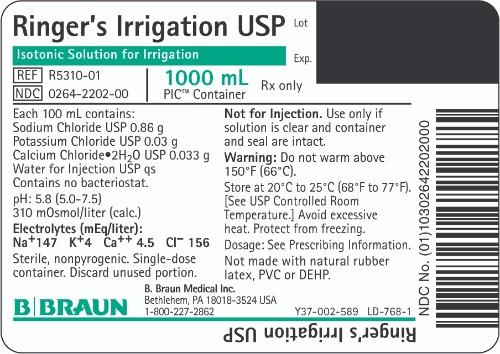
Ringers Sodium Chloride, Potassium Chloride, and Calcium Chloride .86 g/100mL; .03 g/100mL; .033 g/100mL Irrigant — NDC 0264-2202-00 (Billing 00264-2202-00)
This is a package of Ringers Sodium Chloride, Potassium Chloride, and Calcium Chloride .86 g/100mL; .03 g/100mL; .033 g/100mL Irrigant from B. Braun Medical Inc., marketed since Aug 1979 and currently FDA-listed. It is this product's only package size.
NDC database record
One package, one record: these facts belong to NDC 0264-2202-00 alone.
- Record
- FDA NDC Directory package listing · Human prescription drug
- Code segments
- 0264 labeler · 2202 product · 00 package
- Package marketed since
- Aug 6, 1979
- Sample package
- No — commercial package
- Listing certified through
- Dec 31, 2026
- Barcode (UPC-A, from the NDC)
- 3 0264220200 3
- FDA record last changed
- Oct 8, 2026
Identity & classification
Regulatory identifiers FDA, NLM and CMS codes for this package
Drug-database identifiers Medi-Span GPI and First Databank GCN / HICL / AHFS classification
- GSN (GCN sequence number): 001428
- GCN: 04221
- GPI-14 (Medi-Span): 99750020002000
- HICL (First Databank): 000614
- AHFS class code: 40:36.00.00
- RxCUI (RxNorm): 847621
Where does this data come from?
- FDA openFDA NDC Directory · synced Oct 8, 2026
- FDA label on DailyMed · label index refreshed Oct 6, 2026
- RxNorm (NLM RxNav) · catalog refreshed Oct 1, 2026
- Medi-Span GPI (licensed)
- First Databank (licensed) · refreshed Oct 8, 2026
RxNorm drug class
This medicine belongs to the Calcium class.
Where does this data come from?
- RxClass (NLM) · catalog refreshed Oct 1, 2026
Clinical
- The IV versions replace water and electrolytes your body has lost, and Lactated Ringer's and Lacellate can also help counter excess acid. A separate Lactated Ringer's Irrigation pr...
- These are given by healthcare professionals. The IV product runs through a vein under supervision, and the irrigation product is used on a body area during a procedure. Your care t...
- It takes extra care. Severe kidney disease can lead to high potassium and fluid overload, so the IV solution is usually avoided. Heart disease and high potassium also call for caut...
- Is it safe for people with kidney or heart problems?
Patient education
Supplement & herbal interactions
Where does this data come from?
- MedlinePlus (NLM) · refreshed Oct 1, 2026
- FDA label on DailyMed · label index refreshed Oct 6, 2026
Ask a licensed pharmacist directly — free, answered by our team.
Pricing
A drug doesn't have one price. Each row is a different public payment system, and none is what you'd pay at the counter — that depends on your insurance. The ⓘ on each row explains what it measures.
| Price system | Per each | Per package |
|---|---|---|
| Retail pharmacies payNADAC · weekly | Not in the retail survey — common for institutional, discontinued, or low-volume packs. | |
| Medicaid paysCMS SDUD · 12 mo | No recent Medicaid claims on file for this NDC — rare and low-volume NDCs are suppressed in the public data. | |
| Medicare drug plans payPart D · quarterly | No Part D plan price is available for this NDC in our data. | |
Where does this data come from?
- CMS NADAC weekly file
- CMS ASP pricing files · refreshed Sep 20, 2026
- CMS Medicaid State Drug Utilization Data · refreshed Oct 8, 2026
- CMS Part D plan pricing files · refreshed Sep 24, 2026
- VA National Acquisition Center price file
Packaging — all sizes for this product
| Package NDC | Description | Marketing start | Marketing end | Status |
|---|---|---|---|---|
| 00264-2202-00 You're viewing this Main listing | 16 CONTAINER in 1 CASE / 1000 mL in 1 CONTAINER | 1979-08-06 | — | Active |
Therapeutic equivalents
| Product | Labeler | Pack | NADAC/unit | TE | Status | Price vs. this |
|---|---|---|---|---|---|---|
| Ringers .86 g/100mL; .03 g/100mL; .033 g/100mLthis 00264-2202-00 | B. | 1000 ml | — | AT | FDA listed | — |
| Ringers 860 mg/100mL; 33 mg/100mL; 30 mg/100mL 00338-0104-04 | Baxter | 12 bottles | — | AT | FDA listed | — |
Where does this data come from?
- FDA openFDA NDC Directory · synced Oct 8, 2026
- FDA Orange Book · refreshed Oct 3, 2026
- CMS NADAC weekly file
Availability & generic status
We did not find an FDA-approved generic match for this exact strength, form and route.
Where does this data come from?
- FDA Orange Book · refreshed Oct 3, 2026
Inactive Ingredients / Excipients
Inactive ingredients, also called excipients, are components of the drug product other than the active ingredient. They may include fillers, dyes, coatings, preservatives, flavors, or other formulation ingredients.
🧪 Avoiding an ingredient? See Calcium Chloride / Potassium Chloride / Sodium Chloride inactive ingredients by manufacturer: every current product's list side by side, so you can ask your pharmacy for the version that does not list it.
💡 Tap an ingredient (hover on desktop) to see what it is and why it’s used.
-
UNII 059QF0KO0R
Water is a liquid solvent that dissolves and mixes ingredients together in liquid medicines, syrups, and injections. It helps distribute the active drug evenly throughout the product.
1 inactive ingredient listed in the exact product block matched to this NDC.
Where does this data come from?
ingredient classCode="IACT" elements from the exact product block matched by this NDC. Label-section narrative from DailyMed / the openFDA label index is shown separately when available.- FDA label on DailyMed · label index refreshed Oct 6, 2026
- FDA openFDA NDC Directory · synced Oct 8, 2026
Inactive ingredient FAQ
Are inactive ingredients the same for every manufacturer?
Why might an inactive ingredient be missing?
Can inactive ingredients matter?
Manufacturer & labeler
More NDCs from B. Braun Medical Inc. labeler code 00264
- Sodium Chloride 9 mg/mL Injection, Solution NDC 0264-1800-31
- TrophAmine ISOLEUCINE, LEUCINE, LYSINE ACETATE, METHIONINE, PHENYLALANINE, THREONINE, TRYPTOPHAN, VALINE, CYSTEINE HYDROCHLORIDE, HISTIDINE, TYROSINE, N-ACETYL-TYROSINE, ALANINE, ARGININE, PROLINE, SERINE, GLYCINE, ASPARTIC ACID, GLUTAMIC ACID, and TAURINE .82 g/100mL; 1.4 g/100mL; 1.2 g/100mL; .34 g/100mL; .48 g/100mL; .42 g/100mL; .2 g/100mL; .78 g/100mL; .024 g/100mL; .48 g/100mL Solution NDC 0264-1933-10
- POTASSIUM CHLORIDE 14.9 g/100mL Injection, Solution, Concentrate NDC 0264-1944-20
- Balanced Salt Sodium Chloride, Potassium Chloride, Calcium Chloride, Magnesium Chloride, Sodium Acetate, and Sodium Citrate 6.4 mg/mL; .75 mg/mL; .48 mg/mL; .3 mg/mL; 3.9 mg/mL; 1.7 mg/mL Solution NDC 0264-1945-10
- Sterile Water 1 mL/mL Irrigant NDC 0264-2101-00
- Sodium Chloride .9 g/100mL Irrigant NDC 0264-2201-00
- Lactated Ringers Sodium Chloride, Sodium Lactate, Potassium Chloride, and Calcium Chloride .6 g/100mL; .31 g/100mL; .03 g/100mL; .02 g/100mL Irrigant NDC 0264-2203-00
- Physiolyte Sodium Chloride, Sodium Gluconate, Sodium Acetate, Potassium Chloride, and Magnesium Chloride .53 g/100mL; .5 g/100mL; .37 g/100mL; .037 g/100mL; .03 g/100mL Irrigant NDC 0264-2205-00
- Acetic Acid .25 g/100mL Irrigant NDC 0264-2304-00
- Cefazolin Sodium 1 g/50mL Solution NDC 0264-3103-11
- Cefazolin Sodium 2 g/50mL Solution NDC 0264-3105-11
- Cefazolin Sodium 3 g/50mL Solution NDC 0264-3107-11
Where does this data come from?
- FDA openFDA NDC Directory · synced Oct 8, 2026
- Drugs@FDA
Full prescribing information FDA SPL
🎯 Indications and Usage ▾
INDICATIONS AND USAGE Ringer’s Irrigation USP is indicated for all general irrigation, washing and rinsing purposes which permit use of a sterile, nonpyrogenic electrolyte solution.
⏱️ Dosage and Administration ▾
DOSAGE AND ADMINISTRATION The dose is dependent upon the capacity or surface area of the structure to be irrigated and the nature of the procedure. When used as a vehicle for other drugs, the manufacturer’s recommendations should be followed. Parenteral drug products should be inspected visually for particulate matter and discoloration prior to administration, whenever solution and container permits. See PRECAUTIONS .
⛔ Contraindications ▾
CONTRAINDICATIONS NOT FOR INJECTION BY USUAL PARENTERAL ROUTES. An electrolyte solution should not be used for irrigation during electrosurgical procedures.
⚠️ Warnings ▾
WARNINGS FOR IRRIGATION ONLY. NOT FOR INJECTION. Irrigating fluids have been demonstrated to enter the systemic circulation in relatively large volumes; thus this irrigation must be regarded as a systemic drug.
Absorption of large amounts can cause fluid and/or solute overloading resulting in dilution of serum electrolyte concentrations, overhydration, congested states or pulmonary edema. The risk of dilutional states is inversely proportional to the electrolyte concentrations of administered parenteral solutions. The risk of solute overload causing congested states with peripheral and pulmonary edema is directly proportional to the electrolyte concentrations of such solutions.
Do not warm above 150°F (66°C). After opening container, its contents should be used promptly to minimize the possibility of bacterial growth or pyrogen formation. Discard unused portion of irrigating solution since it contains no preservatives.
🤒 Adverse Reactions ▾
ADVERSE REACTIONS Possible adverse effects arising from the irrigation of body cavities, tissues, or indwelling catheters and tubes are usually avoidable when proper procedures are followed. Displaced catheters or drainage tubes can lead to irrigation or infiltration of unintended structures or cavities. Excessive volume or pressure during irrigation of closed cavities may cause undue distention or disruption of tissues.
Accidental contamination from careless technique may transmit infection. Should any adverse reaction occur, discontinue the irrigant, evaluate the patient, institute appropriate therapeutic countermeasures and save the remainder of the fluid for examination if deemed necessary.
🔄 Drug Interactions ▾
Drug Interactions Additives may be incompatible. Consult with pharmacist, if available. When introducing additives, use aseptic technique, mix thoroughly and do not store.
🤰 Pregnancy ▾
Pregnancy Teratogenic Effects Animal reproduction studies have not been conducted with Ringer’s Irrigation USP. It is also not known whether Ringer’s Irrigation USP can cause fetal harm when administered to a pregnant woman or can affect reproduction capacity. Ringer’s Irrigation USP should be given to a pregnant woman only if clearly needed.
🧒 Pediatric Use ▾
Pediatric Use Safety and effectiveness in pediatric patients have not been established.
🧓 Geriatric Use ▾
Geriatric Use Clinical studies of Ringer’s Irrigation have not been performed to determine whether patients over 65 years respond differently from younger subjects. Other reported clinical experience has not identified differences in responses between elderly and younger patients. In general, dose selection for an elderly patient should be cautious, reflecting the greater frequency of decreased hepatic, renal, or cardiac function, and of concomitant disease or other drug therapy.
This drug is known to be substantially excreted by the kidney, and the risk of toxic reactions to this drug may be greater in patients with impaired renal function. Because elderly patients are more likely to have decreased renal function, care should be taken in dose selection, and it may be useful to monitor renal function.
🆘 Overdosage ▾
OVERDOSAGE In the event of overhydration or solute overload, re-evaluate the patient and institute appropriate corrective measures. See WARNINGS , PRECAUTIONS , and ADVERSE REACTIONS .
🧬 Clinical Pharmacology ▾
CLINICAL PHARMACOLOGY Ringer’s Irrigation USP exerts a mechanical cleansing action for sterile irrigation of body cavities, tissues or wounds, indwelling urethral catheters and surgical drainage tubes, and for washing, rinsing or soaking surgical dressings, instruments and laboratory specimens. It also serves as a vehicle for drugs used for irrigation or other pharmaceutical preparations. Ringer’s Irrigation USP provides an isotonic irrigation with the same ionic constituents as Ringer’s Injection USP, a modification of Ringer’s solution (also called Ringer’s mixture) originally used only as a topical physiologic salt solution.
Ringer’s Irrigation USP is considered generally compatible with living tissues and organs. Calcium Chloride in water dissociates to provide calcium (Ca ++ ) and chloride (Cl − ) ions. They are normal constituents of the body fluids and are dependent on various physiologic mechanisms for maintenance of balance between intake and output.
Approximately 80% of body calcium is excreted in the feces as insoluble salts; urinary excretion accounts for the remaining 20%. Potassium chloride in water dissociates to provide potassium (K + ) and chloride (Cl − ) ions. Potassium is the chief cation of body cells (160 mEq/liter of intracellular water).
It is found in low concentration in plasma and extracellular fluids (3.5 to 5.0 mEq/liter in a healthy adult). Potassium plays an important role in electrolyte balance. Normally about 80 to 90% of the potassium intake is excreted in the urine; the remainder in the stools and to a small extent, in the perspiration.
The kidney does not conserve potassium well so that during fasting or in patients on a potassium free diet, potassium loss from the body continues resulting in potassium depletion. Sodium chloride in water dissociates to provide sodium (Na + ) and chloride (Cl − ) ions. Sodium (Na + ) is the principal cation of the extracellular fluid and plays a large part in the therapy of fluid and electrolyte disturbances.
Chloride (Cl − ) has an integral role in buffering action when oxygen and carbon dioxide exchange occurs in the red blood cells. The distribution and excretion of sodium (Na + ) and chloride (Cl − ) are largely under the control of the kidney which maintains a balance between intake and output. Water is an essential constituent of all body tissues and accounts for approximately 70% of total body weight.
Average normal adult daily requirement ranges from two to three liters (1.0 to 1.5 liters each for insensible water loss by perspiration and urine production). Water balance is maintained by various regulatory mechanisms. Water distribution depends primarily on the concentration of electrolytes in the body compartments and sodium (Na + ) plays a major role in maintaining physiologic equilibrium.
📦 How Supplied / Storage and Handling ▾
HOW SUPPLIED Ringer’s Irrigation USP is supplied sterile and nonpyrogenic in PIC™ (Plastic Irrigation Containers). The 1000 mL containers are packaged 16 per case. NDC Cat.
No. Size Ringer’s Irrigation USP 0264-2202-00 R5310-01 1000 mL Exposure of pharmaceutical products to heat should be minimized. Avoid excessive heat.
Protect from freezing. Store at 20°C to 25°C (68°F to 77°F); excursions permitted between 15°C to 30°C (59°F to 86°F). [See USP Controlled Room Temperature.] However, brief exposure up to 40°C does not adversely affect the product. Do not warm above 150°F (66°C).
📦 Storage and Handling ▾
Exposure of pharmaceutical products to heat should be minimized. Avoid excessive heat. Protect from freezing. Store at 20°C to 25°C (68°F to 77°F); excursions permitted between 15°C to 30°C (59°F to 86°F). [See USP Controlled Room Temperature.] However, brief exposure up to 40°C does not adversely affect the product. Do not warm above 150°F (66°C).
📋 Description ▾
DESCRIPTION Ringer’s Irrigation USP is a sterile, nonpyrogenic, solution of electrolytes in water for injection intended only for sterile irrigation, washing and rinsing purposes. Each 100 mL contains: Sodium Chloride USP 0.86 g; Potassium Chloride USP 0.03 g Calcium Chloride Dihydrate USP 0.033 g; Water for Injection USP qs pH: 5.8 (5.0-7.5). The solution is isotonic (310 mOsmol/liter, calc.) and has the following electrolyte content (mEq/liter): Na + 147; K + 4 Ca ++ 4.5; Cl − 156 The solution contains no bacteriostat, antimicrobial agent or added buffer and is intended only for use as a single-dose or short procedure irrigation.
When smaller volumes are required the unused portion should be discarded. Ringer’s Irrigation USP may be classified as a sterile irrigant, wash, rinse and pharmaceutical vehicle. The formulas of the active ingredients are: Ingredients Molecular Formula Molecular Weight Sodium Chloride USP NaCl
58.44 Potassium Chloride USP KCl
74.55Calcium Chloride Dihydrate USP CaCl 2 •2H 2 O 147.01 The plastic container is a copolymer of ethylene and propylene formulated and developed for parenteral drugs. The copolymer contains no plasticizers and exhibits virtually no leachability. The plastic container is also virtually impermeable to vapor transmission and therefore, requires no overwrap to maintain the proper drug concentration.
The safety of the plastic container has been confirmed by biological evaluation procedures. The material passes Class Vl testing as specified in the U.S. Pharmacopeia for Biological Tests — Plastic Containers.
These tests have shown that the container is nontoxic and biologically inert. Not made with natural rubber latex, PVC or DEHP.
⚠️ Precautions ▾
PRECAUTIONS General Do not use for irrigation that may result in absorption into the blood. Caution should be observed when the solution is used for continuous irrigation or allowed to “dwell” inside body cavities because of possible absorption into the blood stream and the production of circulatory overload. Aseptic technique is essential with the use of sterile solutions for irrigation of body cavities, wounds and urethral catheters or for wetting dressings that come in contact with body tissues.
When used as a “pour” irrigation, no part of the contents should be allowed to contact the surface below the outer protected thread area of the semi-rigid wide mouth container. When used for irrigation via irrigation equipment, the administration set should be attached promptly. Unused portions should be discarded and a fresh container of appropriate size used for the start-up of each cycle or repeat procedure.
For repeated irrigations of urethral catheters, a separate container should be used for each patient. Use only if solution is clear and container and seal are intact. Discard unused portion.
Drug Interactions Additives may be incompatible. Consult with pharmacist, if available. When introducing additives, use aseptic technique, mix thoroughly and do not store.
Carcinogenesis, Mutagenesis, Impairment of Fertility Studies with Ringer’s Irrigation USP have not been performed to evaluate carcinogenic potential, mutagenic potential, or effects on fertility. Pregnancy Teratogenic Effects Animal reproduction studies have not been conducted with Ringer’s Irrigation USP. It is also not known whether Ringer’s Irrigation USP can cause fetal harm when administered to a pregnant woman or can affect reproduction capacity.
Ringer’s Irrigation USP should be given to a pregnant woman only if clearly needed. Nursing Mothers Caution should be exercised when Ringer’s Irrigation USP is administered to a nursing woman. Pediatric Use Safety and effectiveness in pediatric patients have not been established.
Geriatric Use Clinical studies of Ringer’s Irrigation have not been performed to determine whether patients over 65 years respond differently from younger subjects. Other reported clinical experience has not identified differences in responses between elderly and younger patients. In general, dose selection for an elderly patient should be cautious, reflecting the greater frequency of decreased hepatic, renal, or cardiac function, and of concomitant disease or other drug therapy.
This drug is known to be substantially excreted by the kidney, and the risk of toxic reactions to this drug may be greater in patients with impaired renal function. Because elderly patients are more likely to have decreased renal function, care should be taken in dose selection, and it may be useful to monitor renal function.
🍼 Nursing Mothers ▾
Nursing Mothers Caution should be exercised when Ringer’s Irrigation USP is administered to a nursing woman.
📄 Carcinogenesis, Mutagenesis, Impairment of Fertility ▾
Carcinogenesis, Mutagenesis, Impairment of Fertility Studies with Ringer’s Irrigation USP have not been performed to evaluate carcinogenic potential, mutagenic potential, or effects on fertility.
📄 Patient Package Insert ▾
Directions for Use of PIC™ (Plastic Irrigation Container) Not for injection. Aseptic technique is required. 1.
Caution – Before use, perform the following checks: (a) Read the label. Ensure solution is the one ordered and is within the expiration date. (b) Invert container and inspect the solution in good light for cloudiness, haze, or particulate matter; check the container for leakage or damage.
Any container which is suspect should not be used. Use only if solution is clear and container and seal are intact. Single-dose container.
Discard unused portion. 2. Outer Closure Removal – Grasp the container with one hand and turn the breakaway ring counterclockwise with the other hand until slight resistance is felt.
Then, twisting the container in the opposite direction, turn the breakaway ring sharply until the entire outer cap is loose and can be lifted off. (Figure 1) 3. Connect the administration set through the sterile set port according to set instructions (Figure 2) or remove screw cap and pour.
4. Do not warm above 150°F (66°C) to assure minimal bottle distortion. Keep bottles upright.
PIC_DFU_Figure 1 PIC_DFU_Figure 2
📄 Package Label / Principal Display Panel ▾
PRINCIPAL DISPLAY PANEL - 1000 mL Bottle Label Ringer’s Irrigation USP Isotonic Solution for Irrigation REF R5310-01 NDC 0264-2202-00 1000 mL PIC™ Container Rx only Lot Exp. Each 100 mL contains: Sodium Chloride USP 0.86 g Potassium Chloride USP 0.03 g Calcium Chloride•2H 2 O USP 0.033 g Water for Injection USP qs Contains no bacteriostat. pH: 5.8 (5.0-7.5) 310 mOsmol/liter (calc.) Electrolytes (mEq/liter): Na + 147 K + 4 Ca ++
4.5Cl – 156 Sterile, nonpyrogenic. Single-dose container. Discard unused portion.
Not for Injection. Use only if solution is clear and container and seal are intact. Warning: Do not warm above 150°F (66°C).
Store at 20°C to 25°C (68°F to 77°F). [See USP Controlled Room Temperature.] Avoid excessive heat. Protect from freezing. Dosage: See Prescribing Information.
Not made with natural rubber latex, PVC or DEHP. B. Braun Medical Inc.
Bethlehem, PA 18018-3524 USA 1-800-227-2862 Y37-002-589 LD-768-1 Ringer’s Irrigation USP Ringer's Irrigation USP - 1000mL Container Label
About this NDC listing & data coverage
What data is (and isn’t) available for this NDC — tap to expand
| NDC identity (package / product / labeler codes) | ✓ Available |
| Labeler | ✓ Available |
| Product & package description | ✓ Available |
| Marketing category & status | ✓ Available |
| Active ingredient / dosage form / route | ✓ Available |
| FDA label (SPL via DailyMed) | ✓ Available |
| Package photos | ✓ Available |
| Inactive ingredients (structured) | ✓ Available |
| NADAC pharmacy acquisition price (CMS) | — Not published for this NDC CMS publishes NADAC only for NDCs reported in its retail-pharmacy survey. |
| Orange Book / therapeutic-equivalence data | ✓ Available |
| HCPCS J-code billing crosswalk | — Not published for this NDC Most self-administered / retail products have no J-code — that is normal. |
| Medicaid utilization (CMS SDUD) | — Not published for this NDC CMS reports utilization only for NDCs with Medicaid claims above its privacy threshold. |