
Sterile Water 1 mL/mL Irrigant — NDC 0264-2101-00 (Billing 00264-2101-00)
This is a package of Sterile Water 1 mL/mL Irrigant from B. Braun Medical Inc., marketed since Sep 1970 and currently FDA-listed. It is the main listing for this product, which comes in 4 package sizes.
NDC database record
One package, one record: these facts belong to NDC 0264-2101-00 alone.
- Record
- FDA NDC Directory package listing · Human prescription drug
- Code segments
- 0264 labeler · 2101 product · 00 package
- Package marketed since
- Sep 10, 1970
- Sample package
- No — commercial package
- Listing certified through
- Dec 31, 2027
- Barcode (UPC-A, from the NDC)
- 3 0264210100 9
- Medicaid fills, this package
- 23,474 prescriptions in the last four reported quarters
- FDA record last changed
- Oct 1, 2026
Other active recalls for Water (different manufacturers) — 3 · tap to view
Identity & classification
Regulatory identifiers FDA, NLM and CMS codes for this package
Drug-database identifiers Medi-Span GPI and First Databank GCN / HICL / AHFS classification
- GSN (GCN sequence number): 009825
- GCN: 45340
- HICL (First Databank): 004283
- AHFS class code: 40:36.00.00
Where does this data come from?
- FDA openFDA NDC Directory · synced Oct 1, 2026
- FDA label on DailyMed · label index refreshed Oct 6, 2026
- RxNorm (NLM RxNav) · catalog refreshed Oct 1, 2026
- Medi-Span GPI (licensed)
- First Databank (licensed) · refreshed Oct 1, 2026
Clinical
- It can seem a little odd at first. In these products, sterile water plays the essential role of carrying or dissolving the actual active medication — like insulin — so it can be sa...
- Why is 'water' listed as the active ingredient on my medicine?
- No — these are very different products that should never be used interchangeably. Sterile Water for Injection is used only as a diluent for other drugs given by needle, and it must...
- Is Sterile Water for Injection the same as the eye wash or the irrigation product?
Patient education
Supplement & herbal interactions
Where does this data come from?
- MedlinePlus (NLM) · refreshed Oct 1, 2026
- FDA label on DailyMed · label index refreshed Oct 6, 2026
Ask a licensed pharmacist directly — free, answered by our team.
Pricing
A drug doesn't have one price. Each row is a different public payment system, and none is what you'd pay at the counter — that depends on your insurance. The ⓘ on each row explains what it measures.
| Price system | Per each | Per package |
|---|---|---|
| Retail pharmacies payNADAC · weekly | Not in the retail survey — common for institutional, discontinued, or low-volume packs. | |
| Medicaid paysCMS SDUD · 12 mo | $0.0131 | $0.21 / 16 containers |
| Medicare drug plans payPart D · quarterly | No Part D plan price is available for this NDC in our data. | |
| Medicare Part B allowsASP · A4217 | No ASP payment limit on file for A4217 this quarter. | |
Where does this data come from?
- CMS NADAC weekly file
- CMS ASP pricing files · refreshed Sep 20, 2026
- CMS Medicaid State Drug Utilization Data · through Q4 2025
- CMS Part D plan pricing files · refreshed Sep 24, 2026
- VA National Acquisition Center price file
Billing & reimbursement
Where does this data come from?
- CMS ASP NDC-HCPCS crosswalk · refreshed Sep 22, 2026
- DMEPDAC NDC-HCPCS crosswalk
- openFDA NSDE billing units · refreshed Sep 7, 2026
Packaging — all sizes for this product
| Package NDC | Description | Marketing start | Marketing end | Status |
|---|---|---|---|---|
| 00264-2101-00 You're viewing this Main listing | 16 CONTAINER in 1 CASE / 1000 mL in 1 CONTAINER | 1970-09-10 | — | Active |
| 00264-2101-10 0264-2101-10 | 16 CONTAINER in 1 CASE / 500 mL in 1 CONTAINER | 1970-09-10 | — | Active |
| 00264-2101-50 0264-2101-50 | 8 CONTAINER in 1 CASE / 2000 mL in 1 CONTAINER | 1970-09-10 | — | Discontinued by firm |
| 00264-2101-70 0264-2101-70 | 4 CONTAINER in 1 CASE / 4000 mL in 1 CONTAINER | 1970-09-10 | — | Discontinued by firm |
In Medicaid, this is the most-dispensed pack of this product — about 87% of fills over the last four reported quarters. See all packs ↓
Pack size FAQ
What quantity is in this package?
What NDC number is used to bill for this package of Sterile Water 1 mL/mL Irrigant?
Therapeutic equivalents
| Product | Labeler | Pack | NADAC/unit | TE | Status | Price vs. this |
|---|---|---|---|---|---|---|
| Sterile Water 1 mL/mLthis 00264-2101-00 | B. | 1000 ml | — | AT | FDA listed | — |
| Sterile Water 100 mL/100mL 00264-7386-50 | B. | 2000 ml | — | AT | FDA listed | — |
| Sterile Water 100 mL/100mL 00338-0003-44 | Baxter | 1000 ml | — | AT | FDA listed | — |
| Sterile Water 100 mL/100mL 00338-0004-02 | Baxter | 24 bottles | — | AT | FDA listed | — |
| Sterile Water 1 mL/mL 00990-7973-05 | ICU | 12 pouches | — | AT | FDA listed | — |
| Sterile Water 1 mL/mL 17271-0802-07 | Becton | 1000 ml | — | AT | FDA listed | — |
| Sterile Water 1 mL/mL 65219-0495-10 | Fresenius | 1000 ml | — | AT | FDA listed | — |
| Sterile Water 1 mL/mL 65219-0497-20 | Fresenius | 2000 ml | — | AT | FDA listed | — |
| Sterile Water 1 mL/mL 65219-0499-30 | Fresenius | 3000 ml | — | AT | FDA listed | — |
Where does this data come from?
- FDA openFDA NDC Directory · synced Oct 1, 2026
- FDA Orange Book · refreshed Oct 3, 2026
- CMS NADAC weekly file
Availability & generic status
The FDA lists approved generic versions of this medicine, but that does not always mean a pharmacy can get one today. Patent rules, launch agreements, supply and pricing can affect when generics actually arrive.
Where does this data come from?
- FDA Orange Book · refreshed Oct 3, 2026
Inactive Ingredients / Excipients
Inactive ingredients, also called excipients, are components of the drug product other than the active ingredient. They may include fillers, dyes, coatings, preservatives, flavors, or other formulation ingredients.
🧪 Avoiding an ingredient? See Water inactive ingredients by manufacturer: every current product's list side by side, so you can ask your pharmacy for the version that does not list it.
Where does this data come from?
IACT rows and label-wide narrative are kept separate; availability and product-level specificity depend on the submitted label.- FDA label on DailyMed · label index refreshed Oct 6, 2026
- FDA openFDA NDC Directory · synced Oct 1, 2026
Inactive ingredient FAQ
Are inactive ingredients the same for every manufacturer?
Why might an inactive ingredient be missing?
Can inactive ingredients matter?
Manufacturer & labeler
More NDCs from B. Braun Medical Inc. labeler code 00264
- Levetiracetam 15 mg/mL Injection NDC 0264-1509-90
- Dextrose 50 mg/mL Injection, Solution NDC 0264-1510-31
- Sodium Chloride 9 mg/mL Injection, Solution NDC 0264-1800-31
- TrophAmine ISOLEUCINE, LEUCINE, LYSINE ACETATE, METHIONINE, PHENYLALANINE, THREONINE, TRYPTOPHAN, VALINE, CYSTEINE HYDROCHLORIDE, HISTIDINE, TYROSINE, N-ACETYL-TYROSINE, ALANINE, ARGININE, PROLINE, SERINE, GLYCINE, ASPARTIC ACID, GLUTAMIC ACID, and TAURINE .82 g/100mL; 1.4 g/100mL; 1.2 g/100mL; .34 g/100mL; .48 g/100mL; .42 g/100mL; .2 g/100mL; .78 g/100mL; .024 g/100mL; .48 g/100mL Solution NDC 0264-1933-10
- POTASSIUM CHLORIDE 14.9 g/100mL Injection, Solution, Concentrate NDC 0264-1944-20
- Balanced Salt Sodium Chloride, Potassium Chloride, Calcium Chloride, Magnesium Chloride, Sodium Acetate, and Sodium Citrate 6.4 mg/mL; .75 mg/mL; .48 mg/mL; .3 mg/mL; 3.9 mg/mL; 1.7 mg/mL Solution NDC 0264-1945-10
- Sodium Chloride .9 g/100mL Irrigant NDC 0264-2201-00
- Ringers Sodium Chloride, Potassium Chloride, and Calcium Chloride .86 g/100mL; .03 g/100mL; .033 g/100mL Irrigant NDC 0264-2202-00
- Lactated Ringers Sodium Chloride, Sodium Lactate, Potassium Chloride, and Calcium Chloride .6 g/100mL; .31 g/100mL; .03 g/100mL; .02 g/100mL Irrigant NDC 0264-2203-00
- Physiolyte Sodium Chloride, Sodium Gluconate, Sodium Acetate, Potassium Chloride, and Magnesium Chloride .53 g/100mL; .5 g/100mL; .37 g/100mL; .037 g/100mL; .03 g/100mL Irrigant NDC 0264-2205-00
- Acetic Acid .25 g/100mL Irrigant NDC 0264-2304-00
- Cefazolin Sodium 1 g/50mL Solution NDC 0264-3103-11
Where does this data come from?
- FDA openFDA NDC Directory · synced Oct 1, 2026
- Drugs@FDA
Full prescribing information FDA SPL
🎯 Indications and Usage ▾
INDICATIONS AND USAGE Sterile Water for Irrigation USP is indicated for use as an irrigating fluid or pharmaceutic aid. Sterile Water may also be used as an adjunct in the preparation of non-intravenously administered nutrient mixtures (see DOSAGE AND ADMINISTRATION ).
⏱️ Dosage and Administration ▾
DOSAGE AND ADMINISTRATION Irrigation Use as directed by physician. This drug product should be inspected visually for particulate matter and discoloration prior to administration, whenever solution and container permit. Nutrient Mixtures Sterile Water for Irrigation USP may be used to prepare non-intravenously administered nutrient mixtures.
It contains no electrolytes or other added substances. Refer to preparation instructions of particular mixture to be used. The plastic container may be used for administration of non-intravenous nutrient mixture to the patient as appropriate.
⛔ Contraindications ▾
CONTRAINDICATIONS Not for injection.
⚠️ Warnings ▾
WARNINGS Sterile Water for Irrigation USP is hypotonic and will cause hemolysis, and is not recommended for use during surgical procedures. After opening container, its contents should be used promptly to minimize the possibility of bacterial growth or pyrogen formation. Discard unused portion of irrigating solution since it contains no preservative.
🤒 Adverse Reactions ▾
ADVERSE REACTIONS None known.
🆘 Overdosage ▾
OVERDOSAGE None known.
🧬 Clinical Pharmacology ▾
CLINICAL PHARMACOLOGY Sterile Water for Irrigation USP is utilized for a variety of clinical indications. Because of its low refractive index (1.3325), water provides excellent visibility during endoscopic urological procedures. It is also utilized as a pharmaceutic aid, as well as in the preparation of enteral nutrient products.
Water is hypotonic and will cause hemolysis and will be readily absorbed by the tissues during surgical procedures; therefore, its use under such conditions is not recommended.
📦 How Supplied / Storage and Handling ▾
HOW SUPPLIED Sterile Water for Irrigation USP is supplied sterile and nonpyrogenic in plastic irrigating containers. The 1000 mL and 500 mL containers are packaged 16 per case. NDC Cat.
No. Size Sterile Water for Irrigation USP (Canada DIN 01963961) 0264-2101-00 R5000-01 1000 mL 0264-2101-10 R5001-01 500 mL Exposure of pharmaceutical products to heat should be minimized. Avoid excessive heat.
Protect from freezing. It is recommended that the product be stored at room temperature (25°C); however, brief exposure up to 40°C does not adversely affect the product. Do not warm above 150°F (66°C).
📋 Description ▾
DESCRIPTION Sterile Water for Irrigation USP is a sterile, hypotonic, nonpyrogenic irrigating fluid or pharmaceutic aid (solvent) entirely composed of Sterile Water for Injection USP. It is prepared by distillation and contains no antimicrobial or bacteriostatic agents or added buffers. The pH is 5.7 (5.0–7.0) The plastic container is a copolymer of ethylene and propylene formulated and developed for parenteral drugs.
The copolymer contains no plasticizers and exhibits virtually no leachability. The plastic container is also virtually impermeable to vapor transmission and therefore, requires no overwrap to maintain the proper drug concentration. The safety of the plastic container has been confirmed by biological evaluation procedures.
The material passes Class Vl testing as specified in the U.S. Pharmacopeia for Biological Tests — Plastic Containers. These tests have shown that the container is nontoxic and biologically inert.
Not made with natural rubber Latex, PVC or DEHP.
⚠️ Precautions ▾
PRECAUTIONS Use only if solution is clear and container and seal are intact.
📄 Package Label / Principal Display Panel ▾
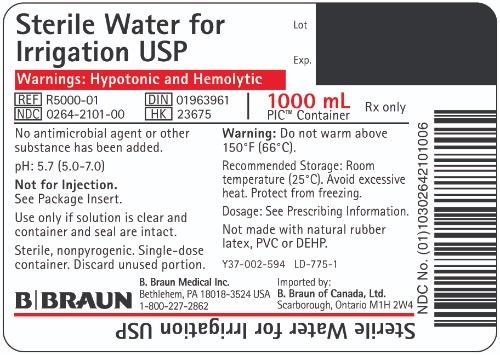
PRINCIPAL DISPLAY PANEL - 1000 mL Container Sterile Water for Irrigation USP Warnings: Hypotonic and Hemolytic REF R5000-01 NDC 0264-2101-00 DIN 01963961 HK 23675 1000 mL PIC™ Container Rx only Lot Exp. No antimicrobial agent or other substance has been added. pH: 5.7 (5.0-7.0) Not for Injection. See Package Insert.
Use only if solution is clear and container and seal are intact. Sterile, nonpyrogenic. Single-dose container.
Discard unused portion. Warning: Do not warm above 150°F (66°C). Recommended Storage: Room temperature (25°C).
Avoid excessive heat. Protect from freezing. Dosage: See Prescribing Information.
Not made with natural rubber latex, PVC or DEHP. Y37-002-594 LD-775-1 B. Braun Medical Inc.
Bethlehem, PA 18018-3524 USA 1-800-227-2862 Imported by: B. Braun of Canada, Ltd. Scarborough, Ontario M1H 2W4 Sterile Water for Irrigation USP 1000 mL Container Label R5000-01
PRINCIPAL DISPLAY PANEL - 500 mL Container Sterile Water for Irrigation USP Warnings: Hypotonic and Hemolytic REF R5001-01 NDC 0264-2101-10 DIN 01963961 HK 23675 500 mL PIC™ Container Rx only Lot Exp. No antimicrobial agent or other substance has been added. pH: 5.7 (5.0-7.0) Not for Injection. See Package Insert.
Use only if solution is clear and container and seal are intact. Sterile, nonpyrogenic. Single-dose container.
Discard unused portion. Warning: Do not warm above 150°F (66°C). Recommended Storage: Room temperature (25°C).
Avoid excessive heat. Protect from freezing. Dosage: See Prescribing Information.
Not made with natural rubber latex, PVC or DEHP. Y37-002-595 LD-776-1 B. Braun Medical Inc.
Bethlehem, PA 18018-3524 USA 1-800-227-2862 Imported by: B. Braun of Canada, Ltd. Scarborough, Ontario M1H 2W4 Sterile Water for Irrigation USP 500 mL Container Label R5001-01
Medicaid utilization & spend
Medicaid utilization by pack size
About this NDC listing & data coverage
What data is (and isn’t) available for this NDC — tap to expand
| NDC identity (package / product / labeler codes) | ✓ Available |
| Labeler | ✓ Available |
| Product & package description | ✓ Available |
| Marketing category & status | ✓ Available |
| Active ingredient / dosage form / route | ✓ Available |
| FDA label (SPL via DailyMed) | ✓ Available |
| Package photos | ✓ Available |
| Inactive ingredients (structured) | — Not published for this NDC The labeler did not submit a structured excipient list, or no SPL is available. |
| NADAC pharmacy acquisition price (CMS) | — Not published for this NDC CMS publishes NADAC only for NDCs reported in its retail-pharmacy survey. |
| Orange Book / therapeutic-equivalence data | ✓ Available |
| HCPCS J-code billing crosswalk | ✓ Available |
| Medicaid utilization (CMS SDUD) | ✓ Available |