
Sterile Water 100 mL/100mL Irrigant — NDC 0338-0004-02 (Billing 00338-0004-02)
This is a package of Sterile Water 100 mL/100mL Irrigant from Baxter Healthcare Corporation, marketed since Dec 1974 and currently FDA-listed.
NDC database record
One package, one record: these facts belong to NDC 0338-0004-02 alone.
- Record
- FDA NDC Directory package listing · Human prescription drug
- Code segments
- 0338 labeler · 0004 product · 02 package
- Package marketed since
- Dec 31, 1974
- Sample package
- No — commercial package
- Listing certified through
- Dec 31, 2027
- Barcode (UPC-A, from the NDC)
- 3 0338000402 7
- Medicaid fills, this package
- 3,067 prescriptions in the last four reported quarters
- FDA record last changed
- Jul 24, 2026
Other active recalls for Water (different manufacturers) — 2 · tap to view
Identity & classification
Regulatory identifiers FDA, NLM and CMS codes for this package
Drug-database identifiers Medi-Span GPI and First Databank GCN / HICL / AHFS classification
- GSN (GCN sequence number): 009825
- GCN: 45340
- GPI-14 (Medi-Span): 99750005002000
- HICL (First Databank): 004283
- AHFS class code: 40:36.00.00
- RxCUI (RxNorm): 150985
Where does this data come from?
- FDA openFDA NDC Directory · synced Oct 1, 2026
- FDA label on DailyMed · label index refreshed Oct 6, 2026
- RxNorm (NLM RxNav) · catalog refreshed Oct 1, 2026
- Medi-Span GPI (licensed)
- First Databank (licensed) · refreshed Oct 1, 2026
Clinical
- It can seem a little odd at first. In these products, sterile water plays the essential role of carrying or dissolving the actual active medication — like insulin — so it can be sa...
- Why is 'water' listed as the active ingredient on my medicine?
- No — these are very different products that should never be used interchangeably. Sterile Water for Injection is used only as a diluent for other drugs given by needle, and it must...
- Is Sterile Water for Injection the same as the eye wash or the irrigation product?
Patient education
Supplement & herbal interactions
Where does this data come from?
- MedlinePlus (NLM) · refreshed Oct 1, 2026
- FDA label on DailyMed · label index refreshed Oct 6, 2026
Ask a licensed pharmacist directly — free, answered by our team.
Pricing
A drug doesn't have one price. Each row is a different public payment system, and none is what you'd pay at the counter — that depends on your insurance. The ⓘ on each row explains what it measures.
| Price system | Per each | Per package |
|---|---|---|
| Retail pharmacies payNADAC · weekly | Not in the retail survey — common for institutional, discontinued, or low-volume packs. | |
| Medicaid paysCMS SDUD · 12 mo | $0.1217 | $2.92 / 24 bottles |
| Medicare drug plans payPart D · quarterly | No Part D plan price is available for this NDC in our data. | |
| Medicare Part B allowsASP · A4217 | No ASP payment limit on file for A4217 this quarter. | |
Where does this data come from?
- CMS NADAC weekly file
- CMS ASP pricing files · refreshed Sep 20, 2026
- CMS Medicaid State Drug Utilization Data · through Q1 2026
- CMS Part D plan pricing files · refreshed Sep 24, 2026
- VA National Acquisition Center price file
Billing & reimbursement
Where does this data come from?
- CMS ASP NDC-HCPCS crosswalk · refreshed Sep 22, 2026
- DMEPDAC NDC-HCPCS crosswalk
- openFDA NSDE billing units · refreshed Sep 7, 2026
Packaging — all sizes for this product
| Package NDC | Description | Marketing start | Marketing end | Status |
|---|---|---|---|---|
| 00338-0004-02 You're viewing this | 24 BOTTLE, PLASTIC in 1 CARTON / 250 mL in 1 BOTTLE, PLASTIC | 1974-12-31 | — | Active |
| 00338-0004-03 0338-0004-03 | 18 BOTTLE, PLASTIC in 1 CARTON / 500 mL in 1 BOTTLE, PLASTIC | 1974-12-31 | — | Active |
| 00338-0004-04 0338-0004-04 Main listing | 12 BOTTLE, PLASTIC in 1 CARTON / 1000 mL in 1 BOTTLE, PLASTIC | 1974-12-31 | — | Active |
This pack accounts for about 6.3% of this product's recent Medicaid fills; most go to a different pack size. See all packs ↓
Pack size FAQ
What quantity is in this package?
What NDC number is used to bill for this package of Sterile Water 100 mL/100mL Irrigant?
Therapeutic equivalents
| Product | Labeler | Pack | NADAC/unit | TE | Status | Price vs. this |
|---|---|---|---|---|---|---|
| Sterile Water 1 mL/mL 00264-2101-00 | B. | 1000 ml | — | AT | FDA listed | — |
| Sterile Water 100 mL/100mL 00264-7386-50 | B. | 2000 ml | — | AT | FDA listed | — |
| Sterile Water 100 mL/100mL 00338-0003-44 | Baxter | 1000 ml | — | AT | FDA listed | — |
| Sterile Water 100 mL/100mLthis 00338-0004-02 | Baxter | 24 bottles | — | AT | FDA listed | — |
| Sterile Water 1 mL/mL 00990-7973-05 | ICU | 12 pouches | — | AT | FDA listed | — |
| Sterile Water 1 mL/mL 17271-0802-07 | Becton | 1000 ml | — | AT | FDA listed | — |
| Sterile Water 1 mL/mL 65219-0495-10 | Fresenius | 1000 ml | — | AT | FDA listed | — |
| Sterile Water 1 mL/mL 65219-0497-20 | Fresenius | 2000 ml | — | AT | FDA listed | — |
| Sterile Water 1 mL/mL 65219-0499-30 | Fresenius | 3000 ml | — | AT | FDA listed | — |
Where does this data come from?
- FDA openFDA NDC Directory · synced Oct 1, 2026
- FDA Orange Book · refreshed Oct 3, 2026
- CMS NADAC weekly file
Availability & generic status
The FDA lists approved generic versions of this medicine, but that does not always mean a pharmacy can get one today. Patent rules, launch agreements, supply and pricing can affect when generics actually arrive.
Where does this data come from?
- FDA Orange Book · refreshed Oct 3, 2026
Inactive Ingredients / Excipients
Inactive ingredients, also called excipients, are components of the drug product other than the active ingredient. They may include fillers, dyes, coatings, preservatives, flavors, or other formulation ingredients.
🧪 Avoiding an ingredient? See Water inactive ingredients by manufacturer: every current product's list side by side, so you can ask your pharmacy for the version that does not list it.
Where does this data come from?
IACT rows and label-wide narrative are kept separate; availability and product-level specificity depend on the submitted label.- FDA label on DailyMed · label index refreshed Oct 6, 2026
- FDA openFDA NDC Directory · synced Oct 1, 2026
Inactive ingredient FAQ
Are inactive ingredients the same for every manufacturer?
Why might an inactive ingredient be missing?
Can inactive ingredients matter?
Manufacturer & labeler
More NDCs from Baxter Healthcare Corporation labeler code 00338
- Sterile Water 100 mL/100mL Irrigant NDC 0338-0003-44
- epinephrine 16 ug/mL Injection, Solution NDC 0338-0006-20
- Fosaprepitant 150 mg/5mL Injection, Powder, Lyophilized, For Solution NDC 0338-0008-01
- Sterile Water 100 mL/100mL Injection, Solution NDC 0338-0013-04
- DEXTROSE 50 g/1000mL Injection, Solution NDC 0338-0017-01
- DEXTROSE 100 g/1000mL Injection, Solution NDC 0338-0023-02
- epinephrine 64 ug/mL Injection, Solution NDC 0338-0024-20
Where does this data come from?
- FDA openFDA NDC Directory · synced Oct 1, 2026
- Drugs@FDA
Full prescribing information FDA SPL
🎯 Indications and Usage ▾
1 INDICATIONS AND USAGE Sterile Water for Irrigation is indicated for use as an irrigant. Sterile Water for Irrigation is indicated for use as an irrigant. ( 1 )
⏱️ Dosage and Administration ▾
2 DOSAGE AND ADMINISTRATION • For Irrigation only. Not for injection or infusion by usual parenteral routes. ( 2.1 , 5.1 ) • The volume and/or rate of irrigation depend on the type of the procedure and the capacity or the surface area of the structure to be irrigated. ( 2.2 ) • For preparation and administration instructions see the full prescribing information. ( 2.1 , 2.3 )
2.1Important Administration Instructions • For irrigation only. Not for intravenous injection. • Sterile Water for Irrigation is hypotonic with an osmolarity of zero mOsmol/L. It is intended for use as an irrigation fluid and not for intravenous administration or administration by other, parenteral routes (e.g., subcutaneous or intramuscular) [see Warnings and Precautions (5.1) ]. • Sterile Water for Irrigation is not potable water and is not intended for oral administration. • Sterile Water for Irrigation that has been warmed must not be returned to storage.
2.2Recommended Dosage The volume and/or rate of irrigation depend on the type of the procedure and the capacity or the surface area of the structure to be irrigated.
2.3Preparation and Administration Instructions For single-dose only. Sterile Water for Irrigation is available in a flexible plastic container and a plastic pour bottle. Use the contents of the opened container immediately to minimize the potential for bacterial growth and pyrogen formation.
Discard the unused contents of opened containers, as Sterile Water for Irrigation contains no antimicrobial preservative. Adding Medications to Either the Flexible Plastic Container or the Plastic Pour Bottle • Use aseptic technique when making additions to Sterile Water for Irrigation. • Additives may be incompatible with Sterile Water for Irrigation. • The compatibility of additives with Sterile Water for Irrigation must be assessed. Before introducing additives, check for a possible color change and/or the appearance of precipitates, insoluble complexes, or crystals. • Before adding a substance or medication, verify that it is soluble and/or stable in water and that the pH range of Sterile Water for Irrigation is appropriate. • Additives known or determined to be incompatible should not be used. • Mix thoroughly after additives have been introduced. • Use immediately.
Administration Instructions for Irrigation by Gravity Using the Flexible Plastic Container 1. Use aseptic technique. 2.
Tear overwrap down side at slit and remove solution container. Visually inspect the container. If the outlet port protector is damaged, detached, or not present, discard container as solution path sterility may be impaired.
Some opacity of the plastic due to moisture absorption during the sterilization process may be observed. This is normal and does not affect the solution quality or safety. The opacity will diminish gradually.
Check for minute leaks by squeezing the container firmly. If leaks are found, discard solution as sterility may be impaired. 3.
Suspend container using hanger hole. 4. Remove plastic protector from outlet port at bottom of container.
5. Attach irrigation set. Refer to complete directions accompanying set.
Warming If desired, warm the flexible plastic container in overwrap to near body temperature in a water bath or fluid warmer heated to not more than 45°C. Microwave heating of irrigation fluids is not recommended. Administration Using the Plastic Pour Bottle 1.
Inspect Sterile Water for Irrigation visually for particulate matter and discoloration prior to use. Discard if the fluid is not clear or the seal is broken. 2.
Use aseptic technique 3. Remove the plastic shrink band by tearing along the perforation line and unscrew the bottle cap. 4.
Prevent contact of the fluid with the external surface of the container (including the thread for the bottle cap of the plastic pour bottle). Warming If desired, warm the plastic pour bottle in a fluid warmer to not more than 50°C for a maximum of 60 days. Discard after 60 days of warming.
Microwave… [Excerpted — this section continues on DailyMed.]
💊 Dosage Forms and Strengths ▾
3 DOSAGE FORMS AND STRENGTHS Irrigation: • 250, 500, 1000, and 1500 mL sterile water for irrigation in a single-dose plastic pour bottle • 1000, 2000 and 3000 mL sterile water for irrigation in a single-dose flexible plastic container • 250, 500, 1000, and 1500 mL sterile water for irrigation in a single-dose plastic pour bottle. ( 3 ) • 1000, 2000 and 3000 mL sterile water for irrigation in a single-dose flexible plastic container. ( 3 )
⛔ Contraindications ▾
4 CONTRAINDICATIONS None. • None. ( 4 )
⚠️ Warnings and Cautions ▾
5 WARNINGS AND PRECAUTIONS • Hypotonicity : Administration by parenteral routes can result in serious adverse reactions. For irrigation use only. ( 5.1 ) • Excessive Water Absorption : May result in hyponatremia, hypoosmolality and fluid overload.
Monitor patients for absorption of clinically relevant amounts of fluid during and after the procedure. Additional monitoring is recommended for patients at increased risk of developing complications of fluid overload syndrome (e.g., patients with renal or cardiac impairment) or hyponatremic encephalopathy (e.g., pediatric patients; women, in particular premenopausal women; patients with hypoxemia; and patients with central nervous system disease). Avoid use in procedures that require longer irrigation times or an irrigation fluid pressure that promotes absorption.
( 5.2 , 8.4 ) • Use with Electrosurgery/Cautery : Ensure compatibility with equipment used with electrosurgery or cautery. ( 5.2 )
5.1Hypotonicity Sterile Water for Irrigation is hypotonic with an osmolarity of zero mOsmol/L. It is intended for use as irrigation fluid and not for intravenous administration or administration by other, usual parenteral routes, such as intravascular administration in general, subcutaneous administration, or intramuscular administration. Serious adverse reactions, including cerebral or pulmonary edema, massive hemolysis, and acute renal failure can result from the hypotonicity of Sterile Water for Irrigation [see Warnings and Precautions (5.2) ].
5.2Excessive Water Absorption Due to the hypotonicity, absorption of Sterile Water for Irrigation can result in serious adverse reactions of hyponatremia, hypoosmolality and fluid overload, resulting in fatality or permanent morbidity. Complications include cerebral edema, encephalopathy, pulmonary edema, massive hemolysis, rhabdomyolysis, renal failure, and hyperkalemia [see Adverse Reactions (6) ]. In addition, excessive volume or pressure of the irrigation fluid may also cause undue distension of body cavities and may cause tissue disruption (e.g., tears or perforation).
These complications can manifest after irrigation has ended and immediate intervention may be required. Monitor patients closely for absorption of clinically relevant amounts of fluid during and for an appropriate period after the procedure. If absorption occurs, discontinue Sterile Water for Irrigation.
Additional close monitoring during and/or after the procedure is recommended for patients at increased risk for developing complications related to hypotonicity, such as: • fluid overload syndrome, including patients with severe renal impairment, impaired cardiac function, or other clinical conditions associated with edematous states. • hyponatremic encephalopathy, including pediatric patients; women, in particular premenopausal women; patients with hypoxemia; and patients with underlying central nervous system disease.
Avoid use of Sterile Water for Irrigation in patients with wounds where significant absorption may occur, such as procedures that require irrigation over a longer period of time or an irrigation fluid pressure that promotes absorption (e.g., transurethral resection of prostate). Sterile Water for Irrigation should only be used by clinicians familiar with the treatment of possible complications.
5.3Use with Electrosurgery/Cautery In contrast to other irrigation fluids containing electrolytes, Sterile Water for Irrigation is non-conductive. Therefore, when choosing the distension solution/fluid used with electrosurgery or cautery, ensure compatibility with the equipment.
🤒 Adverse Reactions ▾
6 ADVERSE REACTIONS The following adverse reactions have been identified during post approval use of Sterile Water for Irrigation. Because these reactions are reported voluntarily from a population of uncertain size, it is not always possible to reliably estimate their frequency or establish a causal relationship to drug exposure. Metabolism and Nutrition disorders : Hyponatremia, fluid overload, fluid absorption, electrolyte imbalance Nervous System Disorders : Cerebral edema General Disorders and Administration Site Conditions : Burning sensation (with irrigation of eyes and skin wounds) Musculoskeletal and Connective Tissue Disorders : Rhabdomyolysis (myoglobinuria) Renal and Urinary Disorders : Renal failure Other Adverse reactions which may occur in association with absorption of water for irrigation include: Blood and Lymphatic System Disorders : Hemolysis (hemoglobinemia, hemoglobinuria) Metabolism and Nutrition Disorders : Hypervolemia, hypoosmolality, hyperkalemia, acid/base balance disorder Nervous System Disorders : Encephalopathy (seizure, loss of vision, lethargy, disorientation, irritability, vomiting, nausea, headache) Cardiac Disorders : Cardiac arrest, cardiac failure, bradycardia, electrocardiogram abnormal Vascular Disorders : Hypertension, postoperative hypotension Respiratory, Thoracic and Mediastinal Disorders: Respiratory arrest, respiratory failure, pulmonary edema Most common adverse reactions are: hyponatremia, fluid overload, fluid absorption, electrolyte imbalance.
( 6 ) To report SUSPECTED ADVERSE REACTIONS, contact Baxter Healthcare Corporation at 1-866-888-2472 or FDA at 1-800-FDA-1088 or www.fda.gov/medwatch.
👥 Use in Specific Populations ▾
8 USE IN SPECIFIC POPULATIONS
8.1Pregnancy Risk Summary Appropriate administration of Sterile Water for Irrigation is not expected to cause adverse developmental outcomes. There are no available data on Sterile Water for Irrigation use in pregnant women to determine a drug-associated risk of adverse developmental outcomes. Animal reproduction studies have not been conducted with Sterile Water for Irrigation.
All pregnancies have a background risk of birth defect, loss, or other adverse outcomes. In the U.S. general population, the estimated background risk of major birth defects and miscarriage in clinically recognized pregnancies is 2 to 4% and 15 to 20% respectively.
8.2Lactation Risk Summary Appropriate administration of Sterile Water for Irrigation is not expected to cause harm to a breastfed infant. There are no data on the presence of Sterile Water for Irrigation in either human or animal milk, the effects on the breastfed infant or the effects on milk production. The lack of clinical data during lactation precludes a clear determination of the risk of Sterile Water for Irrigation to a breastfed infant; therefore, the developmental and health benefits of breastfeeding should be considered along with the mother’s clinical need for Sterile Water for Irrigation and any potential adverse effects on the breastfed infant from Sterile Water for Irrigation or from the underlying maternal condition.
8.4Pediatric Use Safety and effectiveness in pediatric patients have not been established. Pediatric patients are at higher risk compared to adults for developing encephalopathy as a complication of hyponatremia, if there is excessive absorption of Sterile Water for Irrigation [see Warnings and Precautions (5.2) ].
8.5Geriatric Use Sterile Water for Irrigation should be used cautiously in older patients. Geriatric patients are more likely to have decreased cardiac, renal, or hepatic function, and other diseases or concomitant drug therapy.
🤰 Pregnancy ▾
8.1Pregnancy Risk Summary Appropriate administration of Sterile Water for Irrigation is not expected to cause adverse developmental outcomes. There are no available data on Sterile Water for Irrigation use in pregnant women to determine a drug-associated risk of adverse developmental outcomes. Animal reproduction studies have not been conducted with Sterile Water for Irrigation.
All pregnancies have a background risk of birth defect, loss, or other adverse outcomes. In the U.S. general population, the estimated background risk of major birth defects and miscarriage in clinically recognized pregnancies is 2 to 4% and 15 to 20% respectively.
🧒 Pediatric Use ▾
8.4Pediatric Use Safety and effectiveness in pediatric patients have not been established. Pediatric patients are at higher risk compared to adults for developing encephalopathy as a complication of hyponatremia, if there is excessive absorption of Sterile Water for Irrigation [see Warnings and Precautions (5.2) ].
🧓 Geriatric Use ▾
8.5Geriatric Use Sterile Water for Irrigation should be used cautiously in older patients. Geriatric patients are more likely to have decreased cardiac, renal, or hepatic function, and other diseases or concomitant drug therapy.
🆘 Overdosage ▾
10 OVERDOSAGE Excessive rate, volume, pressure or duration of irrigation with hypotonic fluid can result in excessive fluid absorption and permanent morbidity or death as a result of hyponatremia, hypoosmolality and/or fluid overload. In the event of clinically relevant absorption of Sterile Water for Irrigation, immediate intervention may be required [see Warnings and Precautions (5.2) ].
📦 How Supplied / Storage and Handling ▾
16 HOW SUPPLIED/STORAGE AND HANDLING Sterile Water for Irrigation is supplied in single-dose plastic pour bottles and flexible plastic containers as follows: Container Product Codes Fill Volume (mL) NDC Plastic Pour Bottle 2F7112 250 0338-0004-02 2F7113 500 0338-0004-03 2F7114 1000 0338-0004-04 2F7115 1500 0338-0004-05 Flexible Plastic Container 2B7114 1000 0338-0003-44 2B7116 2000 0338-0003-46 2B7117 3000 0338-0003-47 Storage Exposure of pharmaceutical products to heat should be minimized. Avoid excessive heat. Store at room temperature (25°C): brief exposure up to 40°C does not adversely affect the product.
📋 Description ▾
11 DESCRIPTION Sterile Water for Irrigation contains water that is sterilized and packaged for use as an irrigant. No antimicrobial agent or other substance has been added. The pH is 5.5 (5.0 to 7.0).
Sterile Water for Irrigation is hypotonic with an osmolarity of zero mOsmol/L. The flexible plastic container is fabricated from a specially formulated polyvinyl chloride. The amount of water that can permeate from inside the container into the overwrap is insufficient to affect the fluid significantly.
Water in contact with the plastic container may leach out certain chemical components from the plastic in very small amounts; however, biological testing was supportive of the safety of the plastic container materials. The plastic pour bottle is fabricated from specially formulated polyolefin. The polyolefin is a copolymer of ethylene and propylene.
The container requires no vapor barrier.
💬 Information for Patients ▾
17 PATIENT COUNSELING INFORMATION Inform patients, caregivers, or home healthcare providers of the following risks of Sterile Water for Irrigation: • Hypotonicity [see Warnings and Precautions (5.1) ] • Excessive Water Absorption [see Warnings and Precautions (5.2) ]
📄 Package Label / Principal Display Panel ▾
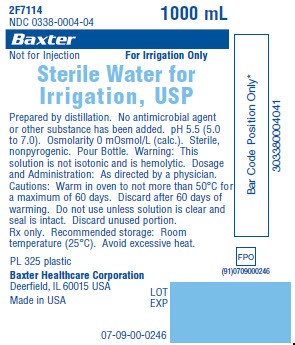
PACKAGE/LABEL PRINCIPAL DISPLAY PANEL Container Label 2F7114 NDC 0338-0004-04 1000 mL Baxter Logo Not for Injection For Irrigation Only Sterile Water for Irrigation USP Prepared by distillation. No antimicrobial agent or other substance has been added. pH 5.5 (5.0 to 7.0). Osmolarity 0 mOsmol/L (calc.).
Sterile, nonpyrogenic. Pour Bottle. Warning: This solution is not isotonic and is hemolytic.
Dosage and Administration: As directed by a physician. Cautions: Warm in oven to not more than 50ºC for a maximum of 60 days. Discard after 60 days of warming.
Do not use unless solution is clear and seal is intact. Discard unused portion. Rx only.
Recommended storage: Room temperature (25ºC). Avoid excessive heat. PL 325 Plastic Baxter Healthcare Corporation Deerfield, IL 60015 USA Made in USA LOT EXP FPO (91)0709000246 Bar Code 07-09-00-0246 Bar Code Position Only* 303380004041 LOT EXP 2000 mL NOT FOR INJECTION 2B7116 NDC 0338-0003-46 STERILE WATER For Irrigation USP For irrigation only Prepared by distillation No antimicrobial agent or other substance has been added pH 5.5 (5.0 TO 7.0).
Osmolarity 0 mOsmol/L (calc) Sterile Nonpyrogenic Single dose container Do not use unless fluid is clear Discard unused portion Cautions This fluid is not isotonic and is hemolytic Squeeze and inspect inner bag which maintains product sterility Discard if leaks are found Rx Only Store unit in moisture barrier overwrap at room temperature (25ºC) until Ready to use Avoid excessive heat See insert Sterile Water H 2 0 For Irrigation USP UROMATIC container Baxter Logo Baxter Healthcare Corporation Deerfield IL 60015 USA Made in USA PL 146 Plastic Baxter UROMATIC and PL 146 are trademarks of Baxter International Inc For product information 1-800-933-0303 1800 1600 1400 1200 1000 800 600 400 200 Representative bottle label 0338-0004-04.jpg Representative Container Label 0338-0003-46
Medicaid utilization & spend
Medicaid utilization by pack size
About this NDC listing & data coverage
What data is (and isn’t) available for this NDC — tap to expand
| NDC identity (package / product / labeler codes) | ✓ Available |
| Labeler | ✓ Available |
| Product & package description | ✓ Available |
| Marketing category & status | ✓ Available |
| Active ingredient / dosage form / route | ✓ Available |
| FDA label (SPL via DailyMed) | ✓ Available |
| Package photos | ✓ Available |
| Inactive ingredients (structured) | — Not published for this NDC The labeler did not submit a structured excipient list, or no SPL is available. |
| NADAC pharmacy acquisition price (CMS) | — Not published for this NDC CMS publishes NADAC only for NDCs reported in its retail-pharmacy survey. |
| Orange Book / therapeutic-equivalence data | ✓ Available |
| HCPCS J-code billing crosswalk | ✓ Available |
| Medicaid utilization (CMS SDUD) | ✓ Available |