
NOREPINEPHRINE BITARTRATE 16 mg/250mL Injection, Solution — NDC 0338-0128-20 (Billing 00338-0128-20)
This is a package of NOREPINEPHRINE BITARTRATE 16 mg/250mL Injection, Solution from Baxter Healthcare Corporation, marketed since Nov 2023 and currently FDA-listed. It is this product's only package size.
NDC database record
One package, one record: these facts belong to NDC 0338-0128-20 alone.
- Record
- FDA NDC Directory package listing · Human prescription drug
- Code segments
- 0338 labeler · 0128 product · 20 package
- Package marketed since
- Feb 6, 2026
- Sample package
- No — commercial package
- Listing certified through
- Dec 31, 2027
- Barcode (UPC-A, from the NDC)
- 3 0338012820 4
- FDA record last changed
- Jul 24, 2026
Identity & classification
Regulatory identifiers FDA, NLM and CMS codes for this package
Drug-database identifiers Medi-Span GPI and First Databank GCN / HICL / AHFS classification
- GSN (GCN sequence number): 068106
- GCN: 30804
- HICL (First Databank): 036346
- AHFS class code: 12:12.12.00
- RxCUI (RxNorm): 2475337
Where does this data come from?
- FDA openFDA NDC Directory · synced Oct 8, 2026
- FDA label on DailyMed · label index refreshed Oct 8, 2026
- RxNorm (NLM RxNav) · catalog refreshed Oct 1, 2026
- Medi-Span GPI (licensed)
- First Databank (licensed) · refreshed Oct 8, 2026
RxNorm drug class
This medicine belongs to the Catecholamine class.
Where does this data come from?
- RxClass (NLM) · catalog refreshed Oct 1, 2026
Clinical
- It raises blood pressure when it has dropped dangerously low, such as in severe, sudden hypotension. It is given in a hospital setting. Some older product labels also list use as a...
- It is given through an IV drip into a large vein by trained staff. Your team adjusts the rate to your blood pressure and lowers it slowly when it's time to stop.
- The most common ones are high blood pressure, slow heart rate, anxiety, headache and trouble breathing. Tell your nurse right away about pain, swelling or skin changes at the IV si...
- Yes. MAO inhibitors, linezolid and tricyclic antidepressants can cause severe, prolonged high blood pressure. It can also raise blood sugar, so diabetes medicines may need adjustin...
Patient education
Supplement & herbal interactions
Where does this data come from?
- MedlinePlus (NLM) · refreshed Oct 8, 2026
- FDA label on DailyMed · label index refreshed Oct 8, 2026
Ask a licensed pharmacist directly — free, answered by our team.
Pricing
A drug doesn't have one price. Each row is a different public payment system, and none is what you'd pay at the counter — that depends on your insurance. The ⓘ on each row explains what it measures.
| Price system | Per mL | Per package |
|---|---|---|
| Retail pharmacies payNADAC · weekly | Not in the retail survey — common for institutional, discontinued, or low-volume packs. | |
| Medicaid paysCMS SDUD · 12 mo | No recent Medicaid claims on file for this NDC — rare and low-volume NDCs are suppressed in the public data. | |
| Medicare drug plans payPart D · quarterly | No Part D plan price is available for this NDC in our data. | |
Where does this data come from?
- CMS NADAC weekly file
- CMS ASP pricing files · refreshed Sep 20, 2026
- CMS Medicaid State Drug Utilization Data · refreshed Oct 8, 2026
- CMS Part D plan pricing files · refreshed Sep 24, 2026
- VA National Acquisition Center price file
Packaging — all sizes for this product
| Package NDC | Description | Marketing start | Marketing end | Status |
|---|---|---|---|---|
| 00338-0128-20 You're viewing this Main listing | 20 BAG in 1 CARTON / 250 mL in 1 BAG | 2026-02-06 | — | Active |
Therapeutic equivalents
| Product | Labeler | Pack | NADAC/unit | TE | Status | Price vs. this |
|---|---|---|---|---|---|---|
| Norepinephrine Bitartrate 16 mg/250mL 00338-0116-20 | Baxter | 250 ml | — | — | FDA listed | — |
| Norepinephrine Bitartrate 16 mg/250mLthis 00338-0128-20 | Baxter | 250 ml | — | — | FDA listed | — |
| Norepinephrine Bitartrate In Sodium Chloride .064 mg/mL 44567-0642-10 | WG | 250 ml | — | — | FDA listed | — |
| Norepinephrine 64 ug/mL 81298-9658-03 | Long | 10 pouches | — | — | FDA listed | — |
Where does this data come from?
- FDA openFDA NDC Directory · synced Oct 8, 2026
- FDA Orange Book · refreshed Oct 3, 2026
- CMS NADAC weekly file
Availability & generic status
The FDA lists approved generic versions of this medicine, but that does not always mean a pharmacy can get one today. Patent rules, launch agreements, supply and pricing can affect when generics actually arrive.
Why the date isn’t exact: Generic timing can change because patents may be challenged, settled, licensed, added, removed, or worked around with a narrower label — and FDA approval does not always mean a pharmacy can get the generic today.
🛈 What do these terms mean?
- Patent
- Legal protection listed in the Orange Book that may delay generic approval or launch. Issued by the U.S. Patent & Trademark Office.
- Substance patent
- Covers the active drug molecule itself — the hardest to design around. A generic generally can’t launch until it expires.
- Formulation (product) patent
- Covers a specific formulation or dosage form. A generic can sometimes work around it with a different formulation.
- Method-of-use patent
- A patent covering one specific approved use of the drug — not necessarily the whole molecule. A generic can sometimes launch with a “skinny label” that carves out the protected use and keeps the others.
- Skinny label
- A generic label that omits a still-patented use when the FDA allows it — letting a generic reach the market for the unprotected uses.
- Exclusivity
- FDA-granted marketing protection, separate from patents — e.g. 5-yr new chemical entity, 7-yr orphan drug, or a +6-month pediatric extension.
- Paragraph IV
- A generic applicant’s formal challenge to a listed patent. It can potentially lead to earlier generic entry, but often involves litigation or a settlement.
- RLD / RS
- Reference Listed Drug — the brand product the FDA uses as the reference for generic applications. Reference Standard — the product the FDA expects generics to compare against in bioequivalence testing.
- TE / AB rating
- FDA therapeutic-equivalence rating. An AB rating generally means the FDA considers a generic therapeutically equivalent to — and substitutable for — the brand.
- LOE (loss of exclusivity)
- The latest patent or exclusivity currently listed — the loss-of-exclusivity / latest-listed-protection date shown on this page. Paragraph-IV challenges and settlements can move the real date earlier; FDA approval and a manufacturer’s decision to market can move it later.
Built from the FDA Orange Book. The bars above are scaled to each protection’s expiry; the red LOE marker is the last one to lapse.
| Patent | Type | Use code | Expires |
|---|---|---|---|
| US 12097170 ↗ | Method of use | U-3995 | Mar 8, 2041 |
| US 12097170 ↗ | Method of use | U-3995 | Mar 8, 2041 |
| US 12097170 ↗ | Method of use | U-3995 | Mar 8, 2041 |
| US 12290494 ↗ | Drug product | — | Mar 8, 2041 |
| US 12290494 ↗ | Drug product | — | Mar 8, 2041 |
Is there a generic version of NOREPINEPH 16 MG/250-0.9% NACL?
The FDA approved a generic — why can’t I get it at my pharmacy yet?
Why do different websites show different generic release dates?
What does “FDA listed” mean?
What does a patent or protection date mean here?
What does “current Orange Book estimate” mean?
Can a generic come out before the last patent expires?
Can a generic come out after the listed dates?
What is the difference between patents and exclusivity?
Why are there multiple patent dates?
Where does this data come from?
- FDA Orange Book · refreshed Oct 3, 2026
Inactive Ingredients / Excipients
Inactive ingredients, also called excipients, are components of the drug product other than the active ingredient. They may include fillers, dyes, coatings, preservatives, flavors, or other formulation ingredients.
🧪 Avoiding an ingredient? See Norepinephrine inactive ingredients by manufacturer: every current product's list side by side, so you can ask your pharmacy for the version that does not list it.
💡 Tap an ingredient (hover on desktop) to see what it is and why it’s used.
-
UNII QTT17582CB
A strong acid used to adjust and maintain the proper pH level in liquid medicines, ensuring stability and preventing breakdown of active ingredients.
-
2.25 g / 250 mL
UNII 451W47IQ8X
Sodium chloride is common table salt. It's used in medicines as a buffer to maintain proper pH, as a filler to add bulk, or to adjust the osmotic balance in liquid formulations.
-
UNII 55X04QC32I
A strong alkaline chemical used to adjust and maintain the pH balance of liquid medicines. It helps keep the medicine stable and ensures it stays effective during storage.
-
3.2 mg / 250 mL
UNII 4VON5FNS3C
Sodium metabisulfite is a preservative derived from sulfur compounds. It prevents microbial growth and oxidation in medicines, helping extend shelf life and maintain product stability.
4 inactive ingredients listed in the exact product block matched to this NDC.
Where does this data come from?
ingredient classCode="IACT" elements from the exact product block matched by this NDC. Label-section narrative from DailyMed / the openFDA label index is shown separately when available.- FDA label on DailyMed · label index refreshed Oct 8, 2026
- FDA openFDA NDC Directory · synced Oct 8, 2026
Inactive ingredient FAQ
Are inactive ingredients the same for every manufacturer?
Why might an inactive ingredient be missing?
Can inactive ingredients matter?
Manufacturer & labeler
More NDCs from Baxter Healthcare Corporation labeler code 00338
- NOREPINEPHRINE BITARTRATE 16 mg/250mL Injection, Solution NDC 0338-0116-20
- Lactated Ringers Sodium chloride, potassium chloride, sodium lactate and calcium chloride 600 mg/100mL; 310 mg/100mL; 30 mg/100mL; 20 mg/100mL Injection, Solution NDC 0338-0117-02
- VANCOMYCIN HYDROCHLORIDE 1.25 g/250mL Injection, Solution NDC 0338-0122-04
- VANCOMYCIN HYDROCHLORIDE 1.5 g/300mL Injection, Solution NDC 0338-0124-04
- Lactated Ringers and Dextrose SODIUM CHLORIDE, SODIUM LACTATE, POTASSIUM CHLORIDE, CALCIUM CHLORIDE and DEXTROSE MONOHYDRATE 5 g/100mL; 600 mg/100mL; 310 mg/100mL; 30 mg/100mL; 20 mg/100mL Injection, Solution NDC 0338-0125-03
- MYXREDLIN insulin human 1 [iU]/mL Injection, Solution NDC 0338-0126-12
- Lactated Ringers sodium chloride, soldium lactate, potassium chloride and calcium 200 mg/1000mL; 300 mg/1000mL; 6 g/1000mL; 3.1 g/1000mL Irrigant NDC 0338-0137-27
- Dextrose and Electrolyte No. 48 Sodium Lactate, Potassium Chloride, Magnesium Chloride, Monobasic Potassium Phosphate, Sodium Chloride and Dextrose monohydrate 5 g/100mL; 31 mg/100mL; 141 mg/100mL; 20 mg/100mL; 12 mg/100mL; 260 mg/100mL Injection NDC 0338-0143-03
- SODIUM CHLORIDE 450 mg/100mL Injection NDC 0338-0160-01
- SODIUM CHLORIDE 900 mg/100mL Injection NDC 0338-0162-01
- SODIUM CHLORIDE 450 mg/100mL Injection NDC 0338-0164-01
- SODIUM CHLORIDE 900 mg/100mL Injection NDC 0338-0166-01
Where does this data come from?
- FDA openFDA NDC Directory · synced Oct 8, 2026
- Drugs@FDA
Full prescribing information FDA SPL
🎯 Indications and Usage ▾
1 INDICATIONS AND USAGE Norepinephrine Bitartrate in Dextrose Injection or Norepinephrine Bitartrate in Sodium Chloride Injection is indicated to raise blood pressure in adult patients with severe, acute hypotension. Norepinephrine Bitartrate in Dextrose Injection or Norepinephrine Bitartrate in Sodium Chloride Injection is a catecholamine indicated for restoration of blood pressure in adult patients with acute hypotensive states. ( 1 )
⏱️ Dosage and Administration ▾
2 DOSAGE AND ADMINISTRATION • No further dilution prior to infusion is required. ( 2.1 ) • Initiate at 8 mcg/min to 12 mcg/min, and adjust the rate to maintain blood pressure sufficient to maintain the circulation of vital organs. ( 2.2 ) • The average maintenance dose ranges from 2 mcg/min to 4 mcg/min. ( 2.2 )
2.1Important Dosage and Administration Instructions Correct Hypovolemia Address hypovolemia before initiation of Norepinephrine Bitartrate in Dextrose Injection or Norepinephrine Bitartrate in Sodium Chloride Injection therapy. If the patient does not respond to therapy, suspect occult hypovolemia [see Warnings and Precautions (5.1)] . Administration Norepinephrine Bitartrate in Dextrose Injection or Norepinephrine Bitartrate in Sodium Chloride Injection is a ready to administer product that requires no further dilution prior to infusion.
Parenteral drug products should be inspected visually for particulate matter and discoloration prior to administration, whenever solution and container permit. Do not use the solution if its color is pinkish or darker than slightly yellow or if it contains a precipitate. Infuse Norepinephrine Bitartrate in Dextrose Injection or Norepinephrine Bitartrate in Sodium Chloride Injection into a large vein.
Avoid infusions into the veins of the leg in the elderly or in patients with occlusive vascular disease of the legs [see Warnings and Precautions (5.1) ]. Avoid using a catheter-tie-in technique. The choice of appropriate concentration of Norepinephrine Bitartrate in Dextrose Injection or Norepinephrine Bitartrate in Sodium Chloride Injection depends on clinical fluid volume requirements.
Use higher concentration solutions in patients requiring fluid restriction. Discontinuation When discontinuing the infusion, reduce the flow rate gradually. Avoid abrupt withdrawal.
2.2Dosage After an initial dosage of 8 mcg per minute to 12 mcg per minute via intravenous infusion, assess patient response and adjust dosage to maintain desired hemodynamic effect. Monitor blood pressure every two minutes until the desired hemodynamic effect is achieved, and then monitor blood pressure every five minutes for the duration of the infusion. Typical maintenance intravenous dosage is 2 mcg per minute to 4 mcg per minute.
2.3Drug Incompatibilities Avoid contact with iron salts, alkalis, or oxidizing agents. Whole blood or plasma, if indicated to increase blood volume, should be administered separately.
💊 Dosage Forms and Strengths ▾
3 DOSAGE FORMS AND STRENGTHS Injection: Norepinephrine bitartrate in either 5% Dextrose or 0.9% Sodium Chloride is a colorless to slightly yellow solution for intravenous infusion, supplied in 250-mL single dose containers as: • 4 mg equivalent of norepinephrine (16 mcg/mL). • 8 mg equivalent of norepinephrine (32 mcg/mL). • 16 mg equivalent of norepinephrine (64 mcg/mL). Injection: 250-mL single dose-containers with • 4 mg equivalent of norepinephrine (16 mcg/mL) in 5% Dextrose or 0.9% Sodium Chloride. • 8 mg equivalent of norepinephrine (32 mcg/mL) in 5% Dextrose or 0.9% Sodium Chloride. • 16 mg equivalent of norepinephrine (64 mcg/mL) in 5% Dextrose or 0.9% Sodium Chloride.
⛔ Contraindications ▾
4 CONTRAINDICATIONS None. • None. ( 4 )
⚠️ Warnings and Cautions ▾
5 WARNINGS AND PRECAUTIONS • Tissue Ischemia : Infuse Norepinephrine Bitartrate in Dextrose Injection or Norepinephrine Bitartrate in Sodium Chloride Injection into a large vein. To prevent sloughing and necrosis in areas in with extravasation, infiltrate the area with an adrenergic blocking agent in saline. ( 5.1 ) • Hypotension After Abrupt Discontinuation: Gradually taper a norepinephrine infusion to prevent hypotension.
( 5.2 ) • Cardiac Arrhythmias: Norepinephrine Bitartrate in Dextrose Injection or Norepinephrine Bitartrate in Sodium Chloride Injection may cause arrhythmias. Monitor cardiac function in patients with underlying heart disease. ( 5.3 ) • Allergic Reactions with Sulfite : Norepinephrine Bitartrate in Sodium Chloride Injection contains sodium metabisulfite: Sulfite may cause allergic-type reactions.
( 5.4 )
5.1Tissue Ischemia Administration of Norepinephrine Bitartrate in Dextrose Injection or Norepinephrine Bitartrate in Sodium Chloride Injection to patients who are hypotensive from hypovolemia can result in severe peripheral and visceral vasoconstriction, decreased renal perfusion and reduced urine output, tissue hypoxia, lactic acidosis, and reduced systemic blood flow despite “normal” blood pressure. Address hypovolemia prior to initiating Norepinephrine Bitartrate in Dextrose Injection or Norepinephrine Bitartrate in Sodium Chloride Injection [see Dosage and Administration (2.1) ].
Avoid Norepinephrine Bitartrate in Dextrose Injection or Norepinephrine Bitartrate in Sodium Chloride Injection in patients with mesenteric or peripheral vascular thrombosis, as this may increase ischemia and extend the area of infarction. Gangrene of the extremities has occurred in patients with occlusive or thrombotic vascular disease or who received prolonged or high dose infusions. Monitor for changes to the skin of the extremities in susceptible patients.
Extravasation of Norepinephrine Bitartrate in Dextrose Injection or Norepinephrine Bitartrate in Sodium Chloride Injection may cause necrosis and sloughing of surrounding tissue. To reduce the risk of extravasation, infuse into a large vein, check the infusion site frequently for free flow, and monitor for signs of extravasation [see Dosage and Administration (2.1) ]. Emergency Treatment of Extravasation To prevent sloughing and necrosis in areas in which extravasation has occurred, infiltrate the ischemic area as soon as possible, using a syringe with a fine hypodermic needle with 5 mg to 10 mg of phentolamine mesylate in 10 mL to 15 mL of 0.9% Sodium Chloride Injection in adults.
Sympathetic blockade with phentolamine causes immediate and conspicuous local hyperemic changes if the area is infiltrated within 12 hours.
5.2Hypotension after Abrupt Discontinuation Sudden cessation of the infusion rate may result in marked hypotension. When discontinuing the infusion, gradually reduce the Norepinephrine Bitartrate in Dextrose Injection or Norepinephrine Bitartrate in Sodium Chloride Injection infusion rate while expanding blood volume with intravenous fluids.
5.3Cardiac Arrhythmias Norepinephrine Bitartrate in Dextrose Injection or Norepinephrine Bitartrate in Sodium Chloride Injection elevates intracellular calcium concentrations and may cause arrhythmias, particularly in the setting of hypoxia or hypercarbia. Perform continuous cardiac monitoring of patients with arrhythmias.
5.4Allergic Reactions Associated with Sulfite This product contains sodium metabisulfite, a sulfite that may cause allergic-type reactions including anaphylactic symptoms and life-threatening or less severe asthmatic episodes in certain susceptible people. The overall prevalence of sulfite sensitivity in the general population is unknown and probably low. Sulfite sensitivity is seen more frequently in asthmatic than in non-asthmatic people.
🤒 Adverse Reactions ▾
6 ADVERSE REACTIONS The following serious adverse reactions are described in greater detail in other sections: • Tissue Ischemia [see Warnings and Precautions (5.1) ] • Hypotension [see Warnings and Precautions (5.2) ] • Cardiac Arrhythmias [see Warnings and Precautions (5.3) ] • Allergic Reactions associated with Sulfite [see Warnings and Precautions (5.4 )] The most common adverse reactions are hypertension and bradycardia. The following adverse reactions can occur: Nervous system disorders: Anxiety, headache Respiratory disorders: Respiratory difficulty, pulmonary edema General disorders and administration site conditions : Extravasation, injection site necrosis [see Warnings and Precautions (5.1)] .
Most common adverse reactions are hypertension, bradycardia, ischemic injury, anxiety, headache, respiratory difficulty, pulmonary edema, and extravasation necrosis at injection site. ( 6 ) To report SUSPECTED ADVERSE REACTIONS, contact Baxter Healthcare at 1-866-888-2472 or FDA at 1-800-FDA-1088 or www.fda.gov/medwatch.
🔄 Drug Interactions ▾
7 DRUG INTERACTIONS • Monoamine oxidase inhibitors (MAOI) or tricyclic antidepressants of the triptyline or imipramine types may result in hypertension. ( 7.1 , 7.2 ) • Antidiabetics: Norepinephrine can decrease insulin sensitivity and raise blood glucose ( 7.3 ) • Cyclopropane and halothane anesthetics increase cardiac autonomic irritability. ( 7.4 )
7.1MAO-Inhibiting Drugs Co-administration of Norepinephrine Bitartrate in Dextrose Injection or Norepinephrine Bitartrate in Sodium Chloride Injection with monoamine oxidase (MAO) inhibitors or other drugs with MAO-inhibiting properties (e.g., linezolid) can cause severe, prolonged hypertension. If administration of Norepinephrine Bitartrate in Dextrose Injection or Norepinephrine Bitartrate in Sodium Chloride Injection cannot be avoided in patients who recently have received any of these drugs and in whom, after discontinuation, MAO activity has not yet sufficiently recovered, monitor for hypertension.
7.2Tricyclic Antidepressants Co-administration of Norepinephrine Bitartrate in Dextrose Injection or Norepinephrine Bitartrate in Sodium Chloride Injection with tricyclic antidepressants (including amitriptyline, nortriptyline, protriptyline, clomipramine, desipramine, imipramine) can cause severe, prolonged hypertension. If administration of Norepinephrine Bitartrate in Dextrose Injection or Norepinephrine Bitartrate in Sodium Chloride Injection cannot be avoided in these patients, monitor for hypertension.
7.3Antidiabetics Norepinephrine Bitartrate in Dextrose Injection or Norepinephrine Bitartrate in Sodium Chloride Injection can decrease insulin sensitivity and raise blood glucose. Monitor glucose and consider dosage adjustment of antidiabetic drugs.
7.4Halogenated Anesthetics Concomitant use of Norepinephrine Bitartrate in Dextrose Injection or Norepinephrine Bitartrate in Sodium Chloride Injection with halogenated anesthetics (e.g., cyclopropane, desflurane, enflurane, isoflurane, and sevoflurane) may lead to ventricular tachycardia or ventricular fibrillation. Monitor cardiac rhythm in patients receiving concomitant halogenated anesthetics.
👥 Use in Specific Populations ▾
8 USE IN SPECIFIC POPULATIONS • Elderly patients may be at greater risk of developing adverse reactions ( 8.5 )
8.1Pregnancy Risk Summary Limited published data consisting of a small number of case reports and multiple small trials involving the use of norepinephrine in pregnant women at the time of delivery have not identified an increased risk of major birth defects, miscarriage or adverse maternal or fetal outcomes. There are risks to the mother and fetus from hypotension associated with septic shock, myocardial infarction and stroke which are medical emergencies in pregnancy and can be fatal if left untreated. (see Clinical Considerations).
In animal reproduction studies, using high doses of intravenous norepinephrine resulted in lowered maternal placental blood flow. Clinical relevance to changes in the human fetus is unknown since the average maintenance dose is ten times lower (see Data). Increased fetal reabsorptions were observed in pregnant hamsters after receiving daily injections at approximately 2 times the maximum recommended dose on a mg/m 3 basis for four days during organogenesis (see Data) .
The estimated background risk of major birth defects and miscarriage for the indicated population is unknown. All pregnancies have a background risk of birth defect, loss, or other adverse outcomes. In the U.S. general population, the estimated background risk of major birth defects and miscarriage in clinically recognized pregnancies is 2%-4% and 15%-20%, respectively.
Clinical Considerations Disease-associated maternal and/or embryo/fetal risk Hypotension associated with septic shock, myocardial infarction, and stroke are medical emergencies in pregnancy which can be fatal if left untreated. Delaying treatment in pregnant women with hypotension associated with septic shock, myocardial infarction and stroke may increase the risk of maternal and fetal morbidity and mortality. Life-sustaining therapy for the pregnant woman should not be withheld due to potential concerns regarding the effects of norepinephrine on the fetus.
Data Animal Data A study in pregnant sheep receiving high doses of intravenous norepinephrine (40 mcg/min, at approximately 10 times the average maintenance dose of 2 mcg/min -4 mcg/min in human, on a mg/kg basis) exhibited a significant decrease in maternal placental blood flow. Decreases in fetal oxygenation, urine and lung liquid flow were also observed. Norepinephrine administration to pregnant rats on Gestation Day 16 or 17 resulted in cataract production in rat fetuses.
In hamsters, an increased number of resorptions (29.1% in study group vs. 3.4% in control group), fetal microscopic liver abnormalities and delayed skeletal ossification were observed at approximately 2 times the maximum recommended intramuscular or subcutaneous dose (on a mg/m 2 basis at a maternal subcutaneous dose of 0.5 mg/kg/day from Gestation Day 7-10).
8.2Lactation Risk Summary There are no data on the presence of norepinephrine in either human or animal milk, the effects on the breastfed infant, or the effects on milk production. Clinically relevant exposure to the infant is not expected based on the short half-life and poor oral bioavailability of norepinephrine.
8.4Pediatric Use Safety and effectiveness in pediatric patients have not been established.
8.5Geriatric Use Clinical studies of norepinephrine did not include sufficient numbers of subjects aged 65 and over to determine whether they respond differently from younger subjects. Other reported clinical experience has not identified differences in responses between the elderly and younger patients. In general, dose selection for an elderly patient should be cautious, usually starting at the low end of the dosing range, reflecting the greater frequency of decreased hepatic, renal, or cardiac function, and of concomitant disease or other drug therapy.
Avoid administration of Norepinephrine Bitartrate in Dextrose Injection or Norepinephrine Bitartrate in Sodium Chlori… [Excerpted — this section continues on DailyMed.]
🤰 Pregnancy ▾
8.1Pregnancy Risk Summary Limited published data consisting of a small number of case reports and multiple small trials involving the use of norepinephrine in pregnant women at the time of delivery have not identified an increased risk of major birth defects, miscarriage or adverse maternal or fetal outcomes. There are risks to the mother and fetus from hypotension associated with septic shock, myocardial infarction and stroke which are medical emergencies in pregnancy and can be fatal if left untreated. (see Clinical Considerations).
In animal reproduction studies, using high doses of intravenous norepinephrine resulted in lowered maternal placental blood flow. Clinical relevance to changes in the human fetus is unknown since the average maintenance dose is ten times lower (see Data). Increased fetal reabsorptions were observed in pregnant hamsters after receiving daily injections at approximately 2 times the maximum recommended dose on a mg/m 3 basis for four days during organogenesis (see Data) .
The estimated background risk of major birth defects and miscarriage for the indicated population is unknown. All pregnancies have a background risk of birth defect, loss, or other adverse outcomes. In the U.S. general population, the estimated background risk of major birth defects and miscarriage in clinically recognized pregnancies is 2%-4% and 15%-20%, respectively.
Clinical Considerations Disease-associated maternal and/or embryo/fetal risk Hypotension associated with septic shock, myocardial infarction, and stroke are medical emergencies in pregnancy which can be fatal if left untreated. Delaying treatment in pregnant women with hypotension associated with septic shock, myocardial infarction and stroke may increase the risk of maternal and fetal morbidity and mortality. Life-sustaining therapy for the pregnant woman should not be withheld due to potential concerns regarding the effects of norepinephrine on the fetus.
Data Animal Data A study in pregnant sheep receiving high doses of intravenous norepinephrine (40 mcg/min, at approximately 10 times the average maintenance dose of 2 mcg/min -4 mcg/min in human, on a mg/kg basis) exhibited a significant decrease in maternal placental blood flow. Decreases in fetal oxygenation, urine and lung liquid flow were also observed. Norepinephrine administration to pregnant rats on Gestation Day 16 or 17 resulted in cataract production in rat fetuses.
In hamsters, an increased number of resorptions (29.1% in study group vs. 3.4% in control group), fetal microscopic liver abnormalities and delayed skeletal ossification were observed at approximately 2 times the maximum recommended intramuscular or subcutaneous dose (on a mg/m 2 basis at a maternal subcutaneous dose of 0.5 mg/kg/day from Gestation Day 7-10).
🧒 Pediatric Use ▾
8.4Pediatric Use Safety and effectiveness in pediatric patients have not been established.
🧓 Geriatric Use ▾
8.5Geriatric Use Clinical studies of norepinephrine did not include sufficient numbers of subjects aged 65 and over to determine whether they respond differently from younger subjects. Other reported clinical experience has not identified differences in responses between the elderly and younger patients. In general, dose selection for an elderly patient should be cautious, usually starting at the low end of the dosing range, reflecting the greater frequency of decreased hepatic, renal, or cardiac function, and of concomitant disease or other drug therapy.
Avoid administration of Norepinephrine Bitartrate in Dextrose Injection or Norepinephrine Bitartrate in Sodium Chloride Injection into the veins in the leg in elderly patients [see Warnings and Precautions (5.1) ].
🆘 Overdosage ▾
10 OVERDOSAGE Overdosage with Norepinephrine Bitartrate in Dextrose Injection or Norepinephrine Bitartrate in Sodium Chloride Injection may result in headache, severe hypertension, reflex bradycardia, marked increase in peripheral resistance, and decreased cardiac output. In case of overdosage, discontinue Norepinephrine Bitartrate in Dextrose Injection or Norepinephrine Bitartrate in Sodium Chloride Injection until the condition of the patient stabilizes.
🧬 Clinical Pharmacology ▾
12 CLINICAL PHARMACOLOGY
12.1Mechanism of Action Norepinephrine is a peripheral vasoconstrictor (alpha-adrenergic action) and an inotropic stimulator of the heart and dilator of coronary arteries (beta-adrenergic action).
12.2Pharmacodynamics The primary pharmacodynamic effects of norepinephrine are cardiac stimulation and vasoconstriction. Cardiac output is generally unaffected, although it can be decreased, and total peripheral resistance is also elevated. The elevation in resistance and pressure result in reflex vagal activity, which slows the heart rate and increases stroke volume.
The elevation in vascular tone or resistance reduces blood flow to the major abdominal organs as well as to skeletal muscle. Coronary blood flow is substantially increased secondary to the indirect effects of alpha stimulation. After intravenous administration, a pressor response occurs rapidly and reaches steady state within 5 minutes.
The pharmacologic actions of norepinephrine are terminated primarily by uptake and metabolism in sympathetic nerve endings. The pressor action stops within 1 minutes-2 minutes after the infusion is discontinued.
12.3Pharmacokinetics Absorption Following initiation of intravenous infusion, the steady state plasma concentration is achieved in 5 min. Distribution Plasma protein binding of norepinephrine is approximately 25%. It is mainly bound to plasma albumin and to a smaller extent to prealbumin and alpha 1-acid glycoprotein. The volume of distribution is
8.8L. Norepinephrine localizes mainly in sympathetic nervous tissue. It crosses the placenta but not the blood-brain barrier. Elimination The mean half-life of norepinephrine is approximately 2.4 min. The average metabolic clearance is
3.1L/min. Metabolism Norepinephrine is metabolized in the liver and other tissues by a combination of reactions involving the enzymes catechol-O-methyltransferase (COMT) and monoamine oxidase (MAO). The major metabolites are normetanephrine and 3-methoxy-4-hydroxy mandelic acid (vanillylmandelic acid, VMA), both of which are inactive.
Other inactive metabolites include 3-methoxy-4-hydroxyphenylglycol, 3,4-dihydroxymandelic acid, and 3,4-dihydroxyphenylglycol. Excretion Norepinephrine metabolites are excreted in urine primarily as the sulfate conjugates and, to a lesser extent, as the glucuronide conjugates. Only small quantities of norepinephrine are excreted unchanged.
🧬 Mechanism of Action ▾
12.1Mechanism of Action Norepinephrine is a peripheral vasoconstrictor (alpha-adrenergic action) and an inotropic stimulator of the heart and dilator of coronary arteries (beta-adrenergic action).
📦 How Supplied / Storage and Handling ▾
16 HOW SUPPLIED/STORAGE AND HANDLING Norepinephrine Bitartrate in Dextrose Injection or Norepinephrine Bitartrate in Sodium Chloride Injection for intravenous infusion is a colorless to slightly yellow solution available in single-dose, ready-to-use containers in an amber/foil overwrap. Each 250 mL of Norepinephrine Bitartrate in Dextrose Injection or Norepinephrine Bitartrate in Sodium Chloride Injection , 4 mg/250 mL, 8 mg/250 mL, and 16 mg/250 mL contains the equivalent of 4 mg, 8 mg, and 16 mg of norepinephrine, respectively (provided as norepinephrine bitartrate monohydrate).
Norepinephrine Bitartrate in Dextrose Injection or Norepinephrine Bitartrate in Sodium Chloride Injection is available in the following: Norepinephrine Bitartrate in 5% Dextrose Injection Product Description NDC Number Twenty containers of 4 mg/250 mL (16 mcg/mL) NDC 0338-0112-20 Twenty containers of 8 mg/250 mL (32 mcg/mL) NDC 0338-0108-20 Twenty containers of 16 mg/250 mL (64 mcg/mL) NDC 0338-0116-20 Norepinephrine Bitartrate in 0.9% Sodium Chloride Injection Product Description NDC Number Twenty containers of 4 mg/250 mL (16 mcg/mL) NDC 0338-0040-20 Twenty containers of 8 mg/250 mL (32 mcg/mL) NDC 0338-0042-20 Twenty containers of 16 mg/250 mL (64 mcg/mL) NDC 0338-0128-20 Store at room temperature [20°C to 25°C (68°F to 77°F)], excursions permitted to 15°C to 30°C (59°F to 86°F) [see USP Controlled Room Temperature].
Protect from light. Once the overwrap is removed, the bag can be stored at room temperature for up to 30 days.
📋 Description ▾
11 DESCRIPTION Norepinephrine Bitartrate in Dextrose Injection or Norepinephrine Bitartrate in Sodium Chloride Injection contains norepinephrine, a sympathomimetic amine. Norepinephrine is sometimes referred to as l-arterenol/Levarterenol or l-norepinephrine which differs from epinephrine by the absence of a methyl group on the nitrogen atom. Chemically, norepinephrine bitartrate monohydrate is (-)-α-(aminomethyl)-3,4-dihydroxybenzyl alcohol tartrate (1:1) (salt) monohydrate and has the following structural formula: Norepinephrine is sparingly soluble in water, very slightly soluble in alcohol and ether, and readily soluble in acids.
Norepinephrine Bitartrate in 5% Dextrose Injection is supplied as a sterile aqueous solution administered by intravenous infusion. Each mL contains the equivalent of 16 mcg, 32 mcg, or 64 micrograms of norepinephrine base supplied as 31.9 mcg, 63.8 mcg, and 127.6 micrograms per mL of norepinephrine bitartrate monohydrate. It contains dextrose monohydrate (50 mg/mL) and may contain hydrochloric acid and/or sodium hydroxide for pH adjustment.
It has a target pH of 3.7. The air in the containers has been displaced by nitrogen gas. Norepinephrine Bitartrate in 0.9% Sodium Chloride Injection is supplied as a sterile aqueous solution administered by intravenous infusion.
Each mL contains the equivalent of 16 mcg, 32 mcg, or 64 micrograms of norepinephrine base supplied as 31.9 mcg, 63.8 mcg, and 127.6 micrograms per mL of norepinephrine bitartrate monohydrate. It contains sodium chloride (9 mg/mL), sodium metabisulfite (3.2 mcg/mL, 6.4 mcg/mL and 12.8 mcg/mL, respectively) and may contain hydrochloric acid and/or sodium hydroxide for pH adjustment. It has a target pH of 3.8.
The air in the containers has been displaced by nitrogen gas. Structural Formula
💬 Information for Patients ▾
17 PATIENT COUNSELING INFORMATION Risk of Tissue Damage Advise the patient, family, or caregiver to report signs of extravasation urgently [see Warnings and Precautions (5.1) ].
🧬 Pharmacokinetics ▾
12.3Pharmacokinetics Absorption Following initiation of intravenous infusion, the steady state plasma concentration is achieved in 5 min. Distribution Plasma protein binding of norepinephrine is approximately 25%. It is mainly bound to plasma albumin and to a smaller extent to prealbumin and alpha 1-acid glycoprotein. The volume of distribution is
8.8L. Norepinephrine localizes mainly in sympathetic nervous tissue. It crosses the placenta but not the blood-brain barrier. Elimination The mean half-life of norepinephrine is approximately 2.4 min. The average metabolic clearance is
3.1L/min. Metabolism Norepinephrine is metabolized in the liver and other tissues by a combination of reactions involving the enzymes catechol-O-methyltransferase (COMT) and monoamine oxidase (MAO). The major metabolites are normetanephrine and 3-methoxy-4-hydroxy mandelic acid (vanillylmandelic acid, VMA), both of which are inactive.
Other inactive metabolites include 3-methoxy-4-hydroxyphenylglycol, 3,4-dihydroxymandelic acid, and 3,4-dihydroxyphenylglycol. Excretion Norepinephrine metabolites are excreted in urine primarily as the sulfate conjugates and, to a lesser extent, as the glucuronide conjugates. Only small quantities of norepinephrine are excreted unchanged.
🧬 Pharmacodynamics ▾
12.2Pharmacodynamics The primary pharmacodynamic effects of norepinephrine are cardiac stimulation and vasoconstriction. Cardiac output is generally unaffected, although it can be decreased, and total peripheral resistance is also elevated. The elevation in resistance and pressure result in reflex vagal activity, which slows the heart rate and increases stroke volume.
The elevation in vascular tone or resistance reduces blood flow to the major abdominal organs as well as to skeletal muscle. Coronary blood flow is substantially increased secondary to the indirect effects of alpha stimulation. After intravenous administration, a pressor response occurs rapidly and reaches steady state within 5 minutes.
The pharmacologic actions of norepinephrine are terminated primarily by uptake and metabolism in sympathetic nerve endings. The pressor action stops within 1 minutes-2 minutes after the infusion is discontinued.
🧪 Nonclinical Toxicology ▾
13 NONCLINICAL TOXICOLOGY
13.1Carcinogenesis, Mutagenesis, Impairment of Fertility Carcinogenesis, mutagenesis, and fertility studies have not been performed.
📄 Carcinogenesis, Mutagenesis, Impairment of Fertility ▾
13.1Carcinogenesis, Mutagenesis, Impairment of Fertility Carcinogenesis, mutagenesis, and fertility studies have not been performed.
📄 Package Label / Principal Display Panel ▾
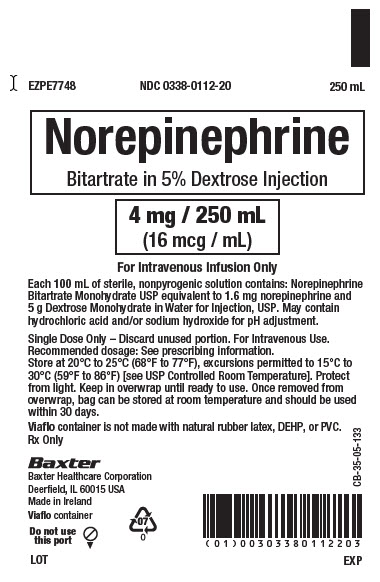
PACKAGE/LABEL PRINCIPAL DISPLAY PANEL Container Label EZPE7748 NDC 0338-0112-20 250 mL Norepinephrine Bitartrate in 5% Dextrose Injection 4 mg / 250 mL (16 mg / mL) For Intravenous Infusion Only Each 100mL of sterile, nonpyrogenic solution contains: Norepinephrine Bitartrate Monohydrate USP equivalent to 1.6 mg norepinephrine and 5 g Dextrose Monohydrate in Water for Injection, USP. May contain hydrochloric acid and/or sodium hydroxide for pH adjustment. Single Dose Only – Discard unused portion.
For Intravenous Use. Recommended dosage: See prescribing information. Store at 20°C to 25°C (68°F to 77°F), excursions permitted to 15° C to 30°C (59°F to 86° F) [see USP Controlled Room Temperature.] Protect from light.
Keep in overwrap until ready to use. Once removed from overwrap , bag can be stored at room temperature and should be used within 30 days . VIAFLO container is not made with natural rubber latex, DEHP, or PVC.
Rx Only Baxter Logo Baxter Healthcare Corporation Deerfield, IL 60015 USA Made in Ireland CB-35-05-133 VIAFLO container Symbol 07 0 Symbol Do not use this port Barcode (01)00303380112203 LOT EXP Container Label EZPE7788 NDC 0338-0108-20 250 mL Norepinephrine Bitartrate in 5% Dextrose Injection 8 mg / 250 mL (32 mcg / mL) For Intravenous Infusion Only Each 100 mL of sterile, nonpyrogenic solution contains: Norepinephrine Bitartrate Monohydrate USP equivalent to 3.2 mg norepinephrine and 5 g Dextrose Monohydrate in Water for Injection, USP.
May contain hydrochloric acid and/or sodium hydroxide for pH adjustment. Single Dose Only – Discard unused portion. For Intravenous Use.
Recommended dosage: See prescribing information. Store at 20°C to 25°C (68°F to 77°F), excursions permitted to 15°C to 30°C (59°F to 86°F). [See USP Controlled Room Temperature.] Protect from light. Keep in overwrap until ready to use.
Once removed from overwrap , bag can be stored at room temperature and should be used within 30 days . VIAFLO container is not made with natural rubber latex, DEHP, or PVC. Rx Only Baxter Logo Baxter Healthcare Corporation Deerfield, IL 60015 USA Made in Ireland VIAFLO container Symbol Do not use this port Symbol 07 0 CB-35-05-134 Symbol 1 Barcode (01)00303380108206 LOT EXP Container Label EZPE7758 NDC 0338-0116-20 250 mL Norepinephrine Bitartrate in 5% Dextrose Injection 16 mg / 250 mL (64 mcg / mL) For Intravenous Infusion Only Each 100 mL of sterile, nonpyrogenic solution contains: Norepinephrine Bitartrate Monohydrate USP equivalent to 6.4 mg norepinephrine and 5 g Dextrose Monohydrate in Water for Injection, USP.
May contain hydrochloric acid and/or sodium hydroxide for pH adjustment. Single Dose Only – Discard unused portion. For Intravenous Use.
Recommended dosage: See prescribing information. Store at 20°C to 25°C (68°F to 77°F), excursions permitted to 15°C to 30°C (59°F to 86°F). [See USP Controlled Room Temperature.] Protect from light. Keep in overwrap until ready to use.
Once removed from overwrap , bag can be stored at room temperature and should be used within 30 days . VIAFLO container is not made with natural rubber latex, DEHP, or PVC. Rx Only Baxter Logo Baxter Healthcare Corporation Deerfield, IL 60015 USA Made in Ireland VIAFLO container Symbol Do not use this port Symbol 07 0 CB-35-05-144 Symbol 1 Barcode (01)00303380116201 LOT EXP Container Label EZPE7764 NDC 0338-0040-01 250 mL Norepinephrine Bitartrate in 0.9% Sodium Chloride Injection 4 mg / 250 mL (16 mcg / mL) For Intravenous Infusion Only WARNING: CONTAINS SULFITES Each 100 mL of sterile, nonpyrogenic solution contains: Norepinephrine Bitartrate Monohydrate USP equivalent to 1.6 mg norepinephrine, 0.9 g Sodium Chloride and 0.32 mg Sodium Metabisulfate in Water for Injection, USP.
May contain hydrochloric acid and/or sodium hydroxide for pH adjustment. Single Dose Only – Discard unused portion. For Intravenous Use.
Recommended dosage: See prescribing information. Store at 20°C to 25°C (68°F to 77°F), excursions permitted to 15°C to 30… [Excerpted — this section continues on DailyMed.]
About this NDC listing & data coverage
What data is (and isn’t) available for this NDC — tap to expand
| NDC identity (package / product / labeler codes) | ✓ Available |
| Labeler | ✓ Available |
| Product & package description | ✓ Available |
| Marketing category & status | ✓ Available |
| Active ingredient / dosage form / route | ✓ Available |
| FDA label (SPL via DailyMed) | ✓ Available |
| Package photos | ✓ Available |
| Inactive ingredients (structured) | ✓ Available |
| NADAC pharmacy acquisition price (CMS) | — Not published for this NDC CMS publishes NADAC only for NDCs reported in its retail-pharmacy survey. |
| Orange Book / therapeutic-equivalence data | ✓ Available |
| HCPCS J-code billing crosswalk | — Not published for this NDC Most self-administered / retail products have no J-code — that is normal. |
| Medicaid utilization (CMS SDUD) | — Not published for this NDC CMS reports utilization only for NDCs with Medicaid claims above its privacy threshold. |