
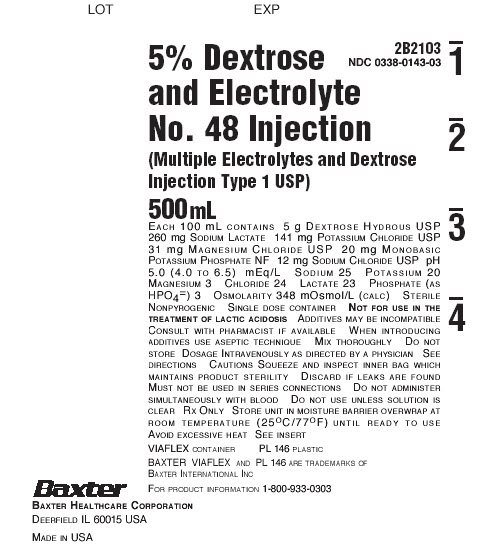
Dextrose and Electrolyte No. 48 Sodium Lactate, Potassium Chloride, Magnesium Chloride, Monobasic Potassium Phosphate, Sodium Chloride and Dextrose monohydrate 5 g/100mL; 260 mg/100mL; 141 mg/100mL; 31 mg/100mL; 20 mg/100mL; 12 mg/100mL Injection, 500 mL — NDC 0338-0143-03 (Billing 00338-0143-03)
This is a package of 500 mL of Dextrose and Electrolyte No. 48 Sodium Lactate, Potassium Chloride, Magnesium Chloride, Monobasic Potassium Phosphate, Sodium Chloride and Dextrose monohydrate 5 g/100mL; 260 mg/100mL; 141 mg/100mL; 31 mg/100mL; 20 mg/100mL; 12 mg/100mL Injection from Baxter Healthcare Company, marketed since Feb 1979 and currently FDA-listed. It is this product's only package size.
NDC database record
One package, one record: these facts belong to NDC 0338-0143-03 alone.
- Record
- FDA NDC Directory package listing · Human prescription drug
- Code segments
- 0338 labeler · 0143 product · 03 package
- Package marketed since
- Feb 2, 1979
- Sample package
- No — commercial package
- Listing certified through
- Dec 31, 2027
- Billing quantity
- 500 mL per package
- Barcode (UPC-A, from the NDC)
- 3 0338014303 0
- Medicaid fills, this package
- 56 prescriptions in the last four reported quarters
- FDA record last changed
- Oct 1, 2026
Identity & classification
Regulatory identifiers FDA, NLM and CMS codes for this package
Drug-database identifiers Medi-Span GPI and First Databank GCN / HICL / AHFS classification
- GSN (GCN sequence number): 001952
- GCN: 62121
- GPI-14 (Medi-Span): 79993002352010
- HICL (First Databank): 014830
- AHFS class code: 40:12.00.00
- RxCUI (RxNorm): 807396
Where does this data come from?
- FDA openFDA NDC Directory · synced Oct 1, 2026
- FDA label on DailyMed · label index refreshed Oct 5, 2026
- RxNorm (NLM RxNav) · catalog refreshed Oct 1, 2026
- Medi-Span GPI (licensed)
- First Databank (licensed) · refreshed Oct 1, 2026
RxNorm drug class
This medicine belongs to the Organic acids class.
Where does this data come from?
- RxClass (NLM) · catalog refreshed Oct 1, 2026
Clinical
Patient education
Supplement & herbal interactions
Where does this data come from?
- MedlinePlus (NLM) · refreshed Oct 1, 2026
- FDA label on DailyMed · label index refreshed Oct 5, 2026
Ask a licensed pharmacist directly — free, answered by our team.
Pricing
A drug doesn't have one price. Each row is a different public payment system, and none is what you'd pay at the counter — that depends on your insurance. The ⓘ on each row explains what it measures.
| Price system | Per each | Per package |
|---|---|---|
| Retail pharmacies payNADAC · weekly | Not in the retail survey — common for institutional, discontinued, or low-volume packs. | |
| Medicaid paysCMS SDUD · 12 mo | $9.50 | $9.50 / 1 bag |
| Medicare drug plans payPart D · quarterly | No Part D plan price is available for this NDC in our data. | |
Where does this data come from?
- CMS NADAC weekly file
- CMS ASP pricing files · refreshed Sep 20, 2026
- CMS Medicaid State Drug Utilization Data · through Q4 2025
- CMS Part D plan pricing files · refreshed Sep 24, 2026
- VA National Acquisition Center price file
Packaging — all sizes for this product
| Package NDC | Description | Marketing start | Marketing end | Status |
|---|---|---|---|---|
| 00338-0143-03 You're viewing this Main listing | 500 mL in 1 BAG | 1979-02-02 | — | Active |
Therapeutic equivalents
| Product | Labeler | Pack | NADAC/unit | TE | Status | Price vs. this |
|---|---|---|---|---|---|---|
| Dextrose and Electrolyte No. 48 5 g/100mL; 260 mg/100mL; 141 mg/100mL; 31 mg/100mL; 20 mg/100mL; 12 mg/100mLthis 00338-0143-03 | Baxter | 500 ml | — | — | FDA listed | — |
Where does this data come from?
- FDA openFDA NDC Directory · synced Oct 1, 2026
- FDA Orange Book · refreshed Oct 3, 2026
- CMS NADAC weekly file
Availability & generic status
We did not find an FDA-approved generic match for this exact strength, form and route.
Where does this data come from?
- FDA Orange Book · refreshed Oct 3, 2026
Inactive Ingredients / Excipients
Inactive ingredients, also called excipients, are components of the drug product other than the active ingredient. They may include fillers, dyes, coatings, preservatives, flavors, or other formulation ingredients.
💡 Tap an ingredient (hover on desktop) to see what it is and why it’s used.
-
UNII 059QF0KO0R
Water is a liquid solvent that dissolves and mixes ingredients together in liquid medicines, syrups, and injections. It helps distribute the active drug evenly throughout the product.
1 inactive ingredient listed in the exact product block matched to this NDC.
Where does this data come from?
ingredient classCode="IACT" elements from the exact product block matched by this NDC. Label-section narrative from DailyMed / the openFDA label index is shown separately when available.- FDA label on DailyMed · label index refreshed Oct 5, 2026
- FDA openFDA NDC Directory · synced Oct 1, 2026
Inactive ingredient FAQ
Are inactive ingredients the same for every manufacturer?
Why might an inactive ingredient be missing?
Can inactive ingredients matter?
Manufacturer & labeler
More NDCs from Baxter Healthcare Company labeler code 00338
- VANCOMYCIN HYDROCHLORIDE 1.25 g/250mL Injection, Solution NDC 0338-0122-04
- VANCOMYCIN HYDROCHLORIDE 1.5 g/300mL Injection, Solution NDC 0338-0124-04
- Lactated Ringers and Dextrose SODIUM CHLORIDE, SODIUM LACTATE, POTASSIUM CHLORIDE, CALCIUM CHLORIDE and DEXTROSE MONOHYDRATE 5 g/100mL; 600 mg/100mL; 310 mg/100mL; 30 mg/100mL; 20 mg/100mL Injection, Solution NDC 0338-0125-03
- MYXREDLIN insulin human 1 [iU]/mL Injection, Solution NDC 0338-0126-12
- NOREPINEPHRINE BITARTRATE 16 mg/250mL Injection, Solution NDC 0338-0128-20
- Lactated Ringers sodium chloride, soldium lactate, potassium chloride and calcium 6 g/1000mL; 3.1 g/1000mL; 300 mg/1000mL; 200 mg/1000mL Irrigant NDC 0338-0137-27
- SODIUM CHLORIDE 450 mg/100mL Injection NDC 0338-0160-01
- SODIUM CHLORIDE 900 mg/100mL Injection NDC 0338-0162-01
- SODIUM CHLORIDE 450 mg/100mL Injection NDC 0338-0164-01
- SODIUM CHLORIDE 900 mg/100mL Injection NDC 0338-0166-01
- Dextrose 2.5 g/50mL Injection NDC 0338-0170-01
- Dextrose 5 g/100mL Injection NDC 0338-0172-01
Where does this data come from?
- FDA openFDA NDC Directory · synced Oct 1, 2026
- Drugs@FDA
Full prescribing information FDA SPL
🎯 Indications and Usage ▾
INDICATIONS AND USAGE 5% Dextrose and Electrolyte No. 48 Injection (Multiple Electrolytes and Dextrose Injection, Type 1, USP) is indicated as a source of water, electrolytes, and calories or as an alkalinizing agent.
⏱️ Dosage and Administration ▾
DOSAGE AND ADMINISTRATION Important Administration Instructions • 5% Dextrose and Electrolyte No. 48 Injection (Multiple Electrolytes and Dextrose Injection, Type 1, USP) is intended for intravenous administration using sterile equipment. • Do not connect flexible plastic containers in series in order to avoid air embolism due to possible residual air contained in the primary container. • Set the vent to the closed position on a vented intravenous administration set to prevent air embolism. • Use a dedicated line without any connections to avoid air embolism. • Do not pressurize intravenous solutions contained in flexible plastic containers to increase flow rates in order to avoid air embolism due to incomplete evacuation of residual air in the container. • Prior to infusion, visually inspect the solution for particulate matter and discoloration.
The solution should be clear and there should be no precipitates. Do not administer unless solution is clear, and container is undamaged. • Do not administer 5% Dextrose and Electrolyte No. 48 Injection (Multiple Electrolytes and Dextrose Injection, Type 1, USP) simultaneously with blood through the same administration set because of the possibility of pseudoagglutination or hemolysis.
Dosing Information The choice of product, dosage, volume, rate, and duration of administration is dependent upon the age, weight and clinical condition of the patient and concomitant therapy, and administration should be determined by a physician experienced in intravenous fluid therapy. Introduction of Additives Additives may be incompatible. Evaluate all additions to the plastic container for compatibility and stability of the resulting preparation.
Consult with a pharmacist, if available. If, in the informed judgment of the physician, it is deemed advisable to introduce additives, use aseptic technique. Mix thoroughly when additives have been introduced.
After addition, if there is a discoloration and/or the appearance of precipitates, insoluble complexes or crystals, do not use. Do not store solutions containing additives. Discard any unused portion.
⛔ Contraindications ▾
CONTRAINDICATIONS 5% Dextrose and Electrolyte No. 48 Injection (Multiple Electrolytes and Dextrose Injection, Type 1, USP) is contraindicated in patients • with a known hypersensitivity to the product (see WARNINGS ) • with clinically significant hyperglycemia (see WARNINGS )
⚠️ Warnings ▾
WARNINGS Hypersensitivity Reactions Hypersensitivity and infusion reactions have been reported with 5% Dextrose and Electrolyte No. 48 Injection (Multiple Electrolytes and Dextrose Injection, Type 1, USP). See ADVERSE REACTIONS .
Stop the infusion immediately if signs or symptoms of a hypersensitivity reaction develop, such as tachycardia, chest pain, dyspnea and flushing. Institute appropriate therapeutic countermeasures as clinically indicated. Electrolyte Imbalances Fluid Overload Depending on the volume and rate of infusion, the intravenous administration of 5% Dextrose and Electrolyte No.
48 Injection (Multiple Electrolytes and Dextrose Injection, Type 1, USP) can cause electrolyte disturbances such as overhydration and congested states, including pulmonary congestion and edema. Avoid 5% Dextrose and Electrolyte No. 48 Injection (Multiple Electrolytes and Dextrose Injection, Type 1, USP) in patients with or at risk for fluid and/or solute overloading.
If use cannot be avoided, monitor fluid balance, electrolyte concentrations, and acid base balance, as needed and especially during prolonged use. Hyponatremia 5% Dextrose and Electrolyte No. 48 Injection (Multiple Electrolytes and Dextrose Injection, Type 1, USP) may cause hyponatremia.
5% Dextrose and Electrolyte No. 48 Injection (Multiple Electrolytes and Dextrose Injection, Type 1, USP) is a hypertonic solution. In the body, however, glucose containing fluids can become extremely physiologically hypotonic due to rapid glucose metabolization.
Monitoring of serum sodium is particularly important for hypotonic fluids. Hyponatremia can lead to acute hyponatremic encephalopathy characterized by headache, nausea, seizures, lethargy, and vomiting. Patients with brain edema are at particular risk of severe, irreversible and life-threatening brain injury.
The risk of hospital-acquired hyponatremia is increased in patients with cardiac or pulmonary failure, and in patients with non-osmotic vasopressin release (including SIADH) treated with high volume of physiologically hypotonic 5% Dextrose and Electrolyte No. 48 Injection (Multiple Electrolytes and Dextrose Injection, Type 1, USP). Avoid 5% Dextrose and Electrolyte No.
48 Injection (Multiple Electrolytes and Dextrose Injection, Type 1, USP) in hypervolemic or overhydrated patients. If use cannot be avoided, monitor serum sodium concentrations. Hyperglycemia and Hyperosmolar Hyperglycemic State Administration of solutions containing dextrose and lactate in patients with impaired glucose tolerance or diabetes mellitus may worsen hyperglycemia (see PRECAUTIONS , Pediatric Use ).
Administration of dextrose at a rate exceeding the patient’s utilization rate may lead to hyperglycemia, coma, and death. Hyperglycemia is associated with an increase in serum osmolality, resulting in osmotic diuresis, dehydration and electrolyte losses. Patients with underlying central nervous system disease and renal impairment who receive dextrose infusions, may be at greater risk of developing hyperosmolar hyperglycemic state.
Monitor blood glucose concentrations and treat hyperglycemia to maintain concentrations within normal limits while administering 5% Dextrose and Electrolyte No. 48 Injection (Multiple Electrolytes and Dextrose Injection, Type 1, USP). Insulin may be administered or adjusted to maintain optimal blood glucose concentrations.
Hypernatremia Hypernatremia may occur with 5% Dextrose and Electrolyte No. 48 Injection (Multiple Electrolytes and Dextrose Injection, Type 1, USP). Conditions that may increase the risk of hypernatremia, fluid overload and edema (central and peripheral), include patients with: primary hyperaldosteronism; secondary hyperaldosteronism associated with, for example, hypertension, congestive heart failure, liver disease (including cirrhosis), renal disease (including renal artery stenosis, nephrosclerosis); and pre-eclampsia.
Certain medications, such as corticosteroids or corticotropin, may also increase risk of so… [Excerpted — this section continues on DailyMed.]
🤒 Adverse Reactions ▾
ADVERSE REACTIONS Post-marketing Adverse Reactions The following adverse reactions associated with the use of 5% Dextrose and Electrolyte No. 48 Injection (Multiple Electrolytes and Dextrose Injection, Type 1, USP) were identified in clinical trials or post marketing reports. Because post marketing reactions were reported voluntarily from a population of uncertain size, it is not always possible to estimate their frequency, reliably, or to establish a causal relationship to drug exposure: Hypersensitivity and Infusion Reactions: palpitations, feeling abnormal, piloerection, edema peripheral, hypotension, dyspnea, wheezing, urticaria, cold sweet, tachycardia, chest pain, chest discomfort, respiratory rate increased, flushing, hyperemia, asthenia, pyrexia, chills.
General Disorders and Administration Site Conditions : infusion site pain, burning sensation, febrile response, infection at the site of injection, venous thrombosis or phlebitis extending from site of injection, extravasation and hypervolemia. Metabolism and nutrition disorders : hyperkalemia, hyperglycemia, hyponatremia. Nervous System Disorders : hyponatremic encephalopathy.
If an adverse reaction does occur, discontinue the infusion, evaluate the patient, institute appropriate therapeutic countermeasures, and save the remainder of the fluid for examination if deemed necessary. Overdose Excessive administration of 5% Dextrose and Electrolyte No. 48 Injection (Multiple Electrolytes and Dextrose Injection, Type 1, USP) can cause: • fluid overload with a risk of edema (peripheral and/or pulmonary), particularly when renal sodium excretion is impaired. • hyperglycemia, hyperosmolarity, and osmotic diuresis, dehydration and electrolyte loss. • hypernatremia and hyperkalemia, especially in patients with severe renal impairment. • hypermagnesemia. • metabolic alkalosis with or without hypokalemia and decreased ionized serum calcium and magnesium concentrations. • Hyperphosphatemia, hypocalcemia, and hypomagnesemia.
See WARNINGS When assessing an overdose, any additives in the solution must also be considered. The effects of an overdose may require immediate medical attention and treatment. Interventions include discontinuation of 5% Dextrose and Electrolyte No.
48 Injection (Multiple Electrolytes and Dextrose Injection, Type 1, USP), dose reduction, and other measures as indicated for the specific clinical constellation (e.g., monitoring of fluid balance, electrolyte concentrations and acid base balance).
🔄 Drug Interactions ▾
Drug Interactions Other Products that Affect Fluid and/or Electrolyte Balance Administration of 5% Dextrose and Electrolyte No. 48 Injection (Multiple Electrolytes and Dextrose Injection, Type 1, USP) to patients treated concomitantly with drugs associated with sodium and fluid retention may increase the risk of hypernatremia and volume overload. Avoid use of 5% Dextrose and Electrolyte No.
48 Injection (Multiple Electrolytes and Dextrose Injection, Type 1, USP) in patients receiving such products, such as corticosteroids or corticotropin. If use cannot be avoided, monitor serum electrolytes, fluid balance and acid-base balance. Other Drugs that Increase the Risk of Hyponatremia Administration of 5% Dextrose and Electrolyte No.
48 Injection (Multiple Electrolytes and Dextrose Injection, Type 1, USP) in patients treated concomitantly with medications associated with hyponatremia may increase the risk of developing hyponatremia. Avoid use of 5% Dextrose and Electrolyte No. 48 Injection (Multiple Electrolytes and Dextrose Injection, Type 1, USP) in patients receiving products, such as diuretics, and certain antiepileptic and psychotropic medications.
Drugs that increase the vasopressin effect reduce renal electrolyte free water excretion and may also increase the risk of hyponatremia following treatment with intravenous fluids. If use cannot be avoided, monitor serum sodium concentrations. Other Products that Increase the Risk of Hyperkalemia Because of its potassium content, avoid use of 5% Dextrose and Electrolyte No.
48 Injection (Multiple Electrolytes and Dextrose Injection, Type 1, USP) in patients receiving products that can cause hyperkalemia or increase the risk of hyperkalemia, such as potassium sparing diuretics, ACE inhibitors, angiotensin II receptor antagonists, or the immunosuppressants tacrolimus and cyclosporine. If use cannot be avoided, monitor serum potassium concentrations. Lithium Renal clearance of lithium may be increased during administration of 5% Dextrose and Electrolyte No.
48 Injection (Multiple Electrolytes and Dextrose Injection, Type 1, USP). Monitor serum lithium concentrations during concomitant use. Drugs with pH Dependent Renal Elimination Due to its alkalinizing effect (formation of bicarbonate), 5% Dextrose and Electrolyte No.
48 Injection (Multiple Electrolytes and Dextrose Injection, Type 1, USP) may interfere with the elimination of drugs with pH dependent renal elimination. Renal clearance of acidic drugs may be increased. Renal clearance of alkaline drugs may be decreased.
🤰 Pregnancy ▾
Pregnancy Teratogenic Effects Animal reproduction studies have not been conducted with 5% Dextrose and Electrolyte No. 48 Injection (Multiple Electrolytes and Dextrose Injection, Type 1, USP). Intrapartum maternal intravenous infusion of glucose-containing solutions may result in fetal insulin production, with an associated risk of fetal hyperglycemia and metabolic acidosis as well as rebound hypoglycemia in the neonate.
5% Dextrose and Electrolyte No. 48 Injection (Multiple Electrolytes and Dextrose Injection, Type 1, USP) should be given to a pregnant woman by health care providers only after careful consider of the potential risk and benefits for each specific patient.
🧒 Pediatric Use ▾
Pediatric Use Safety and effectiveness of 5% Dextrose and Electrolyte No. 48 Injection (Multiple Electrolytes and Dextrose Injection, Type 1, USP) in pediatric patients have not been established by adequate and well controlled trials. The use of 5% Dextrose and Electrolyte No.
48 Injection (Multiple Electrolytes and Dextrose Injection, Type 1, USP) in pediatric patients is based on clinical practice (see DOSAGE AND ADMINISTRATION ). Neonates, especially premature infants with low birth weight, are at increased risk of developing hypo- or hyperglycemia and therefore need close monitoring during treatment with intravenous glucose solutions to ensure adequate glycemic control in order to avoid potential long-term adverse effects. Closely monitor plasma electrolyte concentrations in pediatric patients who may have impaired ability to regulate fluids and electrolytes.
In very low birth weight infants, excessive or rapid administration of 5% Dextrose and Electrolyte No. 48 Injection (Multiple Electrolytes and Dextrose Injection, Type 1, USP) may result in increased serum osmolality and risk of intracerebral hemorrhage. Children (including neonates and older children) are at increased risk of developing hyponatremia as well as for developing hyponatremic encephalopathy.
Lactate-containing solutions should be administered with particular caution to neonates and infants less than 12 months of age. Administration of a lactate-containing intravenous solution to neonates and infants should take into account that the liver and kidneys are still maturing during the first year of life, which also affects the biotransformation and renal excretion of lactate.
🧓 Geriatric Use ▾
Geriatric Use Geriatric patients are at increased risk of developing electrolyte imbalances. 5% Dextrose and Electrolyte No. 48 Injection (Multiple Electrolytes and Dextrose Injection, Type 1, USP) is known to be substantially excreted by the kidney, and the risk of toxic reactions to this drug may be greater in patients with impaired renal function.
Therefore, dose selection for an elderly patient should be cautious, usually starting at the low end of the dosing range, reflecting the greater frequency of decreased hepatic, renal, or cardiac function, and of concomitant disease or other drug therapy. Consider monitoring renal function in elderly patients.
🆘 Overdosage ▾
Overdose Excessive administration of 5% Dextrose and Electrolyte No. 48 Injection (Multiple Electrolytes and Dextrose Injection, Type 1, USP) can cause: • fluid overload with a risk of edema (peripheral and/or pulmonary), particularly when renal sodium excretion is impaired. • hyperglycemia, hyperosmolarity, and osmotic diuresis, dehydration and electrolyte loss. • hypernatremia and hyperkalemia, especially in patients with severe renal impairment. • hypermagnesemia. • metabolic alkalosis with or without hypokalemia and decreased ionized serum calcium and magnesium concentrations. • Hyperphosphatemia, hypocalcemia, and hypomagnesemia.
See WARNINGS When assessing an overdose, any additives in the solution must also be considered. The effects of an overdose may require immediate medical attention and treatment. Interventions include discontinuation of 5% Dextrose and Electrolyte No.
48 Injection (Multiple Electrolytes and Dextrose Injection, Type 1, USP), dose reduction, and other measures as indicated for the specific clinical constellation (e.g., monitoring of fluid balance, electrolyte concentrations and acid base balance).
🧬 Clinical Pharmacology ▾
CLINICAL PHARMACOLOGY 5% Dextrose and Electrolyte No. 48 Injection (Multiple Electrolytes and Dextrose Injection, Type 1, USP) has value as a source of water, electrolytes and calories. They are capable of inducing diuresis depending on the clinical condition of the patient.
5% Dextrose and Electrolyte No. 48 Injection (Multiple Electrolytes and Dextrose Injection, Type 1, USP) produce a metabolic alkalinizing effect. Lactate ions are metabolized ultimately to carbon dioxide and water, which requires the consumption of hydrogen cations.
📦 How Supplied / Storage and Handling ▾
HOW SUPPLIED 5% Dextrose and Electrolyte No. 48 Injection (Multiple Electrolytes and Dextrose Injection, Type 1, USP) in VIAFLEX plastic containers is available as shown below: Code Size (mL) NDC 2B2103 500 NDC 0338-0143-03 Exposure of pharmaceutical products to heat should be minimized. Avoid excessive heat. It is recommended the product be stored at room temperature (25°C); brief exposure up to 40°C does not adversely affect the product.
📋 Description ▾
DESCRIPTION 5% Dextrose and Electrolyte No. 48 Injection (Multiple Electrolytes and Dextrose Injection, Type 1, USP) is a sterile, nonpyrogenic solution for fluid and electrolyte replenishment and caloric supply in a single dose container for intravenous administration. Each 100 mL contains 5 g Dextrose Hydrous, USP*, 260 mg Sodium Lactate (C 3 H 5 NaO 3 ), 141 mg Potassium Chloride, USP (KCl), 31 mg Magnesium Chloride, USP (MgCl 2 •6H 2 0), 20 mg Monobasic Potassium Phosphate, NF (KH 2 PO 4 ), and 12 mg Sodium Chloride, USP (NaCl).
It contains no antimicrobial agents. The pH is 5.0 (4.0 to 6.5). 5% Dextrose and Electrolyte No.
48 Injection (Multiple Electrolytes and Dextrose Injection, Type 1, USP) administered intravenously has value as a source of water, electrolytes, and calories. One liter has an ionic concentration of 25 mEq sodium, 20 mEq potassium, 3 mEq magnesium, 24 mEq chloride, 23 mEq lactate and 3 mEq phosphate (as HPO 4 2- ). The osmolarity is 348 mOsmol/L (calc).
Normal physiologic osmolarity range is approximately 280 to 310 mOsmol/L. Administration of substantially hypertonic solutions (≥ 600 mOsmol/L) may cause vein damage. The caloric content is 180 kcal/L.
Dextrose is derived from corn. The VIAFLEX plastic container is fabricated from a specially formulated polyvinyl chloride (PL 146 Plastic). The amount of water that can permeate from inside the container into the overwrap is insufficient to affect the solution significantly.
Solutions in contact with the plastic container can leach out certain of its chemical components in very small amounts within the expiration period, e.g., di-2-ethylhexyl phthalate (DEHP), up to 5 parts per million. However, the safety of the plastic has been confirmed in tests in animals according to USP biological tests for plastic containers as well as by tissue culture toxicity studies. Structural Formula
⚠️ Precautions ▾
PRECAUTIONS Patients with Renal Impairment In patients with renal impairment, administration of 5% Dextrose and Electrolyte No. 48 Injection (Multiple Electrolytes and Dextrose Injection, Type 1, USP) may result in sodium and/or potassium or magnesium retention (see WARNINGS ). Avoid 5% Dextrose and Electrolyte No.
48 Injection (Multiple Electrolytes and Dextrose Injection, Type 1, USP) in patients with severe renal impairment or conditions that may cause sodium, potassium, magnesium, or phosphate retention, fluid overload, or edema. If use cannot be avoided, monitor patients with severe renal impairment for development of these adverse reactions. Patients with Hepatic Impairment In patients with severe hepatic impairment, lactate metabolism may be impaired and 5% Dextrose and Electrolyte No.
48 Injection (Multiple Electrolytes and Dextrose Injection, Type 1, USP) may not produce its alkalinization. Consider when monitoring serum lactate levels. Monitoring of Serum Lactate Levels Administration of 5% Dextrose and Electrolyte No.
48 Injection (Multiple Electrolytes and Dextrose Injection, Type 1, USP) may result in an iatrogenic increase in serum lactate levels in patients with severe metabolic acidosis including lactic. Drug Interactions Other Products that Affect Fluid and/or Electrolyte Balance Administration of 5% Dextrose and Electrolyte No. 48 Injection (Multiple Electrolytes and Dextrose Injection, Type 1, USP) to patients treated concomitantly with drugs associated with sodium and fluid retention may increase the risk of hypernatremia and volume overload.
Avoid use of 5% Dextrose and Electrolyte No. 48 Injection (Multiple Electrolytes and Dextrose Injection, Type 1, USP) in patients receiving such products, such as corticosteroids or corticotropin. If use cannot be avoided, monitor serum electrolytes, fluid balance and acid-base balance.
Other Drugs that Increase the Risk of Hyponatremia Administration of 5% Dextrose and Electrolyte No. 48 Injection (Multiple Electrolytes and Dextrose Injection, Type 1, USP) in patients treated concomitantly with medications associated with hyponatremia may increase the risk of developing hyponatremia. Avoid use of 5% Dextrose and Electrolyte No.
48 Injection (Multiple Electrolytes and Dextrose Injection, Type 1, USP) in patients receiving products, such as diuretics, and certain antiepileptic and psychotropic medications. Drugs that increase the vasopressin effect reduce renal electrolyte free water excretion and may also increase the risk of hyponatremia following treatment with intravenous fluids. If use cannot be avoided, monitor serum sodium concentrations.
Other Products that Increase the Risk of Hyperkalemia Because of its potassium content, avoid use of 5% Dextrose and Electrolyte No. 48 Injection (Multiple Electrolytes and Dextrose Injection, Type 1, USP) in patients receiving products that can cause hyperkalemia or increase the risk of hyperkalemia, such as potassium sparing diuretics, ACE inhibitors, angiotensin II receptor antagonists, or the immunosuppressants tacrolimus and cyclosporine. If use cannot be avoided, monitor serum potassium concentrations.
Lithium Renal clearance of lithium may be increased during administration of 5% Dextrose and Electrolyte No. 48 Injection (Multiple Electrolytes and Dextrose Injection, Type 1, USP). Monitor serum lithium concentrations during concomitant use.
Drugs with pH Dependent Renal Elimination Due to its alkalinizing effect (formation of bicarbonate), 5% Dextrose and Electrolyte No. 48 Injection (Multiple Electrolytes and Dextrose Injection, Type 1, USP) may interfere with the elimination of drugs with pH dependent renal elimination. Renal clearance of acidic drugs may be increased.
Renal clearance of alkaline drugs may be decreased. Pregnancy Teratogenic Effects Animal reproduction studies have not been conducted with 5% Dextrose and Electrolyte No. 48 Injection (Multiple Electrolytes and Dextrose Injection, Type 1, USP).
Intrapartu… [Excerpted — this section continues on DailyMed.]
🍼 Nursing Mothers ▾
Nursing Mothers It is not known whether this drug is excreted in human milk. Because many drugs are excreted in human milk, caution should be exercised when 5% Dextrose and Electrolyte No. 48 Injection (Multiple Electrolytes and Dextrose Injection, Type 1, USP) is administered to a nursing mother.
📄 Carcinogenesis, Mutagenesis, Impairment of Fertility ▾
Carcinogenesis, Mutagenesis, Impairment of Fertility Studies with 5% Dextrose and Electrolyte No. 48 Injection (Multiple Electrolytes and Dextrose Injection, Type 1, USP) have not been performed to evaluate carcinogenic potential, mutagenic potential, or effects on fertility.
📄 Package Label / Principal Display Panel ▾
PRINCIPAL DISPLAY PANEL - PACKAGING LABELING Container Label Container Label Container Label LOT EXP 2B2103 NDC 0338-0143-03 5% Dextrose and Electrolyte No. 48 Injection (Multiple Electrolytes and Dextrose Injection Type 1 USP) 500mL 500 mL Each 100 mL contains 5 g Dextrose Hydrous USP 260 mg Sodium Lactate 141 mg Potassium Chloride USP 31 mg Magnesium Chloride USP 20 mg Monobasic Potassium Phosphate NF 12 mg Sodium Chloride USP pH 5.0 (4.0 to 6.5) mEq/L Sodium 25 Potassium 20 Magnesium 3 Chloride 24 Lactate 23 Phosphate(as HPO 4 = ) 3 Osmolarity 348 mOsmol/L (calc) Sterile Nonpyrogenic Single dose container Not for use i n the treatme n t of lactic acidosis Additives may be incompatible Consult with pharmacist if available When introducing additives use aseptic technique Mix thoroughly Do not store Dosage Intravenously as directed by a physician See directions Cautions Squeeze and inspect inner bag which maintains product sterility Discard if leaks are found Must not be used in series connections Do not administer simultaneously with blood Do not use unless solution is clear Rx Only Store unit in moisture barrier overwrap at room temperature (25ºC/77ºF) until ready to use Avoid excessive heat insert VIAFLEX container PL 146 plastic BAXTER VIAFELX and PL 146 are trademarks of Baxter International Inc For product information 1-800-933-0303 Baxter Logo Baxter Healthcare Corporation Deerfield, IL 60015 USA Made in USA 5% Dextrose and Electrolyte Representative Container label
Medicaid utilization & spend
About this NDC listing & data coverage
What data is (and isn’t) available for this NDC — tap to expand
| NDC identity (package / product / labeler codes) | ✓ Available |
| Labeler | ✓ Available |
| Product & package description | ✓ Available |
| Marketing category & status | ✓ Available |
| Active ingredient / dosage form / route | ✓ Available |
| FDA label (SPL via DailyMed) | ✓ Available |
| Package photos | ✓ Available |
| Inactive ingredients (structured) | ✓ Available |
| NADAC pharmacy acquisition price (CMS) | — Not published for this NDC CMS publishes NADAC only for NDCs reported in its retail-pharmacy survey. |
| Orange Book / therapeutic-equivalence data | — Not published for this NDC Applies only to products approved under an NDA/ANDA; many listings are out of scope. |
| HCPCS J-code billing crosswalk | — Not published for this NDC Most self-administered / retail products have no J-code — that is normal. |
| Medicaid utilization (CMS SDUD) | ✓ Available |