
Clinisol Lysine, Leucine, Phenylalanine, Valine, Histidine, Isoleucine, Methionine, Threonine, Tryptophan, Alanine, Arginine, Glycine, Proline, Glutamic Acid, Serine, Aspartic Acid, Tyrosine 1.18 g/100mL; 1.04 g/100mL; 1.04 g/100mL; 960 mg/100mL; 894 mg/100mL; 749 mg/100mL; 749 mg/100mL; 749 mg/100mL; 250 mg/100mL; 2.17 g/100mL; 1 Injection, Solution, 2000 mL — NDC 0338-0502-06 (Billing 00338-0502-06)
This is a package of 2,000 mL of Clinisol Lysine, Leucine, Phenylalanine, Valine, Histidine, Isoleucine, Methionine, Threonine, Tryptophan, Alanine, Arginine, Glycine, Proline, Glutamic Acid, Serine, Aspartic Acid, Tyrosine 1.18 g/100mL; 1.04 g/100mL; 1.04 g/100mL; 960 mg/100mL; 894 mg/100mL; 749 mg/100mL; 749 mg/100mL; 749 mg/100mL; 250 mg/100mL; 2.17 g/100mL; 1 Injection, Solution from Baxter Healthcare Corporation, marketed since Aug 1996 and currently FDA-listed. It is the main listing for this product, which comes in 2 package sizes.
NDC database record
One package, one record: these facts belong to NDC 0338-0502-06 alone.
- Record
- FDA NDC Directory package listing · Human prescription drug
- Code segments
- 0338 labeler · 0502 product · 06 package
- Package marketed since
- Aug 30, 1996
- Sample package
- No — commercial package
- Listing certified through
- Dec 31, 2027
- Billing quantity
- 2,000 mL per package
- Barcode (UPC-A, from the NDC)
- 3 0338050206 6
- Medicaid fills, this package
- 24,553 prescriptions in the last four reported quarters
- FDA record last changed
- Oct 1, 2026
Identity & classification
Regulatory identifiers FDA, NLM and CMS codes for this package
Drug-database identifiers Medi-Span GPI and First Databank GCN / HICL / AHFS classification
- GSN (GCN sequence number): 078428
- GCN: 44756
- HICL (First Databank): 044929
- AHFS class code: 40:20.00.00
Where does this data come from?
- FDA openFDA NDC Directory · synced Oct 1, 2026
- FDA label on DailyMed · label index refreshed Oct 5, 2026
- RxNorm (NLM RxNav) · catalog refreshed Oct 1, 2026
- Medi-Span GPI (licensed)
- First Databank (licensed) · refreshed Oct 1, 2026
Clinical
Patient education
Supplement & herbal interactions
Where does this data come from?
- MedlinePlus (NLM) · refreshed Oct 1, 2026
- FDA label on DailyMed · label index refreshed Oct 5, 2026
Ask a licensed pharmacist directly — free, answered by our team.
Pricing
A drug doesn't have one price. Each row is a different public payment system, and none is what you'd pay at the counter — that depends on your insurance. The ⓘ on each row explains what it measures.
| Price system | Per mL | Per package |
|---|---|---|
| Retail pharmacies payNADAC · weekly | Not in the retail survey — common for institutional, discontinued, or low-volume packs. | |
| Medicaid paysCMS SDUD · 12 mo | $0.2043 | $408.60 / 2000 ml |
| Medicare drug plans payPart D · Q2 2026 | $0.0621 | $124.20 / 2000 ml |
Where does this data come from?
- CMS NADAC weekly file
- CMS ASP pricing files · refreshed Sep 20, 2026
- CMS Medicaid State Drug Utilization Data · through Q4 2025
- CMS Part D plan pricing files · refreshed Sep 24, 2026
- VA National Acquisition Center price file
Packaging — all sizes for this product
| Package NDC | Description | Marketing start | Marketing end | Status |
|---|---|---|---|---|
| 00338-0502-03 0338-0502-03 | 500 mL in 1 BAG | 1996-08-30 | — | Active |
| 00338-0502-06 You're viewing this Main listing | 2000 mL in 1 BAG | 1996-08-30 | — | Active |
You're viewing the largest of 2 pack sizes for this product.
In Medicaid, this is the most-dispensed pack of this product — about 100% of fills over the last four reported quarters. See all packs ↓
Pack size FAQ
What quantity is in this package?
How does this package differ from NDC 00338-0502-03?
What NDC number is used to bill for this package of Clinisol Lysine, Leucine, Phenylalanine, Valine, Histidine, Isoleucine, Methionine, Threonine, Tryptophan, Alanine, Arginine, Glycine, Proline, Glutamic Acid, Serine, Aspartic Acid, Tyrosine 1.18 g/100mL; 1.04 g/100mL; 1.04 g/100mL; 960 mg/100mL; 894 mg/100mL; 749 mg/100mL; 749 mg/100mL; 749 mg/100mL; 250 mg/100mL; 2.17 g/100mL; 1 Injection, Solution?
Therapeutic equivalents
| Product | Labeler | Pack | NADAC/unit | TE | Status | Price vs. this |
|---|---|---|---|---|---|---|
| Plenamine 1.18 g/100mL; 1.04 g/100mL; 1.04 g/100mL; 960 mg/100mL; 749 mg/100mL; 749 mg/100mL; 749 mg/100mL; 250 mg/100mL; 2.17 g/100mL; 1.47 g/100mL; 1.0 00264-4500-00 | B. | 1000 ml | — | — | FDA listed | — |
| Clinisol 1.18 g/100mL; 1.04 g/100mL; 1.04 g/100mL; 960 mg/100mL; 894 mg/100mL; 749 mg/100mL; 749 mg/100mL; 749 mg/100mL; 250 mg/100mL; 2.17 g/100mL; 1this 00338-0502-06 | Baxter | 2000 ml | — | — | FDA listed | — |
Where does this data come from?
- FDA openFDA NDC Directory · synced Oct 1, 2026
- FDA Orange Book · refreshed Oct 3, 2026
- CMS NADAC weekly file
Availability & generic status
This product is an FDA-approved generic. Other versions of the same drug are listed under Therapeutic equivalents, least expensive first.
Where does this data come from?
- FDA Orange Book · refreshed Oct 3, 2026
Inactive Ingredients / Excipients
Inactive ingredients, also called excipients, are components of the drug product other than the active ingredient. They may include fillers, dyes, coatings, preservatives, flavors, or other formulation ingredients.
Where does this data come from?
IACT rows and label-wide narrative are kept separate; availability and product-level specificity depend on the submitted label.- FDA label on DailyMed · label index refreshed Oct 5, 2026
- FDA openFDA NDC Directory · synced Oct 1, 2026
Inactive ingredient FAQ
Are inactive ingredients the same for every manufacturer?
Why might an inactive ingredient be missing?
Can inactive ingredients matter?
Manufacturer & labeler
More NDCs from Baxter Healthcare Corporation labeler code 00338
- Lidocaine Hydrochloride and Dextrose 8 mg/mL Injection, Solution NDC 0338-0411-02
- HEPARIN SODIUM IN SODIUM CHLORIDE 200 [USP'U]/100mL Injection, Solution NDC 0338-0424-18
- HEPARIN SODIUM IN SODIUM CHLORIDE 200 [USP'U]/100mL Injection, Solution NDC 0338-0428-12
- HEPARIN SODIUM IN SODIUM CHLORIDE 200 [USP'U]/100mL Injection, Solution NDC 0338-0431-03
- HEPARIN SODIUM IN SODIUM CHLORIDE 200 [USP'U]/100mL Injection, Solution NDC 0338-0433-04
- ProSol Valine, Lysine, Histidine, Isoleucine, Leucine, Phenylalanine, Threonine, Methionine, Tryptophan, Alanine, Glycine, Arginine, Proline, Glutamic Acid, Serine, Aspartic Acid and Tyrosine 1.44 g/100mL; 1.35 g/100mL; 1.18 g/100mL; 1.08 g/100mL; 1.08 g/100mL; 1 g/100mL; 980 mg/100mL; 760 mg/100mL; 320 mg/100mL; 2.76 g/100mL; 2.06 Injection, Solution NDC 0338-0499-06
- Gentamicin Sulfate in Sodium Chloride 80 mg/100mL Injection, Solution NDC 0338-0503-48
- Gentamicin Sulfate in Sodium Chloride 100 mg/100mL Injection, Solution NDC 0338-0505-48
- Gentamicin Sulfate in Sodium Chloride 60 mg/50mL Injection, Solution NDC 0338-0507-41
- Gentamicin Sulfate in Sodium Chloride 80 mg/50mL Injection, Solution NDC 0338-0509-41
- Gentamicin Sulfate in Sodium Chloride 100 mg/50mL Injection, Solution NDC 0338-0511-41
- Intralipid I.V. Fat Emulsion 10 g/100mL Emulsion NDC 0338-0518-12
Where does this data come from?
- FDA openFDA NDC Directory · synced Oct 1, 2026
- Drugs@FDA
Full prescribing information FDA SPL
🎯 Indications and Usage ▾
INDICATIONS AND USAGE 15% CLINISOL - sulfite-free (Amino Acid) Injection Pharmacy Bulk Package is indicated as an adjunct in the offsetting of nitrogen loss or in the treatment of negative nitrogen balance in patients where: (1) the alimentary tract cannot or should not be used, (2) gastrointestinal absorption of protein is impaired, or (3) metabolic requirements for protein are substantially increased, as with extensive burns.
⏱️ Dosage and Administration ▾
DOSAGE AND ADMINISTRATION Doses which achieve nitrogen equilibrium or positive balance are the most desirable. The dosage on the first day should be approximately half the anticipated optimal dosage and should be increased gradually to minimize glycosuria; similarly, withdrawal should be accomplished gradually to avoid rebound hypoglycemia. Fat emulsion coadministration should be considered when prolonged (more than 5 days) parenteral nutrition is required in order to prevent essential fatty acid deficiency (EFAD).
Pediatric Use: Use of 15% CLINISOL - sulfite-free (Amino Acid) Injection in pediatric patients is governed by the same considerations that affect the use of any amino acid solution in pediatrics. The amount administered is dosed on the basis of grams of amino acids/kg of body weight/day. Two to three g/kg of body weight for infants with adequate calories are generally sufficient to satisfy protein needs and promote positive nitrogen balance.
Solutions administered by peripheral vein should not exceed twice normal serum osmolarity (718 mOsmol/L). Parenteral drug products should be inspected visually for particulate matter and discoloration prior to administration. A slight yellow color does not alter the quality and efficacy of this product.
Additives may be incompatible. Complete information is not available. Those additives known to be incompatible should not be used.
Consult with pharmacist, if available. When compounding admixtures, use aseptic technique. Mix thoroughly.
Do not store any unused portion of 15% CLINISOL - sulfite-free (Amino Acid) Injection Pharmacy Bulk Package. Central Vein Infusion In unstressed adult patients with no unusual nitrogen losses, a minimum dosage of 0.1 gram nitrogen (4.2 mL of 15% CLINISOL - sulfite-free (Amino Acid) Injection Pharmacy Bulk Package) plus 4.4 grams (15 calories) of dextrose/fat emulsion per kilogram of body weight per day is required to achieve nitrogen balance and weight stability. For patients stressed by surgery, trauma or sepsis, and those with unusual nitrogen losses, the dosage required for maintenance may be as high as 0.3 to 0.4 grams of nitrogen (13 to 17 mL 15% CLINISOL - sulfite-free (Amino Acid) Injection Pharmacy Bulk Package) per kilogram of body weight per day, with proportionate increases in non-protein calories.
Periodic assessment of nitrogen balance of the individual patient is the best indicator of proper dosage. Use of an infusion pump is advisable to maintain a steady infusion rate during central venous infusion. Peripheral Infusion In patients for whom central vein catheterization is not advisable, admixtures with 15% CLINISOL - sulfite-free (Amino Acid) Injection Pharmacy Bulk Package can be administered by peripheral vein.
Dilution of 250 mL 15% CLINISOL - sulfite-free (Amino Acid) Injection Pharmacy Bulk Package in 750 mL of 10% dextrose will reduce the osmolarity to a level (718 mOsmol/L) which is more favorable to the maintenance of the integrity of the walls of the veins. If infused simultaneously, fat emulsion will provide a dilution effect upon the osmolarity, as well. In pediatric patients, the final solution should not exceed twice normal serum osmolarity (718 mOsmol/L).
⛔ Contraindications ▾
CONTRAINDICATIONS Hypersensitivity to one or more amino acids Severe liver disease or hepatic coma Anuria Metabolic disorders involving impaired nitrogen utilization
⚠️ Warnings ▾
WARNINGS Additives may be incompatible. Consult with pharmacist, if available. When introducing additives, use aseptic techniques.
Mix thoroughly. Do not store. Because of the potential for life-threatening events, caution should be taken to ensure that precipitates have not formed in any parenteral nutrient admixture.
This injection is for compounding only, not for direct infusion. Once container closure has been penetrated, withdrawal of contents should be completed within 4 hours. After initial entry, maintain contents at room temperature (25ºC/77ºF).
Any admixture storage should be under refrigeration and limited to a brief period of time, preferably less than 24 hours. Administration of amino acid solutions at excessive rates or to patients with hepatic insufficiency may result in plasma amino acid imbalances, hyperammonemia, prerenal azotemia, stupor and coma. Conservative doses of amino acids should be given to these patients, dictated by the nutritional status of the patient.
Should symptoms of hyperammonemia develop, amino acid administration should be discontinued and the patient's clinical status reevaluated. WARNING: This product contains aluminum that may be toxic. Aluminum may reach toxic levels with prolonged parenteral administration if kidney function is impaired.
Premature neonates are particularly at risk because their kidneys are immature, and they require large amounts of calcium and phosphate solutions, which contain aluminum. Research indicates that patients with impaired kidney function, including premature neonates, who receive parenteral levels of aluminum at greater than 4 to 5 μg/kg/day accumulate aluminum at levels associated with central nervous system and bone toxicity. Tissue loading may occur at even lower rates of administration.
🤒 Adverse Reactions ▾
ADVERSE REACTIONS Local reactions consisting of a warm sensation, erythema, phlebitis and thrombosis at the infusion site have occurred with peripheral intravenous infusion of amino acids. In such cases the infusion site should be changed promptly to another vein. Generalized flushing, fever and nausea also have been reported during peripheral infusions of amino acid solutions.
The following metabolic complications have been reported with administration of TPN: metabolic acidosis and alkalosis, hypophosphatemia, hypocalcemia, osteoporosis, glycosuria, hyperglycemia, hyperosmolar nonketotic states and dehydration, rebound hypoglycemia, osmotic diuresis and dehydration, elevated liver enzymes, hypo- and hypervitaminosis, electrolyte imbalances, hyperammonemia, coma and death. Sepsis has been reported following intravenous therapy, especially when using central venous catheters for prolonged periods.
Complications known to occur from the placement of central venous catheters are pneumothorax, hemothorax, hydrothorax, artery puncture and transection injury to the brachial plexus, malposition of the catheter, formation of arteriovenous fistula, phlebitis, thrombosis and air and catheter emboli.
🤰 Pregnancy ▾
Pregnancy: Teratogenic Effects Animal reproduction studies have not been conducted with 15% CLINISOL - sulfite-free (Amino Acid) Injection Pharmacy Bulk Package. It is also not known whether 15% CLINISOL - sulfite-free (Amino Acid) Injection Pharmacy Bulk Package can cause fetal harm when administered to a pregnant woman or can affect reproduction capacity. 15% CLINISOL - sulfite-free (Amino Acid) Injection Pharmacy Bulk Package should be given to a pregnant woman only if clearly needed.
🧒 Pediatric Use ▾
Pediatric Use: Safety and effectiveness of 15% CLINISOL - sulfite-free (Amino Acid) Injection in pediatric patients have not been established by adequate and well-controlled studies. However, the use of amino acid injections in pediatric patients as an adjunct in the offsetting of nitrogen loss or in the treatment of negative nitrogen balance is referenced in the medical literature. See Dosage and Administration .
🧬 Clinical Pharmacology ▾
CLINICAL PHARMACOLOGY 15% CLINISOL - sulfite-free (Amino Acid) Injection Pharmacy Bulk Package administered parenterally will provide biologically utilizable source material for protein synthesis when used with concentrated calorie sources, electrolytes, vitamins and minerals. Central Infusion 15% CLINISOL - sulfite-free (Amino Acid) Injection Pharmacy Bulk Package is intended for use in a pharmacy admixture program and as such is restricted to the preparation of admixtures for intravenous use. 15% CLINISOL - sulfite-free (Amino Acid) Injection Pharmacy Bulk Package given by central venous infusion in combination with energy sources, vitamins, trace elements and electrolytes, will meet the requirements for weight maintenance or weight gain.
The energy component may be derived solely from dextrose or may be provided by a combination of dextrose and intravenous fat emulsion. Peripheral Infusion 15% CLINISOL - sulfite-free (Amino Acid) Injection Pharmacy Bulk Package, when diluted to an appropriate osmolarity level (718 mOsmol/L) can also be administered by a peripheral vein when use of a central venous catheter is contraindicated.
📦 How Supplied / Storage and Handling ▾
HOW SUPPLIED 15% CLINISOL - sulfite-free (Amino Acid) Injection Pharmacy Bulk Package is available in VIAFLEX plastic containers as follows. 2B6187 500 mL NDC 0338-0502-03 2B6189 2000 mL NDC 0338-0502-06 Exposure of pharmaceutical products to heat should be minimized. Avoid excessive heat. Protect from freezing. It is recommended the product be stored at room temperature (25ºC/77ºF).
📋 Description ▾
DESCRIPTION 15% CLINISOL - sulfite-free (Amino Acid) Injection Pharmacy Bulk Package is a sterile, clear, nonpyrogenic, hypertonic solution of essential and nonessential amino acids. A Pharmacy Bulk Package is a container of a sterile preparation for parenteral use that contains many single doses. The contents are intended for use in a pharmacy admixture program and are restricted to the preparation of admixtures for intravenous infusion.
The VIAFLEX plastic container is fabricated from a specially formulated polyvinyl chloride (PL 146 Plastic). Exposure to temperatures above 25ºC/77ºF during transport and storage will lead to minor losses in moisture content. Higher temperatures lead to greater losses.
It is unlikely that these minor losses will lead to clinically significant changes within the expiration period. The amount of water that can permeate from inside the container into the overwrap is insufficient to affect the solution significantly. Solutions in contact with the plastic container can leach out certain of its chemical components in very small amounts within the expiration period, e.g., di-2-ethylhexyl phthalate (DEHP), up to 5 parts per million; however, the safety of the plastic has been confirmed in tests in animals according to USP biological test for plastic containers as well as by tissue culture toxicity studies.
Each 100 mL of 15% CLINISOL - sulfite-free (Amino Acid) Injection Pharmacy Bulk Package contains: Amino Acids Total Nitrogen pH 15.0 g 2.37 g 6.0 (5.0 to 7.0) (pH adjusted with glacial acetic acid) Essential Amino Acids Lysine - (from Lysine Acetate) C 6 H 14 N 2 O 2 Leucine - C 6 H 13 NO 2 Phenylalanine – C 9 H 11 NO 2 Valine - C 5 H 11 NO 2 Histidine - C 6 H 9 N 3 O 2 Isoleucine - C 6 H 13 NO 2 Methionine - C 5 H 11 NO 2 S Threonine - C 4 H 9 NO 3 Tryptophan - C 11 H 12 N 2 O 2 Nonessential Amino Acids Alanine - C 3 H 7 NO 2 Arginine - C 6 H 14 N 4 O 2 Glycine - C 2 H 5 NO 2 Proline - C 5 H 9 NO 2 Glutamic Acid - C 5 H 9 NO 4 Serine – C 3 H 7 NO 3 Aspartic Acid – C 4 H 7 NO 4 Tyrosine – C 9 H 11 NO 3 Anion profiles per liter* Acetate from Lysine Acetate and glacial acetic acic *Balanced by ions from amino acids Osmolarity (Calc.) 1.18 g 1.04 g 1.04 g 960 mg 894 mg 749 mg 749 mg 749 mg 250 mg 2.17 g 1.47 g 1.04 g 894 mg 749 mg 592 mg 434 mg 39 mg 127 mEq 1357 mOsmol/L
⚠️ Precautions ▾
PRECAUTIONS General In order for parenterally administered amino acids to be retained by the body and utilized for protein synthesis adequate calories must be administered concurrently. The administration of 15% CLINISOL - sulfite-free (Amino Acid) Injection Pharmacy Bulk Package as part of total parenteral nutrition (TPN) with large volumes of hyperosmotic fluids requires periodic monitoring of the patient for signs of hyperosmolarity, hyperglycemia, glycosuria and hypertriglyceridemia. During parenteral nutrition with concentrated dextrose and amino acid solutions, essential fatty acid deficiency syndrome may develop but may not be clinically apparent.
Early demonstration of this condition can only be accomplished by analysis of plasma lipids. The syndrome may be prevented or corrected by appropriate treatment with intravenous fat emulsions. For complete nutritional support, TPN regimens must also include multiple vitamins and trace elements.
Potentially incompatible ions such as calcium and phosphate may be added to alternate infusate containers to avoid precipitation. Initiation and termination of infusions of TPN fluids must be gradual to permit adjustment of endogenous insulin release. Caution should be exercised against volume overload.
Do not administer unless solution is clear. TPN delivered through a central or large peripheral vein is a special technique requiring a team effort by physician, nurse and pharmacist. The responsibility for administering this therapy should be confined to those trained in the procedures and alert to signs of complications.
Complications known to occur from the placement of central venous catheters include sepsis and vein irritation due to hypertonicity of the infused solution. The risk of sepsis is present during intravenous therapy, especially when using central venous catheters for prolonged periods. It is imperative that the preparation of admixtures and the placement and care of the catheters be accomplished under controlled aseptic conditions.
It is essential that a carefully prepared protocol, based on current medical practices be followed. Drug product contains no more than 25 μg/L of aluminum. Laboratory Tests Frequent clinical evaluations and laboratory determinations are necessary for proper monitoring during administration.
Laboratory tests should include blood glucose, serum electrolytes, liver and renal function, serum osmolarity, blood ammonia, serum protein, pH, hematocrit, and WBC. When 15% CLINISOL - sulfite-free (Amino Acid) Injection Pharmacy Bulk Package is combined with electrolytes, care should be used in administering this solution to patients with congestive heart failure, renal failure, edema, adrenal hyperactivity, acid base imbalance and those receiving diuretics or antihypertensive therapy. Serum electrolytes should be monitored daily.
Carcinogenesis, Mutagenesis, Impairment of Fertility: Long term animal studies with 15% CLINISOL - sulfite-free (Amino Acid) Injection Pharmacy Bulk Package have not been performed to evaluate the carcinogenic potential, mutagenic potential or effects on fertility. Pregnancy: Teratogenic Effects Animal reproduction studies have not been conducted with 15% CLINISOL - sulfite-free (Amino Acid) Injection Pharmacy Bulk Package. It is also not known whether 15% CLINISOL - sulfite-free (Amino Acid) Injection Pharmacy Bulk Package can cause fetal harm when administered to a pregnant woman or can affect reproduction capacity.
15% CLINISOL - sulfite-free (Amino Acid) Injection Pharmacy Bulk Package should be given to a pregnant woman only if clearly needed. Nursing Mothers: Caution should be exercised when 15% CLINISOL - sulfite-free (Amino Acid) Injection Pharmacy Bulk Package is administered to a nursing woman. Pediatric Use: Safety and effectiveness of 15% CLINISOL - sulfite-free (Amino Acid) Injection in pediatric patients have not been established by adequate and well-controlled studies.
However, the use of amino acid injections in… [Excerpted — this section continues on DailyMed.]
🍼 Nursing Mothers ▾
Nursing Mothers: Caution should be exercised when 15% CLINISOL - sulfite-free (Amino Acid) Injection Pharmacy Bulk Package is administered to a nursing woman.
📄 Carcinogenesis, Mutagenesis, Impairment of Fertility ▾
Carcinogenesis, Mutagenesis, Impairment of Fertility: Long term animal studies with 15% CLINISOL - sulfite-free (Amino Acid) Injection Pharmacy Bulk Package have not been performed to evaluate the carcinogenic potential, mutagenic potential or effects on fertility.
📄 Package Label / Principal Display Panel ▾
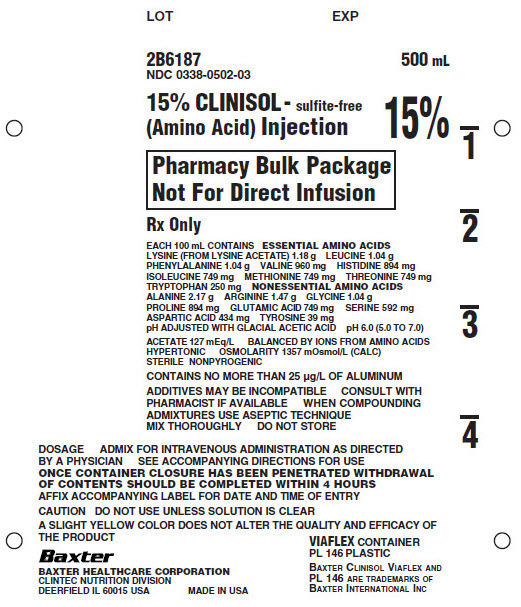
PRINCIPAL DISPLAY PANEL Container Label LOT EXP 2B6187 NDC 0338-0502-03 500mL 15% CLINISOL - sulfite-free (Amino Acid) Injection 15% Pharmacy Bulk Package Not For Direct Infusion Rx Only EACH 100mL CONTAINS ESSENTIAL AMINO ACIDS LYSINE (FROM LYSINE ACETATE) 1.18 g LEUCINE 1.04 g PHENYLALANINE 1.04 g VALINE 960 mg HISTIDINE 894 mg ISOLEUCINE 749 mg METHIONINE 749 mg THREONINE 749 mg TRYPTOPHAN 250 mg NONESSENTIAL AMINO ACIDS ALANINE 2.17 g ARGININE 1.47 g GLYCINE 1.04 g PROLINE 894 mg GLUTAMIC ACID 749 mg SERINE 592 mg ASPARTIC ACID 434 mg TYROSINE 39 mg pH ADJUSTED WITH GLACIAL ACETIC ACID pH 6.0 (5.0 TO 7.0) ACETATE 127 mEq/L BALANCED BY IONS FROM AMINO ACIDS HYPERTONIC OSMOLARITY 1357 mOsmol/L (CALC) STERILE NONPYROGENIC CONTAINS NO MORE THAN 25µg/L OF ALUMINUM ADDITIVES MAY BE INCOMPATIBLE CONSULT WITH PHARMACIST IF AVAILABLE WHEN COMPOUNDING ADMIXTURES USE ASEPTIC TECHIQUE MIX THOROUGHLY DO NOT STORE DOSAGE ADMIX FOR INTRAVEOUS ADMINISTRATION AS DIRECTED BY A PHYSICIAN SEE ACCOMPANYING DIRECTIONS FOR USE ONCE CONTAINER CLOSURE HAS BEEN PENETRATED WITHDRAWAL OF CONTENTS SHOULD BE COMPLETED WITHIN 4 HOURS AFFIX ACCOMPANYING LABEL FOR DATE AND TIME OF ENTRY CAUTION DO NOT USE UNLESS SOLUTION IS CLEAR A SLIGHT YELLOW COLOR DOES NOT ALTER THE QUALITY AND EFFICACY OF THE PRODUCT Baxter BAXTER HEALTHCARE CORPORATION CLINTEC NUTRITION DIVISION DEERFIELD IL 60015 USA MADE IN THE USA VIAFLEX CONTAINER PL 146 PLASTIC BAXTER CLINISOL VIAFLEX AND PL 146 ARE TRADEMARKS OF BAXTER INTERNATIONAL INC 1 2 3 4 Clinisol Representative Container Label NDC 0338-0502-03
Medicaid utilization & spend
Medicaid utilization by pack size
Medicare Part D spend CMS · PART D · 2026 (Q1)
About this NDC listing & data coverage
What data is (and isn’t) available for this NDC — tap to expand
| NDC identity (package / product / labeler codes) | ✓ Available |
| Labeler | ✓ Available |
| Product & package description | ✓ Available |
| Marketing category & status | ✓ Available |
| Active ingredient / dosage form / route | ✓ Available |
| FDA label (SPL via DailyMed) | ✓ Available |
| Package photos | ✓ Available |
| Inactive ingredients (structured) | — Not published for this NDC The labeler did not submit a structured excipient list, or no SPL is available. |
| NADAC pharmacy acquisition price (CMS) | — Not published for this NDC CMS publishes NADAC only for NDCs reported in its retail-pharmacy survey. |
| Orange Book / therapeutic-equivalence data | — Not published for this NDC Applies only to products approved under an NDA/ANDA; many listings are out of scope. |
| HCPCS J-code billing crosswalk | — Not published for this NDC Most self-administered / retail products have no J-code — that is normal. |
| Medicaid utilization (CMS SDUD) | ✓ Available |