
Intralipid I.V. Fat Emulsion 20 g/100mL Emulsion, 500 mL — NDC 0338-0519-13 (Billing 00338-0519-13)
This is a package of 500 mL of Intralipid I.V. Fat Emulsion 20 g/100mL Emulsion from Baxter Healthcare Corporation, marketed since Apr 2004 and currently FDA-listed.
NDC database record
One package, one record: these facts belong to NDC 0338-0519-13 alone.
- Record
- FDA NDC Directory package listing · Human prescription drug
- Code segments
- 0338 labeler · 0519 product · 13 package
- Listing certified through
- Dec 31, 2026
- Billing quantity
- 500 mL per package
- Barcode (UPC-A, from the NDC)
- 3 0338051913 2
- Medicaid fills, this package
- 18 prescriptions in the last four reported quarters
- FDA record last changed
- Oct 2, 2026
Past resolved recalls for this product (2)
Identity & classification
Regulatory identifiers FDA, NLM and CMS codes for this package
Drug-database identifiers Medi-Span GPI and First Databank GCN / HICL / AHFS classification
- GSN (GCN sequence number): 006375
- GCN: 25211
- GPI-14 (Medi-Span): 80200010501620
- HICL (First Databank): 002749
- AHFS class code: 40:20.00.00
- RxCUI (RxNorm): 200317
Where does this data come from?
- FDA openFDA NDC Directory · synced Oct 1, 2026
- FDA label on DailyMed · label index refreshed Oct 6, 2026
- RxNorm (NLM RxNav) · catalog refreshed Oct 1, 2026
- Medi-Span GPI (licensed)
- First Databank (licensed) · refreshed Oct 1, 2026
RxNorm drug class
This medicine belongs to the Lipid Emulsion class.
Where does this data come from?
- RxClass (NLM) · catalog refreshed Oct 1, 2026
Clinical
Patient education
Supplement & herbal interactions
Where does this data come from?
- MedlinePlus (NLM) · refreshed Oct 1, 2026
- FDA label on DailyMed · label index refreshed Oct 6, 2026
Ask a licensed pharmacist directly — free, answered by our team.
Pricing
A drug doesn't have one price. Each row is a different public payment system, and none is what you'd pay at the counter — that depends on your insurance. The ⓘ on each row explains what it measures.
| Price system | Per mL | Per package |
|---|---|---|
| Retail pharmacies payNADAC · weekly | Not in the retail survey — common for institutional, discontinued, or low-volume packs. | |
| Medicaid paysCMS SDUD · 12 mo | $3.31 | $1,653.75 / 500 ml |
| Medicare drug plans payPart D · Q2 2026 | $0.1963 | $98.15 / 500 ml |
Where does this data come from?
- CMS NADAC weekly file
- CMS ASP pricing files · refreshed Sep 20, 2026
- CMS Medicaid State Drug Utilization Data · through Q2 2025
- CMS Part D plan pricing files · refreshed Sep 24, 2026
- VA National Acquisition Center price file
Packaging — all sizes for this product
| Package NDC | Description | Marketing start | Marketing end | Status |
|---|---|---|---|---|
| 00338-0519-14 0338-0519-14 Main listing | 1000 mL in 1 BAG | 2004-04-01 | — | Active |
| 00338-0519-04 0338-0519-04 | 1000 mL in 1 BAG | 2004-04-01 | — | Active |
| 00338-0519-09 0338-0519-09 | 250 mL in 1 BAG | 2004-04-01 | — | Active |
| 00338-0519-13 You're viewing this | 500 mL in 1 BAG | 2004-04-01 | — | Active |
| 00338-0519-58 0338-0519-58 | 100 mL in 1 BAG | 2004-04-01 | — | Active |
This pack accounts for about 11% of this product's recent Medicaid fills; most go to the 1000 ml pack. See all packs ↓
Pack size FAQ
What quantity is in this package?
How does this package differ from NDC 00338-0519-58?
What NDC number is used to bill for this package of Intralipid I.V. Fat Emulsion 20 g/100mL Emulsion?
Therapeutic equivalents
| Product | Labeler | Pack | NADAC/unit | TE | Status | Price vs. this |
|---|---|---|---|---|---|---|
| Intralipid 20 g/100mLthis 00338-0519-13 | Baxter | 500 ml | — | AP | FDA listed | — |
| Intralipid 20 g/100mL 65219-0531-10 | Fresenius | 100 ml | — | AP | FDA listed | — |
| Intralipid 20 g/100mL 65219-0535-50 | Fresenius | 500 ml | — | AP | FDA listed | — |
| Intralipid 20 g/100mL 84549-0533-25 | ProPharma | 250 ml | — | AP | FDA listed | — |
| Intralipid 20 g/100mL 65219-0539-10 | Fresenius | 1000 ml | — | AP | FDA listed | — |
| Intralipid 20 g/100mL 84549-0535-50 | ProPharma | 500 ml | — | AP | FDA listed | — |
| Intralipid 20 g/100mL 65219-0533-25 | Fresenius | 250 ml | — | AP | FDA listed | — |
Where does this data come from?
- FDA openFDA NDC Directory · synced Oct 1, 2026
- FDA Orange Book · refreshed Oct 3, 2026
- CMS NADAC weekly file
Availability & generic status
We did not find an FDA-approved generic match for this exact strength, form and route.
Where does this data come from?
- FDA Orange Book · refreshed Oct 3, 2026
Inactive Ingredients / Excipients
Inactive ingredients, also called excipients, are components of the drug product other than the active ingredient. They may include fillers, dyes, coatings, preservatives, flavors, or other formulation ingredients.
💡 Tap an ingredient (hover on desktop) to see what it is and why it’s used.
-
1.2 g / 100 mL
UNII 1Z74184RGV
Egg phospholipids are naturally derived fats from eggs that help mix oil and water-based ingredients together. They work as emulsifiers in medicines, keeping the formula stable and uniform.
-
2.25 g / 100 mL
UNII PDC6A3C0OX
Glycerin is a clear, thick liquid derived from plant oils or fats. It acts as a humectant to retain moisture, a sweetener, and a solvent in medications.
-
UNII 55X04QC32I
A strong alkaline chemical used to adjust and maintain the pH balance of liquid medicines. It helps keep the medicine stable and ensures it stays effective during storage.
3 inactive ingredients listed in the exact product block matched to this NDC.
Where does this data come from?
ingredient classCode="IACT" elements from the exact product block matched by this NDC. Label-section narrative from DailyMed / the openFDA label index is shown separately when available.- FDA label on DailyMed · label index refreshed Oct 6, 2026
- FDA openFDA NDC Directory · synced Oct 1, 2026
Inactive ingredient FAQ
Are inactive ingredients the same for every manufacturer?
Why might an inactive ingredient be missing?
Can inactive ingredients matter?
Manufacturer & labeler
More NDCs from Baxter Healthcare Corporation labeler code 00338
- Gentamicin Sulfate in Sodium Chloride 80 mg/100mL Injection, Solution NDC 0338-0503-48
- Gentamicin Sulfate in Sodium Chloride 100 mg/100mL Injection, Solution NDC 0338-0505-48
- Gentamicin Sulfate in Sodium Chloride 60 mg/50mL Injection, Solution NDC 0338-0507-41
- Gentamicin Sulfate in Sodium Chloride 80 mg/50mL Injection, Solution NDC 0338-0509-41
- Gentamicin Sulfate in Sodium Chloride 100 mg/50mL Injection, Solution NDC 0338-0511-41
- Intralipid I.V. Fat Emulsion 10 g/100mL Emulsion NDC 0338-0518-12
- Intralipid I. V. Fat Emulsion 30 g/100mL Emulsion NDC 0338-0520-13
- Dextrose 5 g/100mL Injection NDC 0338-0551-11
- Sodium Chloride 900 mg/100mL Injection NDC 0338-0553-11
- Potassium Chloride in Dextrose and Sodium 5 g/100mL; 150 mg/100mL; 330 mg/100mL Injection, Solution NDC 0338-0603-03
- Travasol Leucine, Phenylalanine, Lysine hydrochloride, Methionine, Isoleucine, Valine, Histidine, Threonine, Tryptophan, Alanine, Glycine, Arginine, Proline, Tyrosine, Serine 730 mg/100mL; 560 mg/100mL; 580 mg/100mL; 400 mg/100mL; 600 mg/100mL; 580 mg/100mL; 480 mg/100mL; 420 mg/100mL; 180 mg/100mL; 2.07 g/100mL Injection NDC 0338-0644-03
- Acetic Acid 250 mg/100mL Irrigant NDC 0338-0656-04
Where does this data come from?
- FDA openFDA NDC Directory · synced Oct 1, 2026
- Drugs@FDA
Full prescribing information FDA SPL
🚨 Boxed Warning ▾
WARNINGS Deaths in preterm infants after infusion of intravenous fat emulsion have been reported in the medical literature 2 . Autopsy findings included intravascular fat accumulation in the lungs. Treatment of premature and low birth weight infants with intravenous fat emulsion must be based upon careful benefit-risk assessment.
Strict adherence to the recommended total daily dose is mandatory; hourly infusion rate should be as slow as possible in each case and should not in any case exceed 1 g fat/kg in four hours. Premature and small for gestational age infants have poor clearance of intravenous fat emulsion and increased free fatty acid plasma levels following fat emulsion infusion; therefore, serious consideration must be given to administration of less than the maximum recommended doses in these patients in order to decrease the likelihood of intravenous fat overload.
The infant's ability to eliminate the infused fat from the circulation must be carefully monitored (such as serum triglycerides and/or plasma free fatty acid levels). The lipemia must clear between daily infusions.
🎯 Indications and Usage ▾
INDICATIONS AND USAGE Intralipid ® 20% Pharmacy Bulk Package is indicated for use in a pharmacy admixture program for the preparation of three-in-one or total nutrition admixtures (TNAs) to provide a source of calories and essential fatty acids for patients requiring parenteral nutrition for extended periods of time (usually for more than 5 days) and a source of essential fatty acids for prevention of EFAD.
⏱️ Dosage and Administration ▾
DOSAGE AND ADMINISTRATION Intralipid 20% (A 20% I.V. Fat Emulsion) Pharmacy Bulk Package should be administered only as a part of a three-in-one or total nutrient admixture via peripheral vein or by central venous infusion. Directions For Proper Use of Pharmacy Bulk Package.
INTRALIPID 20% PHARMACY BULK PACKAGE IS NOT INTENDED FOR DIRECT INFUSION. The container closure may be penetrated only once using a suitable sterile transfer device or dispensing set which allows measured dispensing of the contents. The Pharmacy Bulk Package is to be used only in a suitable work area such as a laminar flow hood (or an equivalent clean air compounding area).
Once the closure is penetrated, the contents should be dispensed as soon as possible; the transfer of contents to suitable TPN admixture containers must be completed within 4 hours of closure penetration. The bag should be stored below 25°C (77°F) after the closure has been entered. Admixtures made using Intralipid 20% should be used promptly.
See MIXING GUIDELINES AND LIMITATIONS section for admixture storage recommendations. Adult Patients The initial infusion rate of the nutrient admixture in adults should be 0.1 g fat/minute for the first 15 to 30 minutes of infusion. If no untoward reactions occur (see ADVERSE REACTIONS section), the infusion rate can be increased to 0.2 g fat/minute.
For adults, the admixture should not contain more than 500 mL of Intralipid 20% on the first day of therapy. If the patient has no untoward reactions, the dose can be increased on the following day. The daily dosage should not exceed 2.5 g of fat/ kg of body weight (12.5 mL of Intralipid 20% per kg).
Intralipid 20% should make up no more than 60% of the total caloric input to the patient. Maximum infusion rate should not exceed 0.1 g/kg/hr. Carbohydrate and a source of amino acids should comprise the remaining caloric input.
Pediatric Patients The dosage for premature infants starts at 0.5 g fat/kg body weight/24 hours (2.5 mL Intralipid 20%) and may be increased in relation to the infant's ability to eliminate fat. The maximum recommended dosage is 3 g fat/kg/24 hours. Pediatric patients may be at risk for parenteral nutrition-associated liver disease (PNALD), also known as intestinal failure-associated liver disease (see WARNINGS section) when receiving Intralipid for durations exceeding two weeks.
During intravenous administration of Intralipid 20%, perform liver tests to monitor for PNALD. The initial rate of infusion in older pediatric patients should be no more than 0.01 g fat/minute for the first 10 to 15 minutes. If no untoward reactions occur, the rate can be changed to permit infusion of 0.1 g of fat/kg/hour.
The daily dosage should not exceed 3 g of fat/kg of body weight 3 . Intralipid (equivalent to 0.125 g/kg/hour) should make up no more than 60% of the total caloric input to the patient. Carbohydrate and a source of amino acids should comprise the remaining caloric input.
Essential Fatty Acid Deficiency When Intralipid 20% is administered to correct essential fatty acid deficiency, eight to ten percent of the caloric input should be supplied by Intralipid 20% in order to provide adequate amounts of linoleic and linolenic acids. When EFAD occurs together with stress, the amount of Intralipid 20% needed to correct the deficiency may be increased. Administration See MIXING GUIDELINES AND LIMITATIONS section for information regarding mixing this fat emulsion with other parenteral fluids.
INTRALIPID 20% (A 20% I.V. FAT EMULSION) PHARMACY BULK PACKAGE IS NOT INTENDED FOR DIRECT INFUSION. It must be infused as part of an admixture into a central or peripheral vein.
The flow rate of the admixture should be controlled with an infusion pump. Use a 1.2 micron filter with admixtures containing Intralipid 20%. Filters of less than 1.2 micron pore size must not be used.
Conventional administration sets and TPN pooling bags contain polyvinyl chloride (PVC) components that have DEHP (di(2- ethylhexyl) p… [Excerpted — this section continues on DailyMed.]
⛔ Contraindications ▾
CONTRAINDICATIONS Intralipid is contraindicated in patients with: Disturbances of normal fat metabolism such as pathologic hyperlipemia, lipoid nephrosis or acute pancreatitis if accompanied by hyperlipidemia. Known hypersensitivity to egg, soybean, peanut protein, or to any of the active ingredients or excipients in Intralipid 20%. INTRALIPID 20% PHARMACY BULK PACKAGE IS NOT INTENDED FOR DIRECT INTRAVENOUS ADMINISTRATION.
DILUTING INTRALIPID 20% TO A 10% CONCENTRATION WITH INTRAVENOUS FLUID SUCH AS NORMAL SALINE OR OTHER DILUENTS DOES NOT PRODUCE A DILLITION THAT IS EQUIVALENT IN COMPOSITION TO INTRALIPID 10% I.V. FAT EMULSION, AND SUCH A DILUTION SHOULD NOT BE GIVEN BY DIRECT INTRAVENOUS ADMINISTRATION.
🤒 Adverse Reactions ▾
ADVERSE REACTIONS The adverse reactions observed can be separated into two classes: Those more frequently encountered are due either to a) contamination of the intravenous catheter and result in sepsis, or to b) vein irritation by concurrently infused hypertonic solutions and may result in thrombophlebitis. These adverse reactions are inseparable from the hyperalimentation procedure with or without Intralipid. Less frequent reactions more directly related to Intralipid are: a) immediate or early adverse reactions, each of which has been reported to occur in clinical trials, in an incidence of less than 1%; dyspnea, cyanosis, allergic reactions, hyperlipemia, hypercoagulability, nausea, vomiting, headache, flushing, increase in temperature, sweating, sleepiness, pain in the chest and back, slight pressure over the eyes, dizziness, and irritation at the site of infusion, and, rarely, thrombocytopenia in neonates; b) delayed adverse reactions such as hepatomegaly, jaundice due to central lobular cholestasis, splenomegaly, thrombocytopenia, leukopenia, transient increases in liver tests, and overloading syndrome (focal seizures, fever, leukocytosis, hepatomegaly, splenomegaly and shock).
The deposition of a brown pigmentation in the reticuloendothelial system, the so-called “intravenous fat pigment,” has been reported in patients infused with Intralipid . The causes and significance of this phenomenon are unknown.
🤰 Pregnancy ▾
Pregnancy: Animal reproduction studies have not been conducted with Intralipid. It is also not known whether Intralipid can cause fetal harm when administered to a pregnant woman or can affect reproduction capacity. Intralipid should be given to a pregnant woman only if clearly needed.
🧒 Pediatric Use ▾
Pediatric Use: See DOSAGE AND ADMINISTRATION .
🆘 Overdosage ▾
OVERDOSAGE In the event of fat overload during therapy, stop the infusion of Intralipid 20% (A 20% I.V. Fat Emulsion) until visual inspection of the plasma, determination of triglyceride concentrations, or measurement of plasma light-scattering activity by nephelometry indicates the lipid has cleared. Re-evaluate the patient and institute appropriate corrective measures. See WARNINGS and PRECAUTIONS .
🧬 Clinical Pharmacology ▾
CLINICAL PHARMACOLOGY Intralipid is metabolized and utilized as a source of energy causing an increase in heat production, decrease in respiratory quotient and increase in oxygen consumption. The infused fat particles are cleared from the blood stream in a manner thought to be comparable to the clearing of chylomicrons. Intralipid will prevent the biochemical lesions of essential fatty acid deficiency (EFAD) and correct the clinical manifestations of the EFAD syndrome.
📦 How Supplied / Storage and Handling ▾
HOW SUPPLIED Intralipid 20% is supplied as a sterile emulsion in 1000 mL Pharmacy Bulk Package. 1000 mL NDC 0338-0519-14 Intralipid 20% is also available in the following fill sizes: 100 mL: 0338-0519-58 250 mL: 0338-0519-09 500 mL: 0338 0519-13
📦 Storage and Handling ▾
STORAGE Intralipid 20% should not be stored above 25°C (77°F). Do not freeze Intralipid 20%. If accidentally frozen, discard the bag.
📋 Description ▾
DESCRIPTION Intralipid ® 20% (A 20% I.V. Fat Emulsion) is a sterile, non-pyrogenic fat emulsion intended as a source of calories and essential fatty acids for use in a pharmacy admixture program. It is made up of 20% Soybean Oil, 1.2% Egg Yolk Phospholipids, 2.25% Glycerin, and Water for Injection.
In addition, sodium hydroxide has been added to adjust the pH so that the final product pH is 8. pH range is 6 to 8.9. Intralipid 20% Pharmacy Bulk Package is not intended for direct infusion. It is a sterile dosage form which contains several single doses for use in preparation of three-in-one or total nutrient admixtures (TNAs) in a pharmacy admixture program.
The soybean oil is a refined natural product consisting of a mixture of neutral triglycerides of predominantly unsaturated fatty acids with the following structure: Where are saturated and unsaturated fatty acid residues. The major component fatty acids are linoleic acid (44-62%), oleic acid (19-30%), palmitic acid (7-14%), α-linolenic acid (4-11%) and stearic acid (1.4-5.5%) 1 . These fatty acids have the following chemical and structural formulas: Purified egg phosphatides are a mixture of naturally occurring phospholipids which are isolated from the egg yolk.
These phospholipids have the following general structure: contain saturated and unsaturated fatty acids that abound in neutral fats. R 3 is primarily either the choline or the ethanolamine ester of phosphoric acid. Glycerin is chemically designated C 3 H 8 O 3 and is a clear colorless, hygroscopic syrupy liquid.
It has the following structural formula: Intralipid 20% (A 20% I.V. Fat Emulsion) has an osmolality of approximately 350 mOsmol/kg water (which represents 260 mOsmol/L of emulsion) and contains emulsified fat particles of approximately 0.5 micron size. The total caloric value, including fat, phospholipid and glycerin, is 2.0 kcal per mL of Intralipid 20%.
The phospholipids present contribute 47 milligrams or approximately 1.5 mmol of phosphorus per 100 mL of the emulsion. The primary plastic container (Biofine TM ) is made from multilayered film specifically designed for parenteral nutrition drug products. The film is polypropylene based comprising three co-extruded layers.
It contains no plasticizers and exhibits virtually no leachables. The container does not contain DEHP (di(2-ethylhexyl) phthalate) or PVC. This product is not made with natural rubber latex.
The container is nontoxic and biologically inert. The container-emulsion unit is a closed system and is not dependent upon entry of external air during administration. The container is overwrapped to provide protection from the physical environment and to provide an additional moisture barrier when necessary.
Figure Figure Figure Figure Figure Figure Figure
⚠️ Precautions ▾
PRECAUTIONS When Intralipid 20% is administered, the patient's capacity to eliminate the infused fat from the circulation must be monitored by use of an appropriate laboratory determination of serum triglycerides. Overdosage must be avoided. During intravenous administration with Intralipid 20%, perform liver tests to monitor for PNALD.
If patients develop liver test abnormalities, consider discontinuation of Intralipid or dosage reduction. (See WARNINGS section). Frequent platelet counts should be done in neonatal patients receiving parenteral nutrition with Intralipid.
Drug product contains no more than 25 mcg/L of aluminum. Carcinogenesis, Mutagenesis, Impairment of Fertility: Studies with Intralipid have not been performed to evaluate carcinogenic potential, mutagenic potential, or effects on fertility. Pregnancy: Animal reproduction studies have not been conducted with Intralipid.
It is also not known whether Intralipid can cause fetal harm when administered to a pregnant woman or can affect reproduction capacity. Intralipid should be given to a pregnant woman only if clearly needed. Nursing Mothers: Caution should be exercised when Intralipid is administered to a nursing woman.
Pediatric Use: See DOSAGE AND ADMINISTRATION .
🍼 Nursing Mothers ▾
Nursing Mothers: Caution should be exercised when Intralipid is administered to a nursing woman.
📄 Carcinogenesis, Mutagenesis, Impairment of Fertility ▾
Carcinogenesis, Mutagenesis, Impairment of Fertility: Studies with Intralipid have not been performed to evaluate carcinogenic potential, mutagenic potential, or effects on fertility.
📚 References ▾
REFERENCES Padley FB: “Major Vegetable Fats”, The Lipid Handbook (Gunstone FD, Harwood JL, Padley FB, eds.), Chapman and Hall Ltd., Cambridge, UK (1986), pp. 88-9. Levene MI, Wigglesworth JS, Desai R: Pulmonary fat accumulation after Intralipid infusion in the preterm infant.
Lancet 1980; 2(8199):815-8. American Academy of Pediatrics: Use of intravenous fat emulsion in pediatric patients. Pediatrics 1981; 68:5(Nov) 738-43.
(Rev May 2022) Manufactured for Baxter Healthcare Corporation Deerfield, IL 60015 USA Manufactured by Fresenius Kabi, Uppsala, Sweden Intralipid ® is a registered trademark of Fresenius Kabi AB.
📖 Instructions for Use ▾
Instruction for Use - Intralipid ® 20% Pharmacy Bulk Package Container 1. 1. The integrity indicator (Oxalert™) A should be inspected before removing the overwrap.
If the indicator is black the overwrap is damaged and the product should be discarded. 2. 2.
Remove the overwrap by tearing at the notch and pulling down along the container. The Oxalert sachet (A) and the oxygen absorber (B) should be discarded. Place the bag on a clean, flat surface or hang on a support hook.
3. 3. Break off the tamper-evident arrow flag from the blue infusion port.
Use a compounding set with a diameter of 5.6 +/- 0.1 mm. Follow the instructions for use for the compounding set. 4.
4. Hold the base of the infusion port firmly and insert the spike straight through the center of the septum by rotating the wrist slightly if needed. NOTE: Assure that the spike is inserted straight into the port and not at an angle.
Inspect the bag and contents for particulate matter in a well-lit environment prior to use. Discard the bag if there are any signs of discoloration or particulates. 5.
5. Hang the bag in the hanger cut and start transfer to the compounding bag Figure Figure Figure Figure Figure
📄 Package Label / Principal Display Panel ▾
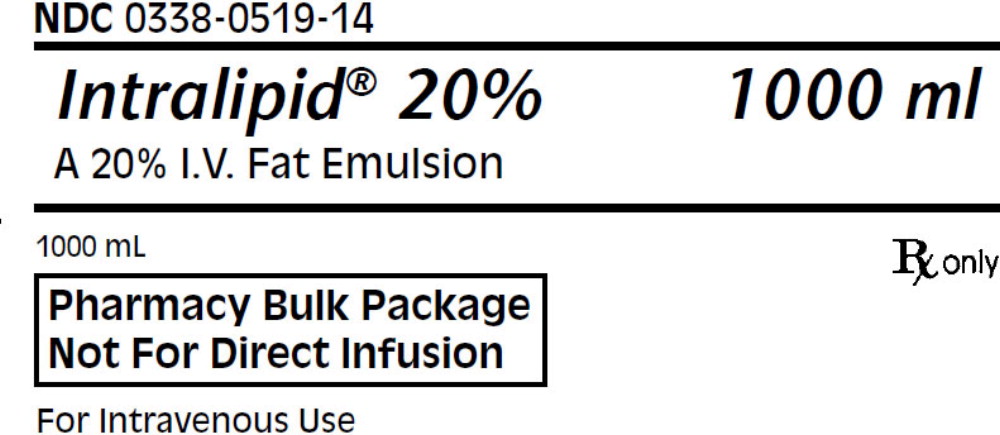
PACKAGE LABEL - PRINCIPAL DISPLAY - Intralipid 1000 mL Bag Label NDC 0338-0519-14 Intralipid ® 20% A 20% I.V. Fat Emulsion 1000 mL Pharmacy Bulk Package Not for Direct Infusion For Intravenous Use Rx only 20 pbp
Medicaid utilization & spend
Medicaid utilization by pack size
Medicare Part D spend CMS · PART D · 2026 (Q1)
About this NDC listing & data coverage
What data is (and isn’t) available for this NDC — tap to expand
| NDC identity (package / product / labeler codes) | ✓ Available |
| Labeler | ✓ Available |
| Product & package description | ✓ Available |
| Marketing category & status | ✓ Available |
| Active ingredient / dosage form / route | ✓ Available |
| FDA label (SPL via DailyMed) | ✓ Available |
| Package photos | ✓ Available |
| Inactive ingredients (structured) | ✓ Available |
| NADAC pharmacy acquisition price (CMS) | — Not published for this NDC CMS publishes NADAC only for NDCs reported in its retail-pharmacy survey. |
| Orange Book / therapeutic-equivalence data | ✓ Available |
| HCPCS J-code billing crosswalk | — Not published for this NDC Most self-administered / retail products have no J-code — that is normal. |
| Medicaid utilization (CMS SDUD) | ✓ Available |