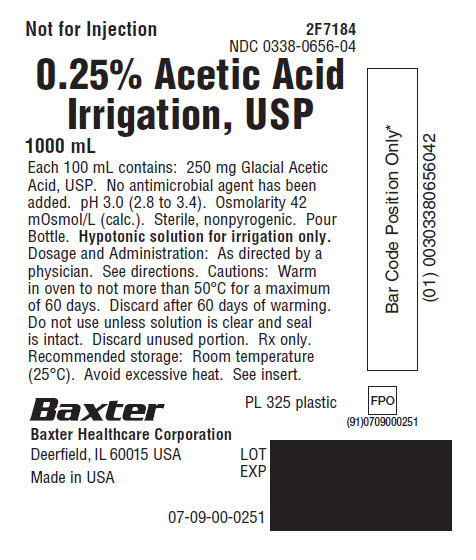
by Baxter Healthcare Corporation · 1000 mL in 1 BOTTLE, PLASTIC
This is a package of 1,000 mL of Acetic Acid 250 mg/100mL Irrigant from Baxter Healthcare Corporation, marketed since Feb 1982 and currently FDA-listed. It is this product's only package size.
NDC 00338-0656-04
🏷️ FDA NDC (as labeled)0338-0656-04billing pads the labeler segment with a zero
🗂️ FDA directory synced Oct 1, 2026 · this listing last changed Jul 24, 2026 · sources: openFDA · FDA label (DailyMed) · FDA Orange & Purple Book · First Databank · CMS NADAC, ASP, Medicare & Medicaid · RxNorm
Drug-database identifiers Medi-Span GPI and First Databank GCN / HICL / AHFS classification
GPI-1456700040002005
GPI classAcetic Acid
GCN Seq No009834
GCN45390
HICL code003597
Ingredient (HICL)Acetic Acid
HIC1 codeW
Therapeutic class — broad (HIC1)Anti-Infecting Agents
HIC2 codeW8
Therapeutic class — intermediate (HIC2)Antiseptics
HIC3 codeW8F
Therapeutic class — specific (HIC3)Irrigants
AHFS code40:36.00.00
AHFS classIrrigating Solutions
FDB label nameACETIC ACID 0.25% IRRIG SOLN
FDB brand nameAcetic Acid
Legend statusF — Federal legend — prescription drug or device
Quick answers
GSN (GCN sequence number):009834
GCN:45390
GPI-14 (Medi-Span):56700040002005
HICL (First Databank):003597
AHFS class code:40:36.00.00
RxCUI (RxNorm):307707
Why two NDCs?
The FDA registers this code as 0338-0656-04 — a 4-4-2 layout, and that's what's printed on the package and shown on DailyMed. For insurance claims, every NDC is standardized to a uniform 11-digit 5-4-2 format by adding a zero to the labeler segment → 00338-0656-04. Same drug, same package — only the format differs.
Where does this data come from?
Identifiers from the FDA openFDA NDC Directory and Structured Product Labeling; RxCUI from RxNorm (NLM); GPI from Medi-Span; GCN / HIC / AHFS / legend from First Databank.
Therapeutic classes from RxNorm RxClass (U.S. National Library of Medicine) — Established Pharmacologic Class (FDA), ATC drug family (WHO) and mechanism of action, matched by this product’s RxCUI.
Plain-language summary from MedlinePlus (U.S. National Library of Medicine); supplement & herbal interactions and nutrient depletion data from the Natural Medicines database; our full guide is HelloPharmacist editorial content.
A drug doesn't have one price. Each row is a different public payment system, and none is what you'd pay at the counter — that depends on your insurance. The ⓘ on each row explains what it measures.
Price system
Per each
Per package
Retail pharmacies payNADAC · weekly
Not in the retail survey — common for institutional, discontinued, or low-volume packs.
Medicaid paysCMS SDUD · 12 mo
$0.0142
$0.01 / 1 bottle
Medicare drug plans payPart D · quarterly
No Part D plan price is available for this NDC in our data.
Where does this data come from?
NADAC (National Average Drug Acquisition Cost) is the CMS weekly pharmacy-acquisition-cost survey — what pharmacies pay. ASP (Average Sales Price) is the CMS Medicare Part B drug-payment file, published quarterly. Medicaid pays is computed by us from CMS State Drug Utilization Data (total reimbursed ÷ units, trailing 12 months) — gross of rebates and inclusive of dispensing fees, so it reflects what Medicaid paid, not an acquisition cost. Medicare drug plans pay is the median negotiated point-of-sale unit cost across plans listing this NDC in the CMS quarterly Prescription Drug Plan pricing files, before rebates. The VA pays is the federal contract price (FSS, and the statutory Big 4 ceiling where listed) from the VA National Acquisition Center pharmaceutical price file. All are free public government data; each measures a different payer, so the figures are not directly comparable.
About this product: this is the brand-name version. We did not find an FDA-approved generic match for this exact strength, form and route.
Where does this data come from?
Equivalents are other NDCs of the same ingredient, form and route from the openFDA NDC Directory, ranked least-expensive-first by NADAC. Therapeutic-equivalence (AB) ratings come from the FDA Orange Book; biologics use the FDA Purple Book for biosimilar & interchangeable status.
We did not find an FDA-approved generic match for this exact strength, form and route.
Where does this data come from?
Patents and exclusivity from the FDA Orange Book (small-molecule drugs), refreshed from public FDA data. Generic launch timing is an estimate, not a guarantee.
Inactive ingredients, also called excipients, are components of the drug product
other than the active ingredient. They may include fillers, dyes, coatings, preservatives, flavors,
or other formulation ingredients.
💡 Tap an ingredient (hover on desktop) to see what it is and why it’s used.
UNII 059QF0KO0R
Water is a liquid solvent that dissolves and mixes ingredients together in liquid medicines, syrups, and injections. It helps distribute the active drug evenly throughout the product.
1 inactive ingredient listed in the exact product block matched to this NDC.
Where does this data come from?
Data sourced from official FDA Structured Product Labeling (SPL) via DailyMed — ingredient classCode="IACT" elements from the exact product block matched by this NDC. Label-section narrative from DailyMed / the openFDA label index is shown separately when available.
Are inactive ingredients the same for every manufacturer?
No. Inactive ingredients can differ by manufacturer, dosage form, strength, and package / product version.
Why might an inactive ingredient be missing?
Some SPLs do not provide a complete structured inactive-ingredient list, and older or unusual labels may only include the information in narrative text.
Can inactive ingredients matter?
Yes. They can matter for allergies, intolerances, dyes, gluten / lactose concerns, preservatives, and formulation differences — but confirm with a pharmacist or the manufacturer when it’s clinically important.
Manufacturer & labeler
LabelerBaxter Healthcare Corporation
Application holderBAXTER HEALTHCARE CORP
FDA applicationNDA018523 (NDA)
Labeler code00338
First marketedFeb 1982
Product typeHuman Prescription Drug
Portfolio283 products on file
More NDCs from Baxter Healthcare Corporation labeler code 00338
The labeler markets the product; the application holder owns the FDA approval. They’re often the same company but can differ (e.g. a repackager or an authorized generic). A mailing address / phone appears here when the manufacturer includes it in the product’s FDA label (not all do).
Where does this data come from?
Labeler, application holder and registered establishment from the FDA openFDA NDC Directory and Drugs@FDA; address/contact from the product’s FDA label.
The complete FDA label for this product — the official prescribing information, verbatim, section by section. Jump with a chip, search within the label, or expand everything.
INDICATIONS AND USAGE 0.25% Acetic Acid Irrigation, USP, is indicated as a constant or intermittent bladder rinse to help prevent the growth and proliferation of susceptible urinary pathogens (especially ammonia forming bacteria) in the management of patients who require prolonged placement of an indwelling urethral catheter. It also may be used for periodic irrigation of an indwelling catheter to help maintain patency by reducing the formation of calcium encrustations.
⏱️Dosage and Administration42 words▾
DOSAGE AND ADMINISTRATION The volume of solution needed will vary with nature and duration of the urologic procedure, according to physician’s instructions. Irrigation drug products should be inspected visually for particulate matter and discoloration prior to administration whenever solution and container permit.
⛔Contraindications3 words▾
CONTRAINDICATIONS None known
⚠️Warnings73 words▾
WARNINGS Not for injection. Use of this solution in patients with mucosal lesions of the urinary bladder may be harmful due to irritation of the lesion. Absorption via open lesions of the bladder mucosa may result in systemic acidosis. The contents of an opened container should be used promptly to minimize the possibility of bacterial growth or pyrogen formation. Discard the unused portion of irrigating solution since no antimicrobial agent has been added.
🤒Adverse Reactions37 words▾
ADVERSE REACTIONS Systemic acidosis, pain and hematuria have been reported in patients receiving urinary bladder irrigation with 0.25% Acetic Acid Irrigation, USP. Should adverse reactions occur, discontinue the irrigation and reevaluate the clinical status of the patient.
🤰Pregnancy58 words▾
Pregnancy Teratogenic Effects Animal reproduction studies have not been conducted with 0.25% Acetic Acid Irrigation, USP. It is also not known whether 0.25% Acetic Acid Irrigation, USP can cause fetal harm when administered to a pregnant woman or can affect reproduction capacity. 0.25% Acetic Acid Irrigation, USP should be given to a pregnant woman only if clearly needed.
🧒Pediatric Use45 words▾
Pediatric Use Safety and effectiveness in pediatric patients have not been established. Warm in oven to not more than 50°C for a maximum of 60 days. Discard after 60 days of warming. Do not administer unless the solution is clear and the seal is intact.
🧬Clinical Pharmacology17 words▾
CLINICAL PHARMACOLOGY The minimal amount of acetic acid which may enter the systemic circulation is readily metabolized.
📦How Supplied / Storage and Handling56 words▾
HOW SUPPLIED 0.25% Acetic Acid Irrigation, USP is supplied in a plastic pour bottle as follows: 2F7184 1000 mL NDC 0338-0656-04 Exposure of pharmaceutical products to heat should be minimized. Avoid excessive heat. It is recommended that the product be stored at room temperature (25°C): brief exposure up to 40ºC does not adversely affect the product.
📋Description123 words▾
DESCRIPTION 0.25% Acetic Acid Irrigation, USP, is a sterile, nonpyrogenic hypotonic solution for irrigation of the urinary bladder. Each 100 mL contains 250 mg Glacial Acetic Acid, USP, (CH 3 COOH) in Water for Injection, USP. pH 3.0 (2.8 to 3.4). Osmolarity: 42 mOsmol/L (calc.).
No antimicrobial agent has been added. The container is made from specially formulated polyolefin (PL 325). The polyolefin is a copolymer of ethylene and propylene.
It contains no plasticizers or other mobile additives. As a result, the container has virtually no extractability or leachability. The total extractables after two years of storage being less than 0.01 ppm.
It is also relatively impermeable to water vapor transmission and, therefore, requires no vapor barrier to maintain the proper drug concentration.
⚠️Precautions104 words▾
PRECAUTIONS Pregnancy Teratogenic Effects Animal reproduction studies have not been conducted with 0.25% Acetic Acid Irrigation, USP. It is also not known whether 0.25% Acetic Acid Irrigation, USP can cause fetal harm when administered to a pregnant woman or can affect reproduction capacity. 0.25% Acetic Acid Irrigation, USP should be given to a pregnant woman only if clearly needed.
Pediatric Use Safety and effectiveness in pediatric patients have not been established. Warm in oven to not more than 50°C for a maximum of 60 days. Discard after 60 days of warming.
Do not administer unless the solution is clear and the seal is intact.
📄Package Label / Principal Display Panel148 words▾
PACKAGE LABEL - PRINCIPAL DISPLAY PANEL Container Label Not for Injection 2F7184 NDC 0338-0656-04 0.25% Acetic Acid Irrigation, USP 1000 mL Each 100 mL contains: 250 mg Glacial Acetic Acid, USP. No antimicrobial agent has been added. pH 3.0 (2.8 to 3.4). Osmolarity 42 mOsmol/L (calc.).
Sterile, nonpyrogenic. Pour Bottle. Hypotonic solution for irrigation only.
Dosage and Administration: As directed by a physician. See directions. Cautions: Warm in oven to not more than 50°C for a maximum of 60 days.
Discard after 60 days of warming. Do not use unless solution is clear and seal is intact. Discard unused portion.
Rx only. Recommended storage: Room temperature (25°C). Avoid excessive heat.
See insert. PL 325 plastic Baxter Logo Baxter Healthcare Corporation Deerfield, IL 60015 USA Made in USA LOT EXP 07-09-00-0251 FPO (91)0709000251 Bar Code Bar Code Posit ion Only* (01) 00303380656042 Acetic Acid Representative Container Label NDC 0338-0656-04
No label section mentions that — try another word, or open the full label on DailyMed below.
Glossary — plain-language definitions of medical terms used in this label:
Absorption: How a medicine moves from where it is taken, such as the stomach or gut, into the bloodstream.
Adverse Reactions: Unwanted or harmful effects that people experienced while taking a medicine, listed on its official label.
animal reproduction studies: Tests in pregnant animals used to check whether a medicine might harm a developing baby.
Clinical Pharmacology: The label section explaining how a medicine works in the body and how the body processes it.
Contraindications: A list of situations or health conditions in which a medicine should not be used because the chance of harm is too high.
Dosage and Administration: The label section explaining how much of a medicine to use and how to take or give it.
fetal harm: Injury or damage to a developing baby while it is growing inside the womb.
hematuria: Blood in the urine.
Indications and Usage: The label section stating which medical conditions the FDA has officially approved the medicine to treat, prevent, or manage.
NDC: A unique number that identifies a specific medicine, its maker, strength, and package size.
Rx only: A label marking meaning the medicine can be obtained only with a prescription from a licensed health professional.
systemic circulation: The main bloodstream that carries a medicine throughout the whole body.
teratogenic: Able to cause physical birth defects in a developing baby when a medicine is taken during pregnancy.
Source: FDA Structured Product Labeling, mirrored from DailyMed / openFDA.
Prefer the government’s original formatting? View this label on DailyMed ↗
Medicaid utilization & spend
📍 This exact package only: Medicaid data is reported per full 11-digit NDC — labeler, product and pack size — so every number here is for this package alone, not the drug overall. Other pack sizes report separately.
💊 Pharmacy benefit only: These are Medicaid outpatient pharmacy claims, billed by NDC. They exclude the medical benefit — clinic- or hospital-administered drugs billed under HCPCS J-codes — so drugs used mostly that way (e.g. Avastin, Lucentis, Keytruda) can look low or missing here. That’s expected, not an error.
📅 Q1 2025 – Q1 2026 · 5 quarters of data
ⓘ The newest quarter is usually incomplete when first published; states restate recent quarters in later CMS releases, so the latest figures typically revise upward. State coverage-policy changes can also shift quarter-to-quarter totals.
Prescriptions last 4 qtrs
3.3K
Units reimbursed last 4 qtrs
4.9M
Gross reimbursed last 4 qtrs
$69.3K
Avg / prescription
$21.01
Avg / unit
$0.0142
Latest quarter Q1 2026
728Rx
Fee-for-service vs managed care ⓘ
71% FFS29% MCO
Fee-for-service · 2,340 Rx Managed care · 959 Rx
State Medicaid map
Units reimbursed · per 100k residents
61.911,448
gray = no data reported ⓘ
Colors are per 100,000 residents, so big states don’t automatically dominate. Tap or hover a state for its actual totals.
Tap or hover a state
…for its Medicaid breakdown
Prescriptions—
Units—
Reimbursed—
🏆 Top states by units · per 100k residents
1Oklahoma11,448 /100k
2Delaware6,499 /100k
3Iowa6,049 /100k
4Minnesota5,510 /100k
5Ohio4,849 /100k
6Indiana4,663 /100k
7Wisconsin4,036 /100k
8Michigan3,390 /100k
National units — by quarter
💵 About the dollar figures: “reimbursed” is what Medicaid paid pharmacies before confidential manufacturer rebates, so the program’s real net cost is lower than these numbers. Fee-for-service and managed-care claims are combined unless split above. Source: CMS State Drug Utilization Data; per-100k rates use 2023 Census population estimates.
Medicare Part D spend CMS · PART D · 2026 (Q1)
Medicare Part D (outpatient prescription) spending for Acetic Acid — the program that covers self-administered drugs. 3 manufacturers.
⚠️ Drug-level data: CMS publishes Part D spending by drug, not by NDC — these figures combine every manufacturer, strength and package size sold under the name Acetic Acid. That’s a different level of aggregation than the Medicaid card above, which is specific to this exact 11-digit NDC (pack size included), so the two aren’t directly comparable.
Period
Total Part D spend
$497.9K
Claims incl. refills
23.7K
Beneficiaries
15.3K
Spend / beneficiary
$32.49
Spend / claim
$21.02
Trend by period
💵 About the dollar figures: spending is what Part D plans paid before confidential manufacturer rebates, so the program’s real net cost is lower. A blank patient count means fewer than 11 people — CMS hides counts that small to protect privacy. Source: CMS Medicare Quarterly Part D Spending by Drug (data.cms.gov), updated quarterly.
Reported adverse events (FAERS)
Read carefully: FAERS reports are voluntary and unverified. Counts are not incidence, do not establish causation, are subject to reporting bias, and cannot be used to compare one drug to another. Shown for signal context only. Reports for Acetic Acid — the ingredient across all brands.
Top reported reactions
Nausea38
Diarrhoea29
Toxicity To Various Agents29
Pain27
Cough25
Dyspnoea25
Arthralgia21
Age at onset
Neonate1
Child2
Adolescent2
Adult33
Elderly30
Reporter sex
Male · 34%
Female · 65%
Unknown · 0%
Serious outcomes
Hospitalization135
Disabling19
Life-threatening5
Reports over time (by year) — tap or hover for the count & year
Most recent year is provisional (FAERS lags ~3 months).
Where does this data come from?
Adverse-event reports from the FDA Adverse Event Reporting System (FAERS) via openFDA. FAERS reports are voluntary and unverified — counts are not incidence and don’t establish causation.
What data is (and isn’t) available for this NDC — tap to expand
NDC identity (package / product / labeler codes)
✓ Available
Labeler
✓ Available
Product & package description
✓ Available
Marketing category & status
✓ Available
Active ingredient / dosage form / route
✓ Available
FDA label (SPL via DailyMed)
✓ Available
Package photos
✓ Available
Inactive ingredients (structured)
✓ Available
NADAC pharmacy acquisition price (CMS)
— Not published for this NDCCMS publishes NADAC only for NDCs reported in its retail-pharmacy survey.
Orange Book / therapeutic-equivalence data
✓ Available
HCPCS J-code billing crosswalk
— Not published for this NDCMost self-administered / retail products have no J-code — that is normal.
Medicaid utilization (CMS SDUD)
✓ Available
“Not published” reflects what the public FDA / CMS / NLM sources provide for this exact package code — it is a property of the data feeds, not a judgment about the product.
Questions about this listing
Why is there no price listed?
The pricing shown on our NDC pages comes from CMS NADAC, a voluntary survey of retail community pharmacy invoices. CMS does not publish a NADAC for every NDC — packages outside the retail survey (institutional and hospital products, bulk packages, discontinued items, and many OTC items) may never receive one. A missing price reflects the survey's scope, not this product's actual cost, and does not mean the product is free or unavailable.
Is the NDC printed on the package the same as the 11-digit billing NDC?
Yes, they identify this exact package in different formats. The form printed on the packaging and shown on DailyMed is the one the FDA registered. Insurance claims use a fixed 11-digit 5-4-2 format, so the short segment is padded with a leading zero and the dashes are dropped. The Identity section at the top of this page lists each form of this code.
Is this package still being marketed?
Yes, per the latest FDA NDC Directory data on this page: this package is listed as actively marketed, with no marketing end date reported by Baxter Healthcare Corporation. Listing status can change — the directory data on this page refreshes weekly.
Who lists this product with the FDA?
Baxter Healthcare Corporation is the labeler of record for this NDC — the company under whose FDA-assigned code the package is listed. The labeler may be the manufacturer itself or a distributor marketing the product under its own code.
Do I need a prescription for this product?
This NDC is listed with FDA as a prescription product, so it is dispensed under a prescriber's order. Your pharmacist can tell you whether any over-the-counter forms of the same medication exist.
This page identifies an FDA-listed package (the NDC) and reports public regulatory and pricing data about the listing. It is reference information, not a medical recommendation — talk to your pharmacist or prescriber about your own medication.
Where does this data come from?
Listing facts (marketing category, packager status, marketing dates) from the FDA openFDA NDC Directory; label availability from DailyMed; pricing coverage from CMS NADAC; equivalence scope from the FDA Orange Book.
For educational and professional reference only — not medical advice. Pricing reflects published
NADAC and CMS ASP (free public data) and may differ from your acquisition cost; always verify before billing or dispensing.