
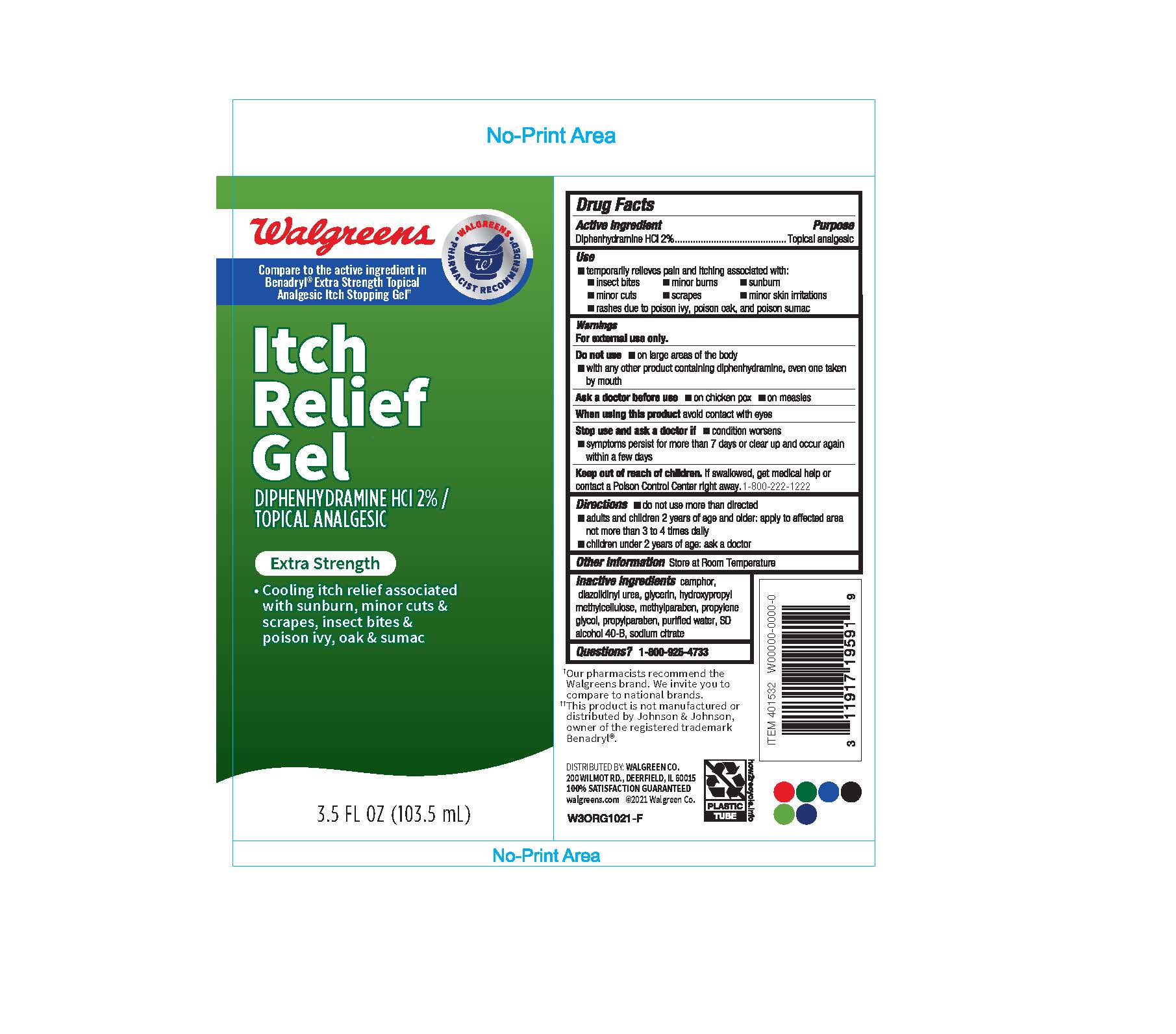
Walgreen Itch Relief Gel Diphenhydramine Hydrochloride 20 mg/mL Gel, 103.5 mL — NDC 0363-0354-04 (Billing 00363-0354-04)
This is a package of 103.5 mL of Walgreen Itch Relief Gel Diphenhydramine Hydrochloride 20 mg/mL Gel from Walgreens, marketed since Feb 2000 and currently FDA-listed. It is this product's only package size.
NDC database record
One package, one record: these facts belong to NDC 0363-0354-04 alone.
- Record
- FDA NDC Directory package listing · Human OTC drug
- Code segments
- 0363 labeler · 0354 product · 04 package
- Package marketed since
- Feb 6, 2024
- Sample package
- No — commercial package
- Listing certified through
- Dec 31, 2027
- Barcode (UPC)
- 0311917195919
- FDA record last changed
- Jul 24, 2026
Identity & classification
Regulatory identifiers FDA, NLM and CMS codes for this package
- RxCUI (RxNorm): 1049880
Where does this data come from?
- FDA openFDA NDC Directory · synced Oct 8, 2026
- FDA label on DailyMed · label index refreshed Oct 8, 2026
- RxNorm (NLM RxNav) · catalog refreshed Oct 8, 2026
- Medi-Span GPI (licensed)
- First Databank (licensed) · refreshed Oct 8, 2026
RxNorm drug class
This medicine belongs to the Histamine-1 Receptor Antagonist class.
Where does this data come from?
- RxClass (NLM) · catalog refreshed Oct 8, 2026
Clinical
Diphenhydramine is used to treat allergy and cold symptoms: sneezing runny nose red, itchy, watery eyes itching of the nose or throat Diphenhydramine is also used to treat insomnia (difficulty falling asleep or staying asleep) in adults, but should not be used to make a child sleepy. Diphenhydramine is in a class of medications called antihistamines. It works by blocking the action of histamine, a substance in the body that causes allergic symptoms. Diphenhydramine is also available in combination with other medications. This monograph only includes information about the use of diphenh...
Read the full MedlinePlus article ↗- Oral products temporarily relieve hay fever and other upper respiratory allergy symptoms like runny nose, sneezing and itchy, watery eyes. They also ease runny nose and sneezing fr...
- Oral forms are generally taken every 4 to 6 hours, with no more than 6 doses in 24 hours. The amount depends on age and the product, so check the package chart or ask me or your do...
- It can. Drowsiness is common, so be careful driving or using machinery. Alcohol, sedatives and tranquilizers make it worse, so avoid them.
- Oral products are not for children under 2 years, and some are not for children under 6. Children can become excitable, and overdose can be very dangerous. Always follow the age di...
Patient education
Supplement & herbal interactions
Where does this data come from?
- MedlinePlus (NLM) · refreshed Oct 8, 2026
- FDA label on DailyMed · label index refreshed Oct 8, 2026
Ask a licensed pharmacist directly — free, answered by our team.
Pricing
A drug doesn't have one price. Each row is a different public payment system, and none is what you'd pay at the counter — that depends on your insurance. The ⓘ on each row explains what it measures.
| Price system | Per g | Per package |
|---|---|---|
| Retail pharmacies payNADAC · weekly | Not in the retail survey — common for institutional, discontinued, or low-volume packs. | |
| Medicaid paysCMS SDUD · 12 mo | No recent Medicaid claims on file for this NDC — rare and low-volume NDCs are suppressed in the public data. | |
| Medicare drug plans payPart D · quarterly | No Part D plan price is available for this NDC in our data. | |
Where does this data come from?
- CMS NADAC weekly file
- CMS ASP pricing files · refreshed Sep 20, 2026
- CMS Medicaid State Drug Utilization Data · refreshed Oct 9, 2026
- CMS Part D plan pricing files · refreshed Sep 24, 2026
- VA National Acquisition Center price file
Packaging — all sizes for this product
| Package NDC | Description | Marketing start | Marketing end | Status |
|---|---|---|---|---|
| 00363-0354-04 You're viewing this Main listing | 103.5 mL in 1 TUBE | 2024-02-06 | — | Active |
Therapeutic equivalents
| Product | Labeler | Pack | NADAC/unit | TE | Status | Price vs. this |
|---|---|---|---|---|---|---|
| Walgreen Itch Relief Gel 20 mg/mLthis 00363-0354-04 | Walgreens | 103.5 ml | — | — | FDA listed | — |
| Walgreens Stop Itch Gel 2 g/100mL 00363-1710-03 | Walgreens | 103 ml | — | — | FDA listed | — |
| Rite Aid Anti-Itch 2 g/100mL 11822-1070-03 | Rite | 103 ml | — | — | FDA listed | — |
| Itch Relief 20 mg/mL 13709-0351-01 | Neilmed | 1 tube | — | — | FDA listed | — |
| Itch Eraser Gel 1.14 g/57g 44224-1116-01 | Tender | 1 tube | — | — | FDA listed | — |
| After Bite Xtra .4 g/20g 44224-1276-01 | Tender | 1 tube | — | — | FDA listed | — |
| After Bite Outdoor .4 g/20g 44224-1565-01 | Tender | 1 tube | — | — | FDA listed | — |
| Tecnu Calagel 20 mg/g 51879-0802-06 | Tec | 1 bottle | — | — | Discontinued | — |
| Itch Stopping 2 g/100g 63868-0260-04 | Chain | 113 g | — | — | FDA listed | — |
| Best Choice Itch Stopping 2 g/100g 63941-0260-04 | Valu | 113 g | — | — | FDA listed | — |
| Itch Stopping 2 g/100g 69842-0620-04 | CVS | 113 g | — | — | FDA listed | — |
| Benadryl Extra Strength Itch Stopping 20 mg/mL 69968-0242-03 | Kenvue | 103 ml | — | — | FDA listed | — |
| Dermachange Aid Anti-Itch 2 g/100mL 83520-0107-03 | Private | 104 ml | — | — | FDA listed | — |
Where does this data come from?
- FDA openFDA NDC Directory · synced Oct 8, 2026
- FDA Orange Book · refreshed Oct 3, 2026
- CMS NADAC weekly file
Availability & generic status
We did not find an FDA-approved generic match for this exact strength, form and route.
Where does this data come from?
- FDA Orange Book · refreshed Oct 3, 2026
Inactive Ingredients / Excipients
Inactive ingredients, also called excipients, are components of the drug product other than the active ingredient. They may include fillers, dyes, coatings, preservatives, flavors, or other formulation ingredients.
🧪 Avoiding an ingredient? See Diphenhydramine inactive ingredients by manufacturer: every current product's list side by side, so you can ask your pharmacy for the version that does not list it.
💡 Tap an ingredient (hover on desktop) to see what it is and why it’s used.
-
UNII 3K9958V90M
A liquid solvent derived from fermentation or chemical synthesis. In medicines, alcohol dissolves active ingredients, helps preserve the product, and improves how the body absorbs certain drugs.
-
UNII 5TJD82A1ET
A cooling crystalline substance made synthetically that is added to medicines as a fragrance, flavoring agent, and mild local irritant to produce a cooling or warming sensation on the skin or mucous membranes.
-
UNII 2968PHW8QP
A weak organic acid derived from citrus fruits or made through fermentation. It works as a buffer to control pH, a preservative to extend shelf life, and a flavoring agent in medications.
-
UNII H5RIZ3MPW4
A chemical preservative used to prevent bacterial and fungal growth in medicines. It helps extend shelf life and maintain product safety during storage and use.
-
UNII PDC6A3C0OX
Glycerin is a clear, thick liquid derived from plant oils or fats. It acts as a humectant to retain moisture, a sweetener, and a solvent in medications.
-
UNII 3NXW29V3WO
Hypromellose is a plant-based thickener made from cellulose. It's used in medicines as a binder to hold ingredients together, a coating for tablets, and a thickener for liquids.
-
UNII A2I8C7HI9T
Methylparaben is a preservative derived from benzoic acid that prevents growth of bacteria, fungi, and mold in medicines. It extends the product's shelf life and maintains safety during storage.
-
UNII 6DC9Q167V3
Propylene glycol is a clear liquid derived from petroleum or vegetable sources. It acts as a solvent, humectant, and preservative in medicines, helping dissolve active ingredients and maintain product stability.
-
UNII Z8IX2SC1OH
Propylparaben is a chemical preservative used to prevent bacterial and fungal growth in medicines and personal care products. It helps extend shelf life and maintain product safety during storage.
-
UNII 1Q73Q2JULR
Sodium citrate is a salt derived from citric acid. It works as a buffer to maintain the medicine's pH level and may also help improve taste or act as a preservative in the formulation.
-
UNII 059QF0KO0R
Water is a liquid solvent that dissolves and mixes ingredients together in liquid medicines, syrups, and injections. It helps distribute the active drug evenly throughout the product.
11 inactive ingredients listed in the exact product block matched to this NDC.
Label-section wording can be broader than the structured product block and may mention additional formulation ingredients.
Where does this data come from?
ingredient classCode="IACT" elements from the exact product block matched by this NDC. Label-section narrative from DailyMed / the openFDA label index is shown separately when available.- FDA label on DailyMed · label index refreshed Oct 8, 2026
- FDA openFDA NDC Directory · synced Oct 8, 2026
Inactive ingredient FAQ
Are inactive ingredients the same for every manufacturer?
Why might an inactive ingredient be missing?
Can inactive ingredients matter?
Manufacturer & labeler
More NDCs from Walgreens labeler code 00363
- Gentle Laxative Bisacodyl 5 mg Tablet, Delayed Release NDC 0363-0327-03
- Night Time Severe Cold and Flu ACETAMINOPHEN, DEXTROMETHORPHAN HBr, DOXYLAMINE SUCCINATE, PHENYLEPHRINE HCl 650 mg/30mL; 20 mg/30mL; 12.5 mg/30mL; 10 mg/30mL Liquid NDC 0363-0331-26
- Mucus Relief Severe Congestion and Cough Maximum Strength dextromethorphan hydrobromide, guaifenesin, phenylephrine hydrochloride 20 mg/20mL; 400 mg/20mL; 10 mg/20mL Liquid NDC 0363-0337-06
- Acetaminophen 650 mg Tablet, Extended Release NDC 0363-0340-08
- Walgreens 40 Invisible Facial Sunscreen Broad Spectrum SPF 40 Avobenzone, Homosalate, Octisalate, Octocrylene 80 mg/mL; 30 mg/mL; 50 mg/mL; 40 mg/mL Gel NDC 0363-0349-09
- Itch Relief Gel Diphenhydramine HCl 2 mg/100mL Gel NDC 0363-0353-04
- Overnight Cold Therapy Pain Relief Menthol, unspecified form 36 mg/mL Gel NDC 0363-0355-03
- Cold Therapy Pain Relief Menthol, unspecified form 36 mg/mL Gel NDC 0363-0356-03
- Walgreens Eczema Relief HYDROCORTISONE ACETATE 10 mg/g Cream NDC 0363-0357-02
- No Mess Hydrocortisone Applicator 10 mg/mL Liquid NDC 0363-0358-12
- Esomeprazole Magnesium 20 mg Tablet, Delayed Release NDC 0363-0361-42
- Hydrocortisone Cool Relief gel with Aloe 1 g/100g Gel NDC 0363-0363-01
Where does this data come from?
- FDA openFDA NDC Directory · synced Oct 8, 2026
- Drugs@FDA
FDA label — Drug Facts FDA SPL
🎯 Indications and Usage ▾
Use temporarily relieves pain and itching associated with: insect bites minor burns sunburn minor cuts scrapes minor skin irritations rashes due to poison ivy, poison oak, and poison sumac
⏱️ Dosage and Administration ▾
Directions do not use more than directed adults and children 2 years of age and older: apply to affected area not more than 3 to 4 times daily children under 2 years of age: ask a doctor
⚠️ Warnings ▾
Warnings For external use only. Do not use on large areas of the body with any other product containing diphenhydramine, even one taken by mouth Ask a doctor before use on chicken pox on measles When using this product avoid contact with eyes Stop use and ask a doctor if condition worsens symptoms persist for more than 7 days or clear up and occur again within a few days Keep out of reach of children. If swallowed, get medical help or contact a Poison Control Center right away.
📦 Storage and Handling ▾
Other information Store at Room Temperature
🧪 Active Ingredient ▾
Active ingredient Diphenhydramine HCl 2%
🧪 Inactive Ingredients ▾
Inactive ingredients SD alcohol 38-B, camphor, citric acid, diazolidinyl urea, glycerin, hydroxypropyl methylcellulose, methylparaben, propylene glycol, propylparaben, purified water, sodium citrate
🎯 Purpose ▾
Purpose Topical Analgesic
📄 Do Not Use ▾
Do not use on large areas of the body with any other product containing diphenhydramine, even one taken by mouth
📄 Ask a Doctor Before Use If ▾
Ask a doctor before use on chicken pox on measles
📄 When Using This Product ▾
When using this product avoid contact with eyes
📄 Stop Use and Ask a Doctor If ▾
Stop use and ask a doctor if condition worsens symptoms persist for more than 7 days or clear up and occur again within a few days
📄 Keep Out of Reach of Children ▾
Keep out of reach of children. If swallowed, get medical help or contact a Poison Control Center right away.
📄 Package Label / Principal Display Panel ▾
PRINCIPAL DISPLAY PANEL - 103.5 mL Tube Label Tube Label
Reported adverse events (FAERS)
Top reported reactions
Age at onset
Reporter sex
Serious outcomes
Where does this data come from?
About this NDC listing & data coverage
What data is (and isn’t) available for this NDC — tap to expand
| NDC identity (package / product / labeler codes) | ✓ Available |
| Labeler | ✓ Available |
| Product & package description | ✓ Available |
| Marketing category & status | ✓ Available |
| Active ingredient / dosage form / route | ✓ Available |
| FDA label (SPL via DailyMed) | ✓ Available |
| Package photos | ✓ Available |
| Inactive ingredients (structured) | ✓ Available |
| NADAC pharmacy acquisition price (CMS) | — Not published for this NDC CMS publishes NADAC only for NDCs reported in its retail-pharmacy survey. |
| Orange Book / therapeutic-equivalence data | — Not published for this NDC Applies only to products approved under an NDA/ANDA; many listings are out of scope. |
| HCPCS J-code billing crosswalk | — Not published for this NDC Most self-administered / retail products have no J-code — that is normal. |
| Medicaid utilization (CMS SDUD) | — Not published for this NDC CMS reports utilization only for NDCs with Medicaid claims above its privacy threshold. |