
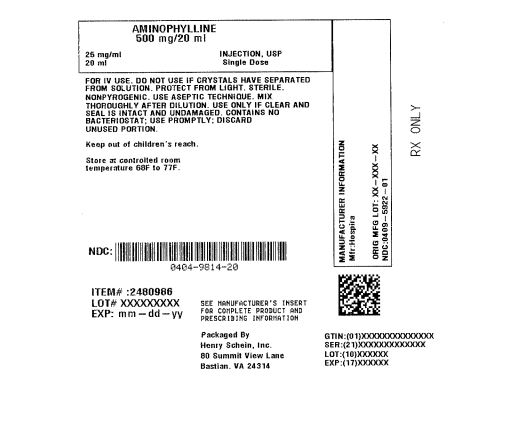
Aminophylline 25 mg/mL Injection, Solution — NDC 0404-9814-20 (Billing 00404-9814-20)
This is a package of Aminophylline 25 mg/mL Injection, Solution from Henry Schein, Inc., marketed since Jan 2022 and currently FDA-listed. It is this product's only package size.
Identity & classification
Regulatory identifiers FDA, NLM and CMS codes for this package
- RxCUI (RxNorm): 1724666
Where does this data come from?
- FDA openFDA NDC Directory · synced Oct 1, 2026
- FDA label on DailyMed · label index refreshed Oct 1, 2026
- RxNorm (NLM RxNav) · catalog refreshed Oct 1, 2026
- Medi-Span GPI (licensed)
- First Databank (licensed) · refreshed Oct 1, 2026
RxNorm drug class
This medicine belongs to the Xanthines class.
Where does this data come from?
- RxClass (NLM) · catalog refreshed Oct 1, 2026
Clinical
- Aminophylline injection is used when your breathing problem is serious enough to need hospital treatment. During a severe asthma attack or a bad flare of a chronic lung condition,...
- Why am I getting aminophylline through an IV instead of just using my inhaler?
- Theophylline — the active drug aminophylline releases — has a narrow window between working well and causing serious problems. What's a safe dose for one person can be too much or...
- Why do the nurses keep checking my blood levels while I'm on this medication?
Patient education
Supplement & herbal interactions
Some supplements/herbs that may interact with Aminophylline — tap one for details:
Aminophylline may be associated with lower levels of 1 nutrient — worth a chat with your pharmacist, not a cause for alarm.
Where does this data come from?
- MedlinePlus (NLM) · refreshed Oct 1, 2026
- FDA label on DailyMed · label index refreshed Oct 1, 2026
Ask a licensed pharmacist directly — free, answered by our team.
Pricing
A drug doesn't have one price. Each row is a different public payment system, and none is what you'd pay at the counter — that depends on your insurance. The ⓘ on each row explains what it measures.
| Price system | Per mL | Per package |
|---|---|---|
| Retail pharmacies payNADAC · weekly | Not in the retail survey — common for institutional, discontinued, or low-volume packs. | |
| Medicaid paysCMS SDUD · 12 mo | No recent Medicaid claims on file for this NDC — rare and low-volume NDCs are suppressed in the public data. | |
| Medicare drug plans payPart D · quarterly | No Part D plan price is available for this NDC in our data. | |
| Medicare Part B allowsASP · J0280 | $11.160 / J0280 unit | — |
Where does this data come from?
- CMS NADAC weekly file
- CMS ASP pricing files · refreshed Sep 20, 2026
- CMS Medicaid State Drug Utilization Data · refreshed Oct 3, 2026
- CMS Part D plan pricing files · refreshed Sep 24, 2026
- VA National Acquisition Center price file
Billing & reimbursement
Where does this data come from?
- CMS ASP NDC-HCPCS crosswalk · refreshed Sep 22, 2026
- DMEPDAC NDC-HCPCS crosswalk
- openFDA NSDE billing units · refreshed Sep 7, 2026
Packaging — all sizes for this product
| Package NDC | Description | Marketing start | Marketing end | Status |
|---|---|---|---|---|
| 00404-9814-20 You're viewing this Main listing | 1 VIAL, SINGLE-DOSE in 1 BAG / 20 mL in 1 VIAL, SINGLE-DOSE | 2022-01-08 | — | Active |
Therapeutic equivalents
| Product | Labeler | Pack | NADAC/unit | TE | Status | Price vs. this |
|---|---|---|---|---|---|---|
| Aminophylline 25 mg/mLthis 00404-9814-20 | Henry | 1 vial | — | — | FDA listed | — |
| Aminophylline 25 mg/mL 00409-5922-01 | Hospira, | 25 vials | — | — | FDA listed | — |
| Aminophylline 25 mg/mL 51662-1341-01 | HF | 20 ml | — | — | FDA listed | — |
| Aminophylline 25 mg/mL 71872-7060-01 | Medical | 1 vial | — | — | FDA listed | — |
| Aminophylline 25 mg/mL 84549-0922-01 | ProPharma | 20 ml | — | — | FDA listed | — |
| Aminophylline 25 mg/mL 51662-1204-01 | HF | 10 ml | — | — | FDA listed | — |
| Aminophylline 25 mg/mL 00409-5921-01 | Hospira, | 25 vials | — | — | FDA listed | — |
| Aminophylline 25 mg/mL 71872-7374-01 | Medical | 1 vial | — | — | FDA listed | — |
| Aminophylline 25 mg/mL 00404-9813-10 | Henry | 1 vial | — | — | FDA listed | — |
Where does this data come from?
- FDA openFDA NDC Directory · synced Oct 1, 2026
- FDA Orange Book · refreshed Sep 3, 2026
- CMS NADAC weekly file
Availability & generic status
This product is an FDA-approved generic. Other versions of the same drug are listed under Therapeutic equivalents, least expensive first.
Where does this data come from?
- FDA Orange Book · refreshed Sep 3, 2026
Inactive Ingredients / Excipients
Inactive ingredients, also called excipients, are components of the drug product other than the active ingredient. They may include fillers, dyes, coatings, preservatives, flavors, or other formulation ingredients.
Where does this data come from?
IACT rows and label-wide narrative are kept separate; availability and product-level specificity depend on the submitted label.- FDA label on DailyMed · label index refreshed Oct 1, 2026
- FDA openFDA NDC Directory · synced Oct 1, 2026
Inactive ingredient FAQ
Are inactive ingredients the same for every manufacturer?
Why might an inactive ingredient be missing?
Can inactive ingredients matter?
Manufacturer & labeler
Where does this data come from?
- FDA openFDA NDC Directory · synced Oct 1, 2026
- Drugs@FDA
Full prescribing information FDA SPL
🎯 Indications and Usage ▾
INDICATIONS AND USAGE Intravenous theophylline is indicated as an adjunct to inhaled beta-2 selective agonists and systemically administered corticosteroids for the treatment of acute exacerbations of the symptoms and reversible airflow obstruction associated with asthma and other chronic lung diseases, e.g., emphysema and chronic bronchitis.
⏱️ Dosage and Administration ▾
DOSAGE AND ADMINISTRATION General Considerations: The steady-state serum theophylline concentration is a function of the infusion rate and the rate of theophylline clearance in the individual patient. Because of marked individual differences in the rate of theophylline clearance, the dose required to achieve a serum theophylline concentration in the 10-20 mcg/mL range varies fourfold among otherwise similar patients in the absence of factors known to alter theophylline clearance. For a given population there is no single theophylline dose that will provide both safe and effective serum concentrations for all patients.
Administration of the median theophylline dose required to achieve a therapeutic serum theophylline concentration in a given population may result in either sub-therapeutic or potentially toxic serum theophylline concentrations in individual patients. The dose of theophylline must be individualized on the basis of serum theophylline concentration measurements in order to achieve a dose that will provide maximum potential benefit with minimal risk of adverse effects. When theophylline is used as an acute bronchodilator, the goal of obtaining a therapeutic serum concentration is best accomplished with an intravenous loading dose.
Because of rapid distribution into body fluids, the serum concentration (C) obtained from an initial loading dose (LD) is related primarily to the volume of distribution (V), the apparent space into which the drug diffuses: C = LD/V If a mean volume of distribution of about
0.5L/kg is assumed (actual range is 0.3 to
0.7L/kg), each mg/kg (ideal body weight) of theophylline administered as a loading dose over 30 minutes results in an average 2 mcg/mL increase in serum theophylline concentration. Therefore, in a patient who has received no theophylline in the previous 24 hours, a loading dose of intravenous theophylline of 4.6 mg/kg (5.7 mg/kg as aminophylline), calculated on the basis of ideal body weight and administered over 30 minutes, on average, will produce a maximum post-distribution serum concentration of 10 mcg/mL with a range of 6-16 mcg/mL.
When a loading dose becomes necessary in the patient who has already received theophylline, estimation of the serum concentration based upon the history is unreliable, and an immediate serum level determination is indicated. The loading dose can then be determined as follows: D = (Desired C - Measured C) (V) where D is the loading dose, C is the serum theophylline concentration, and V is the volume of distribution. The mean volume of distribution can be assumed to be
0.5L/kg and the desired serum concentration should be conservative (e.g., 10 mcg/mL) to allow for the variability in the volume of distribution. A loading dose should not be given before obtaining a serum theophylline concentration if the patient has received any theophylline in the previous 24 hours. A serum concentration obtained 30 minutes after an intravenous loading dose, when distribution is complete, can be used to assess the need for and size of subsequent loading doses, if clinically indicated, and for guidance of continuing therapy.
Once a serum concentration of 10 to 15 mcg/mL has been achieved with the use of a loading dose(s), a constant intravenous infusion is started. The rate of administration is based upon mean pharmacokinetic parameters for the population and calculated to achieve a target serum concentration of 10 mcg/mL (see TABLE V ). For example, in non-smoking adults, initiation of a constant intravenous theophylline infusion of 0.4 mg/kg/hr (0.5 mg/kg/hr as aminophylline) at the completion of the loading dose, on average, will result in a steady-state concentration of 10 mcg/mL with a range of 7-26 mcg/mL.
The mean and range of steady-state serum concentrations are similar when the average child (age 1 to 9 years) is given a loading dose of 4.6 mg/kg theophylline (5.7 mg/kg as aminophylline) followed by a constant intravenous infusion of 0.8 mg/kg/hr (1.0… [Excerpted — this section continues on DailyMed.]
⛔ Contraindications ▾
CONTRAINDICATIONS Aminophylline is contraindicated in patients with a history of hypersensitivity to theophylline or other components in the product including ethylenediamine.
⚠️ Warnings ▾
WARNINGS Concurrent Illness: Theophylline should be used with extreme caution in patients with the following clinical conditions due to the increased risk of exacerbation of the concurrent condition: Active peptic ulcer disease Seizure disorders Cardiac arrhythmias (not including bradyarrhythmias) Conditions That Reduce Theophylline Clearance: There are several readily identifiable causes of reduced theophylline clearance. If the infusion rate is not appropriately reduced in the presence of these risk factors, severe and potentially fatal theophylline toxicity can occur.
Careful consideration must be given to the benefits and risks of theophylline use and the need for more intensive monitoring of serum theophylline concentrations in patients with the following risk factors: Age Neonates (term and premature) Children <1 year Elderly (>60 years) Concurrent Diseases Acute pulmonary edema Congestive heart failure Cor pulmonale Fever; ≥102° for 24 hours or more; or lesser temperature elevations for longer periods Hypothyroidism Liver disease; cirrhosis, acute hepatitis Reduced renal function in infants <3 months of age Sepsis with multi-organ failure Shock Cessation of Smoking Drug Interactions Adding a drug that inhibits theophylline metabolism (e.g., cimetidine, erythromycin, tacrine) or stopping a concurrently administered drug that enhances theophylline metabolism (e.g., carbamazepine, rifampin) (see PRECAUTIONS , Drug Interactions, TABLE II ).
When Signs or Symptoms of Theophylline Toxicity Are Present: Whenever a patient receiving theophylline develops nausea or vomiting, particularly repetitive vomiting, or other signs or symptoms consistent with theophylline toxicity (even if another cause may be suspected), the intravenous infusion should be stopped and a serum theophylline concentration measured immediately. Dosage Increases Increases in the dose of intravenous theophylline should not be made in response to an acute exacerbation of symptoms unless the steady-state serum theophylline concentration is <10 mcg/mL.
As the rate of theophylline clearance may be dose-dependent (i.e., steady-state serum concentrations may increase disproportionately to the increase in dose), an increase in dose based upon a sub-therapeutic serum concentration measurement should be conservative. In general, limiting infusion rate increases to about 25% of the previous infusion rate will reduce the risk of unintended excessive increases in serum theophylline concentration (see DOSAGE AND ADMINISTRATION , TABLE VI ).
🤒 Adverse Reactions ▾
ADVERSE REACTIONS Adverse reactions associated with theophylline are generally mild when peak serum theophylline concentrations are <20 mcg/mL and mainly consist of transient caffeine-like adverse effects such as nausea, vomiting, headache, and insomnia. When peak serum theophylline concentrations exceed 20 mcg/mL, however, theophylline produces a wide range of adverse reactions including persistent vomiting, cardiac arrhythmias, and intractable seizures which can be lethal (see OVERDOSAGE ). Other adverse reactions that have been reported at serum theophylline concentrations <20 mcg/mL include diarrhea, irritability, restlessness, fine skeletal muscle tremors, and transient diuresis.
In patients with hypoxia secondary to COPD, multifocal atrial tachycardia and flutter have been reported at serum theophylline concentrations ≥15 mcg/mL. There have been a few isolated reports of seizures at serum theophylline concentrations <20 mcg/mL in patients with an underlying neurological disease or in elderly patients. The occurrence of seizures in elderly patients with serum theophylline concentrations <20 mcg/mL may be secondary to decreased protein binding resulting in a larger proportion of the total serum theophylline concentration in the pharmacologically active unbound form.
The clinical characteristics of the seizures reported in patients with serum theophylline concentrations <20 mcg/mL have generally been milder than seizures associated with excessive serum theophylline concentrations resulting from an overdose (i.e., they have generally been transient, often stopped without anticonvulsant therapy, and did not result in neurological residua). Products containing aminophylline may rarely produce severe allergic reactions of the skin, including exfoliative dermatitis, after systemic administration in a patient who has been previously sensitized by topical application of a substance containing ethylenediamine.
In such patients skin patch tests are positive for ethylenediamine, a component of aminophylline, and negative for theophylline. Pharmacists and other individuals who experience repeated skin exposure while physically handling aminophylline may develop a contact dermatitis due to the ethylenediamine component. Image8.jpg Image9.jpg
🆘 Overdosage ▾
OVERDOSAGE General : The chronicity and pattern of theophylline overdosage significantly influences clinical manifestations of toxicity, management and outcome. There are two common presentations: 1) acute overdose, i.e., infusion of an excessive loading dose or excessive maintenance infusion rate for less than 24 hours, and 2) chronic overdosage, i.e., excessive maintenance infusion rate for greater than 24 hours. The most common causes of chronic theophylline overdosage include clinician prescribing of an excessive dose or a normal dose in the presence of factors known to decrease the rate of theophylline clearance and increasing the dose in response to an exacerbation of symptoms without first measuring the serum theophylline concentration to determine whether a dose increase is safe.
Several studies have described the clinical manifestations of theophylline overdose following oral administration and attempted to determine the factors that predict life-threatening toxicity. In general, patients who experience an acute overdose are less likely to experience seizures than patients who have experienced a chronic overdosage, unless the peak serum theophylline concentration is >100 mcg/mL. After a chronic overdosage, generalized seizures, life-threatening cardiac arrhythmias, and death may occur at serum theophylline concentrations >30 mcg/mL.
The severity of toxicity after chronic overdosage is more strongly correlated with the patient's age than the peak serum theophylline concentration; patients >60 years are at the greatest risk for severe toxicity and mortality after a chronic overdosage. Pre-existing or concurrent disease may also significantly increase the susceptibility of a patient to a particular toxic manifestation, e.g., patients with neurologic disorders have an increased risk of seizures and patients with cardiac disease have an increased risk of cardiac arrhythmias for a given serum theophylline concentration compared to patients without the underlying disease.
The frequency of various reported manifestations of oral theophylline overdose according to the mode of overdose are listed in TABLE IV . Other manifestations of theophylline toxicity include increases in serum calcium, creatine kinase, myoglobin and leukocyte count, decreases in serum phosphate and magnesium, acute myocardial infarction, and urinary retention in men with obstructive uropathy. Seizures associated with serum theophylline concentrations >30 mcg/mL are often resistant to anticonvulsant therapy and may result in irreversible brain injury if not rapidly controlled.
Death from theophylline toxicity is most often secondary to cardiorespiratory arrest and/or hypoxic encephalopathy following prolonged generalized seizures or intractable cardiac arrhythmias causing hemodynamic compromise. Overdose Management: General Recommendations for Patients with Symptoms of Theophylline Overdose or Serum Theophylline Concentrations >30 mcg/mL While Receiving Intravenous Theophylline. 1.Stop the theophylline infusion.2.While simultaneously instituting treatment, contact a regional poison center to obtain updated information and advice on individualizing the recommendations that follow.3.Institute supportive care, including establishment of intravenous access, maintenance of the airway, and electrocardiographic monitoring.4.
Treatment of seizures : Because of the high morbidity and mortality associated with theophylline-induced seizures, treatment should be rapid and aggressive. Anticonvulsant therapy should be initiated with an intravenous benzodiazepine, e.g., diazepam, in increments of 0.1 - 0.2 mg/kg every 1 - 3 minutes until seizures are terminated. Repetitive seizures should be treated with a loading dose of phenobarbital (20 mg/kg infused over 30 - 60 minutes).
Case reports of theophylline overdose in humans and animal studies suggest that phenytoin is ineffective in terminating theophylline-induced seizures. The doses of benzodiazepines and phenobarbital r… [Excerpted — this section continues on DailyMed.]
🧬 Clinical Pharmacology ▾
CLINICAL PHARMACOLOGY Mechanism of Action: Theophylline has two distinct actions in the airways of patients with reversible obstruction; smooth muscle relaxation (i.e., bronchodilation) and suppression of the response of the airways to stimuli (i.e., nonbronchodilator prophylactic effects). While the mechanisms of action of theophylline are not known with certainty, studies in animals suggest that bronchodilation is mediated by the inhibition of two isozymes of phosphodiesterase (PDE III and, to a lesser extent, PDE IV), while nonbronchodilator prophylactic actions are probably mediated through one or more different molecular mechanisms, that do not involve inhibition of PDE III or antagonism of adenosine receptors.
Some of the adverse effects associated with theophylline appear to be mediated by inhibition of PDE III (e.g., hypotension, tachycardia, headache, and emesis) and adenosine receptor antagonism (e.g., alterations in cerebral blood flow). Theophylline increases the force of contraction of diaphragmatic muscles. This action appears to be due to enhancement of calcium uptake through an adenosine-mediated channel.
Serum Concentration-Effect Relationship : Bronchodilation occurs over the serum theophylline concentration range of 5 - 20 mcg/mL. Clinically important improvement in symptom control and pulmonary function has been found in most studies to require serum theophylline concentrations >10 mcg/mL. At serum theophylline concentrations >20 mcg/mL, both the frequency and severity of adverse reactions increase.
In general, maintaining the average serum theophylline concentration between 10 and 15 mcg/mL will achieve most of the drug's potential therapeutic benefit while minimizing the risk of serious adverse events. Pharmacokinetics: Overview : The pharmacokinetics of theophylline vary widely among similar patients and cannot be predicted by age, sex, body weight or other demographic characteristics. In addition, certain concurrent illnesses and alterations in normal physiology (see TABLE I ) and co-administration of other drugs (see TABLE II ) can significantly alter the pharmacokinetic characteristics of theophylline.
Within-subject variability in metabolism has also been reported in some studies, especially in acutely ill patients. It is, therefore, recommended that serum theophylline concentrations be measured frequently in acutely ill patients receiving intravenous theophylline (e.g., at 24-hr. intervals). More frequent measurements should be made during the initiation of therapy and in the presence of any condition that may significantly alter theophylline clearance (see PRECAUTIONS, Effects on Laboratory Tests ).
Note : In addition to the factors listed above, theophylline clearance is increased and half-life decreased by low carbohydrate/high protein diets, parenteral nutrition, and daily consumption of charcoal-broiled beef. A high carbohydrate/low protein diet can decrease the clearance and prolong the half-life of theophylline. Distribution : Once theophylline enters the systemic circulation, about 40% is bound to plasma protein, primarily albumin.
Unbound theophylline distributes throughout body water, but distributes poorly into body fat. The apparent volume of distribution of theophylline is approximately
0.45L/kg (range 0.3 -
0.7L/kg) based on ideal body weight. Theophylline passes freely across the placenta, into breast milk and into the cerebrospinal fluid (CSF). Saliva theophylline concentrations approximate unbound serum concentrations, but are not reliable for routine or therapeutic monitoring unless special techniques are used.
An increase in the volume of distribution of theophylline, primarily due to reduction in plasma protein binding, occurs in premature neonates, patients with hepatic cirrhosis, uncorrected acidemia, the elderly and in women during the third trimester of pregnancy. In such cases, the patient may show signs of toxicity at total (bound + unbound) serum concentrations of theoph… [Excerpted — this section continues on DailyMed.]
📦 How Supplied / Storage and Handling ▾
HOW SUPPLIED Aminophylline Injection, USP 25 mg/mL is supplied in single-dose containers as follows: Store at 20 to 25°C (68 to 77°F). [See USP Controlled Room Temperature.] PROTECT FROM LIGHT. Store in carton until time of use. SINGLE-DOSE CONTAINER.
Discard unused portion. Distributed by Hospira, Inc., Lake Forest, IL 60045 USA LAB-1171-1.0 Revised: 03/2018 Product Repackaged by Henry Schein, Inc., Bastian, VA 24314 From Original Manufacturer/Distributor's NDC and Unit of Sale To Henry Schein Repackaged Product NDC and Unit of Sale Total Strength/Total Volume (Concentration) per unit NDC 0409-5921-01 25 single-dose containers in a carton NDC 0404-9813-10 1 single-dose container in a bag (Single-dose vial bears NDC 0409-5921-16) 250 mg/10ml (25 mg/ml) NDC 0409-5922-01 25 single-dose containers in a carton NDC 0404-9814-20 1 single-dose container in a bag (Single-dose vial bears NDC 0409-5922-16) 500 mg/20ml (25 mg/ml) Image12.jpg
📋 Description ▾
DESCRIPTION Aminophylline Injection, USP is a sterile, nonpyrogenic solution of aminophylline in water for injection. Aminophylline (dihydrate) is approximately 79% of anhydrous theophylline by weight. Aminophylline Injection is administered by slow intravenous injection or diluted and administered by intravenous infusion.
The solution contains no bacteriostat or antimicrobial agent and is intended for use only as a single-dose injection. When smaller doses are required the unused portion should be discarded. Aminophylline is a 2:1 complex of theophylline and ethylenediamine.
Theophylline is structurally classified as a methylxanthine. Aminophylline occurs as a white or slightly yellowish granule or powder, with a slight ammoniacal odor. Aminophylline has the chemical name 1H-Purine-2, 6-dione, 3,7-dihydro-1,3-dimethyl-, compound with 1,2-ethanediamine (2:1).
The structural formula of aminophylline (dihydrate) is as follows: Aminophylline Injection, USP contains aminophylline (calculated as the dihydrate) 25 mg/mL (equivalent to 19.7 mg/mL anhydrous theophylline) prepared with the aid of ethylenediamine. The solution may contain an excess of ethylenediamine for pH adjustment. pH is 8.8 (8.6 to 9.0). The osmolar concentration is 0.17 mOsmol/mL (calc.).
Formula1.jpg
⚠️ Precautions ▾
PRECAUTIONS General Careful consideration of the various interacting drugs and physiologic conditions that can alter theophylline clearance and require dosage adjustment should occur prior to initiation of theophylline therapy and prior to increases in theophylline dose (see WARNINGS ). Monitoring Serum Theophylline Concentrations: Serum theophylline concentration measurements are readily available and should be used to determine whether the dosage is appropriate. Specifically, the serum theophylline concentration should be measured as follows: 1.Before making a dose increase to determine whether the serum concentration is sub-therapeutic in a patient who continues to be symptomatic.2.Whenever signs or symptoms of theophylline toxicity are present.3.Whenever there is a new illness, worsening of an existing concurrent illness or a change in the patient's treatment regimen that may alter theophylline clearance (e.g., fever >102°F sustained for ≥24 hours, hepatitis, or drugs listed in TABLE II are added or discontinued).
In patients who have received no theophylline in the previous 24 hours, a serum concentration should be measured 30 minutes after completion of the intravenous loading dose to determine whether the serum concentration is <10 mcg/mL indicating the need for an additional loading dose or >20 mcg/mL indicating the need to delay starting the constant intravenous infusion. Once the infusion is begun, a second measurement should be obtained after one expected half-life (e.g., approximately 4 hours in children 1 to 9 years and 8 hours in non-smoking adults; see TABLE I for the expected half-life in additional patient populations).
The second measurement should be compared to the first to determine the direction in which the serum concentration has changed. The infusion rate can then be adjusted before steady state is reached in an attempt to prevent an excessive or sub-therapeutic theophylline concentration from being achieved. If a patient has received theophylline in the previous 24 hours, the serum concentration should be measured before administering an intravenous loading dose to make sure that it is safe to do so.
If a loading dose is not indicated (i.e., the serum theophylline concentration is ≥10 mcg/mL), a second measurement should be obtained as above at the appropriate time after starting the intravenous infusion. If, on the other hand, a loading dose is indicated (see DOSAGE AND ADMINISTRATION for guidance on selection of the appropriate loading dose), a second blood sample should be obtained after the loading dose and a third sample should be obtained one expected half-life after starting the constant infusion to determine the direction in which the serum concentration has changed.
Once the above procedures related to initiation of intravenous theophylline infusion have been completed, subsequent serum samples for determination of theophylline concentration should be obtained at 24-hour intervals for the duration of the infusion. The theophylline infusion rate should be increased or decreased as appropriate based on the serum theophylline levels. When signs or symptoms of theophylline toxicity are present, the intravenous infusion should be stopped and a serum sample for theophylline concentration should be obtained as soon as possible, analyzed immediately, and the result reported to the clinician without delay.
In patients in whom decreased serum protein binding is suspected (e.g., cirrhosis, women during the third trimester of pregnancy), the concentration of unbound theophylline should be measured and the dosage adjusted to achieve an unbound concentration of 6-12 mcg/mL. Saliva concentrations of theophylline cannot be used reliably to adjust dosage without special techniques. Effects on Laboratory Tests: As a result of its pharmacological effects, theophylline at serum concentrations within the 10 - 20 mcg/mL range modestly increases plasma glucose (from a mean of 88 mg% to 98 mg%), uric acid (from a me… [Excerpted — this section continues on DailyMed.]
📄 Package Label / Principal Display Panel ▾
SAMPLE PACKAGE LABEL Label1.jpg
About this NDC listing & data coverage
What data is (and isn’t) available for this NDC — tap to expand
| NDC identity (package / product / labeler codes) | ✓ Available |
| Labeler | ✓ Available |
| Product & package description | ✓ Available |
| Marketing category & status | ✓ Available |
| Active ingredient / dosage form / route | ✓ Available |
| FDA label (SPL via DailyMed) | ✓ Available |
| Package photos | ✓ Available |
| Inactive ingredients (structured) | — Not published for this NDC The labeler did not submit a structured excipient list, or no SPL is available. |
| NADAC pharmacy acquisition price (CMS) | — Not published for this NDC CMS publishes NADAC only for NDCs reported in its retail-pharmacy survey. |
| Orange Book / therapeutic-equivalence data | — Not published for this NDC Applies only to products approved under an NDA/ANDA; many listings are out of scope. |
| HCPCS J-code billing crosswalk | ✓ Available |
| Medicaid utilization (CMS SDUD) | — Not published for this NDC CMS reports utilization only for NDCs with Medicaid claims above its privacy threshold. |