
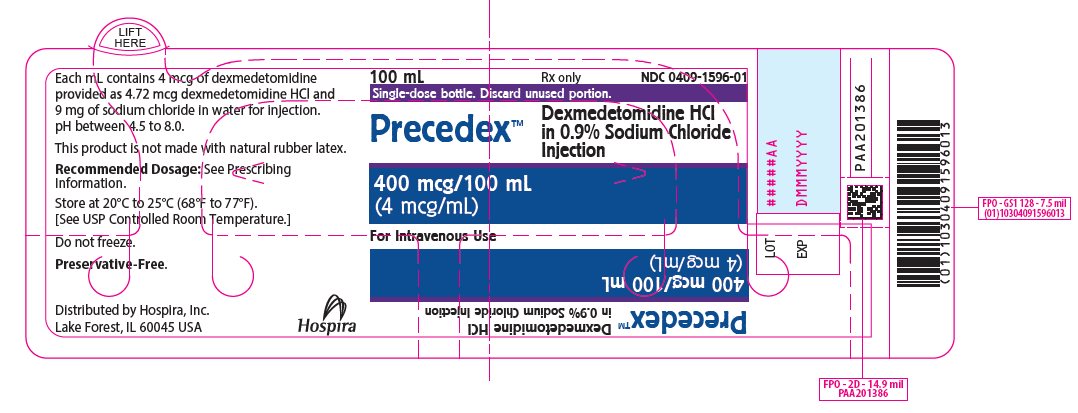
Precedex DEXMEDETOMIDINE HYDROCHLORIDE 4 ug/mL Injection, Solution
Other active recalls for Dexmedetomidine Hydrochloride (different manufacturers) — 1 · tap to view
🆔 Identity & classification
Where does this data come from?
🏷️ RxNorm drug class
This medicine belongs to the Central alpha-2 Adrenergic Agonist class.
Where does this data come from?
🏭 Manufacturer & labeler
Where does this data come from?
🩺 Clinical
Dexmedetomidine is used to provide short-term sedation (you are relaxed, sleepy or in some cases asleep) for surgical procedures or during mechanical ventilation. Dexmedetomidine is in a class of medications called alpha2 receptor agonists. It works by changing the activity of certain natural substances in the brain.
Read the full MedlinePlus article ↗- Dexmedetomidine is used to keep patients calm and comfortable when they need a breathing machine or are going through a stressful procedure in a hospital setting. It helps reduce a...
- Why is my loved one getting dexmedetomidine in the ICU?
- Yes — low blood pressure and a slow heart rate are the most common serious risks with this medication. Your care team knows this and will continuously monitor your heart rate, bloo...
- Can dexmedetomidine cause my heart rate or blood pressure to drop dangerously low?
Patient education
Supplement & herbal interactions
Where does this data come from?
Ask a licensed pharmacist directly — free, answered by our team.
🧪 Inactive Ingredients / Excipients
Inactive ingredients, also called excipients, are components of the drug product other than the active ingredient. They may include fillers, dyes, coatings, preservatives, flavors, or other formulation ingredients.
💡 Tap an ingredient (hover on desktop) to see what it is and why it’s used.
-
9 mg / 1 mL
UNII 451W47IQ8X
Sodium chloride is common table salt. It's used in medicines as a buffer to maintain proper pH, as a filler to add bulk, or to adjust the osmotic balance in liquid formulations.
-
UNII 059QF0KO0R
Water is a liquid solvent that dissolves and mixes ingredients together in liquid medicines, syrups, and injections. It helps distribute the active drug evenly throughout the product.
2 inactive ingredients listed in the exact product block matched to this NDC.
Where does this data come from?
ingredient classCode="IACT" elements from the exact product block matched by this NDC. Label-section narrative from DailyMed / the openFDA label index is shown separately when available.Inactive ingredient FAQ
Are inactive ingredients the same for every manufacturer?
Why might an inactive ingredient be missing?
Can inactive ingredients matter?
💲 Pricing
A drug doesn't have one price. Each row is a different public payment system, and none is what you'd pay at the counter — that depends on your insurance. The ⓘ on each row explains what it measures.
| Price system | Per mL | Per package |
|---|---|---|
| Retail pharmacies payNADAC · weekly | Not in the retail survey — common for institutional, discontinued, or low-volume packs. | |
| Medicaid paysCMS SDUD · 12 mo | $8.42 | $8,422.70 / 1000 ml |
| Medicare drug plans payPart D · quarterly | No Part D plan price is available for this NDC in our data. | |
Where does this data come from?
🔁 Therapeutic equivalents
| Product | Labeler | Pack | NADAC/unit | TE | Status | Price vs. this |
|---|---|---|---|---|---|---|
| Dexmedetomidine Hydrochloride 4 ug/mL 00143-9525-10 | Hikma | 10 pouches | — | AP | FDA listed | — |
| Dexmedetomidine Hydrochloride 400 ug/100mL 00338-9557-12 | Baxter | 100 ml | — | AP | FDA listed | — |
| Precedex 4 ug/mL 00409-0155-02 | Hospira, | 10 bottles | — | AP | FDA listed | — |
| Precedex 4 ug/mL 00409-1174-10 | Hospira, | 10 bottles | — | AP | FDA listed | — |
| Precedex 4 ug/mLthis 00409-1596-10 | Hospira, | 1 bottle | — | AP | FDA listed | — |
| Precedex 4 ug/mL 00409-1660-10 | Hospira, | 10 bottles | — | AP | FDA listed | — |
| Precedex 4 ug/mL 00409-7853-24 | Hospira, | 24 pouches | — | AP | FDA listed | — |
| Dexmedetomidine Hydrochloride In 0.9% Sodium Chloride 4 ug/mL 00781-3495-95 | Sandoz | 10 bottles | — | AP | FDA listed | — |
| Dexmedetomidine Hydrochloride in 0.9% Sodium Chloride 4 ug/mL 25021-0615-50 | Sagent | 10 bottles | — | AP | FDA listed | — |
| Dexmedetomidine Hydrochloride 4 ug/mL 25021-0617-82 | Sagent | 100 ml | — | AP | FDA listed | — |
| Dexmedetomidine Hydrochloride 4 ug/mL 42023-0187-10 | Par | 10 vials | — | AP | FDA listed | — |
| Dexmedetomidine Hydrochloride In 0.9% Sodium Chloride 400 ug/100mL 43066-0557-12 | Baxter | 100 ml | — | AP | FDA listed | — |
| Dexmedetomidine Hydrochloride 400 ug/100mL 43066-0565-12 | Baxter | 100 ml | — | AP | FDA listed | — |
| Dexmedetomidine Hydrochloride 4 ug/mL 43598-0975-58 | Dr.Reddy's | 10 vials | — | AP | FDA listed | — |
| Dexmedetomidine in Dextrose 4 ug/mL 44567-0603-24 | WG | 100 ml | — | AP | FDA listed | — |
| Dexmedetomidine Hydrochloride 4 ug/mL 52536-0126-08 | Wilshire | 8 bottles | — | — | FDA listed | — |
| Dexmedetomidine Hydrochloride 4 ug/mL 55150-0297-10 | Eugia | 10 pouches | — | AP | FDA listed | — |
| Dexmedetomidine Hydrochloride 4 ug/mL 63323-0671-00 | Fresenius | 10 bottles | — | AP | Discontinued | — |
| Dexmedetomidine Hydrochloride 4 ug/mL 66794-0235-41 | Piramal | 10 vials | — | AP | FDA listed | — |
| Dexmedetomidine Hydrochloride 400 ug/100mL 67457-0925-10 | Mylan | 10 bottles | — | AP | FDA listed | — |
| Dexmedetomidine Hydrochloride 4 ug/mL 68083-0239-10 | Gland | 10 vials | — | AP | FDA listed | — |
| Dexmedetomidine Hydrochloride 4 ug/mL 68083-0657-10 | Gland | 10 pouches | — | AP | FDA listed | — |
| Dexmedetomidine Hydrochloride in Sodium Chloride 4 ug/mL 68094-0247-10 | Precision | 10 bottles | — | AP | FDA listed | — |
| Dexmedetomidine Hydrochloride 4 ug/mL 70121-1389-07 | Amneal | 10 bottles | — | AP | FDA listed | — |
| Dexmedetomidine Hydrochloride 4 ug/mL 70121-1712-03 | Amneal | 12 pouches | — | AP | FDA listed | — |
| Dexmedetomidine Hydrochloride 4 ug/mL 71225-0126-04 | Slayback | 10 vials | — | — | Discontinued | — |
| Dexmedetomidine Hydrochloride 4 ug/mL 72572-0128-08 | CIVICA, | 8 bottles | — | — | FDA listed | — |
| Dexmedetomidine Hydrochloride in Sodium Chloride 4 ug/mL 68094-0147-20 | Precision | 20 bottles | — | AP | FDA listed | — |
| Dexmedetomidine Hydrochloride 4 ug/mL 70121-1388-08 | Amneal | 20 bottles | — | AP | FDA listed | — |
| Precedex 4 ug/mL 00409-3301-10 | Hospira, | 10 vials | — | AP | FDA listed | — |
| Dexmedetomidine Hydrochloride 4 ug/mL 72572-0127-10 | CIVICA, | 10 bottles | — | — | FDA listed | — |
| Dexmedetomidine Hydrochloride 4 ug/mL 43598-0976-58 | Dr.Reddy's | 10 vials | — | AP | FDA listed | — |
| Dexmedetomidine Hydrochloride in Sodium Chloride 4 ug/mL 68094-0047-10 | Precision | 10 vials | — | AP | FDA listed | — |
| Precedex 4 ug/mL 00409-4596-20 | Hospira, | 20 bottles | — | AP | FDA listed | — |
| Precedex 4 ug/mL 00409-7838-24 | Hospira, | 24 pouches | — | AP | FDA listed | — |
| Precedex 4 ug/mL 00409-7875-12 | Hospira, | 12 pouches | — | AP | FDA listed | — |
| Dexmedetomidine Hydrochloride 4 ug/mL 00143-9198-10 | Hikma | 250 ml | — | AP | FDA listed | — |
| Dexmedetomidine Hydrochloride 4 ug/mL 66794-0234-44 | Piramal | 20 vials | — | AP | FDA listed | — |
| Precedex 4 ug/mL 00409-1434-01 | Hospira, | 1 bottle | — | AP | FDA listed | — |
| Dexmedetomidine Hydrochloride 4 ug/mL 00143-9526-10 | Hikma | 10 pouches | — | AP | FDA listed | — |
| Dexmedetomidine Hydrochloride 4 ug/mL 42023-0186-20 | Par | 20 vials | — | AP | FDA listed | — |
| Dexmedetomidine Hydrochloride 4 ug/mL 52536-0125-10 | Wilshire | 10 bottles | — | — | FDA listed | — |
| Dexmedetomidine Hydrochloride 4 ug/mL 68083-0238-20 | Gland | 20 vials | — | AP | FDA listed | — |
| Precedex 4 ug/mL 00409-1454-20 | Hospira, | 20 bottles | — | AP | FDA listed | — |
| Precedex 4 ug/mL 00409-2815-01 | Hospira, | 1 bottle | — | AP | FDA listed | — |
Where does this data come from?
⏳ Availability & generic status
The FDA lists approved generic versions of this medicine, but that does not always mean a pharmacy can get one today. Patent rules, launch agreements, supply and pricing can affect when generics actually arrive.
Why the date isn’t exact: Generic timing can change because patents may be challenged, settled, licensed, added, removed, or worked around with a narrower label — and FDA approval does not always mean a pharmacy can get the generic today.
🛈 What do these terms mean?
- Patent
- Legal protection listed in the Orange Book that may delay generic approval or launch. Issued by the U.S. Patent & Trademark Office.
- Substance patent
- Covers the active drug molecule itself — the hardest to design around. A generic generally can’t launch until it expires.
- Formulation (product) patent
- Covers a specific formulation or dosage form. A generic can sometimes work around it with a different formulation.
- Method-of-use patent
- A patent covering one specific approved use of the drug — not necessarily the whole molecule. A generic can sometimes launch with a “skinny label” that carves out the protected use and keeps the others.
- Skinny label
- A generic label that omits a still-patented use when the FDA allows it — letting a generic reach the market for the unprotected uses.
- Exclusivity
- FDA-granted marketing protection, separate from patents — e.g. 5-yr new chemical entity, 7-yr orphan drug, or a +6-month pediatric extension.
- Paragraph IV
- A generic applicant’s formal challenge to a listed patent. It can potentially lead to earlier generic entry, but often involves litigation or a settlement.
- RLD / RS
- Reference Listed Drug — the brand product the FDA uses as the reference for generic applications. Reference Standard — the product the FDA expects generics to compare against in bioequivalence testing.
- TE / AB rating
- FDA therapeutic-equivalence rating. An AB rating generally means the FDA considers a generic therapeutically equivalent to — and substitutable for — the brand.
- LOE (loss of exclusivity)
- The latest patent or exclusivity currently listed — the loss-of-exclusivity / latest-listed-protection date shown on this page. Paragraph-IV challenges and settlements can move the real date earlier; FDA approval and a manufacturer’s decision to market can move it later.
Built from the FDA Orange Book. The bars above are scaled to each protection’s expiry; the red LOE marker is the last one to lapse.
| Patent | Type | Use code | Expires |
|---|---|---|---|
| US 8455527 ↗ | Method of use | U-421 | Jan 4, 2032 |
| US 8455527 ↗ | Method of use | U-421 | Jan 4, 2032 |
| US 8455527 ↗ | Method of use | U-421 | Jan 4, 2032 |
| US 9616049 ↗ | Drug product | — | Jan 4, 2032 |
| US 8242158 ↗ | Drug product | — | Jan 4, 2032 |
| US 10016396 ↗ | Drug product | — | Jan 4, 2032 |
| US 9616049 ↗ | Drug product | — | Jan 4, 2032 |
| US 8338470 ↗ | Drug product | — | Jan 4, 2032 |
| US 8242158 ↗ | Drug product | — | Jan 4, 2032 |
| US 8338470 ↗ | Drug product | — | Jan 4, 2032 |
| US 8648106 ↗ | Drug product | — | Jan 4, 2032 |
| US 8648106 ↗ | Drug product | — | Jan 4, 2032 |
| US 10016396 ↗ | Drug product | — | Jan 4, 2032 |
| US 9320712 ↗ | Drug product | — | Jan 4, 2032 |
| US 8338470 ↗ | Drug product | — | Jan 4, 2032 |
| US 8242158 ↗ | Drug product | — | Jan 4, 2032 |
| US 9320712 ↗ | Drug product | — | Jan 4, 2032 |
| US 9320712 ↗ | Drug product | — | Jan 4, 2032 |
| US 9616049 ↗ | Drug product | — | Jan 4, 2032 |
| US 8648106 ↗ | Drug product | — | Jan 4, 2032 |
| US 8455527*PED ↗ | Drug product | — | Jul 4, 2032 |
| US 8242158*PED ↗ | Drug product | — | Jul 4, 2032 |
| US 8338470*PED ↗ | Drug product | — | Jul 4, 2032 |
| US 8455527*PED ↗ | Drug product | — | Jul 4, 2032 |
| US 8242158*PED ↗ | Drug product | — | Jul 4, 2032 |
| US 8338470*PED ↗ | Drug product | — | Jul 4, 2032 |
| US 8648106*PED ↗ | Drug product | — | Jul 4, 2032 |
| US 8648106*PED ↗ | Drug product | — | Jul 4, 2032 |
| US 8648106*PED ↗ | Drug product | — | Jul 4, 2032 |
| US 8242158*PED ↗ | Drug product | — | Jul 4, 2032 |
| US 8455527*PED ↗ | Drug product | — | Jul 4, 2032 |
| US 8338470*PED ↗ | Drug product | — | Jul 4, 2032 |
| US 9320712*PED ↗ | Drug product | — | Jul 4, 2032 |
| US 9320712*PED ↗ | Drug product | — | Jul 4, 2032 |
| US 9320712*PED ↗ | Drug product | — | Jul 4, 2032 |
| US 9616049*PED ↗ | Drug product | — | Jul 4, 2032 |
| US 9616049*PED ↗ | Drug product | — | Jul 4, 2032 |
| US 9616049*PED ↗ | Drug product | — | Jul 4, 2032 |
Is there a generic version of PRECEDEX 400 MCG/100 ML BOTTLE?
The FDA approved a generic — why can’t I get it at my pharmacy yet?
Why do different websites show different generic release dates?
What does “FDA listed” mean?
What does a patent or protection date mean here?
What does “current Orange Book estimate” mean?
Can a generic come out before the last patent expires?
Can a generic come out after the listed dates?
What is the difference between patents and exclusivity?
Why are there multiple patent dates?
Where does this data come from?
🗺️ Medicaid utilization & spend
💊 Medicaid utilization by pack size
📦 Packaging — all sizes for this product
| Package NDC | Description | Marketing start | Status |
|---|---|---|---|
| 00409-1596-01 | 1 BOTTLE in 1 CARTON (0409-1596-01) / 100 mL in 1 BOTTLE | 2023-11-13 | Active |
| 00409-1596-10 You're viewing this | 10 CARTON in 1 CASE (0409-1596-10) / 1 BOTTLE in 1 CARTON (0409-1596-01) / 100 mL in 1 BOTTLE | 2023-11-13 | Active |
Pack size FAQ
What quantity is in NDC 00409-1596-10?
What NDC number is used to bill for this package of Precedex DEXMEDETOMIDINE HYDROCHLORIDE 4 ug/mL Injection, Solution?
🧭 About this NDC listing & data coverage
What data is (and isn’t) available for this NDC — tap to expand
| NDC identity (package / product / labeler codes) | ✓ Available |
| Labeler | ✓ Available |
| Product & package description | ✓ Available |
| Marketing category & status | ✓ Available |
| Active ingredient / dosage form / route | ✓ Available |
| FDA label (SPL via DailyMed) | ✓ Available |
| Package photos | ✓ Available |
| Inactive ingredients (structured) | ✓ Available |
| NADAC pharmacy acquisition price (CMS) | — Not published for this NDC CMS publishes NADAC only for NDCs reported in its retail-pharmacy survey. |
| Orange Book / therapeutic-equivalence data | ✓ Available |
| HCPCS J-code billing crosswalk | — Not published for this NDC Most self-administered / retail products have no J-code — that is normal. |
| Medicaid utilization (CMS SDUD) | ✓ Available |
Questions about this listing
Why is there no price listed?
Is the NDC printed on the package the same as the 11-digit billing NDC?
What do the three segments of this NDC mean?
Is this package still being marketed?
Does this product come in other package sizes?
Who lists this product with the FDA?
Do I need a prescription for this product?
Where does this data come from?
📄 Full prescribing information FDA SPL
🎯 Indications and Usage ▾
1 INDICATIONS AND USAGE PRECEDEX is a alpha 2 -adrenergic receptor agonist indicated for: • Sedation of initially intubated and mechanically ventilated adult patients during treatment in an intensive care setting. Administer PRECEDEX by continuous infusion not to exceed 24 hours. ( 1.1 ) • Sedation of non-intubated adult patients prior to and/or during surgical and other procedures.
( 1.2 ) • Sedation of non-intubated pediatric patients aged 1 month to less than 18 years prior to and during non-invasive procedures. ( 1.2 )
1.1Intensive Care Unit Sedation PRECEDEX is indicated for sedation of initially intubated and mechanically ventilated adult patients during treatment in an intensive care setting. PRECEDEX should be administered by continuous infusion not to exceed 24 hours. PRECEDEX has been continuously infused in mechanically ventilated adult patients prior to extubation, during extubation, and post-extubation.
It is not necessary to discontinue PRECEDEX prior to extubation.
1.2Procedural Sedation PRECEDEX is indicated for sedation of non-intubated adult patients prior to and/or during surgical and other procedures. PRECEDEX is indicated for sedation of non-intubated pediatric patients aged 1 month to less than 18 years prior to and during non-invasive procedures.
⏱️ Dosage and Administration ▾
2 DOSAGE AND ADMINISTRATION • Individualize and titrate PRECEDEX dosing to desired clinical effect. ( 2.1 ) • Administer PRECEDEX using a controlled infusion device. ( 2.1 ) • Dilute the 200 mcg/2 mL (100 mcg/mL) vial contents in 0.9% sodium chloride solution to achieve required concentration (4 mcg/mL) prior to administration.
( 2.4 ) • The 80 mcg/20 mL single-dose vial, and 200 mcg/50 mL, 400 mcg/100 mL, and 1,000 mcg/250 mL single-dose bottles and single-dose flexible containers do not require further dilution prior to administration. ( 2.4 ) • For Adult Intensive Care Unit Sedation : Initiate at one mcg/kg over 10 minutes , followed by a maintenance infusion of 0.2 mcg/kg/ hour to 0.7 mcg/kg/ hour . ( 2.2 ) • For Adult Procedural Sedation : Initiate at one mcg/kg over 10 minutes , followed by a maintenance infusion initiated at 0.6 mcg/kg/ hour and titrated to achieve desired clinical effect with doses ranging from 0.2 mcg/kg/ hour to 1 mcg/kg/ hour .
( 2.2 ) • For Sedation of Pediatric Patients During Non-invasive Procedures : Patients 1 month to less than 2 years old initiate at 1.5 mcg/kg over 10 minutes followed by a maintenance infusion of 1.5 mcg/kg/ hour and titrated to achieve desired clinical effect with dosage ranging from 0.5 mcg/kg/ hour to 1.5 mcg/kg/ hour ; patients 2 to less than 18 years old initiate at 2 mcg/kg over 10 minutes followed by a maintenance infusion of 1.5 mcg/kg/ hour and titrated to achieve desired clinical effect with dosage ranging from 0.5 mcg/kg/ hour to 1.5 mcg/kg/ hour .
( 2.2 ) • Alternative Doses : Recommended for patients over 65 years of age and awake fiberoptic intubation patients. ( 2.2 )
2.1Administration Instructions • PRECEDEX dosing should be individualized and titrated to desired clinical response. • PRECEDEX is not indicated for infusions lasting longer than 24 hours. • PRECEDEX should be administered using a controlled infusion device.
2.2Recommended Dosage Table 1: Recommended Dosage in Adult Patients INDICATION DOSAGE AND ADMINISTRATION Initiation of Intensive Care Unit Sedation For adult patients: a loading infusion of one mcg/kg over 10 minutes . For adult patients being converted from alternate sedative therapy: a loading dose may not be required. For patients over 65 years of age: Consider a dose reduction [see Use in Specific Populations (8.5) ] .
For adult patients with impaired hepatic function: Consider a dose reduction [see Use in Specific Populations (8.6) , Clinical Pharmacology (12.3) ] . Maintenance of Intensive Care Unit Sedation For adult patients: a maintenance infusion of 0.2 mcg/kg/ hour to 0.7 mcg/kg/ hour . The rate of the maintenance infusion should be adjusted to achieve the desired level of sedation.
For patients over 65 years of age: Consider a dose reduction [see Use in Specific Populations (8.5) ]. For adult patients with impaired hepatic function: Consider a dose reduction [see Use in Specific Populations (8.6) , Clinical Pharmacology (12.3) ] Initiation of Procedural Sedation For adult patients: a loading infusion of one mcg/kg over 10 minutes . For less invasive procedures such as ophthalmic surgery, a loading infusion of 0.5 mcg/kg given over 10 minutes may be suitable.
For awake fiberoptic intubation in adult patients: a loading infusion of one mcg/kg over 10 minutes . For patients over 65 years of age: a loading infusion of 0.5 mcg/kg over 10 minutes [see Use in Specific Populations (8.5) ]. For adult patients with impaired hepatic function: Consider a dose reduction [see Use in Specific Populations (8.6) , Clinical Pharmacology (12.3) ] .
Maintenance of Procedural Sedation For adult patients: the maintenance infusion is generally initiated at 0.6 mcg/kg/ hour and titrated to achieve desired clinical effect with doses ranging from 0.2 mcg/kg/ hour to 1 mcg/kg/ hour . Adjust the rate of the maintenance infusion to achieve the targeted level of sedation. For awake fiberoptic intubation in adult patients: a maintenance infusion of 0.7 mcg/kg…
💊 Dosage Forms and Strengths ▾
3 DOSAGE FORMS AND STRENGTHS PRECEDEX Presentations Requiring Dilution: PRECEDEX (dexmedetomidine hydrochloride) injection is a clear and colorless solution, to be used after dilution. It is available as: • 200 mcg/2 mL (100 mcg/mL) single-dose vial. PRECEDEX Presentations that are Ready To Use: PRECEDEX (dexmedetomidine hydrochloride) in 0.9% sodium chloride injection is a clear and colorless solution, ready to use.
It is available as: • PRECEDEX 80 mcg/20 mL (4 mcg/mL) single-dose vial. • PRECEDEX 200 mcg/50 mL (4 mcg/mL) single-dose glass bottle. • PRECEDEX 400 mcg/100 mL (4 mcg/mL) single-dose glass bottle. • PRECEDEX 1,000 mcg/250 mL (4 mcg/mL) single-dose glass bottle. • PRECEDEX 200 mcg/50 mL (4 mcg/mL) single-dose flexible container. • PRECEDEX 400 mcg/100 mL (4 mcg/mL) single-dose flexible container. • PRECEDEX 1,000 mcg/250 mL (4 mcg/mL) single-dose flexible container. • PRECEDEX Injection, 200 mcg/2 mL (100 mcg/mL) in a single-dose vial.
To be used after dilution. ( 3 ) • PRECEDEX in 0.9% Sodium Chloride Injection, 80 mcg/20 mL (4 mcg/mL) in a single-dose vial. Ready to use.
( 3 ) • PRECEDEX in 0.9% Sodium Chloride Injection, 200 mcg/50 mL, 400 mcg/100 mL, and 1,000 mcg/250 mL (4 mcg/mL) in single-dose glass bottles. Ready to use. ( 3 ) • PRECEDEX in 0.9% Sodium Chloride Injection, 200 mcg/50 mL, 400 mcg/100 mL, and 1,000 mcg/250 mL (4 mcg/mL) in single-dose flexible containers.
Ready to use. ( 3 )
⛔ Contraindications ▾
4 CONTRAINDICATIONS None. None. ( 4 )
⚠️ Warnings and Cautions ▾
5 WARNINGS AND PRECAUTIONS • Monitoring : Continuously monitor patients while receiving PRECEDEX. ( 5.1 ) • Bradycardia and Sinus Arrest : Have occurred in young healthy volunteers with high vagal tone or with different routes of administration, e.g., rapid intravenous or bolus administration. ( 5.2 ) • Hypotension and Bradycardia : May necessitate medical intervention.
May be more pronounced in patients with hypovolemia, diabetes mellitus, or chronic hypertension, and in the elderly. Use with caution in patients with advanced heart block or severe ventricular dysfunction. ( 5.2 ) • Co-administration with Other Vasodilators or Negative Chronotropic Agents : Use with caution due to additive pharmacodynamic effects.
( 5.2 ) • Transient Hypertension : Observed primarily during the loading dose. Consider reduction in loading infusion rate. ( 5.3 ) • Arousability : Patients can become aroused/alert with stimulation; this alone should not be considered as lack of efficacy.
( 5.4 ) • Tolerance and Tachyphylaxis : Prolonged exposure to dexmedetomidine beyond 24 hours may be associated with tolerance and tachyphylaxis and a dose-related increase in adverse events. ( 5.7 )
5.1Drug Administration PRECEDEX should be administered only by persons skilled in the management of patients in the intensive care or operating room setting. Due to the known pharmacological effects of PRECEDEX, patients should be continuously monitored while receiving PRECEDEX.
5.2Hypotension, Bradycardia, and Sinus Arrest Clinically significant episodes of bradycardia and sinus arrest have been reported with PRECEDEX administration in young, healthy adult volunteers with high vagal tone or with different routes of administration including rapid intravenous or bolus administration. Reports of hypotension and bradycardia have been associated with PRECEDEX infusion. Some of these cases have resulted in fatalities.
If medical intervention is required, treatment may include decreasing or stopping the infusion of PRECEDEX, increasing the rate of intravenous fluid administration, elevation of the lower extremities, and use of pressor agents. Because PRECEDEX has the potential to augment bradycardia induced by vagal stimuli, clinicians should be prepared to intervene. The intravenous administration of anticholinergic agents (e.g., glycopyrrolate, atropine) should be considered to modify vagal tone.
In clinical trials, glycopyrrolate or atropine were effective in the treatment of most episodes of PRECEDEX-induced bradycardia. However, in some patients with significant cardiovascular dysfunction, more advanced resuscitative measures were required. Caution should be exercised when administering PRECEDEX to patients with advanced heart block and/or severe ventricular dysfunction.
Because PRECEDEX decreases sympathetic nervous system activity, hypotension and/or bradycardia may be expected to be more pronounced in patients with hypovolemia, diabetes mellitus, or chronic hypertension and in elderly patients. In clinical trials where other vasodilators or negative chronotropic agents were co-administered with PRECEDEX an additive pharmacodynamic effect was not observed. Nonetheless, caution should be used when such agents are administered concomitantly with PRECEDEX.
5.3Transient Hypertension Transient hypertension has been observed primarily during the loading dose in association with the initial peripheral vasoconstrictive effects of PRECEDEX. Treatment of the transient hypertension has generally not been necessary, although reduction of the loading infusion rate may be desirable.
5.4Arousability Some patients receiving PRECEDEX have been observed to be arousable and alert when stimulated. This alone should not be considered as evidence of lack of efficacy in the absence of other clinical signs and symptoms.
5.5Withdrawal Intensive Care Unit Sedation With administration up to 7 days, regardless of dose, 12 (5%) PRECEDEX adult subjects experienced at least 1 event related to…
🤒 Adverse Reactions ▾
6 ADVERSE REACTIONS The following clinically significant adverse reactions are described elsewhere in the labeling: • Hypotension, bradycardia and sinus arrest [see Warnings and Precautions (5.2) ] • Transient hypertension [see Warnings and Precautions (5.3) ] • The most common adverse reactions (incidence >2%) in adults are hypotension, bradycardia, and dry mouth. ( 6.1 ) • The most common adverse reactions (incidence >5%) in pediatric patients aged 1 month to less than 17 years are bradypnea, bradycardia, hypertension, and hypotension.
( 6.1 ) • Adverse reactions in adults, associated with infusions >24 hours in duration include ARDS, respiratory failure, and agitation. ( 6.1 ) To report SUSPECTED ADVERSE REACTIONS, contact Hospira, Inc. at 1-800-441-4100, or FDA at 1-800-FDA-1088 or www.fda.gov/medwatch .
6.1Clinical Trials Experience Because clinical trials are conducted under widely varying conditions, adverse reactions rates observed in the clinical trials of a drug cannot be directly compared to rates in the clinical trials of another drug and may not reflect the rates observed in practice. Most common treatment-emergent adverse reactions, occurring in greater than 2% of adult patients in both Intensive Care Unit and procedural sedation studies include hypotension, bradycardia and dry mouth. Intensive Care Unit Sedation Adverse reaction information is derived from the continuous infusion trials of PRECEDEX for sedation in the Intensive Care Unit setting in which 1,007 adult patients received PRECEDEX.
The mean total dose was 7.4 mcg/kg (range: 0.8 to 84.1), mean dose per hour was 0.5 mcg/kg/hr (range: 0.1 to 6.0) and the mean duration of infusion of 15.9 hours (range: 0.2 to 157.2). The population was between 17 to 88 years of age, 43% ≥65 years of age, 77% male and 93% Caucasian. Treatment-emergent adverse reactions occurring at an incidence of >2% are provided in Table 3 .
The most frequent adverse reactions were hypotension, bradycardia and dry mouth [see Warnings and Precautions (5.2) ] . Table 3: Adverse Reactions with an Incidence >2%-Adult Intensive Care Unit Sedation Population <24 hours 26 subjects in the all PRECEDEX group and 10 subjects in the randomized PRECEDEX group had exposure for greater than 24 hours. Adverse Event All PRECEDEX (N = 1007) (%) Randomized PRECEDEX (N = 798) (%) Placebo (N = 400) (%) Propofol (N = 188) (%) Hypotension 25% 24% 12% 13% Hypertension 12% 13% 19% 4% Nausea 9% 9% 9% 11% Bradycardia 5% 5% 3% 0 Atrial Fibrillation 4% 5% 3% 7% Pyrexia 4% 4% 4% 4% Dry Mouth 4% 3% 1% 1% Vomiting 3% 3% 5% 3% Hypovolemia 3% 3% 2% 5% Atelectasis 3% 3% 3% 6% Pleural Effusion 2% 2% 1% 6% Agitation 2% 2% 3% 1% Tachycardia 2% 2% 4% 1% Anemia 2% 2% 2% 2% Hyperthermia 2% 2% 3% 0 Chills 2% 2% 3% 2% Hyperglycemia 2% 2% 2% 3% Hypoxia 2% 2% 2% 3% Post-procedural Hemorrhage 2% 2% 3% 4% Pulmonary Edema 1% 1% 1% 3% Hypocalcemia 1% 1% 0 2% Acidosis 1% 1% 1% 2% Urine Output Decreased 1% 1% 0 2% Sinus Tachycardia 1% 1% 1% 2% Ventricular Tachycardia <1% 1% 1% 5% Wheezing <1% 1% 0 2% Edema Peripheral <1% 0 1% 2% Adverse reaction information was also derived from the placebo-controlled, continuous infusion trials of PRECEDEX for sedation in the surgical intensive care unit setting in which 387 adult patients received PRECEDEX for less than 24 hours.
The most frequently observed treatment-emergent adverse events included hypotension, hypertension, nausea, bradycardia, fever, vomiting, hypoxia, tachycardia and anemia (see Table 4 ). Table 4: Treatment-Emergent Adverse Events Occurring in >1% of All Dexmedetomidine-Treated Adult Patients in the Randomized Placebo-Controlled Continuous Infusion <24 Hours ICU Sedation Studies Adverse Event Randomized Dexmedetomidine (N = 387) Placebo (N = 379) Hypotension 28% 13% Hypertension 16% 18% Nausea 11% 9% Bradycardia 7% 3% Fever 5% 4% Vomiting 4% 6% Atrial Fibrillation 4% 3% Hypoxia 4% 4% Tachycardia 3% 5% Hemorrhage 3% 4% Anemia 3% 2% Dry Mouth 3% 1% Rigors 2% 3% Agitation 2% 3% H…
🔄 Drug Interactions ▾
7 DRUG INTERACTIONS Anesthetics, Sedatives, Hypnotics, Opioids: Enhancement of pharmacodynamic effects. Reduction in dosage of PRECEDEX or the concomitant medication may be required. ( 7.1 )
7.1Anesthetics, Sedatives, Hypnotics, Opioids Co-administration of PRECEDEX with anesthetics, sedatives, hypnotics, and opioids is likely to lead to an enhancement of effects. Specific studies have confirmed these effects with sevoflurane, isoflurane, propofol, alfentanil, and midazolam. No pharmacokinetic interactions between PRECEDEX and isoflurane, propofol, alfentanil and midazolam have been demonstrated.
However, due to possible pharmacodynamic interactions, when co-administered with PRECEDEX, a reduction in dosage of PRECEDEX or the concomitant anesthetic, sedative, hypnotic or opioid may be required.
7.2Neuromuscular Blockers In one study of 10 healthy adult volunteers, administration of PRECEDEX for 45 minutes at a plasma concentration of one ng/mL resulted in no clinically meaningful increases in the magnitude of neuromuscular blockade associated with rocuronium administration.
👥 Use in Specific Populations ▾
8 USE IN SPECIFIC POPULATIONS • Geriatric Patients: Dose reduction should be considered. ( 2.2 , 2.3 , 5.2 , 8.5 ) • Hepatic Impairment: Dose reduction should be considered. ( 2.2 , 2.3 , 5.9 , 8.6 )
8.1Pregnancy Risk Summary Available data from published randomized controlled trials and case reports over several decades of use with intravenously administered dexmedetomidine during pregnancy have not identified a drug-associated risk of major birth defects and miscarriage; however, the reported exposures occurred after the first trimester. Most of the available data are based on studies with exposures that occurred at the time of caesarean section delivery, and these studies have not identified an adverse effect on maternal outcomes or infant Apgar scores.
Available data indicate that dexmedetomidine crosses the placenta. In animal reproduction studies, fetal toxicity that lower fetal viability and reduced live fetuses occurred with subcutaneous administration of dexmedetomidine to pregnant rats during organogenesis at doses 1.8 times the maximum recommended human dose (MRHD) of 17.8 mcg/kg/day. Developmental toxicity (low pup weights and adult offspring weights, decreased F1 grip strength, increased early implantation loss and decreased viability of second-generation offspring) occurred when pregnant rats were subcutaneously administered dexmedetomidine at doses less than the clinical dose from late pregnancy through lactation and weaning (see Data ) .
The estimated background risk of major birth defects and miscarriage for the indicated population is unknown. All pregnancies have a background risk of birth defect, loss, or other adverse outcomes. In the U.S. general population, the estimated background risk of major birth defects and miscarriage in clinically recognized pregnancies is 2–4% and 15–20%, respectively.
Data Animal Data Increased post-implantation losses and reduced live fetuses in the presence of maternal toxicity (i.e. decreased body weight) were noted in a rat embryo-fetal development study in which pregnant dams were administered subcutaneous doses of dexmedetomidine 200 mcg/kg/day (equivalent to 1.8 times the intravenous MRHD of 17.8 mcg/kg/day based on body surface area [BSA]) during the period of organogenesis (Gestation Day [GD] 6 to 15). No malformations were reported. No malformations or embryo-fetal toxicity were noted in a rabbit embryo-fetal development study in which pregnant does were administered dexmedetomidine intravenously at doses of up to 96 mcg/kg/day (approximately half the human exposure at the MRHD based on AUC) during the period of organogenesis (GD 6 to 18).
Reduced pup and adult offspring birth weights, and grip strength were reported in a rat developmental toxicology study in which pregnant females were administered dexmedetomidine subcutaneously at doses of 8 mcg/kg/day (0.07 times the MRHD based on BSA) during late pregnancy through lactation and weaning (GD 16 to postnatal day [PND] 25). Decreased viability of second generation offspring and an increase in early implantation loss along with delayed motor development occurred in the 32 mcg/kg/day group (equivalent to less than the clinical dose based on BSA) when first generation offspring were allowed to mate.
This study limited dosing to hard palate closure (GD 15 to 18) through weaning instead of dosing from implantation (GD 6 to 7) to weaning (PND 21). In a study in the pregnant rat, placental transfer of dexmedetomidine was observed when radiolabeled dexmedetomidine was administered subcutaneously.
8.2Lactation Risk Summary Available published literature reports the presence of dexmedetomidine in human milk following intravenous administration (see Data ) . There is no information regarding the effects of dexmedetomidine on the breastfed infant or the effects on milk production. Advise women to monitor the breastfed infant for irritability. The developmental and health benefits of breastfeeding should be considered along with…
🤰 Pregnancy ▾
8.1Pregnancy Risk Summary Available data from published randomized controlled trials and case reports over several decades of use with intravenously administered dexmedetomidine during pregnancy have not identified a drug-associated risk of major birth defects and miscarriage; however, the reported exposures occurred after the first trimester. Most of the available data are based on studies with exposures that occurred at the time of caesarean section delivery, and these studies have not identified an adverse effect on maternal outcomes or infant Apgar scores.
Available data indicate that dexmedetomidine crosses the placenta. In animal reproduction studies, fetal toxicity that lower fetal viability and reduced live fetuses occurred with subcutaneous administration of dexmedetomidine to pregnant rats during organogenesis at doses 1.8 times the maximum recommended human dose (MRHD) of 17.8 mcg/kg/day. Developmental toxicity (low pup weights and adult offspring weights, decreased F1 grip strength, increased early implantation loss and decreased viability of second-generation offspring) occurred when pregnant rats were subcutaneously administered dexmedetomidine at doses less than the clinical dose from late pregnancy through lactation and weaning (see Data ) .
The estimated background risk of major birth defects and miscarriage for the indicated population is unknown. All pregnancies have a background risk of birth defect, loss, or other adverse outcomes. In the U.S. general population, the estimated background risk of major birth defects and miscarriage in clinically recognized pregnancies is 2–4% and 15–20%, respectively.
Data Animal Data Increased post-implantation losses and reduced live fetuses in the presence of maternal toxicity (i.e. decreased body weight) were noted in a rat embryo-fetal development study in which pregnant dams were administered subcutaneous doses of dexmedetomidine 200 mcg/kg/day (equivalent to 1.8 times the intravenous MRHD of 17.8 mcg/kg/day based on body surface area [BSA]) during the period of organogenesis (Gestation Day [GD] 6 to 15). No malformations were reported. No malformations or embryo-fetal toxicity were noted in a rabbit embryo-fetal development study in which pregnant does were administered dexmedetomidine intravenously at doses of up to 96 mcg/kg/day (approximately half the human exposure at the MRHD based on AUC) during the period of organogenesis (GD 6 to 18).
Reduced pup and adult offspring birth weights, and grip strength were reported in a rat developmental toxicology study in which pregnant females were administered dexmedetomidine subcutaneously at doses of 8 mcg/kg/day (0.07 times the MRHD based on BSA) during late pregnancy through lactation and weaning (GD 16 to postnatal day [PND] 25). Decreased viability of second generation offspring and an increase in early implantation loss along with delayed motor development occurred in the 32 mcg/kg/day group (equivalent to less than the clinical dose based on BSA) when first generation offspring were allowed to mate.
This study limited dosing to hard palate closure (GD 15 to 18) through weaning instead of dosing from implantation (GD 6 to 7) to weaning (PND 21). In a study in the pregnant rat, placental transfer of dexmedetomidine was observed when radiolabeled dexmedetomidine was administered subcutaneously.
🧒 Pediatric Use ▾
8.4Pediatric Use Sedation for Non-Invasive Procedures The safety and efficacy of PRECEDEX have been established in pediatric patients 1 month to less than 18 years of age for sedation during non-invasive procedures. Use in this age group is based on one randomized double-blind, dose-ranging safety and efficacy trial in non-intubated pediatric patients 1 month to less than 17 years of age who required sedation prior to undergoing MRI scans [see Clinical Studies (14.2) ] . An increase in frequency of bradypnea, bradycardia, hypertension and hypotension was observed in pediatric patients treated with PRECEDEX [see Adverse Reactions (6.1) ].
The overall safety profile of PRECEDEX in pediatric patients was consistent with the known safety profile in adults [see Adverse Reactions (6.1) ] . The safety and effectiveness of PRECEDEX have not been established in pediatric patients less than 1 month of age. ICU Sedation The safety and efficacy of PRECEDEX have not been established in pediatric patients for ICU sedation.
One assessor-blinded trial in pediatric patients and two open label studies in neonates were conducted to assess efficacy for ICU sedation. These studies did not meet their primary efficacy endpoints and the safety data submitted were insufficient to fully characterize the safety profile of PRECEDEX for these patient populations.
🧓 Geriatric Use ▾
8.5Geriatric Use Intensive Care Unit Sedation A total of 729 patients in the clinical studies were 65 years of age and over. A total of 200 patients were 75 years of age and over. In patients greater than 65 years of age, a higher incidence of bradycardia and hypotension was observed following administration of PRECEDEX [see Warnings and Precautions (5.2) ] .
Therefore, a dose reduction may be considered in patients over 65 years of age [see Dosage and Administration (2.2 , 2.3) , Clinical Pharmacology (12.3) ]. Procedural Sedation A total of 131 patients in the clinical studies were 65 years of age and over. A total of 47 patients were 75 years of age and over.
Hypotension occurred in a higher incidence in PRECEDEX-treated patients 65 years or older (72%) and 75 years or older (74%) as compared to patients <65 years (47%). A reduced loading dose of 0.5 mcg/kg given over 10 minutes is recommended and a reduction in the maintenance infusion should be considered for patients greater than 65 years of age.
🆘 Overdosage ▾
10 OVERDOSAGE The tolerability of PRECEDEX was studied in one study in which healthy adult subjects were administered doses at and above the recommended dose of 0.2 mcg/kg/hr to 0.7 mcg/kg/hr. The maximum blood concentration achieved in this study was approximately 13 times the upper boundary of the therapeutic range. The most notable effects observed in two subjects who achieved the highest doses were first degree atrioventricular block and second-degree heart block.
No hemodynamic compromise was noted with the atrioventricular block and the heart block resolved spontaneously within one minute. Five adult patients received an overdose of PRECEDEX in the intensive care unit sedation studies. Two of these patients had no symptoms reported; one patient received a 2 mcg/kg loading dose over 10 minutes (twice the recommended loading dose) and one patient received a maintenance infusion of 0.8 mcg/kg/hr.
Two other patients who received a 2 mcg/kg loading dose over 10 minutes, experienced bradycardia and/or hypotension. One patient who received a loading bolus dose of undiluted PRECEDEX (19.4 mcg/kg), had cardiac arrest from which he was successfully resuscitated.
🧬 Clinical Pharmacology ▾
12 CLINICAL PHARMACOLOGY
12.1Mechanism of Action PRECEDEX is a relatively selective centrally acting alpha 2 -adrenergic agonist with sedative properties. Alpha 2 selectivity is observed in animals following slow intravenous infusion of low and medium doses (10–300 mcg/kg). Both alpha 1 and alpha 2 activity is observed following slow intravenous infusion of high doses (≥1,000 mcg/kg) or with rapid intravenous administration.
12.2Pharmacodynamics In a study in healthy adult volunteers (N = 10), respiratory rate and oxygen saturation remained within normal limits and there was no evidence of respiratory depression when PRECEDEX was administered by intravenous infusion at doses within the recommended dose range (0.2 mcg/kg/hr to 0.7 mcg/kg/hr).
12.3Pharmacokinetics Following intravenous administration to adults, dexmedetomidine exhibits the following pharmacokinetic parameters: a rapid distribution phase with a distribution half-life (t 1/2 ) of approximately 6 minutes; a terminal elimination half-life (t 1/2 ) of approximately 2 hours; and steady-state volume of distribution (V ss ) of approximately 118 liters. Clearance is estimated to be approximately 39 L/h. The mean body weight associated with this clearance estimate was 72 kg.
Dexmedetomidine exhibits linear pharmacokinetics in the dosage range of 0.2 mcg/kg/hr to 0.7 mcg/kg/hr when administered to adults by intravenous infusion for up to 24 hours. Table 10 shows the main pharmacokinetic parameters when PRECEDEX was infused (after appropriate loading doses) at maintenance infusion rates of 0.17 mcg/kg/hr (target plasma concentration of 0.3 ng/mL) for 12 and 24 hours, 0.33 mcg/kg/hr (target plasma concentration of 0.6 ng/mL) for 24 hours, and 0.70 mcg/kg/hr (target plasma concentration of 1.25 ng/mL) for 24 hours.
Table 10: Mean ± SD Pharmacokinetic Parameters in Adults Parameter Loading Infusion (min)/Total Infusion Duration (hrs) 10 min/12 hrs 10 min/24 hrs 10 min/24 hrs 35 min/24 hrs Dexmedetomidine Target Plasma Concentration (ng/mL) and Dose (mcg/kg/hr) 0.3/0.17 0.3/0.17 0.6/0.33 1.25/0.70 Abbreviations: t 1/2 = half‑life, CL = clearance, V ss = steady‑state volume of distribution. t 1/2 Presented as harmonic mean and pseudo standard deviation. , hour 1.78 ± 0.30 2.22 ± 0.59 2.23 ± 0.21 2.50 ±
0.61CL, liter/hour 46.3 ± 8.3 43.1 ± 6.5 35.3 ± 6.8 36.5 ±
7.5V ss , liter 88.7 ± 22.9 102.4 ± 20.3 93.6 ± 17.0 99.6 ±
17.8Avg C ss Mean C ss = Average steady-state concentration of dexmedetomidine. The mean C ss was calculated based on post-dose sampling from 2.5 to 9 hours samples for 12 hour infusion and post-dose sampling from 2.5 to 18 hours for 24 hour infusions. , ng/mL 0.27 ± 0.05 0.27 ± 0.05 0.67 ± 0.10 1.37 ±
0.20The loading doses for each of the above indicated groups were 0.5, 0.5, 1 and 2.2 mcg/kg, respectively. Dexmedetomidine pharmacokinetic parameters in adults after PRECEDEX maintenance doses of 0.2 mcg/kg/hr to 1.4 mcg/kg/hr for >24 hours were similar to the pharmacokinetic (PK) parameters after PRECEDEX maintenance dosing for <24 hours in other studies. The values for clearance (CL), volume of distribution (V), and t 1/2 were
39.4L/hr, 152 L, and 2.67 hours, respectively. Distribution The steady-state volume of distribution (V ss ) of dexmedetomidine was approximately 118 liters. Dexmedetomidine protein binding was assessed in the plasma of normal healthy male and female subjects.
The average protein binding was 94% and was constant across the different plasma concentrations tested. Protein binding was similar in males and females. The fraction of PRECEDEX that was bound to plasma proteins was significantly decreased in subjects with hepatic impairment compared to healthy subjects.
The potential for protein binding displacement of dexmedetomidine by fentanyl, ketorolac, theophylline, digoxin and lidocaine was explored in vitro , and negligible changes in the plasma protein binding of PRECEDEX were observed. The potential for protein binding displacement…
🧬 Mechanism of Action ▾
12.1Mechanism of Action PRECEDEX is a relatively selective centrally acting alpha 2 -adrenergic agonist with sedative properties. Alpha 2 selectivity is observed in animals following slow intravenous infusion of low and medium doses (10–300 mcg/kg). Both alpha 1 and alpha 2 activity is observed following slow intravenous infusion of high doses (≥1,000 mcg/kg) or with rapid intravenous administration.
📦 How Supplied / Storage and Handling ▾
16 HOW SUPPLIED/STORAGE AND HANDLING Store at 20°C to 25°C (68°F to 77°F); excursions permitted between 15°C to 30°C (59°F to 86°F). [See USP Controlled Room Temperature.] Do not use if product is discolored or if precipitate matter is present. PRECEDEX (dexmedetomidine hydrochloride) injection 200 mcg/2 mL (100 mcg/mL) is clear and colorless. The strength is based on the dexmedetomidine base.
Discard unused portion. Unit of Sale Concentration NDC 0409-1638-02 Tray of 25 single-dose clear glass vials 200 mcg/2 mL (100 mcg/mL) PRECEDEX (dexmedetomidine hydrochloride in 0.9% Sodium Chloride) injection (4 mcg/mL) is clear and colorless. The strength is based on the dexmedetomidine base.
Discard unused portion. Unit of Sale Concentration NDC 0409-1660-20 Carton of 10 single-dose clear glass vials 80 mcg/20 mL (4 mcg/mL) NDC 0409-1660-50 Tray of 20 single-dose clear glass bottles 200 mcg/50 mL (4 mcg/mL) NDC 0409-1660-10 Tray of 10 single-dose clear glass bottles 400 mcg/100 mL (4 mcg/mL) NDC 0409-1596-10 Case of 10 cartons containing 1 single-dose clear glass bottle 400 mcg/100 mL (4 mcg/mL) NDC 0409-1434-01 Carton containing 1 single-dose clear glass bottle 1,000 mcg/250 mL (4 mcg/mL) NDC 0409-7838-24 Case of 24 single-dose flexible containers 200 mcg/50 mL (4 mcg/mL) NDC 0409-7853-24 Case of 24 single-dose flexible containers 400 mcg/100 mL (4 mcg/mL) NDC 0409-7875-12 Case of 12 single-dose flexible containers 1,000 mcg/250 mL (4 mcg/mL)
📦 Storage and Handling ▾
Store at 20°C to 25°C (68°F to 77°F); excursions permitted between 15°C to 30°C (59°F to 86°F). [See USP Controlled Room Temperature.] Do not use if product is discolored or if precipitate matter is present. PRECEDEX (dexmedetomidine hydrochloride) injection 200 mcg/2 mL (100 mcg/mL) is clear and colorless. The strength is based on the dexmedetomidine base.
Discard unused portion. Unit of Sale Concentration NDC 0409-1638-02 Tray of 25 single-dose clear glass vials 200 mcg/2 mL (100 mcg/mL) PRECEDEX (dexmedetomidine hydrochloride in 0.9% Sodium Chloride) injection (4 mcg/mL) is clear and colorless. The strength is based on the dexmedetomidine base.
Discard unused portion. Unit of Sale Concentration NDC 0409-1660-20 Carton of 10 single-dose clear glass vials 80 mcg/20 mL (4 mcg/mL) NDC 0409-1660-50 Tray of 20 single-dose clear glass bottles 200 mcg/50 mL (4 mcg/mL) NDC 0409-1660-10 Tray of 10 single-dose clear glass bottles 400 mcg/100 mL (4 mcg/mL) NDC 0409-1596-10 Case of 10 cartons containing 1 single-dose clear glass bottle 400 mcg/100 mL (4 mcg/mL) NDC 0409-1434-01 Carton containing 1 single-dose clear glass bottle 1,000 mcg/250 mL (4 mcg/mL) NDC 0409-7838-24 Case of 24 single-dose flexible containers 200 mcg/50 mL (4 mcg/mL) NDC 0409-7853-24 Case of 24 single-dose flexible containers 400 mcg/100 mL (4 mcg/mL) NDC 0409-7875-12 Case of 12 single-dose flexible containers 1,000 mcg/250 mL (4 mcg/mL)
📋 Description ▾
11 DESCRIPTION PRECEDEX (dexmedetomidine hydrochloride) injection (100 mcg/mL) is a sterile, nonpyrogenic solution suitable for intravenous infusion following dilution. PRECEDEX (dexmedetomidine hydrochloride) in 0.9% Sodium Chloride Injection (4 mcg/mL) is a sterile, nonpyrogenic ready to use solution suitable for intravenous infusion. PRECEDEX contains dexmedetomidine hydrochloride as the active pharmaceutical ingredient.
Dexmedetomidine hydrochloride is a central alpha 2 -adrenergic agonist. Dexmedetomidine hydrochloride is the S-enantiomer of medetomidine. Dexmedetomidine hydrochloride chemical name is 1H-Imidazole, 4-[1-(2,3-dimethylphenyl)ethyl]-, monohydrochloride, (S).
Dexmedetomidine hydrochloride has a molecular weight of 236.7 and the empirical formula is C 13 H 16 N 2 •HCl and the structural formula is: Dexmedetomidine hydrochloride is a white or almost white powder that is freely soluble in water and has a pKa of 7.1. Its partition coefficient in-octanol: water at pH 7.4 is 2.89. PRECEDEX Injection is intended to be used after dilution.
It is supplied as a clear, colorless, isotonic solution with a pH between 4.5 to 7.0. Each mL contains 118 mcg of dexmedetomidine hydrochloride (equivalent to 100 mcg or 0.1 mg of dexmedetomidine) and 9 mg of sodium chloride in water for injection. The solution is preservative-free and contains no additives or chemical stabilizers.
PRECEDEX in 0.9% Sodium Chloride Injection is ready to be used. It is supplied as a clear, colorless, isotonic solution with a pH between 4.5 to 8.0. Each mL contains 4.72 mcg of dexmedetomidine hydrochloride (equivalent to 4 mcg or 0.004 mg of dexmedetomidine) and 9 mg sodium chloride in water for injection.
The solution is preservative-free and contains no additives or chemical stabilizers. Chemical Structure
💬 Information for Patients ▾
17 PATIENT COUNSELING INFORMATION PRECEDEX is indicated for short-term intravenous sedation. Dosage must be individualized and titrated to the desired clinical effect. Blood pressure, heart rate and oxygen levels will be monitored both continuously during the infusion of PRECEDEX and as clinically appropriate after discontinuation. • When PRECEDEX is infused for more than 6 hours, patients should be informed to report nervousness, agitation, and headaches that may occur for up to 48 hours. • Additionally, patients should be informed to report symptoms that may occur within 48 hours after the administration of PRECEDEX such as: weakness, confusion, excessive sweating, weight loss, abdominal pain, salt cravings, diarrhea, constipation, dizziness or light-headedness. • Advise breastfeeding mothers who were exposed to PRECEDEX to monitor breastfed neonates for irritability [see Use in Specific Populations (8.2) ] .