
Magnesium Sulfate in Dextrose 10 mg/mL Injection, Solution — NDC 0409-6727-24 (Billing 00409-6727-24)
This is a package of Magnesium Sulfate in Dextrose 10 mg/mL Injection, Solution from Hospira, Inc., marketed since Sep 2005 and currently FDA-listed.
Identity & classification
Regulatory identifiers FDA, NLM and CMS codes for this package
Drug-database identifiers Medi-Span GPI and First Databank GCN / HICL / AHFS classification
- GSN (GCN sequence number): 063498
- GCN: 99224
- HICL (First Databank): 006306
- AHFS class code: 24:04.04.92
- RxCUI (RxNorm): 829757
Where does this data come from?
- FDA openFDA NDC Directory · synced Oct 1, 2026
- FDA label on DailyMed · label index refreshed Oct 1, 2026
- RxNorm (NLM RxNav) · catalog refreshed Oct 1, 2026
- Medi-Span GPI (licensed)
- First Databank (licensed) · refreshed Oct 1, 2026
RxNorm drug class
This medicine belongs to the Osmotically acting laxatives class.
Where does this data come from?
- RxClass (NLM) · catalog refreshed Oct 1, 2026
Clinical
- It depends on the product. Injections treat low magnesium and prevent and control seizures in preeclampsia and eclampsia. Oral products such as Epsom Salts relieve occasional const...
- Dissolve the dose in a full glass (8 ounces) of water and drink it, with extra liquid as directed. A bowel movement usually comes in ½ to 6 hours. Follow the age-based package dire...
- Flushing, sweating, low blood pressure, drowsiness and weaker reflexes are the most common. Your care team watches for these and checks your magnesium levels.
- What side effects should I expect with the injection?
Patient education
Supplement & herbal interactions
Where does this data come from?
- MedlinePlus (NLM) · refreshed Oct 1, 2026
- FDA label on DailyMed · label index refreshed Oct 1, 2026
Ask a licensed pharmacist directly — free, answered by our team.
Pricing
A drug doesn't have one price. Each row is a different public payment system, and none is what you'd pay at the counter — that depends on your insurance. The ⓘ on each row explains what it measures.
| Price system | Per mL | Per package |
|---|---|---|
| Retail pharmacies payNADAC · weekly | Not in the retail survey — common for institutional, discontinued, or low-volume packs. | |
| Medicaid paysCMS SDUD · 12 mo | No recent Medicaid claims on file for this NDC — rare and low-volume NDCs are suppressed in the public data. | |
| Medicare drug plans payPart D · quarterly | No Part D plan price is available for this NDC in our data. | |
Where does this data come from?
- CMS NADAC weekly file
- CMS ASP pricing files · refreshed Sep 20, 2026
- CMS Medicaid State Drug Utilization Data · refreshed Oct 3, 2026
- CMS Part D plan pricing files · refreshed Sep 24, 2026
- VA National Acquisition Center price file
Packaging — all sizes for this product
| Package NDC | Description | Marketing start | Marketing end | Status |
|---|---|---|---|---|
| 00409-6727-23 0409-6727-23 Main listing | 24 POUCH in 1 CASE / 1 BAG in 1 POUCH / 100 mL in 1 BAG | 2005-09-27 | — | Active |
| 00409-6727-50 0409-6727-50 | 50 POUCH in 1 CASE / 1 BAG in 1 POUCH / 100 mL in 1 BAG | 2022-12-27 | — | Active |
| 00409-6727-24 You're viewing this | 24 POUCH in 1 CASE / 1 BAG in 1 POUCH / 100 mL in 1 BAG | 2026-08-24 | — | Active |
This pack shows little to no recent Medicaid volume — a different pack size carries most fills. See all packs ↓
Pack size FAQ
What quantity is in this package?
What NDC number is used to bill for this package of Magnesium Sulfate in Dextrose 10 mg/mL Injection, Solution?
Therapeutic equivalents
| Product | Labeler | Pack | NADAC/unit | TE | Status | Price vs. this |
|---|---|---|---|---|---|---|
| Magnesium Sulfate in Dextrose 10 mg/mL 00264-4400-54 | B. | 100 ml | — | AP | FDA listed | — |
| Magnesium Sulfate In Dextrose 10 mg/mL 00338-1709-40 | Baxter | 100 ml | — | AP | FDA listed | — |
| Magnesium Sulfate in Dextrose 10 mg/mLthis 00409-6727-24 | Hospira, | 24 pouches | — | AP | FDA listed | — |
| Magnesium Sulfate in Dextrose 1 g/100mL 44567-0410-24 | WG | 100 ml | — | AP | FDA listed | — |
| Magnesium Sulfate in 5% Dextrose 1 g/100mL 63323-0108-26 | Fresenius | 100 ml | — | AP | FDA listed | — |
Where does this data come from?
- FDA openFDA NDC Directory · synced Oct 1, 2026
- FDA Orange Book · refreshed Oct 3, 2026
- CMS NADAC weekly file
Availability & generic status
The FDA lists approved generic versions of this medicine, but that does not always mean a pharmacy can get one today. Patent rules, launch agreements, supply and pricing can affect when generics actually arrive.
Where does this data come from?
- FDA Orange Book · refreshed Oct 3, 2026
Inactive Ingredients / Excipients
Inactive ingredients, also called excipients, are components of the drug product other than the active ingredient. They may include fillers, dyes, coatings, preservatives, flavors, or other formulation ingredients.
💡 Tap an ingredient (hover on desktop) to see what it is and why it’s used.
-
UNII LX22YL083G
A simple sugar derived from corn or other sources. It acts as a filler to give the medicine bulk and volume, and as a sweetener to improve taste in oral medications.
-
UNII 55X04QC32I
A strong alkaline chemical used to adjust and maintain the pH balance of liquid medicines. It helps keep the medicine stable and ensures it stays effective during storage.
-
UNII O40UQP6WCF
A strong acid used in small amounts to adjust and maintain the pH balance of a medicine, helping ensure stability and proper dissolution of the active ingredients.
-
UNII 059QF0KO0R
Water is a liquid solvent that dissolves and mixes ingredients together in liquid medicines, syrups, and injections. It helps distribute the active drug evenly throughout the product.
4 inactive ingredients listed in the exact product block matched to this NDC.
Where does this data come from?
ingredient classCode="IACT" elements from the exact product block matched by this NDC. Label-section narrative from DailyMed / the openFDA label index is shown separately when available.- FDA label on DailyMed · label index refreshed Oct 1, 2026
- FDA openFDA NDC Directory · synced Oct 1, 2026
Inactive ingredient FAQ
Are inactive ingredients the same for every manufacturer?
Why might an inactive ingredient be missing?
Can inactive ingredients matter?
Manufacturer & labeler
Where does this data come from?
- FDA openFDA NDC Directory · synced Oct 1, 2026
- Drugs@FDA
Full prescribing information FDA SPL
🎯 Indications and Usage ▾
1 INDICATIONS AND USAGE Magnesium Sulfate in 5% Dextrose Injection is indicated for: • Prevention of eclampsia in patients with preeclampsia • Treatment of seizures and prevention of recurrent seizures in patients with eclampsia Magnesium Sulfate in 5% Dextrose Injection is indicated for ( 1 ): • Prevention of eclampsia in patients with preeclampsia ( 1 ) • Treatment of seizures and prevention of recurrent seizures in patients with eclampsia ( 1 )
⏱️ Dosage and Administration ▾
2 DOSAGE AND ADMINISTRATION • Administer via intravenous infusion pump ( 2.1 ) • Recommended loading dosage is 4 to 6 grams over 15 minutes followed by a recommended maintenance dosage of 1 to 2 grams every hour; maximum recommended dosage is 30 to 40 grams over 24 hours ( 2.2 ) • Obtain serum magnesium concentrations and assess clinical status to adjust the dose ( 2.2 ) • Administration beyond 5 to 7 days is not recommended ( 2.2 , 5.1 ) • In patients with severe renal impairment and/or urine output less than 0.5 mL/kg/hour, administer a 4 gram loading dose followed by a maintenance dosage of 1 gram every hour; do not exceed the maximum recommended dosage of 20 grams over 48 hours ( 2.3 ) • Do not administer Magnesium Sulfate in 5% Dextrose Injection with incompatible drugs through the same intravenous line, specifically with salicylates and alkali carbonates ( 2.4 )
2.1Important Administration Instructions Magnesium Sulfate in 5% Dextrose Injection is: • A clear solution. Visually inspect Magnesium Sulfate in 5% Dextrose Injection for particulate matter and discoloration prior to administration. Do not administer unless solution is clear and colorless to slightly yellow. • For intravenous use only • Administered via intravenous infusion pump Magnesium Sulfate in 5% Dextrose Injection does not require dilution prior to intravenous administration.
After removing the overwrap, check for minute leaks by squeezing the container fully. Do not administer Magnesium Sulfate in 5% Dextrose Injection if there is a leak or there is greater than 2 mL of water in the overwrap [see Description (11) ]. Do not administer Magnesium Sulfate in 5% Dextrose Injection with incompatible drugs through the same intravenous line [see Dosage and Administration (2.4) ] .
Do not use Magnesium Sulfate in 5% Dextrose Injection in series connections.
2.2Recommended Dosage • The recommended loading dosage of Magnesium Sulfate in 5% Dextrose Injection in patients with eclampsia or preeclampsia is 4 to 6 grams over 15 minutes followed by a recommended maintenance dosage of 1 to 2 grams every hour. • Obtain serum magnesium concentrations and assess clinical status to adjust the dosage. • In patients with eclampsia, consider targeting the maintenance dosage to achieve serum magnesium concentrations of 3 to 6 mg per 100 mL (2.5 to 5 mEq per liter). For patients with recurrent eclampsia, consider giving an additional 2 gram intravenous bolus. • For patients with eclampsia, therapy should continue until seizures cease. • The maximum recommended dosage is 30 to 40 grams of magnesium sulfate over 24 hours. • Administration of Magnesium Sulfate in 5% Dextrose Injection beyond 5 to 7 days is not recommended [see Warnings and Precautions (5.1) ] .
2.3Dosage in Patients with Severe Renal Impairment and/or Oliguria • In patients with severe renal impairment and/or a urine output less than 0.5 mL/kg/hour, initiate Magnesium Sulfate in 5% Dextrose Injection with a 4 gram loading dose followed by a maintenance dosage of 1 gram every hour. • Titrate the magnesium sulfate maintenance dosage to maintain concentrations in the target range through frequent monitoring of magnesium concentrations and observation for clinical signs of magnesium toxicity (e.g., facial edema, diminished strength of deep tendon reflexes, respiratory depression).
A lower maintenance dosage requirement is likely in these patients. • Do not exceed the maximum recommended dosage of 20 grams of Magnesium Sulfate in 5% Dextrose Injection over 48 hours.
2.4Drug Incompatibilities Magnesium Sulfate in 5% Dextrose Injection is not compatible with administration of a variety of solutions and forms precipitates of magnesium salts. Before using Magnesium Sulfate in 5% Dextrose Injection with another parenteral product, investigate potential incompatibilities. Incompatible products that should not be coadministered include salicylates and alkali carbonates.
💊 Dosage Forms and Strengths ▾
3 DOSAGE FORMS AND STRENGTHS Magnesium Sulfate in 5% Dextrose Injection, USP is a clear and colorless to slightly yellow solution supplied in single-dose flexible plastic containers: • 0.01 grams per mL (1%): ▪ 100 mL flexible plastic container containing 1 gram of magnesium sulfate in 5% dextrose injection Each 100 mL contains 5 grams of hydrous dextrose in water for injection. Supplied in premixed single-dose flexible plastic containers: ( 3 ) • 0.01 grams/mL (1%) in 100 mL flexible plastic container containing 1 gram of magnesium sulfate in 5% dextrose injection
⛔ Contraindications ▾
4 CONTRAINDICATIONS Magnesium Sulfate in 5% Dextrose Injection is contraindicated in patients: • with heart block or myocardial damage • in diabetic coma • with myasthenia gravis [see Warnings and Precautions (5.6) ] • Heart block or myocardial damage ( 4 ) • Diabetic coma ( 4 ) • Myasthenia gravis ( 4 , 5.6 )
⚠️ Warnings and Cautions ▾
5 WARNINGS AND PRECAUTIONS • Fetal-neonatal toxicity with prolonged use : Administration beyond 5 to 7 days is not recommended and can lead to hypocalcemia and bone abnormalities ( 2.2 , 5.1 ) • Risk of magnesium toxicity : Monitor magnesium concentrations and clinical signs of magnesium toxicity including respiratory depression, an injectable calcium salt should be immediately available to counteract hazards, for significant toxicity stop Magnesium Sulfate in 5% Dextrose Injection ( 5.2 ) • Risk of elevated blood glucose: Solutions containing dextrose should be used with caution in patients with known prediabetes or diabetes mellitus ( 5.3 ) • Co-administration with unapproved tocolytics : Do not use concomitantly with beta adrenergic agents such as terbutaline and calcium channel blockers such as nifedipine ( 5.4 ) • Aluminum toxicity : Aluminum may reach toxic concentrations with prolonged parenteral administration in patients with renal impairment ( 5.5 ) • Exacerbation of Myasthenia Gravis : Use is contraindicated because use in patients with underlying myasthenia gravis can precipitate a myasthenic crisis ( 5.6 )
5.1Fetal-Neonatal Toxicity with Prolonged Use Continuous administration of magnesium sulfate beyond 5 to 7 days in pregnant women can lead to hypocalcemia and bone abnormalities in the developing fetus, including skeletal demineralization and osteopenia. In addition, cases of neonatal fracture have been reported. Neonates of women receiving Magnesium Sulfate in 5% Dextrose Injection (especially with prolonged maternal use) are at risk for magnesium toxicity including hyporeflexia, hypotonia, and respiratory depression.
There is one reported case of neonatal death as the result of magnesium toxicity after transplacental exposure. The shortest duration of magnesium sulfate treatment that can lead to fetal harm is not known. Administration of Magnesium Sulfate in 5% Dextrose Injection beyond 5 to 7 days is not recommended.
5.2Risk of Magnesium Toxicity Patients receiving Magnesium Sulfate in 5% Dextrose Injection are at risk for magnesium toxicity including respiratory depression, acute renal failure and rarely, pulmonary edema. Monitor clinical signs of magnesium toxicity (for example, facial edema, diminished strength of deep tendon reflexes, respiratory depression) and magnesium concentrations during infusions of Magnesium Sulfate in 5% Dextrose Injection. Clinical indications of a safe dosage regimen include the presence of the patellar reflex (knee jerk) and absence of respiratory depression (approximately 16 breaths or more per minute).
Serum magnesium concentrations usually sufficient to control convulsions range from 3 to 6 mg per 100 mL (2.5 to 5 mEq per liter). The strength of the deep tendon reflexes begins to diminish when serum magnesium concentrations exceed 4 mEq per liter. Reflexes may be absent at concentration of 10 mEq per liter, at which point respiratory paralysis is a potential hazard.
An injectable calcium salt should be immediately available to counteract the potential hazards of magnesium toxicity in patients with preeclampsia and eclampsia. If there is significant magnesium toxicity, stop the Magnesium Sulfate in 5% Dextrose Injection infusion and recheck serum magnesium concentration. Patients with renal impairment are at greater risk of magnesium toxicity because magnesium is excreted by the body solely by the kidneys [see Use in Specific Populations (8.6) ] .
Urine output should be maintained at a level of 100 mL per 4 hours. Monitoring serum magnesium levels and the patient's clinical status is essential to avoid the consequences of overdosage in patients with preeclampsia. Discontinuation of the magnesium infusion is recommended when urine output is less than 100 mL every 4 hours to avoid magnesium toxicity, especially if serum creatinine is increasing progressively.
5.3Risk of Elevated Blood Glucose Solutions containing dextrose should be used with caution in patients with known p… [Excerpted — this section continues on DailyMed.]
🤒 Adverse Reactions ▾
6 ADVERSE REACTIONS The following adverse reactions have been identified in clinical studies or postmarketing reports. Because these reactions are reported voluntarily from a population of uncertain size, it is not always possible to reliably estimate their frequency or establish a causal relationship to drug exposure. Cardiovascular: hypotension, circulatory collapse, cardiac depression including bradycardia Central Nervous System: central nervous system depression leading to respiratory paralysis, visual disturbances, flushing, sweating, hypothermia Metabolic: hypocalcemia with signs of tetany, hypermagnesemia Neurologic: lethargy, sedation, somnolence, myasthenic crisis Neuromuscular: depressed deep tendon reflexes, flaccid paralysis Pulmonary: decreased respiratory rate, pulmonary edema The most common adverse reactions are flushing, sweating, hypotension, depressed reflexes, flaccid paralysis, hypothermia, circulatory collapse, cardiac and central nervous system (CNS) depression proceeding to respiratory paralysis and hypocalcemia.
Bradycardia, pulmonary edema, decreased respiratory rate, lethargy, sedation, somnolence, visual disturbances, and hypermagnesemia are also reported ( 6 ) To report SUSPECTED ADVERSE REACTIONS, contact Pfizer Inc., at 1-800-438-1985 or FDA at 1-800-FDA-1088 or www.fda.gov/medwatch .
🔄 Drug Interactions ▾
7 DRUG INTERACTIONS Table 1 presents the potential clinical impact of medications that may be commonly administered concomitantly with Magnesium Sulfate in 5% Dextrose Injection in the clinical setting. Table 1: Potential Clinically Significant Drug Interactions with Magnesium Sulfate in 5% Dextrose Injection For drug incompatibility information [see Dosage and Administration (2.4) ] . Neuromuscular Blocking Agents Clinical Impact: • Potentiation and prolongation of neuromuscular blockade is possible with the concomitant use of magnesium sulfate and neuromuscular blocking agents [see Clinical Pharmacology (12.2) ] . • The underlying mechanism of this interaction may involve suppression of peripheral neuromuscular function by decreasing acetylcholine release, reduction of endplate sensitivity, and decreased muscle fiber excitability with magnesium sulfate therapy.
Intervention: • Monitor respiration and the depth of neuromuscular blockade frequently (e.g., train-of-four monitoring) when a neuromuscular blocking agent is used concomitantly with Magnesium Sulfate in 5% Dextrose Injection. • Adjust the dosage of the neuromuscular blocking agent accordingly to maintain the desired level of musculoskeletal activity. The amount of reversal agent(s) required to achieve adequate reversal of the neuromuscular blocking agent(s) may also be increased. Examples: • Depolarizing neuromuscular blockers: succinylcholine • Non-depolarizing neuromuscular blockers: atracurium, cisatracurium, pancuronium, rocuronium, vecuronium Narcotics and/or Propofol Clinical Impact: • Potentiation and prolongation of analgesia and CNS depression is possible with the concomitant use of Magnesium Sulfate in 5% Dextrose Injection with narcotics and/or propofol.
The potential for magnesium sulfate to affect other CNS depressants is unknown [see Clinical Pharmacology (12.2) ] . • The underlying mechanism of this interaction may involve antagonism of N-methyl-D-aspartate (NMDA) by magnesium sulfate therapy. Intervention: • Monitor the depth of CNS depression frequently using a reliable instrument. • Adjust the narcotic and/or propofol dosage accordingly to maintain the desired level of analgesia and sedation. Examples: • Narcotics and propofol Dihydropyridine Calcium Channel Blockers Clinical Impact: • An exaggerated hypotensive response is possible with the concomitant use of Magnesium Sulfate in 5% Dextrose Injection with dihydropyridine calcium channel blockers.
The potential for magnesium sulfate to affect other calcium channel blockers (e.g., diltiazem and verapamil) is unknown [see Clinical Pharmacology (12.2) ] . Intervention: • Monitor vital signs (heart rate, blood pressure, respiration) frequently. • Supportive care and/or discontinuation of the calcium channel blocker may be required. Examples: • Amlodipine, clevidipine, felodipine, isradipine, nicardipine, nifedipine, nimodipine, and nisoldipine Drugs that May Induce Magnesium Loss Clinical Impact: • Reduced magnesium concentrations may impact efficacy Intervention: • Monitor magnesium concentrations frequently and adjust the Magnesium Sulfate in 5% Dextrose Injection dosage to maintain concentrations in the target range [see Dosage and Administration (2) ] .
Examples: • Alcohol, aminoglycosides, amphotericin B, cisplatin, cyclosporine, digitalis, loop diuretics, thiazide diuretics • Neuromuscular blocking agents : Potentiation and prolongation of neuromuscular blockade is possible with the concomitant use of Magnesium Sulfate in 5% Dextrose Injection ( 7 ) • Narcotics and/or propofol : Potentiation and prolongation of analgesia and CNS depression is possible with the concomitant use of Magnesium Sulfate in 5% Dextrose Injection ( 7 ) • Dihydropyridine calcium channel blockers : An exaggerated hypotensive response is possible with the concomitant use of Magnesium Sulfate in 5% Dextrose Injection ( 7 ) • Drugs that may induce magnesium loss with concomitant use of Magnesium Sulfate in 5% Dextrose Injectio… [Excerpted — this section continues on DailyMed.]
👥 Use in Specific Populations ▾
8 USE IN SPECIFIC POPULATIONS Patients with severe renal impairment and/or a urine output less than 100 mL every 4 hours are at greater risk for increased magnesium concentrations that may lead to toxicity ( 8.6 )
8.1Pregnancy Risk Summary Magnesium Sulfate in 5% Dextrose Injection is indicated in pregnant women for the prevention of eclampsia in women with preeclampsia and the treatment of seizures and prevention of recurrent seizures in women with eclampsia. Fetal, neonatal, and maternal risks are discussed throughout the labeling. Clinical Considerations Labor or Delivery: Magnesium Sulfate in 5% Dextrose Injection is not approved for the treatment of pre-term labor.
Administration of Magnesium Sulfate in 5% Dextrose Injection to pregnant women longer than 5 to 7 days may lead to hypocalcemia and bone abnormalities in the developing fetus, including skeletal demineralization and osteopenia [see Warnings and Precautions (5.1) ] .
8.2Lactation The use of intravenous magnesium in pregnant women increases human milk magnesium concentrations only slightly and oral absorption of magnesium by the infant is poor. The effect of intravenous magnesium on milk production is unknown. The developmental and health benefits to the neonate of breastfeeding should be considered along with the mother's clinical need for Magnesium Sulfate in 5% Dextrose Injection and any potential adverse effects on the breastfed infant from Magnesium Sulfate in 5% Dextrose Injection or from the underlying maternal condition.
8.4Pediatric Use The safety and effectiveness of Magnesium Sulfate in 5% Dextrose Injection have been established for the prevention of eclampsia in adolescents with preeclampsia and the treatment of seizures and prevention of recurrent seizures in adolescents with eclampsia. Dosing recommendation in pregnant adolescent patients are the same as for pregnant adult patients [see Dosage and Administration (2.2) ] .
8.6Renal Impairment Magnesium is excreted solely by the kidneys. Patients with severe renal impairment (urine output less than 100 mL per 4 hours) are at greater risk for increased magnesium concentrations that may lead to magnesium toxicity [see Warnings and Precautions (5.2) and Clinical Pharmacology (12.3) ] . In patients with severe renal impairment, dosage reduction is recommended and the maximum recommended dosage is lower than patients with normal renal function [see Dosage and Administration (2.3) ] .
🤰 Pregnancy ▾
8.1Pregnancy Risk Summary Magnesium Sulfate in 5% Dextrose Injection is indicated in pregnant women for the prevention of eclampsia in women with preeclampsia and the treatment of seizures and prevention of recurrent seizures in women with eclampsia. Fetal, neonatal, and maternal risks are discussed throughout the labeling. Clinical Considerations Labor or Delivery: Magnesium Sulfate in 5% Dextrose Injection is not approved for the treatment of pre-term labor.
Administration of Magnesium Sulfate in 5% Dextrose Injection to pregnant women longer than 5 to 7 days may lead to hypocalcemia and bone abnormalities in the developing fetus, including skeletal demineralization and osteopenia [see Warnings and Precautions (5.1) ] .
🧒 Pediatric Use ▾
8.4Pediatric Use The safety and effectiveness of Magnesium Sulfate in 5% Dextrose Injection have been established for the prevention of eclampsia in adolescents with preeclampsia and the treatment of seizures and prevention of recurrent seizures in adolescents with eclampsia. Dosing recommendation in pregnant adolescent patients are the same as for pregnant adult patients [see Dosage and Administration (2.2) ] .
🆘 Overdosage ▾
10 OVERDOSAGE Manifestations of magnesium toxicity include a drop in blood pressure, difficulty breathing, and disappearance of the patellar reflex. As serum magnesium rises above 4 mEq per liter, the deep tendon reflexes decrease. As the serum magnesium level approaches 10 mEq per liter, the tendon reflexes disappear and respiratory paralysis may occur [see Warnings and Precautions (5.2) ] .
Other signs and symptoms of magnesium overdosage include flushing, sweating, hypotension, weakness, hypothermia, circulatory collapse, cardiac and central nervous system depression proceeding to respiratory paralysis, cardiac arrest, and prolongation of PR and QRS intervals. Patients with renal impairment and underlying neuromuscular diseases such as myasthenia gravis may experience magnesium intoxication at lower magnesium concentrations (Magnesium Sulfate in 5% Dextrose Injection is contraindicated in patients with myasthenia gravis).
If patient is experiencing magnesium toxicity, immediately discontinue Magnesium Sulfate in 5% Dextrose Injection. Artificial respiration may be required. Administer an injectable calcium salt to counteract the potential hazards of magnesium toxicity [see Warnings and Precautions (5.2) ] .
Hypermagnesemia in the newborn (after administration of Magnesium Sulfate in 5% Dextrose Injection to the mother) may require resuscitation and assisted ventilation via endotracheal intubation or intermittent positive pressure ventilation as well as intravenous calcium.
🧬 Clinical Pharmacology ▾
12 CLINICAL PHARMACOLOGY
12.1Mechanism of Action Magnesium prevents seizures in patients with preeclampsia and controls seizures in patients with eclampsia by blocking neuromuscular transmission and decreasing the amount of acetylcholine liberated at the end plate by the motor nerve impulse. Magnesium has a depressant effect on the central nervous system [see Drug Interactions (7) ] . Magnesium acts peripherally to produce vasodilation.
12.2Pharmacodynamics With intravenous administration of magnesium sulfate the onset of anticonvulsant action is immediate and lasts about 30 minutes. The estimated magnesium concentration (above baseline) required to elicit half-maximum effect (EC 50 ) on systolic and diastolic blood pressure in pregnant women with preeclampsia that received intravenous magnesium sulfate therapy was reported to be 1.5 and 1.8 mEq per liter (1.9 and 2.2 mg per dL), respectively, in a published study. Effective anticonvulsant serum concentrations range from 2.5 to 7.5 mEq per liter.
Drug Interaction Studies The following information is based upon published case reports and clinical studies that could not be confirmed by an adequately controlled study, but still warrant consideration given the potential risks involved [see Drug Interactions (7) ] . Neuromuscular Blocking Agents: Potentiation and prolongation of neuromuscular blockade requiring modification of the neuromuscular blocking agent dosage and/or increased reversal agent requirements were reported in preeclamptic women who received magnesium sulfate treatment who underwent subsequent surgery (for example, caesarian section) with anesthesia that included either a depolarizing (d-tubocurarine, succinylcholine) or nondepolarizing neuromuscular blocking agent (vecuronium, rocuronium).
Narcotics and/or Propofol: Potentiation and prolongation of analgesic and/or sedative effects as well as a reduced requirement for an intravenous narcotic (fentanyl, sufentanil, tramadol), intrathecal narcotic (fentanyl), and/or intravenous propofol was reported in magnesium sulfate treated patients who required surgery or intensive care that also included narcotic and/or propofol therapy. Dihydropyridine Calcium Channel Blockers: An exaggerated hypotensive response (blood pressure 80–93/49–60 mm Hg) was reported in preeclamptic women who received oral nifedipine in addition to magnesium sulfate treatment.
Blood pressure returned to previous levels within approximately 30 minutes with supportive care.
12.3Pharmacokinetics Distribution Approximately 1 to 2% of total body magnesium is located in the extracellular fluid space. Magnesium is 30% bound to albumin. Elimination The average half-life and systemic clearance of magnesium sulfate in preeclamptic women is approximately 4 to 5 hours and 4 to 5 liters per hour, respectively.
Excretion: Magnesium is excreted solely by the kidney at a rate proportional to the serum concentration and glomerular filtration. Specific Populations Patients with Renal Impairment: Plasma magnesium concentrations of 7 to 12.3 mEq per liter (8.6 to 15.1 mg per dL) were reported in preeclamptic women with a urine output less than 100 mL per 4 hours that received 20 grams of magnesium sulfate intravenously over 2 to 8 hours in a published study [see Dosage and Administration (2.3) and Use in Specific Populations (8.6) ] .
🧬 Mechanism of Action ▾
12.1Mechanism of Action Magnesium prevents seizures in patients with preeclampsia and controls seizures in patients with eclampsia by blocking neuromuscular transmission and decreasing the amount of acetylcholine liberated at the end plate by the motor nerve impulse. Magnesium has a depressant effect on the central nervous system [see Drug Interactions (7) ] . Magnesium acts peripherally to produce vasodilation.
📦 How Supplied / Storage and Handling ▾
16 HOW SUPPLIED/STORAGE AND HANDLING Magnesium Sulfate in 5% Dextrose Injection, USP is a clear solution supplied in single-dose flexible plastic containers (see Table 2 ). Table 2: How Supplied Information NDC Number (Unit of Sale) Concentration Total Magnesium Sulfate As the heptahydrate; Total Magnesium Ion Magnesium Sulfate Concentration Magnesium Ion Concentration Osmolarity Osmolarity was calculated. NDC 0409-6727-23 Case of 24 single-dose flexible plastic containers 1 g/100 mL (10 mg/mL) 1 g 8.1 mEq 0.01 g/mL (1%) 8.1 mEq/100 mL 333 mOsmol/liter NDC 0409-6727-24 Case of 24 single-dose flexible plastic containers 1 g/100 mL (10 mg/mL) 1 g 8.1 mEq 0.01 g/mL (1%) 8.1 mEq/100 mL 333 mOsmol/liter Storage Store at 20°C to 25°C (68°F to 77°F). [See USP Controlled Room Temperature.] Protect from freezing.
📦 Storage and Handling ▾
Storage Store at 20°C to 25°C (68°F to 77°F). [See USP Controlled Room Temperature.] Protect from freezing.
📋 Description ▾
11 DESCRIPTION Magnesium Sulfate in 5% Dextrose Injection, USP is a sterile, nonpyrogenic solution of magnesium sulfate heptahydrate and dextrose in water for injection for intravenous use. Each 100 mL contains 1 gram of magnesium sulfate heptahydrate and dextrose, hydrous 5 grams in water for injection [see How Supplied/Storage and Handling (16) ] . Magnesium Sulfate in 5% Dextrose Injection, USP may contain sulfuric acid and/or sodium hydroxide for pH adjustment.
The pH is 4.5 (3.5 to 6.5). Magnesium Sulfate, USP heptahydrate is chemically known as sulfuric acid magnesium salt (1:1), heptahydrate and chemically designated MgSO 4 ∙ 7H 2 O, with a molecular weight of 246.47. It occurs as colorless crystals or white powder freely soluble in water.
Dextrose, USP is chemically designated D-glucose, monohydrate, a hexose sugar freely soluble in water. The molecular formula is C 6 H 12 O 6 ∙ H 2 O and the molecular weight is 198.17. It has the following structural formula: Water for Injection, USP is chemically designated H 2 O.
Water can permeate from inside the flexible plastic container into the overwrap [see Dosage and Administration (2.1) ] but not in amounts sufficient to affect the solution significantly. Solutions in contact with the plastic container may leach out certain chemical components from the plastic in very small amounts; however, biological testing was supportive of the safety of the plastic container materials. Exposure to temperatures above 25°C (77°F) during transport and storage will lead to minor losses in moisture content.
Higher temperatures lead to greater losses. It is unlikely that these minor losses will lead to clinically significant changes within the expiration period. Chemical Structure
💬 Information for Patients ▾
17 PATIENT COUNSELING INFORMATION Magnesium Sulfate in 5% Dextrose Injection is typically administered to pregnancy women in emergent situations. When feasible, advise the patient and family of the following: Fetal-Neonatal Toxicity Reported With Prolonged Use Continuous administration of Magnesium Sulfate in 5% Dextrose Injection in pregnant women beyond 5 to 7 days can lead to hypocalcemia and bone abnormalities in the developing fetus, including skeletal demineralization and osteopenia. In addition, cases of neonatal fracture have been reported [see Warnings and Precautions (5.1) ] .
Risk of Magnesium Toxicity Pregnant women receiving Magnesium Sulfate in 5% Dextrose Injection are at risk for magnesium toxicity, including facial edema, diminished strength of deep tendon reflexes, and respiratory depression [see Warnings and Precautions (5.2) ] . This product’s labeling may have been updated. For the most recent prescribing information, please visit www.pfizer.com .
🧬 Pharmacokinetics ▾
12.3Pharmacokinetics Distribution Approximately 1 to 2% of total body magnesium is located in the extracellular fluid space. Magnesium is 30% bound to albumin. Elimination The average half-life and systemic clearance of magnesium sulfate in preeclamptic women is approximately 4 to 5 hours and 4 to 5 liters per hour, respectively.
Excretion: Magnesium is excreted solely by the kidney at a rate proportional to the serum concentration and glomerular filtration. Specific Populations Patients with Renal Impairment: Plasma magnesium concentrations of 7 to 12.3 mEq per liter (8.6 to 15.1 mg per dL) were reported in preeclamptic women with a urine output less than 100 mL per 4 hours that received 20 grams of magnesium sulfate intravenously over 2 to 8 hours in a published study [see Dosage and Administration (2.3) and Use in Specific Populations (8.6) ] .
🧬 Pharmacodynamics ▾
12.2Pharmacodynamics With intravenous administration of magnesium sulfate the onset of anticonvulsant action is immediate and lasts about 30 minutes. The estimated magnesium concentration (above baseline) required to elicit half-maximum effect (EC 50 ) on systolic and diastolic blood pressure in pregnant women with preeclampsia that received intravenous magnesium sulfate therapy was reported to be 1.5 and 1.8 mEq per liter (1.9 and 2.2 mg per dL), respectively, in a published study. Effective anticonvulsant serum concentrations range from 2.5 to 7.5 mEq per liter.
Drug Interaction Studies The following information is based upon published case reports and clinical studies that could not be confirmed by an adequately controlled study, but still warrant consideration given the potential risks involved [see Drug Interactions (7) ] . Neuromuscular Blocking Agents: Potentiation and prolongation of neuromuscular blockade requiring modification of the neuromuscular blocking agent dosage and/or increased reversal agent requirements were reported in preeclamptic women who received magnesium sulfate treatment who underwent subsequent surgery (for example, caesarian section) with anesthesia that included either a depolarizing (d-tubocurarine, succinylcholine) or nondepolarizing neuromuscular blocking agent (vecuronium, rocuronium).
Narcotics and/or Propofol: Potentiation and prolongation of analgesic and/or sedative effects as well as a reduced requirement for an intravenous narcotic (fentanyl, sufentanil, tramadol), intrathecal narcotic (fentanyl), and/or intravenous propofol was reported in magnesium sulfate treated patients who required surgery or intensive care that also included narcotic and/or propofol therapy. Dihydropyridine Calcium Channel Blockers: An exaggerated hypotensive response (blood pressure 80–93/49–60 mm Hg) was reported in preeclamptic women who received oral nifedipine in addition to magnesium sulfate treatment.
Blood pressure returned to previous levels within approximately 30 minutes with supportive care.
🧪 Nonclinical Toxicology ▾
13 NONCLINICAL TOXICOLOGY
13.1Carcinogenesis, Mutagenesis, Impairment of Fertility Studies with Magnesium Sulfate in 5% Dextrose Injection have not been performed to evaluate carcinogenic potential, mutagenic potential or effects on fertility.
📄 Carcinogenesis, Mutagenesis, Impairment of Fertility ▾
13.1Carcinogenesis, Mutagenesis, Impairment of Fertility Studies with Magnesium Sulfate in 5% Dextrose Injection have not been performed to evaluate carcinogenic potential, mutagenic potential or effects on fertility.
📄 Package Label / Principal Display Panel ▾
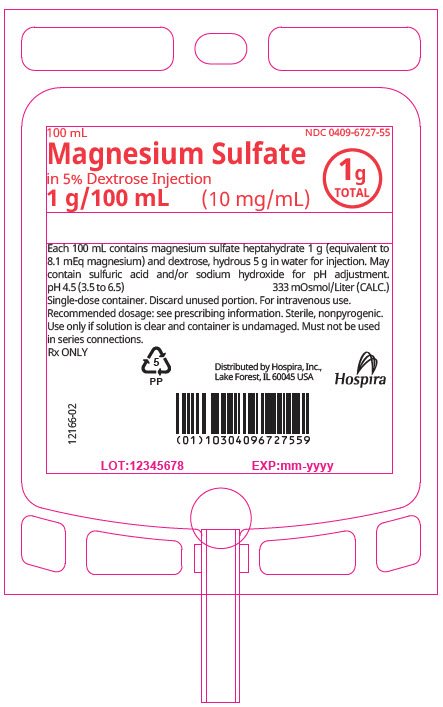
PRINCIPAL DISPLAY PANEL - 100 mL Bag Label 100 mL NDC 0409-6727-55 Magnesium Sulfate in 5% Dextrose Injection, USP 1 g/100 mL (10 mg/mL) 1g TOTAL Each 100 mL contains magnesium sulfate heptahydrate 1 g (equivalent to 8.1 mEq magnesium) and dextrose, hydrous 5 g in water for injection. May contain sulfuric acid and/or sodium hydroxide for pH adjustment. pH 4.5 (3.5 to 6.5) 333 mOsmol/Liter (CALC.) Single-dose container. Discard unused portion.
For intravenous use. Recommended Dosage: See Prescribing Information. Sterile, nonpyrogenic.
Use only if solution is clear and container is undamaged. Rx ONLY 12166-05 5 PP MADE IN CZECH REPUBLIC Distributed by Hospira, Inc., Lake Forest, IL 60045 USA Hospira LOT:12345678 EXP: YYYY-MMM PRINCIPAL DISPLAY PANEL - 100 mL Bag Label
PRINCIPAL DISPLAY PANEL - 100 mL Bag Overwrap 100 mL NDC 0409-6727-55 Magnesium Sulfate in 5% Dextrose Injection, USP 1 g/100 mL (10 mg/mL) 1g TOTAL Each 100 mL contains magnesium sulfate heptahydrate 1 g (equivalent to 8.1 mEq magnesium) and dextrose, hydrous 5 g in water for injection. May contain sulfuric acid and/or sodium hydroxide for pH adjustment. 333 mOsmol/Liter (CALC.) pH 4.5 (3.5 to 6.5.) DO NOT ADD SUPPLEMENTARY MEDICATION.
WHENEVER POSSIBLE USE CENTRAL ROUTE. Single-dose container. For intravenous use.
Recommended dosage: See prescribing information. Sterile, nonpyrogenic. Use only if solution is clear.
After removing the overwrap, check for minute leaks by squeezing container firmly. If leaks are found, discard unit as sterility may be impaired. Must not be used in series connections.
The overwrap is a moisture barrier. Do not remove unit from overwrap until ready for use. Use unit promptly when pouch is opened.
Store at 20 to 25°C (68 to 77°F). [See USP Controlled Room Temperature.] Protect from freezing. See prescribing information. Not Made With Natural Rubber Latex Rx Only 7 OTHER Distributed by Hospira, Inc., Lake Forest, IL 60045 USA Hospira 13089-01 PRINCIPAL DISPLAY PANEL - 100 mL Bag Overwrap
Medicaid utilization by pack size
Reported adverse events (FAERS)
Top reported reactions
Age at onset
Reporter sex
Serious outcomes
Where does this data come from?
About this NDC listing & data coverage
What data is (and isn’t) available for this NDC — tap to expand
| NDC identity (package / product / labeler codes) | ✓ Available |
| Labeler | ✓ Available |
| Product & package description | ✓ Available |
| Marketing category & status | ✓ Available |
| Active ingredient / dosage form / route | ✓ Available |
| FDA label (SPL via DailyMed) | ✓ Available |
| Package photos | ✓ Available |
| Inactive ingredients (structured) | ✓ Available |
| NADAC pharmacy acquisition price (CMS) | — Not published for this NDC CMS publishes NADAC only for NDCs reported in its retail-pharmacy survey. |
| Orange Book / therapeutic-equivalence data | ✓ Available |
| HCPCS J-code billing crosswalk | — Not published for this NDC Most self-administered / retail products have no J-code — that is normal. |
| Medicaid utilization (CMS SDUD) | — Not published for this NDC CMS reports utilization only for NDCs with Medicaid claims above its privacy threshold. |