
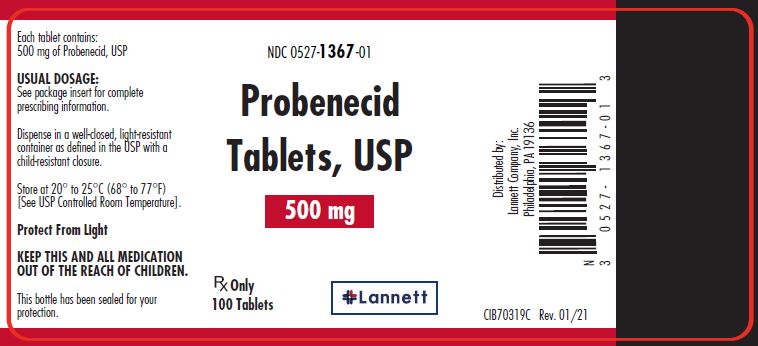
Probenecid 500 mg Tablet, Film Coated, 100-count — NDC 0527-1367-01 (Billing 00527-1367-01)
This is a package of 100 tablets of Probenecid 500 mg Tablet, Film Coated from Lannett Company, Inc., marketed since Jul 1976 and currently FDA-listed; retail pharmacies pay about $0.6361 per tablet (NADAC). It is the main listing for this product, which comes in 2 package sizes.
NDC database record
One package, one record: these facts belong to NDC 0527-1367-01 alone.
- Record
- FDA NDC Directory package listing · Human prescription drug
- Code segments
- 0527 labeler · 1367 product · 01 package
- Package marketed since
- Jul 29, 1976
- Sample package
- No — commercial package
- Listing certified through
- Dec 31, 2026
- Billing quantity
- 100 EA per package
- Barcode (UPC)
- 0305271367013
- Medicaid fills, this package
- 1,305 prescriptions in the last four reported quarters
- FDA record last changed
- Jul 24, 2026
Identity & classification
Regulatory identifiers FDA, NLM and CMS codes for this package
Drug-database identifiers Medi-Span GPI and First Databank GCN / HICL / AHFS classification
- GSN (GCN sequence number): 008236
- GCN: 35072
- GPI-14 (Medi-Span): 68100010000310
- HICL (First Databank): 003675
- AHFS class code: 40:40.00.00
- RxCUI (RxNorm): 198152
Where does this data come from?
- FDA openFDA NDC Directory · synced Oct 1, 2026
- FDA label on DailyMed · label index refreshed Oct 6, 2026
- RxNorm (NLM RxNav) · catalog refreshed Oct 1, 2026
- Medi-Span GPI (licensed)
- First Databank (licensed) · refreshed Oct 1, 2026
RxNorm drug class
This medicine belongs to the Preparations with no effect on uric acid metabolism class.
Where does this data come from?
- RxClass (NLM) · catalog refreshed Oct 1, 2026
Clinical
Probenecid is used to treat chronic gout and gouty arthritis. It is used to prevent attacks related to gout, not treat them once they occur. It acts on the kidneys to help the body eliminate uric acid. Probenecid is also used to make certain antibiotics more effective by preventing the body from passing them in the urine. This medication is sometimes prescribed for other uses; ask your doctor or pharmacist for more information.
Read the full MedlinePlus article ↗- It treats the high uric acid that causes gout and gouty arthritis. It is also sometimes paired with penicillin-type antibiotics to keep their levels in your blood higher for longer...
- Take it by mouth as your prescriber directs, usually in divided doses through the day. Drink plenty of fluids, and if your doctor recommends something to make your urine less acidi...
- No. Aspirin and other salicylates cancel out probenecid’s effect. If you need a mild pain reliever, acetaminophen is preferred, but check with me or your doctor first.
- Can I take aspirin for pain while on it?
Patient education
Supplement & herbal interactions
Some supplements/herbs that may interact with Probenecid — tap one for details:
Probenecid may be associated with lower levels of 1 nutrient — worth a chat with your pharmacist, not a cause for alarm.
Where does this data come from?
- MedlinePlus (NLM) · refreshed Oct 1, 2026
- FDA label on DailyMed · label index refreshed Oct 6, 2026
Ask a licensed pharmacist directly — free, answered by our team.
Pricing
A drug doesn't have one price. Each row is a different public payment system, and none is what you'd pay at the counter — that depends on your insurance. The ⓘ on each row explains what it measures.
| Price system | Per ea | Per package |
|---|---|---|
| Retail pharmacies payNADAC · weekly | $0.636 | $63.61 / 100 tablets |
| Medicaid paysCMS SDUD · 12 mo | $0.8492 | $84.92 / 100 tablets |
| Medicare drug plans payPart D · Q2 2026 | $1.02 | $102.05 / 100 tablets |
Where does this data come from?
- CMS NADAC weekly file · file of Sep 30, 2026
- CMS ASP pricing files · refreshed Sep 20, 2026
- CMS Medicaid State Drug Utilization Data · through Q4 2025
- CMS Part D plan pricing files · refreshed Sep 24, 2026
- VA National Acquisition Center price file
Packaging — all sizes for this product
| Package NDC | Description | Per unit | Per pack | Marketing start | Marketing end | Status |
|---|---|---|---|---|---|---|
| 00527-1367-01 You're viewing this Main listing | 100 TABLET, FILM COATED in 1 BOTTLE | $0.6361 / ea | $63.61 | 1976-07-29 | — | Active |
| 00527-1367-10 0527-1367-10 | 1000 TABLET, FILM COATED in 1 BOTTLE | $0.6361 / ea | $636.14 | 1976-07-29 | — | Active |
You're viewing the smallest of 2 pack sizes for this product.
This pack has the lowest per-ea cost of the 2 priced pack sizes ($0.6361 NADAC).
In Medicaid, this is the most-dispensed pack of this product — about 100% of fills over the last four reported quarters. See all packs ↓
Pack size FAQ
What quantity is in this package?
How does this package differ from NDC 00527-1367-10?
What NDC number is used to bill for this package of Probenecid 500 mg Tablet, Film Coated?
Prices are the latest CMS NADAC pharmacy acquisition cost per NDC; per-pack figures are per-unit × pack quantity, shown only when the pack is denominated in the same measure NADAC prices.
Therapeutic equivalents
| Product | Labeler | Pack | NADAC/unit | TE | Status | Price vs. this |
|---|---|---|---|---|---|---|
| Probenecid 500 mgthis 00527-1367-01 | Lannett | 100 tablets | $0.636 | AB | Availability likely | — |
| Probenecid 500 mg 00591-5347-01 | Actavis | 100 tablets | $0.636 | AB | Availability likely | — |
| Probenecid 500 mg 16571-0831-01 | Rising | 100 tablets | $0.636 | AB | Availability likely | — |
| Probenecid 500 mg 10135-0541-01 | Marlex | 100 tablets | — | AB | FDA listed | — |
| Probenecid 500 mg 70518-4649-00 | REMEDYREPACK | 50 tablets | — | AB | FDA listed | — |
| Probenecid 500 mg 72162-2237-01 | Bryant | 100 tablets | — | AB | FDA listed | — |
| Probenecid 500 mg 72162-2386-01 | Bryant | 100 tablets | — | AB | FDA listed | — |
Where does this data come from?
- FDA openFDA NDC Directory · synced Oct 1, 2026
- FDA Orange Book · refreshed Oct 3, 2026
- CMS NADAC weekly file · file of Sep 30, 2026
Availability & generic status
This product is an FDA-approved generic. Other versions of the same drug are listed under Therapeutic equivalents, least expensive first.
Where does this data come from?
- FDA Orange Book · refreshed Oct 3, 2026
What it looks like
Where does this data come from?
- FDA label on DailyMed · label index refreshed Oct 6, 2026
Inactive Ingredients / Excipients
Inactive ingredients, also called excipients, are components of the drug product other than the active ingredient. They may include fillers, dyes, coatings, preservatives, flavors, or other formulation ingredients.
🧪 Avoiding an ingredient? See Probenecid inactive ingredients by manufacturer: every current product's list side by side, so you can ask your pharmacy for the version that does not list it.
💡 Tap an ingredient (hover on desktop) to see what it is and why it’s used.
-
UNII LMI26O6933
Alumina is a white powder form of aluminum oxide. It's used as a filler to add bulk to tablets and capsules, and sometimes as a thickening or anti-caking agent in powdered formulations.
-
UNII OP1R32D61U
Microcrystalline cellulose is a purified form of cellulose, a natural fiber from plant sources. It acts as a binder and filler in tablets and capsules, helping hold ingredients together and give the medicine its shape and size.
-
UNII 35SW5USQ3G
A synthetic yellow dye used to color medicines. It helps make tablets, capsules, and liquids visually distinct so patients can easily identify their medication.
-
UNII L06K8R7DQK
A synthetic blue dye approved by the FDA for use in medications and foods. It serves as a colorant to make pills and liquids visually distinct and easier to identify.
-
UNII H77VEI93A8
A synthetic yellow dye used to color medications. It helps identify the drug and make it visually distinctive, with no effect on how the medicine works.
-
UNII 70097M6I30
Magnesium stearate is a salt made from magnesium and stearic acid, a fatty substance. It's used in tablets and capsules as a lubricant and glidant to help ingredients flow smoothly during manufacturing and prevent sticking.
-
UNII 3WJQ0SDW1A
Polyethylene glycol is a synthetic liquid or solid polymer used in medicines as a solvent, lubricant, and humectant. It helps dissolve active ingredients, reduces friction during manufacturing, and retains moisture in the final product.
-
UNII 532B59J990
Polyvinyl alcohol is a synthetic polymer made from plant-derived materials. It's used as a binder to hold ingredients together, a film-former in coatings, and a thickener in liquid formulations.
-
UNII FZ989GH94E
Povidone is a synthetic polymer made from a plastic-like material. It acts as a binder to hold tablet ingredients together and as a disintegrant to help the tablet break apart in your stomach so the medicine can be absorbed.
-
UNII ETJ7Z6XBU4
Silicon dioxide is a naturally occurring mineral used as a glidant and anti-caking agent. It helps powder ingredients flow smoothly and prevents clumping during manufacturing and storage.
-
UNII 368GB5141J
A detergent and foaming agent derived from coconut or palm oil. In medications, it helps break down and mix oil and water-based ingredients, aids in tablet disintegration, and improves how the drug dissolves and spreads in the mouth or digestive system.
-
UNII 5856J3G2A2
A starch-based powder made from potatoes and processed with sodium. It acts as a disintegrant, helping the tablet or capsule break apart quickly in the stomach so the medicine can be absorbed.
-
UNII O8232NY3SJ
A plant-based carbohydrate derived from corn kernels. It acts as a filler to add bulk, a binder to hold ingredients together, and a disintegrant to help the tablet break apart in your stomach for absorption.
-
UNII 7SEV7J4R1U
A powder made from a naturally occurring mineral. In medicines, talc works as a glidant and anti-caking agent, helping tablets and capsules flow smoothly during manufacturing and preventing clumping.
-
UNII 15FIX9V2JP
Titanium dioxide is a bright white mineral powder commonly used as a colorant and opacifying agent. It makes pills and tablets white or lighter in color and helps make coatings non-transparent.
15 inactive ingredients listed in the exact product block matched to this NDC.
Where does this data come from?
ingredient classCode="IACT" elements from the exact product block matched by this NDC. Label-section narrative from DailyMed / the openFDA label index is shown separately when available.- FDA label on DailyMed · label index refreshed Oct 6, 2026
- FDA openFDA NDC Directory · synced Oct 1, 2026
Inactive ingredient FAQ
Are inactive ingredients the same for every manufacturer?
Why might an inactive ingredient be missing?
Can inactive ingredients matter?
Manufacturer & labeler
More NDCs from Lannett Company, Inc. labeler code 00527
- Ursodiol 300 mg Capsule NDC 0527-1326-01
- Baclofen 10 mg Tablet NDC 0527-1330-01
- Baclofen 5 mg Tablet NDC 0527-1333-01
- Doxycycline 50 mg Tablet, Film Coated NDC 0527-1335-01
- Baclofen 20 mg Tablet NDC 0527-1337-01
- Doxycycline 100 mg Tablet, Film Coated NDC 0527-1338-25
- Danazol 100 mg Capsule NDC 0527-1368-01
- Danazol 200 mg Capsule NDC 0527-1369-01
- Danazol 50 mg Capsule NDC 0527-1392-01
- Loxapine 5 mg Capsule NDC 0527-1394-01
- Loxapine 10 mg Capsule NDC 0527-1395-01
- Loxapine 25 mg Capsule NDC 0527-1396-01
Where does this data come from?
- FDA openFDA NDC Directory · synced Oct 1, 2026
- Drugs@FDA
Full prescribing information FDA SPL
🎯 Indications and Usage ▾
INDICATIONS AND USAGE Probenecid tablets are indicated for the treatment of the hyperuricemia associated with gout and gouty arthritis. As an adjuvant to therapy with penicillin or with ampicillin, methicillin, oxacillin, cloxacillin, or nafcillin, for elevation and prolongation of plasma levels by whatever route the antibiotic is given.
⏱️ Dosage and Administration ▾
DOSAGE AND ADMINISTRATION Gout: Therapy with probenecid should not be started until an acute gouty attack has subsided. However, if an acute attack is precipitated during therapy, probenecid may be continued without changing the dosage, and full therapeutic dosage of colchicine, or other appropriate therapy, should be given to control the acute attack. The recommended adult dosage is 250 mg (1/2 probenecid tablet), twice a day for one week, followed by 500 mg (1 tablet) twice a day thereafter.
Some degree of renal impairment may be present in patients with gout. A daily dosage of 1000 mg may be adequate. However, if necessary, the daily dosage may be increased by 500 mg increments every 4 weeks within tolerance (and usually not above 2000 mg per day) if symptoms of gouty arthritis are not controlled or the 24 hour uric acid excretion is not above 700 mg.
As noted, probenecid may not be effective in chronic renal insufficiency particularly when the glomerular filtration rate is 30 mL/minute or less. Gastric intolerance may be indicative of overdosage, and may be corrected by decreasing the dosage. As uric acid tends to crystallize out of an acid urine, a liberal fluid intake is recommended, as well as sufficient sodium bicarbonate (3 to 7.5 g daily), or potassium citrate (7.5 g daily) to maintain an alkaline urine (see PRECAUTIONS ).
Alkalization of the urine is recommended until the serum urate level returns to normal limits and tophaceous deposits disappear, i.e., during the period when urinary excretion of uric acid is at a high level. Thereafter, alkalization of the urine and the usual restriction of purine-producing foods may be somewhat relaxed. Probenecid should be continued at the dosage that will maintain normal serum urate levels.
When acute attacks have been absent for 6 months or more and serum urate levels remain within normal limits, the daily dosage may be decreased by 500 mg every 6 months. The maintenance dosage should not be reduced to the point where serum urate levels tend to rise. Probenecid and Penicillin Therapy (General): Adults: The recommended dosage is 2000 mg (4 tablets of probenecid) daily in divided doses.
This dosage should be reduced in older patients in whom renal impairment may be present. Children: 2-14 years of age: Initial dose: 25 mg/kg body weight (or 0.7 g/square meter body surface). Maintenance Dose: 40 mg/kg body weight (or 1.2 g/square meter body surface) per day, divided into 4 doses.
For children weighing more than 50 kg (110 lb) the adult dosage is recommended. Probenecid is contraindicated in children under 2 years of age. The PSP excretion test may be used to determine the effectiveness of probenecid in retarding penicillin excretion and maintaining therapeutic levels.
The renal clearance of PSP is reduced to about one-fifth the normal rate when dosage of probenecid is adequate. Penicillin Therapy (Gonorrhea) Recommended by the Center for Disease Control, U.S. Department of Health and Human Services, Public Health Service (Morbidity and Mortality Weekly Report Supplement, Volume 34, Number 4S, October 18, 1985).
In uncomplicated gonococcal infections in men and women (urethral, cervical, rectal), 1 g of probenecid should be given orally with 4.8 million units of aqueous procaine penicillin G See package circulars of manufacturers for detailed information about CONTRAINDICATIONS, WARNINGS, PRECAUTIONS, and ADVERSE REACTIONS . (given IM), or 3 g of amoxicillin (given orally), or 3.5 g of ampicillin (given orally). For further guidance, see CDC recommendations for definition of regimens of choice, alternative regimens, treatment of hypersensitive patients, and other aspects of therapy.
⛔ Contraindications ▾
CONTRAINDICATIONS Hypersensitivity to probenecid. Children under 2 years of age. Not recommended in persons with known blood dyscrasias or uric acid kidney stones. Therapy with probenecid should not be started until an acute gouty attack has subsided.
⚠️ Warnings ▾
WARNINGS Exacerbation of gout following therapy with probenecid may occur; in such cases colchicine or other appropriate therapy is advisable. Probenecid increases plasma concentrations of methotrexate in both animals and humans. In animal studies, increased methotrexate toxicity has been reported.
If probenecid is given with methotrexate, the dosage of methotrexate should be reduced and serum levels may need to be monitored. In patients on probenecid the use of salicylates in either small or large doses is contraindicated because it antagonizes the uricosuric action of probenecid. The biphasic action of salicylates in the renal tubules accounts for the so-called "paradoxical effect" of uricosuric agents.
In patients on probenecid who require a mild analgesic agent the use of acetaminophen rather than small doses of salicylates would be preferred. Rarely, severe allergic reactions and anaphylaxis have been reported with the use of probenecid. Most of these have been reported to occur within several hours after readministration following prior usage of the drug.
The appearance of hypersensitivity reactions requires cessation of therapy with probenecid. Use in Pregnancy: Probenecid crosses the placental barrier and appears in cord blood. The use of any drug in women of childbearing potential requires that the anticipated benefit be weighed against the possible hazards.
🤒 Adverse Reactions ▾
ADVERSE REACTIONS The following adverse reactions have been observed and within each category are listed in order of decreasing severity. Central Nervous System: headache, dizziness. Metabolic: precipitation of acute gouty arthritis.
Gastrointestinal: hepatic necrosis, vomiting, nausea, anorexia, sore gums. Genitourinary: nephrotic syndrome, uric acid stones with or without hematuria, renal colic, costovertebral pain, urinary frequency. Hypersensitivity: anaphylaxis, fever, urticaria, pruritus.
Hematologic: aplastic anemia, leukopenia, hemolytic anemia which in some patients could be related to genetic deficiency of glucose -6- phosphate dehydrogenase in red blood cells, anemia. Integumentary: dermatitis, alopecia, flushing.
🔄 Drug Interactions ▾
Drug Interactions: When probenecid is used to elevate plasma concentrations of penicillin or other beta-lactams, or when such drugs are given to patients taking probenecid therapeutically, high plasma concentrations of the other drug may increase the incidence of adverse reactions associated with that drug. In the case of penicillin or other beta-lactams, psychic disturbances have been reported. The use of salicylates antagonizes the uricosuric action of probenecid (see WARNINGS ).
The uricosuric action of probenecid is also antagonized by pyrazinamide. Probenecid produces an insignificant increase in free sulfonamide plasma concentrations, but a significant increase in total sulfonamide plasma levels. Since probenecid decreases the renal excretion of conjugated sulfonamides, plasma concentrations of the latter should be determined from time to time when a sulfonamide and probenecid are coadministered for prolonged periods.
Probenecid may prolong or enhance the action of oral sulfonylureas and thereby increase the risk of hypoglycemia. It has been reported that patients receiving probenecid require significantly less thiopental for induction of anesthesia. In addition, ketamine and thiopental anesthesia were significantly prolonged in rats receiving probenecid.
The concomitant administration of probenecid increases the mean plasma elimination half-life of a number of drugs which can lead to increased plasma concentrations. These include agents such as indomethacin, acetaminophen, naproxen, ketoprofen, meclofenamate, lorazepam, and rifampin. Although the clinical significance of this observation has not been established, a lower dosage of the drug may be required to produce a therapeutic effect, and increases in dosage of the drug in question should be made cautiously and in small increments when probenecid is being coadministered.
Although specific instances of toxicity due to this potential interaction have not been observed to date, physicians should be alert to this possibility. Probenecid given concomitantly with sulindac had only a slight effect on plasma sulfide levels, while plasma levels of sulindac and sulfone were increased. Sulindac was shown to produce a modest reduction in the uricosuric action of probenecid, which probably is not significant under most circumstances.
In animals and in humans, probenecid has been reported to increase plasma concentrations of methotrexate (see WARNINGS ). Falsely high readings for theophylline have been reported in an in vitro study, using the Schack and Waxler technique, when therapeutic concentrations of theophylline and probenecid were added to human plasma.
🧬 Clinical Pharmacology ▾
CLINICAL PHARMACOLOGY Probenecid is a uricosuric and renal tubular blocking agent. It inhibits the tubular reabsorption of urate, thus increasing the urinary excretion of uric acid and decreasing serum urate levels. Effective uricosuria reduces the miscible urate pool, retards urate deposition, and promotes resorption of urate deposits.
Probenecid inhibits the tubular secretion of penicillin and usually increases penicillin plasma levels by any route the antibiotic is given. A 2-fold to 4-fold elevation has been demonstrated for various penicillins. Probenecid also has been reported to inhibit the renal transport of many other compounds including aminohippuric acid (PAH), aminosalicylic acid (PAS), indomethacin, sodium iodomethamate and related iodinated organic acids, 17-ketosteroids, pantothenic acid, phenolsulfonphthalein (PSP), sulfonamides, and sulfonylureas.
See also Drug Interactions . Probenecid decreases both hepatic and renal excretion of sulfobromophtalein (BSP). The tubular reabsorption of phosphorus is inhibited in hypoparathyroid but not in euparathyroid individuals.
Probenecid does not influence plasma concentrations of salicylates, nor the excretion of streptomycin, chloramphenicol, chlortetracycline, oxytetracycline, or neomycin.
📦 How Supplied / Storage and Handling ▾
HOW SUPPLIED Probenecid Tablets, USP are available containing 500 mg of Probenecid, USP. The tablets are capsule shaped, film-coated yellow, debossed LCI on one side and 1367 on the other side. They are available as follows: NDC 0527-1367-01 bottles of 100 tablets NDC 0527-1367-10 bottles of 1000 tablets STORE AT 20° -25°C (68° -77°F) [See USP Controlled Room Temperature] PROTECT FROM LIGHT.
Dispense in tight, light-resistant container as defined in the USP using a child-resistant closure. Distributed by: Lannett Company, Inc. Philadelphia, PA 19136 CIB70317C Rev.
01/21
📋 Description ▾
DESCRIPTION: Probenecid is a uricosuric and renal tubular transport blocking agent. The chemical name for probenecid is 4-[(dipropylamino) sulfonyl]-benzoic acid. It has the following structural formula: Probenecid, USP is a white or nearly white, fine, crystalline powder.
Probenecid is soluble in dilute alkali, in alcohol, in chloroform, and in acetone; it is practically insoluble in water and in dilute acids. Each tablet for oral administration contains 500 mg of probenecid and the following inactive ingredients: microcrystalline cellulose, sodium lauryl sulfate, sodium starch glycolate, starch (corn), povidone, colloidal silicon dioxide, magnesium stearate, polyvinyl alcohol, titanium dioxide, polyethylene glycol, talc, D&C Yellow #10 Aluminum Lake, FD&C Yellow #6 Aluminum Lake, and FD&C Blue #2 Aluminum Lake. probenecid-molec-structure
⚠️ Precautions ▾
PRECAUTIONS General: Hematuria, renal colic, costovertebral pain, and formation of uric acid stones associated with the use of probenecid in gouty patients may be prevented by alkalization of the urine and a liberal fluid intake (see DOSAGE AND ADMINISTRATION ). In these cases when alkali is administered, the acid-base balance of the patient should be watched. Use with caution in patients with a history of peptic ulcer.
Probenecid has been used in patients with some renal impairment, but dosage requirements may be increased. Probenecid may not be effective in chronic renal insufficiency particularly when the glomerular filtration rate is 30 mL/minute or less. Because of its mechanism of action, probenecid is not recommended in conjunction with a penicillin in the presence of known renal impairment.
A reducing substance may appear in the urine of patients receiving probenecid. This disappears with discontinuance of therapy. Suspected glycosuria should be confirmed by using a test specific for glucose.
Drug Interactions: When probenecid is used to elevate plasma concentrations of penicillin or other beta-lactams, or when such drugs are given to patients taking probenecid therapeutically, high plasma concentrations of the other drug may increase the incidence of adverse reactions associated with that drug. In the case of penicillin or other beta-lactams, psychic disturbances have been reported. The use of salicylates antagonizes the uricosuric action of probenecid (see WARNINGS ).
The uricosuric action of probenecid is also antagonized by pyrazinamide. Probenecid produces an insignificant increase in free sulfonamide plasma concentrations, but a significant increase in total sulfonamide plasma levels. Since probenecid decreases the renal excretion of conjugated sulfonamides, plasma concentrations of the latter should be determined from time to time when a sulfonamide and probenecid are coadministered for prolonged periods.
Probenecid may prolong or enhance the action of oral sulfonylureas and thereby increase the risk of hypoglycemia. It has been reported that patients receiving probenecid require significantly less thiopental for induction of anesthesia. In addition, ketamine and thiopental anesthesia were significantly prolonged in rats receiving probenecid.
The concomitant administration of probenecid increases the mean plasma elimination half-life of a number of drugs which can lead to increased plasma concentrations. These include agents such as indomethacin, acetaminophen, naproxen, ketoprofen, meclofenamate, lorazepam, and rifampin. Although the clinical significance of this observation has not been established, a lower dosage of the drug may be required to produce a therapeutic effect, and increases in dosage of the drug in question should be made cautiously and in small increments when probenecid is being coadministered.
Although specific instances of toxicity due to this potential interaction have not been observed to date, physicians should be alert to this possibility. Probenecid given concomitantly with sulindac had only a slight effect on plasma sulfide levels, while plasma levels of sulindac and sulfone were increased. Sulindac was shown to produce a modest reduction in the uricosuric action of probenecid, which probably is not significant under most circumstances.
In animals and in humans, probenecid has been reported to increase plasma concentrations of methotrexate (see WARNINGS ). Falsely high readings for theophylline have been reported in an in vitro study, using the Schack and Waxler technique, when therapeutic concentrations of theophylline and probenecid were added to human plasma.
📄 Package Label / Principal Display Panel ▾
PRINCIPAL DISPLAY PANEL NDC 0527- 1367 -01 Probenecid Tablets, USP 500 mg Rx Only 100 Tablets Lannett 500 mg 100 count