
FILSUVEZ birch triterpenes 100 mg/g Gel, 1 tube — NDC 10122-310-02 (Billing 10122-0310-02)
This is a package of 1 tube of FILSUVEZ birch triterpenes 100 mg/g Gel from Chiesi USA, Inc., marketed since Feb 2024 and currently FDA-listed. It is this product's only package size.
NDC database record
One package, one record: these facts belong to NDC 10122-310-02 alone.
- Record
- FDA NDC Directory package listing · Human prescription drug
- Code segments
- 10122 labeler · 310 product · 02 package
- Package marketed since
- Feb 22, 2024
- Sample package
- No — commercial package
- Listing certified through
- Dec 31, 2027
- Barcode (UPC-A, from the NDC)
- 3 1012231002 5
- Medicaid fills, this package
- 567 prescriptions in the last four reported quarters
- FDA record last changed
- Aug 6, 2026
Identity & classification
Regulatory identifiers FDA, NLM and CMS codes for this package
Drug-database identifiers Medi-Span GPI and First Databank GCN / HICL / AHFS classification
- GSN (GCN sequence number): 084481
- GCN: 53808
- HICL (First Databank): 048746
- AHFS class code: 84:92.00.00
- RxCUI (RxNorm): 2675587
Where does this data come from?
- FDA openFDA NDC Directory · synced Oct 8, 2026
- FDA label on DailyMed · label index refreshed Oct 8, 2026
- RxNorm (NLM RxNav) · catalog refreshed Oct 8, 2026
- Medi-Span GPI (licensed)
- First Databank (licensed) · refreshed Oct 8, 2026
Clinical
Birch triterpenes is used for treatment of wounds associated with certain types of epidermolysis bullosa (condition that causes blistering of the skin) in adults and children 6 months of age or older. Birch triterpenes is in a class of medications called botanicals. How it works to help epidermolysis bullosa is not well understood.
Read the full MedlinePlus article ↗Patient education
Supplement & herbal interactions
Some supplements/herbs that may interact with Birch Triterpenes (prescription drug) — tap one for details:
Where does this data come from?
- MedlinePlus (NLM) · refreshed Oct 8, 2026
- FDA label on DailyMed · label index refreshed Oct 8, 2026
Ask a licensed pharmacist directly — free, answered by our team.
Pricing
A drug doesn't have one price. Each row is a different public payment system, and none is what you'd pay at the counter — that depends on your insurance. The ⓘ on each row explains what it measures.
| Price system | Per g | Per package |
|---|---|---|
| Retail pharmacies payNADAC · weekly | Not in the retail survey — common for institutional, discontinued, or low-volume packs. | |
| Medicaid paysCMS SDUD · 12 mo | $91.18 | $2,133.70 / 23.4 g |
| Medicare drug plans payPart D · quarterly | No Part D plan price is available for this NDC in our data. | |
Where does this data come from?
- CMS NADAC weekly file
- CMS ASP pricing files · refreshed Sep 20, 2026
- CMS Medicaid State Drug Utilization Data · through Q1 2026
- CMS Part D plan pricing files · refreshed Sep 24, 2026
- VA National Acquisition Center price file
Packaging — all sizes for this product
| Package NDC | Description | Marketing start | Marketing end | Status |
|---|---|---|---|---|
| 10122-0310-02 You're viewing this Main listing | 1 TUBE in 1 CARTON / 23.4 g in 1 TUBE | 2024-02-22 | — | Active |
Therapeutic equivalents
| Product | Labeler | Pack | NADAC/unit | TE | Status | Price vs. this |
|---|---|---|---|---|---|---|
| Filsuvez 100 mg/gthis 10122-0310-02 | Chiesi | 1 tube | — | — | FDA listed | — |
| Filsuvez 100 mg/g 76431-0310-01 | Amryt | 1 tube | — | — | FDA listed | — |
Where does this data come from?
- FDA openFDA NDC Directory · synced Oct 8, 2026
- FDA Orange Book · refreshed Oct 9, 2026
- CMS NADAC weekly file
Availability & generic status
We did not find an FDA-approved generic match for this exact strength, form and route. Patent/protection dates below may affect future generic timing.
Why the date isn’t exact: Generic timing can change because patents may be challenged, settled, licensed, added, removed, or worked around with a narrower label — and FDA approval does not always mean a pharmacy can get the generic today.
Our estimate: 2035 to 2036 a wide window
How sure: Probable. More likely than not, but it can still move.
Why then: The patent fight is likely to end in an agreement that sets the launch. The terms are not public yet.
That is before the January 2039 date above, which is common: a court ruling or a deal with the brand’s maker often lets a generic in before the last patent runs out.
See the full forecast for generic Filsuvez →🛈 What do these terms mean?
- Patent
- Legal protection listed in the Orange Book that may delay generic approval or launch. Issued by the U.S. Patent & Trademark Office.
- Substance patent
- Covers the active drug molecule itself — the hardest to design around. A generic generally can’t launch until it expires.
- Formulation (product) patent
- Covers a specific formulation or dosage form. A generic can sometimes work around it with a different formulation.
- Method-of-use patent
- A patent covering one specific approved use of the drug — not necessarily the whole molecule. A generic can sometimes launch with a “skinny label” that carves out the protected use and keeps the others.
- Skinny label
- A generic label that omits a still-patented use when the FDA allows it — letting a generic reach the market for the unprotected uses.
- Exclusivity
- FDA-granted marketing protection, separate from patents — e.g. 5-yr new chemical entity, 7-yr orphan drug, or a +6-month pediatric extension.
- Paragraph IV
- A generic applicant’s formal challenge to a listed patent. It can potentially lead to earlier generic entry, but often involves litigation or a settlement.
- RLD / RS
- Reference Listed Drug — the brand product the FDA uses as the reference for generic applications. Reference Standard — the product the FDA expects generics to compare against in bioequivalence testing.
- TE / AB rating
- FDA therapeutic-equivalence rating. An AB rating generally means the FDA considers a generic therapeutically equivalent to — and substitutable for — the brand.
- LOE (loss of exclusivity)
- The latest patent or exclusivity currently listed — the loss-of-exclusivity / latest-listed-protection date shown on this page. Paragraph-IV challenges and settlements can move the real date earlier; FDA approval and a manufacturer’s decision to market can move it later.
Built from the FDA Orange Book. The bars above are scaled to each protection’s expiry; the red LOE marker is the last one to lapse.
| Patent | Type | Use code | Expires |
|---|---|---|---|
| US 11266660 ↗ | Method of use | U-3811 | Jan 4, 2039 |
| US 9827214 ↗ | Method of use | U-3811 | Nov 24, 2030 |
| US 9352041 ↗ | Method of use | U-3811 | Nov 24, 2030 |
| US 12268695 ↗ | Method of use | U-3811 | Jan 4, 2039 |
| US 11083733 ↗ | Drug product | — | Jan 4, 2039 |
| US 8828444 ↗ | Drug product | — | Jun 21, 2027 |
| Code | What it grants | Expires |
|---|---|---|
| NCE | New Chemical Entity (5-year) | Dec 18, 2028 |
| ODE-460 | Orphan Drug Exclusivity (7-year) | Dec 18, 2030 |
Is there a generic version of FILSUVEZ 10% GEL?
The FDA approved a generic — why can’t I get it at my pharmacy yet?
Why do different websites show different generic release dates?
What does “FDA listed” mean?
What does a patent or protection date mean here?
What does “current Orange Book estimate” mean?
Can a generic come out before the last patent expires?
Can a generic come out after the listed dates?
What is the difference between patents and exclusivity?
Why are there multiple patent dates?
Where does this data come from?
- FDA Orange Book · refreshed Oct 9, 2026
Inactive Ingredients / Excipients
Inactive ingredients, also called excipients, are components of the drug product other than the active ingredient. They may include fillers, dyes, coatings, preservatives, flavors, or other formulation ingredients.
💡 Tap an ingredient (hover on desktop) to see what it is and why it’s used.
-
UNII 3W1JG795YI
Sunflower oil is a natural vegetable oil derived from sunflower seeds. It serves as a solvent, lubricant, and carrier in medicines, helping dissolve active ingredients and improve how the medication flows and absorbs in the body.
1 inactive ingredient listed in the exact product block matched to this NDC.
Where does this data come from?
ingredient classCode="IACT" elements from the exact product block matched by this NDC. Label-section narrative from DailyMed / the openFDA label index is shown separately when available.- FDA label on DailyMed · label index refreshed Oct 8, 2026
- FDA openFDA NDC Directory · synced Oct 8, 2026
Inactive ingredient FAQ
Are inactive ingredients the same for every manufacturer?
Why might an inactive ingredient be missing?
Can inactive ingredients matter?
Manufacturer & labeler
More NDCs from Chiesi USA, Inc. labeler code 10122
- Trimbow beclomethasone dipropionate/formoterol fumarate/glycopyrrolate 86 ug; 4.9 ug; 10.6 ug Aerosol, Metered NDC 10122-120-02
- Trimbow beclomethasone dipropionate/formoterol fumarate/glycopyrrolate 172 ug; 4.9 ug; 10.6 ug Aerosol, Metered NDC 10122-121-02
- ELFABRIO pegunigalsidase alfa 20 mg/10mL Injection, Solution, Concentrate NDC 10122-160-02
- ELFABRIO pegunigalsidase alfa 5 mg/2.5mL Injection, Solution, Concentrate NDC 10122-165-02
- Lamzede Velmanase alfa-tycv 10 mg Injection, Powder, Lyophilized, For Solution NDC 10122-180-02
- Myalept metreleptin 11.3 mg/2.2mL Injection, Powder, Lyophilized, For Solution NDC 10122-210-02
- Juxtapid lomitapide mesylate 2 mg Capsule NDC 10122-402-28
- Juxtapid lomitapide mesylate 5 mg Capsule NDC 10122-405-28
- Juxtapid lomitapide mesylate 10 mg Capsule NDC 10122-410-28
- Juxtapid lomitapide mesylate 20 mg Capsule NDC 10122-420-28
- Juxtapid lomitapide mesylate 30 mg Capsule NDC 10122-430-28
- Trimbow beclomethasone dipropionate/formoterol fumarate/glycopyrrolate 86 ug; 4.9 ug; 10.6 ug Aerosol, Metered NDC 10122-460-02
Where does this data come from?
- FDA openFDA NDC Directory · synced Oct 8, 2026
- Drugs@FDA
Full prescribing information FDA SPL
🎯 Indications and Usage ▾
1 INDICATIONS AND USAGE FILSUVEZ is indicated for the treatment of wounds associated with dystrophic and junctional epidermolysis bullosa (EB) in adult and pediatric patients 6 months of age and older. FILSUVEZ topical gel is indicated for the treatment of wounds associated with dystrophic and junctional epidermolysis bullosa in adult and pediatric patients 6 months of age and older. ( 1 )
⏱️ Dosage and Administration ▾
2 DOSAGE AND ADMINISTRATION Wash hands before and after applying FILSUVEZ or wear gloves for application. Apply a 1 mm layer of FILSUVEZ to the affected wound surface only. Do not rub in the gel.
Cover the wound with a sterile non-adhesive wound dressing. Alternatively, apply FILSUVEZ directly to the dressing so that the topical gel is in direct contact with the wound. Apply FILSUVEZ to cleansed wounds with wound dressing changes until the wound is healed.
If a FILSUVEZ-treated wound becomes infected, discontinue treatment to that wound until the infection has resolved. Each tube of FILSUVEZ is for one-time use only. Once the tube is opened, use the product immediately.
Discard the tube after use in household trash or through a drug take back site, if available. Avoid contact of FILSUVEZ with eyes and mucous membranes (e.g., mouth, vagina, anus). In case of accidental contact, irrigate the area with water.
FILSUVEZ is for topical use only. Not for use on mucous membranes (oral, intravaginal, or intra-anal). Not for ophthalmic use.
Apply a 1 mm layer of FILSUVEZ to the affected wound surface and cover with wound dressing or apply FILSUVEZ directly to dressing so that the topical gel is in direct contact with the wound. Do not rub in the topical gel. ( 2 ) Apply FILSUVEZ at wound dressing changes until the wound is healed.
( 2 ) Each tube of FILSUVEZ is for one-time use only. ( 2 ) For topical use; not for oral, intravaginal, intra-anal, or ophthalmic use. ( 2 )
💊 Dosage Forms and Strengths ▾
3 DOSAGE FORMS AND STRENGTHS Topical gel: 10% birch triterpenes w/w in a colorless to slightly yellowish, opalescent, non-aqueous gel supplied in 25 mL sterile tubes. Topical gel: 10% birch triterpenes w/w supplied in 25 mL sterile tubes ( 3 )
⛔ Contraindications ▾
4 CONTRAINDICATIONS None. None ( 4 )
⚠️ Warnings and Cautions ▾
5 WARNINGS AND PRECAUTIONS Hypersensitivity Reactions : If signs or symptoms of hypersensitivity occur, discontinue use immediately and initiate appropriate therapy. ( 5.1 )
5.1Hypersensitivity Reactions Local hypersensitivity and skin reactions have been reported in patients treated with FILSUVEZ, including urticaria and dermatitis. If signs and symptoms of local or systemic hypersensitivity occur, discontinue FILSUVEZ immediately and initiate appropriate therapy.
🤒 Adverse Reactions ▾
6 ADVERSE REACTIONS The following clinically significant adverse reactions are discussed elsewhere in the labeling: Hypersensitivity Reactions [see Warnings and Precautions (5.1) ] The most common (incidence ≥2%) adverse reactions are application site reactions. ( 6.1 ) To report SUSPECTED ADVERSE REACTIONS, contact Chiesi USA Inc. at 1-888-661-9260 or FDA at 1-800-FDA-1088 or www.fda.gov/medwatch.
6.1Clinical Trials Experience Because clinical trials are conducted under widely varying conditions, adverse reaction rates observed in the clinical trials of a drug cannot be directly compared to rates in the clinical trials of another drug and may not reflect the rates observed in practice. The safety of FILSUVEZ was evaluated in EASE, a randomized, double-blind, multicenter, placebo-controlled trial in 223 adult and pediatric subjects with inherited EB. During the double-blind phase of EASE, subjects received topical treatment with either FILSUVEZ or a placebo gel on partial-thickness wounds every 1 to 4 days for a total of 90 days.
Treated wounds were covered with non-adhesive dressings. Following completion of the double-blind phase, all subjects received FILSUVEZ for a total of 24 months during the open-label phase [see Clinical Studies (14) ] . Table 1 presents adverse reactions that occurred in at least 2% of subjects treated with FILSUVEZ during the 90-day double-blind phase of EASE and at a greater frequency than in the placebo gel group.
Table 1: Number (%) of Subjects with Adverse Reactions Occurring in ≥ 2% Adverse Reaction FILSUVEZ (N=109) n (%) Placebo Gel (N=114) n (%) Application site reaction Includes: application site pruritus, administration site pain, administration site pruritus. 8 (7.3) 7 (6.1) Squamous cell carcinoma of the skin (SCC) was reported as an adverse event in the double-blind and open-label periods of EASE. Four subjects with recessive dystrophic EB each reported one SCC: a 20-year-old male on day 1 of the double-blind period; three female subjects ages 22, 46, and 49 years during the open-label period.
Two of the four subjects had applied FILSUVEZ to the area which developed the SCC.
👥 Use in Specific Populations ▾
8 USE IN SPECIFIC POPULATIONS
8.1Pregnancy Risk Summary There are no available data with use of FILSUVEZ in pregnant women to evaluate for drug-associated risk of major birth defects, miscarriage or adverse maternal or fetal outcomes. In an animal reproduction study, oral administration of birch triterpenes to pregnant rats during the period of organogenesis had no effects on reproductive or fetal parameters (see Data ) . Systemic absorption of FILSUVEZ in humans is low following topical administration of FILSUVEZ, and maternal use is not expected to result in fetal exposure to the drug [see Pharmacokinetics (12.3) ] .
The background risk of major birth defects and miscarriage for the indicated population is unknown . In the U.S. general population, the estimated background risk of major birth defects and miscarriage in clinically recognized pregnancies is 2% to 4% and 15% to 20%, respectively. Data Animal Data In an embryofetal development study, birch triterpenes were orally administered to pregnant rats at doses of 10, 30, or 100 mg/kg/day during the period of organogenesis.
Birch triterpenes did not cause maternal toxicity or fetal malformations at doses up to 100 mg/kg/day. In a prenatal and postnatal development study, birch triterpenes were orally administered to pregnant rats at doses of 10, 30, or 100 mg/kg/day from gestation day 5 through lactation day 20. Birch triterpenes did not affect development at doses up to 100 mg/kg/day.
The available data do not support relevant comparisons of systemic birch triterpenes exposures achieved in the animal studies to exposures observed in humans after topical use of FILSUVEZ.
8.2Lactation Risk Summary There are no data on the presence of birch triterpenes or metabolites in human milk, the effects on the breastfed infant, or the effect on milk production. No effects on the breastfed infant are anticipated since the systemic exposure of the breastfeeding woman to FILSUVEZ would be low. Therefore, the developmental and health benefits of breastfeeding should be considered along with the mother's clinical need for FILSUVEZ and any potential adverse effects on the breastfed infant from FILSUVEZ or from the underlying maternal condition [see Pharmacokinetics (12.3) ].
8.4Pediatric Use The safety and effectiveness of FILSUVEZ for the treatment of wounds associated with dystrophic and junctional EB have been established in pediatric patients 6 months of age and older. Use of FILSUVEZ in this age group is supported by evidence from a single randomized, placebo-controlled trial in 156 subjects 6 months to 17 years of age [see Clinical Studies (14) ] . The safety and effectiveness of FILSUVEZ have not been established in pediatric patients younger than 6 months of age.
8.5Geriatric Use Clinical studies of FILSUVEZ did not include sufficient numbers of EB subjects 65 years of age and older to determine whether they respond differently from younger subjects.
🤰 Pregnancy ▾
8.1Pregnancy Risk Summary There are no available data with use of FILSUVEZ in pregnant women to evaluate for drug-associated risk of major birth defects, miscarriage or adverse maternal or fetal outcomes. In an animal reproduction study, oral administration of birch triterpenes to pregnant rats during the period of organogenesis had no effects on reproductive or fetal parameters (see Data ) . Systemic absorption of FILSUVEZ in humans is low following topical administration of FILSUVEZ, and maternal use is not expected to result in fetal exposure to the drug [see Pharmacokinetics (12.3) ] .
The background risk of major birth defects and miscarriage for the indicated population is unknown . In the U.S. general population, the estimated background risk of major birth defects and miscarriage in clinically recognized pregnancies is 2% to 4% and 15% to 20%, respectively. Data Animal Data In an embryofetal development study, birch triterpenes were orally administered to pregnant rats at doses of 10, 30, or 100 mg/kg/day during the period of organogenesis.
Birch triterpenes did not cause maternal toxicity or fetal malformations at doses up to 100 mg/kg/day. In a prenatal and postnatal development study, birch triterpenes were orally administered to pregnant rats at doses of 10, 30, or 100 mg/kg/day from gestation day 5 through lactation day 20. Birch triterpenes did not affect development at doses up to 100 mg/kg/day.
The available data do not support relevant comparisons of systemic birch triterpenes exposures achieved in the animal studies to exposures observed in humans after topical use of FILSUVEZ.
🧒 Pediatric Use ▾
8.4Pediatric Use The safety and effectiveness of FILSUVEZ for the treatment of wounds associated with dystrophic and junctional EB have been established in pediatric patients 6 months of age and older. Use of FILSUVEZ in this age group is supported by evidence from a single randomized, placebo-controlled trial in 156 subjects 6 months to 17 years of age [see Clinical Studies (14) ] . The safety and effectiveness of FILSUVEZ have not been established in pediatric patients younger than 6 months of age.
🧓 Geriatric Use ▾
8.5Geriatric Use Clinical studies of FILSUVEZ did not include sufficient numbers of EB subjects 65 years of age and older to determine whether they respond differently from younger subjects.
🧬 Clinical Pharmacology ▾
12 CLINICAL PHARMACOLOGY
12.1Mechanism of Action The mechanism of action of FILSUVEZ in the treatment of wounds associated with epidermolysis bullosa is unknown.
12.2Pharmacodynamics Pharmacodynamics of FILSUVEZ are unknown.
12.3Pharmacokinetics Absorption Systemic exposure to betulin was assessed in the 66 evaluable subjects aged ≥13 months to ≤52 years with dystrophic and junctional EB in the clinical trial EASE using venous blood sampling and validated liquid chromatography with tandem mass spectrometry assay. Following treatment with FILSUVEZ once daily (n=27), every 2 (n=33) or 3 days (n=4) or once weekly (n=2) for 90 days with a mean treatment area of 12% body surface area or affected wound surface area of 0.11 m 2 at baseline, betulin blood concentrations in 68% subjects (n=45) were below the lower limit of quantification of 10 ng/mL on Day 90.
The highest concentrations of betulin in adult and pediatric subjects with a median age of 10 years (range: ≥13 months to <18 years) were 33 ng/mL and 207 ng/mL, respectively, which were observed on Day 90. Distribution Plasma protein binding of betulin in vitro is >99.9 %. Metabolism The in vitro study indicated that incubation of 1 µmol/L betulin with human hepatocytes generated several unidentified phase I and/or phase II metabolites.
In vitro, betulin was mainly metabolized by cytochrome P450 (CYP)3A. The relative contribution of CYP3A and phase II metabolizing enzymes in the overall metabolism of betulin has not been fully characterized. Drug Interaction Studies Clinical Studies No clinical studies evaluating the drug interaction potential of FILSUVEZ have been conducted.
In Vitro Studies CYP Enzymes: Betulin inhibited CYP3A and CYP2C8 with an IC 50 value of >0.17 µmol/L (75 ng/mL). Betulin up to 10 µmol/L (4427 ng/mL) did not induce CYP 1A2, 2B6, or 3A4. These findings suggest that FILSUVEZ has no clinically meaningful effect on the PK of drugs metabolized by CYP 1A2, 2B6, 2C8, 2C9, 2C19, 2D6, or 3A.
🧬 Mechanism of Action ▾
12.1Mechanism of Action The mechanism of action of FILSUVEZ in the treatment of wounds associated with epidermolysis bullosa is unknown.
📦 How Supplied / Storage and Handling ▾
16 HOW SUPPLIED/STORAGE AND HANDLING FILSUVEZ (birch triterpenes) topical gel, 10% (w/w) is a colorless to slightly yellowish, opalescent, non-aqueous gel and is supplied in 25 mL white aluminum tubes containing 23.4 grams of gel per tube (NDC 10122-310-01). Each sterile tube is for one-time use only. Once opened, the product should be used immediately and discarded after use.
Store at 20°C to 25°C (68° F to 77°F); excursions permitted to 15° to 30°C (59° to 86°F) [see USP Controlled Room Temperature]). Do not freeze. Do not use beyond the expiration date.
📦 Storage and Handling ▾
Store at 20°C to 25°C (68° F to 77°F); excursions permitted to 15° to 30°C (59° to 86°F) [see USP Controlled Room Temperature]). Do not freeze. Do not use beyond the expiration date.
📋 Description ▾
11 DESCRIPTION FILSUVEZ (birch triterpenes) topical gel is a sterile botanical drug product for topical use and contains birch triterpenes in an oil base. FILSUVEZ is a colorless to slightly yellowish, opalescent, non-aqueous gel. Birch triterpenes is a botanical drug substance composed of a mixture of pentacyclic triterpenes.
The botanical drug substance is a dry extract, refined, from birch bark from Betula pendula Roth , Betula pubescens Ehrh., as well as hybrids of both species, quantified to 72-88% (w/w) betulin, 2.4-5.7% (w/w) lupeol, 2.6-4.2% (w/w) betulinic acid, 0.5-1.2% (w/w) erythrodiol, 0.3-0.8% (w/w) oleanolic acid. The structural formulae of the main triterpene constituents are shown in Figure 1. Figure 1: Structure of Triterpene Constituents Betulin Erythrodiol Betulinic acid Oleanolic acid Lupeol Each gram of FILSUVEZ topical gel 10% (w/w) contains 100 mg of birch triterpenes in an oil base of refined sunflower oil.
FILSUVEZ contains no additional excipients. Chemical Structure - Betulin Chemical Structure - Erythrodiol Chemical Structure - Betulinic acid Chemical Structure - Oleanolic acid Chemical Structure - Lupeol
💬 Information for Patients ▾
17 PATIENT COUNSELING INFORMATION Advise the patient to read the FDA-approved patient labeling ( Patient Information and Instructions for Use ). Administration Instructions Advise patients (and/or their caregivers or guardians) of the following [see Dosage and Administration (2) ] : Wash hands before and after applying FILSUVEZ or wear gloves for application. Apply a 1 mm layer of FILSUVEZ to the affected wound surface.
Do not rub in the gel. Cover the wound with a sterile non-adhesive wound dressing. Alternatively, apply a generous layer of FILSUVEZ directly to the dressing so that the gel is in direct contact with the wound.
Apply FILSUVEZ to cleansed wounds at dressing changes until the wound is healed. FILSUVEZ is for topical use only. FILSUVEZ is not for ophthalmic use and should not be applied to mucous membranes.
In case of accidental contact, irrigate eyes with water. The sterile tube of topical gel is for one-time use only. Once the tube is opened, use the product immediately.
Discard the tube after use, even if there is some topical gel left. Hypersensitivity Reactions Inform patients that local hypersensitivity and skin reactions, including urticaria and dermatitis, have been reported in patients treated with FILSUVEZ. If signs and symptoms of local hypersensitivity or skin reactions occur, instruct patients to discontinue FILSUVEZ immediately and contact their healthcare provider [see Warnings and Precautions (5.1) ].
🧬 Pharmacokinetics ▾
12.3Pharmacokinetics Absorption Systemic exposure to betulin was assessed in the 66 evaluable subjects aged ≥13 months to ≤52 years with dystrophic and junctional EB in the clinical trial EASE using venous blood sampling and validated liquid chromatography with tandem mass spectrometry assay. Following treatment with FILSUVEZ once daily (n=27), every 2 (n=33) or 3 days (n=4) or once weekly (n=2) for 90 days with a mean treatment area of 12% body surface area or affected wound surface area of 0.11 m 2 at baseline, betulin blood concentrations in 68% subjects (n=45) were below the lower limit of quantification of 10 ng/mL on Day 90.
The highest concentrations of betulin in adult and pediatric subjects with a median age of 10 years (range: ≥13 months to <18 years) were 33 ng/mL and 207 ng/mL, respectively, which were observed on Day 90. Distribution Plasma protein binding of betulin in vitro is >99.9 %. Metabolism The in vitro study indicated that incubation of 1 µmol/L betulin with human hepatocytes generated several unidentified phase I and/or phase II metabolites.
In vitro, betulin was mainly metabolized by cytochrome P450 (CYP)3A. The relative contribution of CYP3A and phase II metabolizing enzymes in the overall metabolism of betulin has not been fully characterized. Drug Interaction Studies Clinical Studies No clinical studies evaluating the drug interaction potential of FILSUVEZ have been conducted.
In Vitro Studies CYP Enzymes: Betulin inhibited CYP3A and CYP2C8 with an IC 50 value of >0.17 µmol/L (75 ng/mL). Betulin up to 10 µmol/L (4427 ng/mL) did not induce CYP 1A2, 2B6, or 3A4. These findings suggest that FILSUVEZ has no clinically meaningful effect on the PK of drugs metabolized by CYP 1A2, 2B6, 2C8, 2C9, 2C19, 2D6, or 3A.
🧬 Pharmacodynamics ▾
12.2Pharmacodynamics Pharmacodynamics of FILSUVEZ are unknown.
🔬 Clinical Studies ▾
14 CLINICAL STUDIES The efficacy of FILSUVEZ for the treatment of partial-thickness wounds associated with inherited EB was evaluated in a randomized, double-blind, placebo-controlled trial in adults and pediatric subjects 6 months of age and older (EASE; NCT03068780) with dystrophic EB (DEB) and junctional EB (JEB). Subjects were randomized 1:1 to receive FILSUVEZ (n=109) or placebo topical gel (n=114) and instructed to apply approximately 1 mm (0.04 inch) of the investigational product to all their wounds at each dressing change (every 1 to 4 days) for 90 days.
At randomization, 1 wound was selected by the investigator as the target wound for the evaluation of the primary efficacy endpoint. The target wound was defined as a partial-thickness wound of 10-50 cm 2 in surface area and present for 21 days to 9 months prior to screening. Of the 223 subjects randomized, the median age was 12 years (range: 6 months to 81 years), 70% were under 18 years of age, and 60% were male and 40% were female.
Eighty three (83)% of subjects were White, 5% were Asian, 1% were Black or African American, and 10% were other races or did not have race recorded. For ethnicity, 35% identified as Hispanic or Latino and 65% identified as not Hispanic or Latino. Of these 223 subjects, 195 had DEB, of which 175 subjects had recessive DEB (RDEB) and 20 had dominant DEB (DDEB); in addition, there were 26 subjects with JEB and 2 subjects with EB simplex.
The primary endpoint was the proportion of subjects with first complete closure of the target wound by Day 45 of the 90-day double-blind phase of the study, based on clinical assessment by the investigator. Efficacy results from EASE are presented in Table 2. Table 2: Efficacy Results for the Treatment of Partial-Thickness Wounds in Subjects with EB in Trial EASE (Full Analysis Set) Efficacy Parameter FILSUVEZ N=109 Placebo Gel N=114 95% CI for the Treatment Difference CI=Confidence interval Proportion of subjects with first complete closure of target wound within 45 days 41.3% 28.9% (0.8, 25.6) By EB subtype Two subjects with EB simplex are not included RDEB (n=175) 44.0% 26.2% (3.9, 31.6) DDEB (n=20) 50.0% 50.0% (-47.8, 47.8) JEB (n=26) 18.2% 26.7% (-40.4, 23.5) Proportion of subjects with first complete closure of target wound within 90 days 50.5% 43.9% (-6.2, 20.0)
🧪 Nonclinical Toxicology ▾
13 NONCLINICAL TOXICOLOGY
13.1Carcinogenesis, Mutagenesis, Impairment of Fertility No carcinogenicity studies have been performed with FILSUVEZ or birch triterpenes. Birch triterpenes were not genotoxic in the in vitro bacterial mutagenicity (Ames) assay, an in vitro mammalian chromosome aberration assay using human peripheral lymphocytes, or at doses up to 500 mg/kg in an in vivo mouse micronucleus assay. In a fertility and early embryonic development study in rats, birch triterpenes were orally administered at doses of 10, 30, or 100 mg/kg/day from 2 weeks before mating through gestation day 6.
Birch triterpenes had no effects on mating or fertility in male or female rats at doses up to 100 mg/kg/day.
📄 Carcinogenesis, Mutagenesis, Impairment of Fertility ▾
13.1Carcinogenesis, Mutagenesis, Impairment of Fertility No carcinogenicity studies have been performed with FILSUVEZ or birch triterpenes. Birch triterpenes were not genotoxic in the in vitro bacterial mutagenicity (Ames) assay, an in vitro mammalian chromosome aberration assay using human peripheral lymphocytes, or at doses up to 500 mg/kg in an in vivo mouse micronucleus assay. In a fertility and early embryonic development study in rats, birch triterpenes were orally administered at doses of 10, 30, or 100 mg/kg/day from 2 weeks before mating through gestation day 6.
Birch triterpenes had no effects on mating or fertility in male or female rats at doses up to 100 mg/kg/day.
📄 Patient Package Insert ▾
PATIENT INFORMATION FILSUVEZ ® (fill-sue-vez) (birch triterpenes) topical gel This Patient Information has been approved by the U.S. Food and Drug Administration Issued: 12/2023 Important information: FILSUVEZ is for use on the skin (topical use) only. Do not use FILSUVEZ in your eyes, mouth, vagina or anus.
What is FILSUVEZ? FILSUVEZ is a prescription medicine used on the skin to treat wounds that may happen with dystrophic and junctional epidermolysis bullosa (EB) in adults and children 6 months of age and older. It is not known if FILSUVEZ is safe and effective in children younger than 6 months of age.
Do not use FILSUVEZ if you are allergic to any of its ingredients. See the end of this leaflet for a complete list of ingredients in FILSUVEZ. Before using FILSUVEZ, tell your healthcare provider about all of your medical conditions, including if you: are pregnant or plan to become pregnant.
It is not known if FILSUVEZ will harm your unborn baby. are breastfeeding or plan to breastfeed. It is not known if FILSUVEZ passes into your breast milk. Tell your healthcare provider about all the medicines you take, including prescription and over-the-counter medicines, vitamins and herbal supplements.
How should I use FILSUVEZ? See the detailed " Instructions for Use " that comes with FILSUVEZ for information on how to apply FILSUVEZ. Use FILSUVEZ exactly as your healthcare provider tells you to use it.
Clean wounds before applying FILSUVEZ as instructed by your healthcare provider. Wash hands before applying FILSUVEZ or wear gloves. Apply FILSUVEZ at each dressing change until the wound is healed.
Check the expiration date on the FILSUVEZ tube. Do not use FILSUVEZ if the expiration date has passed. Call your pharmacist or healthcare provider for instructions.
The tube of FILSUVEZ is for one-time use only. After the tube has been opened, apply the gel right away. Throw away any remaining gel and the tube after use.
Wash hands after applying FILSUVEZ and caring for wounds. Do not use around or get FILSUVEZ in the eyes, or mucous membrane areas examples are mouth, vagina or anus. If you get FILSUVEZ in your eyes or mucous membrane area, rinse with clean water right away.
Contact your healthcare provider if you have any discomfort. If the wounds you are treating with FILSUVEZ become infected, stop treatment and contact your healthcare provider. Signs or symptoms of infection may include the wound becoming red, warm, swollen, painful or drains yellow or greenish fluid (pus).
What are the possible side effects of FILSUVEZ? FILSUVEZ may cause serious side effects including: Allergic reactions. Allergic reactions and skin reactions to FILSUVEZ may include the following symptoms: red itchy bumps (hives), skin rash, redness or itching.
If you get any of these symptoms, stop using FILSUVEZ right away and call your healthcare provider. The most common side effect of FILSUVEZ is application site reactions, such as pain and itchy skin. These are not all the possible side effects of FILSUVEZ.
Call your doctor for medical advice about side effects. You may report side effects to FDA at 1-800-FDA-1088. How should I store FILSUVEZ?
Store FILSUVEZ at room temperature between 68°F to 77°F (20°C to 25°C). Do not freeze. FILSUVEZ is for one-time use only.
Throw away (dispose of) any remaining FILSUVEZ and the tube right away after use in household trash or through a drug take-back option, if available. Go to www.fda.gov/drugdisposal for more information on drug disposal. Keep FILSUVEZ and all medicines out of the reach of children.
General information about the safe and effective use of FILSUVEZ Medicines are sometimes prescribed for purposes other than those listed in a Patient Information leaflet. Do not use FILSUVEZ for a condition for which it was not prescribed. Do not give FILSUVEZ to other people, even if they have the same symptoms that you have.
It may harm them. You can ask your pharmacist or healthcare provider for information about FILSUVEZ th… [Excerpted — this section continues on DailyMed.]
📖 Instructions for Use ▾
INSTRUCTIONS FOR USE FILSUVEZ ® [fill-sue-vez] (birch triterpenes) topical gel Chiesi Important information: FILSUVEZ is for use on the skin (topical use) only. Do not use FILSUVEZ in or around your eyes or mucous membranes (for example, the mouth, vagina, or anus). This Instructions for Use contains information on how to apply FILSUVEZ.
Read this Instructions for Use before you start using FILSUVEZ. Ask your healthcare provider if you have any questions. Important Information You Need to Know Before Applying Filsuvez Use FILSUVEZ exactly as your healthcare provider tells you to use it.
Apply FILSUVEZ directly to the wound or to the dressing surface that will be in contact with the wound. Clean wounds before applying FILSUVEZ as instructed by your healthcare provider. Apply FILSUVEZ with a clean or gloved hand.
Apply FILSUVEZ at each dressing change until the wound is completely healed. Do not get FILSUVEZ in or apply around the eyes, or mucous membranes (For example, mouth, vagina, or anus). If you get FILSUVEZ in your eyes or mucous membranes, rinse with clean water right away.
Contact your healthcare provider if you have any discomfort. Wash hands after applying FILSUVEZ and caring for wounds. The tube of FILSUVEZ is for one-time use only.
After the tube has been opened, apply the FILSUVEZ gel right away. Throw away any remaining gel and the tube after use. Check the expiration date on the FILSUVEZ tube.
Do not use FILSUVEZ if the expiration date has passed. Call your pharmacist or healthcare provider for instructions. Gather your supplies a new tube of FILSUVEZ gloves (if using) sterile, non-adhesive dressing Applying Filsuvez Wash your hands with soap and water or wear gloves.
Open a new tube of FILSUVEZ. Apply the gel right away. You can apply FILSUVEZ in 2 ways, either directly to the wound or to the non-adhesive dressing surface that will be in contact with the wound.
Option 1: Apply FILSUVEZ directly to wound. Apply a 1 mm layer of FILSUVEZ to the wound (See Step 1 ). Cover the entire wound surface with a 1 mm layer of FILSUVEZ (Step 2).
Do not rub in the gel. Cover the wound with a sterile, non-adhesive wound dressing (see Step 3 ). Step 1 Step 2 Step 3 OR Option 2: Apply FILSUVEZ directly to sterile, non-adhesive dressing.
Apply a generous layer of FILSUVEZ directly to the sterile, non-adhesive dressing (see Step 1 ). Cover the entire non-adhesive dressing with FILSUVEZ (Step 2). Cover the wound with the dressing so that the gel is in direct contact with the wound (see Step 3 ).
Secure the non-adhesive wound dressing as directed by your healthcare provider . Step 1 Step 2 Step 3 How should I store FILSUVEZ? Store FILSUVEZ at room temperature between 68°F to 77°F (20°C to 25°C).
Do not freeze. Keep FILSUVEZ and all medicines out of the reach of children. How should I throw away (dispose of) FILSUVEZ?
Throw away (dispose of) any remaining FILSUVEZ and the tube right away after use in household trash or through a drug take-back option, if available. Go to www.fda.gov/drugdisposal for more information on drug disposal. Manufactured by: Lichtenheldt GmbH, Pharmazeutische Fabrik, Werk 1, Industriestr.
7-11, 23812 Wahlstedt, Germany For more information, call 1-888-661-9260 or go to www.filsuvez.com This Instructions for Use has been approved by the U.S. Food and Drug Administration. Approved: December-2023 7419-01 Image Step 1 Step 2 Step 3 Step 1 Step 2 Step 3
📄 Package Label / Principal Display Panel ▾
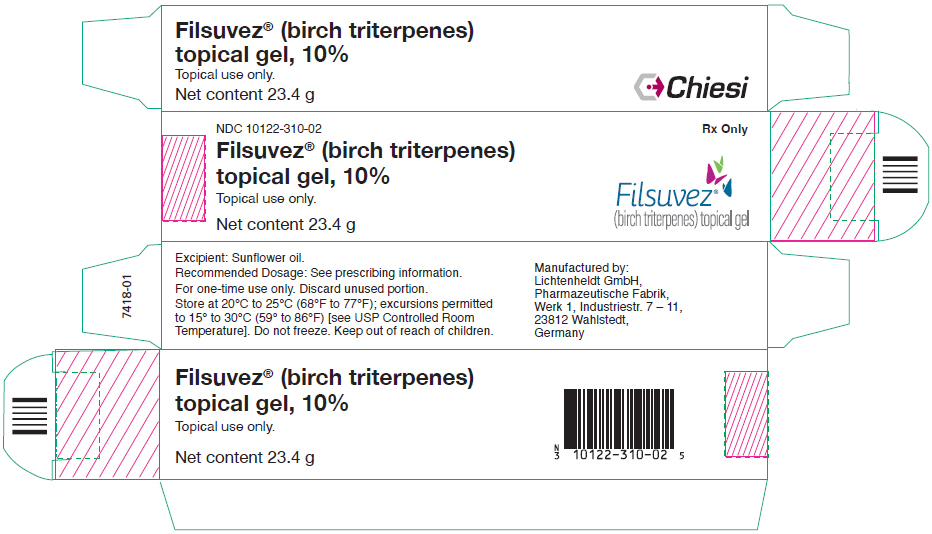
PRINCIPAL DISPLAY PANEL - 23.4 g Tube Carton NDC 10122-310-02 Rx Only Filsuvez ® (birch triterpenes) topical gel, 10% Topical use only. Net content 23.4 g Filsuvez ® (birch triterpenes) topical gel PRINCIPAL DISPLAY PANEL - 23.4 g Tube Carton
Medicaid utilization & spend
Medicare Part D spend CMS · PART D · 2026 (Q1)
Reported adverse events (FAERS)
Top reported reactions
Reporter sex
Serious outcomes
Where does this data come from?
About this NDC listing & data coverage
What data is (and isn’t) available for this NDC — tap to expand
| NDC identity (package / product / labeler codes) | ✓ Available |
| Labeler | ✓ Available |
| Product & package description | ✓ Available |
| Marketing category & status | ✓ Available |
| Active ingredient / dosage form / route | ✓ Available |
| FDA label (SPL via DailyMed) | ✓ Available |
| Package photos | ✓ Available |
| Inactive ingredients (structured) | ✓ Available |
| NADAC pharmacy acquisition price (CMS) | — Not published for this NDC CMS publishes NADAC only for NDCs reported in its retail-pharmacy survey. |
| Orange Book / therapeutic-equivalence data | ✓ Available |
| HCPCS J-code billing crosswalk | — Not published for this NDC Most self-administered / retail products have no J-code — that is normal. |
| Medicaid utilization (CMS SDUD) | ✓ Available |