
Plasbumin Albumin (Human) 5 g/20mL Solution — NDC 13533-692-20 (Billing 13533-0692-20)
This is a package of Plasbumin Albumin (Human) 5 g/20mL Solution from GRIFOLS USA, LLC, marketed since Sep 1994 and currently FDA-listed.
NDC database record
One package, one record: these facts belong to NDC 13533-692-20 alone.
- Record
- FDA NDC Directory package listing · Plasma derivative
- Code segments
- 13533 labeler · 692 product · 20 package
- Package marketed since
- Sep 26, 1994
- Sample package
- No — commercial package
- Listing certified through
- Dec 31, 2026
- Barcode (UPC-A, from the NDC)
- 3 1353369220 9
- FDA record last changed
- Oct 8, 2026
Identity & classification
Regulatory identifiers FDA, NLM and CMS codes for this package
Drug-database identifiers Medi-Span GPI and First Databank GCN / HICL / AHFS classification
- GSN (GCN sequence number): 006331
- GCN: 25060
- GPI-14 (Medi-Span): 85400010002015
- HICL (First Databank): 002728
- AHFS class code: 16:00.00.00
Where does this data come from?
- FDA openFDA NDC Directory · synced Oct 8, 2026
- FDA label on DailyMed · label index refreshed Oct 6, 2026
- RxNorm (NLM RxNav) · catalog refreshed Oct 1, 2026
- Medi-Span GPI (licensed)
- First Databank (licensed) · refreshed Oct 8, 2026
Clinical
Albumin (human) injection is used to treat low blood volume (hypovolemia) and low albumin levels in the blood (hypoalbuminemia) caused by bleeding, burns, major injuries or infections, malnutrition, major surgery, and other serious medical problems. It is also used during certain surgeries and medical treatments. Albumin (human) injection is in a class of medications called protein colloids. It works by keeping fluid from leaking out of blood vessels and helps to move important substances through the body.
Read the full MedlinePlus article ↗Patient education
Supplement & herbal interactions
Where does this data come from?
- MedlinePlus (NLM) · refreshed Oct 1, 2026
- FDA label on DailyMed · label index refreshed Oct 6, 2026
Ask a licensed pharmacist directly — free, answered by our team.
Pricing
A drug doesn't have one price. Each row is a different public payment system, and none is what you'd pay at the counter — that depends on your insurance. The ⓘ on each row explains what it measures.
| Price system | Per mL | Per package |
|---|---|---|
| Retail pharmacies payNADAC · weekly | Not in the retail survey — common for institutional, discontinued, or low-volume packs. | |
| Medicaid paysCMS SDUD · 12 mo | No recent Medicaid claims on file for this NDC — rare and low-volume NDCs are suppressed in the public data. | |
| Medicare drug plans payPart D · quarterly | No Part D plan price is available for this NDC in our data. | |
Where does this data come from?
- CMS NADAC weekly file
- CMS ASP pricing files · refreshed Sep 20, 2026
- CMS Medicaid State Drug Utilization Data · refreshed Oct 8, 2026
- CMS Part D plan pricing files · refreshed Sep 24, 2026
- VA National Acquisition Center price file
Packaging — all sizes for this product
| Package NDC | Description | Marketing start | Marketing end | Status |
|---|---|---|---|---|
| 13533-0692-16 13533-692-16 Main listing | 1 VIAL in 1 CARTON / 20 mL in 1 VIAL | 1994-09-26 | — | Active |
| 13533-0692-20 You're viewing this | 1 VIAL in 1 CARTON / 50 mL in 1 VIAL | 1994-09-26 | — | Active |
| 13533-0692-71 13533-692-71 | 1 VIAL in 1 CARTON / 100 mL in 1 VIAL | 1994-09-26 | — | Active |
Pack size FAQ
What quantity is in this package?
What NDC number is used to bill for this package of Plasbumin Albumin (Human) 5 g/20mL Solution?
Therapeutic equivalents
| Product | Labeler | Pack | NADAC/unit | TE | Status | Price vs. this |
|---|---|---|---|---|---|---|
| Albuked 5 g/20mL 76125-0792-10 | KEDRION | 1 vial | — | — | FDA listed | — |
| Plasbumin 5 g/20mLthis 13533-0692-20 | GRIFOLS | 1 vial | — | — | FDA listed | — |
| Albuked 5 g/20mL 50090-6320-01 | A-S | 25 vials | — | — | Discontinued | — |
Where does this data come from?
- FDA openFDA NDC Directory · synced Oct 8, 2026
- FDA Purple Book · refreshed Oct 5, 2026
- CMS NADAC weekly file
Availability & biosimilar status
Biologics have no small-molecule generics; biosimilar competition is tracked in the FDA Purple Book.
Where does this data come from?
- FDA Purple Book · refreshed Oct 5, 2026
Inactive Ingredients / Excipients
Inactive ingredients, also called excipients, are components of the drug product other than the active ingredient. They may include fillers, dyes, coatings, preservatives, flavors, or other formulation ingredients.
💡 Tap an ingredient (hover on desktop) to see what it is and why it’s used.
-
UNII 4460NBV53F
N-acetyl-DL-tryptophan is a modified form of the amino acid tryptophan. In medications, it typically serves as a buffering agent or pH regulator to maintain the product's chemical stability and effectiveness.
-
UNII 9XTM81VK2B
Sodium caprylate is a salt derived from caprylic acid, a naturally occurring fatty acid. In medicines, it acts as a preservative and antimicrobial agent to help prevent contamination and extend shelf life.
-
UNII 059QF0KO0R
Water is a liquid solvent that dissolves and mixes ingredients together in liquid medicines, syrups, and injections. It helps distribute the active drug evenly throughout the product.
3 inactive ingredients listed in the exact product block matched to this NDC.
Where does this data come from?
ingredient classCode="IACT" elements from the exact product block matched by this NDC. Label-section narrative from DailyMed / the openFDA label index is shown separately when available.- FDA label on DailyMed · label index refreshed Oct 6, 2026
- FDA openFDA NDC Directory · synced Oct 8, 2026
Inactive ingredient FAQ
Are inactive ingredients the same for every manufacturer?
Why might an inactive ingredient be missing?
Can inactive ingredients matter?
Manufacturer & labeler
More NDCs from GRIFOLS USA, LLC labeler code 13533
- HyperTET Tetanus Immune Globulin (Human) 250 [iU]/mL Injection NDC 13533-634-02
- GAMASTAN IMMUNE GLOBULIN (HUMAN) .165 g/mL Injection, Solution NDC 13533-635-04
- HYPERHEP B HEPATITIS B IMMUNE GLOBULIN (HUMAN) 220 [iU]/mL Injection NDC 13533-636-01
- HYPERRHO MINI-DOSE RHO(D) IMMUNE GLOBULIN (HUMAN) 250 [iU]/mL Solution NDC 13533-661-06
- Plasbumin Albumin (Human) 2.5 g/50mL Solution NDC 13533-690-20
- Plasbumin Albumin (Human) 10 g/50mL Solution NDC 13533-691-20
- Prolastin-C ALPHA-1-PROTEINASE Inhibitor (HUMAN) Kit NDC 13533-700-02
- Prolastin-C ALPHA-1-PROTEINASE Inhibitor (HUMAN) Kit NDC 13533-703-10
- Prolastin-C Liquid Alpha1-Proteinase Inhibitor (Human) 1000 mg/20mL Injection, Solution NDC 13533-705-01
- Prolastin-C ALPHA-1-PROTEINASE Inhibitor (HUMAN) Kit NDC 13533-706-22
- Gamunex-C Immune Globulin (Human) 10 g/100mL Injection NDC 13533-800-12
- Gamunex-C Immune Globulin (Human) 10 g/100mL Injection NDC 13533-805-01
Where does this data come from?
- FDA openFDA NDC Directory · synced Oct 8, 2026
- Drugs@FDA
Full FDA label FDA SPL
🎯 Indications and Usage ▾
INDICATIONS AND USAGE Emergency Treatment of Hypovolemic Shock Plasbumin-25 is hyperoncotic and on intravenous infusion will expand the plasma volume by an additional amount, three to four times the volume actually administered, by withdrawing fluid from the interstitial spaces, provided the patient is normally hydrated interstitially or there is interstitial edema. [1] If the patient is dehydrated, additional crystalloids must be given, [4] or alternatively, Albumin (Human) 5%, USP (Plasbumin ® -5) should be used. The patient ’ s hemodynamic response should be monitored and the usual precautions against circulatory overload observed.
The total dose should not exceed the level of albumin found in the normal individual, i.e., about 2 g per kg body weight in the absence of active bleeding. Although Plasbumin-5 is to be preferred for the usual volume deficits, Plasbumin-25 with appropriate crystalloids may offer therapeutic advantages in oncotic deficits or in long-standing shock where treatment has been delayed. [2] Removal of ascitic fluid from a patient with cirrhosis may cause changes in cardiovascular function and even result in hypovolemic shock.
In such circumstances, the use of an albumin infusion may be required to support the blood volume. [2] Burn Therapy An optimal therapeutic regimen with respect to the administration of colloids, crystalloids, and water following extensive burns has not been established. During the first 24 hours after sustaining thermal injury, large volumes of crystalloids are infused to restore the depleted extracellular fluid volume. Beyond 24 hours Plasbumin-25 can be used to maintain plasma colloid osmotic pressure.
Hypoproteinemia With or Without Edema During major surgery, patients can lose over half of their circulating albumin with the attendant complications of oncotic deficit. [2,4,5] A similar situation can occur in sepsis or intensive care patients. Treatment with Plasbumin-25 may be of value in such cases. [2] Adult Respiratory Distress Syndrome (ARDS) [2,5] This is characterized by deficient oxygenation caused by pulmonary interstitial edema complicating shock and postsurgical conditions. When clinical signs are those of hypoproteinemia with a fluid volume overload, Plasbumin-25 together with a diuretic may play a role in therapy.
Cardiopulmonary Bypass [2,6] With the relatively small priming volume required with modern pumps, preoperative dilution of the blood using albumin and crystalloid has been shown to be safe and well-tolerated. Although the limit to which the hematocrit and plasma protein concentration can be safely lowered has not been defined, it is common practice to adjust the albumin and crystalloid pump prime to achieve a hematocrit of 20% and a plasma albumin concentration of 2.5 g per 100 mL in the patient. Acute Liver Failure [2] In the uncommon situation of rapid loss of liver function with or without coma, administration of albumin may serve the double purpose of supporting the colloid osmotic pressure of the plasma as well as binding excess plasma bilirubin.
Neonatal Hemolytic Disease [2,3] The administration of Plasbumin-25 may be indicated prior to exchange transfusion, in order to bind free bilirubin, thus lessening the risk of kernicterus. A dosage of 1 g/kg body weight is given about 1 hour prior to exchange transfusion. Caution must be observed in hypervolemic infants.
Sequestration of Protein Rich Fluids [7] This occurs in such conditions as acute peritonitis, pancreatitis, mediastinitis, and extensive cellulitis. The magnitude of loss into the third space may require treatment of reduced volume or oncotic activity with an infusion of albumin. Erythrocyte Resuspension [2] Albumin may be required to avoid excessive hypoproteinemia, during certain types of exchange transfusion, or with the use of very large volumes of previously frozen or washed red cells.
About 25 g of albumin per liter of erythrocytes is commonly used, although the requirements in preexiste… [Excerpted — this section continues on DailyMed.]
⏱️ Dosage and Administration ▾
DOSAGE AND ADMINISTRATION Plasbumin-25 should always be administered by intravenous infusion. Plasbumin-25 may be administered either undiluted or diluted in 0.9% Sodium Chloride or 5% Dextrose in Water. If sodium restriction is required, Plasbumin-25 should only be administered either undiluted or diluted in a sodium-free carbohydrate solution such as 5% Dextrose in Water.
A number of factors beyond our control could reduce the efficacy of this product or even result in an ill effect following its use. These include improper storage and handling of the product after it leaves our hands, diagnosis, dosage, method of administration, and biological differences in individual patients. Because of these factors, it is important that this product be stored properly and that the directions be followed carefully during use.
Hypovolemic Shock —For treatment of hypovolemic shock, the volume administered and the speed of infusion should be adapted to the response of the individual patient. Burns —After a burn injury (usually beyond 24 hours) there is a close correlation between the amount of albumin infused and the resultant increase in plasma colloid osmotic pressure. The aim should be to maintain the plasma albumin concentration in the region of 2.5 ± 0.5 g per 100 mL with a plasma oncotic pressure of 20 mm Hg (equivalent to a total plasma protein concentration of 5.2 g per 100 mL). [2] This is best achieved by the intravenous administration of Plasbumin-25.
The duration of therapy is decided by the loss of protein from the burned areas and in the urine. In addition, oral or parenteral feeding with amino acids should be initiated, as the long-term administration of albumin should not be considered as a source of nutrition. Hypoproteinemia With or Without Edema —Unless the underlying pathology responsible for the hypoproteinemia can be corrected, the intravenous administration of Plasbumin-25 must be considered purely symptomatic or supportive (see section Situations in Which Albumin Administration is Not Warranted ) . [2] The usual daily dose of albumin for adults is 50 to 75 g and for children 25 g.
Patients with severe hypoproteinemia who continue to lose albumin may require larger quantities. Since hypoproteinemic patients usually have approximately normal blood volumes, the rate of administration of Plasbumin-25 should not exceed 2 mL per minute, as more rapid injection may precipitate circulatory embarrassment and pulmonary edema. Other dosage recommendations are given under the specific indications referred to above.
Preparation for Administration Remove seal to expose stopper. Always swab stopper top immediately with a suitable antiseptic prior to entering vial. Parenteral drug products should be inspected visually for particulate matter and discoloration prior to administration, whenever solution and container permit.
Only 16 gauge needles or dispensing pins should be used with 20 mL vial sizes and larger. Needles or dispensing pins should only be inserted within the stopper area delineated by the raised ring. The stopper should be penetrated perpendicular to the plane of the stopper within the ring.
⛔ Contraindications ▾
CONTRAINDICATIONS Certain patients, e.g., those with a history of congestive cardiac failure, renal insufficiency or stabilized chronic anemia, are at special risk of developing circulatory overload. A history of an allergic reaction to albumin is a specific contraindication to usage.
⚠️ Warnings ▾
WARNINGS Plasbumin-25 is made from human plasma. Products made from human plasma may contain infectious agents, such as viruses, and, theorectically, the Creutzfeldt-Jakob Disease (CJD) agent that can cause disease. The theoretical risk for transmission of CJD is considered extremely remote.
No cases of transmission of viral diseases or CJD have ever been identified for albumin. The risk that such products will transmit an infectious agent has been reduced by screening plasma donors for prior exposure to certain viruses, by testing for the presence of certain current virus infections, and by inactivating and/or removing certain viruses. Despite these measures, such products can still potentially transmit disease.
There is also the possibility that unknown infectious agents may be present in such products. Individuals who receive infusions of blood or plasma products may develop signs and/or symptoms of some viral infections, particularly hepatitis C. ALL infections thought by a physician possibly to have been transmitted by this product should be reported by the physician or other healthcare provider to Talecris Biotherapeutics, Inc. [1-800-520-2807].
The physician should discuss the risks and benefits of this product with the patient, before prescribing or administering it to the patient. As with any hyperoncotic protein solution likely to be administered in large volumes, severe hemolysis and acute renal failure may result from the inappropriate use of Sterile Water for Injection as a diluent for Albumin (Human), 25%. Acceptable diluents include 0.9% Sodium Chloride or 5% Dextrose in Water.
Please refer to the DOSAGE AND ADMINISTRATION section for recommended diluents. Solutions which have been frozen should not be used. Do not use if turbid.
Do not begin administration more than 4 hours after the container has been entered. Partially used vials must be discarded. Vials which are cracked or which have been previously entered or damaged should not be used, as this may have allowed the entry of microorganisms.
Albumin (Human) 25%, USP (Plasbumin ® -25) contains no preservative.
🤒 Adverse Reactions ▾
ADVERSE REACTIONS Adverse reactions to albumin are rare. Such reactions may be allergic in nature or due to high plasma protein levels from excessive albumin administration. Allergic manifestations include urticaria, chills, fever, and changes in respiration, pulse and blood pressure.
🧬 Clinical Pharmacology ▾
CLINICAL PHARMACOLOGY Each 20 mL vial of Plasbumin-25 supplies the oncotic equivalent of approximately 100 mL citrated plasma; 50 mL supplies the oncotic equivalent of approximately 250 mL citrated plasma. When administered intravenously to an adequately hydrated subject, the oncotic (colloid osmotic) effect of 20 mL Plasbumin-25 is such that it will draw approximately a further 70 mL of fluid from the extravascular tissues into the circulation within 15 minutes, [1] thus increasing the total blood volume and reducing both hemoconcentration and whole blood viscosity.
Accordingly, the main clinical indications are for hypoproteinemic states involving reduced oncotic pressure, with or without accompanying edema. [2] Plasbumin-25 can also be used as a plasma volume expander. Albumin is a transport protein and it may be useful in severe hemolytic disease in the neonate who is awaiting exchange transfusion. The infused albumin may reduce the level of free bilirubin in the blood. [3] This could also be of importance in acute liver failure where albumin might serve the dual role of supporting plasma oncotic pressure, as well as binding excessive plasma bilirubin. [2]
📦 How Supplied / Storage and Handling ▾
HOW SUPPLIED Plasbumin-25 is available in 20 mL, 50 mL, and 100 mL rubber-stoppered vials. Each single dose vial contains albumin in the following approximate amounts: NDC Number Size Grams Protein 13533-692-16 20 mL 5.0 13533-692-20 50 mL 12.5 13533-692-71 100 mL 25.0
📦 Storage and Handling ▾
STORAGE Store at room temperature not exceeding 30°C (86°F). Do not freeze. Do not use after expiration date. CAUTION Rx only U.S. federal law prohibits dispensing without prescription.
📋 Description ▾
DESCRIPTION Albumin (Human) 25%, USP (Plasbumin ® -25) is made from pooled human venous plasma using the Cohn cold ethanol fractionation process. Part of the fractionation may be performed by another licensed manufacturer. It is prepared in accordance with the applicable requirements established by the U.S. Food and Drug Administration. Plasbumin-25 is a 25% sterile solution of albumin in an aqueous diluent. The preparation is stabilized with
0.02 M sodium caprylate and
0.02M acetyltryptophan. The aluminum content of the product is not more than 200 µg/L. The approximate sodium content of the product is 145 mEq/L.
It contains no preservative. Plasbumin-25 must be administered intravenously. Each vial of Plasbumin-25 is heat-treated at 60°C for 10 hours against the possibility of transmitting the hepatitis viruses.
Additionally, the manufacturing process was investigated for its capacity to decrease the infectivity of an experimental agent of transmissible spongiform encephalopathy (TSE), considered as a model for the variant Creutzfeldt-Jakob disease (vCJD) and Creutzfeldt-Jakob disease (CJD) agents. [11-14] The production steps from Pooled Plasma to Effluent IV‑1 in the Plasbumin-25 manufacturing process have been shown to decrease TSE infectivity of that experimental model agent (a total of ≥ 7.0 logs). These studies provide reasonable assurance that low levels of vCJD/CJD agent infectivity, if present in the starting material, would be removed.
Plasbumin 25 L/A Label
⚠️ Precautions ▾
PRECAUTIONS General Patients should always be monitored carefully in order to guard against the possibility of circulatory overload. Plasbumin-25 is hyperoncotic, therefore, in the presence of dehydration, albumin must be given with or followed by addition of fluids. [4] In hemorrhage the administration of albumin should be supplemented by the transfusion of whole blood to treat the relative anemia associated with hemodilution. [8] When circulating blood volume has been reduced, hemodilution following the administration of albumin persists for many hours.
In patients with a normal blood volume, hemodilution lasts for a much shorter period. [4,9,10] The rapid rise in blood pressure which may follow the administration of a colloid with positive oncotic activity necessitates careful observation to detect and treat severed blood vessels which may not have bled at the lower blood pressure. Drug Interactions Plasbumin-25 is compatible with whole blood, packed red cells, as well as the standard carbohydrate and electrolyte solutions intended for intravenous use. It should, however, not be mixed with protein hydrolysates, amino acid solutions nor those containing alcohol.
Pregnancy Category C Animal reproduction studies have not been conducted with Plasbumin-25. It is also not known whether Plasbumin-25 can cause fetal harm when administered to a pregnant woman or can affect reproduction capacity. Plasbumin-25 should be given to a pregnant woman only if clearly needed.
Pediatric Use Safety and effectiveness in the pediatric population have not been established.
📚 References ▾
REFERENCES Heyl JT, Gibson JG II, Janeway CA: Studies on the plasma proteins. V. The effect of concentrated solutions of human and bovine serum albumin on blood volume after acute blood loss in man.
J Clin Invest 22:763-73, 1943. Tullis JL: Albumin. 1.
Background and use. 2. Guidelines for clinical use.
JAMA 237:355-60; 460-3, 1977. Comley A, Wood B: Albumin administration in exchange transfusion for hyperbilirubinaemia. Arch Dis Child 43:151-4, 1968.
Janeway CA, Gibson ST, Woodruff LM, et al: Chemical, clinical, and immunological studies on the products of human plasma fractionation. VII. Concentrated human serum albumin.
J Clin Invest 23:465-90, 1944. Skillman JJ, Tanenbaum BJ: Unrecognized losses of albumin, plasma, and red cells during abdominal vascular operations. Curr Top Surg Res 2:523-33, 1970.
Zubiate P, Kay JH, Mendez AM, et al: Coronary artery surgery: a new technique with use of little blood, if any. J Thorac Cardiovasc Surg 68(2):263-7, 1974. Clowes GHA Jr, Vucinic M, Weidner MG: Circulatory and metabolic alterations associated with survival or death in peritonitis: clinical analysis of 25 cases.
Ann Surg 163:866-85,1966. Heyl JT, Janeway CA: The use of human albumin in military medicine. I.
The theoretical and experimental basis for its use. US Navy Med Bull 40:785-91, 1942. Woodruff LM, Gibson ST: The clinical evaluation of human albumin.
US Navy Med Bull 40:791-6, 1942. Janeway CA, Berenberg W, Hutchins G: Indications and uses of blood, blood derivatives and blood substitutes. Med Clin North Am 29:1069-94, 1945.
Stenland CJ, Lee DC, Brown P, et al: Partitioning of human and sheep forms of the pathogenic prion protein during the purification of therapeutic proteins from human plasma. Transfusion 2002. 42(11):1497-500.
Lee DC, Stenland CJ, Miller JL, et al: A direct relationship between the partitioning of the pathogenic prion protein and transmissible spongiform encephalopathy infectivity during the purification of plasma proteins. Transfusion 2001. 41(4):449-55.
Lee DC, Stenland CJ, Hartwell RC, et al: Monitoring plasma processing steps with a sensitive Western blot assay for the detection of the prion protein. J Virol Methods 2000. 84(1):77-89.
Cai K, Miller JL, Stenland CJ, et al: Solvent-dependent precipitation of prion protein. Biochim Biophys Acta 2002. 1597(1):28-35.
08940017 (Rev. April 2010) Talecris Biotherapeutics, Inc. Research Triangle Park, NC 27709 USA U.S.
License No. 1716
📄 Package Label / Principal Display Panel ▾
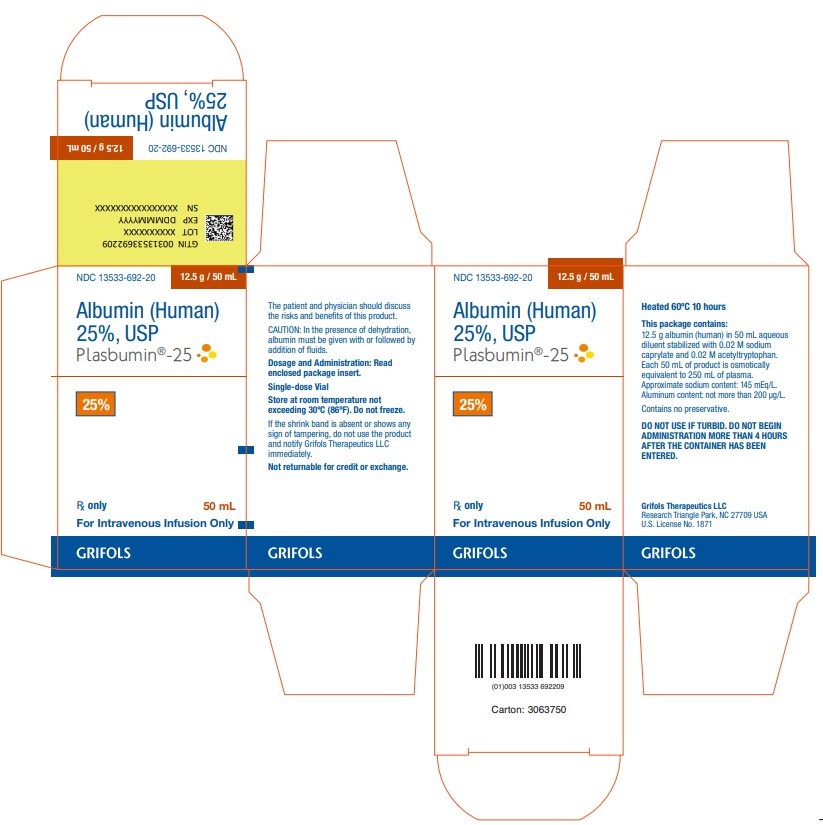
PACKAGE LABEL Albumin (Human) 25%, USP Plasbumin ® -25 Heated 60°C 10 hours For Intravenous Use Only This package contains: 12.5 g albumin(human) in 50 mL aqueous diluent buffered with sodium carbonate and stabilized with
0.02 M sodium caprylate and
0.02M acetyltryptophan. Each 50 mL of product is osmotically equivalent to 250 mL of plasma. Approximate sodium content: 145 mEq/L.
Aluminum content not more than 200 µg/L. Contains no preservative. DO NOT USE IF TURBID.
DO NOT BEGIN ADMINISTRATION MORE THAN 4 HOURS AFTER THE CONTAINER HAS BEEN ENTERED. 50 mL Talecris Biotherapeutics NDC 13533-692-20 The patient and physician should discuss the risks and benefits of this product. CAUTION: In the presence of dehydration, albumin must be given with or followed by addition of fluids.
Dosage and Administration: Read enclosed package insert. Single Dose Vial Store at room temperature not exceeding 30°C (86°F). Do not freeze.
If the shrink band is absent or shows any sign of tampering, do not use the product and notify Talecris Biotherapeutics, Inc. immediately. Not returnable for credit or exchange. CAUTION: U.S. federal law prohibits dispensing without prescription.
Rx only 08909035 Talecris Biotherapeutics, Inc. Research Triangle Park, NC 27709 USA U.S. License No.
1716
Medicare Part D spend CMS · PART D · 2025 (Q1-Q4)
Reported adverse events (FAERS)
Top reported reactions
Age at onset
Reporter sex
Serious outcomes
Where does this data come from?
About this NDC listing & data coverage
What data is (and isn’t) available for this NDC — tap to expand
| NDC identity (package / product / labeler codes) | ✓ Available |
| Labeler | ✓ Available |
| Product & package description | ✓ Available |
| Marketing category & status | ✓ Available |
| Active ingredient / dosage form / route | ✓ Available |
| FDA label (SPL via DailyMed) | ✓ Available |
| Package photos | ✓ Available |
| Inactive ingredients (structured) | ✓ Available |
| NADAC pharmacy acquisition price (CMS) | — Not published for this NDC CMS publishes NADAC only for NDCs reported in its retail-pharmacy survey. |
| Orange Book / therapeutic-equivalence data | — Not published for this NDC Applies only to products approved under an NDA/ANDA; many listings are out of scope. |
| HCPCS J-code billing crosswalk | — Not published for this NDC Most self-administered / retail products have no J-code — that is normal. |
| Medicaid utilization (CMS SDUD) | — Not published for this NDC CMS reports utilization only for NDCs with Medicaid claims above its privacy threshold. |