
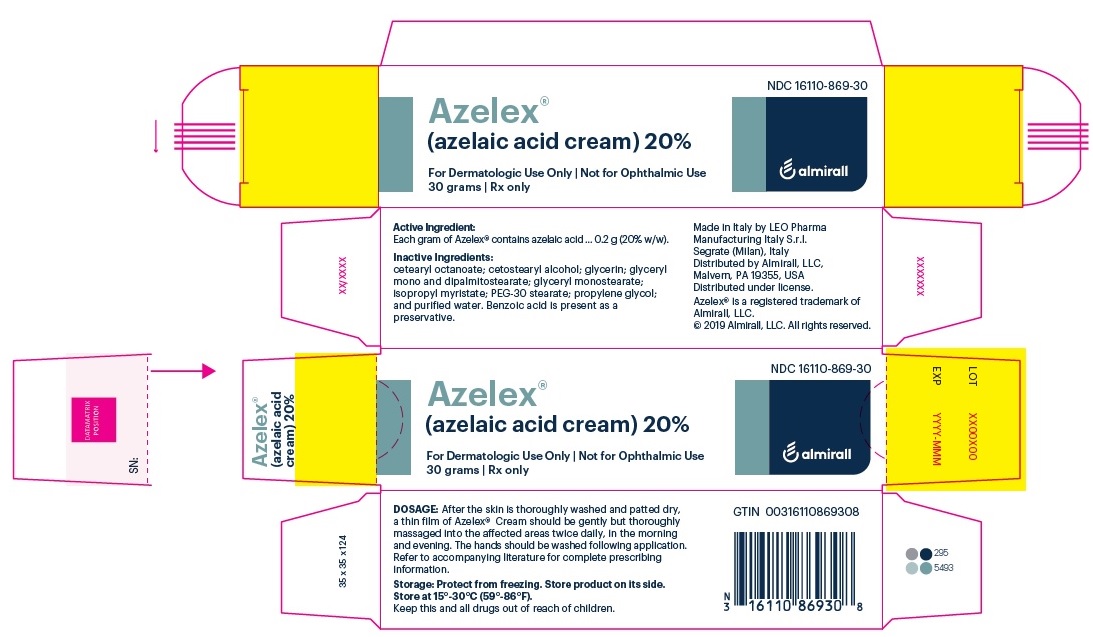
AZELEX azelaic acid .2 g/g Cream
Other active recalls for Azelaic Acid (different manufacturers) — 3 · tap to view
🆔 Identity & classification
Where does this data come from?
🏷️ RxNorm drug class
This medicine belongs to the Other anti-acne preparations for topical use class.
Where does this data come from?
🏭 Manufacturer & labeler
Where does this data come from?
🩺 Clinical
Azelaic acid gel and foam is used to clear the bumps, lesions, and swelling caused by rosacea (a skin disease that causes redness, flushing, and pimples on the face). Azelaic acid cream is used to treat the pimples and swelling caused by acne. Azelaic acid is in a class of medications called dicarboxylic acids. It works to treat rosacea by decreasing the swelling and redness of the skin. It works to treat acne by killing the bacteria that infect pores and by decreasing production of keratin, a natural substance that can lead to the development of acne.
Read the full MedlinePlus article ↗- It's used to treat the red bumps and pimples that come with mild to moderate rosacea — a chronic skin condition that mainly affects the face. It's applied directly to the skin, not...
- Yes, that's actually one of the most commonly reported side effects, especially in the first few weeks of use. It usually settles down as your skin adjusts. That said, if the irrit...
- My skin is burning and stinging after I apply it — is that normal?
- Shake the can well before each use. Gently wash your face with a mild cleanser, pat it dry, then apply a thin layer of foam to your whole face — cheeks, chin, forehead, and nose —...
Patient education
Supplement & herbal interactions
Some supplements/herbs that may interact with Azelaic Acid — tap one for details:
Where does this data come from?
Ask a licensed pharmacist directly — free, answered by our team.
🧪 Inactive Ingredients / Excipients
Inactive ingredients, also called excipients, are components of the drug product other than the active ingredient. They may include fillers, dyes, coatings, preservatives, flavors, or other formulation ingredients.
💡 Tap an ingredient (hover on desktop) to see what it is and why it’s used.
-
UNII 8SKN0B0MIM
Benzoic acid is a naturally occurring organic acid used as a preservative in medicines and foods. It helps prevent bacterial and fungal growth to extend shelf life and maintain product stability.
-
UNII 9M64UO4C25
A synthetic oily substance used as an emollient and texture enhancer in medicines. It helps soften formulations, improves how the medicine spreads or feels on skin, and can act as a lubricant in tablets or capsules.
-
UNII 2DMT128M1S
A waxy solid derived from plant or animal sources. It acts as an emulsifier to blend oil and water components, and also thickens the medicine to give it the right texture and consistency.
-
UNII PDC6A3C0OX
Glycerin is a clear, thick liquid derived from plant oils or fats. It acts as a humectant to retain moisture, a sweetener, and a solvent in medications.
-
UNII KC98RO82HJ
A waxy substance made from glycerin and fatty acids. It acts as an emulsifier to help mix oil and water components, and as a thickener to give the medicine proper texture and consistency.
-
UNII 230OU9XXE4
A waxy substance made from glycerin and stearic acid that acts as an emulsifier to blend oily and watery ingredients together. It also helps thicken and stabilize the medicine's texture.
-
UNII 0RE8K4LNJS
Isopropyl myristate is an oily liquid made from coconut or palm oil. It's used in medicines as an emollient and penetration enhancer to help the medicine absorb through skin or improve spreadability in topical products.
-
UNII 1U8KB35S20
PEG-30 Stearate is a man-made ingredient made by combining polyethylene glycol with stearic acid. It works as an emulsifier and surfactant to help mix oil and water-based ingredients together in the medicine.
-
UNII 6DC9Q167V3
Propylene glycol is a clear liquid derived from petroleum or vegetable sources. It acts as a solvent, humectant, and preservative in medicines, helping dissolve active ingredients and maintain product stability.
-
UNII 059QF0KO0R
Water is a liquid solvent that dissolves and mixes ingredients together in liquid medicines, syrups, and injections. It helps distribute the active drug evenly throughout the product.
10 inactive ingredients listed in the exact product block matched to this NDC.
Where does this data come from?
ingredient classCode="IACT" elements from the exact product block matched by this NDC. Label-section narrative from DailyMed / the openFDA label index is shown separately when available.Inactive ingredient FAQ
Are inactive ingredients the same for every manufacturer?
Why might an inactive ingredient be missing?
Can inactive ingredients matter?
💲 Pricing
A drug doesn't have one price. Each row is a different public payment system, and none is what you'd pay at the counter — that depends on your insurance. The ⓘ on each row explains what it measures.
| Price system | Per g | Per package |
|---|---|---|
| Retail pharmacies payNADAC · weekly | Not in the retail survey — common for institutional, discontinued, or low-volume packs. | |
| Medicaid paysCMS SDUD · 12 mo | No recent Medicaid claims on file for this NDC — rare and low-volume NDCs are suppressed in the public data. | |
| Medicare drug plans payPart D · Q2 2026 | $18.97 | $569.21 / 30 g |
Where does this data come from?
🔁 Therapeutic equivalents
| Product | Labeler | Pack | NADAC/unit | TE | Status | Price vs. this |
|---|---|---|---|---|---|---|
| Azelex .2 g/gthis 16110-0869-30 | Almirall, | 1 tube | — | — | FDA listed | — |
Where does this data come from?
⏳ Availability & generic status
We did not find an FDA-approved generic match for this exact strength, form and route.
Where does this data come from?
📊 Medicare Part D spend CMS · PART D · 2026 (Q1)
📦 Packaging — all sizes for this product
| Package NDC | Description | Marketing start | Status |
|---|---|---|---|
| 16110-0869-30 You're viewing this | 1 TUBE in 1 CARTON (16110-869-30) / 30 g in 1 TUBE | 2019-07-12 | Active |
| 16110-0869-50 | 1 TUBE in 1 CARTON (16110-869-50) / 50 g in 1 TUBE | 2019-07-12 | Active |
Pack size FAQ
What quantity is in NDC 16110-0869-30?
What NDC number is used to bill for this package of AZELEX azelaic acid .2 g/g Cream?
🧭 About this NDC listing & data coverage
What data is (and isn’t) available for this NDC — tap to expand
| NDC identity (package / product / labeler codes) | ✓ Available |
| Labeler | ✓ Available |
| Product & package description | ✓ Available |
| Marketing category & status | ✓ Available |
| Active ingredient / dosage form / route | ✓ Available |
| FDA label (SPL via DailyMed) | ✓ Available |
| Package photos | ✓ Available |
| Inactive ingredients (structured) | ✓ Available |
| NADAC pharmacy acquisition price (CMS) | — Not published for this NDC CMS publishes NADAC only for NDCs reported in its retail-pharmacy survey. |
| Orange Book / therapeutic-equivalence data | — Not published for this NDC Applies only to products approved under an NDA/ANDA; many listings are out of scope. |
| HCPCS J-code billing crosswalk | — Not published for this NDC Most self-administered / retail products have no J-code — that is normal. |
| Medicaid utilization (CMS SDUD) | — Not published for this NDC CMS reports utilization only for NDCs with Medicaid claims above its privacy threshold. |
Questions about this listing
Why is there no price listed?
Is the NDC printed on the package the same as the 11-digit billing NDC?
What do the three segments of this NDC mean?
Is this package still being marketed?
Does this product come in other package sizes?
Who lists this product with the FDA?
Do I need a prescription for this product?
Where does this data come from?
📄 Full prescribing information FDA SPL
🎯 Indications and Usage ▾
INDICATIONS AND USAGE AZELEX ® cream is indicated for the topical treatment of mild-to-moderate inflammatory acne vulgaris.
⏱️ Dosage and Administration ▾
DOSAGE AND ADMINISTRATION After the skin is thoroughly washed and patted dry, a thin film of AZELEX ® cream should be gently but thoroughly massaged into the affected areas twice daily, in the morning and evening. The hands should be washed following application. The duration of use of AZELEX ® cream can vary from person to person and depends on the severity of the acne.
Improvement of the condition occurs in the majority of patients with inflammatory lesions within four weeks.
⛔ Contraindications ▾
CONTRAINDICATIONS AZELEX ® cream is contraindicated in individuals who have shown hypersensitivity to any of its components.
⚠️ Warnings ▾
WARNINGS AZELEX ® cream is for dermatologic use only and not for ophthalmic use. There have been isolated reports of hypopigmentation after use of azelaic acid. Since azelaic acid has not been well studied in patients with dark complexions, these patients should be monitored for early signs of hypopigmentation.
🤒 Adverse Reactions ▾
ADVERSE REACTIONS During U.S. clinical trials with AZELEX ® cream, adverse reactions were generally mild and transient in nature. The most common adverse reactions occurring in approximately 1-5% of patients were pruritus, burning, stinging and tingling. Other adverse reactions such as erythema, dryness, rash, peeling, irritation, dermatitis, and contact dermatitis were reported in less than 1% of subjects.
There is the potential for experiencing allergic reactions with use of AZELEX ® cream. In patients using azelaic acid formulations, the following additional adverse experiences have been reported rarely: worsening of asthma, vitiligo depigmentation, small depigmented spots, hypertrichosis, reddening (signs of keratosis pilaris), and exacerbation of recurrent herpes labialis.
🤰 Pregnancy ▾
Pregnancy Teratogenic Effects Embryotoxic effects were observed in Segment I and Segment II oral studies with rats receiving 2500 mg/kg/day of azelaic acid. Similar effects were observed in Segment II studies in rabbits given 150 to 500 mg/kg/day and in monkeys given 500 mg/kg/day. The doses at which these effects were noted were all within toxic dose ranges for the dams.
No teratogenic effects were observed. There are, however, no adequate and well-controlled studies in pregnant women. Because animal reproduction studies are not always predictive of human response, this drug should be used during pregnancy only if clearly needed.
🧒 Pediatric Use ▾
Pediatric Use Safety and effectiveness in pediatric patients under 12 years of age have not been established.
🧓 Geriatric Use ▾
Geriatric Use Clinical studies of AZELEX ® cream did not include sufficient numbers of subjects aged 65 and over to determine whether they respond differently from younger subjects.
🧬 Clinical Pharmacology ▾
CLINICAL PHARMACOLOGY The exact mechanism of action of azelaic acid is not known. The following in vitro data are available, but their clinical significance is unknown. Azelaic acid has been shown to possess antimicrobial activity against Propionibacterium acnes and Staphylococcus epidermidis.
The antimicrobial action may be attributable to inhibition of microbial cellular protein synthesis. A normalization of keratinization leading to an anticomedonal effect of azelaic acid may also contribute to its clinical activity. Electron microscopic and immunohistochemical evaluation of skin biopsies from human subjects treated with AZELEX ® cream demonstrated a reduction in the thickness of the stratum corneum, a reduction in number and size of keratohyalin granules, and a reduction in the amount and distribution of filaggrin (a protein component of keratohyalin) in epidermal layers.
This is suggestive of the ability to decrease microcomedo formation. Pharmacokinetics Following a single application of AZELEX ® cream to human skin in vitro , azelaic acid penetrates into the stratum corneum (approximately 3 to 5% of the applied dose) and other viable skin layers (up to 10% of the dose is found in the epidermis and dermis). Negligible cutaneous metabolism occurs after topical application.
Approximately 4% of the topically applied azelaic acid is systemically absorbed. Azelaic acid is mainly excreted unchanged in the urine but undergoes some β-oxidation to shorter chain dicarboxylic acids. The observed half-lives in healthy subjects are approximately 45 minutes after oral dosing and 12 hours after topical dosing, indicating percutaneous absorption rate-limited kinetics.
Azelaic acid is a dietary constituent (whole grain cereals and animal products), and can be formed endogenously from longer-chain dicarboxylic acids, metabolism of oleic acid, and ψ-oxidation of monocarboxylic acids. Endogenous plasma concentration (20 to 80 ng/mL) and daily urinary excretion (4 to 28 mg) of azelaic acid are highly dependent on dietary intake. After topical treatment with AZELEX ® cream in humans, plasma concentration and urinary excretion of azelaic acid are not significantly different from baseline levels.
📦 How Supplied / Storage and Handling ▾
HOW SUPPLIED AZELEX ® cream is supplied in a closed orifice tube with a white, spiked screwcap in the following sizes: 30 g - NDC 16110-869-30 50 g - NDC 16110-869-50 Storage: Protect from freezing. Store product on its side. Store at 15°-30° C (59°-86° F).
Revised: 02/2024 Distributed by Almirall, LLC, Malvern, PA 19355, U.S.A. © 2019 Almirall. All right reserved. ® marks owned by Almirall, LLC. Made in Italy by LEO Pharma Manufacturing Italy S.r.l., Segrate (Milan), Italy
📋 Description ▾
DESCRIPTION AZELEX ® (azelaic acid cream) 20% contains azelaic acid, a naturally occurring saturated dicarboxylic acid. Structural Formula: HOOC-(CH 2 ) 7 -COOH Chemical Name: 1,7-heptanedicarboxylic acid Empirical Formula: C 9 H 16 O 4 Molecular Weight: 188.22 Active Ingredient: Each gram of AZELEX ® contains azelaic acid......... 0.2 g (20% w/w).
Inactive Ingredients: cetearyl octanoate; cetostearyl alcohol; glycerin; glyceryl mono and dipalmitostearate; glyceryl monostearate; isopropyl myristate; PEG-30 stearate; propylene glycol; and purified water. Benzoic acid is present as a preservative.
💬 Information for Patients ▾
Information for Patients Patients should be told: To use AZELEX ® cream for the full prescribed treatment period. To avoid the use of occlusive dressings or wrappings. To keep AZELEX ® cream away from the mouth, eyes and other mucous membranes.
If it does come in contact with the eyes, they should wash their eyes with large amounts of water and consult a physician if eye irritation persists. If they have dark complexions, to report abnormal changes in skin color to their physician. Due in part to the low pH of azelaic acid, temporary skin irritation (pruritus, burning, or stinging) may occur when AZELEX ® cream is applied to broken or inflamed skin, usually at the start of treatment.
However, this irritation commonly subsides if treatment is continued. If it continues, AZELEX