
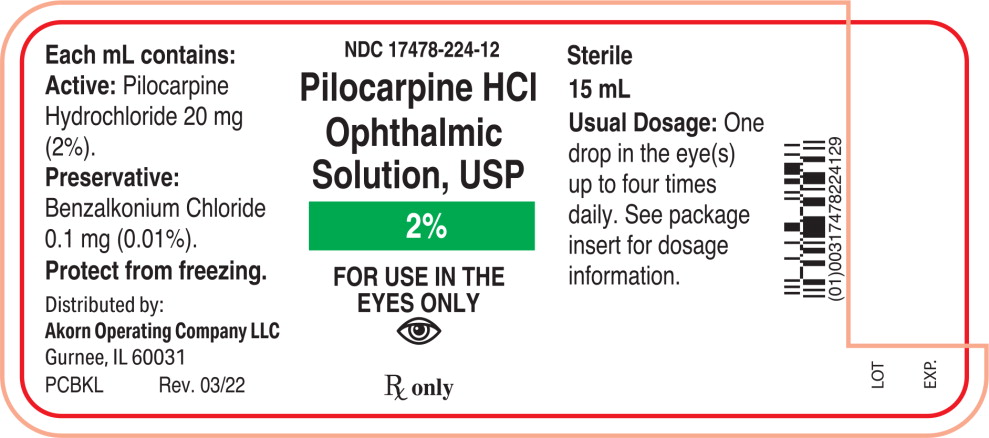
Pilocarpine Hydrochloride 20 mg/mL Solution/ Drops
🆔 Identity & classification
Where does this data come from?
🏭 Manufacturer & labeler
Where does this data come from?
🩺 Clinical
- Actually, pilocarpine for dry mouth comes as a tablet you swallow — not the same as the eye drops. The eye drops treat glaucoma and a condition called presbyopia (trouble focusing...
- I have two different conditions — can the same pilocarpine drop treat both glaucoma and my dry eyes?
- You may notice some improvement in saliva production fairly quickly, but for dry mouth related to head and neck radiation, it can take up to 12 weeks of consistent use to know if t...
- I started the tablets for dry mouth — when will I notice a difference?
Patient education
Supplement & herbal interactions
Where does this data come from?
Ask a licensed pharmacist directly — free, answered by our team.
🧪 Inactive Ingredients / Excipients
Inactive ingredients, also called excipients, are components of the drug product other than the active ingredient. They may include fillers, dyes, coatings, preservatives, flavors, or other formulation ingredients.
Where does this data come from?
IACT rows and label-wide narrative are kept separate; availability and product-level specificity depend on the submitted label.Inactive ingredient FAQ
Are inactive ingredients the same for every manufacturer?
Why might an inactive ingredient be missing?
Can inactive ingredients matter?
💲 Pricing
A drug doesn't have one price. Each row is a different public payment system, and none is what you'd pay at the counter — that depends on your insurance. The ⓘ on each row explains what it measures.
| Price system | Per mL | Per package |
|---|---|---|
| Retail pharmacies payNADAC · weekly | $4.236 | $63.54 / 15 ml |
| Medicaid paysCMS SDUD · 12 mo | No recent Medicaid claims on file for this NDC — rare and low-volume NDCs are suppressed in the public data. | |
| Medicare drug plans payPart D · quarterly | No Part D plan price is available for this NDC in our data. | |
Where does this data come from?
🔁 Therapeutic equivalents
| Product | Labeler | Pack | NADAC/unit | TE | Status | Price vs. this |
|---|---|---|---|---|---|---|
| Pilocarpine Hydrochloride 20 mg/mLthis 17478-0224-12 | Akorn | 1 bottle | $4.236 | AT | Discontinued | — |
Where does this data come from?
⏳ Availability & generic status
This product is an FDA-approved generic. Other versions of the same drug are listed under Therapeutic equivalents, least expensive first.
Where does this data come from?
🔬 Reported adverse events (FAERS)
Top reported reactions
Age at onset
Reporter sex
Serious outcomes
Where does this data come from?
📦 Packaging — all sizes for this product
| Package NDC | Description | Marketing start | Status |
|---|---|---|---|
| 17478-0224-12 You're viewing this | 1 BOTTLE, DROPPER in 1 CARTON (17478-224-12) / 15 mL in 1 BOTTLE, DROPPER | 2017-09-28 | Inactivated by FDA |
🧭 About this NDC listing & data coverage
What data is (and isn’t) available for this NDC — tap to expand
| NDC identity (package / product / labeler codes) | ✓ Available |
| Labeler | ✓ Available |
| Product & package description | ✓ Available |
| Marketing category & status | ✓ Available |
| Active ingredient / dosage form / route | ✓ Available |
| FDA label (SPL via DailyMed) | ✓ Available |
| Package photos | ✓ Available |
| Inactive ingredients (structured) | — Not published for this NDC The labeler did not submit a structured excipient list, or no SPL is available. |
| NADAC pharmacy acquisition price (CMS) | ✓ Available |
| Orange Book / therapeutic-equivalence data | ✓ Available |
| HCPCS J-code billing crosswalk | — Not published for this NDC Most self-administered / retail products have no J-code — that is normal. |
| Medicaid utilization (CMS SDUD) | — Not published for this NDC CMS reports utilization only for NDCs with Medicaid claims above its privacy threshold. |
Questions about this listing
What does the discontinued status mean for this NDC?
Is the NDC printed on the package the same as the 11-digit billing NDC?
What do the three segments of this NDC mean?
Who lists this product with the FDA?
Do I need a prescription for this product?
Where does this data come from?
📄 Full prescribing information FDA SPL
🎯 Indications and Usage ▾
1 INDICATIONS AND USAGE Pilocarpine hydrochloride ophthalmic solution is indicated for the: Pilocarpine hydrochloride ophthalmic solution is a muscarinic cholinergic agonist indicated for The reduction of elevated intraocular pressure (IOP) in patients with open-angle glaucoma or ocular hypertension ( 1.1 ) The management of acute angle-closure glaucoma ( 1.2 ) The prevention of postoperative elevated IOP associated with laser surgery ( 1.3 ) The induction of miosis ( 1.4 )
1.1Reduction of Elevated Intraocular Pressure (IOP) in Patients with Open-Angle Glaucoma or Ocular Hypertension
1.2 Management of Acute Angle-Closure Glaucoma
1.3 Prevention of Postoperative Elevated IOP Associated with Laser Surgery
1.4 Induction of Miosis
⏱️ Dosage and Administration ▾
2 DOSAGE AND ADMINISTRATION Instill one drop in the eye(s) up to four times daily ( 2 ).
2.1Reduction of Elevated Intraocular Pressure (IOP) in Patients with Open-Angle Glaucoma or Ocular Hypertension One drop of pilocarpine hydrochloride ophthalmic solution 1%, 2% or 4% should be applied topically in the eye(s) up to four times daily. Pilocarpine-naïve patients should be started on the 1% concentration as higher concentrations are often not tolerated initially. The frequency of instillation and concentration of pilocarpine hydrochloride ophthalmic solution are determined by the severity of the elevated intraocular pressure and miotic response of the patient.
To limit systemic exposure to pilocarpine, patients may be instructed to perform punctal occlusion for 2 minutes after instillation of pilocarpine hydrochloride ophthalmic solution.
2.2Management of Acute Angle-Closure Glaucoma Prior to pilocarpine hydrochloride ophthalmic solution use, treatment with secretory suppressants and hyperosmotic agents may be needed to lower IOP below 50 mmHg and relieve iris ischemia. For initial management of acute angle-closure glaucoma, one drop of pilocarpine hydrochloride ophthalmic solution 1% or 2% may be applied topically in the eye(s) up to three times over a 30-minute period. If laser iridoplasty or iridomy is used to break the attack, one drop of pilocarpine hydrochloride ophthalmic solution 4% should be administered prior to the procedure.
Following laser iridoplasty, one drop of pilocarpine hydrochloride ophthalmic solution 1% should be administered four times daily until an iridotomy can be performed.
2.3Prevention of Postoperative Elevated IOP Associated with Laser Surgery One drop of pilocarpine hydrochloride ophthalmic solution 1%, 2% or 4% (or two drops administered five minutes apart) should be applied topically in the eye(s) 15 to 60 minutes prior to surgery.
2.4Induction of Miosis One drop of pilocarpine hydrochloride ophthalmic solution 1%, 2% or 4% (or two drops administered five minutes apart) should be applied topically in the eye(s).
2.5Use with Other Topical Ophthalmic Medications Pilocarpine hydrochloride ophthalmic solution may be used in combination with beta-blockers, carbonic anhydrase inhibitors, sympathomimetics or hyperosmotic agents. If more than one topical ophthalmic drug is being used, the drugs should be administered at least five ( 5 ) minutes apart.
2.6Use in Pediatric Patients In children under 2 years of age, one drop of pilocarpine hydrochloride ophthalmic solution 1% should be applied topically in the eye(s) three times daily. Children 2 years of age and over should be dosed as for adults. For the induction of miosis prior to goniotomy or trabeculotomy in children, one drop of pilocarpine hydrochloride ophthalmic solution 1% or 2% should be applied topically in the eye 15 to 60 minutes prior to surgery.
💊 Dosage Forms and Strengths ▾
3 DOSAGE FORMS AND STRENGTHS Bottle filled with 15 mL of 1% (10 mg/mL), 2% (20 mg/mL) or 4% (40 mg/mL) pilocarpine hydrochloride sterile ophthalmic solution. Solution containing 1% (10 mg/mL), 2% (20 mg/mL) or 4% (40 mg/mL) pilocarpine hydrochloride ( 3 )
⛔ Contraindications ▾
4 CONTRAINDICATIONS None. None.
⚠️ Warnings and Cautions ▾
5 WARNINGS AND PRECAUTIONS Poor illumination: Exercise caution in night driving and other hazardous occupations in poor illumination ( 5.1 ). Pre-existing retinal disease: Rare cases of retinal detachment have been reported; a thorough examination of the retina including funduscopy is advised in all patients prior to the initiation of therapy ( 5.2 ). Iritis: Caution is advised in patients with iritis ( 5.3 ).
Congenital glaucoma: Caution is advised in pediatric patients with primary congenital glaucoma for control of IOP as cases of a paradoxical increase in IOP have been reported ( 5.4 ).
5.1Poor Illumination Patients should be advised to exercise caution in night driving and other hazardous occupations in poor illumination. In addition, miotics may cause accommodative spasm. Patients should be advised not to drive or use machinery if vision is not clear.
5.2Pre-existing Retinal Disease As with all miotics, rare cases of retinal detachment have been reported when used in certain susceptible individuals and those with pre-existing retinal disease; therefore, a thorough examination of the retina including funduscopy is advised in all patients prior to the initiation of therapy.
5.3Iritis Pilocarpine hydrochloride ophthalmic solution is not recommended to be used when iritis is present.
5.4Primary Congenital Glaucoma Caution is advised when using pilocarpine hydrochloride ophthalmic solution in pediatric patients with primary congenital glaucoma for control of intraocular pressure (IOP) as cases of a paradoxical increase in IOP have been reported. In addition, the use of pilocarpine hydrochloride ophthalmic solution is not recommended in pediatric patients diagnosed with glaucoma secondary to anterior segment dysgenesis or uveitis (especially if uveitis is active).
5.5Contact Lens Wear Contact lens wearers should be advised to remove their lenses prior to the instillation of pilocarpine hydrochloride ophthalmic solution and to wait 10 minutes after dosing before reinserting their contact lenses.
🤒 Adverse Reactions ▾
6 ADVERSE REACTIONS Most common adverse reactions are headache/browache, accommodative change, eye irritation, eye pain, blurred vision, and/or visual impairment ( 6 ). To report SUSPECTED ADVERSE REACTIONS, contact Akorn Operating Company LLC at 1-800-932-5676 or FDA at 1-800-FDA-1088 or www.fda.gov/medwatch. Clinical Studies Experience Because clinical trials are conducted under widely varying conditions, adverse reaction rates observed in the clinical trials of a drug cannot be directly compared to rates in the clinical trials of another drug and may not reflect the rates observed in practice.
The safety data described below reflect exposure in four controlled clinical trials of 90 days to 2 years duration in 317 patients diagnosed with open-angle glaucoma or ocular hypertension. In the four clinical trials, patients were treated with pilocarpine hydrochloride ophthalmic solution 2%, two to four times daily or with pilocarpine 1%, 1.75% or 2% in fixed combination with betaxolol 0.25%, two or three times daily. The most frequently reported adverse reactions occurring in ≥ 5% of patients in the pilocarpine 2% populations were: headache/browache, accommodative change, blurred vision, eye irritation, visual impairment (dim, dark, or “jumping” vision), and eye pain.
The adverse reaction profile reported for the use of pilocarpine hydrochloride ophthalmic solution in pediatric patients is comparable to that seen in adult patients.
👥 Use in Specific Populations ▾
8 USE IN SPECIFIC POPULATIONS
8.1Pregnancy Pregnancy. Category C. Animal reproduction studies have not been conducted with pilocarpine hydrochloride. It is also not known whether pilocarpine hydrochloride can cause fetal harm when administered to a pregnant woman or can affect reproduction capacity. Pilocarpine hydrochloride ophthalmic solution should be given to a pregnant woman only if clearly needed.
8.3Nursing Mothers It is not known whether this drug is excreted in human milk. Because many drugs are excreted in human milk, caution should be exercised when pilocarpine hydrochloride ophthalmic solution is administered to a nursing woman.
8.4Pediatric Use Safety and effectiveness of pilocarpine hydrochloride ophthalmic solution in pediatric patients have been established.
8.5Geriatric Use No overall differences in safety or effectiveness have been observed between elderly and younger patients.
🤰 Pregnancy ▾
8.1Pregnancy Pregnancy. Category C. Animal reproduction studies have not been conducted with pilocarpine hydrochloride. It is also not known whether pilocarpine hydrochloride can cause fetal harm when administered to a pregnant woman or can affect reproduction capacity. Pilocarpine hydrochloride ophthalmic solution should be given to a pregnant woman only if clearly needed.
🧒 Pediatric Use ▾
8.4Pediatric Use Safety and effectiveness of pilocarpine hydrochloride ophthalmic solution in pediatric patients have been established.
🧓 Geriatric Use ▾
8.5Geriatric Use No overall differences in safety or effectiveness have been observed between elderly and younger patients.
🆘 Overdosage ▾
10 OVERDOSAGE Systemic toxicity following topical ocular administration of pilocarpine is rare, but occasionally patients who are sensitive may develop sweating and gastrointestinal overactivity following the suggested dosage and administration. Overdosage can produce sweating, salivation, nausea, tremors and slowing of the pulse and a decrease in blood pressure. In moderate overdosage, spontaneous recovery is to be expected and is aided by intravenous fluids to compensate for dehydration.
For patients demonstrating severe poisoning, atropine, the pharmacologic antagonist to pilocarpine, should be used.
🧬 Clinical Pharmacology ▾
12 CLINICAL PHARMACOLOGY
12.1Mechanism of Action Pilocarpine hydrochloride is a direct acting cholinergic parasympathomimetic agent which acts through direct stimulation of muscarinic receptors and smooth muscle such as the iris and secretory glands. Pilocarpine contracts the ciliary muscle, causing increased tension on the scleral spur and opening of the trabecular meshwork spaces to facilitate outflow of aqueous humor. Outflow resistance is reduced, lowering intraocular pressure (IOP).
Pilocarpine also produces miosis through contraction of the iris sphincter muscle. Miosis relieves appositional angle narrowing and closure, which lowers IOP in certain types of angle-closure glaucoma.
12.3Pharmacokinetics Systemic exposure to pilocarpine was evaluated in 14 healthy subjects administered 2 drops of pilocarpine hydrochloride ophthalmic solution 4% to both eyes four times daily for eight days. A comparison of C max values on Days 5 and 8 indicated that pilocarpine concentrations in plasma reached steady-state following topical administration of pilocarpine hydrochloride ophthalmic solution 4%. The mean (SD) C max and AUC 0-last values on Day 8 were 3.7 (3.2) ng/mL and 7.7 (8.4) ng×hour/mL, respectively.
The T max values on Day 8 ranged from 0.5 to 1 hour.
🧬 Mechanism of Action ▾
12.1Mechanism of Action Pilocarpine hydrochloride is a direct acting cholinergic parasympathomimetic agent which acts through direct stimulation of muscarinic receptors and smooth muscle such as the iris and secretory glands. Pilocarpine contracts the ciliary muscle, causing increased tension on the scleral spur and opening of the trabecular meshwork spaces to facilitate outflow of aqueous humor. Outflow resistance is reduced, lowering intraocular pressure (IOP).
Pilocarpine also produces miosis through contraction of the iris sphincter muscle. Miosis relieves appositional angle narrowing and closure, which lowers IOP in certain types of angle-closure glaucoma.
📦 How Supplied / Storage and Handling ▾
16 HOW SUPPLIED/STORAGE AND HANDLING Pilocarpine Hydrochloride Ophthalmic Solution, USP 1%, 2% and 4% is supplied sterile in white low density polyethylene plastic ophthalmic bottles and natural low density polyethylene tips with green polypropylene caps. 15 mL in 15 mL bottles 1% - NDC 17478-223-12 2% - NDC 17478-224-12 4% - NDC 17478-226-12 STORAGE: Store at 20° to 25°C (68° to 77°F) [see USP Controlled Room Temperature]. Protect from freezing.
Keep tightly closed.
📦 Storage and Handling ▾
STORAGE: Store at 20° to 25°C (68° to 77°F) [see USP Controlled Room Temperature]. Protect from freezing. Keep tightly closed.
📋 Description ▾
11 DESCRIPTION Pilocarpine Hydrochloride Ophthalmic Solution, USP is a cholinergic agonist prepared as a sterile topical ophthalmic solution. The active ingredient is represented by the chemical structure: Established name: Pilocarpine hydrochloride Chemical name: 2(3 H )-furanone, 3-ethyldihydro-4-[(1-methyl-1 H -imidazol-5-yl)-methyl]-monohydrochloride, (3S- cis )-. Molecular Formula: C 11 H 16 N 2 O 2 • HCl Molecular Weight: 244.72 Each mL of Pilocarpine Hydrochloride Ophthalmic Solution, USP contains: Active: Pilocarpine hydrochloride 1% (10 mg/mL), 2% (20 mg/mL), or 4% (40 mg/mL).
Preservative: Benzalkonium chloride 0.01%. Inactives: Hypromellose (2910) 5 mg (0.5%), boric acid, sodium citrate, sodium chloride (present in 1% only); hydrochloric acid and/or sodium hydroxide (to adjust pH); water for injection. Pilocarpine Hydrochloride Ophthalmic Solution, USP has a pH of 3.5 to 5.5 and an osmolality of 270 to 350 mOsm/kg (1% product), 290 to 350 mOsm/kg (2% product) and 500 to 600 mOsm/kg (4% product). structural formula
💬 Information for Patients ▾
17 PATIENT COUNSELING INFORMATION
17.1Avoiding Contamination of the Product Do not touch dropper tip to any surface, as this may contaminate the contents.
17.2Night Driving Caution is advised with night driving and when hazardous activities are undertaken in poor illumination.
17.3Accommodative Spasm Pilocarpine hydrochloride ophthalmic solution may cause problems when changing focus between near objects and distant objects. Do not drive or use machinery if vision is not clear.
17.4Contact Lens Wear Contact lens should be removed prior to the instillation of pilocarpine hydrochloride ophthalmic solution. Wait 10 minutes after dosing before reinserting contact lenses.
17.5Concomitant Topical Ocular Therapy If more than one topical ophthalmic medication is being used, the medicines must be administered at least 5 minutes apart.
17.6Systemic Exposure To limit exposure to pilocarpine to the eye alone, close eyes gently and apply pressure with finger to the corner of eye by the nose for 2 minutes after instillation of pilocarpine hydrochloride ophthalmic solution. Rx Only AKORN Distributed by: Akorn Operating Company LLC Gurnee, IL 60031 PC00N Rev. 03/22