
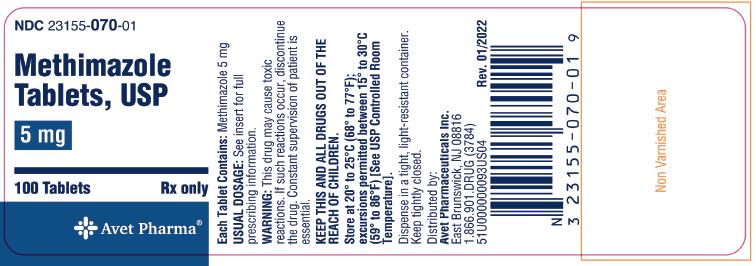
Methimazole 5 mg Tablet, 100-count — NDC 23155-070-01 (Billing 23155-0070-01)
This is a package of 100 tablets of Methimazole 5 mg Tablet from Heritage Pharmaceuticals Inc. d/b/a Avet Pharmaceuticals Inc., marketed since Jan 2012 and currently FDA-listed; retail pharmacies pay about $0.0702 per tablet (NADAC). It is the main listing for this product, which comes in 2 package sizes.
Identity & classification
Regulatory identifiers FDA, NLM and CMS codes for this package
Drug-database identifiers Medi-Span GPI and First Databank GCN / HICL / AHFS classification
- GSN (GCN sequence number): 006675
- GCN: 26401
- GPI-14 (Medi-Span): 28300010000305
- HICL (First Databank): 002855
- AHFS class code: 68:36.08.00
- RxCUI (RxNorm): 197941
Where does this data come from?
- FDA openFDA NDC Directory · synced Oct 1, 2026
- FDA label on DailyMed · label index refreshed Oct 1, 2026
- RxNorm (NLM RxNav) · catalog refreshed Oct 1, 2026
- Medi-Span GPI (licensed)
- First Databank (licensed) · refreshed Oct 1, 2026
RxNorm drug class
This medicine belongs to the Thyroid Hormone Synthesis Inhibitor class.
Where does this data come from?
- RxClass (NLM) · catalog refreshed Oct 1, 2026
Clinical
Methimazole is used to treat hyperthyroidism, a condition that occurs when the thyroid gland produces too much thyroid hormone. It is also taken before thyroid surgery or radioactive iodine therapy. This medication is sometimes prescribed for other uses; ask your doctor or pharmacist for more information.
Read the full MedlinePlus article ↗- It treats hyperthyroidism, which means an overactive thyroid, from Graves’ disease or toxic multinodular goiter. It is used when surgery or radioactive iodine isn’t a good option....
- You take the tablets by mouth, and the daily amount is usually split into 3 doses about 8 hours apart. Your prescriber chooses your dose and will change it as your thyroid improves...
- Some people get a rash, itching, nausea, upset stomach, headache, joint or muscle aches, hair loss, or a change in taste. Mention anything that bothers you or doesn’t go away.
- Call right away if you develop a fever or sore throat, since these can signal a dangerously low white blood cell count. Also call for yellow skin or eyes, loss of appetite, itching...
Patient education
Supplement & herbal interactions
Some supplements/herbs that may interact with Methimazole — tap one for details:
Where does this data come from?
- MedlinePlus (NLM) · refreshed Oct 1, 2026
- FDA label on DailyMed · label index refreshed Oct 1, 2026
Ask a licensed pharmacist directly — free, answered by our team.
Pricing
A drug doesn't have one price. Each row is a different public payment system, and none is what you'd pay at the counter — that depends on your insurance. The ⓘ on each row explains what it measures.
| Price system | Per ea | Per package |
|---|---|---|
| Retail pharmacies payNADAC · weekly | $0.070 | $7.02 / 100 tablets |
| Medicaid paysCMS SDUD · 12 mo | $0.2454 | $24.54 / 100 tablets |
| Medicare drug plans payPart D · Q2 2026 | $0.1781 | $17.81 / 100 tablets |
Where does this data come from?
- CMS NADAC weekly file · file of Sep 30, 2026
- CMS ASP pricing files · refreshed Sep 20, 2026
- CMS Medicaid State Drug Utilization Data · through Q1 2026
- CMS Part D plan pricing files · refreshed Sep 24, 2026
- VA National Acquisition Center price file
Packaging — all sizes for this product
| Package NDC | Description | Per unit | Per pack | Marketing start | Marketing end | Status |
|---|---|---|---|---|---|---|
| 23155-0070-01 You're viewing this Main listing | 100 TABLET in 1 BOTTLE | $0.0702 / ea | $7.02 | 2012-01-15 | — | Active |
| 23155-0070-10 23155-070-10 | 1000 TABLET in 1 BOTTLE | — | — | 2012-01-15 | — | Active |
You're viewing the smallest of 2 pack sizes for this product.
In Medicaid, this is the most-dispensed pack of this product — about 100% of fills over the last four reported quarters. See all packs ↓
Pack size FAQ
What quantity is in this package?
How does this package differ from NDC 23155-0070-10?
What NDC number is used to bill for this package of Methimazole 5 mg Tablet?
Prices are the latest CMS NADAC pharmacy acquisition cost per NDC; per-pack figures are per-unit × pack quantity, shown only when the pack is denominated in the same measure NADAC prices.
Therapeutic equivalents
| Product | Labeler | Pack | NADAC/unit | TE | Status | Price vs. this |
|---|---|---|---|---|---|---|
| Methimazole 5 mg 00832-6072-11 | Upsher-Smith | 100 tablets | $0.070 | AB | Availability likely | — |
| Methimazole 5 mg 11788-0011-01 | AiPing | 100 tablets | $0.070 | AB | Availability likely | — |
| Methimazole 5 mgthis 23155-0070-01 | Heritage | 100 tablets | $0.070 | AB | Availability likely | — |
| Methimazole 5 mg 33342-0335-11 | Macleods | 100 tablets | $0.070 | AB | Availability likely | — |
| Methimazole 5 mg 50268-0495-15 | AvPAK | 50 tablets | $0.070 | AB | Availability likely | — |
| Methimazole 5 mg 60687-0669-01 | American | 100 tablets | $0.070 | AB | Availability likely | — |
| Methimazole 5 mg 64380-0212-01 | Strides | 100 tablets | $0.070 | AB | Availability likely | — |
| Methimazole 5 mg 64980-0264-01 | Rising | 100 tablets | $0.070 | AB | Availability likely | — |
| Methimazole 5 mg 69452-0328-20 | Bionpharma | 100 tablets | $0.070 | AB | Availability likely | — |
| methimazole 5 mg 72578-0212-01 | Viona | 100 tablets | $0.070 | AB | Availability likely | — |
| Methimazole 5 mg 72603-0315-01 | NORTHSTAR | 100 tablets | $0.070 | AB | Availability likely | — |
| Methimazole 5 mg 50090-6536-00 | A-S | 90 tablets | — | AB | FDA listed | — |
| Methimazole 5 mg 60429-0380-01 | Golden | 100 tablets | — | AB | FDA listed | — |
| Methimazole 5 mg 62135-0205-01 | Chartwell | 100 tablets | — | AB | FDA listed | — |
| Methimazole 5 mg 63629-8347-01 | Bryant | 30 tablets | — | AB | FDA listed | — |
| Methimazole 5 mg 63629-9249-01 | Bryant | 100 tablets | — | AB | FDA listed | — |
| Methimazole 5 mg 63629-9250-01 | Bryant | 500 tablets | — | AB | FDA listed | — |
| methimazole 5 mg 67046-1651-03 | Coupler | 30 tablets | — | AB | FDA listed | — |
| Methimazole 5 mg 68788-8226-03 | Preferred | 30 tablets | — | AB | FDA listed | — |
| Methimazole 5 mg 68788-8883-01 | Preferred | 100 tablets | — | AB | FDA listed | — |
| Methimazole 5 mg 70518-1506-00 | REMEDYREPACK | 30 tablets | — | AB | FDA listed | — |
| Methimazole 5 mg 71335-2881-01 | Bryant | 100 tablets | — | AB | FDA listed | — |
| Methimazole 5 mg 71335-3026-01 | Bryant | 500 tablets | — | AB | FDA listed | — |
| Methimazole 5 mg 72162-1802-01 | Bryant | 100 tablets | — | AB | FDA listed | — |
| Methimazole 5 mg 73190-0084-01 | AvKARE | 100 tablets | — | AB | FDA listed | — |
| methimazole 5 mg 76483-0082-00 | SQUARE | 100 tablets | — | AB | FDA listed | — |
| Methimazole 5 mg 70518-4747-00 | REMEDYREPACK | 100 tablets | — | AB | FDA listed | — |
Where does this data come from?
- FDA openFDA NDC Directory · synced Oct 1, 2026
- FDA Orange Book · refreshed Sep 3, 2026
- CMS NADAC weekly file · file of Sep 30, 2026
Availability & generic status
This product is an FDA-approved generic. Other versions of the same drug are listed under Therapeutic equivalents, least expensive first.
Where does this data come from?
- FDA Orange Book · refreshed Sep 3, 2026
What it looks like
Where does this data come from?
- FDA label on DailyMed · label index refreshed Oct 1, 2026
Inactive Ingredients / Excipients
Inactive ingredients, also called excipients, are components of the drug product other than the active ingredient. They may include fillers, dyes, coatings, preservatives, flavors, or other formulation ingredients.
💡 Tap an ingredient (hover on desktop) to see what it is and why it’s used.
-
UNII EWQ57Q8I5X
Lactose monohydrate is a natural sugar derived from milk. It serves as a filler and binder in tablets and capsules, helping create the proper size, texture, and consistency of the medicine.
-
UNII 70097M6I30
Magnesium stearate is a salt made from magnesium and stearic acid, a fatty substance. It's used in tablets and capsules as a lubricant and glidant to help ingredients flow smoothly during manufacturing and prevent sticking.
-
UNII O8232NY3SJ
A plant-based carbohydrate derived from corn kernels. It acts as a filler to add bulk, a binder to hold ingredients together, and a disintegrant to help the tablet break apart in your stomach for absorption.
-
UNII 7SEV7J4R1U
A powder made from a naturally occurring mineral. In medicines, talc works as a glidant and anti-caking agent, helping tablets and capsules flow smoothly during manufacturing and preventing clumping.
4 inactive ingredients listed in the exact product block matched to this NDC.
Where does this data come from?
ingredient classCode="IACT" elements from the exact product block matched by this NDC. Label-section narrative from DailyMed / the openFDA label index is shown separately when available.- FDA label on DailyMed · label index refreshed Oct 1, 2026
- FDA openFDA NDC Directory · synced Oct 1, 2026
Inactive ingredient FAQ
Are inactive ingredients the same for every manufacturer?
Why might an inactive ingredient be missing?
Can inactive ingredients matter?
Manufacturer & labeler
Where does this data come from?
- FDA openFDA NDC Directory · synced Oct 1, 2026
- Drugs@FDA
Full prescribing information FDA SPL
🎯 Indications and Usage ▾
INDICATIONS AND USAGE Methimazole tablets are indicated: In patients with Graves' disease with hyperthyroidism or toxic multinodular goiter for whom surgery or radioactive iodine therapy is not an appropriate treatment option. To ameliorate symptoms of hyperthyroidism in preparation for thyroidectomy or radioactive iodine therapy.
⏱️ Dosage and Administration ▾
DOSAGE AND ADMINISTRATION Methimazole tablets are administered orally. The total daily dosage is usually given in 3 divided doses at approximately 8-hour intervals. Adult - The initial daily dosage is 15 mg for mild hyperthyroidism, 30 to 40 mg for moderately severe hyperthyroidism, and 60 mg for severe hyperthyroidism, divided into 3 doses at 8-hour intervals.
The maintenance dosage is 5 to 15 mg daily. Pediatric - Initially, the daily dosage is 0.4 mg/kg of body weight divided into 3 doses and given at 8-hour intervals. The maintenance dosage is approximately 1/2 of the initial dose.
⛔ Contraindications ▾
CONTRAINDICATIONS Methimazole tablets are contraindicated in the presence of hypersensitivity to the drug or any of the other product components.
⚠️ Warnings ▾
WARNINGS First Trimester Use of Methimazole and Congenital Malformations Methimazole crosses the placental membranes and can cause fetal harm, when administered in the first trimester of pregnancy. Rare instances of congenital defects, including aplasia cutis, craniofacial malformations (facial dysmorphism; choanal atresia), gastrointestinal malformations (esophageal atresia with or without tracheoesophageal fistula) omphalocele and abnormalities of the omphalomesenteric duct have occurred in infants born to mothers who received methimazole tablets in the first trimester of pregnancy.
If methimazole tablets are used during pregnancy or if the patient becomes pregnant while taking this drug, the patient should be warned of the potential hazard to the fetus. Because of the risk for congenital malformations associated with use of methimazole tablets in the first trimester of pregnancy it may be appropriate to use other agents in pregnant women requiring treatment for hyperthyroidism. If methimazole tablets are used, the lowest possible dose to control the maternal disease should be given.
Agranulocytosis Agranulocytosis is potentially a life-threatening adverse reaction of methimazole therapy. Patients should be instructed to immediately report to their physicians any symptoms suggestive of agranulocytosis, such as fever or sore throat. Leukopenia, thrombocytopenia, and aplastic anemia (pancytopenia) may also occur.
The drug should be discontinued in the presence of agranulocytosis or aplastic anemia (pancytopenia), and the patient's bone marrow indices should be monitored. Liver Toxicity Although there have been reports of hepatotoxicity (including acute liver failure) associated with methimazole, the risk of hepatotoxicity appears to be less with methimazole than with propylthiouracil, especially in the pediatric population. Symptoms suggestive of hepatic dysfunction (anorexia, pruritis, right upper quadrant pain, etc.) should prompt evaluation of liver function (bilirubin, alkaline phosphatase) and hepatocellular integrity (ALT, AST).
Drug treatment should be discontinued promptly in the event of clinically significant evidence of liver abnormality including hepatic transaminase values exceeding 3 times the upper limit of normal. Hypothyroidism Methimazole can cause hypothyroidism necessitating routine monitoring of TSH and free T4 levels with adjustments in dosing to maintain a euthyroid state. Because the drug readily crosses placental membranes, methimazole can cause fetal goiter and cretinism when administered to a pregnant woman.
For this reason, it is important that a sufficient, but not excessive, dose be given during pregnancy (see PRECAUTIONS, Pregnancy ). Vasculitis Cases of vasculitis resulting in severe complications have been reported in patients receiving methimazole therapy. These cases of vasculitis include: leukocytoclastic cutaneous vasculitis, acute kidney injury and glomerulonephritis, alveolar/pulmonary hemorrhage, CNS vasculitis, and neuropathy.
Most cases were associated with anti-neutrophilic cytoplasmic antibodies (ANCA)-positive vasculitis. In some cases, vasculitis resolved/improved with drug discontinuation; however, more severe cases required treatment with additional measures including corticosteroids, immunosuppressant therapy, and plasmapheresis. If vasculitis is suspected, discontinue therapy and initiate appropriate intervention.
🤒 Adverse Reactions ▾
ADVERSE REACTIONS Major adverse reactions (which occur with much less frequency than the minor adverse reactions) include inhibition of myelopoiesis (agranulocytosis, granulocytopenia, thrombocytopenia, and aplastic anemia), drug fever, a lupus-like syndrome, insulin autoimmune syndrome (which can result in hypoglycemic coma), hepatitis (jaundice may persist for several weeks after discontinuation of the drug), periarteritis, and hypoprothrombinemia. Nephritis occurs very rarely. There have been postmarketing case reports of acute pancreatitis.
There are reports of a vasculitis, often associated with the presence of anti-neutrophilic cytoplasmic antibodies (ANCA), resulting in severe complications (see WARNINGS ). Minor adverse reactions include skin rash, urticaria, nausea, vomiting, epigastric distress, arthralgia, paresthesia, loss of taste, abnormal loss of hair, myalgia, headache, pruritus, drowsiness, neuritis, edema, vertigo, skin pigmentation, jaundice, sialadenopathy, and lymphadenopathy.
🔄 Drug Interactions ▾
Drug Interactions Anticoagulants (oral): Due to potential inhibition of vitamin K activity by methimazole, the activity of oral anticoagulants (e.g., warfarin) may be increased; additional monitoring of PT/INR should be considered, especially before surgical procedures. β-adrenergic blocking agents: Hyperthyroidism may cause an increased clearance of beta blockers with a high extraction ratio. A dose reduction of beta-adrenergic blockers may be needed when a hyperthyroid patient becomes euthyroid. Digitalis glycosides: Serum digitalis levels may be increased when hyperthyroid patients on a stable digitalis glycoside regimen become euthyroid; a reduced dosage of digitalis glycosides may be needed.
Theophylline: Theophylline clearance may decrease when hyperthyroid patients on a stable theophylline regimen become euthyroid; a reduced dose of theophylline may be needed.
🤰 Pregnancy ▾
Pregnancy See WARNINGS If methimazole tablets are used during the first trimester of pregnancy or if the patient becomes pregnant while taking this drug, the patient should be warned of the potential hazard to the fetus. In pregnant women with untreated or inadequately treated Graves' disease, there is an increased risk of adverse events of maternal heart failure, spontaneous abortion, preterm birth, stillbirth and fetal or neonatal hyperthyroidism. Because methimazole crosses placental membranes and can induce goiter and cretinism in the developing fetus, hyperthyroidism should be closely monitored in pregnant women and treatment adjusted such that a sufficient, but not excessive, dose be given during pregnancy.
In many pregnant women, the thyroid dysfunction diminishes as the pregnancy proceeds; consequently, a reduction of dosage may be possible. In some instances, anti-thyroid therapy can be discontinued several weeks or months before delivery. Due to the rare occurrence of congenital malformations associated with methimazole use, it may be appropriate to use an alternative anti-thyroid medication in pregnant women requiring treatment for hyperthyroidism particularly in the first trimester of pregnancy during organogenesis.
Given the potential maternal adverse effects of propylthiouracil (e.g., hepatotoxicity), it may be preferable to switch from propylthiouracil to methimazole for the second and third trimesters.
🧒 Pediatric Use ▾
Pediatric Use Because of postmarketing reports of severe liver injury in pediatric patient treated with propylthiouracil, methimazole is the preferred choice when an antithyroid drug is required for a pediatric patient (see DOSAGE AND ADMINISTRATION ).
🆘 Overdosage ▾
OVERDOSAGE Signs and Symptoms Symptoms may include nausea, vomiting, epigastric distress, headache, fever, joint pain, pruritus, and edema. Aplastic anemia (pancytopenia) or agranulocytosis may be manifested in hours to days. Less frequent events are hepatitis, nephrotic syndrome, exfoliative dermatitis, neuropathies, and CNS stimulation or depression.
No information is available on the median lethal dose of the drug or the concentration of methimazole in biologic fluids associated with toxicity and/or death. Treatment To obtain up-to-date information about the treatment of overdose, a good resource is your certified Regional Poison Control Center. In managing overdosage, consider the possibility of multiple drug overdoses, interaction among drugs, and unusual drug kinetics in the patient.
In the event of an overdose, appropriate supportive treatment should be initiated as dictated by the patient's medical status.
🧬 Clinical Pharmacology ▾
CLINICAL PHARMACOLOGY Methimazole inhibits the synthesis of thyroid hormones and thus is effective in the treatment of hyperthyroidism. The drug does not inactivate existing thyroxine and tri-iodothyronine that are stored in the thyroid or circulating in the blood nor does it interfere with the effectiveness of thyroid hormones given by mouth or by injection. Methimazole is readily absorbed in the gastrointestinal tract, metabolized in the liver, and excreted in the urine.
📦 How Supplied / Storage and Handling ▾
HOW SUPPLIED Methimazole tablets, USP 5 mg - round, white to off white bi-convex tablet. Debossed HP bisect 70 on one side and plain on the reverse side. They are available in: Bottles of 100 NDC 23155-070-01 Bottles of 1000 NDC 23155-070-10 Methimazole tablets, USP 10 mg - round, white to off white bi-convex tablet.
Debossed HP bisect 71 on one side and plain on the reverse side. They are available in: Bottles of 100 NDC 23155-071-01 Bottles of 1000 NDC 23155-071-10 Store at 20° to 25°C (68° to 77°F); excursions permitted between 15° to 30°C (59° to 86°F) [See USP Controlled Room Temperature]. Dispense in tight, light-resistant container.
Distributed by: Avet Pharmaceuticals Inc. East Brunswick, NJ 08816 1.866.901.DRUG (3784) 51U000000174US06 Revised: 01/2022 logo
📋 Description ▾
DESCRIPTION Methimazole (1-methylimidazole-2-thiol) is a white, crystalline substance that is freely soluble in water. It differs chemically from the drugs of the thiouracil series primarily because it has a 5- instead of a 6-membered ring. Methimazole tablet, USP contains 5 or 10 mg (43.8 or 87.6 μmol) methimazole, an orally administered antithyroid drug.
Each tablet also contains lactose monohydrate, magnesium stearate, pregelatinized starch and talc. The molecular weight is 114.16, and the molecular formula is C 4 H 6 N 2 S. The structural formula is as follows: structure
💬 Information for Patients ▾
Information for Patients Patients should be advised that if they become pregnant or intend to become pregnant while taking an antithyroid drug, they should contact their physician immediately about their therapy. Inform patients that cases of vasculitis resulting in severe complications have occurred with methimazole tablets. Inform patients to promptly report symptoms that may be associated with vasculitis including new rash, hematuria or decreased urine output, dyspnea or hemoptysis (see WARNINGS and ADVERSE REACTIONS ).
⚠️ Precautions ▾
PRECAUTIONS General Patients who receive methimazole should be under close surveillance and should be cautioned to report immediately any evidence of illness, particularly sore throat, skin eruptions, fever, headache, or general malaise. In such cases, white-blood-cell and differential counts should be obtained to determine whether agranulocytosis has developed. Particular care should be exercised with patients who are receiving additional drugs known to cause agranulocytosis.
Information for Patients Patients should be advised that if they become pregnant or intend to become pregnant while taking an antithyroid drug, they should contact their physician immediately about their therapy. Inform patients that cases of vasculitis resulting in severe complications have occurred with methimazole tablets. Inform patients to promptly report symptoms that may be associated with vasculitis including new rash, hematuria or decreased urine output, dyspnea or hemoptysis (see WARNINGS and ADVERSE REACTIONS ).
Laboratory Tests Because methimazole may cause hypoprothrombinemia and bleeding, prothrombin time should be monitored during therapy with the drug, especially before surgical procedures. Thyroid function tests should be monitored periodically during therapy. Once clinical evidence of hyperthyroidism has resolved, the finding of a rising serum TSH indicates that a lower maintenance dose of methimazole tablets should be employed.
Drug Interactions Anticoagulants (oral): Due to potential inhibition of vitamin K activity by methimazole, the activity of oral anticoagulants (e.g., warfarin) may be increased; additional monitoring of PT/INR should be considered, especially before surgical procedures. β-adrenergic blocking agents: Hyperthyroidism may cause an increased clearance of beta blockers with a high extraction ratio. A dose reduction of beta-adrenergic blockers may be needed when a hyperthyroid patient becomes euthyroid. Digitalis glycosides: Serum digitalis levels may be increased when hyperthyroid patients on a stable digitalis glycoside regimen become euthyroid; a reduced dosage of digitalis glycosides may be needed.
Theophylline: Theophylline clearance may decrease when hyperthyroid patients on a stable theophylline regimen become euthyroid; a reduced dose of theophylline may be needed. Carcinogenesis, Mutagenesis, Impairment of Fertility In a 2 year study, rats were given methimazole at doses of 0.5, 3, and 18 mg/kg/day. These doses were 0.3, 2, and 12 times the 15 mg/day maximum human maintenance dose (when calculated on the basis of surface area).
Thyroid hyperplasia, adenoma, and carcinoma developed in rats at the two higher doses. The clinical significance of these findings is unclear. Pregnancy See WARNINGS If methimazole tablets are used during the first trimester of pregnancy or if the patient becomes pregnant while taking this drug, the patient should be warned of the potential hazard to the fetus.
In pregnant women with untreated or inadequately treated Graves' disease, there is an increased risk of adverse events of maternal heart failure, spontaneous abortion, preterm birth, stillbirth and fetal or neonatal hyperthyroidism. Because methimazole crosses placental membranes and can induce goiter and cretinism in the developing fetus, hyperthyroidism should be closely monitored in pregnant women and treatment adjusted such that a sufficient, but not excessive, dose be given during pregnancy. In many pregnant women, the thyroid dysfunction diminishes as the pregnancy proceeds; consequently, a reduction of dosage may be possible.
In some instances, anti-thyroid therapy can be discontinued several weeks or months before delivery. Due to the rare occurrence of congenital malformations associated with methimazole use, it may be appropriate to use an alternative anti-thyroid medication in pregnant women requiring treatment for hyperthyroidism particularly in the first trimester of pregnancy during organogenesis. Given the potenti… [Excerpted — this section continues on DailyMed.]
🍼 Nursing Mothers ▾
Nursing Mothers Methimazole is present in breast milk. However, several studies found no effect on clinical status in nursing infants of mothers taking methimazole. A long-term study of 139 thyrotoxic lactating mothers and their infants failed to demonstrate toxicity in infants who are nursed by mothers receiving treatment with methimazole. Monitor thyroid function at frequent (weekly or biweekly) intervals.
📄 Carcinogenesis, Mutagenesis, Impairment of Fertility ▾
Carcinogenesis, Mutagenesis, Impairment of Fertility In a 2 year study, rats were given methimazole at doses of 0.5, 3, and 18 mg/kg/day. These doses were 0.3, 2, and 12 times the 15 mg/day maximum human maintenance dose (when calculated on the basis of surface area). Thyroid hyperplasia, adenoma, and carcinoma developed in rats at the two higher doses. The clinical significance of these findings is unclear.
📄 Package Label / Principal Display Panel ▾
PACKAGE LABEL PRINCIPAL DISPLAY PANEL - 5 mg(100 tablets) label 5 mg (100 tablets)
PACKAGE LABEL PRINCIPAL DISPLAY PANEL - 10 mg(100 tablets) label 10 mg (100 tablets)