
Nymalize nimodipine 60 mg/10mL Solution, 237 mL — NDC 24338-260-08 (Billing 24338-0260-08)
This is a package of 237 mL of Nymalize nimodipine 60 mg/10mL Solution from Azurity Pharmaceuticals, Inc., marketed since May 2020 and currently FDA-listed. It is the main listing for this product, which comes in 2 package sizes.
NDC database record
One package, one record: these facts belong to NDC 24338-260-08 alone.
- Record
- FDA NDC Directory package listing · Human prescription drug
- Code segments
- 24338 labeler · 260 product · 08 package
- Package marketed since
- Jul 13, 2021
- Sample package
- No — commercial package
- Listing certified through
- Dec 31, 2026
- Billing quantity
- 237 mL per package
- Barcode (UPC-A, from the NDC)
- 3 2433826008 1
- FDA record last changed
- Jul 24, 2026
Identity & classification
Regulatory identifiers FDA, NLM and CMS codes for this package
Drug-database identifiers Medi-Span GPI and First Databank GCN / HICL / AHFS classification
- GSN (GCN sequence number): 082451
- GCN: 48405
- GPI-14 (Medi-Span): 34000022002054
- HICL (First Databank): 000184
- AHFS class code: 24:28.08.00
- RxCUI (RxNorm): 2361311
Where does this data come from?
- FDA openFDA NDC Directory · synced Oct 8, 2026
- FDA label on DailyMed · label index refreshed Oct 6, 2026
- RxNorm (NLM RxNav) · catalog refreshed Oct 1, 2026
- Medi-Span GPI (licensed)
- First Databank (licensed) · refreshed Oct 8, 2026
RxNorm drug class
This medicine belongs to the Dihydropyridine Calcium Channel Blocker class.
Where does this data come from?
- RxClass (NLM) · catalog refreshed Oct 1, 2026
Clinical
Nimodipine is used to decrease brain damage that may be caused by a subarachnoid hemorrhage (bleeding in the space surrounding the brain that occurs when a weakened blood vessel in the brain bursts). Nimodipine is in a class of medications called calcium channel blockers. It works by relaxing blood vessels in the brain to allow more blood to flow to damaged areas.
Read the full MedlinePlus article ↗- Nimodipine is given specifically after a subarachnoid hemorrhage — that's when an aneurysm in the brain ruptures and bleeds into the space around the brain. After that kind of blee...
- What exactly is nimodipine being used for in my (or my family member's) care?
- It's a lot, yes — and there's a real pharmacological reason. Nimodipine is eliminated from the body relatively quickly, so blood levels drop fast between doses. Taking it every 4 h...
- Why does it have to be taken every 4 hours? That's a lot.
Patient education
Supplement & herbal interactions
Some supplements/herbs that may interact with Nimodipine — tap one for details:
Nimodipine may be associated with lower levels of 1 nutrient — worth a chat with your pharmacist, not a cause for alarm.
Where does this data come from?
- MedlinePlus (NLM) · refreshed Oct 1, 2026
- FDA label on DailyMed · label index refreshed Oct 6, 2026
Ask a licensed pharmacist directly — free, answered by our team.
Pricing
A drug doesn't have one price. Each row is a different public payment system, and none is what you'd pay at the counter — that depends on your insurance. The ⓘ on each row explains what it measures.
| Price system | Per mL | Per package |
|---|---|---|
| Retail pharmacies payNADAC · weekly | Not in the retail survey — common for institutional, discontinued, or low-volume packs. | |
| Medicaid paysCMS SDUD · 12 mo | No recent Medicaid claims on file for this NDC — rare and low-volume NDCs are suppressed in the public data. | |
| Medicare drug plans payPart D · Q2 2026 | $10.84 | $2,568.37 / 237 ml |
Where does this data come from?
- CMS NADAC weekly file
- CMS ASP pricing files · refreshed Sep 20, 2026
- CMS Medicaid State Drug Utilization Data · refreshed Oct 8, 2026
- CMS Part D plan pricing files · refreshed Sep 24, 2026
- VA National Acquisition Center price file
Packaging — all sizes for this product
| Package NDC | Description | Marketing start | Marketing end | Status |
|---|---|---|---|---|
| 24338-0260-08 You're viewing this Main listing | 237 mL in 1 BOTTLE | 2021-07-13 | — | Active |
| 24338-0260-12 24338-260-12 | 12 PACKAGE in 1 CARTON / 1 SYRINGE, PLASTIC in 1 PACKAGE / 10 mL in 1 SYRINGE, PLASTIC | 2020-05-04 | — | Active |
Pack size FAQ
What quantity is in this package?
What NDC number is used to bill for this package of Nymalize nimodipine 60 mg/10mL Solution?
Therapeutic equivalents
| Product | Labeler | Pack | NADAC/unit | TE | Status | Price vs. this |
|---|---|---|---|---|---|---|
| Nymalize 30 mg/5mL 24338-0230-12 | Azurity | 1 syringe | — | AB | FDA listed | — |
| Nymalize 60 mg/10mLthis 24338-0260-08 | Azurity | 237 ml | — | AB | FDA listed | — |
Where does this data come from?
- FDA openFDA NDC Directory · synced Oct 8, 2026
- FDA Orange Book · refreshed Oct 3, 2026
- CMS NADAC weekly file
Availability & generic status
The FDA lists approved generic versions of this medicine, but that does not always mean a pharmacy can get one today. Patent rules, launch agreements, supply and pricing can affect when generics actually arrive.
Why the date isn’t exact: Generic timing can change because patents may be challenged, settled, licensed, added, removed, or worked around with a narrower label — and FDA approval does not always mean a pharmacy can get the generic today.
🛈 What do these terms mean?
- Patent
- Legal protection listed in the Orange Book that may delay generic approval or launch. Issued by the U.S. Patent & Trademark Office.
- Substance patent
- Covers the active drug molecule itself — the hardest to design around. A generic generally can’t launch until it expires.
- Formulation (product) patent
- Covers a specific formulation or dosage form. A generic can sometimes work around it with a different formulation.
- Method-of-use patent
- A patent covering one specific approved use of the drug — not necessarily the whole molecule. A generic can sometimes launch with a “skinny label” that carves out the protected use and keeps the others.
- Skinny label
- A generic label that omits a still-patented use when the FDA allows it — letting a generic reach the market for the unprotected uses.
- Exclusivity
- FDA-granted marketing protection, separate from patents — e.g. 5-yr new chemical entity, 7-yr orphan drug, or a +6-month pediatric extension.
- Paragraph IV
- A generic applicant’s formal challenge to a listed patent. It can potentially lead to earlier generic entry, but often involves litigation or a settlement.
- RLD / RS
- Reference Listed Drug — the brand product the FDA uses as the reference for generic applications. Reference Standard — the product the FDA expects generics to compare against in bioequivalence testing.
- TE / AB rating
- FDA therapeutic-equivalence rating. An AB rating generally means the FDA considers a generic therapeutically equivalent to — and substitutable for — the brand.
- LOE (loss of exclusivity)
- The latest patent or exclusivity currently listed — the loss-of-exclusivity / latest-listed-protection date shown on this page. Paragraph-IV challenges and settlements can move the real date earlier; FDA approval and a manufacturer’s decision to market can move it later.
Built from the FDA Orange Book. The bars above are scaled to each protection’s expiry; the red LOE marker is the last one to lapse.
| Patent | Type | Use code | Expires |
|---|---|---|---|
| US 11413277 ↗ | Method of use | U-2804 | Apr 16, 2038 |
| US 12186308 ↗ | Method of use | U-2804 | Apr 16, 2038 |
| US 10342787 ↗ | Method of use | U-2804 | Apr 16, 2038 |
| US 10576070 ↗ | Method of use | U-2804 | Apr 16, 2038 |
| US 11207306 ↗ | Method of use | U-2804 | Apr 16, 2038 |
| US 11806338 ↗ | Drug product | — | Apr 16, 2038 |
Is there a generic version of NYMALIZE 60 MG/10 ML SOLUTION?
The FDA approved a generic — why can’t I get it at my pharmacy yet?
Why do different websites show different generic release dates?
What does “FDA listed” mean?
What does a patent or protection date mean here?
What does “current Orange Book estimate” mean?
Can a generic come out before the last patent expires?
Can a generic come out after the listed dates?
What is the difference between patents and exclusivity?
Why are there multiple patent dates?
Where does this data come from?
- FDA Orange Book · refreshed Oct 3, 2026
What it looks like
Where does this data come from?
- FDA label on DailyMed · label index refreshed Oct 6, 2026
Inactive Ingredients / Excipients
Inactive ingredients, also called excipients, are components of the drug product other than the active ingredient. They may include fillers, dyes, coatings, preservatives, flavors, or other formulation ingredients.
🧪 Avoiding an ingredient? See Nimodipine inactive ingredients by manufacturer: every current product's list side by side, so you can ask your pharmacy for the version that does not list it.
💡 Tap an ingredient (hover on desktop) to see what it is and why it’s used.
-
UNII 3K9958V90M
A liquid solvent derived from fermentation or chemical synthesis. In medicines, alcohol dissolves active ingredients, helps preserve the product, and improves how the body absorbs certain drugs.
-
UNII PDC6A3C0OX
Glycerin is a clear, thick liquid derived from plant oils or fats. It acts as a humectant to retain moisture, a sweetener, and a solvent in medications.
-
UNII A2I8C7HI9T
Methylparaben is a preservative derived from benzoic acid that prevents growth of bacteria, fungi, and mold in medicines. It extends the product's shelf life and maintains safety during storage.
-
UNII B697894SGQ
Polyethylene glycol 400 is a clear, thick liquid made from petroleum-derived polymers. It acts as a solvent and humectant in medicines, helping dissolve active ingredients and retain moisture in the formulation.
4 inactive ingredients listed in the exact product block matched to this NDC.
Where does this data come from?
ingredient classCode="IACT" elements from the exact product block matched by this NDC. Label-section narrative from DailyMed / the openFDA label index is shown separately when available.- FDA label on DailyMed · label index refreshed Oct 6, 2026
- FDA openFDA NDC Directory · synced Oct 8, 2026
Inactive ingredient FAQ
Are inactive ingredients the same for every manufacturer?
Why might an inactive ingredient be missing?
Can inactive ingredients matter?
Manufacturer & labeler
More NDCs from Azurity Pharmaceuticals, Inc. labeler code 24338
- SUPREP Bowel Prep sodium sulfate, potassium sulfate, magnesium sulfate 17.5 g/mL; 3.13 g/mL; 1.6 g/mL Solution, Concentrate NDC 24338-175-01
- SUPREP Bowel Prep sodium sulfate, potassium sulfate, magnesium sulfate 13.13 g/133.1mL; 2.35 g/133.1mL; 1.2 g/133.1mL Solution, Concentrate NDC 24338-177-01
- Sklice ivermectin 5 mg/g Lotion NDC 24338-185-04
- Sutab sodium sulfate, magnesium sulfate, and potassium chloride 17.75 g; 2.7 g; 2.25 g Tablet NDC 24338-201-01
- Nymalize nimodipine 30 mg/5mL Solution NDC 24338-230-12
- GoLYTELY Polyethylene Glycol 3350, Sodium Sulfate Anhydrous, Sodium Bicarbonate, Sodium Chloride, Potassium Chloride 3350 236 g/4L; 22.74 g/4L; 6.74 g/4L; 5.86 g/4L; 2.97 g/4L Powder, For Solution NDC 24338-236-01
- VIVIMUSTA BENDAMUSTINE HYDROCHLORIDE 25 mg/mL Injection NDC 24338-270-01
- FeraBright Ferumoxytol 30 mg/mL Injection NDC 24338-310-10
- Gleostine lomustine 10 mg Capsule, Gelatin Coated NDC 24338-340-05
- Gleostine lomustine 40 mg Capsule, Gelatin Coated NDC 24338-341-05
- Gleostine lomustine 100 mg Capsule, Gelatin Coated NDC 24338-342-05
- FeraBright Ferumoxytol 30 mg/mL Injection NDC 24338-510-17
Where does this data come from?
- FDA openFDA NDC Directory · synced Oct 8, 2026
- Drugs@FDA
Full prescribing information FDA SPL
🎯 Indications and Usage ▾
1 INDICATIONS AND USAGE NYMALIZE is indicated for the improvement of neurological outcome by reducing the incidence and severity of ischemic deficits in adult patients with subarachnoid hemorrhage (SAH) from ruptured intracranial berry aneurysms regardless of their post-ictus neurological condition (i.e., Hunt and Hess Grades I-V). NYMALIZE is a dihydropyridine calcium channel blocker indicated for the improvement of neurological outcome by reducing the incidence and severity of ischemic deficits in adult patients with subarachnoid hemorrhage (SAH) from ruptured intracranial berry aneurysms regardless of their post-ictus neurological condition (i.e., Hunt and Hess Grades I-V).
( 1 )
⏱️ Dosage and Administration ▾
2 DOSAGE AND ADMINISTRATION Administer only enterally (e.g., oral, nasogastric tube, or gastric tube route). Do not administer intravenously or by other parenteral routes. ( 2.1 ) Give one hour before a meal or two hours after a meal.
( 2.1 ) Start dosing within 96 hours of the SAH. ( 2.1 ) Recommended dose is 10 mL (60 mg) every 4 hours for 21 consecutive days. ( 2.2 ) Nasogastric or Gastric Tube Administration: Administer 10 mL (60 mg) every 4 hours with supplied prefilled oral syringe.
Refill syringe with 10 mL of 0.9% saline water solution; flush remaining contents from nasogastric or gastric tube into stomach. ( 2.3 ) Patients with Cirrhosis: Reduce dosage to 5 mL (30 mg) every 4 hours. ( 2.4 )
2.1Administration Instructions Administer only enterally (e.g., oral, nasogastric tube, or gastric tube route). Do not administer intravenously or by other parenteral routes. For all routes of administration, begin NYMALIZE within 96 hours of the onset of SAH. Administer one hour before a meal or two hours after a meal for all routes of administration [see Clinical Pharmacology (12.3) ] .
2.2Administration by Oral Route The recommended oral dosage is 10 mL (60 mg) every 4 hours for 21 consecutive days.
2.3Administration Via Nasogastric or Gastric Tube Using the supplied prefilled oral syringe labeled "For Oral Use Only", administer 10 mL (60 mg) every 4 hours into a nasogastric or gastric tube for 21 consecutive days. For each dose, refill the syringe with 10 mL of 0.9% saline solution and then flush any remaining contents from nasogastric or gastric tube into the stomach.
2.4Dosage Adjustments in Patients with Cirrhosis In patients with cirrhosis, reduce the dosage to 5 mL (30 mg) every 4 hours [ s ee Warnings and Precautions (5.2) , Clinical Pharmacology (12.3) ] .
💊 Dosage Forms and Strengths ▾
3 DOSAGE FORMS AND STRENGTHS Oral Solution (6 mg per mL): 60 mg per 10 mL, pale yellow solution in unit-dose prefilled syringe 30 mg per 5 mL, pale yellow solution in unit-dose prefilled syringe 30 mg per 5 mL, pale yellow solution in unit-dose prefilled ENFit ® syringe 60 mg per 10 mL (6 mg/mL), pale yellow solution in 8 oz bottle Oral solution (6 mg per mL): 60 mg per 10 mL in unit-dose prefilled syringe ( 3 ) 30 mg per 5 mL in unit-dose prefilled syringe ( 3 ) 30 mg per 5 mL in unit-dose prefilled ENFit ® syringe ( 3 ) 60 mg per 10 mL (6 mg/mL) in 8 oz bottle ( 3 )
⛔ Contraindications ▾
4 CONTRAINDICATIONS None. None ( 4 )
⚠️ Warnings and Cautions ▾
5 WARNINGS AND PRECAUTIONS Hypotension: Monitor blood pressure. ( 5.1 ) Patients with Cirrhosis: Higher risk of adverse reactions. Monitor blood pressure and pulse. ( 5.2 ) CYP3A4 Strong Inhibitors: May significantly increase risk of hypotension. Concomitant use with NYMALIZE should generally be avoided. ( 5.3 ) CYP3A4 Strong Inducers: May significantly reduce efficacy of nimodipine. Concomitant use with NYMALIZE should generally be avoided. ( 5.4 )
5.1Hypotension Blood pressure should be carefully monitored during treatment with NYMALIZE. In clinical studies of patients with subarachnoid hemorrhage, about 5% of nimodipine-treated patients compared to 1% of placebo-treated patients had hypotension and about 1% of nimodipine-treated patients left the study because of this [see Adverse Reactions (6) ].
5.2Possible Increased Risk of Adverse Reactions in Patients with Cirrhosis Given that the plasma levels of nimodipine are increased in patients with cirrhosis, these patients are at higher risk of adverse reactions. Therefore, monitor blood pressure and pulse rate closely and administer a lower dosage [see Dosage and Administration (2.4) , Clinical Pharmacology (12.3) ] .
5.3Possible Increased Risk of Hypotension with Strong CYP3A4 Inhibitors Concomitant use of strong inhibitors of CYP3A4, such as some macrolide antibiotics (e.g., clarithromycin, telithromycin), some HIV protease inhibitors (e.g., indinavir, nelfinavir, ritonavir, saquinavir), some HCV protease inhibitors (e.g., boceprevir, telaprevir), some azole antimycotics (e.g., ketoconazole, itraconazole, posaconazole, voriconazole), conivaptan, delavirdine, and nefazodone with nimodipine should generally be avoided because of a risk of significant hypotension [see Drug Interactions (7.2) ] .
5.4Possible Reduced Efficacy with Strong CYP3A4 Inducers Concomitant use of strong CYP3A4 inducers (e.g., carbamazepine, phenobarbital, phenytoin, rifampin, St. John's wort) and nimodipine should generally be avoided, as nimodipine plasma concentration and efficacy may be significantly reduced [see Drug Interactions (7.3) ].
🤒 Adverse Reactions ▾
6 ADVERSE REACTIONS The safety and efficacy of NYMALIZE (nimodipine oral solution) in the treatment of patients with SAH is based on adequate and well-controlled studies of nimodipine oral capsules in patients with SAH. NYMALIZE (nimodipine oral solution) has comparable bioavailability to nimodipine oral capsules. The following clinically significant adverse reaction appears in other sections of the labeling: Hypotension [see Warnings and Precautions (5.1) ].
Most common adverse reactions (incidence ≥1% and ≥1% placebo) were hypotension, headache, nausea, and bradycardia. ( 6.1 ) To report SUSPECTED ADVERSE REACTIONS, contact Azurity Pharmaceuticals, Inc. at 1-800-461-7449 or FDA at 1-800-FDA-1088 or www.fda.gov/medwatch.
6.1Clinical Trials Experience Because clinical trials are conducted under widely varying conditions, adverse reaction rates observed in the clinical trials of a drug cannot be directly compared to rates in the clinical trials of another drug and may not reflect the rates observed in clinical practice. In clinical trials of nimodipine oral capsules in patients with SAH, eleven percent (92 of 823) of nimodipine-treated patients reported adverse events compared to six percent (29 of 479) of placebo-treated patients. The most common adverse event was decreased blood pressure in 4.4% of nimodipine-treated patients.
The events reported with a frequency greater than 1% are displayed in Table 1 by dose. Table 1: Adverse Events [n (%)] reported with a frequency > 1% in four clinical trials (Study 1, Study 2, Study 3, and Study 4) Placebo (n=479) Nimodipine dose every 4 hours 0.35 mg/kg (n=82) 30 mg (n=71) 60 mg (n=494) 90 mg (n=172) 120 mg (n=4) Decreased Blood Pressure 6 (1.2) 1 (1.2) 0 19 (3.8) 14 (8.1) 2 (50.0) Edema 3 (0.6) 0 0 2 (0.4) 2 (1.2) 0 Diarrhea 3 (0.6) 0 3 (4.2) 0 3 (1.7) 0 Rash 3 (0.6) 2 (2.4) 0 3 (0.6) 2 (1.2) 0 Headache 1 (0.2) 0 1 (1.4) 6 (1.2) 0 0 Gastrointestinal Symptoms 0 2 (2.4) 0 0 2 (1.2) 0 Nausea 0 1 (1.2) 1 (1.4) 6 (1.2) 1 (0.6) 0 Dyspnea 0 1 (1.2) 0 0 0 0 EKG Abnormalities 0 0 1 (1.4) 0 1 (0.6) 0 Tachycardia 0 0 1 (1.4) 0 0 0 Bradycardia 0 0 0 5 (1.0) 1 (0.6) 0 Muscle Pain/Cramp 0 0 1 (1.4) 1 (0.2) 1 (0.6) 0 Acne 0 0 1 (1.4) 0 0 0 Depression 0 0 1 (1.4) 0 0 0 SAH is frequently accompanied by alterations in consciousness that may lead to an under-reporting of adverse experiences.
As a calcium channel blocker, nimodipine may have the potential to exacerbate heart failure in susceptible patients or to interfere with A-V conduction, but these events were not observed in SAH trials.
🔄 Drug Interactions ▾
7 DRUG INTERACTIONS Anti-Hypertensives : May increase risk of hypotension. Monitor blood pressure. ( 7.1 ) CYP3A4 Moderate and Weak Inhibitors: May increase risk of hypotension. Monitor blood pressure. Dose reduction of NYMALIZE may be needed. Avoid grapefruit juice. ( 7.2 ) CYP3A4 Moderate and Weak Inducers: May reduce efficacy of NYMALIZE. Dose increase may be needed. ( 7.3 )
7.1Blood Pressure Lowering Drugs Nimodipine may increase the blood pressure lowering effect of concomitantly administered anti-hypertensives such as diuretics, beta-blockers, ACE inhibitors, angiotensin receptor blockers, other calcium channel blockers, α-adrenergic blockers, PDE5 inhibitors, and α-methyldopa. In Europe, nimodipine was observed to occasionally intensify the effect of antihypertensive drugs taken concomitantly by hypertensive patients; this phenomenon was not observed in North American clinical trials.
Blood pressure should be carefully monitored, and dose adjustment of the blood pressure lowering drug(s) may be necessary.
7.2CYP3A4 Inhibitors Nimodipine plasma concentration can be significantly increased when concomitantly administered with strong CYP3A4 inhibitors. As a consequence, the blood pressure lowering effect may be increased. Therefore, the concomitant administration of NYMALIZE and strong CYP3A4 inhibitors should generally be avoided [ see Warnings and Precautions (5.3) ].
Strong CYP3A4 inhibitors include some members of the following classes: macrolide antibiotics (e.g., clarithromycin, telithromycin), HIV protease inhibitors (e.g., indinavir, nelfinavir, ritonavir, saquinavir), HCV protease inhibitors (e.g., boceprevir, telaprevir), azole antimycotics (e.g., ketoconazole, itraconazole, posaconazole, voriconazole), conivaptan, delavirdine, nefazodone Nimodipine plasma concentration can also be increased in the presence of moderate and weak inhibitors of CYP3A4. If nimodipine is concomitantly administered with these drugs, blood pressure should be monitored, and a reduction of the nimodipine dose may be necessary.
Moderate and weak CYP3A4 inhibitors include alprozalam, ameprenavir, amiodarone, aprepitant, atazanavir, cimetidine, cyclosporine, diltiazem, erythromycin, fluconazole, fluoxetine, isoniazid, oral contraceptives, quinuprestin/dalfopristin, valproic acid, and verapamil. A study in eight healthy volunteers has shown a 50% increase in mean peak nimodipine plasma concentrations and a 90% increase in mean area under the curve, after a one-week course of cimetidine at 1,000 mg/day and nimodipine at 90 mg/day. This effect may be mediated by the known inhibition of hepatic cytochrome P-450 (CYP) by cimetidine, which could decrease first-pass metabolism of nimodipine.
Grapefruit juice inhibits CYP3A4. Ingestion of grapefruit/grapefruit juice is not recommended while taking nimodipine.
7.3CYP3A4 Inducers Nimodipine plasma concentration and efficacy may be significantly reduced when concomitantly administered with strong CYP3A4 inducers. Therefore, concomitant use of NYMALIZE with strong CYP3A4 inducers (e.g., carbamazepine, phenobarbital, phenytoin, rifampin, St. John's wort) should generally be avoided [see Warnings and Precautions (5.4) ] .
Moderate and weak inducers of CYP3A4 may also reduce the efficacy of nimodipine. Patients on these should be closely monitored for lack of effectiveness, and a nimodipine dosage increase may be required. Moderate and weak CYP3A4 inducers include, for example: amprenavir, aprepitant, armodafinil, bosentan, efavirnenz, etravirine, Echinacea, modafinil, nafcillin, pioglitazone, prednisone, rufinamide, and vemurafenib.
👥 Use in Specific Populations ▾
8 USE IN SPECIFIC POPULATIONS Pregnancy: Based on animal data may cause fetal harm. ( 8.1 )
8.1Pregnancy Risk Summary There are no adequate data on the developmental risk associated with the use of NYMALIZE in pregnant women. In animal studies, oral administration of nimodipine during pregnancy resulted in adverse effects on development (increased embryofetal mortality, increased incidences of fetal structural abnormalities, decreased fetal growth) at doses equivalent to (rat) or less than (rabbit) those used clinically [see Data ] . In the U.S. general population, the estimated background risk of major birth defects and miscarriage in clinically recognized pregnancies is 2-4% and 15-20%, respectively.
The background risk of major birth defects and miscarriage for the indicated population is unknown. Data Animal Data Nimodipine has been shown to have a teratogenic effect in two studies in rabbit. In one study, incidences of malformations and stunted fetuses were increased at oral doses of 1 mg/kg/day and 10 mg/kg/day administered throughout organogenesis but not at 3 mg/kg/day.
In the second study, an increased incidence of stunted fetuses was seen at 1 mg/kg/day but not at higher doses (3 mg/kg/day and 10 mg/kg/day). The lowest effect dose in rabbits (1 mg/kg/day) is less than the recommended human dose (RHD) of 360 mg/day on a body surface area (mg/m 2 ) basis. Nimodipine was embryotoxic, causing resorption and stunted growth of fetuses in rats at 100 mg/kg/day administered orally throughout organogenesis; this dose is approximately 3 times the RHD on a mg/m 2 basis.
In two other studies in rats, nimodipine administered orally at 30 mg/kg/day throughout organogenesis and continued until sacrifice (day 20 of pregnancy or day 21 postpartum) was associated with higher incidences of skeletal variation, stunted fetuses, and stillbirths but no malformations; this dose is similar to the RHD on a mg/m 2 basis.
8.2Lactation Risk Summary Nimodipine has been detected in human milk. There are no data on the effects of nimodipine on the breastfed infant or on milk production. The developmental and health benefits of breastfeeding should be considered along with the mother's clinical need for NYMALIZE and any potential adverse effects on the breastfed infant from NYMALIZE or from the underlying maternal condition.
Data Animal Data [ 14 C]Nimodipine and its radiolabeled metabolites were secreted in milk of orally dosed lactating rats. The milk concentration of nimodipine and/or metabolites was higher than that in plasma, with a milk/plasma ratio of 0.65 to 4.7.
8.4Pediatric Use Safety and effectiveness in pediatric patients have not been established.
8.5Geriatric Use Clinical studies of nimodipine did not include sufficient numbers of subjects aged 65 and over to determine whether they had a different clinical response than younger subjects. Other reported clinical experience has not identified differences in responses between the elderly and younger patients. In general, dosing in elderly patients should be cautious, reflecting the greater frequency of decreased hepatic, renal or cardiac function, and of concomitant disease or other drug therapy [see Clinical Pharmacology (12.3) ] .
🤰 Pregnancy ▾
8.1Pregnancy Risk Summary There are no adequate data on the developmental risk associated with the use of NYMALIZE in pregnant women. In animal studies, oral administration of nimodipine during pregnancy resulted in adverse effects on development (increased embryofetal mortality, increased incidences of fetal structural abnormalities, decreased fetal growth) at doses equivalent to (rat) or less than (rabbit) those used clinically [see Data ] . In the U.S. general population, the estimated background risk of major birth defects and miscarriage in clinically recognized pregnancies is 2-4% and 15-20%, respectively.
The background risk of major birth defects and miscarriage for the indicated population is unknown. Data Animal Data Nimodipine has been shown to have a teratogenic effect in two studies in rabbit. In one study, incidences of malformations and stunted fetuses were increased at oral doses of 1 mg/kg/day and 10 mg/kg/day administered throughout organogenesis but not at 3 mg/kg/day.
In the second study, an increased incidence of stunted fetuses was seen at 1 mg/kg/day but not at higher doses (3 mg/kg/day and 10 mg/kg/day). The lowest effect dose in rabbits (1 mg/kg/day) is less than the recommended human dose (RHD) of 360 mg/day on a body surface area (mg/m 2 ) basis. Nimodipine was embryotoxic, causing resorption and stunted growth of fetuses in rats at 100 mg/kg/day administered orally throughout organogenesis; this dose is approximately 3 times the RHD on a mg/m 2 basis.
In two other studies in rats, nimodipine administered orally at 30 mg/kg/day throughout organogenesis and continued until sacrifice (day 20 of pregnancy or day 21 postpartum) was associated with higher incidences of skeletal variation, stunted fetuses, and stillbirths but no malformations; this dose is similar to the RHD on a mg/m 2 basis.
🧒 Pediatric Use ▾
8.4Pediatric Use Safety and effectiveness in pediatric patients have not been established.
🧓 Geriatric Use ▾
8.5Geriatric Use Clinical studies of nimodipine did not include sufficient numbers of subjects aged 65 and over to determine whether they had a different clinical response than younger subjects. Other reported clinical experience has not identified differences in responses between the elderly and younger patients. In general, dosing in elderly patients should be cautious, reflecting the greater frequency of decreased hepatic, renal or cardiac function, and of concomitant disease or other drug therapy [see Clinical Pharmacology (12.3) ] .
🆘 Overdosage ▾
10 OVERDOSAGE There have been no reports of overdosage from the oral administration of nimodipine. Symptoms of overdosage would be expected to be related to cardiovascular effects such as excessive peripheral vasodilation with marked systemic hypotension. Clinically significant hypotension due to nimodipine overdosage may require active cardiovascular support with pressor agents and specific treatments for calcium channel blocker overdose.
Since nimodipine is highly protein-bound, dialysis is not likely to be of benefit.
🧬 Clinical Pharmacology ▾
12 CLINICAL PHARMACOLOGY
12.1Mechanism of Action Nimodipine is a dihydropyridine calcium channel blocker. The contractile processes of smooth muscle cells are dependent upon calcium ions, which enter these cells during depolarization as slow ionic transmembrane currents. Nimodipine inhibits calcium ion transfer into these cells and thus inhibits contractions of vascular smooth muscle.
In animal experiments, nimodipine had a greater effect on cerebral arteries than on arteries elsewhere in the body perhaps because it is highly lipophilic, allowing it to cross the blood-brain barrier; concentrations of nimodipine as high as 12.5 ng/mL have been detected in the cerebrospinal fluid of nimodipine-treated SAH patients. The precise mechanism of action of nimodipine in reducing the incidence and severity of ischemic deficits in adult patients with SAH from ruptured intracranial berry aneurysms is unknown.
Although the clinical studies demonstrate a favorable effect of nimodipine on the severity of neurological deficits caused by cerebral vasospasm following SAH, there is no arteriographic evidence that nimodipine either prevents or relieves the spasm of these arteries. However, whether or not the arteriographic methodology utilized was adequate to detect a clinically meaningful effect, if any, on vasospasm is unknown.
12.3Pharmacokinetics After a single 60 mg oral dose of NYMALIZE, mean (CV%) C max was 69.9 ng/mL (36.1%), AUC inf was 151 h ∙ ng/mL (36.0%) and within subject variability (CV%) was 21.7% and 12.4%, respectively. There were no signs of accumulation when nimodipine was given three times a day for seven days. Absorption In humans, nimodipine was absorbed with a time to maximum concentration (T max ) ranging from 0.25 to 1.05 hours following oral administration.
Because of a high first-pass metabolism, the bioavailability of nimodipine averages 13% after oral administration. Effect of Food In a study of 24 healthy male volunteers, administration of nimodipine capsules following a standard breakfast resulted in a 68% lower peak plasma concentration and 38% lower bioavailability relative to dosing under fasted conditions [see Dosage and Administration (2.1) ] . Distribution Nimodipine is over 95% bound to plasma proteins.
The binding was concentration independent over the range of 10 ng/mL to 10 mcg/mL. Elimination The terminal elimination half-life is approximately 8 to 9 hours but earlier elimination rates are much more rapid, equivalent to a half-life of 1-2 hours; a consequence is the need for frequent (every 4 hours) dosing. Metabolism Numerous metabolites, all of which are either inactive or considerably less active than the parent compound, have been identified.
The metabolism of nimodipine is mediated by CYP3A4 [see Drug Interactions (7.2 , 7.3) ]. Excretion Nimodipine is eliminated almost exclusively in the form of metabolites and less than 1% is recovered in the urine as unchanged drug. Specific Populations Patients with Cirrhosis The bioavailability of nimodipine is significantly increased in patients with cirrhosis, with C max approximately double that in normals, which necessitates lowering the dose in this group of patients [see Dosage and Administration (2.4) , Warnings and Precautions (5.2) ] .
Geriatric Patients In a single parallel-group study involving 24 elderly subjects (aged 59-79 years) and 24 younger subjects (aged 22-40 years), the observed AUC and C max of nimodipine was approximately 2-fold higher in the elderly population compared to the younger study subjects following oral administration (given as a single dose of 30 mg and dosed to steady-state with 30 mg three times daily [less than the recommended dosing regimen] for 6 days). The clinical response to these age-related pharmacokinetic differences, however, was not considered significant [see Use in Specific Populations (8.5) ].
🧬 Mechanism of Action ▾
12.1Mechanism of Action Nimodipine is a dihydropyridine calcium channel blocker. The contractile processes of smooth muscle cells are dependent upon calcium ions, which enter these cells during depolarization as slow ionic transmembrane currents. Nimodipine inhibits calcium ion transfer into these cells and thus inhibits contractions of vascular smooth muscle.
In animal experiments, nimodipine had a greater effect on cerebral arteries than on arteries elsewhere in the body perhaps because it is highly lipophilic, allowing it to cross the blood-brain barrier; concentrations of nimodipine as high as 12.5 ng/mL have been detected in the cerebrospinal fluid of nimodipine-treated SAH patients. The precise mechanism of action of nimodipine in reducing the incidence and severity of ischemic deficits in adult patients with SAH from ruptured intracranial berry aneurysms is unknown.
Although the clinical studies demonstrate a favorable effect of nimodipine on the severity of neurological deficits caused by cerebral vasospasm following SAH, there is no arteriographic evidence that nimodipine either prevents or relieves the spasm of these arteries. However, whether or not the arteriographic methodology utilized was adequate to detect a clinically meaningful effect, if any, on vasospasm is unknown.
📦 How Supplied / Storage and Handling ▾
16 HOW SUPPLIED/STORAGE AND HANDLING NYMALIZE (nimodipine) Oral Solution 6 mg/mL is a pale yellow solution and is supplied as follows: NDC 24338-260-08: 8 oz. bottle (237 mL) 60 mg/10 mL (6 mg/mL) NDC 24338-260-12: Carton containing 12 individually wrapped 10 mL packages. Each package contains one 60 mg/10 mL unit-dose prefilled oral syringe with a purple plunger (NDC 24338-260-10). NDC 24338-230-12: Carton containing 12 individually wrapped 5 mL packages.
Each package contains one 30 mg/5 mL unit-dose prefilled oral syringe with a white plunger (NDC 24338-230-05). NDC 24338-230-30: Carton containing 12 blisters. Each blister contains one 30 mg/5 mL unit-dose prefilled ENFit ® oral syringe (NDC 24338-230-15).
Store between 20ºC to 25ºC (68ºF to 77ºF); excursions permitted to 15ºC to 30ºC (59ºF to 86ºF) [see USP Controlled Room Temperature]. Protect from light. Do not refrigerate.
📦 Storage and Handling ▾
Store between 20ºC to 25ºC (68ºF to 77ºF); excursions permitted to 15ºC to 30ºC (59ºF to 86ºF) [see USP Controlled Room Temperature]. Protect from light. Do not refrigerate.
📋 Description ▾
11 DESCRIPTION NYMALIZE contains nimodipine, a dihydropyridine calcium channel blocker. Nimodipine is isopropyl 2-methoxyethyl 1,4-dihydro-2,6-dimethyl-4-( m -nitrophenyl)-3,5-pyridinedicarboxylate. It has a molecular weight of 418.5 and a molecular formula of C 21 H 26 N 2 O 7 .
The structural formula is: Nimodipine is a yellow crystalline substance, practically insoluble in water. NYMALIZE Oral Solution contains 60 mg of nimodipine per 10 mL. In addition, the oral solution contains the following inactive ingredients: ethanol, glycerin, methylparaben, polyethylene glycol 400.
Chemical Structure
💬 Information for Patients ▾
17 PATIENT COUNSELING INFORMATION Inform patients that the most frequent adverse reaction associated with nimodipine is decreased blood pressure [ see Warnings and Precautions (5.1) ] . Inform them that use of NYMALIZE with anti-hypertensives can cause increased drop in blood pressure [see Drug Interactions (7.1) ] . Patients should be aware that ingestion of grapefruit or grapefruit juice should be avoided when taking NYMALIZE due to its ability to increase nimodipine plasma concentrations and potential to increase the risk of hypotension [see Drug Interactions (7.2) ] .
Advise patients to notify their healthcare provider if they become pregnant during treatment or plan to become pregnant during therapy [see Use in Specific Populations (8.1) ] . Advise female patients to notify their physicians if they intend to breastfeed or are breastfeeding an infant [see Use in Specific Populations (8.2) ] .
🧬 Pharmacokinetics ▾
12.3Pharmacokinetics After a single 60 mg oral dose of NYMALIZE, mean (CV%) C max was 69.9 ng/mL (36.1%), AUC inf was 151 h ∙ ng/mL (36.0%) and within subject variability (CV%) was 21.7% and 12.4%, respectively. There were no signs of accumulation when nimodipine was given three times a day for seven days. Absorption In humans, nimodipine was absorbed with a time to maximum concentration (T max ) ranging from 0.25 to 1.05 hours following oral administration.
Because of a high first-pass metabolism, the bioavailability of nimodipine averages 13% after oral administration. Effect of Food In a study of 24 healthy male volunteers, administration of nimodipine capsules following a standard breakfast resulted in a 68% lower peak plasma concentration and 38% lower bioavailability relative to dosing under fasted conditions [see Dosage and Administration (2.1) ] . Distribution Nimodipine is over 95% bound to plasma proteins.
The binding was concentration independent over the range of 10 ng/mL to 10 mcg/mL. Elimination The terminal elimination half-life is approximately 8 to 9 hours but earlier elimination rates are much more rapid, equivalent to a half-life of 1-2 hours; a consequence is the need for frequent (every 4 hours) dosing. Metabolism Numerous metabolites, all of which are either inactive or considerably less active than the parent compound, have been identified.
The metabolism of nimodipine is mediated by CYP3A4 [see Drug Interactions (7.2 , 7.3) ]. Excretion Nimodipine is eliminated almost exclusively in the form of metabolites and less than 1% is recovered in the urine as unchanged drug. Specific Populations Patients with Cirrhosis The bioavailability of nimodipine is significantly increased in patients with cirrhosis, with C max approximately double that in normals, which necessitates lowering the dose in this group of patients [see Dosage and Administration (2.4) , Warnings and Precautions (5.2) ] .
Geriatric Patients In a single parallel-group study involving 24 elderly subjects (aged 59-79 years) and 24 younger subjects (aged 22-40 years), the observed AUC and C max of nimodipine was approximately 2-fold higher in the elderly population compared to the younger study subjects following oral administration (given as a single dose of 30 mg and dosed to steady-state with 30 mg three times daily [less than the recommended dosing regimen] for 6 days). The clinical response to these age-related pharmacokinetic differences, however, was not considered significant [see Use in Specific Populations (8.5) ].
🔬 Clinical Studies ▾
14 CLINICAL STUDIES The safety and efficacy of NYMALIZE (nimodipine oral solution) in the treatment of patients with SAH is based on adequate and well-controlled studies of nimodipine oral capsules in patients with SAH. NYMALIZE (nimodipine oral solution) has comparable bioavailability to nimodipine oral capsules. Nimodipine has been shown in 4 randomized, double-blind, placebo-controlled trials to reduce the severity of neurological deficits resulting from vasospasm in patients who have had a recent SAH (Studies 1, 2, 3, and 4).
The trials used doses ranging from 20-30 mg to 90 mg every 4 hours, with drug given for 21 days in 3 studies, and for at least 18 days in the other. Three of the four trials followed patients for 3-6 months. Three of the trials studied relatively well patients, with all or most patients in Hunt and Hess Grades I - III (essentially free of focal deficits after the initial bleed).
Study 4 studied much sicker patients with Hunt and Hess Grades III - V. Studies 1 and 2 were similar in design, with relatively unimpaired SAH patients randomized to nimodipine or placebo. In each, a judgment was made as to whether any late-developing deficit was due to spasm or other causes, and the deficits were graded.
Both studies showed significantly fewer severe deficits due to spasm in the nimodipine group; Study 2 showed fewer spasm-related deficits of all severities. No effect was seen on deficits not related to spasm. See Table 2 .
Table 2: Deficits in Patients with Hunt and Hess Grades I to III in Study 1 and Study 2 Study Grade Hunt and Hess Grade Treatment Patients Number Analyzed Number of Patients with Any Deficit Due to Spasm Numbers with Severe Deficit Study 1 I-III Nimodipine 20-30 mg every 4 hours 56 13 1 Placebo 60 16 8 p=0.03 Study 2 I-III Nimodipine 60 mg every 4 hours 31 4 2 Placebo 39 11 10 Study 3 was a 554-patient trial that included SAH patients with all grades of severity (89% were in Hunt and Hess Grades I-III). In Study 3, patients were treated with placebo or 60 mg of nimodipine every 4 hours.
Outcomes were not defined as spasm related or not but there was a significant reduction in the overall rate of brain infarction and severely disabling neurological outcome at 3 months (Table 3): Table 3: Degree of Recovery or Disability in Study 3 (89% Hunt and Hess Grades I-III) Nimodipine Placebo Total patients 278 276 Good recovery 199 p = 0.0444 – good and moderate vs severe and dead 169 Moderate disability 24 16 Severe disability 12 p = 0.001 – severe disability 31 Death 43 p = 0.056 – death 60 Study 4 enrolled much sicker patients, (Hunt and Hess Grades III-V), who had a high rate of death and disability, and used a dose of 90 mg every 4 hours, but was otherwise similar to Study 1 and Study 2.
Analysis of delayed ischemic deficits, many of which result from spasm, showed a significant reduction in spasm-related deficits. Among analyzed patients (72 nimodipine, 82 placebo), there were the following outcomes (Table 4). Table 4: Neurological Ischemic Deficits in Study 4 [Hunt and Hess Grades III-V] Delayed Ischemic Deficits (DID) Permanent Deficits Nimodipine 90 mg every 4 hours Placebo Nimodipine 90 mg every 4 hours Placebo n (%) n (%) n (%) n (%) DID Spasm Alone 8 (11) p = 0.001, Nimodipine vs placebo 25 (31) 5 (7) 22 (27) DID Spasm Contributing 18 (25) 21 (26) 16 (22) 17 (21) DID Without Spasm 7 (10) 8 (10) 6 (8) 7 (9) No DID 39 (54) 28 (34) 45 (63) 36 (44) When data were combined for Study 3 and Study 4, the treatment difference on success rate (i.e., good recovery) on the Glasgow Outcome Scale was 25.3% (nimodipine) versus 10.9% (placebo) for Hunt and Hess Grades IV or V.
Table 5 demonstrates that nimodipine tends to improve good recovery of SAH patients with poor neurological status post-ictus, while decreasing the numbers with severe disability and vegetative survival. Table 5: Glasgow Outcome Scale in Combined Studies 3 and 4 Glasgow Outcome p = 0.045, nimodipine vs. placebo Nimodipine (n=87) Pla… [Excerpted — this section continues on DailyMed.]
🧪 Nonclinical Toxicology ▾
13 NONCLINICAL TOXICOLOGY
13.1Carcinogenesis, Mutagenesis, Impairment of Fertility Carcinogenesis In a two-year study in rats, the incidences of adenocarcinoma of the uterus and Leydig cell adenoma of the testes were increased at 1800 ppm nimodipine in the diet (approximately 90-120 mg/kg/day). The increases were not statistically significant, however, and the higher rates were within the historical control range for these tumors. Nimodipine was found not to be carcinogenic in a 91-week mouse study, but the high dose of 1800 ppm nimodipine in the diet (approximately 550-775 mg/kg/day) was associated with an increased mortality rate.
Mutagenesis Mutagenicity studies, including the Ames, micronucleus, and dominant lethal assays, were negative. Impairment of Fertility Nimodipine did not impair the fertility and general reproductive performance of male and female rats following oral doses of up to 30 mg/kg/day when administered prior to mating and continuing in females to day 7 of pregnancy. This dose in a rat is similar to a clinical dose of 60 mg every 4 hours in a 60 kg patient, on a body surface area (mg/m 2 ) basis.
📄 Carcinogenesis, Mutagenesis, Impairment of Fertility ▾
13.1Carcinogenesis, Mutagenesis, Impairment of Fertility Carcinogenesis In a two-year study in rats, the incidences of adenocarcinoma of the uterus and Leydig cell adenoma of the testes were increased at 1800 ppm nimodipine in the diet (approximately 90-120 mg/kg/day). The increases were not statistically significant, however, and the higher rates were within the historical control range for these tumors. Nimodipine was found not to be carcinogenic in a 91-week mouse study, but the high dose of 1800 ppm nimodipine in the diet (approximately 550-775 mg/kg/day) was associated with an increased mortality rate.
Mutagenesis Mutagenicity studies, including the Ames, micronucleus, and dominant lethal assays, were negative. Impairment of Fertility Nimodipine did not impair the fertility and general reproductive performance of male and female rats following oral doses of up to 30 mg/kg/day when administered prior to mating and continuing in females to day 7 of pregnancy. This dose in a rat is similar to a clinical dose of 60 mg every 4 hours in a 60 kg patient, on a body surface area (mg/m 2 ) basis.
📄 Package Label / Principal Display Panel ▾
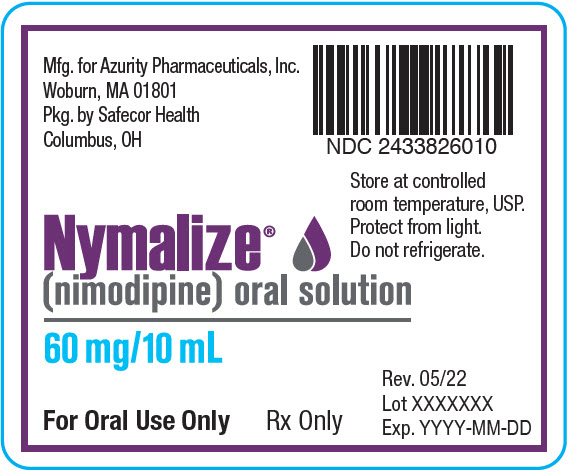
PRINCIPAL DISPLAY PANEL - 10 mL Syringe Label Mfg. for Azurity Pharmaceuticals, Inc. Woburn, MA 01801 Pkg. by Safecor Health Columbus, OH NDC 2433826010 Store at controlled room temperature, USP. Protect from light. Do not refrigerate. Nymalize ® (nimodipine) oral solution 60 mg/10 mL For Oral Use Only Rx Only Rev. 05/22 Lot XXXXXXX Exp. YYYY-MM-DD PRINCIPAL DISPLAY PANEL - 10 mL Syringe Label
PRINCIPAL DISPLAY PANEL - 10 mL Syringe Package 10 mL Nymalize ® (nimodipine) oral solution 60 mg / 10 mL For Oral Use Only Recommended Dosage: See prescribing information. Keep out of reach of children Package not child resistant Store between 20°C to 25°C (68°F - 77°F); excursions permitted to 15°C to 30°C (59°F - 86°F) [see USP Controlled Room Temperature] Protect from light Do not refrigerate NDC: 24338-260-10 One 10 mL Unit-Dose Oral Syringe Rx Only EXP: 2023-05-31 Lot: 22A0047 Mfg For Azurity Pharmaceuticals, Inc.
Woburn, MA 01801 Pkg By Safecor, Columbus, OH 43204 NYM-OW10-S01 REV. 05/22 PRINCIPAL DISPLAY PANEL - 10 mL Syringe Package
PRINCIPAL DISPLAY PANEL - 10 mL Syringe Package Carton NDC: 24338-260-12 Rx Only Nymalize ® (nimodipine) oral solution 60 mg/10 mL Contains 12 Prefilled Oral Syringes For Oral Use Only Distributed by: azurity ® pharmaceuticals Woburn, MA 01801 PRINCIPAL DISPLAY PANEL - 10 mL Syringe Package Carton
PRINCIPAL DISPLAY PANEL - 5 mL Syringe Label Mfg. for Azurity Pharmaceuticals, Inc. Woburn, MA 01801 Pkg. by Safecor Health Columbus, OH NDC 2433823005 Store at controlled room temperature, USP. Protect from light. Do not refrigerate. Nymalize ® (nimodipine) oral solution 30 mg/5 mL For Oral Use Only Rx Only Rev. 05/22 Lot XXXXXXX Exp. YYYY-MM-DD PRINCIPAL DISPLAY PANEL - 5 mL Syringe Label
PRINCIPAL DISPLAY PANEL - 5 mL Syringe Package 5 mL Nymalize ® (nimodipine) oral solution 30 mg / 5 mL For Oral Use Only Recommended Dosage: See prescribing information. Keep out of reach of children Package not child resistant Store between 20°C to 25°C (68°F - 77°F); excursions permitted to 15°C to 30°C (59°F - 86°F) [see USP Controlled Room Temperature] Protect from light Do not refrigerate NDC: 24338-230-05 One 5 mL Unit-Dose Oral Syringe Rx Only EXP: 2023-04-30 Lot: 22A0060 Mfg For Azurity Pharmaceuticals, Inc.
Woburn, MA 01801 Pkg By Safecor, Columbus, OH 43204 NYM-OW05-S01 REV. 05/22 PRINCIPAL DISPLAY PANEL - 5 mL Syringe Package
PRINCIPAL DISPLAY PANEL - 5 mL Syringe Package Carton NDC: 24338-230-12 Rx Only Nymalize ® (nimodipine) oral solution 30 mg/5 mL Contains 12 Prefilled Oral Syringes For Oral Use Only Distributed by: azurity ® pharmaceuticals Woburn, MA 01801 PRINCIPAL DISPLAY PANEL - 5 mL Syringe Package Carton
PRINCIPAL DISPLAY PANEL - 5 mL ENFit® Syringe Label NDC 24338-230-15 Rx Only Nymalize® (nimodipine) oral solution 30 mg/5 mL ENFit ® Syringe For Oral Use Only 5 mL ENFit® Syringe Label
PRINCIPAL DISPLAY PANEL - 5 mL ENFit® Syringe Blister Label NDC 24338-230-15 Rx Only Nymalize® (nimodipine) oral solution 30 mg/5 mL ENFit ® Syringe One 5 mL ENFit ® Syringe For Oral Use Only Store between 20°C to 25°C (68°F - 77°F); excursions permitted to 15°C to 30°C (59°F- 86°F). [see USP Controlled Room Temperature] Protect from light. Do not refrigerate. Manufactured for: azurity ® Pharmaceuticals Woburn, MA 01801 5 mL ENFit® Syringe Blister Label
PRINCIPAL DISPLAY PANEL - 5 mL ENFit® Syringe Carton Label NDC 24338-230-30 Rx Only Nymalize® (nimodipine) oral solution 30 mg/5 mL ENFit® Syringe Contains 12 Prefilled ENFit ® Oral Syringes For Oral Use Only Recommended Dosage: See prescribing information. Keep out of reach of children. Package not child resistant.
Store between 20°C to 25°C (68°F - 77°F); excursions permitted to 15°C to 30°C (59°F- 86°F). [see USP Controlled Room Temperature] Protect from light. Do not refrigerate. Manufactured for: azurity® Pharmaceuticals Woburn, MA 01801 5 mL ENFit® Syringe Carton Label
Medicare Part D spend CMS · PART D · 2025 (Q1-Q4)
About this NDC listing & data coverage
What data is (and isn’t) available for this NDC — tap to expand
| NDC identity (package / product / labeler codes) | ✓ Available |
| Labeler | ✓ Available |
| Product & package description | ✓ Available |
| Marketing category & status | ✓ Available |
| Active ingredient / dosage form / route | ✓ Available |
| FDA label (SPL via DailyMed) | ✓ Available |
| Package photos | ✓ Available |
| Inactive ingredients (structured) | ✓ Available |
| NADAC pharmacy acquisition price (CMS) | — Not published for this NDC CMS publishes NADAC only for NDCs reported in its retail-pharmacy survey. |
| Orange Book / therapeutic-equivalence data | ✓ Available |
| HCPCS J-code billing crosswalk | — Not published for this NDC Most self-administered / retail products have no J-code — that is normal. |
| Medicaid utilization (CMS SDUD) | — Not published for this NDC CMS reports utilization only for NDCs with Medicaid claims above its privacy threshold. |