
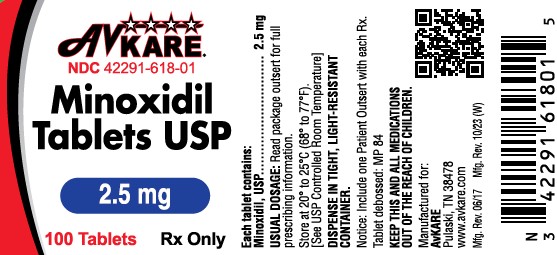
Minoxidil 2.5 mg Tablet, 100-count — NDC 42291-618-01 (Billing 42291-0618-01)
This is a package of 100 tablets of Minoxidil 2.5 mg Tablet from AvKARE, marketed since Aug 2013 and currently FDA-listed. It is this product's only package size.
NDC database record
One package, one record: these facts belong to NDC 42291-618-01 alone.
- Record
- FDA NDC Directory package listing · Human prescription drug
- Code segments
- 42291 labeler · 618 product · 01 package
- Package marketed since
- Aug 1, 2013
- Sample package
- No — commercial package
- Listing certified through
- Dec 31, 2027
- Billing quantity
- 100 EA per package
- Barcode (UPC)
- 0342291618015, 0342291619012
- FDA record last changed
- Jul 24, 2026
Identity & classification
Regulatory identifiers FDA, NLM and CMS codes for this package
Drug-database identifiers Medi-Span GPI and First Databank GCN / HICL / AHFS classification
- GSN (GCN sequence number): 000300
- GCN: 01291
- GPI-14 (Medi-Span): 36400020000305
- HICL (First Databank): 000093
- AHFS class code: 24:08.16.00
- RxCUI (RxNorm): 197986
Where does this data come from?
- FDA openFDA NDC Directory · synced Oct 8, 2026
- FDA label on DailyMed · label index refreshed Oct 8, 2026
- RxNorm (NLM RxNav) · catalog refreshed Oct 1, 2026
- Medi-Span GPI (licensed)
- First Databank (licensed) · refreshed Oct 8, 2026
RxNorm drug class
This medicine belongs to the Arteriolar Vasodilator class.
Where does this data come from?
- RxClass (NLM) · catalog refreshed Oct 1, 2026
Clinical
Minoxidil is used with other medications to treat high blood pressure. It is in a class of medications called vasodilators. It works by relaxing the blood vessels so that blood can flow more easily through the body. High blood pressure is a common condition and when not treated, can cause damage to the brain, heart, blood vessels, kidneys and other parts of the body. Damage to these organs may cause heart disease, a heart attack, heart failure, stroke, kidney failure, loss of vision, and other problems. In addition to taking medication, making lifestyle changes will also help to control your b...
Read the full MedlinePlus article ↗- The topical products in the label are specifically approved for hair regrowth on the top of the scalp only — not for use on other parts of the body. Applying it elsewhere isn't rec...
- Can I use the topical minoxidil solution on my beard or other areas, not just my scalp?
- Hair regrowth takes time and patience. Some people start to see results after about 2 months of twice-daily use, but for others it may take 4 months or more. Not everyone responds...
- How long does it take to see results with topical minoxidil?
Patient education
Supplement & herbal interactions
Some supplements/herbs that may interact with Minoxidil — tap one for details:
Minoxidil may be associated with lower levels of 1 nutrient — worth a chat with your pharmacist, not a cause for alarm.
Where does this data come from?
- MedlinePlus (NLM) · refreshed Oct 8, 2026
- FDA label on DailyMed · label index refreshed Oct 8, 2026
Ask a licensed pharmacist directly — free, answered by our team.
Pricing
A drug doesn't have one price. Each row is a different public payment system, and none is what you'd pay at the counter — that depends on your insurance. The ⓘ on each row explains what it measures.
| Price system | Per each | Per package |
|---|---|---|
| Retail pharmacies payNADAC · weekly | Not in the retail survey — common for institutional, discontinued, or low-volume packs. | |
| Medicaid paysCMS SDUD · 12 mo | No recent Medicaid claims on file for this NDC — rare and low-volume NDCs are suppressed in the public data. | |
| Medicare drug plans payPart D · Q2 2026 | $0.1978 | $19.78 / 100 tablets |
Where does this data come from?
- CMS NADAC weekly file
- CMS ASP pricing files · refreshed Sep 20, 2026
- CMS Medicaid State Drug Utilization Data · refreshed Oct 8, 2026
- CMS Part D plan pricing files · refreshed Sep 24, 2026
- VA National Acquisition Center price file
Packaging — all sizes for this product
| Package NDC | Description | Marketing start | Marketing end | Status |
|---|---|---|---|---|
| 42291-0618-01 You're viewing this Main listing | 100 TABLET in 1 BOTTLE | 2013-08-01 | — | Active |
Therapeutic equivalents
| Product | Labeler | Pack | NADAC/unit | TE | Status | Price vs. this |
|---|---|---|---|---|---|---|
| Minoxidil 2.5 mg 00591-5642-01 | Actavis | 100 tablets | $0.098 | AB | Availability likely | — |
| Minoxidil 2.5 mg 49884-0256-01 | Par | 100 tablets | $0.098 | AB | Availability likely | — |
| Minoxidil 2.5 mg 53489-0386-01 | Sun | 100 tablets | $0.098 | AB | Availability likely | — |
| Minoxidil 2.5 mg 68084-0204-01 | American | 100 tablets | $0.098 | AB | Availability likely | — |
| Minoxidil 2.5 mgthis 42291-0618-01 | AvKARE | 100 tablets | — | — | FDA listed | — |
| Minoxidil 2.5 mg 43353-0342-09 | Aphena | 9000 tablets | — | — | FDA listed | — |
| Minoxidil 2.5 mg 50090-7758-00 | A-S | 90 tablets | — | AB | FDA listed | — |
| Minoxidil 2.5 mg 51407-0901-01 | Golden | 100 tablets | — | AB | FDA listed | — |
| Minoxidil 2.5 mg 63629-2232-01 | Bryant | 100 tablets | — | AB | FDA listed | — |
| Minoxidil 2.5 mg 63629-9433-01 | Bryant | 30 tablets | — | AB | FDA listed | — |
| Minoxidil 2.5 mg 68071-3794-03 | NuCare | 30 tablets | — | AB | FDA listed | — |
| Minoxidil 2.5 mg 68788-8273-03 | Preferred | 30 tablets | — | AB | FDA listed | — |
| Minoxidil 2.5 mg 71205-0757-30 | Proficient | 30 tablets | — | AB | FDA listed | — |
| Minoxidil 2.5 mg 72162-1489-01 | Bryant | 100 tablets | — | AB | FDA listed | — |
| Minoxidil 2.5 mg 72789-0278-01 | PD-Rx | 100 tablets | — | AB | FDA listed | — |
| Minoxidil 2.5 mg 82804-0240-30 | Proficient | 30 tablets | — | AB | FDA listed | — |
| Minoxidil 2.5 mg 71335-3174-01 | Bryant | 30 tablets | — | AB | FDA listed | — |
| Minoxidil 2.5 mg 68071-5324-03 | NuCare | 30 tablets | — | AB | FDA listed | — |
Where does this data come from?
- FDA openFDA NDC Directory · synced Oct 8, 2026
- FDA Orange Book · refreshed Oct 3, 2026
- CMS NADAC weekly file
Availability & generic status
This product is an FDA-approved generic. Other versions of the same drug are listed under Therapeutic equivalents, least expensive first.
Where does this data come from?
- FDA Orange Book · refreshed Oct 3, 2026
What it looks like
Where does this data come from?
- FDA label on DailyMed · label index refreshed Oct 8, 2026
Inactive Ingredients / Excipients
Inactive ingredients, also called excipients, are components of the drug product other than the active ingredient. They may include fillers, dyes, coatings, preservatives, flavors, or other formulation ingredients.
🧪 Avoiding an ingredient? See Minoxidil inactive ingredients by manufacturer: every current product's list side by side, so you can ask your pharmacy for the version that does not list it.
💡 Tap an ingredient (hover on desktop) to see what it is and why it’s used.
-
UNII 3SY5LH9PMK
Anhydrous lactose is a milk sugar with no water content. It acts as a filler and binder in tablets and capsules, adding bulk and helping ingredients stick together.
-
UNII OP1R32D61U
Microcrystalline cellulose is a purified form of cellulose, a natural fiber from plant sources. It acts as a binder and filler in tablets and capsules, helping hold ingredients together and give the medicine its shape and size.
-
UNII 70097M6I30
Magnesium stearate is a salt made from magnesium and stearic acid, a fatty substance. It's used in tablets and capsules as a lubricant and glidant to help ingredients flow smoothly during manufacturing and prevent sticking.
-
UNII ETJ7Z6XBU4
Silicon dioxide is a naturally occurring mineral used as a glidant and anti-caking agent. It helps powder ingredients flow smoothly and prevents clumping during manufacturing and storage.
-
UNII 5856J3G2A2
A starch-based powder made from potatoes and processed with sodium. It acts as a disintegrant, helping the tablet or capsule break apart quickly in the stomach so the medicine can be absorbed.
5 inactive ingredients listed in the exact product block matched to this NDC.
Where does this data come from?
ingredient classCode="IACT" elements from the exact product block matched by this NDC. Label-section narrative from DailyMed / the openFDA label index is shown separately when available.- FDA label on DailyMed · label index refreshed Oct 8, 2026
- FDA openFDA NDC Directory · synced Oct 8, 2026
Inactive ingredient FAQ
Are inactive ingredients the same for every manufacturer?
Why might an inactive ingredient be missing?
Can inactive ingredients matter?
Manufacturer & labeler
More NDCs from AvKARE labeler code 42291
- Norgestimate and Ethinyl Estradiol Kit NDC 42291-565-84
- Phytonadione 5 mg Tablet NDC 42291-566-30
- Oseltamivir Phosphate 6 mg/mL For Suspension NDC 42291-567-60
- norgestimate and ethinyl estradiol Kit NDC 42291-590-84
- Methotrexate 2.5 mg Tablet NDC 42291-594-01
- Metoclopramide 10 mg Tablet NDC 42291-596-90
- Montelukast Sodium 4 mg Tablet, Chewable NDC 42291-622-10
- Montelukast Sodium 5 mg Tablet, Chewable NDC 42291-623-10
- Mexiletine Hydrochloride 150 mg Capsule NDC 42291-624-01
- Mexiletine Hydrochloride 200 mg Capsule NDC 42291-625-01
- Mexiletine Hydrochloride 250 mg Capsule NDC 42291-626-01
- Naltrexone Hydrochloride 50 mg Tablet, Film Coated NDC 42291-632-30
Where does this data come from?
- FDA openFDA NDC Directory · synced Oct 8, 2026
- Drugs@FDA
Full prescribing information FDA SPL
🚨 Boxed Warning ▾
WARNING Minoxidil tablets contain the powerful antihypertensive agent, minoxidil, which may produce serious adverse effects. It can cause pericardial effusion, occasionally progressing to tamponade, and angina pectoris may be exacerbated. Minoxidil should be reserved for hypertensive patients who do not respond adequately to maximum therapeutic doses of a diuretic and two other antihypertensive agents.
In experimental animals, minoxidil caused several kinds of myocardial lesions as well as other adverse cardiac effects (see Cardiac Lesions in Animals ). Minoxidil must be administered under close supervision, usually concomitantly with therapeutic doses of a beta-adrenergic blocking agent to prevent tachycardia and increased myocardial workload. It must also usually be given with a diuretic, frequently one acting in the ascending limb of the loop of Henle, to prevent serious fluid accumulation.
Patients with malignant hypertension and those already receiving guanethidine (see WARNINGS ) should be hospitalized when minoxidil is first administered so that they can be monitored to avoid too rapid, or large orthostatic, decreases in blood pressure.
🎯 Indications and Usage ▾
INDICATIONS AND USAGE Because of the potential for serious adverse effects, minoxidil tablets are indicated only in the treatment of hypertension that is symptomatic or associated with target organ damage and is not manageable with maximum therapeutic doses of a diuretic plus two other antihypertensive drugs. At the present time use in milder degrees of hypertension is not recommended because the benefit-risk relationship in such patients has not been defined. Minoxidil reduced supine diastolic blood pressure by 20 mm Hg or to 90 mm Hg or less in approximately 75% of patients, most of who had hypertension that could not be controlled by other drugs.
⏱️ Dosage and Administration ▾
DOSAGE AND ADMINISTRATION Patients over 12 years of age: The recommended initial dosage of minoxidil tablets is 5 mg of minoxidil given as a single daily dose. Daily dosage can be increased to 10, 20 and then to 40 mg in single or divided doses if required for optimum blood pressure control. The effective dosage range is usually 10 to 40 mg per day.
The maximum recommended dosage is 100 mg per day. Patients under 12 years of age: The initial dosage is 0.2 mg/kg minoxidil as a single daily dose. The dosage may be increased in 50 to 100% increments until optimum blood pressure control is achieved.
The effective dosage range is usually 0.25 mg to 1 mg/kg/day. The maximum recommended dosage is 50 mg daily ( see 9. Pediatric Use under PRECAUTIONS ).
Dose frequency: The magnitude of within-day fluctuation of arterial pressure during therapy with minoxidil is directly proportional to the extent of pressure reduction. If supine diastolic pressure has been reduced less than 30 mm Hg, the drug need be administered only once a day; if supine diastolic pressure has been reduced more than 30 mm Hg, the daily dosage should be divided into two equal parts. Frequency of dosage adjustment: Dosage must be titrated carefully according to individual response.
Intervals between dosage adjustments normally should be at least 3 days since the full response to a given dose is not obtained for at least that amount of time. Where a more rapid management of hypertension is required, dose adjustments can be made every 6 hours if the patient is carefully monitored. Concomitant therapy: Diuretic and beta-blocker or other sympathetic nervous system suppressant.
Diuretics: Minoxidil must be used in conjunction with a diuretic in patients relying on renal function for maintaining salt and water balance. Diuretics have been used at the following dosages when starting therapy with minoxidil: hydrochlorothiazide (50 mg, b.i.d.) or other thiazides at equieffective dosage; chlorthalidone (50 to 100 mg, once daily); furosemide (40 mg, b.i.d.). If excessive salt and water retention results in a weight gain of more than 5 pounds, diuretic therapy should be changed to furosemide; if the patient is already taking furosemide, dosage should be increased in accordance with the patient's requirements.
Beta-blocker or other sympathetic nervous system suppressants: When therapy with minoxidil is begun, the dosage of a beta-adrenergic receptor blocking drug should be the equivalent of 80 to 160 mg of propranolol per day in divided doses. If beta-blockers are contraindicated, methyldopa (250 to 750 mg, b.i.d.) may be used instead. Methyldopa must be given for at least 24 hours before starting therapy with minoxidil because of the delay in the onset of methyldopa's action.
Limited clinical experience indicates that clonidine may also be used to prevent tachycardia induced by minoxidil; the usual dosage is 0.1 to 0.2 mg twice daily. Sympathetic nervous system suppressants may not completely prevent an increase in heart rate due to minoxidil but usually do prevent tachycardia. Typically, patients receiving a beta-blocker prior to initiation of therapy with minoxidil have a bradycardia and can be expected to have an increase in heart rate toward normal when minoxidil is added.
When treatment with minoxidil and beta-blocker or other sympathetic nervous system suppressant are begun simultaneously, their opposing cardiac effects usually nullify each other, leading to little change in heart rate.
⛔ Contraindications ▾
CONTRAINDICATIONS Minoxidil tablets are contraindicated in pheochromocytoma, because it may stimulate secretion of catecholamines from the tumor through its antihypertensive action. Minoxidil tablets are contraindicated in those patients with a history of hypersensitivity to any of the components of the preparation.
⚠️ Warnings ▾
WARNINGS 1. Salt and Water Retention Congestive Heart Failure — concomitant use of an adequate diuretic is required — Minoxidil tablets must usually be administered concomitantly with a diuretic adequate to prevent fluid retention and possible congestive heart failure; a high ceiling (loop) diuretic is almost always required. Body weight should be monitored closely.
If minoxidil is used without a diuretic, retention of several hundred milliequivalents of salt and corresponding volumes of water can occur within a few days, leading to increased plasma and interstitial fluid volume and local or generalized edema. Diuretic treatment alone, or in combination with restricted salt intake, will usually minimize fluid retention, although reversible edema did develop in approximately 10% of nondialysis patients so treated. Ascites has also been reported.
Diuretic effectiveness was limited mostly by disease-related impaired renal function. The condition of patients with pre-existing congestive heart failure occasionally deteriorated in association with fluid retention although because of the fall in blood pressure (reduction of afterload), more than twice as many improved than worsened. Rarely, refractory fluid retention may require discontinuation of minoxidil.
Provided that the patient is under close medical supervision, it may be possible to resolve refractory salt retention by discontinuing minoxidil for 1 or 2 days and then resuming treatment in conjunction with vigorous diuretic therapy. 2. Concomitant Treatment to Prevent Tachycardia is Usually Required Minoxidil increases the heart rate.
Angina may worsen or appear for the first time during minoxidil treatment, probably because of the increased oxygen demands associated with increased heart rate and cardiac output. The increase in rate and the occurrence of angina generally can be prevented by the concomitant administration of a beta-adrenergic blocking drug or other sympathetic nervous system suppressant. The ability of beta-adrenergic blocking agents to minimize papillary muscle lesions in animals is further reason to utilize such an agent concomitantly.
Round-the-clock effectiveness of the sympathetic suppressant should be ensured. 3. Pericarditis, Pericardial Effusion and Tamponade There have been reports of pericarditis occurring in association with the use of minoxidil.
The relationship of this association to renal status is uncertain. Pericardial effusion, occasionally with tamponade, has been observed in about 3% of treated patients not on dialysis, especially those with inadequate or compromised renal function. Although in many cases, the pericardial effusion was associated with a connective tissue disease, the uremic syndrome, congestive heart failure, or marked fluid retention, there have been instances in which these potential causes of effusion were not present.
Patients should be observed closely for any suggestion of a pericardial disorder, and echocardiographic studies should be carried out if suspicion arises. More vigorous diuretic therapy, dialysis, pericardiocentesis, or surgery may be required. If the effusion persists, withdrawal of minoxidil should be considered in light of other means of controlling the hypertension and the patient's clinical status.
4. Interaction with Guanethidine Although minoxidil does not itself cause orthostatic hypotension, its administration to patients already receiving guanethidine can result in profound orthostatic effects. If at all possible, guanethidine should be discontinued well before minoxidil is begun.
Where this is not possible, minoxidil therapy should be started in the hospital and the patient should remain institutionalized until severe orthostatic effects are no longer present or the patient has learned to avoid activities that provoke them. 5. Hazard of Rapid Control of Blood Pressure In patients with very severe blood pressure elevation, too rapid control of blood pressure, especially with intravenous agents, can… [Excerpted — this section continues on DailyMed.]
🤒 Adverse Reactions ▾
ADVERSE REACTIONS 1. Salt and Water Retention (see WARNINGS: Concomitant use of Adequate Diuretic is Required ) — Temporary edema developed in 7% of patients who were not edematous at the start of therapy. 2.
Pericarditis, Pericardial Effusion and Tamponade (see WARNINGS ). 3. Dermatologic — Hypertrichosis — Elongation, thickening, and enhanced pigmentation of fine body hair are seen in about 80% of patients taking minoxidil tablets.
This develops within 3 to 6 weeks after starting therapy. It is usually first noticed on the temples, between the eyebrows, between the hairline and the eyebrows, or in the side-burn area of the upper lateral cheek, later extending to the back, arms, legs, and scalp. Upon discontinuation of minoxidil, new hair growth stops, but 1 to 6 months may be required for restoration to pretreatment appearance.
No endocrine abnormalities have been found to explain the abnormal hair growth; thus, it is hypertrichosis without virilism. Hair growth is especially disturbing to children and women and such patients should be thoroughly informed about this effect before therapy with minoxidil is begun. Allergic — Rashes have been reported, including rare reports of bullous eruptions, and Stevens-Johnson Syndrome.
4. Hematologic — Thrombocytopenia and leukopenia (WBC<3000/mm 3 ) have rarely been reported. 5.
Gastrointestinal — Nausea and/or vomiting has been reported. In clinical trials the incidence of nausea and vomiting associated with the underlying disease has shown a decrease from pretrial levels. 6.
Miscellaneous — Breast tenderness — This developed in less than 1 % of patients. 7. Altered Laboratory Findings — (a) ECG changes — Changes in direction and magnitude of the ECG T-waves occur in approximately 60% of patients treated with minoxidil.
In rare instances a large negative amplitude of the T-wave may encroach upon the S-T segment, but the S-T segment is not independently altered. These changes usually disappear with continuance of treatment and revert to the pretreatment state if minoxidil is discontinued. No symptoms have been associated with these changes, nor have there been alterations in blood cell counts or in plasma enzyme concentrations that would suggest myocardial damage.
Long-term treatment of patients manifesting such changes has provided no evidence of deteriorating cardiac function. At present the changes appear to be nonspecific and without identifiable clinical significance. (b) Effects of hemodilution — hematocrit, hemoglobin and erythrocyte count usually fall about 7% initially and then recover to pretreatment levels.
(c) Other — Alkaline phosphatase increased varyingly without other evidence of liver or bone abnormality. Serum creatinine increased an average of 6% and BUN slightly more, but later declined to pretreatment levels.
🔄 Drug Interactions ▾
4. Drug interactions See " Interaction with Guanethidine " under WARNINGS .
🤰 Pregnancy ▾
6. Pregnancy Teratogenic Effects Pregnancy Category C. Oral administration of minoxidil has been associated with evidence of increased fetal resorption in rabbits, but not rats, when administered at five times the maximum recommended oral antihypertensive human dose.
There was no evidence of teratogenic effects in rats and rabbits. Subcutaneous administration of minoxidil to pregnant rats at 80 mg/kg/day was maternally toxic but not teratogenic. Higher subcutaneous doses produced evidence of development toxicity.
There are no adequate and well controlled studies in pregnant women. Minoxidil should be used during pregnancy only if the potential benefit justifies the potential risk to the fetus.
🧒 Pediatric Use ▾
9. Pediatric Use Use in pediatric patients has been limited to date, particularly in infants. The recommendations under DOSAGE AND ADMINISTRATION can be considered only a rough guide at present and a careful titration is essential.
🧓 Geriatric Use ▾
10. Geriatric Use Clinical studies of minoxidil tablets did not include sufficient numbers of subjects aged 65 and over to determine whether they respond differently from younger subjects. Other reported clinical experience has not identified the differences in responses between the elderly and younger patients.
In general, dose selection for an elderly patient should be cautious, usually starting at the low end of the dosing range, reflecting the greater frequency of decreased hepatic, renal, or cardiac function, and of concomitant disease or other drug therapy.
🆘 Overdosage ▾
OVERDOSAGE There have been only a few instances of deliberate or accidental overdosage with minoxidil tablets. One patient recovered after taking 50 mg of minoxidil together with 500 mg of a barbiturate. When exaggerated hypotension is encountered, it is most likely to occur in association with residual sympathetic nervous system blockade from previous therapy (guanethidine-like effects or alpha-adrenergic blockage), which prevents the usual compensatory maintenance of blood pressure.
Intravenous administration of normal saline will help to maintain blood pressure and facilitate urine formation in these patients. Sympathomimetic drugs such as norepinephrine or epinephrine should be avoided because of their excessive cardiac stimulating action. Phenylephrine, angiotensin II, vasopressin, and dopamine all reverse hypotension due to minoxidil, but should only be used if underperfusion of a vital organ is evident.
Radioimmunoassay can be performed to determine the concentration of minoxidil in the blood. At the maximum adult dose of 100 mg/day, peak blood levels of 1641 ng/mL and 2441 ng/mL were observed in two patients, respectively. Due to patient-to-patient variation in blood levels, it is difficult to establish an overdosage warning level.
In general, a substantial increase above 2000 ng/mL should be regarded as overdosage, unless the physician is aware that the patient has taken no more than the maximum dose. Oral LD 50 in rats has ranged from 1321–3492 mg/kg; in mice, 2456–2648 mg/kg.
🧬 Clinical Pharmacology ▾
CLINICAL PHARMACOLOGY 1. General Pharmacologic Properties Minoxidil is an orally effective direct acting peripheral vasodilator that reduces elevated systolic and diastolic blood pressure by decreasing peripheral vascular resistance. Microcirculatory blood flow in animals is enhanced or maintained in all systemic vascular beds.
In man, forearm and renal vascular resistance decline; forearm blood flow increases while renal blood flow and glomerular filtration rate are preserved. Because it causes peripheral vasodilation, minoxidil elicits a number of predictable reactions. Reduction of peripheral arteriolar resistance and the associated fall in blood pressure trigger sympathetic, vagal inhibitory, and renal homeostatic mechanisms, including an increase in renin secretion, that lead to increased cardiac rate and output and salt and water retention.
These adverse effects can usually be minimized by concomitant administration of a diuretic and a beta-adrenergic blocking agent or other sympathetic nervous system suppressant. Minoxidil does not interfere with vasomotor reflexes and therefore does not produce orthostatic hypotension. The drug does not enter the central nervous system in experimental animals in significant amounts, and it does not affect CNS function in man.
2. Effects on Blood Pressure and Target Organs The extent and time-course of blood pressure reduction by minoxidil do not correspond closely to its concentration in plasma. After an effective single oral dose, blood pressure usually starts to decline within one-half hour, reaches a minimum between 2 and 3 hours and recovers at an arithmetically linear rate of about 30%/day.
The total duration of effect is approximately 75 hours. When minoxidil is administered chronically, once or twice a day, the time required to achieve maximum effect on blood pressure with a given daily dose is inversely related to the size of the dose. Thus, maximum effect is achieved on 10 mg/day within 7 days, on 20 mg/day within 5 days, and on 40 mg/day within 3 days.
The blood pressure response to minoxidil is linearly related to the logarithm of the dose administered. The slope of this log-linear dose-response relationship is proportional to the extent of hypertension and approaches zero at a supine diastolic blood pressure of approximately 85 mm Hg. When used in severely hypertensive patients resistant to other therapy, frequently with an accompanying diuretic and beta-blocker, minoxidil tablets usually decreased the blood pressure and reversed encephalopathy and retinopathy.
3. Absorption and Metabolism Minoxidil is at least 90% absorbed from the Gl tract in experimental animals and man. Plasma levels of the parent drug reach maximum within the first hour and decline rapidly thereafter.
The average plasma half-life in man is 4.2 hours. Approximately 90% of the administered drug is metabolized, predominantly by conjugation with glucuronic acid at the N-oxide position in the pyrimidine ring, but also by conversion to more polar products. Known metabolites exert much less pharmacologic effect than minoxidil itself; all are excreted principally in the urine.
Minoxidil does not bind to plasma proteins, and its renal clearance corresponds to the glomerular filtration rate. In the absence of functional renal tissue, minoxidil and its metabolites can be removed by hemodialysis. 4.
Cardiac Lesions in Animals Minoxidil produces several cardiac lesions in animals. Some are characteristic of agents that cause tachycardia and diastolic hypotension (beta-agonists like isoproterenol, arterial dilators like hydralazine) while others are produced by a narrower range of agents with arterial dilating properties. The significance of these lesions for humans is not clear, as they have not been recognized in patients treated with oral minoxidil at systemically active doses, despite formal review of over 150 autopsies of treated patients.
Papillary muscle/subendocardial necrosis The most characteristic lesion… [Excerpted — this section continues on DailyMed.]
📦 How Supplied / Storage and Handling ▾
HOW SUPPLIED Minoxidil tablets are available as follows: Minoxidil tablets 2.5 mg are round, scored, white and debossed on one side and on the reverse side. Bottles of 90 NDC 42291-618-90 Bottles of 100 NDC 42291-618-01 Bottles of 1000 NDC 42291-618-10 Minoxidil tablets 10 mg are round, scored, white and debossed on one side and on the reverse side. Bottles of 90 NDC 42291-619-90 Bottles of 100 NDC 42291-619-01 Bottles of 1000 NDC 42291-619-10 Figure Figure Figure Figure Store at 20° to 25°C (68° to 77° F). [See USP Controlled Room Temperature] DISPENSE IN TIGHT, LIGHT-RESISTANT CONTAINER.
📦 Storage and Handling ▾
Store at 20° to 25°C (68° to 77° F). [See USP Controlled Room Temperature] DISPENSE IN TIGHT, LIGHT-RESISTANT CONTAINER.
📋 Description ▾
DESCRIPTION Minoxidil tablets contain minoxidil, an antihypertensive peripheral vasodilator. Minoxidil occurs as a white to off-white, crystalline powder, soluble in alcohol and propylene glycol; sparingly soluble in methanol; slightly soluble in water; practically insoluble in chloroform, acetone and ethyl acetate. The chemical name for minoxidil is 2,4-Pyrimidinediamine, 6-(1-piperidinyl)-, 3-oxide.
The structural formula is represented below: Minoxidil tablets for oral administration contain either 2.5 mg or 10 mg of minoxidil. Inactive ingredients: anhydrous lactose, colloidal silicon dioxide, magnesium stearate, microcrystalline cellulose, and sodium starch glycolate. Chemical Structure
💬 Information for Patients ▾
2. Information for patient The patient should be fully aware of the importance of continuing all of his antihypertensive medications and of the nature of symptoms that would suggest fluid overload. A patient brochure has been prepared and is included with each minoxidil package. The text of this brochure is reprinted at the end of the insert.
⚠️ Precautions ▾
PRECAUTIONS 1. General Precautions Monitor fluid and electrolyte balance and body weight (see WARNINGS: Salt and Water Retention ). Observe patients for signs and symptoms of pericardial effusion (see WARNINGS: Pericarditis, Pericardial Effusion, and Tamponade ).
Use after myocardial infarction — Minoxidil tablets have not been used in patients who have had a myocardial infarction within the preceding month. It is possible that a reduction of arterial pressure with minoxidil might further limit blood flow to the myocardium, although this might be compensated by decreased oxygen demand because of lower blood pressure. Hypersensitivity — Possible hypersensitivity to minoxidil, manifested as a skin rash, has been seen in less than 1% of patients; whether the drug should be discontinued when this occurs depends on treatment alternatives.
Renal failure or dialysis patients may require smaller doses of minoxidil and should have close medical supervision to prevent exacerbation of renal failure or precipitation of cardiac failure. 2. Information for patient The patient should be fully aware of the importance of continuing all of his antihypertensive medications and of the nature of symptoms that would suggest fluid overload.
A patient brochure has been prepared and is included with each minoxidil package. The text of this brochure is reprinted at the end of the insert. 3.
Laboratory tests Those laboratory tests which are abnormal at the time of initiation of minoxidil therapy, such as urinalysis, renal function tests, EKG, chest x-ray, echocardiogram, etc., should be repeated at intervals to ascertain whether improvement or deterioration is occurring under minoxidil therapy. Initially such tests should be performed frequently, e.g., 1–3 month intervals; later as stabilization occurs, at intervals of 6–12 months. 4.
Drug interactions See " Interaction with Guanethidine " under WARNINGS . 5. Carcinogenesis, Mutagenesis, Impairment of Fertility Two-year carcinogenicity studies of minoxidil have been conducted by the dermal and oral (dietary) routes of administration in mice and rats.
There were no positive findings with the oral (dietary) route of administration in rats. In the two-year dermal study in mice, an increased incidence of mammary adenomas and adenocarcinomas in the females at all dose levels (8, 25 and 80 mg/kg/day) was attributed to increased prolactin activity. Hyperprolactinemia is a well-known mechanism in the enhancement of mouse mammary tumors, but has not been associated with mammary tumorigenesis in women.
Additionally, topical minoxidil has not been shown to cause hyperprolactinemia in women on clinical trials. Absorption of minoxidil through rodent skin is greater than would be experienced by patients treated topically with minoxidil for hair loss. Dietary administration of minoxidil to mice for up to 2 years was associated with an increased incidence of malignant lymphomas in females at all dose levels (10, 25 and 63 mg/kg/day) and an increased incidence of hepatic nodules in males (63 mg/kg/day).
There was no effect of dietary minoxidil on the incidence of malignant liver tumors. In the two-year dermal study in rats there were significant increases in incidence of pheochromocytomas in males and females and preputial gland adenomas in males. Changes in incidence of neoplasms found to be increased in the dermal or oral carcinogenicity studies were typical of those expected in rodents treated with other hypotensive agents (adrenal pheochromocytomas in rats), treatment-related hormonal alterations (mammary carcinomas in female mice; preputial gland adenomas in male rats) or representative of normal variations within the range of historical incidence for rodent neoplasms (malignant lymphomas, liver nodules/adenomas in mice).
Based on differences in absorption of minoxidil and mechanisms of tumorigenesis in these rodent species, none of these changes were considered to be relevant to the safety of patients treated topi… [Excerpted — this section continues on DailyMed.]
🍼 Nursing Mothers ▾
8. Nursing Mothers There has been one report of minoxidil excretion in the breast milk of a woman treated with 5 mg oral minoxidil twice daily for hypertension. Because of the potential for adverse effects in nursing infants from minoxidil absorption minoxidil should not be administered to a nursing woman.
📄 Carcinogenesis, Mutagenesis, Impairment of Fertility ▾
5. Carcinogenesis, Mutagenesis, Impairment of Fertility Two-year carcinogenicity studies of minoxidil have been conducted by the dermal and oral (dietary) routes of administration in mice and rats. There were no positive findings with the oral (dietary) route of administration in rats.
In the two-year dermal study in mice, an increased incidence of mammary adenomas and adenocarcinomas in the females at all dose levels (8, 25 and 80 mg/kg/day) was attributed to increased prolactin activity. Hyperprolactinemia is a well-known mechanism in the enhancement of mouse mammary tumors, but has not been associated with mammary tumorigenesis in women. Additionally, topical minoxidil has not been shown to cause hyperprolactinemia in women on clinical trials.
Absorption of minoxidil through rodent skin is greater than would be experienced by patients treated topically with minoxidil for hair loss. Dietary administration of minoxidil to mice for up to 2 years was associated with an increased incidence of malignant lymphomas in females at all dose levels (10, 25 and 63 mg/kg/day) and an increased incidence of hepatic nodules in males (63 mg/kg/day). There was no effect of dietary minoxidil on the incidence of malignant liver tumors.
In the two-year dermal study in rats there were significant increases in incidence of pheochromocytomas in males and females and preputial gland adenomas in males. Changes in incidence of neoplasms found to be increased in the dermal or oral carcinogenicity studies were typical of those expected in rodents treated with other hypotensive agents (adrenal pheochromocytomas in rats), treatment-related hormonal alterations (mammary carcinomas in female mice; preputial gland adenomas in male rats) or representative of normal variations within the range of historical incidence for rodent neoplasms (malignant lymphomas, liver nodules/adenomas in mice).
Based on differences in absorption of minoxidil and mechanisms of tumorigenesis in these rodent species, none of these changes were considered to be relevant to the safety of patients treated topically with minoxidil for hair loss. There was no evidence of epithelial hyperplasia or tumorigenesis at the sites of topical application of minoxidil in either species in the two-year dermal carcinogenesis studies. No evidence of carcinogenicity was detected in rats or rabbits treated topically with minoxidil for one year.
Topical minoxidil (2% and 5%) did not significantly (p < 0.05) reduce the latency period of UV light-initiated skin tumors in hairless mice, as compared to controls, in a 12-month photocarcinogenicity study. Minoxidil was not mutagenic in the Salmonella (Ames) test, the DNA damage alkaline elution assay, the in vitro rat hepatocyte unscheduled DNA synthesis (UDS) assay, the rat bone marrow micronucleus assay, or the mouse bone marrow micronucleus assay. An equivocal result was recorded in an in vitro cytogenetic assay using Chinese hamster cells at long exposure times, but a similar assay using human lymphocytes was negative.
In a study in which male and female rats received one or five times the maximum recommended human oral antihypertensive dose of minoxidil (multiples based on a 50 kg patient) there was a dose-dependent reduction in conception rate.
📄 Patient Package Insert ▾
PATIENT INFORMATION Minoxidil tablets contain minoxidil, a medicine for the treatment of high blood pressure in the patient who has not been controlled or is experiencing unacceptable side effects with other medications. It must usually be taken with other medicines. Be absolutely sure to take all of your medicines for high blood pressure according to your doctor's instructions.
Do not stop taking minoxidil unless your doctor tells you to. Do not give any of your medicine to other people. It is important that you look for the warning signals of certain undesired effects of minoxidil.
Call your doctor if they occur. Your doctor will need to see you regularly while you are taking minoxidil. Be sure to keep all your appointments or to arrange for new ones if you must miss one.
Do not hesitate to call your doctor if any discomforts or problems occur. The information here is intended to help you take minoxidil properly. It does not tell you all there is to know about minoxidil.
There is a more technical leaflet that you may request from the pharmacist; you may need your doctor's help in understanding parts of that leaflet. What is Minoxidil? Minoxidil tablets contain minoxidil which is a drug for lowering the blood pressure.
It works by relaxing and enlarging certain small blood vessels so that blood flows through them more easily. Why lower blood pressure? Your doctor has prescribed minoxidil to lower your blood pressure and protect vital parts of your body.
Uncontrolled blood pressure can cause stroke, heart failure, blindness, kidney failure and heart attacks. Most people with high blood pressure need to take medicines to treat it for their whole lives. Who should take minoxidil tablets?
There are many people with high blood pressure, but most of them do not need minoxidil. Minoxidil is used ONLY when your doctor decides that: your high blood pressure is severe; your high blood pressure is causing symptoms or damage to vital organs; and other medicines did not work well enough or had very disturbing side effects. Minoxidil should be taken only when a doctor prescribes it.
Never give any of your minoxidil tablets, or any other high blood pressure medicine, to a friend or relative. Pregnancy: In some cases doctors may prescribe minoxidil for women who are pregnant or who are planning to have children. However, its safe use in pregnancy has not been established.
Laboratory animals had a reduced ability to become pregnant and a reduced survival of offspring while taking minoxidil. If you are pregnant or are planning to become pregnant, be sure to tell your doctor. How to take minoxidil tablets.
Usually, your doctor will prescribe two other medicines along with minoxidil. These will help lower blood pressure and will help prevent undesired effects of minoxidil. Often, when a medicine like minoxidil lowers blood pressure, your body tries to return the blood pressure to the original higher level.
It does this by holding on to water and salt (so there will be more fluid to pump) and by making your heart beat faster. To prevent this, your doctor will usually prescribe a water tablet to remove the extra salt and water from your body (a diuretic: dye-u-RET-tic) and another medicine to slow your heart beat. You must follow your doctor's instructions exactly, taking all the prescribed medicines, in the right amounts, each day.
These medicines will help keep your blood pressure down. The water tablet and heart beat medicine will help prevent the undesired effects of minoxidil. Minoxidil tablets come in two strengths (2.5 milligrams and 10 milligrams) that are marked on each tablet.
Pay close attention to the tablet markings to be sure you are taking the correct strength. Your doctor may prescribe half a tablet; the tablets are scored (partly cut on one side) so that you can easily break them. When you first start taking minoxidil, your doctor may need to see you often in order to adjust your dosage.
Take all your medicine according to the sch… [Excerpted — this section continues on DailyMed.]
📄 Package Label / Principal Display Panel ▾
PACKAGE LABEL.PRINCIPAL DISPLAY PANEL 1 2
Medicare Part D spend CMS · PART D · 2026 (Q1)
About this NDC listing & data coverage
What data is (and isn’t) available for this NDC — tap to expand
| NDC identity (package / product / labeler codes) | ✓ Available |
| Labeler | ✓ Available |
| Product & package description | ✓ Available |
| Marketing category & status | ✓ Available |
| Active ingredient / dosage form / route | ✓ Available |
| FDA label (SPL via DailyMed) | ✓ Available |
| Package photos | ✓ Available |
| Inactive ingredients (structured) | ✓ Available |
| NADAC pharmacy acquisition price (CMS) | — Not published for this NDC CMS publishes NADAC only for NDCs reported in its retail-pharmacy survey. |
| Orange Book / therapeutic-equivalence data | — Not published for this NDC Applies only to products approved under an NDA/ANDA; many listings are out of scope. |
| HCPCS J-code billing crosswalk | — Not published for this NDC Most self-administered / retail products have no J-code — that is normal. |
| Medicaid utilization (CMS SDUD) | — Not published for this NDC CMS reports utilization only for NDCs with Medicaid claims above its privacy threshold. |