
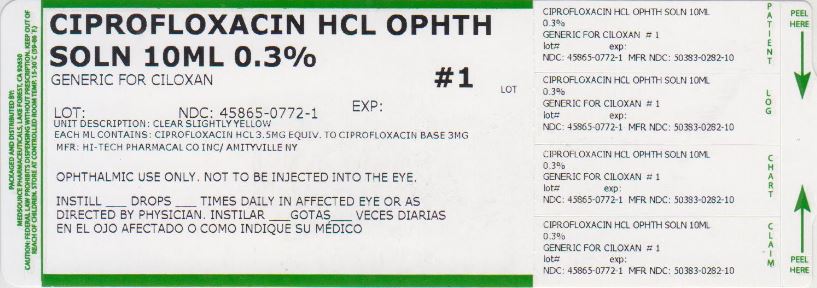
Ciprofloxacin 3 mg/mL Solution/ Drops
Other active recalls for Ciprofloxacin (different manufacturers) — 3 · tap to view
🆔 Identity & classification
Where does this data come from?
🏭 Manufacturer & labeler
Where does this data come from?
🩺 Clinical
- Ciprofloxacin treats a wide range of bacterial infections — things like urinary tract infections, skin infections, bone and joint infections, infectious diarrhea, typhoid fever, an...
- What kinds of infections does ciprofloxacin actually treat?
- You can take ciprofloxacin with or without food — that part's flexible. But avoid taking it at the same time as milk, yogurt, or calcium-fortified juices, because dairy and calcium...
- The most common side effects are nausea, diarrhea, and vomiting — uncomfortable, but usually manageable. The ones that mean stop-and-call-your-doctor-now are tendon pain (especiall...
Patient education
Supplement & herbal interactions
Some supplements/herbs that may interact with Ciprofloxacin — tap one for details:
Ciprofloxacin may be associated with lower levels of 11 nutrients — worth a chat with your pharmacist, not a cause for alarm.
Where does this data come from?
Ask a licensed pharmacist directly — free, answered by our team.
🧪 Inactive Ingredients / Excipients
Inactive ingredients, also called excipients, are components of the drug product other than the active ingredient. They may include fillers, dyes, coatings, preservatives, flavors, or other formulation ingredients.
💡 Tap an ingredient (hover on desktop) to see what it is and why it’s used.
-
UNII Q40Q9N063P
Acetic acid is a weak organic acid commonly used in medicines as a buffer and pH adjuster. It helps maintain the proper acidity level to ensure the drug remains stable and effective in its formulation.
-
UNII F5UM2KM3W7
Benzalkonium chloride is a chemical compound that works as a preservative and antimicrobial agent in medications. It prevents bacterial and fungal growth in liquid formulations to keep the product safe during storage and use.
-
UNII 7FLD91C86K
Edetate disodium is a chemical compound that binds and removes certain metal ions. In medicines, it acts as a preservative and stabilizer by preventing metals like calcium from interfering with the product's shelf life and consistency.
-
UNII QTT17582CB
A strong acid used to adjust and maintain the proper pH level in liquid medicines, ensuring stability and preventing breakdown of active ingredients.
-
UNII 3OWL53L36A
A natural sugar alcohol derived from seaweed or synthesized in the lab. It's used as a filler to add bulk, a sweetener in sugar-free formulas, and a disintegrant to help tablets break apart in the stomach.
-
UNII 4550K0SC9B
Sodium acetate is a salt derived from acetic acid. It acts as a buffer to help maintain the medicine's pH stability and may serve as a preservative or solubilizer in liquid formulations.
-
UNII 55X04QC32I
A strong alkaline chemical used to adjust and maintain the pH balance of liquid medicines. It helps keep the medicine stable and ensures it stays effective during storage.
-
UNII 059QF0KO0R
Water is a liquid solvent that dissolves and mixes ingredients together in liquid medicines, syrups, and injections. It helps distribute the active drug evenly throughout the product.
8 inactive ingredients listed in the exact product block matched to this NDC.
Where does this data come from?
ingredient classCode="IACT" elements from the exact product block matched by this NDC. Label-section narrative from DailyMed / the openFDA label index is shown separately when available.Inactive ingredient FAQ
Are inactive ingredients the same for every manufacturer?
Why might an inactive ingredient be missing?
Can inactive ingredients matter?
💲 Pricing
A drug doesn't have one price. Each row is a different public payment system, and none is what you'd pay at the counter — that depends on your insurance. The ⓘ on each row explains what it measures.
| Price system | Per mL | Per package |
|---|---|---|
| Retail pharmacies payNADAC · weekly | Not in the retail survey — common for institutional, discontinued, or low-volume packs. | |
| Medicaid paysCMS SDUD · 12 mo | No recent Medicaid claims on file for this NDC — rare and low-volume NDCs are suppressed in the public data. | |
| Medicare drug plans payPart D · quarterly | No Part D plan price is available for this NDC in our data. | |
Where does this data come from?
🔁 Therapeutic equivalents
| Product | Labeler | Pack | NADAC/unit | TE | Status | Price vs. this |
|---|---|---|---|---|---|---|
| Ciprofloxacin 3 mg/mLthis 45865-0772-01 | Medsource | 1 bottle | — | AT | Discontinued | — |
Where does this data come from?
⏳ Availability & generic status
This product is an FDA-approved generic. Other versions of the same drug are listed under Therapeutic equivalents, least expensive first.
Where does this data come from?
📊 Medicare Part D spend CMS · PART D · 2026 (Q1)
📦 Packaging — all sizes for this product
| Package NDC | Description | Marketing start | Status |
|---|---|---|---|
| 45865-0772-01 You're viewing this | 1 BOTTLE, DROPPER in 1 CARTON (45865-772-01) / 10 mL in 1 BOTTLE, DROPPER | 2015-09-22 | Inactivated by FDA |
🧭 About this NDC listing & data coverage
What data is (and isn’t) available for this NDC — tap to expand
| NDC identity (package / product / labeler codes) | ✓ Available |
| Labeler | ✓ Available |
| Product & package description | ✓ Available |
| Marketing category & status | ✓ Available |
| Active ingredient / dosage form / route | ✓ Available |
| FDA label (SPL via DailyMed) | ✓ Available |
| Package photos | ✓ Available |
| Inactive ingredients (structured) | ✓ Available |
| NADAC pharmacy acquisition price (CMS) | — Not published for this NDC CMS publishes NADAC only for NDCs reported in its retail-pharmacy survey. |
| Orange Book / therapeutic-equivalence data | ✓ Available |
| HCPCS J-code billing crosswalk | — Not published for this NDC Most self-administered / retail products have no J-code — that is normal. |
| Medicaid utilization (CMS SDUD) | — Not published for this NDC CMS reports utilization only for NDCs with Medicaid claims above its privacy threshold. |
Questions about this listing
Why is there no price listed?
What does the discontinued status mean for this NDC?
Is the NDC printed on the package the same as the 11-digit billing NDC?
What do the three segments of this NDC mean?
Who lists this product with the FDA?
Do I need a prescription for this product?
Where does this data come from?
📄 Full prescribing information FDA SPL
🎯 Indications and Usage ▾
INDICATIONS AND USAGE Ciprofloxacin Ophthalmic Solution is indicated for the treatment of infections caused by susceptible strains of the designated microorganisms in the conditions listed below: Corneal Ulcers: Pseudomonas aeruginosa Serratia marcescens * Staphylococcus aureus Staphylococcus epidermidis Streptococcus pneumoniae Streptococcus (Viridans Group)* Conjunctivitis: Haemophilus influenzae Staphylococcus aureus Staphylococcus epidermidis Streptococcus pneumoniae *Efficacy for this organism was studied in fewer than 10 infections.
⏱️ Dosage and Administration ▾
DOSAGE AND ADMINISTRATION Corneal Ulcers The recommended dosage regimen for the treatment of corneal ulcers is two drops into the affected eye every 15 minutes for the first six hours and then two drops into the affected eye every 30 minutes for the remainder of the first day. On the second day, instill two drops in the affected eye hourly. On the third through the fourteenth day, place two drops in the affected eye every four hours.
Treatment may be continued after 14 days if corneal re-epithelialization has not occurred. Bacterial Conjunctivitis The recommended dosage regimen for the treatment of bacterial conjunctivitis is one or two drops instilled into the conjunctival sac(s) every two hours while awake for two days and one or two drops every four hours while awake for the next five days.
⛔ Contraindications ▾
CONTRAINDICATIONS A history of hypersensitivity to ciprofloxacin or any other component of the medication is a contraindication to its use. A history of hypersensitivity to other quinolones may also contraindicate the use of ciprofloxacin.
⚠️ Warnings ▾
WARNINGS NOT FOR INJECTION INTO THE EYE. Serious and occasionally fatal hypersensitivity (anaphylactic) reactions, some following the first dose, have been reported in patients receiving systemic quinolone therapy. Some reactions were accompanied by cardiovascular collapse, loss of consciousness, tingling, pharyngeal or facial edema, dyspnea, urticaria, and itching.
Only a few patients had a history of hypersensitivity reactions. Serious anaphylactic reactions require immediate emergency treatment with epinephrine and other resuscitation measures, including oxygen, intravenous fluids, intravenous antihistamines, corticosteroids, pressor amines and airway management, as clinically indicated. Remove contact lenses before using.
🤒 Adverse Reactions ▾
ADVERSE REACTIONS To report SUSPECTED ADVERSE REACTIONS, contact Hi-Tech Pharmacal Co., Inc. at 1-800-262-9010 or FDA at 1-800-FDA-1088 or www.fda.gov/medwatch. The most frequently reported drug related adverse reaction was local burning or discomfort. In corneal ulcer studies with frequent administration of the drug, white crystalline precipitates were seen in approximately 17% of patients (See PRECAUTIONS ).
Other reactions occurring in less than 10% of patients included lid margin crusting, crystals/scales, foreign body sensation, itching, conjunctival hyperemia and a bad taste following instillation. Additional events occurring in less than 1% of patients included corneal staining, keratopathy/keratitis, allergic reactions, lid edema, tearing, photophobia, corneal infiltrates, nausea and decreased vision.
🔄 Drug Interactions ▾
Drug interactions Specific drug interaction studies have not been conducted with ophthalmic ciprofloxacin. However, the systemic administration of some quinolones has been shown to elevate plasma concentrations of theophylline, interfere with the metabolism of caffeine, enhance the effects of the oral anticoagulant, warfarin, and its derivatives and has been associated with transient elevations in serum creatinine in patients receiving cyclosporine concomitantly.
🤰 Pregnancy ▾
Pregnancy Pregnancy Category C: Reproduction studies have been performed in rats and mice at doses up to six times the usual daily human oral dose and have revealed no evidence of impaired fertility or harm to the fetus due to ciprofloxacin. In rabbits, as with most antimicrobial agents, ciprofloxacin (30 and 100 mg/kg orally) produced gastrointestinal disturbances resulting in maternal weight loss and an increased incidence of abortion. No teratogenicity was observed at either dose.
After intravenous administration, at doses up to 20 mg/kg, no maternal toxicity was produced and no embryotoxicity or teratogenicity was observed. There are no adequate and well controlled studies in pregnant women. Ciprofloxacin Ophthalmic Solution should be used during pregnancy only if the potential benefit justifies the potential risk to the fetus.
🧒 Pediatric Use ▾
Pediatric use Safety and effectiveness in pediatric patients below the age of 1 year have not been established. Although ciprofloxacin and other quinolones cause arthropathy in immature animals after oral administration, topical ocular administration of ciprofloxacin to immature animals did not cause any arthropathy and there is no evidence that the ophthalmic dosage form has any effect on the weight bearing joints.
🧓 Geriatric Use ▾
Geriatric use No overall differences in safety or effectiveness have been observed between elderly and younger patients.
🧬 Clinical Pharmacology ▾
CLINICAL PHARMACOLOGY Systemic Absorption A systemic absorption study was performed in which Ciprofloxacin Ophthalmic Solution was administered in each eye every two hours while awake for two days followed by every four hours while awake for an additional 5 days. The maximum reported plasma concentration of ciprofloxacin was less than 5 ng/mL. The mean concentration was usually less than 2.5 ng/mL.
Microbiology Ciprofloxacin has in vitro activity against a wide range of gram-negative and gram-positive organisms. The bactericidal action of ciprofloxacin results from interference with the enzyme DNA gyrase which is needed for the synthesis of bacterial DNA. Ciprofloxacin has been shown to be active against most strains of the following organisms both in vitro and in clinical infections.
(See INDICATIONS AND USAGE section). Gram-Positive Staphylococcus aureus Staphylococcus epidermidis Streptococcus pneumoniae Streptococcus (Viridans Group) Gram-Negative Haemophilus influenzae Pseudomonas aeruginosa Serratia marcescens Ciprofloxacin has been shown to be active in vitro against most strains of the following organisms, however, the clinical significance of these data is unknown: Gram-Positive Enterococcus faecalis (Many strains are only moderately susceptible) Staphylococcus haemolyticus Staphylococcus hominis Staphylococcus saprophyticus Streptococcus pyogenes Gram-Negative Acinetobacter calcoaceticus subsp. anitratus Aeromonas caviae Aeromonas hydrophila Brucella melitensis Campylobacter coli Campylobacter jejuni Citrobacter diversus Citrobacter freundii Edwardsiella tarda Enterobacter aerogenes Enterobacter cloacae Escherichia coli Haemophilus ducreyi Haemophilus parainfluenzae Klebsiella pneumoniae Klebsiella oxytoca Legionella pneumophila Moraxella (Branhamella) catarrhalis Morganella morganii Neisseria gonorrhoeae Neisseria meningitidis Pasteurella multocida Proteus mirabilis Proteus vulgaris Providencia rettgeri Providencia stuartii Salmonella enteritidis Salmonella typhi Shigella sonneii Shigella flexneri Vibrio cholerae Vibrio parahaemolyticus Vibrio vulnificus Yersinia enterocolitica Other Organisms Chlamydia trachomatis (only moderately susceptible) and Mycobacterium tuberculosis (only moderately susceptible).
Most strains of Pseudomonas cepacia and some strains of Pseudomonas maltophilia are resistant to ciprofloxacin as are most anaerobic bacteria, including Bacteroides fragilis and Clostridium difficile. The minimal bactericidal concentration (MBC) generally does not exceed the minimal inhibitory concentration (MIC) by more than a factor of 2. Resistance to ciprofloxacin in vitro usually develops slowly (multiple-step mutation).
Ciprofloxacin does not cross-react with other antimicrobial agents such as beta-lactams or aminoglycosides; therefore, organisms resistant to these drugs may be susceptible to ciprofloxacin. Clinical Studies Following therapy with Ciprofloxacin Ophthalmic Solution, 76% of the patients with corneal ulcers and positive bacterial cultures were clinically cured and complete re-epithelialization occurred in about 92% of the ulcers. In 3 and 7 day multicenter clinical trials, 52% of the patients with conjunctivitis and positive conjunctival cultures were clinically cured and 70-80% had all causative pathogens eradicated by the end of treatment.
📦 How Supplied / Storage and Handling ▾
HOW SUPPLIED As a sterile ophthalmic solution: 2.5 mL, 5 mL and 10 mL, in plastic controlled drop-tip dispensers. 2.5 mL – NDC 50383-282-02 5 mL - NDC 50383-282-05 10 mL - NDC 50383-282-10
📋 Description ▾
DESCRIPTION Ciprofloxacin Ophthalmic Solution is a synthetic, sterile, multiple dose, antimicrobial for topical ophthalmic use. Ciprofloxacin is a fluoroquinolone antibacterial active against a broad spectrum of gram-positive and gram-negative ocular pathogens. It is available as the monohydrochloride monohydrate salt of 1-cyclopropyl-6-fluoro-1,4-dihydro-4-oxo-7-(1-piperazinyl)-3-quinoline-carboxylic acid.
It is a faint to light yellow crystalline powder with a molecular weight of 385.8. Its empirical formula is C 17 H 18 FN 3 O 3 •HCl•H 2 O and its chemical structure is as follows: Ciprofloxacin differs from other quinolones in that it has a fluorine atom at the 6-position, a piperazine moiety at the 7-position, and a cyclopropyl ring at the 1-position. Each mL of Ciprofloxacin Ophthalmic Solution contains: Active: ciprofloxacin HCl 3.5 mg equivalent to 3 mg base.
Preservative: benzalkonium chloride 0.006%. Inactive: acetic acid, edetate disodium 0.05%, mannitol 4.6%, purified water, sodium acetate, hydrochloric acid and/or sodium hydroxide may be used to adjust pH. The pH is approximately 4.5 and the osmolality is approximately 300 mOsm.
Ciprofloxacin Structural Formula
💬 Information for Patients ▾
Information for patients Do not touch dropper tip to any surface, as this may contaminate the solution.