
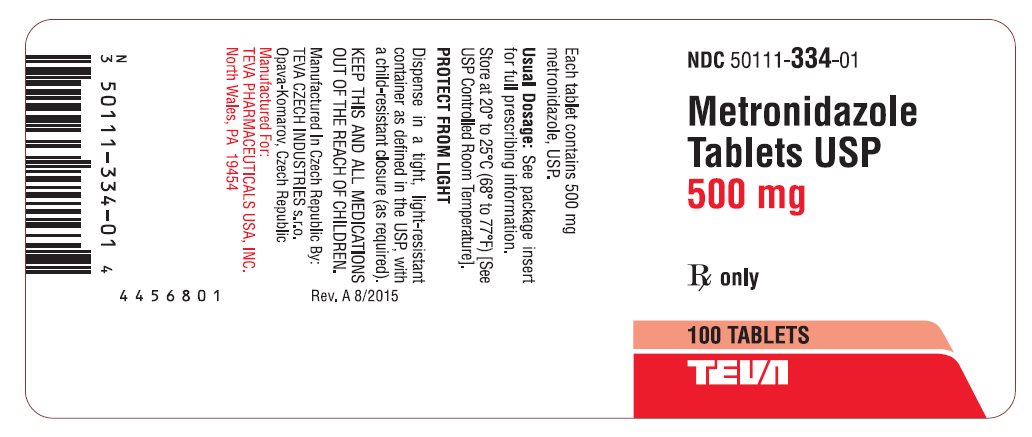
Metronidazole 500 mg Tablet, 100-count — NDC 50111-334-01 (Billing 50111-0334-01)
This is a package of 100 tablets of Metronidazole 500 mg Tablet from Teva Pharmaceuticals USA, Inc., marketed since Sep 1990 and currently FDA-listed; retail pharmacies pay about $0.1043 per tablet (NADAC). It is the main listing for this product, which comes in 2 package sizes.
NDC database record
One package, one record: these facts belong to NDC 50111-334-01 alone.
- Record
- FDA NDC Directory package listing · Human prescription drug
- Code segments
- 50111 labeler · 334 product · 01 package
- Package marketed since
- Sep 30, 1990
- Sample package
- No — commercial package
- Listing certified through
- Dec 31, 2027
- Billing quantity
- 100 EA per package
- Barcode (UPC)
- 0350111333017, 0350111334014
- Medicaid fills, this package
- 808,092 prescriptions in the last four reported quarters
- FDA record last changed
- Aug 27, 2026
Identity & classification
Regulatory identifiers FDA, NLM and CMS codes for this package
Drug-database identifiers Medi-Span GPI and First Databank GCN / HICL / AHFS classification
- GSN (GCN sequence number): 009592
- GCN: 43032
- HICL (First Databank): 004157
- AHFS class code: 08:30.04.00
- RxCUI (RxNorm): 311681
Where does this data come from?
- FDA openFDA NDC Directory · synced Oct 8, 2026
- FDA label on DailyMed · label index refreshed Oct 6, 2026
- RxNorm (NLM RxNav) · catalog refreshed Oct 1, 2026
- Medi-Span GPI (licensed)
- First Databank (licensed) · refreshed Oct 8, 2026
RxNorm drug class
This medicine belongs to the Nitroimidazole Antimicrobial class.
Where does this data come from?
- RxClass (NLM) · catalog refreshed Oct 1, 2026
Clinical
Metronidazole is used to treat certain infections in the body caused by bacteria including sexually transmitted diseases (STDs) and bacterial vaginosis (an infection caused by too much of certain types of harmful bacteria in the vagina) in women. Metronidazole is in a class of medications called nitroimidazole antimicrobials. It works by stopping the growth of bacteria. Antibiotics will not work for colds, flu, or other viral infections. Using antibiotics when they are not needed increases your risk of getting an infection later that resists antibiotic treatment.
Read the full MedlinePlus article ↗- It depends on the product. Oral forms treat trichomoniasis, and some also treat amebiasis and anaerobic infections. Vaginal gels treat bacterial vaginosis, and topical cream or lot...
- No. Alcohol with oral metronidazole can cause cramps, nausea, vomiting, headache and flushing. Avoid alcohol and products with propylene glycol during treatment and for at least th...
- The most common are nausea, headache, loss of appetite, vomiting, diarrhea and stomach cramps. A metallic taste is also common. Call your doctor if you notice numbness or tingling,...
- Yes. Metronidazole can interact with warfarin, lithium, busulfan, disulfiram and drugs that affect heart rhythm. Some of these combinations need blood tests or should be avoided, s...
Patient education
Supplement & herbal interactions
Some supplements/herbs that may interact with Metronidazole — tap one for details:
Metronidazole may be associated with lower levels of 7 nutrients — worth a chat with your pharmacist, not a cause for alarm.
Where does this data come from?
- MedlinePlus (NLM) · refreshed Oct 1, 2026
- FDA label on DailyMed · label index refreshed Oct 6, 2026
Ask a licensed pharmacist directly — free, answered by our team.
Pricing
A drug doesn't have one price. Each row is a different public payment system, and none is what you'd pay at the counter — that depends on your insurance. The ⓘ on each row explains what it measures.
| Price system | Per ea | Per package |
|---|---|---|
| Retail pharmacies payNADAC · weekly | $0.104 | $10.43 / 100 tablets |
| Medicaid paysCMS SDUD · 12 mo | $0.4832 | $48.32 / 100 tablets |
| Medicare drug plans payPart D · Q2 2026 | $0.2060 | $20.60 / 100 tablets |
Where does this data come from?
- CMS NADAC weekly file · file of Sep 30, 2026
- CMS ASP pricing files · refreshed Sep 20, 2026
- CMS Medicaid State Drug Utilization Data · through Q1 2026
- CMS Part D plan pricing files · refreshed Sep 24, 2026
- VA National Acquisition Center price file
Packaging — all sizes for this product
| Package NDC | Description | Per unit | Per pack | Marketing start | Marketing end | Status |
|---|---|---|---|---|---|---|
| 50111-0334-01 You're viewing this Main listing | 100 TABLET in 1 BOTTLE | $0.1043 / ea | $10.43 | 1990-09-30 | — | Active |
| 50111-0334-02 50111-334-02 | 500 TABLET in 1 BOTTLE | $0.1043 / ea | $52.13 | 1990-09-30 | — | Active |
You're viewing the smallest of 2 pack sizes for this product.
This pack has the lowest per-ea cost of the 2 priced pack sizes ($0.1043 NADAC).
In Medicaid, this is the most-dispensed pack of this product — about 91% of fills over the last four reported quarters. See all packs ↓
Pack size FAQ
What quantity is in this package?
How does this package differ from NDC 50111-0334-02?
What NDC number is used to bill for this package of Metronidazole 500 mg Tablet?
Prices are the latest CMS NADAC pharmacy acquisition cost per NDC; per-pack figures are per-unit × pack quantity, shown only when the pack is denominated in the same measure NADAC prices.
Therapeutic equivalents
| Product | Labeler | Pack | NADAC/unit | TE | Status | Price vs. this |
|---|---|---|---|---|---|---|
| Metronidazole 500 mg 00904-7126-61 | Major | 100 tablets | $0.104 | AB | Availability likely | — |
| Metronidazole 500 mg 16571-0664-01 | Rising | 100 tablets | $0.104 | AB | Availability likely | — |
| Metronidazole 500 mg 23155-0652-01 | Heritage | 100 tablets | $0.104 | AB | Availability likely | — |
| Metronidazole 500 mg 29300-0227-01 | Unichem | 100 tablets | $0.104 | AB | Availability likely | — |
| Metronidazole 500 mgthis 50111-0334-01 | Teva | 100 tablets | $0.104 | AB | Availability likely | — |
| Metronidazole 500 mg 50268-0535-15 | AvPAK | 50 tablets | $0.104 | AB | Availability likely | — |
| metronidazole 500 mg 58657-0934-01 | Method | 100 tablets | $0.104 | AB | Availability likely | — |
| Metronidazole 500 mg 60687-0550-01 | American | 100 tablets | $0.104 | AB | Availability likely | — |
| Metronidazole 500 mg 62135-0796-90 | Chartwell | 90 tablets | $0.104 | AB | Availability likely | — |
| Metronidazole 500 mg 68001-0365-00 | BluePoint | 100 tablets | $0.104 | AB | Availability likely | — |
| metronidazole 500 mg 72578-0008-01 | Viona | 100 tablets | $0.104 | AB | Availability likely | — |
| Metronidazole 500 mg 65862-0695-01 | Aurobindo | 100 tablets | $0.123 | AB | FDA listed | +18% |
| Metronidazole 500 mg 15955-0389-01 | Alembic | 100 tablets | — | AB | FDA listed | — |
| Metronidazole 500 mg 46708-0429-30 | Alembic | 30 tablets | — | AB | FDA listed | — |
| Metronidazole 500 mg 50090-0211-00 | A-S | 4 tablets | — | AB | FDA listed | — |
| Metronidazole 500 mg 50090-0212-01 | A-S | 30 tablets | — | AB | FDA listed | — |
| Metronidazole 500 mg 50090-0213-00 | A-S | 14 tablets | — | AB | FDA listed | — |
| metronidazole 500 mg 51407-0372-01 | Golden | 100 tablets | — | AB | FDA listed | — |
| Metronidazole 500 mg 51655-0441-20 | Northwind | 20 tablets | — | AB | FDA listed | — |
| Metronidazole 500 mg 54348-0740-00 | PharmPak, | 1 tablet | — | AB | FDA listed | — |
| Metronidazole 500 mg 55154-8190-00 | Cardinal | 10 tablets | — | AB | FDA listed | — |
| Metronidazole 500 mg 55700-0298-04 | Quality | 4 tablets | — | AB | FDA listed | — |
| Metronidazole 500 mg 60760-0336-14 | St. | 14 tablets | — | AB | FDA listed | — |
| metronidazole 500 mg 60760-0539-14 | ST. | 14 tablets | — | AB | FDA listed | — |
| Metronidazole 500 mg 61919-0032-10 | Direct_Rx | 10 tablets | — | AB | FDA listed | — |
| Metronidazole 500 mg 62332-0017-30 | Alembic | 30 tablets | — | AB | FDA listed | — |
| Metronidazole 500 mg 63187-0035-04 | Proficient | 4 tablets | — | AB | FDA listed | — |
| Metronidazole 500 mg 63187-0827-04 | Proficient | 4 tablets | — | AB | FDA listed | — |
| Metronidazole 500 mg 63629-1386-00 | Bryant | 40 tablets | — | AB | FDA listed | — |
| Metronidazole 500 mg 63629-7916-01 | Bryant | 14 tablets | — | AB | FDA listed | — |
| Metronidazole 500 mg 67046-1060-03 | Coupler | 30 tablets | — | AB | FDA listed | — |
| Metronidazole 500 mg 67046-1173-03 | Coupler | 30 tablets | — | AB | FDA listed | — |
| Metronidazole 500 mg 67296-0078-01 | Redpharm | 30 tablets | — | AB | FDA listed | — |
| Metronidazole 500 mg 67296-2152-01 | Redpharm | 14 tablets | — | AB | FDA listed | — |
| Metronidazole 500 mg 68071-1876-00 | NuCare | 42 tablets | — | AB | FDA listed | — |
| Metronidazole 500 mg 68071-2280-04 | NuCare | 4 tablets | — | AB | FDA listed | — |
| Metronidazole 500 mg 68071-2288-04 | NuCare | 4 tablets | — | AB | FDA listed | — |
| Metronidazole 500 mg 68071-2399-04 | NuCare | 4 tablets | — | AB | FDA listed | — |
| metronidazole 500 mg 68071-2409-01 | NuCare | 4 tablets | — | AB | FDA listed | — |
| Metronidazole 500 mg 68071-5073-02 | NuCare | 21 tablets | — | AB | FDA listed | — |
| metronidazole 500 mg 68788-7815-01 | Preferred | 14 tablets | — | AB | FDA listed | — |
| Metronidazole 500 mg 68788-8674-01 | Preferred | 14 tablets | — | AB | FDA listed | — |
| metronidazole 500 mg 69292-0208-01 | AMICI | 100 tablets | — | AB | FDA listed | — |
| Metronidazole 500 mg 70518-0058-00 | REMEDYREPACK | 14 tablets | — | AB | FDA listed | — |
| Metronidazole 500 mg 70518-0088-02 | REMEDYREPACK | 14 tablets | — | AB | FDA listed | — |
| Metronidazole 500 mg 70518-1240-00 | REMEDYREPACK | 4 tablets | — | AB | FDA listed | — |
| Metronidazole 500 mg 70518-1241-00 | REMEDYREPACK | 14 tablets | — | AB | FDA listed | — |
| Metronidazole 500 mg 70518-2305-01 | REMEDYREPACK | 4 tablets | — | AB | Discontinued | — |
| metronidazole 500 mg 70518-2663-00 | REMEDYREPACK | 4 tablets | — | AB | FDA listed | — |
| Metronidazole 500 mg 70518-3110-00 | REMEDYREPACK | 30 tablets | — | AB | Discontinued | — |
| Metronidazole 500 mg 70518-3265-01 | REMEDYREPACK | 4 tablets | — | AB | FDA listed | — |
| Metronidazole 500 mg 70771-1046-01 | Zydus | 100 tablets | — | AB | FDA listed | — |
| Metronidazole 500 mg 71209-0063-02 | Cadila | 50 tablets | — | AB | FDA listed | — |
| Metronidazole 500 mg 71335-0358-00 | Bryant | 40 tablets | — | AB | FDA listed | — |
| Metronidazole 500 mg 71335-1681-00 | Bryant | 40 tablets | — | AB | FDA listed | — |
| metronidazole 500 mg 71335-1703-00 | Bryant | 40 tablets | — | AB | FDA listed | — |
| Metronidazole 500 mg 71335-1922-00 | Bryant | 40 tablets | — | AB | FDA listed | — |
| Metronidazole 500 mg 71335-2640-01 | Bryant | 14 tablets | — | AB | FDA listed | — |
| metronidazole 500 mg 71335-2681-01 | Bryant | 14 tablets | — | AB | FDA listed | — |
| Metronidazole 500 mg 72162-2403-02 | Bryant | 14 tablets | — | AB | FDA listed | — |
| Metronidazole 500 mg 72789-0005-14 | PD-Rx | 14 tablets | — | AB | FDA listed | — |
| Metronidazole 500 mg 72789-0007-04 | PD-Rx | 4 tablets | — | AB | FDA listed | — |
| Metronidazole 500 mg 72789-0011-04 | PD-Rx | 4 tablets | — | AB | FDA listed | — |
| metronidazole 500 mg 76420-0801-01 | Asclemed | 100 tablets | — | AB | FDA listed | — |
| metronidazole 500 mg 82868-0014-14 | Northwind | 14 tablets | — | AB | FDA listed | — |
| Metronidazole 500 mg 82982-0072-14 | Pharmasource | 14 tablets | — | AB | Discontinued | — |
| metronidazole 500 mg 85766-0024-01 | Sportpharm | 100 tablets | — | AB | FDA listed | — |
| Metronidazole 500 mg 85742-0025-24 | Kanchan | 50 tablets | — | AB | FDA listed | — |
| Metronidazole 500 mg 72162-2678-01 | Bryant | 100 tablets | — | AB | FDA listed | — |
Where does this data come from?
- FDA openFDA NDC Directory · synced Oct 8, 2026
- FDA Orange Book · refreshed Oct 3, 2026
- CMS NADAC weekly file · file of Sep 30, 2026
Availability & generic status
This product is an FDA-approved generic. Other versions of the same drug are listed under Therapeutic equivalents, least expensive first.
Where does this data come from?
- FDA Orange Book · refreshed Oct 3, 2026
What it looks like
Where does this data come from?
- FDA label on DailyMed · label index refreshed Oct 6, 2026
Inactive Ingredients / Excipients
Inactive ingredients, also called excipients, are components of the drug product other than the active ingredient. They may include fillers, dyes, coatings, preservatives, flavors, or other formulation ingredients.
🧪 Avoiding an ingredient? See Metronidazole inactive ingredients by manufacturer: every current product's list side by side, so you can ask your pharmacy for the version that does not list it.
💡 Tap an ingredient (hover on desktop) to see what it is and why it’s used.
-
UNII 68401960MK
Crospovidone is a synthetic polymer made from polyvinylpyrrolidone. It acts as a disintegrant, helping tablets break apart quickly in the stomach so the medicine dissolves and absorbs into the body.
-
UNII Z82Y2C65EA
Hydrogenated cottonseed oil is a solid fat made by adding hydrogen to cottonseed oil. It's used in medicines as a binder and lubricant to help hold ingredients together and make tablets easier to compress and release.
-
UNII OP1R32D61U
Microcrystalline cellulose is a purified form of cellulose, a natural fiber from plant sources. It acts as a binder and filler in tablets and capsules, helping hold ingredients together and give the medicine its shape and size.
-
UNII ETJ7Z6XBU4
Silicon dioxide is a naturally occurring mineral used as a glidant and anti-caking agent. It helps powder ingredients flow smoothly and prevents clumping during manufacturing and storage.
4 inactive ingredients listed in the exact product block matched to this NDC.
Where does this data come from?
ingredient classCode="IACT" elements from the exact product block matched by this NDC. Label-section narrative from DailyMed / the openFDA label index is shown separately when available.- FDA label on DailyMed · label index refreshed Oct 6, 2026
- FDA openFDA NDC Directory · synced Oct 8, 2026
Inactive ingredient FAQ
Are inactive ingredients the same for every manufacturer?
Why might an inactive ingredient be missing?
Can inactive ingredients matter?
Manufacturer & labeler
More NDCs from Teva Pharmaceuticals USA, Inc. labeler code 50111
- Hydralazine Hydrochloride 25 mg Tablet NDC 50111-327-01
- Hydralazine Hydrochloride 50 mg Tablet NDC 50111-328-01
- Metronidazole 250 mg Tablet NDC 50111-333-01
- Hydralazine Hydrochloride 100 mg Tablet NDC 50111-397-01
- Hydralazine Hydrochloride 10 mg Tablet NDC 50111-398-01
- Trazodone Hydrochloride 150 mg Tablet NDC 50111-450-01
- Oxybutynin Chloride 5 mg Tablet NDC 50111-456-01
- Trazodone Hydrochloride 50 mg Tablet NDC 50111-560-01
- Trazodone Hydrochloride 100 mg Tablet NDC 50111-561-01
Where does this data come from?
- FDA openFDA NDC Directory · synced Oct 8, 2026
- Drugs@FDA
Full prescribing information FDA SPL
🚨 Boxed Warning ▾
WARNING Metronidazole has been shown to be carcinogenic in mice and rats (see PRECAUTIONS ). Unnecessary use of the drug should be avoided. Its use should be reserved for the conditions described in the INDICATIONS AND USAGE section below.
🎯 Indications and Usage ▾
INDICATIONS AND USAGE Symptomatic Trichomoniasis Metronidazole tablets are indicated for the treatment of T. vaginalis infection in females and males when the presence of the trichomonad has been confirmed by appropriate laboratory procedures (wet smears and/or cultures). Asymptomatic Trichomoniasis Metronidazole tablets are indicated in the treatment of asymptomatic T. vaginalis infection in females when the organism is associated with endocervicitis, cervicitis, or cervical erosion. Since there is evidence that presence of the trichomonad can interfere with accurate assessment of abnormal cytological smears, additional smears should be performed after eradication of the parasite.
Treatment of Asymptomatic Sexual Partners T. vaginalis infection is a venereal disease. Therefore, asymptomatic sexual partners of treated patients should be treated simultaneously if the organism has been found to be present, in order to prevent reinfection of the partner. The decision as to whether to treat an asymptomatic male partner who has a negative culture or one for whom no culture has been attempted is an individual one.
In making this decision, it should be noted that there is evidence that a woman may become reinfected if her sexual partner is not treated. Also, since there can be considerable difficulty in isolating the organism from the asymptomatic male carrier, negative smears and cultures cannot be relied upon in this regard. In any event, the sexual partner should be treated with metronidazole tablets in cases of reinfection.
Amebiasis Metronidazole tablets are indicated in the treatment of acute intestinal amebiasis (amebic dysentery) and amebic liver abscess. In amebic liver abscess, metronidazole tablets therapy does not obviate the need for aspiration or drainage of pus. Anaerobic Bacterial Infections Metronidazole tablets are indicated in the treatment of serious infections caused by susceptible anaerobic bacteria.
Indicated surgical procedures should be performed in conjunction with metronidazole tablets therapy. In a mixed aerobic and anaerobic infection, antimicrobials appropriate for the treatment of the aerobic infection should be used in addition to metronidazole tablets. INTRA-ABDOMINAL INFECTIONS, including peritonitis, intra-abdominal abscess, and liver abscess, caused by Bacteroides species including the B. fragilis group ( B. fragilis, B. distasonis, B. ovatus, B. thetaiotaomicron, B. vulgatus ), Clostridium species, Eubacterium species, Peptococcus species , and Peptostreptococcus species.
SKIN AND SKIN STRUCTURE INFECTIONS caused by Bacteroides species including the B. fragilis group, Clostridium species, Peptococcus species , Peptostreptococcus species, and Fusobacterium species. GYNECOLOGIC INFECTIONS, including endometritis, endomyometritis, tubo-ovarian abscess, and postsurgical vaginal cuff infection, caused by Bacteroides species including the B. fragilis group, Clostridium species, Peptococcus species , Peptostreptococcus species, and Fusobacterium species. BACTERIAL SEPTICEMIA caused by Bacteroides species including the B. fragilis group and Clostridium species.
BONE AND JOINT INFECTIONS, (as adjunctive therapy), caused by Bacteroides species including the B. fragilis group. CENTRAL NERVOUS SYSTEM (CNS) INFECTIONS, including meningitis and brain abscess, caused by Bacteroides species including the B. fragilis group. LOWER RESPIRATORY TRACT INFECTIONS, including pneumonia, empyema, and lung abscess, caused by Bacteroides species including the B. fragilis group.
ENDOCARDITIS caused by Bacteroides species including the B. fragilis group. To reduce the development of drug-resistant bacteria and maintain the effectiveness of metronidazole tablets and other antibacterial drugs, metronidazole tablets should be used only to treat or prevent infections that are proven or strongly suspected to be caused by susceptible bacteria. When culture and susceptibility information are available, they should be considered in s… [Excerpted — this section continues on DailyMed.]
⛔ Contraindications ▾
CONTRAINDICATIONS Hypersensitivity Metronidazole tablets are contraindicated in patients with a prior history of hypersensitivity to metronidazole or other nitroimidazole derivatives. In patients with trichomoniasis, metronidazole tablets are contraindicated during the first trimester of pregnancy (see PRECAUTIONS ). Psychotic Reaction with Disulfiram Use of oral metronidazole is associated with psychotic reactions in alcoholic patients who were using disulfiram concurrently.
Do not administer metronidazole to patients who have taken disulfiram within the last two weeks (see PRECAUTIONS , Drug Interactions ). Interaction with Alcohol Use of oral metronidazole is associated with a disulfiram-like reaction to alcohol, including abdominal cramps, nausea, vomiting, headaches, and flushing. Discontinue consumption of alcohol or products containing propylene glycol during and for at least three days after therapy with metronidazole (see PRECAUTIONS , Drug Interactions ).
Cockayne Syndrome Metronidazole tablets are contraindicated in patients with Cockayne syndrome. Severe irreversible hepatotoxicity/acute liver failure with fatal outcomes have been reported after initiation of metronidazole in patients with Cockayne syndrome (see ADVERSE REACTIONS ) .
⚠️ Warnings ▾
WARNINGS Hypersensitivity Reactions Hypersensitivity reactions including severe cutaneous adverse reactions (SCARs) can be serious and potentially life threatening (see ADVERSE REACTIONS ). Severe Cutaneous Adverse Reactions Severe cutaneous adverse reactions (SCARs) including toxic epidermal necrolysis (TEN), Stevens-Johnson syndrome (SJS), drug reaction with eosinophilia and systemic symptoms (DRESS), and acute generalized exanthematous pustulosis (AGEP) have been reported with the use of metronidazole. Symptoms can be serious and potentially life threatening.
If symptoms or signs of SCARs develop, discontinue metronidazole immediately and institute appropriate therapy. Central and Peripheral Nervous System Effects Encephalopathy and peripheral neuropathy: Cases of encephalopathy and peripheral neuropathy (including optic neuropathy) have been reported with metronidazole. Encephalopathy has been reported in association with cerebellar toxicity characterized by ataxia, dizziness, and dysarthria.
CNS lesions seen on MRI have been described in reports of encephalopathy. CNS symptoms are generally reversible within days to weeks upon discontinuation of metronidazole. CNS lesions seen on MRI have also been described as reversible.
Peripheral neuropathy, mainly of sensory type has been reported and is characterized by numbness or paresthesia of an extremity. Convulsive seizures have been reported in patients treated with metronidazole. Aseptic meningitis: Cases of aseptic meningitis have been reported with metronidazole.
Symptoms can occur within hours of dose administration and generally resolve after metronidazole therapy is discontinued. The appearance of abnormal neurologic signs and symptoms demands the prompt evaluation of the benefit/risk ratio of the continuation of therapy (see ADVERSE REACTIONS ).
🤒 Adverse Reactions ▾
ADVERSE REACTIONS The following reactions have been reported during treatment with metronidazole: Central Nervous System: The most serious adverse reactions reported in patients treated with metronidazole have been convulsive seizures, encephalopathy, aseptic meningitis, optic and peripheral neuropathy, the latter characterized mainly by numbness or paresthesia of an extremity. Since persistent peripheral neuropathy has been reported in some patients receiving prolonged administration of metronidazole, patients should be specifically warned about these reactions and should be told to stop the drug and report immediately to their physicians if any neurologic symptoms occur.
In addition, patients have reported headache, syncope, dizziness, vertigo, incoordination, ataxia, tinnitus, hearing impairment, hearing loss, confusion, dysarthria, irritability, depression, weakness, and insomnia (see WARNINGS ). Gastrointestinal: The most common adverse reactions reported have been referable to the gastrointestinal tract, particularly nausea, sometimes accompanied by headache, anorexia, and occasionally vomiting; diarrhea; epigastric distress; and abdominal cramping and constipation. Mouth: A sharp, unpleasant metallic taste is not unusual.
Furry tongue, glossitis, and stomatitis have occurred; these may be associated with a sudden overgrowth of Candida which may occur during therapy. Dermatologic: Dermatitis bullous, fixed drug eruption, erythematous rash and pruritus. Hematopoietic: Reversible neutropenia (leukopenia); rarely, reversible thrombocytopenia.
Cardiovascular: QT prolongation has been reported, particularly when metronidazole was administered with drugs with the potential for prolonging the QT interval. Flattening of the T-wave may be seen in electrocardiographic tracings. Hypersensitivity: Toxic epidermal necrolysis (TEN), Stevens-Johnson Syndrome (SJS), drug reaction with eosinophilia and systemic symptoms (DRESS), acute generalized exanthematous pustulosis (AGEP) (see WARNINGS ), urticaria, erythematous rash, flushing, nasal congestion, dryness of the mouth (or vagina or vulva), and fever.
Renal: Dysuria, cystitis, polyuria, incontinence, and a sense of pelvic pressure. Instances of darkened urine have been reported by approximately one patient in 100,000. Although the pigment which is probably responsible for this phenomenon has not been positively identified, it is almost certainly a metabolite of metronidazole and seems to have no clinical significance.
Hepatic: Cases of severe irreversible hepatotoxicity/acute liver failure, including cases with fatal outcomes with very rapid onset after initiation of systemic use of metronidazole, have been reported in patients with Cockayne syndrome (latency from drug start to signs of liver failure as short as 2 days) (see CONTRAINDICATIONS ). Other: Proliferation of Candida in the vagina, dyspareunia, decrease of libido, proctitis, and fleeting joint pains sometimes resembling “serum sickness.” Rare cases of pancreatitis, which generally abated on withdrawal of the drug, have been reported.
Patients with Crohn’s disease are known to have an increased incidence of gastrointestinal and certain extraintestinal cancers. There have been some reports in the medical literature of breast and colon cancer in Crohn’s disease patients who have been treated with metronidazole at high doses for extended periods of time. A cause and effect relationship has not been established.
Crohn’s disease is not an approved indication for metronidazole tablets. To report SUSPECTED ADVERSE REACTIONS, contact Teva at 1-888-838-2872 or FDA at 1-800-FDA-1088 or http://www.fda.gov/medwatch.
🆘 Overdosage ▾
OVERDOSAGE Single oral doses of metronidazole, up to 15 g, have been reported in suicide attempts and accidental overdoses. Symptoms reported include nausea, vomiting, and ataxia. Oral metronidazole has been studied as a radiation sensitizer in the treatment of malignant tumors.
Neurotoxic effects, including seizures and peripheral neuropathy, have been reported after 5 to 7 days of doses of 6 to 10.4 g every other day. Treatment of Overdosage There is no specific antidote for metronidazole overdose; therefore, management of the patient should consist of symptomatic and supportive therapy.
🧬 Clinical Pharmacology ▾
CLINICAL PHARMACOLOGY Absorption Disposition of metronidazole in the body is similar for both oral and intravenous dosage forms. Following oral administration, metronidazole is well absorbed, with peak plasma concentrations occurring between one and two hours after administration. Plasma concentrations of metronidazole are proportional to the administered dose.
Oral administration of 250 mg, 500 mg, or 2,000 mg produced peak plasma concentrations of 6 mcg/mL, 12 mcg/mL, and 40 mcg/mL, respectively. Studies reveal no significant bioavailability differences between males and females; however, because of weight differences, the resulting plasma levels in males are generally lower. Distribution Metronidazole is the major component appearing in the plasma, with lesser quantities of metabolites also being present.
Less than 20% of the circulating metronidazole is bound to plasma proteins. Metronidazole appears in cerebrospinal fluid, saliva, and breast milk in concentrations similar to those found in plasma. Bactericidal concentrations of metronidazole have also been detected in pus from hepatic abscesses.
Metabolism/Excretion The major route of elimination of metronidazole and its metabolites is via the urine (60% to 80% of the dose), with fecal excretion accounting for 6% to 15% of the dose. The metabolites that appear in the urine result primarily from side-chain oxidation [1-(β-hydroxyethyl)-2-hydroxymethyl-5-nitroimidazole and 2-methyl-5-nitroimidazole-1-yl-acetic acid] and glucuronide conjugation, with unchanged metronidazole accounting for approximately 20% of the total. Both the parent compound and the hydroxyl metabolite possess in vitro antimicrobial activity.
Renal clearance of metronidazole is approximately 10 mL/min/1.73 m 2 . The average elimination half-life of metronidazole in healthy subjects is eight hours. Renal Impairment Decreased renal function does not alter the single-dose pharmacokinetics of metronidazole.
Subjects with end-stage renal disease (ESRD; CL CR = 8.1 ± 9.1 mL/min) and who received a single intravenous infusion of metronidazole 500 mg had no significant change in metronidazole pharmacokinetics but had 2-fold higher C max of hydroxy-metronidazole and 5-fold higher C max of metronidazole acetate, compared to healthy subjects with normal renal function (CL CR = 126 ± 16 mL/min). Thus, on account of the potential accumulation of metronidazole metabolites in ESRD patients, monitoring for metronidazole associated adverse events is recommended (see PRECAUTIONS ).
Effect of Dialysis Following a single intravenous infusion or oral dose of metronidazole 500 mg, the clearance of metronidazole was investigated in ESRD subjects undergoing hemodialysis or continuous ambulatory peritoneal dialysis (CAPD). A hemodialysis session lasting for 4 to 8 hours removed 40% to 65% of the administered metronidazole dose, depending on the type of dialyzer membrane used and the duration of the dialysis session. If the administration of metronidazole cannot be separated from the dialysis session, supplementation of metronidazole dose following hemodialysis should be considered (see DOSAGE AND ADMINISTRATION ).
A peritoneal dialysis session lasting for 7.5 hours removed approximately 10% of the administered metronidazole dose. No adjustment in metronidazole dose is needed in ESRD patients undergoing CAPD. Hepatic Impairment Following a single intravenous infusion of 500 mg metronidazole, the mean AUC 24 of metronidazole was higher by 114% in patients with severe (Child-Pugh C) hepatic impairment, and by 54% and 53% in patients with mild (Child-Pugh A) and moderate (Child-Pugh B) hepatic impairment, respectively, compared to healthy control subjects.
There were no significant changes in the AUC 24 of hydroxyl-metronidazole in these hepatically impaired patients. A reduction in metronidazole dosage by 50% is recommended in patients with severe (Child-Pugh C) hepatic impairment (see DOSAGE AND ADMINISTRATION ). No dosage adjustme… [Excerpted — this section continues on DailyMed.]
📦 How Supplied / Storage and Handling ▾
HOW SUPPLIED Metronidazole tablets, USP are available as follows: 250 mg - White, round, convex tablets debossed “ PLIVA 333 ” on one side and unscored on the other side. Available in bottles of 100 ( NDC 50111-333-01 ), 250 ( NDC 50111-333-06 ) and 500 ( NDC 50111-333-02 ). 500 mg - White, oblong, convex tablets debossed “ PLIVA 334 ” on one side and unscored on the other side.
Available in bottles of 100 ( NDC 50111-334-01 ) and 500 ( NDC 50111-334-02 ). Storage and Stability Store at 20° to 25°C (68° to 77°F) [See USP Controlled Room Temperature]. PROTECT FROM LIGHT Dispense in a tight, light-resistant container as defined in the USP, with a child-resistant closure (as required).
Keep this and all medications out of the reach of children. Manufactured In Czech Republic By: Teva Czech Industries s.r.o. Opava-Komarov, Czech Republic Manufactured For: Teva Pharmaceuticals USA, Inc.
North Wales, PA 19454 Rev. J 7/2024
📋 Description ▾
DESCRIPTION Metronidazole tablets USP, 250 mg or 500 mg is an oral formulation of the synthetic nitroimidazole antimicrobial, 1 H -Imidazole-1-ethanol, 2-methyl-5-nitro, which has the following structural formula: C 6 H 9 N 3 O 3 M.W. 171.15 Metronidazole tablets, USP contain 250 mg or 500 mg of metronidazole, USP. Inactive ingredients include silicified microcrystalline cellulose, crospovidone, colloidal silicon dioxide and hydrogenated vegetable oil. structural formula
⚠️ Precautions ▾
PRECAUTIONS General Hepatic Impairment Patients with hepatic impairment metabolize metronidazole slowly, with resultant accumulation of metronidazole in the plasma. For patients with severe hepatic impairment (Child-Pugh C), a reduced dose of metronidazole is recommended. For patients with mild to moderate hepatic impairment, no dosage adjustment is needed but these patients should be monitored for metronidazole associated adverse events (see CLINICAL PHARMACOLOGY and DOSAGE AND ADMINISTRATION ).
Renal Impairment Patients with end-stage renal disease may excrete metronidazole and metabolites slowly in the urine, resulting in significant accumulation of metronidazole metabolites. Monitoring for metronidazole associated adverse events is recommended (see CLINICAL PHARMACOLOGY ). Fungal Superinfections Known or previously unrecognized candidiasis may present more prominent symptoms during therapy with metronidazole and requires treatment with a candidacidal agent.
Use in Patients with Blood Dyscrasias Metronidazole is a nitroimidazole and should be used with caution in patients with evidence of or history of blood dyscrasia. A mild leukopenia has been observed during its administration; however, no persistent hematologic abnormalities attributable to metronidazole have been observed in clinical studies. Total and differential leukocyte counts are recommended before and after therapy.
Drug-Resistant Bacteria and Parasites Prescribing metronidazole in the absence of a proven or strongly suspected bacterial or parasitic infection or a prophylactic indication is unlikely to provide benefit to the patient and increases the risk of the development of drug-resistant bacteria and parasites. Information for Patients Interaction with Alcohol Discontinue consumption of alcoholic beverages or products containing propylene glycol while taking metronidazole and for at least three days afterward because abdominal cramps, nausea, vomiting, headaches, and flushing may occur (see CONTRAINDICATIONS and PRECAUTIONS, Drug Interactions ).
Treatment of Bacterial and Parasitic Infections Patients should be counseled that metronidazole should only be used to treat bacterial and parasitic infections. Metronidazole does not treat viral infections (e.g., the common cold). When metronidazole is prescribed to treat a bacterial infection, patients should be told that although it is common to feel better early in the course of therapy, the medication should be taken exactly as directed.
Skipping doses or not completing the full course of therapy may (1) decrease the effectiveness of the immediate treatment and (2) increase the likelihood that bacteria will develop resistance and will not be treatable by metronidazole in the future. Severe Cutaneous Adverse Reactions Advise patients that metronidazole may increase the risk of serious and sometimes fatal dermatologic reactions, including TEN, SJS, and DRESS. Instruct the patient to be alert for skin rash, blisters, fever or other signs and symptoms of these hypersensitivity reactions.
Advise patients to stop metronidazole tablets immediately if they develop any type of rash and seek medical attention. Drug Interactions Disulfiram Psychotic reactions have been reported in alcoholic patients who are using metronidazole and disulfiram concurrently. Metronidazole should not be given to patients who have taken disulfiram within the last two weeks (see CONTRAINDICATIONS ).
Alcoholic Beverages Abdominal cramps, nausea, vomiting, headaches, and flushing may occur if alcoholic beverages or products containing propylene glycol are consumed during or following metronidazole therapy (see CONTRAINDICATIONS ). Warfarin and other Oral Anticoagulants Metronidazole has been reported to potentiate the anticoagulant effect of warfarin and other oral coumarin anticoagulants, resulting in a prolongation of prothrombin time. When metronidazole is prescribed for patients on this type of anticoagulant therapy, prothrombin time and INR s… [Excerpted — this section continues on DailyMed.]
🔒 Drug Abuse and Dependence ▾
DOSAGE AND ADMINISTRATION Trichomoniasis In the Female One-day treatment - Two grams of metronidazole tablets, given either as a single dose or in two divided doses of one gram each, given in the same day. Seven-day course of treatment - 250 mg three times daily for seven consecutive days. There is some indication from controlled comparative studies that cure rates as determined by vaginal smears and signs and symptoms, may be higher after a seven-day course of treatment than after a one-day treatment regimen.
The dosage regimen should be individualized. Single-dose treatment can assure compliance, especially if administered under supervision, in those patients who cannot be relied on to continue the seven-day regimen. A seven-day course of treatment may minimize reinfection by protecting the patient long enough for the sexual contacts to obtain appropriate treatment.
Further, some patients may tolerate one treatment regimen better than the other. Pregnant patients should not be treated during the first trimester (see CONTRAINDICATIONS ). In pregnant patients for whom alternative treatment has been inadequate, the one-day course of therapy should not be used, as it results in higher serum levels which can reach the fetal circulation (see PRECAUTIONS , Pregnancy ).
When repeat courses of the drug are required, it is recommended that an interval of four to six weeks elapse between courses and that the presence of the trichomonad be reconfirmed by appropriate laboratory measures. Total and differential leukocyte counts should be made before and after re-treatment. In the Male: Treatment should be individualized as it is for the female.
Amebiasis Adults For acute intestinal amebiasis (acute amebic dysentery): 750 mg orally three times daily for 5 to 10 days. For amebic liver abscess: 500 mg or 750 mg orally three times daily for 5 to 10 days. Pediatric patients: 35 to 50 mg/kg/24 hours, divided into three doses, orally for 10 days.
Anaerobic Bacterial Infections In the treatment of most serious anaerobic infections, intravenous metronidazole is usually administered initially. The usual adult oral dosage is 7.5 mg/kg every six hours (approx. 500 mg for a 70-kg adult).
A maximum of 4 g should not be exceeded during a 24-hour period. The usual duration of therapy is 7 to 10 days; however, infections of the bone and joint, lower respiratory tract, and endocardium may require longer treatment. Dosage Adjustments Patients with Severe Hepatic Impairment For patients with severe hepatic impairment (Child-Pugh C), the dose of metronidazole tablets should be reduced by 50% (see CLINICAL PHARMACOLOGY and PRECAUTIONS ).
Patients Undergoing Hemodialysis: Hemodialysis removes significant amounts of metronidazole and its metabolites from systemic circulation. The clearance of metronidazole will depend on the type of dialysis membrane used, the duration of the dialysis session, and other factors. If the administration of metronidazole cannot be separated from the hemodialysis session, supplementation of metronidazole dosage following the hemodialysis session should be considered, depending on the patient’s clinical situation (see CLINICAL PHARMACOLOGY ).
📄 Package Label / Principal Display Panel ▾
Package/Label Display Panel NDC 50111-333-01 Metronidazole Tablets USP 250 mg Rx only 100 TABLETS 1
Package/Label Display Panel NDC 50111-334-01 Metronidazole Tablets USP 500 mg Rx only 100 TABLETS 2