
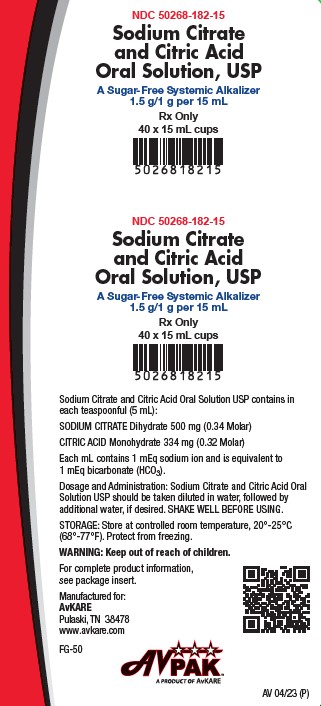
Sodium Citrate and Citric Acid 500 mg/5mL; 334 mg/5mL Solution — NDC 50268-0182-15 package photo

Sodium Citrate and Citric Acid 500 mg/5mL; 334 mg/5mL Solution

by AvPAK · 40 CUP, UNIT-DOSE in 1 CARTON (50268-182-15) / 15 mL in 1 CUP, UNIT-DOSE (50268-182-11)
NDC 50268-0182-15
🏷️ FDA NDC (as labeled) 50268-182-15 billing pads the product segment with a zero
Rx only On market Non-controlled
🗂️ Data synced Sep 17, 2026 · sources: openFDA · FDA label (DailyMed) · FDA Orange & Purple Book · First Databank · CMS NADAC, ASP, Medicare & Medicaid · RxNorm
📋 All sources & update times →

🆔 Identity & classification

FDA NDC (as labeled) 50268-182-15
Product NDC 50268-182
11-digit billing NDC 50268018215
NCPDP billing unit ML — per mL (volume)
RxCUI 543014
UNII 1Q73Q2JULR, XF417D3PSL
SPL Set ID fe070e2e-3e72-fb84-e053-6294a90afd88
Established class (EPC) Calculi Dissolution Agent; Anti-coagulant
Mechanism of action Acidifying Activity; Calcium Chelating Activity
Physiologic effect Decreased Coagulation Factor Activity
DEA schedule Non-controlled
Marketing category UNAPPROVED DRUG OTHER
Marketing status On market
FDA listing status Listed (active directory)
Marketing start 2023-06-13
Route ORAL
Dosage form SOLUTION
Substance SODIUM CITRATE; ANHYDROUS CITRIC ACID
GPI-14 56202020002010
GCN Seq No 043912
GCN 51957
HICL code 003682
Ingredient (HICL) Citric Acid/Sodium Citrate
HIC1 code R
Therapeutic class — broad (HIC1) Kidney/Urinary Tract
HIC2 code R1
Therapeutic class — intermediate (HIC2) Affect Primarily Kidneys/Urinary Tract
HIC3 code R1S
Therapeutic class — specific (HIC3) Urinary Ph Modifiers
AHFS code 40:08.00.00
AHFS class Alkalinizing Agents
FDB label name SOD CITRATE-CITRIC ACID CUP
FDB brand name Sodium Citrate-Citric Acid
Legend status Q — Non-drug — dietary supplement, vitamin, medical food, or herbal preparation
Why two NDCs? The FDA registers this code as 50268-182-15 — a 5-3-2 layout, and that's what's printed on the package and shown on DailyMed. For insurance claims, every NDC is standardized to a uniform 11-digit 5-4-2 format by adding a zero to the product segment → 50268-0182-15. Same drug, same package — only the format differs.
Where does this data come from?
Identifiers from the FDA openFDA NDC Directory and Structured Product Labeling; RxCUI from RxNorm (NLM); GPI from Medi-Span; GCN / HIC / AHFS / legend from First Databank.

🏷️ RxNorm drug class

This medicine belongs to the Calculi Dissolution Agent class.

Pharmacologic class Calculi Dissolution Agent, Anti-coagulant
Drug family (ATC) Acid preparations
How it works Calcium Chelating Activity, Acidifying Activity
Where does this data come from?
Therapeutic classes from RxNorm RxClass (U.S. National Library of Medicine) — Established Pharmacologic Class (FDA), ATC drug family (WHO) and mechanism of action, matched by this product’s RxCUI.

🏭 Manufacturer & labeler

LabelerAvPAK
Labeler code50268
First marketedJun 2023
Product typeHuman Prescription Drug
Portfolio346 products on file
The labeler markets the product; the application holder owns the FDA approval. They’re often the same company but can differ (e.g. a repackager or an authorized generic). A mailing address / phone appears here when the manufacturer includes it in the product’s FDA label (not all do).
Where does this data come from?
Labeler, application holder and registered establishment from the FDA openFDA NDC Directory and Drugs@FDA; address/contact from the product’s FDA label.

🩺 Clinical

Label name SOD CITRATE-CITRIC ACID CUP Ingredient Citric Acid/Sodium Citrate
🧪 What is this product?

This is an oral solution containing sodium citrate and citric acid, marketed without an FDA-approved application. Sodium citrate and citric acid are typically used together to help neutralize or alkalize urine and other body fluids. These ingredients are also commonly used in products intended to help dissolve or prevent certain types of kidney stones and to reduce clotting in blood samples or dialysis lines. The solution is a prescription product.

Where does this data come from?
Plain-language summary from MedlinePlus (U.S. National Library of Medicine); supplement & herbal interactions and nutrient depletion data from the Natural Medicines database; our full guide is HelloPharmacist editorial content.

🧪 Inactive Ingredients / Excipients

Inactive ingredients, also called excipients, are components of the drug product other than the active ingredient. They may include fillers, dyes, coatings, preservatives, flavors, or other formulation ingredients.

💡 Tap an ingredient (hover on desktop) to see what it is and why it’s used.

  • UNII BUC5I9595W
    A natural flavoring derived from cherry fruit that gives the medicine its cherry taste. It helps mask bitter drug flavors and makes the medication more pleasant to take.
  • UNII OJ245FE5EU
    Sodium benzoate is a salt derived from benzoic acid, a preservative. It's added to medicines to prevent growth of bacteria, fungi, and other microorganisms that could spoil the product.
  • UNII 96K6UQ3ZD4
    Sucralose is a synthetic sweetener made from sugar. It's added to medicines to improve taste without adding calories, helping make bitter or unpleasant-tasting drugs easier to take.
  • UNII 059QF0KO0R
    Water is a liquid solvent that dissolves and mixes ingredients together in liquid medicines, syrups, and injections. It helps distribute the active drug evenly throughout the product.

4 inactive ingredients listed in the exact product block matched to this NDC.

Where does this data come from?
Data sourced from official FDA Structured Product Labeling (SPL) via DailyMedingredient classCode="IACT" elements from the exact product block matched by this NDC. Label-section narrative from DailyMed / the openFDA label index is shown separately when available.

Inactive ingredient FAQ

Are inactive ingredients the same for every manufacturer?
No. Inactive ingredients can differ by manufacturer, dosage form, strength, and package / product version.
Why might an inactive ingredient be missing?
Some SPLs do not provide a complete structured inactive-ingredient list, and older or unusual labels may only include the information in narrative text.
Can inactive ingredients matter?
Yes. They can matter for allergies, intolerances, dyes, gluten / lactose concerns, preservatives, and formulation differences — but confirm with a pharmacist or the manufacturer when it’s clinically important.

💲 Pricing

A drug doesn't have one price. Each row is a different public payment system, and none is what you'd pay at the counter — that depends on your insurance. The ⓘ on each row explains what it measures.

Price systemPer mLPer package
Retail pharmacies payNADAC · weekly Not in the retail survey — common for institutional, discontinued, or low-volume packs.
Medicaid paysCMS SDUD · 12 mo No recent Medicaid claims on file for this NDC — rare and low-volume NDCs are suppressed in the public data.
Medicare drug plans payPart D · quarterly No Part D plan price is available for this NDC in our data.
ℹ️
No price is published for this exact package yet. CMS surveys NADAC per package size, so a different pack of the same drug often has one.
Where does this data come from?
NADAC (National Average Drug Acquisition Cost) is the CMS weekly pharmacy-acquisition-cost survey — what pharmacies pay. ASP (Average Sales Price) is the CMS Medicare Part B drug-payment file, published quarterly. Medicaid pays is computed by us from CMS State Drug Utilization Data (total reimbursed ÷ units, trailing 12 months) — gross of rebates and inclusive of dispensing fees, so it reflects what Medicaid paid, not an acquisition cost. Medicare drug plans pay is the median negotiated point-of-sale unit cost across plans listing this NDC in the CMS quarterly Prescription Drug Plan pricing files, before rebates. The VA pays is the federal contract price (FSS, and the statutory Big 4 ceiling where listed) from the VA National Acquisition Center pharmaceutical price file. All are free public government data; each measures a different payer, so the figures are not directly comparable.

🔁 Therapeutic equivalents

ProductLabelerPackNADAC/unitTEStatusPrice vs. this
Sodium Citrate and Citric Acid 500 mg/5mL; 334 mg/5mL 62135-0434-47 Chartwell 473 ml $0.024 Availability likely
Sodium Citrate and Citric Acid 500 mg/5mL; 334 mg/5mL 00121-0595-00 Pharmaceutical 10 cups FDA listed
Sodium Citrate and Citric Acid 500 mg/5mL; 334 mg/5mL 00121-1190-00 Pharmaceutical 10 cups FDA listed
Sodium Citrate and Citric Acid 500 mg/5mL; 334 mg/5mL 17856-0595-04 Atlantic 1 cup FDA listed
Sodium Citrate and Citric Acid 500 mg/5mL; 334 mg/5mLthis 50268-0182-15 AvPAK 40 cups FDA listed
Sodium Citrate and Citric Acid 500 mg/5mL; 334 mg/5mL 50268-0183-30 AvPAK 40 cups FDA listed
Sodium Citrate and Citric Acid 500 mg/5mL; 334 mg/5mL 55154-5777-05 Cardinal 5 cups FDA listed
Sodium Citrate and Citric Acid 1500 mg/15mL; 1002 mg/15mL 60687-0832-16 American 10 cups FDA listed
Sodium Citrate and Citric Acid 3000 mg/30mL; 2004 mg/30mL 60687-0834-76 American 10 cups FDA listed
Sodium Citrate and Citric Acid 1500 mg/15mL; 1002 mg/15mL 62135-0868-24 Chartwell 10 cups FDA listed
Sodium Citrate and Citric Acid 3000 mg/30mL; 2004 mg/30mL 62135-0869-24 Chartwell 10 cups FDA listed
Sodium Citrate and Citric Acid 1500 mg/15mL; 1002 mg/15mL 68999-0868-24 Chartwell 10 cups FDA listed
Sodium Citrate and Citric Acid 3000 mg/30mL; 2004 mg/30mL 68999-0869-24 Chartwell 10 cups FDA listed
Sodium Citrate and Citric Acid 334 mg/5mL; 500 mg/5mL 81033-0017-50 Kesin 100 cups FDA listed
Sodium Citrate and Citric Acid 500 mg/5mL; 334 mg/5mL 84447-0017-01 Belleview 200000 ml FDA listed
About this product: other versions of the same ingredient, strength and form are listed above, least expensive first, with FDA equivalence ratings where available.
Where does this data come from?
Equivalents are other NDCs of the same ingredient, form and route from the openFDA NDC Directory, ranked least-expensive-first by NADAC. Therapeutic-equivalence (AB) ratings come from the FDA Orange Book; biologics use the FDA Purple Book for biosimilar & interchangeable status.

Availability & generic status

🏛️
2023
On the market since
Jun 2023
📍
2026
Currently FDA-listed
3 years listed
🔒
·
No generic listed yet
brand only
ℹ️No FDA-approved generic found

We did not find an FDA-approved generic match for this exact strength, form and route.

Where does this data come from?
Patents and exclusivity from the FDA Orange Book (small-molecule drugs), refreshed from public FDA data. Generic launch timing is an estimate, not a guarantee.

🔬 Reported adverse events (FAERS)

Read carefully: FAERS reports are voluntary and unverified. Counts are not incidence, do not establish causation, are subject to reporting bias, and cannot be used to compare one drug to another. Shown for signal context only. Reports for Sodium Citrate and Citric Acid (this brand).

Top reported reactions

Pneumonia4
Blood Glucose Increased3
Diarrhoea3
Hypoxia3
Pyrexia3
Vomiting3
Alanine Aminotransferase Increased2

Age at onset

Infant1
Adolescent1
Adult2
Elderly1

Reporter sex

45 reports
Male · 54%
Female · 46%

Serious outcomes

Hospitalization31
Reports over time (by year) — tap or hover for the count & year
2022 2023 2024 2026 9 1
Most recent year is provisional (FAERS lags ~3 months).
Where does this data come from?
Adverse-event reports from the FDA Adverse Event Reporting System (FAERS) via openFDA. FAERS reports are voluntary and unverified — counts are not incidence and don’t establish causation.

📦 Packaging — all sizes for this product

Package NDCDescription Marketing startStatus
50268-0182-15 You're viewing this 40 CUP, UNIT-DOSE in 1 CARTON (50268-182-15) / 15 mL in 1 CUP, UNIT-DOSE (50268-182-11) 2023-06-13 Active

🧭 About this NDC listing & data coverage

Finished prescription product Marketed without an FDA application

Listed without an FDA application

This product's marketing category indicates it is marketed without an approved FDA application (no NDA, ANDA, or BLA on file). Having an NDC does not by itself establish FDA approval — the NDC Directory is a listing system, not an approval decision. Approval-linked data such as Orange Book therapeutic-equivalence ratings therefore does not apply.

What data is (and isn’t) available for this NDC — tap to expand
NDC identity (package / product / labeler codes) ✓ Available
Labeler ✓ Available
Product & package description ✓ Available
Marketing category & status ✓ Available
Active ingredient / dosage form / route ✓ Available
FDA label (SPL via DailyMed) ✓ Available
Package photos ✓ Available
Inactive ingredients (structured) ✓ Available
NADAC pharmacy acquisition price (CMS) — Not published for this NDC CMS publishes NADAC only for NDCs reported in its retail-pharmacy survey.
Orange Book / therapeutic-equivalence data — Not published for this NDC Applies only to products approved under an NDA/ANDA; many listings are out of scope.
HCPCS J-code billing crosswalk — Not published for this NDC Most self-administered / retail products have no J-code — that is normal.
Medicaid utilization (CMS SDUD) — Not published for this NDC CMS reports utilization only for NDCs with Medicaid claims above its privacy threshold.
“Not published” reflects what the public FDA / CMS / NLM sources provide for this exact package code — it is a property of the data feeds, not a judgment about the product.

Questions about this listing

Is this NDC FDA-approved?
An NDC listing does not by itself establish FDA approval — the NDC Directory records that a product is listed with FDA, not that it was reviewed and approved. This listing's marketing category is "Unapproved Drug Other". Products approved under an application carry an NDA, ANDA, or BLA number.
Why is there no price listed?
The pricing shown on our NDC pages comes from CMS NADAC, a voluntary survey of retail community pharmacy invoices. CMS does not publish a NADAC for every NDC — packages outside the retail survey (institutional and hospital products, bulk packages, discontinued items, and many OTC items) may never receive one. A missing price reflects the survey's scope, not this product's actual cost, and does not mean the product is free or unavailable.
Is the NDC printed on the package the same as the 11-digit billing NDC?
Yes, they identify this exact package in different formats. The FDA registers it as 50268-182-15, which is what is printed on the packaging and shown on DailyMed. Insurance claims use a fixed 11-digit 5-4-2 format, so the short segment is padded with a leading zero: 50268-0182-15, written without dashes as 50268018215. The Identity section at the top of this page lists every form of this code.
What do the three segments of this NDC mean?
In 50268-0182-15, the first segment (50268) is the labeler code FDA assigned to AvPAK; the middle segment (0182) identifies this specific product — its ingredient, strength, and dosage form; and the last segment (15) identifies this exact package size and type. Together they name one specific package of one specific product.
Is this package still being marketed?
Yes, per the latest FDA NDC Directory data on this page: this package is listed as actively marketed, with no marketing end date reported by AvPAK. Listing status can change — the directory data on this page refreshes weekly.
Who lists this product with the FDA?
AvPAK is the labeler of record for this NDC — the company under whose FDA-assigned code the package is listed. The labeler may be the manufacturer itself or a distributor marketing the product under its own code.
Do I need a prescription for this product?
This NDC is listed with FDA as a prescription product, so it is dispensed under a prescriber's order. Your pharmacist can tell you whether any over-the-counter forms of the same medication exist.
This page identifies an FDA-listed package (the NDC) and reports public regulatory and pricing data about the listing. It is reference information, not a medical recommendation — talk to your pharmacist or prescriber about your own medication.
Where does this data come from?
Listing facts (marketing category, packager status, marketing dates) from the FDA openFDA NDC Directory; label availability from DailyMed; pricing coverage from CMS NADAC; equivalence scope from the FDA Orange Book.

📄 Full prescribing information FDA SPL

The complete FDA label for this product — the official prescribing information, verbatim, section by section. Jump with a chip, search within the label, or expand everything.
🎯 Indications and Usage 149 words

INDICATIONS AND USAGE Sodium Citrate and Citric Acid Oral Solution USP is an effective alkalinizing agent. It is useful in those conditions where long-term maintenance of an alkaline urine is desirable, and is of value in the alleviation of chronic metabolic acidosis, such as results from chronic renal insufficiency or the syndrome of renal tubular acidosis, especially when the administration of potassium salts is undesirable or contraindicated. This product is also useful for buffering and neutralizing gastric hydrochloric acid quickly and effectively.

Sodium Citrate and Citric Acid Oral Solution USP is concentrated, and when administered after meals and before bedtime, allows one to maintain an alkaline urinary pH around the clock, usually without the necessity of a 2 A.M. dose. This product alkalinizes the urine without producing a systemic alkalosis in the recommended dosage. This product is highly palatable, pleasant tasting, and tolerable, even when administered for long periods.

⏱️ Dosage and Administration 27 words

DOSAGE AND ADMINISTRATION Sodium Citrate and Citric Acid Oral Solution USP should be taken diluted in water, followed by additional water, if desired. SHAKE WELL BEFORE USING.

Contraindications 10 words

CONTRAINDICATIONS Patients on sodium-restricted diets or with severe renal impairment.

🤒 Adverse Reactions 76 words

ADVERSE REACTIONS Sodium Citrate and Citric Acid Oral Solution USP is generally well tolerated, without any unpleasant side effects, when given in recommended doses to patients with normal renal function and urinary output. However, as with any alkalinizing agent, caution must be used in certain patients with abnormal renal mechanisms to avoid development of alkalosis, especially in the presence of hypocalcemia. To report SUSPECTED ADVERSE REACTIONS, contact AvKARE at 1-800-361-3993 or FDA at 1-800-FDA-1088 or www.fda.gov/medwatch..

🆘 Overdosage 14 words

OVERDOSAGE Overdosage with sodium salts may cause diarrhea, nausea and vomiting, hypernoia, and convulsions.

🧬 Clinical Pharmacology 49 words

CLINICAL PHARMACOLOGY Sodium citrate is absorbed and metabolized to sodium bicarbonate, thus acting as a systemic alkalizer. The effects are essentially those of chlorides before absorption and those of bicarbonates subsequently. Oxidation is virtually complete so that less than 5% of sodium citrate is excreted in the urine unchanged.

📦 How Supplied / Storage and Handling 57 words

HOW SUPPLIED Sodium Citrate and Citric Acid Oral Solution USP (colorless, cherry flavor) is supplied in the following oral dosage forms: NDC 50268-182-11: 15 mL unit dose cup NDC 50268-182-15: Case contains 40 unit dose cups of 15 mL NDC 50268-183-11: 30 mL unit dose cup NDC 50268-183-30: Case contains 40 unit dose cups of 30 mL

📦 Storage and Handling 14 words

STORAGE: Keep tightly closed. Store at controlled room temperature, 20°-25°C (68°-77°F). Protect from freezing.

📋 Description 85 words

DESCRIPTION Sodium Citrate and Citric Acid Oral Solution USP is a stable and pleasant-tasting systemic alkalizer containing sodium citrate and citric acid in a sugar-free base. It is a nonparticulate neutralizing buffer. Sodium Citrate and Citric Acid Oral Solution USP contains in each teaspoonful (5 mL): SODIUM CITRATE Dihydrate 500 mg (0.34 Molar) CITRIC ACID Monohydrate 334 mg (0.32 Molar) Each mL contains 1 mEq sodium ion and is equivalent to 1 mEq bicarbonate (HCO3).

INACTIVE INGREDIENTS: Flavoring, purified water, sodium benzoate, and sucralose solution.

Source: FDA Structured Product Labeling, mirrored from DailyMed / openFDA. Prefer the government’s original formatting? View this label on DailyMed ↗
For educational and professional reference only — not medical advice. Pricing reflects published NADAC and CMS ASP (free public data) and may differ from your acquisition cost; always verify before billing or dispensing.