
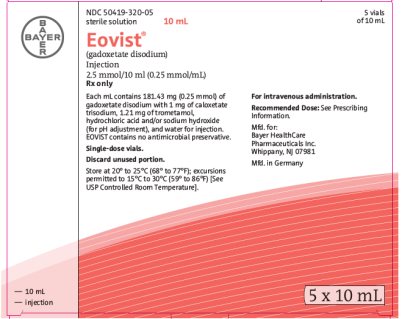
EOVIST Gadoxetate Disodium 181.43 mg/mL Injection, Solution — NDC 50419-320-05 (Billing 50419-0320-05)
This is a package of EOVIST Gadoxetate Disodium 181.43 mg/mL Injection, Solution from Bayer HealthCare Pharmaceuticals Inc., marketed since Jul 2008 and currently FDA-listed. It is the main listing for this product, which comes in 3 package sizes.
NDC database record
One package, one record: these facts belong to NDC 50419-320-05 alone.
- Record
- FDA NDC Directory package listing · Human prescription drug
- Code segments
- 50419 labeler · 320 product · 05 package
- Package marketed since
- Jul 3, 2008
- Sample package
- No — commercial package
- Listing certified through
- Dec 31, 2027
- Barcode (UPC-A, from the NDC)
- 3 5041932005 4
- Medicaid fills, this package
- 2,959 prescriptions in the last four reported quarters
- FDA record last changed
- Jul 24, 2026
Identity & classification
Regulatory identifiers FDA, NLM and CMS codes for this package
Drug-database identifiers Medi-Span GPI and First Databank GCN / HICL / AHFS classification
- GSN (GCN sequence number): 064327
- GCN: 13287
- GPI-14 (Medi-Span): 94500044102020
- HICL (First Databank): 033801
- AHFS class code: 36:44.00.00
Where does this data come from?
- FDA openFDA NDC Directory · synced Oct 8, 2026
- FDA label on DailyMed · label index refreshed Oct 8, 2026
- RxNorm (NLM RxNav) · catalog refreshed Oct 8, 2026
- Medi-Span GPI (licensed)
- First Databank (licensed) · refreshed Oct 8, 2026
Clinical
Patient education
Supplement & herbal interactions
Where does this data come from?
- MedlinePlus (NLM) · refreshed Oct 8, 2026
- FDA label on DailyMed · label index refreshed Oct 8, 2026
Ask a licensed pharmacist directly — free, answered by our team.
Pricing
A drug doesn't have one price. Each row is a different public payment system, and none is what you'd pay at the counter — that depends on your insurance. The ⓘ on each row explains what it measures.
| Price system | Per mL | Per package |
|---|---|---|
| Retail pharmacies payNADAC · weekly | Not in the retail survey — common for institutional, discontinued, or low-volume packs. | |
| Medicaid paysCMS SDUD · 12 mo | $12.79 | $639.41 / 50 ml |
| Medicare drug plans payPart D · quarterly | No Part D plan price is available for this NDC in our data. | |
| Medicare Part B allowsASP · A9581 | $14.752 / A9581 unit | — |
Where does this data come from?
- CMS NADAC weekly file
- CMS ASP pricing files · refreshed Sep 20, 2026
- CMS Medicaid State Drug Utilization Data · through Q1 2026
- CMS Part D plan pricing files · refreshed Sep 24, 2026
- VA National Acquisition Center price file
Billing & reimbursement
Where does this data come from?
- CMS ASP NDC-HCPCS crosswalk · refreshed Sep 22, 2026
- DMEPDAC NDC-HCPCS crosswalk
- openFDA NSDE billing units · refreshed Oct 7, 2026
Packaging — all sizes for this product
| Package NDC | Description | Marketing start | Marketing end | Status |
|---|---|---|---|---|
| 50419-0320-05 You're viewing this Main listing | 5 VIAL, SINGLE-DOSE in 1 BOX / 10 mL in 1 VIAL, SINGLE-DOSE | 2008-07-03 | — | Active |
| 50419-0320-15 50419-320-15 | 5 VIAL, SINGLE-DOSE in 1 BOX / 15 mL in 1 VIAL, SINGLE-DOSE | 2008-07-03 | — | Active |
| 50419-0320-75 50419-320-75 | 5 VIAL, SINGLE-DOSE in 1 BOX / 10 mL in 1 VIAL, SINGLE-DOSE | 2008-07-03 | — | Active |
In Medicaid, this is the most-dispensed pack of this product — about 100% of fills over the last four reported quarters. See all packs ↓
Pack size FAQ
What quantity is in this package?
What NDC number is used to bill for this package of EOVIST Gadoxetate Disodium 181.43 mg/mL Injection, Solution?
Therapeutic equivalents
| Product | Labeler | Pack | NADAC/unit | TE | Status | Price vs. this |
|---|---|---|---|---|---|---|
| Eovist 181.43 mg/mLthis 50419-0320-05 | Bayer | 5 vials | — | — | FDA listed | — |
Where does this data come from?
- FDA openFDA NDC Directory · synced Oct 8, 2026
- FDA Orange Book · refreshed Oct 3, 2026
- CMS NADAC weekly file
Availability & generic status
We did not find an FDA-approved generic match for this exact strength, form and route.
Where does this data come from?
- FDA Orange Book · refreshed Oct 3, 2026
Inactive Ingredients / Excipients
Inactive ingredients, also called excipients, are components of the drug product other than the active ingredient. They may include fillers, dyes, coatings, preservatives, flavors, or other formulation ingredients.
💡 Tap an ingredient (hover on desktop) to see what it is and why it’s used.
-
UNII QTT17582CB
A strong acid used to adjust and maintain the proper pH level in liquid medicines, ensuring stability and preventing breakdown of active ingredients.
-
UNII 55X04QC32I
A strong alkaline chemical used to adjust and maintain the pH balance of liquid medicines. It helps keep the medicine stable and ensures it stays effective during storage.
-
UNII 023C2WHX2V
Tromethamine is a chemical buffer that helps maintain the proper acidity level in liquid medicines. It neutralizes acids and stabilizes the solution so the medication remains effective and safe throughout its shelf life.
-
UNII 059QF0KO0R
Water is a liquid solvent that dissolves and mixes ingredients together in liquid medicines, syrups, and injections. It helps distribute the active drug evenly throughout the product.
4 inactive ingredients listed in the exact product block matched to this NDC.
Where does this data come from?
ingredient classCode="IACT" elements from the exact product block matched by this NDC. Label-section narrative from DailyMed / the openFDA label index is shown separately when available.- FDA label on DailyMed · label index refreshed Oct 8, 2026
- FDA openFDA NDC Directory · synced Oct 8, 2026
Inactive ingredient FAQ
Are inactive ingredients the same for every manufacturer?
Why might an inactive ingredient be missing?
Can inactive ingredients matter?
Manufacturer & labeler
More NDCs from Bayer HealthCare Pharmaceuticals Inc. labeler code 50419
- Xofigo Radium Ra 223 dichloride 30 uCi/mL Injection NDC 50419-208-01
- Adempas riociguat .5 mg Tablet, Film Coated NDC 50419-250-01
- Adempas riociguat 1 mg Tablet, Film Coated NDC 50419-251-01
- Adempas riociguat 1.5 mg Tablet, Film Coated NDC 50419-252-01
- Adempas riociguat 2 mg Tablet, Film Coated NDC 50419-253-01
- Adempas riociguat 2.5 mg Tablet, Film Coated NDC 50419-254-01
- Ambelvist Gadoquatrane 257.9 mg/mL Injection NDC 50419-321-11
- Ambelvist Gadoquatrane 257.9 mg/mL Injection NDC 50419-322-11
- Ambelvist Gadoquatrane 257.9 mg/mL Injection NDC 50419-323-11
- Ambelvist Gadoquatrane 257.9 mg/mL Injection NDC 50419-324-11
- Gadavist gadobutrol 604.72 mg/mL Injection NDC 50419-325-11
- Ambelvist Gadoquatrane 257.9 mg/mL Injection NDC 50419-326-11
Where does this data come from?
- FDA openFDA NDC Directory · synced Oct 8, 2026
- Drugs@FDA
Full prescribing information FDA SPL
🚨 Boxed Warning ▾
WARNING: RISK ASSOCIATED WITH INTRATHECAL USE and NEPHROGENIC SYSTEMIC FIBROSIS Risk Associated with Intrathecal Use Intrathecal administration of gadolinium-based contrast agents (GBCAs) can cause serious adverse reactions including death, coma, encephalopathy, and seizures. EOVIST is not approved for intrathecal use [see Warnings and Precautions (5.1) ]. Nephrogenic Systemic Fibrosis GBCAs increase the risk for nephrogenic systemic fibrosis (NSF) among patients with impaired elimination of the drugs.
Avoid use of EOVIST in these patients unless the diagnostic information is essential and not available with non-contrasted MRI or other modalities. NSF may result in fatal or debilitating fibrosis affecting the skin, muscle and internal organs. The risk for NSF appears highest among patients with: Chronic, severe kidney disease (GFR < 30 mL/min/1.73m 2 ), or Acute kidney injury.
Screen patients for acute kidney injury and other conditions that may reduce renal function. For patients at risk for chronically reduced renal function (for example, age > 60 years, hypertension or diabetes), estimate the glomerular filtration rate (GFR) through laboratory testing. For patients at highest risk for NSF, do not exceed the recommended EOVIST dose and allow a sufficient period of time for elimination of the drug from the body prior to any re-administration [see Warnings and Precautions (5.2) ].
WARNING: RISK ASSOCIATED WITH INTRATHECAL USE and NEPHROGENIC SYSTEMIC FIBROSIS See full prescribing information for complete boxed warning. Intrathecal administration of gadolinium-based contrast agents (GBCAs) can cause serious adverse reactions including death, coma, encephalopathy, and seizures. EOVIST is not approved for intrathecal use.
( 5.1 ) GBCAs increase the risk for nephrogenic systemic fibrosis (NSF) among patients with impaired elimination of the drugs. Avoid use of EOVIST in these patients unless the diagnostic information is essential and not available with non-contrasted MRI or other modalities. The risk for NSF appears highest among patients with: Chronic, severe kidney disease (GFR < 30 mL/min/1.73m 2 ), or Acute kidney injury.
Screen patients for acute kidney injury and other conditions that may reduce renal function. For patients at risk for chronically reduced renal function (for example, age >60 years, hypertension or diabetes), estimate the glomerular filtration rate (GFR) through laboratory testing. ( 5.2 )
🎯 Indications and Usage ▾
1 INDICATIONS AND USAGE EOVIST is indicated for use in magnetic resonance imaging (MRI) of the liver to detect and characterize lesions in adult and pediatric patients, including term neonates, with known or suspected focal liver disease. EOVIST is a gadolinium-based contrast agent indicated for use in magnetic resonance imaging (MRI) of the liver to detect and characterize lesions in adult and pediatric patients, including term neonates, with known or suspected focal liver disease. ( 1 )
⏱️ Dosage and Administration ▾
2 DOSAGE AND ADMINISTRATION Recommended dose is 0.025 mmol/kg actual body weight (equivalent to 0.1 mL/kg) administered by intravenous injection at 1 mL/sec to 2 mL/sec. ( 2.1 ) See Full Prescribing Information for administration and imaging instructions. ( 2.2 , 2.3 )
2.1Recommended Dose The recommended dose of EOVIST for adult and pediatric patients, including term neonates, is 0.025 mmol/kg actual body weight (equivalent to 0.1 mL/kg) administered intravenously at a recommended rate of 1 mL/sec to 2 mL/sec.
2.2Administration and Drug Handling EOVIST is for intravenous use only and must not be administered intrathecally [see Warnings and Precautions (5.1) ]. Use aseptic technique when preparing and administering EOVIST. Visually inspect EOVIST for particulate matter and discoloration prior to administration.
Do not use the solution if it is discolored or if particulate matter is present. Use EOVIST immediately after obtaining appropriate dose from vial. Pierce the rubber stopper only once.
Discard any unused portion of an EOVIST vial. Do not mix EOVIST with other medications and do not administer EOVIST in the same intravenous line simultaneously with other medications. Flush the intravenous cannula with 0.9% Sodium Chloride Injection after EOVIST injection.
2.3Imaging Liver lesions are detected and characterized with pre-contrast MRI and EOVIST MRI obtained during dynamic and hepatocyte imaging phases. Perform a pre-contrast MRI, inject EOVIST, and begin dynamic imaging approximately 15 seconds to 25 seconds after completion of the injection. Dynamic imaging consists of the arterial, the porto-venous (approximately 60 seconds post-injection), and the blood equilibrium (approximately 120 seconds) phases.
Begin the hepatocyte imaging phase approximately 20 minutes post-injection. Hepatocyte phase imaging may be performed up to 120 minutes post-injection. Elevated intrinsic levels of bilirubin (>3 mg/dL) or ferritin can reduce the hepatic contrast effect of EOVIST.
Perform MR imaging no later than 60 minutes following EOVIST administration to patients with these laboratory abnormalities, including patients who have elevated ferritin levels due to hemodialysis [see Warnings and Precautions (5.8) and Use in Specific Populations (8.6 , 8.7) ]. Lesions with no or minimal hepatocyte function (cysts, metastases, and the majority of hepatocellular carcinomas) generally will not accumulate EOVIST. Well-differentiated hepatocellular carcinoma may contain functioning hepatocytes and can show some enhancement in the hepatocyte imaging phase.
Additional clinical information is therefore needed to support a diagnosis of hepatocellular carcinoma.
💊 Dosage Forms and Strengths ▾
3 DOSAGE FORMS AND STRENGTHS Injection: 0.25 mmol/mL of gadoxetate disodium as a clear and colorless to pale yellow solution available in the following strengths: 2.5 mmol/10 mL (0.25 mmol/mL) in single-dose vial 3.75 mmol/15 mL (0.25 mmol/mL) in single-dose vial Injection: 0.025 mmol/mL of gadoxetate disodium 2.5 mmol/10 mL (0.25 mmol/mL) in single-dose vial 3.75 mmol/15 mL (0.25 mmol/mL) in single-dose vial ( 3 )
⛔ Contraindications ▾
4 CONTRAINDICATIONS EOVIST is contraindicated in patients with history of severe hypersensitivity reactions to EOVIST [see Warnings and Precautions (5.3) ] . History of severe hypersensitivity reaction to EOVIST ( 4 )
⚠️ Warnings and Cautions ▾
5 WARNINGS AND PRECAUTIONS Hypersensitivity Reactions: Anaphylactic and other hypersensitivity reactions with cardiovascular, respiratory and cutaneous manifestations, ranging from mild to severe reactions including shock can occur. Monitor patients closely for need of emergency cardiorespiratory support ( 5.3 ) Gadolinium Retention: Gadolinium is retained for months or years in brain, bone, and other organs. ( 5.4 )
5.1Risk Associated with Intrathecal Use Intrathecal administration of GBCAs can cause serious adverse reactions including death, coma, encephalopathy, and seizures. The safety and effectiveness of EOVIST have not been established with intrathecal use. EOVIST is not approved for intrathecal use [see Dosage and Administration (2.2) ].
5.2Nephrogenic Systemic Fibrosis GBCAs increase the risk for nephrogenic systemic fibrosis (NSF) among patients with impaired elimination of the drugs. Avoid use of EOVIST among these patients unless the diagnostic information is essential and not available with non-contrast enhanced MRI or other modalities. The GBCA-associated NSF risk appears highest for patients with chronic, severe kidney disease (GFR < 30 mL/min/1.73m 2 ) as well as patients with acute kidney injury.
The risk appears lower for patients with chronic, moderate kidney disease (GFR 30 to 59 mL/min/1.73m 2 ) and little, if any, for patients with chronic, mild kidney disease (GFR 60 to 89 mL/min/1.73m 2 ). NSF may result in fatal or debilitating fibrosis affecting the skin, muscle and internal organs. Report any diagnosis of NSF following EOVIST administration to Bayer HealthCare (1-888-842-2937) or FDA at 1-800-FDA-1088 or www.fda.gov/medwatch.
Screen patients for acute kidney injury and other conditions that may reduce renal function. Features of acute kidney injury consist of rapid (over hours to days) and usually reversible decrease in kidney function, commonly in the setting of surgery, severe infection, injury or drug-induced kidney toxicity. Serum creatinine levels and estimated GFR may not reliably assess renal function in the setting of acute kidney injury.
For patients at risk for chronically reduced renal function (for example, age > 60 years, diabetes mellitus or chronic hypertension), estimate the GFR through laboratory testing. Among the factors that may increase the risk for NSF are repeated or higher than recommended doses of a GBCA and degree of renal impairment at the time of exposure. Record the specific GBCA and the dose administrated to a patient.
For patients at highest risk for NSF, do not exceed the recommended EOVIST dose and allow a sufficient period of time for elimination of the drug prior to any re-administration. For patients receiving hemodialysis, consider the prompt initiation of hemodialysis following the administration of a GBCA in order to enhance the contrast agent's elimination [see Use in Specific Populations (8.6) and Clinical Pharmacology (12.3) ]. The usefulness of hemodialysis in the prevention of NSF is unknown.
5.3Hypersensitivity Reactions Anaphylactic and other hypersensitivity reactions with cardiovascular, respiratory and cutaneous manifestations, ranging from mild to severe, including shock have occurred following EOVIST administration. Most hypersensitivity reactions to EOVIST have occurred within half an hour after administration. Delayed reactions can occur up to several days after EOVIST administration [see Adverse Reactions (6.2) ] .
Before EOVIST administration, assess all patients for any history of a reaction to contrast media, bronchial asthma and allergic disorders. These patients may have an increased risk for a hypersensitivity reaction to EOVIST. EOVIST is contraindicated in patients with history of hypersensitivity reactions to EOVIST [see Contraindications (4) ].
Administer EOVIST only in situations where trained personnel and therapies are promptly available for the treatment of hypersensitivity reactions, including personnel trained in resuscitation.… [Excerpted — this section continues on DailyMed.]
🤒 Adverse Reactions ▾
6 ADVERSE REACTIONS The following clinically significant adverse reactions are discussed elsewhere in the labeling: Nephrogenic systemic fibrosis [see Warnings and Precautions (5.2) ] Hypersensitivity reactions [see Contraindications (4) and Warnings and Precautions (5.3) ] Most common adverse reactions (incidence ≥ 0.5%) are nausea, headache, feeling hot, dizziness, and back pain. ( 6.1 ) To report SUSPECTED ADVERSE REACTIONS, contact Bayer HealthCare Pharmaceuticals Inc. at 1-888-84-BAYER (1-888-842-2937) or FDA at 1-800-FDA-1088 or www.fda.gov/medwatch.
6.1Clinical Trials Experience Because clinical trials are conducted under widely varying conditions, adverse reaction rates observed in the clinical trials of a drug cannot be directly compared to rates in the clinical trials of another drug and may not reflect the rates observed in clinical practice. Adverse Reactions in Adults The safety of EOVIST was evaluated in 1,989 adult subjects who received EOVIST in clinical trials. Overall, 59% of the subjects were male, and the racial and ethnic distribution was 64% White, 22% Asian, 3% Hispanic or Latino, 2% Black or African American, and 0.5% other ethnic groups.
The average age was 57 years (age range from 19 to 84 years). Table 1 lists adverse reactions that occurred in ≥ 0.1% of subjects who received the recommended dose of EOVIST in clinical trials. Table 1: Adverse Reactions Reported in ≥ 0.1% of Adult Subjects who Received EOVIST in Clinical Trials Adverse Reaction EOVIST n = 1,581 Rate (%) Nausea
1.1 Headache
1.1 Feeling hot
0.8 Dizziness
0.6 Back pain
0.6 Vomiting
0.4 Blood pressure increased
0.4 Injection site reactions (pain, burning, coldness, extravasation, irritation)
0.4 Dysgeusia
0.4 Paresthesia
0.3 Flushing
0.3 Parosmia
0.3 Pruritus (generalized, eye)
0.3 Rash
0.3 Respiratory disorders (dyspnea, respiratory distress)
0.2 Fatigue
0.2 Chest pain
0.1 Vertigo
0.1 Dry mouth
0.1 Chills
0.1 Feeling abnormal
0.1Adverse reactions that occurred with a frequency of < 0.1% in subjects who received EOVIST include: tremor, akathisia, bundle branch block, palpitation, oral discomfort, salivary hypersecretion, maculopapular rash, hyperhidrosis, discomfort, and malaise. Elevation of serum iron values and serum bilirubin laboratory values were reported in < 1% of subjects after administration of EOVIST. The values did not exceed more than 3 times the baseline values and returned to baseline within 1 to 4 days.
Adverse Reactions in Pediatric Patients In a study of EOVIST in 52 pediatric patients between 2 months of age and 18 years of age, no new safety signals were observed [see Use in Specific Populations (8.4) ].
6.2Postmarketing Experience The following additional adverse reactions have been identified during the postmarketing use of EOVIST or other GBCAs. Because these reactions are reported voluntarily from a population of uncertain size, it is not possible to reliably estimate their frequency or establish a causal relationship to drug exposure. Cardiac Disorders: Tachycardia Gastrointestinal Disorders: Acute pancreatitis with onset within 48 hours after GBCA administration General Disorders and Administration Site Conditions: Fatigue, asthenia, pain syndromes, and heterogeneous clusters of symptoms in the neurological, cutaneous, and musculoskeletal systems with variable onset and duration after GBCA administration [see Warnings and Precautions (5.4) ] Immune System Disorders: Hypersensitivity reactions (anaphylactic shock, hypotension, pharyngolaryngeal edema, urticaria, face edema, rhinitis, conjunctivitis, abdominal pain, hypoesthesia, sneezing, cough and pallor) Psychiatric Disorders: Restlessness Renal Disorders: Nephrogenic systemic fibrosis Respiratory, Thoracic, and Mediastinal Disorders: Acute respiratory distress syndrome, pulmonary edema Skin Disorders: Gadolinium associated plaques
🔄 Drug Interactions ▾
7 DRUG INTERACTIONS Serum Iron Test EOVIST contains caloxetate trisodium that can interfere with serum iron determination using complexometric methods (for example, ferrocene complexation method) and may result in falsely high or low values for up to 24 hours after the administration of EOVIST. Conduct serum iron tests either before or at least 24 hours following administration of EOVIST. Serum iron determination using complexometric methods (for example, ferrocene complexation method) may result in falsely high or low values for up to 24 hours.
Conduct serum iron tests either before or at least 24 hours following administration. ( 7 )
👥 Use in Specific Populations ▾
8 USE IN SPECIFIC POPULATIONS Pregnancy: Use only if imaging is essential during pregnancy and cannot be delayed. ( 8.1 )
8.1Pregnancy Risk Summary GBCAs cross the placenta and result in fetal exposure. In human placental imaging studies, contrast was visualized in the placenta and fetal tissues after maternal GBCA administration. Based on animal studies, use of GBCAs during pregnancy may result in fetal gadolinium retention.
Published epidemiological studies on the association between GBCAs and adverse fetal outcomes have reported inconsistent findings and have important methodological limitations (see Data ). In animal reproduction studies, no teratogenicity was observed with repeated daily intravenous administration of gadoxetate disodium to rats during organogenesis at doses up to 32 times the recommended single human dose; however, an increase in preimplantation loss was noted at doses 3.2 times the single human dose. Post implantation loss was observed with repeated daily intravenous administration of gadoxetate disodium to rabbits on gestation days 6 through 18 at doses 26 times the recommended single human dose (see Data ) .
Because of the potential risks of gadolinium to the fetus, use EOVIST only if imaging is essential during pregnancy and cannot be delayed. The background risk of major birth defects and miscarriage for the indicated population is unknown. All pregnancies have a background risk of birth defect, loss, or other adverse outcomes.
In the U.S. general population, the estimated background risk of major birth defects and miscarriage in clinically recognized pregnancies is 2% to 4% and 15% to 20%, respectively. Data Human Data Available data regarding exposure to GBCAs during pregnancy from published epidemiological studies are not sufficient to assess the risk of adverse fetal and neonatal effects that may be associated with GBCAs. A retrospective cohort study of over 1.4 million pregnancies in Ontario, Canada, comparing pregnant women who had a GBCA MRI to pregnant women who did not have an MRI, reported a higher occurrence of stillbirths and neonatal deaths in the group receiving GBCA MRI.
Limitations of this study include a lack of comparison with non-contrast MRI and lack of information about the maternal indication for MRI. Another retrospective cohort study of over 11 million pregnancies in the Medicaid database found no increased risk of fetal or neonatal death or Neonatal Intensive Care Unit admission when comparing pregnancies exposed to GBCA MRI versus non-contrast MRI. These two retrospective studies assessed a limited number of potential pregnancy outcomes and did not evaluate the full spectrum of potential fetal risk.
Animal Data Gadolinium Retention GBCAs administered to pregnant non-human primates (0.1 mmol/kg on gestational days 85 and 135) result in measurable gadolinium concentration in the offspring in bone, brain, skin, liver, kidney, and spleen for at least 7 months. GBCAs administered to pregnant mice (2 mmol/kg daily on gestational days 16 through 19) result in measurable gadolinium concentrations in the pups in bone, brain, kidney, liver, blood, muscle, and spleen at one month postnatal age. Reproductive Toxicology Animal reproductive and developmental toxicity studies were done in rats and rabbits.
Gadoxetate disodium was not teratogenic when given intravenously during organogenesis to pregnant rats at doses up to 32 times the recommended single human dose (mmol/m 2 basis). However, an increase in preimplantation loss was noted at 3.2 times the human dose (mmol/m 2 basis). Compared to untreated controls, rates of post implantation loss and absorption increased and litter size decreased when pregnant rabbits received gadoxetate disodium at doses 26 times the recommended human single dose (mmol/m 2 basis).
This occurred without evidence of maternal toxicity. Because pregnant animals received repeated daily doses of gadoxetate disodium, their overall exposure was significantly higher… [Excerpted — this section continues on DailyMed.]
🤰 Pregnancy ▾
8.1Pregnancy Risk Summary GBCAs cross the placenta and result in fetal exposure. In human placental imaging studies, contrast was visualized in the placenta and fetal tissues after maternal GBCA administration. Based on animal studies, use of GBCAs during pregnancy may result in fetal gadolinium retention.
Published epidemiological studies on the association between GBCAs and adverse fetal outcomes have reported inconsistent findings and have important methodological limitations (see Data ). In animal reproduction studies, no teratogenicity was observed with repeated daily intravenous administration of gadoxetate disodium to rats during organogenesis at doses up to 32 times the recommended single human dose; however, an increase in preimplantation loss was noted at doses 3.2 times the single human dose. Post implantation loss was observed with repeated daily intravenous administration of gadoxetate disodium to rabbits on gestation days 6 through 18 at doses 26 times the recommended single human dose (see Data ) .
Because of the potential risks of gadolinium to the fetus, use EOVIST only if imaging is essential during pregnancy and cannot be delayed. The background risk of major birth defects and miscarriage for the indicated population is unknown. All pregnancies have a background risk of birth defect, loss, or other adverse outcomes.
In the U.S. general population, the estimated background risk of major birth defects and miscarriage in clinically recognized pregnancies is 2% to 4% and 15% to 20%, respectively. Data Human Data Available data regarding exposure to GBCAs during pregnancy from published epidemiological studies are not sufficient to assess the risk of adverse fetal and neonatal effects that may be associated with GBCAs. A retrospective cohort study of over 1.4 million pregnancies in Ontario, Canada, comparing pregnant women who had a GBCA MRI to pregnant women who did not have an MRI, reported a higher occurrence of stillbirths and neonatal deaths in the group receiving GBCA MRI.
Limitations of this study include a lack of comparison with non-contrast MRI and lack of information about the maternal indication for MRI. Another retrospective cohort study of over 11 million pregnancies in the Medicaid database found no increased risk of fetal or neonatal death or Neonatal Intensive Care Unit admission when comparing pregnancies exposed to GBCA MRI versus non-contrast MRI. These two retrospective studies assessed a limited number of potential pregnancy outcomes and did not evaluate the full spectrum of potential fetal risk.
Animal Data Gadolinium Retention GBCAs administered to pregnant non-human primates (0.1 mmol/kg on gestational days 85 and 135) result in measurable gadolinium concentration in the offspring in bone, brain, skin, liver, kidney, and spleen for at least 7 months. GBCAs administered to pregnant mice (2 mmol/kg daily on gestational days 16 through 19) result in measurable gadolinium concentrations in the pups in bone, brain, kidney, liver, blood, muscle, and spleen at one month postnatal age. Reproductive Toxicology Animal reproductive and developmental toxicity studies were done in rats and rabbits.
Gadoxetate disodium was not teratogenic when given intravenously during organogenesis to pregnant rats at doses up to 32 times the recommended single human dose (mmol/m 2 basis). However, an increase in preimplantation loss was noted at 3.2 times the human dose (mmol/m 2 basis). Compared to untreated controls, rates of post implantation loss and absorption increased and litter size decreased when pregnant rabbits received gadoxetate disodium at doses 26 times the recommended human single dose (mmol/m 2 basis).
This occurred without evidence of maternal toxicity. Because pregnant animals received repeated daily doses of gadoxetate disodium, their overall exposure was significantly higher than that achieved with the standard single dose administered to humans.
🧒 Pediatric Use ▾
8.4Pediatric Use The safety and effectiveness of EOVIST for magnetic resonance imaging (MRI) of the liver to detect and characterize lesions have been established in pediatric patients, including term neonates. Use of EOVIST in this age group is supported by evidence from adequate and well-controlled studies in adults and an observational study in 52 pediatric patients between 2 months of age and 18 years of age who were referred for evaluation of suspected or known focal liver lesions. In this observational study, EOVIST improved border delineation and increased contrast of the primary lesion in the majority of patients when compared to non-contrast images [see Adverse Reactions (6.1) and Clinical Studies (14) ] .
The safety and effectiveness of EOVIST have not been established in preterm neonates.
🧓 Geriatric Use ▾
8.5Geriatric Use In clinical studies of EOVIST, 674 (34%) patients were 65 years of age and over, while 20 (1%) were 80 years of age and over. No overall differences in safety or effectiveness were observed between these subjects and younger subjects, and other reported clinical experience has not identified differences between the elderly and younger patients. In general, use of EOVIST in an elderly patient should be cautious, reflecting the greater frequency of decreased hepatic, renal or cardiac function and of concomitant disease or other drug therapy.
🆘 Overdosage ▾
10 OVERDOSAGE In case of inadvertent overdosage in patients with severely impaired renal and/or hepatic function, EOVIST can be partially removed by hemodialysis [see Clinical Pharmacology (12.3) ]. For additional overdose management recommendations, consider contacting the Poison Help line at 1-800-222-1222 or consulting a medical toxicologist.
🧬 Clinical Pharmacology ▾
12 CLINICAL PHARMACOLOGY
12.1Mechanism of Action Gadoxetate is a paramagnetic molecule that develops a magnetic moment when placed in a magnetic field. The magnetic moment alters the relaxation rates of water protons in its vicinity in the body, leading to an increase in signal intensity (brightness) of tissues. Gadoxetate is selectively taken up by hepatocytes, resulting in increased signal intensity in liver tissue.
12.2Pharmacodynamics In MRI, visualization of normal and pathological tissue depends in part on variations in the radiofrequency signal intensity that occurs with: Differences in proton density Differences of the spin-lattice or longitudinal relaxation times (T 1 ) Differences in the spin-spin or transverse relaxation time (T 2 ) When placed in a magnetic field, gadoxetate shortens the T 1 and T 2 relaxation times in targeted tissues. The extent to which a contrast agent can affect the relaxation rate of tissue water (1/T 1 or 1/T 2 ) is termed relaxivity (r 1 or r 2 ).
The relaxivity of gadoxetate in human plasma is about
6.9 L/mmol/sec at pH 7, 37°C and
1.5T.
12.3Pharmacokinetics Distribution Gadoxetate exhibits a biphasic mode of action: first, distribution in the extracellular space after injection and subsequently, selective uptake by hepatocytes (and biliary excretion) due to the lipophilic (EOB) moiety. After intravenous administration, the plasma concentration time profile of gadoxetate is characterized by a bi-exponential decline. The total distribution volume of gadoxetate at steady state is about
0.21L/kg (extracellular space); plasma protein binding is less than 10%. Following GBCA administration, gadolinium is present for months or years in brain, bone, skin, and other organs [see Warnings and Precautions (5.4) ]. Elimination The mean terminal elimination half-life of gadoxetate (0.01 to 0.1 mmol/kg) has been observed in healthy subjects of 22 to 39 years of age to be 0.91 to 0.95 hour.
The pharmacokinetics are dose-linear up to a dose of 0.1 mmol/kg (4 times the recommended dose) . A total serum clearance (Cl tot ) was 250 mL/min, whereas the renal clearance (Cl r ) corresponds to about 120 mL/min, a value similar to the glomerular filtration rate in healthy subjects. Metabolism Gadoxetate is not metabolized.
Excretion Gadoxetate is equally eliminated via the renal and hepatobiliary routes. Specific Populations Geriatric Patients In a clinical pharmacology study, the AUC and terminal half-life of gadoxetate were slightly increased (1.2-fold and 1.3-fold, respectively) and total clearance was decreased by 0.8-fold in geriatric patients compared to non-geriatric patients. Patients with Renal Impairment In a study of patients with end-stage renal failure, the AUC was increased about 6-fold and the terminal half-life was prolonged about 12-fold.
Approximately 30% of the injected dose was removed by dialysis in a single 3-hour dialysis session, which started 1 hour after an EOVIST dose. Gadoxetate was almost completely eliminated via hemodialysis and biliary excretion within the observation period of 6 days, predominantly within the first 3 days [see Use in Specific Populations (8.6) ] . In patients with moderate renal impairment, a moderate increase in AUC and terminal half-life (1.5-fold and 1.2-fold, respectively) was observed in comparison to healthy subjects with normal renal function.
Patients with Hepatic Impairment In patients with severe hepatic impairment, especially in patients with abnormally high (> 3 mg/dL) serum bilirubin levels, the AUC of gadoxetate was increased up to 60% and the elimination half-life was increased up to 49%. The hepatobiliary excretion substantially decreased to about 5% of the administered dose [see Use in Specific Populations (8.7) ] . In patients with mild or moderate hepatic impairment, a slight to moderate increase in plasma AUC (1.6-fold), half-life (1.1-fold), and urinary excretion (1.3-fold), as well as decrease in hepatobiliary excretion (0.7-fold) was ob… [Excerpted — this section continues on DailyMed.]
🧬 Mechanism of Action ▾
12.1Mechanism of Action Gadoxetate is a paramagnetic molecule that develops a magnetic moment when placed in a magnetic field. The magnetic moment alters the relaxation rates of water protons in its vicinity in the body, leading to an increase in signal intensity (brightness) of tissues. Gadoxetate is selectively taken up by hepatocytes, resulting in increased signal intensity in liver tissue.
📦 How Supplied / Storage and Handling ▾
16 HOW SUPPLIED/STORAGE AND HANDLING How Supplied EOVIST (gadoxetate disodium) injection is supplied at a concentration of 0.25 mmol/mL of gadoxetate disodium as a clear and colorless to pale yellow solution available in the following strengths: 2.5 mmol/10 mL (2.5 mmol/mL) in single-dose vials, boxes of 5 (NDC 50419-320-05) 3.75 mmol/15 mL (2.5 mmol/mL) in single-dose vials, boxes of 5 (NDC 50419-320-15) Storage and Handling Store at 20°C to 25° C (68°F to 77° F); excursions permitted to 15°C to 30° C (59°F to 86°F) [see USP Controlled Room Temperature].
📦 Storage and Handling ▾
Storage and Handling Store at 20°C to 25° C (68°F to 77° F); excursions permitted to 15°C to 30° C (59°F to 86°F) [see USP Controlled Room Temperature].
📋 Description ▾
11 DESCRIPTION EOVIST (gadoxetate disodium) injection is a paramagnetic gadolinium-based contrast agent for intravenous use. Gadoxetate disodium (Gd-EOB-DTPA) is a highly water-soluble, hydrophilic compound with a lipophilic moiety, the ethoxybenzyl group (EOB). EOB-DTPA forms a stable complex with the paramagnetic gadolinium ion with a thermodynamic stability of log KGdL=-23.46.
The chemical name for gadoxetate disodium is (4S)-4-(4-Ethoxybenzyl)-3,6,9-tris(carboxylatomethyl)-3,6,9-triazaundecanedioic acid, gadolinium complex, disodium salt. Gadoxetate disodium has a molecular weight of 725.72 and an empirical formula of GdC 23 H 28 N 3 O 11 Na 2 . The structural formula of gadoxetate disodium is: EOVIST is a sterile, clear, colorless to pale yellow solution.
Each mL contains 181.43 mg (0.25 mmol) of gadoxetate disodium (containing 0.25 mmol of gadolinium) and the following inactive ingredients: 1 mg of caloxetate trisodium, 1.21 mg of trometamol, hydrochloric acid and/or sodium hydroxide (for pH adjustment), and water for injection. EOVIST contains no antimicrobial preservative. Pertinent physiochemical properties of EOVIST are provided in Table 2.
Table 2: Physicochemical Properties of EOVIST Parameter Value Osmolality at 37°C (Osm/kg H 2 O) 0.688 Viscosity at 37°C (cP)
1.19Density at 37°C (g/mL) 1.088 pH 6.8-8 Chemical Structure
💬 Information for Patients ▾
17 PATIENT COUNSELING INFORMATION Advise the patient to read the FDA-approved patient labeling (Medication Guide). Nephrogenic Systemic Fibrosis Inform the patient that EOVIST may increase the risk for NSF among patients with impaired elimination of the drug and that NSF may result in fatal or debilitating fibrosis affecting the skin, muscle, and internal organs. Instruct the patients to contact their physician if they develop signs or symptoms of NSF following EOVIST administration, such as burning, itching, swelling, scaling, hardening and tightening of the skin; red or dark patches on the skin; stiffness in joints with trouble moving, bending or straightening the arms, hands, legs or feet; pain in the hip bones or ribs; or muscle weakness [see Warnings and Precautions (5.2) ] .
Gadolinium Retention Advise patients that gadolinium is retained for months or years in brain, bone, skin, and other organs following EOVIST administration even in patients with normal renal function. The clinical consequences of retention are unknown. Retention depends on multiple factors and is greater following administration of linear GBCAs than following administration of macrocyclic GBCAs [see Warnings and Precautions (5.4) ].
Pregnancy Advise pregnant women of the potential risk of fetal exposure to EOVIST [see Use in Specific Populations (8.1) ] .
💬 Medication Guide ▾
MEDICATION GUIDE EOVIST (e-o-vist) (gadoxetate disodium) Injection, for intravenous use This Medication Guide has been approved by the U.S. Food and Drug Administration Revised: 2/2026 What is the most important information I should know about EOVIST? GBCAs like EOVIST may cause serious side effects including death, coma, encephalopathy, and seizures when it is given intrathecally (injection given into the spinal canal).
It is not known if EOVIST is safe and effective with intrathecal use. EOVIST is not approved for this use. EOVIST contains a metal called gadolinium.
Small amounts of gadolinium can stay in your body including the brain, bones, skin and other parts of your body for a long time (several months to years). It is not known how gadolinium may affect you, but so far, studies have not found harmful effects in patients with normal kidneys. Rarely, patients have reported pains, tiredness, and skin, muscle or bone ailments for a long time, but these symptoms have not been directly linked to gadolinium.
At equivalent doses, the amount of gadolinium that stays in the body is different for different gadolinium medicines. Gadolinium stays in the body more after gadodiamide than after gadoxetate disodium, or gadobenate dimeglumine. Gadolinium stays in the body the least after gadoterate meglumine, gadobutrol, gadoteridol, and gadopiclenol.
People who get many doses of gadolinium medicines, women who are pregnant and young children may be at increased risk from gadolinium staying in the body. Some people with kidney problems who get gadolinium medicines can develop a condition with severe thickening of the skin, muscles and other organs in the body (nephrogenic systemic fibrosis). Your healthcare provider should screen you to see how well your kidneys are working before you receive EOVIST.
What is EOVIST? EOVIST is a prescription medicine called a gadolinium-based contrast agent (GBCA). EOVIST, like other GBCAs, is injected into your vein and used with a magnetic resonance imaging (MRI) scanner.
An MRI exam with a GBCA, including EOVIST, helps your doctor to see problems better than an MRI exam without a GBCA. EOVIST is used to better see the problems in your liver. Your doctor has reviewed your medical records and has determined that you would benefit from using a GBCA with your MRI exam.
Do not receive EOVIST if you have had a severe allergic reaction to EOVIST. Before receiving EOVIST, tell your healthcare provider about all your medical conditions, including if you: have had any MRI procedures in the past where you received a GBCA. Your healthcare provider may ask you for more information including the dates of these MRI procedures. are pregnant or plan to become pregnant.
It is not known if EOVIST can harm your unborn baby. Talk to your healthcare provider about the possible risks to an unborn baby if a GBCA such as EOVIST is received during pregnancy. have kidney problems, diabetes, or high blood pressure. have had an allergic reaction to dyes (contrast agents) including GBCAs What are the possible side effects of EOVIST? See " What is the most important information I should know about EOVIST? " Allergic reactions.
EOVIST can cause allergic reactions that can sometimes be serious. Your healthcare provider will monitor you closely for symptoms of an allergic reaction. The most common side effects of EOVIST include: nausea, headache, feeling hot, dizziness, and back pain.
These are not all the possible side effects of EOVIST. Call your doctor for medical advice about side effects. You may report side effects to FDA at 1-800-FDA-1088.
General information about the safe and effective use of EOVIST. Medicines are sometimes prescribed for purposes other than those listed in a Medication Guide. You can ask your healthcare provider for information about EOVIST that is written for health professionals.
What are the ingredients in EOVIST? Active ingredient: gadoxetate disodium Inactive ingredients: caloxetate trisodium, trometamo… [Excerpted — this section continues on DailyMed.]
🧬 Pharmacokinetics ▾
12.3Pharmacokinetics Distribution Gadoxetate exhibits a biphasic mode of action: first, distribution in the extracellular space after injection and subsequently, selective uptake by hepatocytes (and biliary excretion) due to the lipophilic (EOB) moiety. After intravenous administration, the plasma concentration time profile of gadoxetate is characterized by a bi-exponential decline. The total distribution volume of gadoxetate at steady state is about
0.21L/kg (extracellular space); plasma protein binding is less than 10%. Following GBCA administration, gadolinium is present for months or years in brain, bone, skin, and other organs [see Warnings and Precautions (5.4) ]. Elimination The mean terminal elimination half-life of gadoxetate (0.01 to 0.1 mmol/kg) has been observed in healthy subjects of 22 to 39 years of age to be 0.91 to 0.95 hour.
The pharmacokinetics are dose-linear up to a dose of 0.1 mmol/kg (4 times the recommended dose) . A total serum clearance (Cl tot ) was 250 mL/min, whereas the renal clearance (Cl r ) corresponds to about 120 mL/min, a value similar to the glomerular filtration rate in healthy subjects. Metabolism Gadoxetate is not metabolized.
Excretion Gadoxetate is equally eliminated via the renal and hepatobiliary routes. Specific Populations Geriatric Patients In a clinical pharmacology study, the AUC and terminal half-life of gadoxetate were slightly increased (1.2-fold and 1.3-fold, respectively) and total clearance was decreased by 0.8-fold in geriatric patients compared to non-geriatric patients. Patients with Renal Impairment In a study of patients with end-stage renal failure, the AUC was increased about 6-fold and the terminal half-life was prolonged about 12-fold.
Approximately 30% of the injected dose was removed by dialysis in a single 3-hour dialysis session, which started 1 hour after an EOVIST dose. Gadoxetate was almost completely eliminated via hemodialysis and biliary excretion within the observation period of 6 days, predominantly within the first 3 days [see Use in Specific Populations (8.6) ] . In patients with moderate renal impairment, a moderate increase in AUC and terminal half-life (1.5-fold and 1.2-fold, respectively) was observed in comparison to healthy subjects with normal renal function.
Patients with Hepatic Impairment In patients with severe hepatic impairment, especially in patients with abnormally high (> 3 mg/dL) serum bilirubin levels, the AUC of gadoxetate was increased up to 60% and the elimination half-life was increased up to 49%. The hepatobiliary excretion substantially decreased to about 5% of the administered dose [see Use in Specific Populations (8.7) ] . In patients with mild or moderate hepatic impairment, a slight to moderate increase in plasma AUC (1.6-fold), half-life (1.1-fold), and urinary excretion (1.3-fold), as well as decrease in hepatobiliary excretion (0.7-fold) was observed in comparison to healthy subjects with normal liver function.
🧬 Pharmacodynamics ▾
12.2Pharmacodynamics In MRI, visualization of normal and pathological tissue depends in part on variations in the radiofrequency signal intensity that occurs with: Differences in proton density Differences of the spin-lattice or longitudinal relaxation times (T 1 ) Differences in the spin-spin or transverse relaxation time (T 2 ) When placed in a magnetic field, gadoxetate shortens the T 1 and T 2 relaxation times in targeted tissues. The extent to which a contrast agent can affect the relaxation rate of tissue water (1/T 1 or 1/T 2 ) is termed relaxivity (r 1 or r 2 ).
The relaxivity of gadoxetate in human plasma is about
6.9 L/mmol/sec at pH 7, 37°C and
1.5T.
🔬 Clinical Studies ▾
14 CLINICAL STUDIES The effectiveness of EOVIST was evaluated in patients with suspected or known focal liver lesions in four non-randomized, intrapatient-controlled studies (i.e., Studies 1, 2, 3, and 4). Studies 1 and 2 ("detection" studies) evaluated predominantly the detection of liver lesions and enrolled patients who were scheduled for liver surgery. MRI results were compared to a reference standard that consisted of surgical histopathology and the results from intra-operative ultrasound of the liver.
The studies assessed the sensitivity of pre-contrast MRI and EOVIST-contrasted MRI for the detection of liver lesions, when each set of images was compared to the reference. Studies 3 and 4 ("characterization" studies) evaluated morphological characterization of liver lesions and enrolled patients with known or suspected focal liver lesions, including patients who were not scheduled for liver surgery. MRI results were compared to a reference standard that consisted of surgical histopathology and other prospectively defined criteria.
The studies assessed the correctness of liver lesion characterization by pre-contrast MRI and EOVIST-contrasted MRI, when each set of images was compared to the reference. Lesions were characterized as one of the following choices: hepatocellular carcinoma, cholangiocarcinoma, metastasis, focal lymphoma, adenoma, focal nodular hyperplasia, hemangioma, abscess, focal liver fibrosis, regenerative nodule, focal fat, hydatid cyst, liver cyst, "not assessable", normal, no lesion or "other." In all four studies, patients underwent a baseline, pre-contrast MRI followed by the administration of EOVIST at a dose of 0.025 mmol/kg, with MRI performed immediately (the "dynamic" phase) and at 10 minutes to 20 minutes following EOVIST administration (the "hepatocyte" phase).
Patients also underwent computerized tomography with contrast examinations of the liver. Pre-contrast MRI and EOVIST-contrasted MR images were evaluated in a systematic, randomized, paired and unpaired fashion by three radiologists who were blinded to clinical information. CT images were also evaluated by the radiologists in a separate reading session.
Diagnostic efficacy was determined in 621 patients. The average age was 57 years (range 19 to 84 years) and 54% were male. The racial and ethnic representations were 90% White, 4% Black or African American, 3% Hispanic or Latino, 2% Asian, and 1% of other ethnic groups.
The combination of non-contrasted and EOVIST-contrasted MR images had improved sensitivity for the detection and characterization of liver lesions, compared to pre-contrasted MR images (Tables 3 and 4). The improved sensitivity in detection of lesions was predominantly related to the detection of additional lesions among patients with multiple lesions on the pre-contrast MR images. The false positive rates for detection of lesions were similar for non-contrasted MR images and EOVIST-contrasted MR images (32% versus 34%, respectively).
Liver lesion detection and characterization results were similar between CT and the combination of pre-contrasted and EOVIST-contrasted MR images. Table 3: Sensitivity in Liver Lesion Detection Diagnostic Procedure Reader Study 1 Sensitivity (%) n=129 Study 2 Sensitivity (%) n=126 Pre-contrast MRI Reader 1 76 77 Reader 2 76 73 Reader 3 71 72 Combined pre- and EOVIST-contrast MRI Reader 1 81 82 Reader 2 78 76 Reader 3 74 78 Difference: combined pre + EOVIST-contrast MRI minus pre MRI (95% confidence interval) Reader 1 5 (1, 9) Statistically significant improvement 5 (1, 9) Reader 2 2 (-1, 5) 3 (-1, 7) Reader 3 3 (0, 6) 6 (0, 10) Table 4: Proportion of Correctly Characterized Lesions Diagnostic Procedure Reader Study 3 Study 4 n Proportion correct (%) Proportion of correctly characterized lesions with respect to the reference n Proportion correct (%) Pre-contrast MRI Reader 1 182 51 177 60 Reader 2 182 59 177 64 Reader 3 182 53 177 48 Combined pre- and EOVIST-contrast MRI Reader 1 182 67 177 61 R… [Excerpted — this section continues on DailyMed.]
🧪 Nonclinical Toxicology ▾
13 NONCLINICAL TOXICOLOGY
13.1Carcinogenesis, Mutagenesis, Impairment of Fertility Carcinogenesis No carcinogenicity studies of EOVIST have been conducted. Mutagenesis Gadoxetate disodium was not mutagenic in in vitro reverse mutation tests in bacteria, or in chromosome aberration tests in human peripheral blood lymphocytes, and was negative in an in vivo micronucleus test in mice after intravenous injection of doses up to 4 mmol/kg. Impairment of Fertility Gadoxetate disodium had no effect on fertility and general reproductive performance of male and female rats when given in doses 6.5 times the human dose (based on body surface area).
13.2Animal Toxicology and/or Pharmacology A dose-related increase in QTc which was resolved by 30 minutes post dosing was observed in dogs when given a single dose of EOVIST. The increase was noted when given in doses equal to or greater than 0.1 mmol/kg (2.2 times the human dose). Maximum increase in QTcF was equal to or less than 20 ms at doses up to 0.5 mmol/kg (11 times the human dose).
A gait disturbance was observed in 1 of 3 mice when given EOVIST at a dose of approximately 1.1 mmol/kg (3.6 times the human dose); the disturbance occurred at 30 minutes post dosing and resolved at 4 hours post dosing. Local intolerance reactions, including moderate interstitial hemorrhage, edema, and focal muscle fiber necrosis, were observed after intramuscular administration of EOVIST [see Warning and Precautions (5.5) ].
📄 Carcinogenesis, Mutagenesis, Impairment of Fertility ▾
13.1Carcinogenesis, Mutagenesis, Impairment of Fertility Carcinogenesis No carcinogenicity studies of EOVIST have been conducted. Mutagenesis Gadoxetate disodium was not mutagenic in in vitro reverse mutation tests in bacteria, or in chromosome aberration tests in human peripheral blood lymphocytes, and was negative in an in vivo micronucleus test in mice after intravenous injection of doses up to 4 mmol/kg. Impairment of Fertility Gadoxetate disodium had no effect on fertility and general reproductive performance of male and female rats when given in doses 6.5 times the human dose (based on body surface area).
📄 Package Label / Principal Display Panel ▾
Carton 5 x 10 mL NDC 50419-320-05 5 vials of 10 mL sterile solution Eovist® 10 mL (gadoxetate disodium) Injection 0.25 mol/L Rx only Each mL contains 181.43 gadoxetate disodium and the excipients caloxetate trisodium, trometamol, hydrochloric acid and/or sodium hydroxide (for pH adjustment), and water for injection. Eovist® contains no antimicrobial preservative. Single-dose container.
Discard unused portion. Store at 20-25°C (68-77°F); excursions permitted to 15-30°C [See USP Controlled Room Temperature.] For intravenous administration. Dosage: See package insert.
Mfd. for: Bayer HealthCare Pharmaceuticals Inc. Wayne, NJ 07470 Mfd. in Germany Eovist 10 mL carton
Medicaid utilization & spend
Medicaid utilization by pack size
Reported adverse events (FAERS)
Top reported reactions
Age at onset
Reporter sex
Serious outcomes
Where does this data come from?
About this NDC listing & data coverage
What data is (and isn’t) available for this NDC — tap to expand
| NDC identity (package / product / labeler codes) | ✓ Available |
| Labeler | ✓ Available |
| Product & package description | ✓ Available |
| Marketing category & status | ✓ Available |
| Active ingredient / dosage form / route | ✓ Available |
| FDA label (SPL via DailyMed) | ✓ Available |
| Package photos | ✓ Available |
| Inactive ingredients (structured) | ✓ Available |
| NADAC pharmacy acquisition price (CMS) | — Not published for this NDC CMS publishes NADAC only for NDCs reported in its retail-pharmacy survey. |
| Orange Book / therapeutic-equivalence data | — Not published for this NDC Applies only to products approved under an NDA/ANDA; many listings are out of scope. |
| HCPCS J-code billing crosswalk | ✓ Available |
| Medicaid utilization (CMS SDUD) | ✓ Available |