
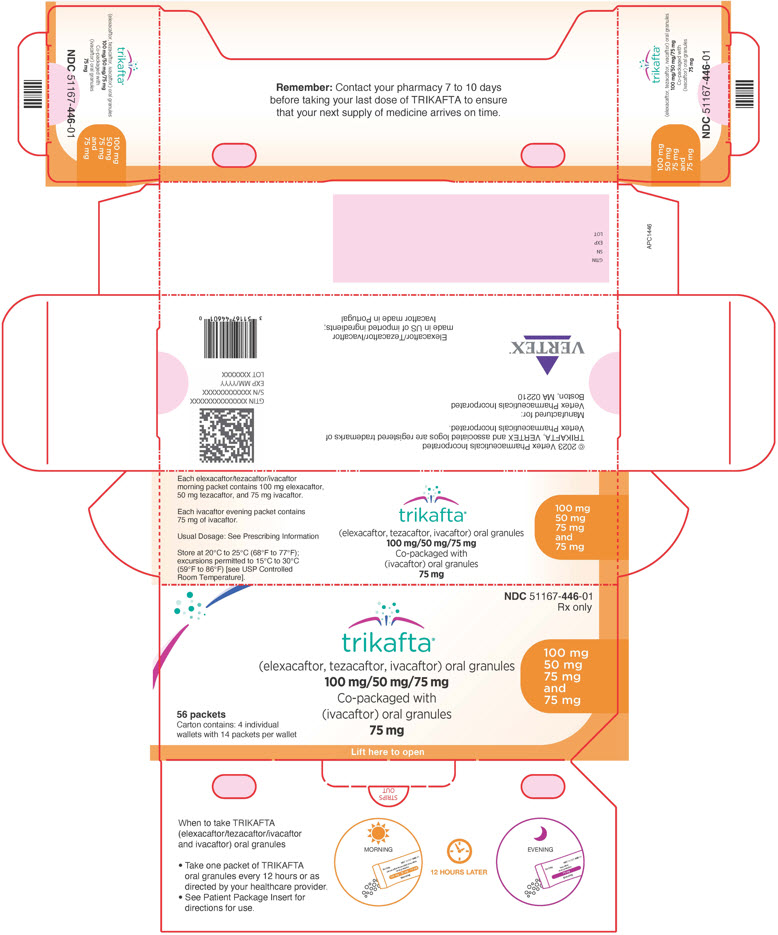
Trikafta Elexacaftor, Tezacaftor, and Ivacaftor Kit — NDC 51167-446-01 (Billing 51167-0446-01)
This is a package of Trikafta Elexacaftor, Tezacaftor, and Ivacaftor Kit from Vertex Pharmaceuticals Incorporated, marketed since Apr 2023 and currently FDA-listed. It is this product's only package size.
NDC database record
One package, one record: these facts belong to NDC 51167-446-01 alone.
- Record
- FDA NDC Directory package listing · Human prescription drug
- Code segments
- 51167 labeler · 446 product · 01 package
- Package marketed since
- Apr 26, 2023
- Sample package
- No — commercial package
- Listing certified through
- Dec 31, 2027
- Barcode (UPC-A, from the NDC)
- 3 5116744601 0
- Medicaid fills, this package
- 6,045 prescriptions in the last four reported quarters
- FDA record last changed
- Jul 24, 2026
Identity & classification
Regulatory identifiers FDA, NLM and CMS codes for this package
Drug-database identifiers Medi-Span GPI and First Databank GCN / HICL / AHFS classification
- GSN (GCN sequence number): 084694
- GCN: 54047
- GPI-14 (Medi-Span): 4530990340B140
- HICL (First Databank): 046112
- AHFS class code: 48:14.04.00
- RxCUI (RxNorm): 1243046
Where does this data come from?
- FDA openFDA NDC Directory · synced Oct 8, 2026
- FDA label on DailyMed · label index refreshed Oct 8, 2026
- RxNorm (NLM RxNav) · catalog refreshed Oct 1, 2026
- Medi-Span GPI (licensed)
- First Databank (licensed) · refreshed Oct 8, 2026
RxNorm drug class
This medicine belongs to the Cystic Fibrosis Transmembrane Conductance Regulator Potentiator class.
Where does this data come from?
- RxClass (NLM) · catalog refreshed Oct 1, 2026
Clinical
- Trikafta doesn't cure CF, but it works differently from most CF treatments. Instead of just managing symptoms, it targets the defective CFTR protein at the root of the disease — he...
- What exactly does Trikafta do — does it cure cystic fibrosis?
- The fat in food is actually essential for this medication to be absorbed properly. Without fat in your stomach, your body won't take up enough of the medicine, and it won't work as...
- Why do I have to take it with food — can't I just take it with water?
Patient education
Supplement & herbal interactions
Where does this data come from?
- MedlinePlus (NLM) · refreshed Oct 8, 2026
- FDA label on DailyMed · label index refreshed Oct 8, 2026
Ask a licensed pharmacist directly — free, answered by our team.
Pricing
A drug doesn't have one price. Each row is a different public payment system, and none is what you'd pay at the counter — that depends on your insurance. The ⓘ on each row explains what it measures.
| Price system | Per each | Per package |
|---|---|---|
| Retail pharmacies payNADAC · weekly | Not in the retail survey — common for institutional, discontinued, or low-volume packs. | |
| Medicaid paysCMS SDUD · 12 mo | $488.31 | — |
| Medicare drug plans payPart D · Q2 2026 | $509.00 | — |
Where does this data come from?
- CMS NADAC weekly file
- CMS ASP pricing files · refreshed Sep 20, 2026
- CMS Medicaid State Drug Utilization Data · through Q1 2026
- CMS Part D plan pricing files · refreshed Sep 24, 2026
- VA National Acquisition Center price file
Packaging — all sizes for this product
| Package NDC | Description | Marketing start | Marketing end | Status |
|---|---|---|---|---|
| 51167-0446-01 You're viewing this Main listing | 4 PACKAGE in 1 CARTON / 1 KIT in 1 PACKAGE * 1 GRANULE in 1 PACKET * 1 GRANULE in 1 PACKET | 2023-04-26 | — | Active |
Therapeutic equivalents
| Product | Labeler | Pack | NADAC/unit | TE | Status | Price vs. this |
|---|---|---|---|---|---|---|
| Trikafta 51167-0445-01 | Vertex | 1 granule | — | — | FDA listed | — |
| Trikafta 51167-0106-02 | Vertex | 7 tablets | — | — | FDA listed | — |
| Trikafta 51167-0331-01 | Vertex | 14 tablets | — | — | FDA listed | — |
| Trikaftathis 51167-0446-01 | Vertex | 1 granule | — | — | FDA listed | — |
Where does this data come from?
- FDA openFDA NDC Directory · synced Oct 8, 2026
- FDA Orange Book · refreshed Oct 3, 2026
- CMS NADAC weekly file
Availability & generic status
We did not find an FDA-approved generic match for this exact strength, form and route. Patent/protection dates below may affect future generic timing.
Why the date isn’t exact: Generic timing can change because patents may be challenged, settled, licensed, added, removed, or worked around with a narrower label — and FDA approval does not always mean a pharmacy can get the generic today.
🛈 What do these terms mean?
- Patent
- Legal protection listed in the Orange Book that may delay generic approval or launch. Issued by the U.S. Patent & Trademark Office.
- Substance patent
- Covers the active drug molecule itself — the hardest to design around. A generic generally can’t launch until it expires.
- Formulation (product) patent
- Covers a specific formulation or dosage form. A generic can sometimes work around it with a different formulation.
- Method-of-use patent
- A patent covering one specific approved use of the drug — not necessarily the whole molecule. A generic can sometimes launch with a “skinny label” that carves out the protected use and keeps the others.
- Skinny label
- A generic label that omits a still-patented use when the FDA allows it — letting a generic reach the market for the unprotected uses.
- Exclusivity
- FDA-granted marketing protection, separate from patents — e.g. 5-yr new chemical entity, 7-yr orphan drug, or a +6-month pediatric extension.
- Paragraph IV
- A generic applicant’s formal challenge to a listed patent. It can potentially lead to earlier generic entry, but often involves litigation or a settlement.
- RLD / RS
- Reference Listed Drug — the brand product the FDA uses as the reference for generic applications. Reference Standard — the product the FDA expects generics to compare against in bioequivalence testing.
- TE / AB rating
- FDA therapeutic-equivalence rating. An AB rating generally means the FDA considers a generic therapeutically equivalent to — and substitutable for — the brand.
- LOE (loss of exclusivity)
- The latest patent or exclusivity currently listed — the loss-of-exclusivity / latest-listed-protection date shown on this page. Paragraph-IV challenges and settlements can move the real date earlier; FDA approval and a manufacturer’s decision to market can move it later.
Built from the FDA Orange Book. The bars above are scaled to each protection’s expiry; the red LOE marker is the last one to lapse.
| Patent | Type | Use code | Expires |
|---|---|---|---|
| US 10081621 ↗ | Method of use | U-4065 | Mar 25, 2031 |
| US 10081621 ↗ | Method of use | U-4065 | Mar 25, 2031 |
| US 9974781 ↗ | Method of use | U-4066 | Apr 9, 2027 |
| US 9974781 ↗ | Method of use | U-4066 | Apr 9, 2027 |
| US 9931334 ↗ | Method of use | U-4068 | Dec 28, 2026 |
| US 9931334 ↗ | Method of use | U-4068 | Dec 28, 2026 |
| US 9670163 ↗ | Method of use | U-4068 | Dec 28, 2026 |
| US 9670163 ↗ | Method of use | U-4068 | Dec 28, 2026 |
| US 8598181 ↗ | Method of use | U-4066 | May 1, 2027 |
| US 8598181 ↗ | Method of use | U-4066 | May 1, 2027 |
| US 12458635 ↗ | Method of use | U-4333 | Aug 13, 2029 |
| US 12458635 ↗ | Method of use | U-4333 | Aug 13, 2029 |
| US 11639347 ↗ | Drug substance | U-3583 | Apr 9, 2027 |
| US 11639347 ↗ | Drug substance | U-3583 | Apr 9, 2027 |
| US 11578062 ↗ | Method of use | U-3584 | Mar 25, 2031 |
| US 11578062 ↗ | Method of use | U-3584 | Mar 25, 2031 |
| US 11564916 ↗ | Method of use | U-3585 | Aug 13, 2029 |
| US 11564916 ↗ | Method of use | U-3585 | Aug 13, 2029 |
| US 11517564 ↗ | Method of use | U-3586 | Dec 8, 2037 |
| US 11517564 ↗ | Method of use | U-3586 | Dec 8, 2037 |
| US 10793547 ↗ | Drug substance | U-3588 | Dec 8, 2037 |
| US 10793547 ↗ | Drug substance | U-3588 | Dec 8, 2037 |
| US 10758534 ↗ | Drug substance | U-3589 | Oct 6, 2035 |
| US 10758534 ↗ | Drug substance | U-3589 | Oct 6, 2035 |
| US 10239867 ↗ | Drug substance | U-3590 | Apr 9, 2027 |
| US 10239867 ↗ | Drug substance | U-3590 | Apr 9, 2027 |
| US 9974781 ↗ | Method of use | U-3589 | Apr 9, 2027 |
| US 9974781 ↗ | Method of use | U-3589 | Apr 9, 2027 |
| US 9670163 ↗ | Method of use | U-3591 | Dec 28, 2026 |
| US 9670163 ↗ | Method of use | U-3591 | Dec 28, 2026 |
| US 8598181 ↗ | Method of use | U-3589 | May 1, 2027 |
| US 8598181 ↗ | Method of use | U-3589 | May 1, 2027 |
| US 8415387 ↗ | Method of use | U-3589 | Nov 12, 2027 |
| US 8415387 ↗ | Method of use | U-3589 | Nov 12, 2027 |
| US 12214083 ↗ | Method of use | U-4141 | Feb 27, 2033 |
| US 12214083 ↗ | Method of use | U-4141 | Feb 27, 2033 |
| US 10239867 ↗ | Drug substance | U-4053 | Apr 9, 2027 |
| US 10239867 ↗ | Drug substance | U-4053 | Apr 9, 2027 |
| US 10758534 ↗ | Drug substance | U-4066 | Oct 6, 2035 |
| US 10758534 ↗ | Drug substance | U-4066 | Oct 6, 2035 |
| US 10793547 ↗ | Drug substance | U-4066 | Dec 8, 2037 |
| US 10793547 ↗ | Drug substance | U-4066 | Dec 8, 2037 |
| US 8415387 ↗ | Method of use | U-4066 | Nov 12, 2027 |
| US 8415387 ↗ | Method of use | U-4066 | Nov 12, 2027 |
| US 8324242 ↗ | Method of use | U-4066 | Aug 5, 2027 |
| US 8324242 ↗ | Method of use | U-4066 | Aug 5, 2027 |
| US 11639347 ↗ | Drug substance | U-4053 | Apr 9, 2027 |
| US 12350262 ↗ | Method of use | U-4220 | Jul 17, 2038 |
| US 8354427 ↗ | Method of use | U-3593 | Jul 6, 2026 |
| US 8354427 ↗ | Method of use | U-3593 | Jul 6, 2026 |
| US 8324242 ↗ | Method of use | U-3589 | Aug 5, 2027 |
| US 8324242 ↗ | Method of use | U-3589 | Aug 5, 2027 |
| US 11426407 ↗ | Drug substance | U-3595 | Oct 6, 2035 |
| US 11426407 ↗ | Drug substance | U-3595 | Oct 6, 2035 |
| US 10022352 ↗ | Method of use | U-3596 | Apr 9, 2027 |
| US 10022352 ↗ | Method of use | U-3596 | Apr 9, 2027 |
| US 9931334 ↗ | Method of use | U-3591 | Dec 28, 2026 |
| US 9931334 ↗ | Method of use | U-3591 | Dec 28, 2026 |
| US 11179367 ↗ | Method of use | U-3597 | Dec 8, 2037 |
| US 11179367 ↗ | Method of use | U-3597 | Dec 8, 2037 |
| US 11147770 ↗ | Method of use | U-3598 | Feb 27, 2033 |
| US 11147770 ↗ | Method of use | U-3598 | Feb 27, 2033 |
| US 10272046 ↗ | Method of use | U-3599 | Feb 27, 2033 |
| US 10272046 ↗ | Method of use | U-3599 | Feb 27, 2033 |
| US 10081621 ↗ | Method of use | U-3600 | Mar 25, 2031 |
| US 10081621 ↗ | Method of use | U-3600 | Mar 25, 2031 |
| US 11752106 ↗ | Method of use | U-3696 | Feb 27, 2033 |
| US 11752106 ↗ | Method of use | U-3696 | Feb 27, 2033 |
| US 11752106 ↗ | Method of use | U-4052 | Feb 27, 2033 |
| US 11752106 ↗ | Method of use | U-4052 | Feb 27, 2033 |
| US 11639347 ↗ | Drug substance | U-4053 | Apr 9, 2027 |
| US 11578062 ↗ | Method of use | U-4054 | Mar 25, 2031 |
| US 11578062 ↗ | Method of use | U-4054 | Mar 25, 2031 |
| US 11564916 ↗ | Method of use | U-4055 | Aug 13, 2029 |
| US 11564916 ↗ | Method of use | U-4055 | Aug 13, 2029 |
| US 11517564 ↗ | Method of use | U-4057 | Dec 8, 2037 |
| US 11517564 ↗ | Method of use | U-4057 | Dec 8, 2037 |
| US 11426407 ↗ | Drug substance | U-4058 | Oct 6, 2035 |
| US 11426407 ↗ | Drug substance | U-4058 | Oct 6, 2035 |
| US 11179367 ↗ | Method of use | U-4059 | Dec 8, 2037 |
| US 11179367 ↗ | Method of use | U-4059 | Dec 8, 2037 |
| US 11147770 ↗ | Method of use | U-4060 | Feb 27, 2033 |
| US 11147770 ↗ | Method of use | U-4060 | Feb 27, 2033 |
| US 10272046 ↗ | Method of use | U-4062 | Feb 27, 2033 |
| US 10272046 ↗ | Method of use | U-4062 | Feb 27, 2033 |
| US 8324242 ↗ | Method of use | U-4476 | Aug 5, 2027 |
| US 8324242 ↗ | Method of use | U-4476 | Aug 5, 2027 |
| US 8415387 ↗ | Method of use | U-4476 | Nov 12, 2027 |
| US 8415387 ↗ | Method of use | U-4476 | Nov 12, 2027 |
| US 8598181 ↗ | Method of use | U-4476 | May 1, 2027 |
| US 8598181 ↗ | Method of use | U-4476 | May 1, 2027 |
| US 9670163 ↗ | Method of use | U-4478 | Dec 28, 2026 |
| US 9670163 ↗ | Method of use | U-4478 | Dec 28, 2026 |
| US 9931334 ↗ | Method of use | U-4478 | Dec 28, 2026 |
| US 9931334 ↗ | Method of use | U-4478 | Dec 28, 2026 |
| US 9974781 ↗ | Method of use | U-4476 | Apr 9, 2027 |
| US 9974781 ↗ | Method of use | U-4476 | Apr 9, 2027 |
| US 10081621 ↗ | Method of use | U-4481 | Mar 25, 2031 |
| US 10081621 ↗ | Method of use | U-4481 | Mar 25, 2031 |
| US 10239867 ↗ | Drug substance | U-4476 | Apr 9, 2027 |
| US 10239867 ↗ | Drug substance | U-4476 | Apr 9, 2027 |
| US 10272046 ↗ | Method of use | U-4482 | Feb 27, 2033 |
| US 10272046 ↗ | Method of use | U-4482 | Feb 27, 2033 |
| US 10758534 ↗ | Drug substance | U-4476 | Oct 6, 2035 |
| US 10758534 ↗ | Drug substance | U-4476 | Oct 6, 2035 |
| US 10793547 ↗ | Drug substance | U-4476 | Dec 8, 2037 |
| US 10793547 ↗ | Drug substance | U-4476 | Dec 8, 2037 |
| US 11147770 ↗ | Method of use | U-4483 | Feb 27, 2033 |
| US 11147770 ↗ | Method of use | U-4483 | Feb 27, 2033 |
| US 11179367 ↗ | Method of use | U-4484 | Dec 8, 2037 |
| US 11179367 ↗ | Method of use | U-4484 | Dec 8, 2037 |
| US 11426407 ↗ | Drug substance | U-4476 | Oct 6, 2035 |
| US 11426407 ↗ | Drug substance | U-4476 | Oct 6, 2035 |
| US 11517564 ↗ | Method of use | U-4476 | Dec 8, 2037 |
| US 11517564 ↗ | Method of use | U-4476 | Dec 8, 2037 |
| US 11564916 ↗ | Method of use | U-4485 | Aug 13, 2029 |
| US 11564916 ↗ | Method of use | U-4485 | Aug 13, 2029 |
| US 11578062 ↗ | Method of use | U-4488 | Mar 25, 2031 |
| US 11578062 ↗ | Method of use | U-4488 | Mar 25, 2031 |
| US 11639347 ↗ | Drug substance | U-4476 | Apr 9, 2027 |
| US 11639347 ↗ | Drug substance | U-4476 | Apr 9, 2027 |
| US 11752106 ↗ | Method of use | U-4489 | Feb 27, 2033 |
| US 11752106 ↗ | Method of use | U-4489 | Feb 27, 2033 |
| US 12214083 ↗ | Method of use | U-4492 | Feb 27, 2033 |
| US 12214083 ↗ | Method of use | U-4492 | Feb 27, 2033 |
| US 12350262 ↗ | Method of use | U-4476 | Jul 17, 2038 |
| US 12458635 ↗ | Method of use | U-4493 | Aug 13, 2029 |
| US 12458635 ↗ | Method of use | U-4493 | Aug 13, 2029 |
| US 11453655 ↗ | Drug substance | — | Dec 8, 2037 |
| US 8410274 ↗ | Drug product | — | Dec 28, 2026 |
| US 8410274 ↗ | Drug product | — | Dec 28, 2026 |
| US 8883206 ↗ | Drug product | — | Feb 27, 2033 |
| US 10646481 ↗ | Drug product | — | Aug 13, 2029 |
| US 7776905 ↗ | Drug substance | — | Jun 3, 2027 |
| US 10646481 ↗ | Drug product | — | Aug 13, 2029 |
| US RE50453 ↗ | Drug substance | — | Jul 10, 2031 |
| US 8623905 ↗ | Drug substance | — | May 1, 2027 |
| US 8623905 ↗ | Drug substance | — | May 1, 2027 |
| US 7776905 ↗ | Drug substance | — | Jun 3, 2027 |
| US 7495103 ↗ | Drug substance | — | May 20, 2027 |
| US 7645789 ↗ | Drug substance | — | May 1, 2027 |
| US 8754224 ↗ | Drug substance | — | Dec 28, 2026 |
| US 8754224 ↗ | Drug substance | — | Dec 28, 2026 |
| US RE50453 ↗ | Drug substance | — | Jul 10, 2031 |
| US 11453655 ↗ | Drug substance | — | Dec 8, 2037 |
| US 7645789 ↗ | Drug substance | — | May 1, 2027 |
| US 8883206 ↗ | Drug product | — | Feb 27, 2033 |
| US 7495103 ↗ | Drug substance | — | May 20, 2027 |
| Code | What it grants | Expires |
|---|---|---|
| M-313 | New indication / labeling change (3-year) | Dec 20, 2027 |
| NP | New Product | Apr 26, 2026 |
| ODE-433 | Orphan Drug Exclusivity (7-year) | Apr 26, 2030 |
| ODE-512 | Orphan Drug Exclusivity (7-year) | Dec 20, 2031 |
| ODE-543 | Orphan Drug Exclusivity (7-year) | Mar 27, 2033 |
| NP | New Product | Apr 26, 2026 |
| ODE-433 | Orphan Drug Exclusivity (7-year) | Apr 26, 2030 |
| ODE-512 | Orphan Drug Exclusivity (7-year) | Dec 20, 2031 |
| ODE-543 | Orphan Drug Exclusivity (7-year) | Mar 27, 2033 |
Is there a generic version of TRIKAFTA 100-50-75 MG/75MG PKT?
The FDA approved a generic — why can’t I get it at my pharmacy yet?
Why do different websites show different generic release dates?
What does “FDA listed” mean?
What does a patent or protection date mean here?
What does “current Orange Book estimate” mean?
Can a generic come out before the last patent expires?
Can a generic come out after the listed dates?
What is the difference between patents and exclusivity?
Why are there multiple patent dates?
Where does this data come from?
- FDA Orange Book · refreshed Oct 3, 2026
What it looks like
Where does this data come from?
- FDA label on DailyMed · label index refreshed Oct 8, 2026
Inactive Ingredients / Excipients
Inactive ingredients, also called excipients, are components of the drug product other than the active ingredient. They may include fillers, dyes, coatings, preservatives, flavors, or other formulation ingredients.
🧪 Avoiding an ingredient? See Elexacaftor, Tezacaftor, and Ivacaftor inactive ingredients by manufacturer: every current product's list side by side, so you can ask your pharmacy for the version that does not list it.
Where does this data come from?
IACT rows and label-wide narrative are kept separate; availability and product-level specificity depend on the submitted label.- FDA label on DailyMed · label index refreshed Oct 8, 2026
- FDA openFDA NDC Directory · synced Oct 8, 2026
Inactive ingredient FAQ
Are inactive ingredients the same for every manufacturer?
Why might an inactive ingredient be missing?
Can inactive ingredients matter?
Manufacturer & labeler
More NDCs from Vertex Pharmaceuticals Incorporated labeler code 51167
- Kalydeco ivacaftor 150 mg Tablet, Film Coated NDC 51167-200-01
- CASGEVY exagamglogene autotemcel 13000000 1/mL Injection, Suspension NDC 51167-290-09
- Kalydeco ivacaftor 50 mg Granule NDC 51167-300-01
- Trikafta Elexacaftor, Tezacaftor, and Ivacaftor Kit NDC 51167-331-01
- Kalydeco ivacaftor 75 mg Granule NDC 51167-400-01
- Trikafta Elexacaftor, Tezacaftor, and Ivacaftor Kit NDC 51167-445-01
- Orkambi lumacaftor and ivacaftor 150 mg; 188 mg Granule NDC 51167-500-02
- JOURNAVX Suzetrigine 50 mg Tablet, Film Coated NDC 51167-548-25
- Kalydeco ivacaftor 25 mg Granule NDC 51167-600-01
- SYMDEKO Tezacaftor and Ivacaftor Kit NDC 51167-661-01
- Orkambi lumacaftor and ivacaftor 100 mg; 125 mg Tablet, Film Coated NDC 51167-700-02
- Kalydeco ivacaftor 13.4 mg Granule NDC 51167-770-01
Where does this data come from?
- FDA openFDA NDC Directory · synced Oct 8, 2026
- Drugs@FDA
Full prescribing information FDA SPL
🚨 Boxed Warning ▾
WARNING: DRUG-INDUCED LIVER INJURY AND LIVER FAILURE TRIKAFTA can cause serious and potentially fatal drug-induced liver injury. Cases of liver failure leading to transplantation and death have been reported in patients with and without a history of liver disease taking TRIKAFTA, in both clinical trials and the postmarketing setting [see Adverse Reactions (6) ]. Liver injury has been reported within the first month of therapy and up to 15 months following initiation of TRIKAFTA .
Assess liver function tests (ALT, AST, alkaline phosphatase, and bilirubin) in all patients prior to initiating TRIKAFTA. Assess liver function tests every month during the first 6 months of treatment, then every 3 months for the next 12 months, then at least annually thereafter. Consider more frequent monitoring for patients with a history of liver disease or liver function test elevations at baseline [see Dosage and Administration (2.1) , Warnings and Precautions (5.1) , Adverse Reactions (6) and Use in Specific Populations (8.7) ] .
Interrupt TRIKAFTA for significant elevations in liver function tests or in the event of signs or symptoms of liver injury. Consider referral to a hepatologist. Follow patients closely with clinical and laboratory monitoring until abnormalities resolve.
If abnormalities resolve, resume treatment only if the benefit is expected to outweigh the risk. Closer monitoring is advised after resuming TRIKAFTA [see Warnings and Precautions (5.1) ] . TRIKAFTA should not be used in patients with severe hepatic impairment (Child-Pugh Class C).
TRIKAFTA is not recommended in patients with moderate hepatic impairment (Child-Pugh Class B). If used, use with caution at a reduced dosage and monitor patients closely [see Dosage and Administration (2.3) , Warnings and Precautions (5.1) , Adverse Reactions (6) , Use in Specific Populations (8.7) and Clinical Pharmacology (12.3) ] . WARNING: DRUG-INDUCED LIVER INJURY AND LIVER FAILURE See full prescribing information for complete boxed warning.
TRIKAFTA can cause serious and potentially fatal drug-induced liver injury. Liver failure leading to transplantation and death has been reported. ( 5.1 , 6 ) Assess liver function tests (ALT, AST, alkaline phosphatase, bilirubin) in all patients prior to initiating TRIKAFTA.
( 2.1 , 5.1 ) Monitor liver function tests (ALT, AST, alkaline phosphatase, bilirubin) every month for the first 6 months of treatment, then every 3 months for the next 12 months, then at least annually. ( 2.1 , 5.1 ) Interrupt TRIKAFTA for significant elevations in liver function tests or signs or symptoms of liver injury. Follow patients closely with clinical and laboratory monitoring until abnormalities resolve.
( 5.1 ) Resume TRIKAFTA if abnormalities resolve and only if the benefit is expected to outweigh the risk. ( 5.1 ) TRIKAFTA should not be used in patients with severe hepatic impairment (Child-Pugh Class C). TRIKAFTA is not recommended in patients with moderate hepatic impairment (Child-Pugh Class B).
( 2.3 , 5.1 , 8.7 , 12.3 )
🎯 Indications and Usage ▾
1 INDICATIONS AND USAGE TRIKAFTA is indicated for the treatment of cystic fibrosis (CF) in adult and pediatric patients aged 2 years and older who have a clinical diagnosis of CF and who have at least one variant in the cystic fibrosis transmembrane conductance regulator ( CFTR ) gene that is either responsive based on clinical and/or in vitro data (see Table 6 ) or results in production of CFTR protein [see Clinical Pharmacology (12.1) ] . If the patient's genotype is unknown, an FDA-cleared CF genetic test should be used to confirm the presence of at least one variant in the CFTR gene that is either responsive based on clinical and/or in vitro data or results in production of CFTR protein.
TRIKAFTA is a combination of ivacaftor, a CFTR potentiator, tezacaftor, and elexacaftor indicated for the treatment of cystic fibrosis (CF) in adult and pediatric patients aged 2 years and older who have a clinical diagnosis of CF and who have at least one variant in the CFTR gene that is either responsive based on clinical and/or in vitro data or results in production of CFTR protein. ( 1 , 12.1 ) If the patient's genotype is unknown, an FDA-cleared CF genetic test should be used to confirm the presence of at least one variant in the CFTR gene that is either responsive based on clinical and/or in vitro data or results in production of CFTR protein.
( 1 )
⏱️ Dosage and Administration ▾
2 DOSAGE AND ADMINISTRATION Prior to initiating TRIKAFTA obtain liver function tests (ALT, AST, alkaline phosphatase, and bilirubin) in all patients. Monitor liver function tests every month during the first 6 months of treatment, then every 3 months during the next 12 months, then at least annually thereafter. ( 2.1 , 5.1) Recommended Dosage for Adult and Pediatric Patients Aged 2 Years and Older (with fat-containing food ( 2.2 , 12.3 )) Age Weight Morning Dose Evening Dose 2 to less than 6 years Less than 14 kg One packet containing elexacaftor 80 mg/tezacaftor 40 mg/ivacaftor 60 mg oral granules One packet containing ivacaftor 59.5 mg oral granules 14 kg or more One packet containing elexacaftor 100 mg/tezacaftor 50 mg/ivacaftor 75 mg oral granules One packet containing ivacaftor 75 mg oral granules 6 to less than 12 years Less than 30 kg Two tablets, each containing elexacaftor 50 mg/tezacaftor 25 mg/ivacaftor 37.5 mg One tablet of ivacaftor 75 mg 30 kg or more Two tablets, each containing elexacaftor 100 mg/tezacaftor 50 mg/ivacaftor 75 mg One tablet of ivacaftor 150 mg 12 years and older - Two tablets, each containing elexacaftor 100 mg/tezacaftor 50 mg/ivacaftor 75 mg One tablet of ivacaftor 150 mg Should not be used in patients with severe hepatic impairment.
Use not recommended in patients with moderate hepatic impairment unless the benefit outweighs the risk. Reduce dose if used in patients with moderate hepatic impairment. Liver function tests should be closely monitored.
( 2.3 , 5.1 , 6 , 8.7 , 12.3 ) See full prescribing information for dosage modifications due to drug interactions with TRIKAFTA. ( 2.4 , 5.6 , 7.1 , 12.3 )
2.1Recommended Laboratory Testing Prior to TRIKAFTA Initiation and During Treatment Prior to initiating TRIKAFTA, obtain liver function tests (ALT, AST, alkaline phosphatase, and bilirubin) for all patients. Monitor liver function tests every month during the first 6 months of treatment, then every 3 months for the next 12 months, then at least annually thereafter. Consider more frequent monitoring for patients with a history of liver disease or liver function test elevations at baseline [see Warnings and Precautions (5.1) and Use in Specific Populations (8.7) ] .
2.2Recommended Dosage in Adults and Pediatric Patients Aged 2 Years and Older Recommended dosage for adult and pediatric patients aged 2 years and older is provided in Table 1. Administer TRIKAFTA tablets (swallow the tablets whole) or oral granules orally with fat-containing food, in the morning and in the evening approximately 12 hours apart. Examples of meals or snacks that contain fat are those prepared with butter or oils or those containing eggs, peanut butter, cheeses, nuts, whole milk, or meats [see Clinical Pharmacology (12.3) ] .
Administer each dose of TRIKAFTA oral granules immediately before or after ingestion of fat-containing food. Mix entire contents of each packet of oral granules with one teaspoon (5 mL) of age-appropriate soft food or liquid that is at or below room temperature. Some examples of soft food or liquids include pureed fruits or vegetables, yogurt, applesauce, water, milk, or juice.
Once mixed, the product should be consumed completely within one hour. Table 1: Recommended Dosage of TRIKAFTA for Adult and Pediatric Patients Aged 2 Years and Older Age Weight Oral Morning Dose Oral Evening Dose 2 to less than 6 years Less than 14 kg One packet (containing elexacaftor 80 mg/tezacaftor 40 mg/ivacaftor 60 mg) oral granules One packet (containing ivacaftor 59.5 mg) oral granules 14 kg or more One packet (containing elexacaftor 100 mg/tezacaftor 50 mg/ivacaftor 75 mg) oral granules One packet (containing ivacaftor 75 mg) oral granules 6 to less than 12 years Less than 30 kg Two tablets of elexacaftor 50 mg/tezacaftor 25 mg/ivacaftor 37.5 mg (total dose of elexacaftor 100 mg/tezacaftor 50 mg/ivacaftor 75 mg) One tablet of ivacaftor 75 mg 30 kg or more Two tablets of elexacaftor 100 mg/tezacaftor 50 mg/ivacaftor… [Excerpted — this section continues on DailyMed.]
💊 Dosage Forms and Strengths ▾
3 DOSAGE FORMS AND STRENGTHS Tablets: Fixed-dose combination containing elexacaftor 50 mg, tezacaftor 25 mg and ivacaftor 37.5 mg co-packaged with ivacaftor 75 mg; Fixed-dose combination containing elexacaftor 100 mg, tezacaftor 50 mg, and ivacaftor 75 mg co-packaged with ivacaftor 150 mg. ( 3 ) Oral granules: Unit-dose packets of elexacaftor 100 mg, tezacaftor 50 mg and ivacaftor 75 mg co-packaged with unit-dose packets of ivacaftor 75 mg; Unit-dose packets of elexacaftor 80 mg, tezacaftor 40 mg and ivacaftor 60 mg co-packaged with unit-dose packets of ivacaftor 59.5 mg.
( 3 ) Tablets : Fixed-dose combination containing elexacaftor 50 mg, tezacaftor 25 mg, and ivacaftor 37.5 mg co-packaged with ivacaftor 75 mg: Elexacaftor, tezacaftor and ivacaftor tablets are light orange, oblong-shaped and debossed with "T50" on one side and plain on the other Ivacaftor tablets are light blue, oblong-shaped, and printed with "V 75" in black ink on one side and plain on the other Fixed-dose combination containing elexacaftor 100 mg, tezacaftor 50 mg, and ivacaftor 75 mg co-packaged with ivacaftor 150 mg: Elexacaftor, tezacaftor and ivacaftor tablets are orange, oblong-shaped and debossed with "T100" on one side and plain on the other Ivacaftor tablets are light blue, oblong-shaped, and printed with "V 150" in black ink on one side and plain on the other Oral Granules : Fixed-dose combination oral granules containing elexacaftor 100 mg, tezacaftor 50 mg, and ivacaftor 75 mg co-packaged with ivacaftor 75 mg oral granules: Elexacaftor, tezacaftor, and ivacaftor oral granules are white to off-white, sweetened, unflavored granules approximately 2 mm in diameter contained in a white and orange unit-dose packet Ivacaftor oral granules are white to off-white, sweetened, unflavored granules approximately 2 mm in diameter contained in a white and pink unit-dose packet Fixed-dose combination oral granules containing elexacaftor 80 mg, tezacaftor 40 mg, and ivacaftor 60 mg co-packaged with ivacaftor 59.5 mg oral granules: Elexacaftor, tezacaftor, and ivacaftor oral granules are white to off-white, sweetened, unflavored granules approximately 2 mm in diameter contained in a white and blue unit-dose packet Ivacaftor oral granules are white to off-white, sweetened, unflavored granules approximately 2 mm in diameter contained in a white and green unit-dose packet
⛔ Contraindications ▾
4 CONTRAINDICATIONS None. None. ( 4 )
⚠️ Warnings and Cautions ▾
5 WARNINGS AND PRECAUTIONS Drug-induced liver injury and liver failure : TRIKAFTA can cause serious and potentially fatal drug-induced liver injury. Assess liver function tests (ALT, AST, alkaline phosphatase, bilirubin) in all patients prior to initiating and throughout treatment with TRIKAFTA. Interrupt TRIKAFTA in the event of significant elevations in liver function tests or signs or symptoms of liver injury.
TRIKAFTA should not be used in patients with severe hepatic impairment (Child-Pugh Class C). TRIKAFTA is not recommended in patients with moderate hepatic impairment (Child-Pugh Class B). ( 2.1 , 2.3 , 5.1 , 6 , 8.7 , 12.3 ) Hypersensitivity reactions : Angioedema and anaphylaxis have been reported with TRIKAFTA in the postmarketing setting.
Initiate appropriate therapy in the event of a hypersensitivity reaction. ( 5.2 ) Intracranial hypertension : Intracranial hypertension (IH) has been reported in the postmarketing setting with the use of TRIKAFTA. If an unusual headache or visual disturbances occur during treatment, and IH is suspected, interrupt TRIKAFTA and refer for prompt medical evaluation.
( 5.3 ) Neuropsychiatric events, including suicidal thoughts and behaviors : Serious neuropsychiatric events, including symptoms of anxiety, depression, suicidal ideation and behavior, and sleep disturbances, have been reported in the postmarketing setting for TRIKAFTA or drugs containing the same or similar active ingredients. Monitor patients closely for new or worsening symptoms. Consider the risks and benefits for the individual patient to determine if therapy with TRIKAFTA should be interrupted at the occurrence of neuropsychiatric symptoms.
( 5.4 ) Use with CYP3A inducers : Concomitant use with strong CYP3A inducers (e.g., rifampin, St. John's wort) significantly decrease ivacaftor exposure and are expected to decrease elexacaftor and tezacaftor exposure, which may reduce TRIKAFTA efficacy. Therefore, concomitant use is not recommended.
( 5.5 , 7.1 , 12.3 ) Cataracts : Non-congenital lens opacities/cataracts have been reported in pediatric patients treated with ivacaftor-containing regimens. Baseline and follow-up examinations are recommended in pediatric patients initiating TRIKAFTA treatment. ( 5.7 , 8.4 )
5.1Drug-Induced Liver Injury and Liver Failure TRIKAFTA can cause serious and potentially fatal drug-induced liver injury. Cases of liver failure leading to transplantation and death have been reported in patients with and without a history of liver disease taking TRIKAFTA, in both clinical trials and the postmarketing setting [see Adverse Reactions (6) ] . Liver injury has been reported within the first month of therapy and up to 15 months following initiation of TRIKAFTA.
Assess liver function tests (ALT, AST, alkaline phosphatase, and bilirubin) in all patients prior to initiating TRIKAFTA. Assess liver function tests every month during the first 6 months of treatment, then every 3 months for the next 12 months, then at least annually thereafter. Consider more frequent monitoring for patients with a history of liver disease or liver function test elevations at baseline [see Dosage and Administration (2.1) , Adverse Reactions (6) , and Use in Specific Populations (8.7) ] .
Interrupt TRIKAFTA in the event of signs or symptoms of liver injury. These may include: Significant elevations in liver function tests (e.g., ALT or AST >5 × the upper limit of normal (ULN) or ALT or AST >3 × ULN with bilirubin >2 × ULN) Clinical symptoms suggestive of liver injury (e.g., jaundice, right upper quadrant pain, nausea, vomiting, altered mental status, ascites). Consider referral to a hepatologist and follow patients closely with clinical and laboratory monitoring until abnormalities resolve.
If abnormalities resolve and if the benefit is expected to outweigh the risk, resume TRIKAFTA treatment with close monitoring. TRIKAFTA should not be used in patients with severe hepatic impairment (Child-Pugh Class C). TRIKAFTA is not rec… [Excerpted — this section continues on DailyMed.]
🤒 Adverse Reactions ▾
6 ADVERSE REACTIONS The following clinically significant adverse reactions are discussed in greater detail in other sections of the labeling: Drug-Induced Liver Injury and Liver Failure [see Warnings and Precautions (5.1) ] Hypersensitivity Reactions, Including Anaphylaxis [see Warnings and Precautions (5.2) ] Intracranial Hypertension [see Warnings and Precautions (5.3) ] Neuropsychiatric Events, Including Suicidal Thoughts and Behaviors [see Warnings and Precautions (5.4) ] Cataracts [see Warnings and Precautions (5.7) ] The most common adverse drug reactions to TRIKAFTA (≥5% of patients and at a frequency higher than placebo by ≥1%) were headache, upper respiratory tract infection, abdominal pain, diarrhea, rash, alanine aminotransferase increased, nasal congestion, blood creatine phosphokinase increased, aspartate aminotransferase increased, rhinorrhea, rhinitis, influenza, sinusitis, blood bilirubin increased and constipation.
( 6.1 ) To report SUSPECTED ADVERSE REACTIONS, contact Vertex Pharmaceuticals Incorporated at 1-877-634-8789 or FDA at 1-800-FDA-1088 or www.fda.gov/medwatch.
6.1Clinical Trials Experience Because clinical trials are conducted under widely varying conditions, adverse reaction rates observed in the clinical trials of a drug cannot be directly compared to rates in the clinical trials of another drug and may not reflect the rates observed in clinical practice. Patients with Cystic Fibrosis with at Least One F508del Variant The safety profile of TRIKAFTA in patients with CF with at least one F508del variant is based on data from 510 patients aged 12 years and older in two double-blind, controlled trials of 24 weeks and 4 weeks treatment duration (Trials 1 and 2, respectively).
Eligible patients were also able to participate in an open-label extension safety study (up to 96 weeks of TRIKAFTA). In the two controlled trials, a total of 257 patients aged 12 years and older received at least one dose of TRIKAFTA. In Trial 1, the proportion of patients who discontinued study drug prematurely due to adverse events was 1% for TRIKAFTA-treated patients and 0% for placebo-treated patients.
In Trial 1, serious adverse reactions that occurred more frequently in TRIKAFTA-treated patients compared to placebo were rash (1% vs <1%) and influenza (1% vs 0%). There were no deaths. Table 4 shows adverse reactions occurring in ≥5% of TRIKAFTA-treated patients and higher than placebo by ≥1% in the 24-week, placebo-controlled, parallel-group trial (Trial 1).
Table 4: Adverse Reactions Occurring in ≥5% of TRIKAFTA-Treated Patients and Higher than Placebo by ≥1% in Trial 1 Adverse Reactions TRIKAFTA N=202 n (%) Placebo N=201 n (%) Headache 35 (17) 30 (15) Upper respiratory tract infection Includes upper respiratory tract infection and viral upper respiratory tract infection. 32 (16) 25 (12) Abdominal pain Includes abdominal pain, abdominal pain upper, abdominal pain lower. 29 (14) 18 (9) Diarrhea 26 (13) 14 (7) Rash Includes rash, rash generalized, rash erythematous, rash macular, rash pruritic.
21 (10) 10 (5) Alanine aminotransferase increased 20 (10) 7 (3) Nasal congestion 19 (9) 15 (7) Blood creatine phosphokinase increased 19 (9) 9 (4) Aspartate aminotransferase increased 19 (9) 4 (2) Rhinorrhea 17 (8) 6 (3) Rhinitis 15 (7) 11 (5) Influenza 14 (7) 3 (1) Sinusitis 11 (5) 8 (4) Blood bilirubin increased 10 (5) 2 (1) Additional adverse reactions that occurred in TRIKAFTA-treated patients at a frequency of 2% to <5% and higher than placebo by ≥1% include the following: flatulence, abdominal distension, conjunctivitis, pharyngitis, respiratory tract infection, tonsillitis, urinary tract infection, C-reactive protein increased, hypoglycemia, dizziness, dysmenorrhea, acne, eczema and pruritus.
In addition, the following clinical trials have also been conducted [see Use in Specific Populations (8.4) , Clinical Pharmacology (12.3) and Clinical Studies (14) ]: a 24-week, open-label trial in 66 patients with CF aged 6 to less than 1… [Excerpted — this section continues on DailyMed.]
🔄 Drug Interactions ▾
7 DRUG INTERACTIONS Strong CYP3A inducers: Avoid concomitant use. ( 5.5 , 7.1 , 12.3 ) Strong or moderate CYP3A inhibitors: Reduce TRIKAFTA dosage when used concomitantly. Avoid food or drink containing grapefruit. ( 2.4 , 5.6 , 7.1 , 12.3 )
7.1Effect of Other Drugs and Grapefruit on TRIKAFTA Strong CYP3A Inducers Concomitant use of TRIKAFTA with strong CYP3A inducers is not recommended. Elexacaftor, tezacaftor and ivacaftor are substrates of CYP3A (ivacaftor is a sensitive substrate of CYP3A). Concomitant use of CYP3A inducers may result in reduced exposures and thus reduced TRIKAFTA efficacy [see Warnings and Precautions (5.5) ] .
Concomitant use of ivacaftor with rifampin, a strong CYP3A inducer, significantly decreased ivacaftor area under the curve (AUC) by 89%. Elexacaftor and tezacaftor exposures are expected to decrease during concomitant use with strong CYP3A inducers [see Clinical Pharmacology (12.3) ] . Examples of strong CYP3A inducers include: rifampin, rifabutin, phenobarbital, carbamazepine, phenytoin and St.
John's wort ( Hypericum perforatum ) Strong or Moderate CYP3A Inhibitors The dosage of TRIKAFTA should be reduced when used concomitantly with strong CYP3A inhibitors [see Dosage and Administration (2.4) and Warnings and Precautions (5.6) ] . Concomitant use with itraconazole, a strong CYP3A inhibitor, increased elexacaftor AUC by 2.8-fold and tezacaftor AUC by 4.0- to 4.5-fold. When used concomitantly with itraconazole and ketoconazole, ivacaftor AUC increased by 15.6-fold and 8.5-fold, respectively [see Clinical Pharmacology (12.3) ] .
Examples of strong CYP3A inhibitors include: ketoconazole, itraconazole, posaconazole and voriconazole telithromycin and clarithromycin The dosage of TRIKAFTA should be reduced when used concomitantly with moderate CYP3A inhibitors [see Dosage and Administration (2.4) and Warnings and Precautions (5.6) ]. Simulations indicated that concomitant use with moderate CYP3A inhibitors may increase elexacaftor and tezacaftor AUC by approximately 1.9- to 2.3-fold and 2.1-fold, respectively. Concomitant use of fluconazole increased ivacaftor AUC by 2.9-fold [see Clinical Pharmacology (12.3) ] .
Examples of moderate CYP3A inhibitors include: fluconazole erythromycin Grapefruit Concomitant use of TRIKAFTA with grapefruit juice, which contains one or more components that moderately inhibit CYP3A, may increase exposure of elexacaftor, tezacaftor and ivacaftor; therefore, food or drink containing grapefruit should be avoided during treatment with TRIKAFTA [see Dosage and Administration (2.4) ] .
7.2Effect of TRIKAFTA on Other Drugs CYP2C9 Substrates Ivacaftor may inhibit CYP2C9; therefore, monitoring of the international normalized ratio (INR) during concomitant use of TRIKAFTA with warfarin is recommended. Other medicinal products for which exposure may be increased by TRIKAFTA include glimepiride and glipizide; these medicinal products should be used with caution [see Clinical Pharmacology (12.3) ] . Transporters Concomitant use of ivacaftor or tezacaftor/ivacaftor with digoxin, a sensitive P-gp substrate, increased digoxin AUC by 1.3-fold, consistent with weak inhibition of P-gp by ivacaftor.
Administration of TRIKAFTA may increase systemic exposure of medicinal products that are sensitive substrates of P-gp, which may increase or prolong their therapeutic effect and adverse reactions. When used concomitantly with digoxin or other substrates of P-gp with a narrow therapeutic index such as cyclosporine, everolimus, sirolimus and tacrolimus, caution and appropriate monitoring should be used [see Clinical Pharmacology (12.3) ] . Elexacaftor and M23-ELX inhibit uptake by OATP1B1 and OATP1B3 in vitro.
Concomitant use of TRIKAFTA may increase exposures of medicinal products that are substrates of these transporters, such as statins, glyburide, nateglinide and repaglinide. When used concomitantly with substrates of OATP1B1 or OATP1B3, caution and appropriate monitoring should be used [see C… [Excerpted — this section continues on DailyMed.]
👥 Use in Specific Populations ▾
8 USE IN SPECIFIC POPULATIONS
8.1Pregnancy Risk Summary There are limited and incomplete human data from clinical trials on the use of TRIKAFTA or its individual components, elexacaftor, tezacaftor and ivacaftor, in pregnant women to inform a drug-associated risk. Although there are no animal reproduction studies with the concomitant administration of elexacaftor, tezacaftor and ivacaftor, separate reproductive and developmental studies were conducted with each active component of TRIKAFTA in pregnant rats and rabbits. In animal embryo fetal development (EFD) studies oral administration of elexacaftor to pregnant rats and rabbits during organogenesis demonstrated no adverse developmental effects at doses that produced maternal exposures up to approximately 2 times the exposure at the maximum recommended human dose (MRHD) in rats and 4 times the MRHD in rabbits [based on summed AUCs of elexacaftor and its metabolite (for rat) and AUC of elexacaftor (for rabbit)].
Oral administration of tezacaftor to pregnant rats and rabbits during organogenesis demonstrated no adverse developmental effects at doses that produced maternal exposures up to approximately 3 times the exposure at the MRHD in rats and 0.2 times the MRHD in rabbits (based on summed AUCs of tezacaftor and M1-TEZ). Oral administration of ivacaftor to pregnant rats and rabbits during organogenesis demonstrated no adverse developmental effects at doses that produced maternal exposures up to approximately 5 and 14 times the exposure at the MRHD, respectively [based on summed AUCs of ivacaftor and its metabolites (for rat) and AUC of ivacaftor (for rabbit)].
No adverse developmental effects were observed after oral administration of elexacaftor, tezacaftor or ivacaftor to pregnant rats from the period of organogenesis through lactation at doses that produced maternal exposures approximately 1 time, approximately 1 time and 3 times the exposures at the MRHD, respectively [based on summed AUCs of parent and metabolite(s)] (see Data ) . The background risk of major birth defects and miscarriage for the indicated population is unknown. In the U.S. general population, the estimated background risk of major birth defects and miscarriage in clinically recognized pregnancies is 2% to 4% and 15% to 20%, respectively.
Data Animal Data Elexacaftor In an EFD study, pregnant rats were administered oral doses of elexacaftor at 15, 25, and 40 mg/kg/day during the period of organogenesis from gestation Days 6-17. Elexacaftor did not cause adverse developmental outcomes at exposures up to 9 times the MRHD (based on summed AUCs for elexacaftor and its metabolite at maternal doses up to 40 mg/kg/day). Lower mean fetal body weights were observed at doses ≥25 mg/kg/day that produced maternal exposures ≥4 times the MRHD.
Maternal toxicity was observed at 40 mg/kg/day (9 times the MRHD). In an EFD study, pregnant rabbits were administered oral doses of elexacaftor at 50, 100, or 125 mg/kg/day during the period of organogenesis from gestation Days 7-20. Elexacaftor was not teratogenic at exposures up to 4 times the MRHD (based on AUC of elexacaftor at maternal doses up to 125 mg/kg/day).
Maternal toxicity was observed at 125 mg/kg/day (4 times the MRHD). In a pre- and postnatal development (PPND), pregnant rats were administered elexacaftor at oral doses of 5, 7.5, and 10 mg/kg/day from gestation Day 6 through lactation Day 18. Elexacaftor did not cause adverse developmental outcomes in pups at maternal doses up to 10 mg/kg/day (approximately 1 time the MRHD based on summed AUCs of elexacaftor and its metabolite).
Placental transfer of elexacaftor was observed in pregnant rats. Tezacaftor In an EFD study, pregnant rats were administered tezacaftor at oral doses of 25, 50, or 100 mg/kg/day during the period of organogenesis from gestation Days 6-17. Tezacaftor did not cause adverse developmental effects at exposures up to 3 times the MRHD (based on summed AUCs of tezacaftor and M1-TEZ).
Maternal t… [Excerpted — this section continues on DailyMed.]
🤰 Pregnancy ▾
8.1Pregnancy Risk Summary There are limited and incomplete human data from clinical trials on the use of TRIKAFTA or its individual components, elexacaftor, tezacaftor and ivacaftor, in pregnant women to inform a drug-associated risk. Although there are no animal reproduction studies with the concomitant administration of elexacaftor, tezacaftor and ivacaftor, separate reproductive and developmental studies were conducted with each active component of TRIKAFTA in pregnant rats and rabbits. In animal embryo fetal development (EFD) studies oral administration of elexacaftor to pregnant rats and rabbits during organogenesis demonstrated no adverse developmental effects at doses that produced maternal exposures up to approximately 2 times the exposure at the maximum recommended human dose (MRHD) in rats and 4 times the MRHD in rabbits [based on summed AUCs of elexacaftor and its metabolite (for rat) and AUC of elexacaftor (for rabbit)].
Oral administration of tezacaftor to pregnant rats and rabbits during organogenesis demonstrated no adverse developmental effects at doses that produced maternal exposures up to approximately 3 times the exposure at the MRHD in rats and 0.2 times the MRHD in rabbits (based on summed AUCs of tezacaftor and M1-TEZ). Oral administration of ivacaftor to pregnant rats and rabbits during organogenesis demonstrated no adverse developmental effects at doses that produced maternal exposures up to approximately 5 and 14 times the exposure at the MRHD, respectively [based on summed AUCs of ivacaftor and its metabolites (for rat) and AUC of ivacaftor (for rabbit)].
No adverse developmental effects were observed after oral administration of elexacaftor, tezacaftor or ivacaftor to pregnant rats from the period of organogenesis through lactation at doses that produced maternal exposures approximately 1 time, approximately 1 time and 3 times the exposures at the MRHD, respectively [based on summed AUCs of parent and metabolite(s)] (see Data ) . The background risk of major birth defects and miscarriage for the indicated population is unknown. In the U.S. general population, the estimated background risk of major birth defects and miscarriage in clinically recognized pregnancies is 2% to 4% and 15% to 20%, respectively.
Data Animal Data Elexacaftor In an EFD study, pregnant rats were administered oral doses of elexacaftor at 15, 25, and 40 mg/kg/day during the period of organogenesis from gestation Days 6-17. Elexacaftor did not cause adverse developmental outcomes at exposures up to 9 times the MRHD (based on summed AUCs for elexacaftor and its metabolite at maternal doses up to 40 mg/kg/day). Lower mean fetal body weights were observed at doses ≥25 mg/kg/day that produced maternal exposures ≥4 times the MRHD.
Maternal toxicity was observed at 40 mg/kg/day (9 times the MRHD). In an EFD study, pregnant rabbits were administered oral doses of elexacaftor at 50, 100, or 125 mg/kg/day during the period of organogenesis from gestation Days 7-20. Elexacaftor was not teratogenic at exposures up to 4 times the MRHD (based on AUC of elexacaftor at maternal doses up to 125 mg/kg/day).
Maternal toxicity was observed at 125 mg/kg/day (4 times the MRHD). In a pre- and postnatal development (PPND), pregnant rats were administered elexacaftor at oral doses of 5, 7.5, and 10 mg/kg/day from gestation Day 6 through lactation Day 18. Elexacaftor did not cause adverse developmental outcomes in pups at maternal doses up to 10 mg/kg/day (approximately 1 time the MRHD based on summed AUCs of elexacaftor and its metabolite).
Placental transfer of elexacaftor was observed in pregnant rats. Tezacaftor In an EFD study, pregnant rats were administered tezacaftor at oral doses of 25, 50, or 100 mg/kg/day during the period of organogenesis from gestation Days 6-17. Tezacaftor did not cause adverse developmental effects at exposures up to 3 times the MRHD (based on summed AUCs of tezacaftor and M1-TEZ).
Maternal toxicity in rats was observed a… [Excerpted — this section continues on DailyMed.]
🧒 Pediatric Use ▾
8.4Pediatric Use The safety and effectiveness of TRIKAFTA for the treatment of CF have been established in pediatric patients aged 2 years and older who have a clinical diagnosis of CF and who have at least one variant in the CFTR gene that is either responsive based on clinical and/or in vitro data or results in production of CFTR protein. Use of TRIKAFTA for this indication for pediatric patients 12 years of age and older was supported by evidence from two adequate and well-controlled studies (Trials 1 and 2) in CF patients aged 12 years and older [see Adverse Reactions (6.1) and Clinical Studies (14) ].
Use of TRIKAFTA for this indication in pediatric patients 2 to less than 12 years of age is based on the following: Trial 1, 56 pediatric patients aged 12 to less than 18 years who had an F508del variant on one allele and a variant on the second allele that results in either no CFTR protein or a CFTR protein that is not responsive to ivacaftor and tezacaftor/ivacaftor [see Adverse Reactions (6) and Clinical Studies (14) ] . Trial 2, 16 pediatric patients aged 12 to less than 18 years who were homozygous for the F508del variant [see Adverse Reactions (6) and Clinical Studies (14) ] .
Trial 3, 66 pediatric patients aged 6 to less than 12 years who were homozygous for the F508del variant or heterozygous for the F508del variant with a variant on the second allele that results in either no CFTR protein or a CFTR protein that is not responsive to ivacaftor and tezacaftor/ivacaftor [see Adverse Reactions (6) and Clinical Pharmacology (12.3) ] . Trial 4, 75 pediatric patients aged 2 to less than 6 years who had at least one F508del variant or a variant known to be responsive to TRIKAFTA [see Adverse Reactions (6) and Clinical Pharmacology (12.3) ].
Trial 5, 64 pediatric patients aged 6 years to less than 18 years who had at least one qualifying non- F508del TRIKAFTA-responsive variant and did not have an exclusionary variant [see Adverse Reactions (6) and Clinical Studies (14.2) ]. The effectiveness of TRIKAFTA in patients aged 2 to less than 12 years was extrapolated from patients aged 12 years and older with support from population pharmacokinetic analyses showing elexacaftor, tezacaftor, and ivacaftor exposure levels in patients aged 2 to less than 12 years within the range of exposures observed in patients aged 12 years and older [see Clinical Pharmacology (12.3) ] .
Safety of TRIKAFTA in patients aged 6 to less than 12 years was derived from a 24-week, open-label, clinical trial in 66 patients aged 6 to less than 12 years (mean age at baseline 9.3 years) administered either a total dose of elexacaftor 100 mg/tezacaftor 50 mg/ivacaftor 75 mg in the morning and ivacaftor 75 mg in the evening (for patients weighing less than 30 kg) or a total dose of elexacaftor 200 mg/tezacaftor 100 mg/ivacaftor 150 mg in the morning and ivacaftor 150 mg in the evening (for patients weighing 30 kg or more) (Trial 3).
Safety of TRIKAFTA in patients aged 2 to less than 6 years was derived from a 24-week, open-label, clinical trial in 75 patients aged 2 to less than 6 years (mean age at baseline 4.1 years) administered either a total dose of elexacaftor 80 mg/tezacaftor 40 mg/ivacaftor 60 mg in the morning and ivacaftor 59.5 mg in the evening (for patients weighing 10 kg to less than 14 kg) or a total dose of elexacaftor 100 mg/tezacaftor 50 mg/ivacaftor 75 mg in the morning and ivacaftor 75 mg in the evening (for patients weighing 14 kg or more) (Trial 4).
The safety profile of patients in these trials was similar to that observed in Trial 1 [see Adverse Reactions (6) ]. The safety and effectiveness of TRIKAFTA in patients with CF younger than 2 years of age have not been established. Juvenile Animal Toxicity Data Findings of cataracts were observed in juvenile rats dosed from postnatal Day 7 through 35 with ivacaftor dose levels of 10 mg/kg/day and higher (0.21 times the MRHD based on systemic exposure of ivacaftor and its metabolites).
This find… [Excerpted — this section continues on DailyMed.]
🧓 Geriatric Use ▾
8.5Geriatric Use Clinical studies of TRIKAFTA did not include any patients aged 65 years and older.
🆘 Overdosage ▾
10 OVERDOSAGE Treatment of overdosage consists of general supportive measures including monitoring of vital signs and observation of the clinical status of the patient.
🧬 Clinical Pharmacology ▾
12 CLINICAL PHARMACOLOGY
12.1Mechanism of Action Elexacaftor and tezacaftor bind to different sites on the CFTR protein and have an additive effect in facilitating the cellular processing and trafficking of select mutant forms of CFTR (including F508del-CFTR) to increase the amount of CFTR protein delivered to the cell surface compared to either molecule alone. Ivacaftor potentiates the channel open probability (or gating) of the CFTR protein at the cell surface. The combined effect of elexacaftor, tezacaftor and ivacaftor is increased quantity and function of CFTR at the cell surface, resulting in increased CFTR activity as measured both by CFTR-mediated chloride transport in vitro and by sweat chloride in patients with CF.
CFTR Chloride Transport Assay in Fischer Rat Thyroid Cells Expressing Mutant CFTR Protein Effects of elexacaftor/tezacaftor/ivacaftor on chloride transport for mutant CFTR proteins was determined in Ussing chamber electrophysiology studies using a panel of Fischer Rat Thyroid (FRT) cell lines stably expressing individual mutant CFTR protein. Elexacaftor/tezacaftor/ivacaftor increased chloride transport in FRT cells expressing CFTR variants, as identified in Table 6. The threshold that the treatment-induced increase in chloride transport must exceed for the mutant CFTR protein to be considered responsive is ≥10% of normal over baseline.
This threshold was used because it is expected to predict clinical benefit. For individual variants, the magnitude of the net change over baseline in CFTR-mediated chloride transport in vitro is not correlated with the magnitude of clinical response. CFTR Chloride Transport Assay in Human Bronchial Epithelial Cells Expressing Mutant CFTR Protein Homozygous and heterozygous N1303K -Human Bronchial Epithelial (HBE) cells showed greater chloride transport in the presence of elexacaftor/tezacaftor/ivacaftor than F508del/F508del -HBE cells treated with tezacaftor/ivacaftor (which has shown clinical benefit in people homozygous for F508del) .
Patient Selection Select adult and pediatric patients 2 years of age and older for the treatment of CF with TRIKAFTA based on a clinical diagnosis of CF and the presence of at least one variant in the CFTR gene that is either responsive based on clinical and/or in vitro data or results in production of CFTR protein [see Indications and Usage (1) ] . TRIKAFTA should only be used in patients with a clinical diagnosis of CF. The presence of eligible CFTR variant(s) should not be the sole determinant for using TRIKAFTA.
Table 6 lists CFTR variants responsive to TRIKAFTA based on clinical and/or in vitro data in FRT or HBE cells [see Clinical Studies (14) ] . Table 6: List of CFTR Gene Variants Responsive to TRIKAFTA The list of responsive CFTR variants is non-exhaustive. There may be protein-producing CFTR variants not listed that respond to treatment with TRIKAFTA.
Variants responsive to TRIKAFTA based on clinical data Clinical data obtained from Trials 1, 2, and 5. 2789+5G→A D1152H This variant is also predicted to be responsive by FRT assay. L206W R1066H S945L 3272-26A→G F508del L997F R117C T338I 3849+10kbC→T G85E M1101K R347H V232D A455E L1077P P5L R347P Variants responsive to TRIKAFTA based on in vitro data The N1303K variant is predicted to be responsive by HBE assay.
All other variants predicted to be responsive with in vitro data are supported by FRT assay. 1140-1151dup E264V H620P N396Y S1251N 1461insGAT E282D H620Q N418S S1255P 1507_1515del9 E292K H939R N900K S13F 2055del9 E384K H939R;H949L P1013H S13P 2183A→G E403D H954P P1013L S158N 2851A/G E474K I1023R P1021L S182R 293A→G E527G I1027T P1021T S18I 3007del6 E56K I105N P111L S18N 3132T→G E588V I1139V P1372T S308P 3141del9 E60K I1203V P140S S341P 3143del9 E822K I1234L P205S S364P 314del9 E92K I1234V del6aa P439S S434P 3331del6 F1016S I125T P499A S492F 3410T→C F1052V I1269N P574H S50P 3523A→G F1074L I1366N P67L S519G 3601A→C F1078S I1366T P750L S531P 3761T→G F1099L I148L P798S S549I 3791… [Excerpted — this section continues on DailyMed.]
🧬 Mechanism of Action ▾
12.1Mechanism of Action Elexacaftor and tezacaftor bind to different sites on the CFTR protein and have an additive effect in facilitating the cellular processing and trafficking of select mutant forms of CFTR (including F508del-CFTR) to increase the amount of CFTR protein delivered to the cell surface compared to either molecule alone. Ivacaftor potentiates the channel open probability (or gating) of the CFTR protein at the cell surface. The combined effect of elexacaftor, tezacaftor and ivacaftor is increased quantity and function of CFTR at the cell surface, resulting in increased CFTR activity as measured both by CFTR-mediated chloride transport in vitro and by sweat chloride in patients with CF.
CFTR Chloride Transport Assay in Fischer Rat Thyroid Cells Expressing Mutant CFTR Protein Effects of elexacaftor/tezacaftor/ivacaftor on chloride transport for mutant CFTR proteins was determined in Ussing chamber electrophysiology studies using a panel of Fischer Rat Thyroid (FRT) cell lines stably expressing individual mutant CFTR protein. Elexacaftor/tezacaftor/ivacaftor increased chloride transport in FRT cells expressing CFTR variants, as identified in Table 6. The threshold that the treatment-induced increase in chloride transport must exceed for the mutant CFTR protein to be considered responsive is ≥10% of normal over baseline.
This threshold was used because it is expected to predict clinical benefit. For individual variants, the magnitude of the net change over baseline in CFTR-mediated chloride transport in vitro is not correlated with the magnitude of clinical response. CFTR Chloride Transport Assay in Human Bronchial Epithelial Cells Expressing Mutant CFTR Protein Homozygous and heterozygous N1303K -Human Bronchial Epithelial (HBE) cells showed greater chloride transport in the presence of elexacaftor/tezacaftor/ivacaftor than F508del/F508del -HBE cells treated with tezacaftor/ivacaftor (which has shown clinical benefit in people homozygous for F508del) .
Patient Selection Select adult and pediatric patients 2 years of age and older for the treatment of CF with TRIKAFTA based on a clinical diagnosis of CF and the presence of at least one variant in the CFTR gene that is either responsive based on clinical and/or in vitro data or results in production of CFTR protein [see Indications and Usage (1) ] . TRIKAFTA should only be used in patients with a clinical diagnosis of CF. The presence of eligible CFTR variant(s) should not be the sole determinant for using TRIKAFTA.
Table 6 lists CFTR variants responsive to TRIKAFTA based on clinical and/or in vitro data in FRT or HBE cells [see Clinical Studies (14) ] . Table 6: List of CFTR Gene Variants Responsive to TRIKAFTA The list of responsive CFTR variants is non-exhaustive. There may be protein-producing CFTR variants not listed that respond to treatment with TRIKAFTA.
Variants responsive to TRIKAFTA based on clinical data Clinical data obtained from Trials 1, 2, and 5. 2789+5G→A D1152H This variant is also predicted to be responsive by FRT assay. L206W R1066H S945L 3272-26A→G F508del L997F R117C T338I 3849+10kbC→T G85E M1101K R347H V232D A455E L1077P P5L R347P Variants responsive to TRIKAFTA based on in vitro data The N1303K variant is predicted to be responsive by HBE assay.
All other variants predicted to be responsive with in vitro data are supported by FRT assay. 1140-1151dup E264V H620P N396Y S1251N 1461insGAT E282D H620Q N418S S1255P 1507_1515del9 E292K H939R N900K S13F 2055del9 E384K H939R;H949L P1013H S13P 2183A→G E403D H954P P1013L S158N 2851A/G E474K I1023R P1021L S182R 293A→G E527G I1027T P1021T S18I 3007del6 E56K I105N P111L S18N 3132T→G E588V I1139V P1372T S308P 3141del9 E60K I1203V P140S S341P 3143del9 E822K I1234L P205S S364P 314del9 E92K I1234V del6aa P439S S434P 3331del6 F1016S I125T P499A S492F 3410T→C F1052V I1269N P574H S50P 3523A→G F1074L I1366N P67L S519G 3601A→C F1078S I1366T P750L S531P 3761T→G F1099L I148L P798S S549I 3791C/T F1107L I148N P988R S5… [Excerpted — this section continues on DailyMed.]
📦 How Supplied / Storage and Handling ▾
16 HOW SUPPLIED/STORAGE AND HANDLING TRIKAFTA tablets are co-packaged blister pack sealed into a printed wallet, containing elexacaftor, tezacaftor and ivacaftor fixed-dose combination tablets and ivacaftor tablets. Four such wallets are placed in a printed outer carton. TRIKAFTA tablets are supplied as follows: Table 14: TRIKAFTA Tablets and Package Configuration Strengths Tablet Description Package Configuration NDC Elexacaftor 50 mg, tezacaftor 25 mg, and ivacaftor 37.5 mg tablets light orange, oblong-shaped, debossed with "T50" on one side and plain on the other 84-count carton containing 4 wallets, each wallet containing 14 tablets of elexacaftor, tezacaftor and ivacaftor, and 7 tablets of ivacaftor NDC 51167-106-02 Ivacaftor 75 mg light blue, film-coated, oblong-shaped, printed with the characters "V 75" in black ink on one side and plain on the other Elexacaftor 100 mg, tezacaftor 50 mg, and ivacaftor 75 mg orange, oblong-shaped, debossed with "T100" on one side and plain on the other 84-count carton containing 4 wallets, each wallet containing 14 tablets of elexacaftor, tezacaftor and ivacaftor, and 7 tablets of ivacaftor NDC 51167-331-01 Ivacaftor 150 mg light blue, film-coated, oblong-shaped, printed with the characters "V 150" in black ink on one side and plain on the other TRIKAFTA oral granules are supplied in morning and evening unit-dose packets.
The morning dose packets contain a fixed-dose combination of elexacaftor, tezacaftor, and ivacaftor oral granules. The evening dose packets contain ivacaftor oral granules. The packets are placed into a printed wallet.
Four such wallets are placed in a printed outer carton. TRIKAFTA granules are supplied as follows: Table 15: TRIKAFTA Oral Granules and Package Configuration Strengths Granule Description Package Configuration NDC Elexacaftor 80 mg, tezacaftor 40 mg, and ivacaftor 60 mg white to off-white, sweetened, unflavored granules approximately 2 mm in diameter enclosed in white and blue unit-dose packets 56-count carton containing 4 wallets, each wallet containing 7 white and blue packets of elexacaftor, tezacaftor and ivacaftor, and 7 white and green packets of ivacaftor NDC 51167-445-01 Ivacaftor 59.5 mg white to off-white, sweetened, unflavored granules approximately 2 mm in diameter enclosed in white and green unit-dose packets Elexacaftor 100 mg, tezacaftor 50 mg, and ivacaftor 75 mg white to off-white, sweetened, unflavored granules approximately 2 mm in diameter enclosed in white and orange unit-dose packets 56-count carton containing 4 wallets, each wallet containing 7 white and orange packets of elexacaftor, tezacaftor and ivacaftor, and 7 white and pink packets of ivacaftor NDC 51167-446-01 Ivacaftor 75 mg white to off-white, sweetened, unflavored granules approximately 2 mm in diameter enclosed in white and pink unit-dose packets Store at 20 ºC – 25 ºC (68 ºF – 77 ºF); excursions permitted to 15 ºC – 30 ºC (59 ºF – 86 ºF) [see USP Controlled Room Temperature].
📦 Storage and Handling ▾
Store at 20 ºC – 25 ºC (68 ºF – 77 ºF); excursions permitted to 15 ºC – 30 ºC (59 ºF – 86 ºF) [see USP Controlled Room Temperature].
📋 Description ▾
11 DESCRIPTION TRIKAFTA is a co-package of elexacaftor, tezacaftor and ivacaftor fixed-dose combination tablets or granules and ivacaftor tablets or granules. Both tablets and granules are for oral administration. The elexacaftor, tezacaftor and ivacaftor fixed-dose combination tablets are available as: orange, oblong-shaped, film-coated tablet containing 100 mg of elexacaftor, 50 mg of tezacaftor, 75 mg of ivacaftor, or light orange, oblong-shaped, film-coated tablet containing 50 mg of elexacaftor, 25 mg of tezacaftor, 37.5 mg of ivacaftor.
The fixed-dose combination tablet contains the following inactive ingredients: croscarmellose sodium, hypromellose, hypromellose acetate succinate, magnesium stearate, microcrystalline cellulose, and sodium lauryl sulfate. The tablet film coat contains hydroxypropyl cellulose, hypromellose, iron oxide red, iron oxide yellow, talc, and titanium dioxide. The ivacaftor tablet is available as a light blue, oblong-shaped, film-coated tablet containing 150 mg or 75 mg of ivacaftor and the following inactive ingredients: colloidal silicon dioxide, croscarmellose sodium, hypromellose acetate succinate, lactose monohydrate, magnesium stearate, microcrystalline cellulose and sodium lauryl sulfate.
The tablet film coat contains carnauba wax, FD&C Blue #2, PEG 3350, polyvinyl alcohol, talc, and titanium dioxide. The printing ink contains ammonium hydroxide, iron oxide black, propylene glycol, and shellac. The elexacaftor, tezacaftor and ivacaftor fixed-dose combination oral granules are white to off-white, sweetened, unflavored granules approximately 2 mm in diameter enclosed in unit-dose packets.
Each unit-dose packet contains 100 mg of elexacaftor, 50 mg of tezacaftor, 75 mg of ivacaftor or 80 mg of elexacaftor, 40 mg of tezacaftor, 60 mg of ivacaftor and the following inactive ingredients: colloidal silicon dioxide, croscarmellose sodium, hypromellose, hypromellose acetate succinate, lactose monohydrate, magnesium stearate, mannitol, sodium lauryl sulfate, and sucralose. The ivacaftor oral granules are white to off-white, sweetened, unflavored granules approximately 2 mm in diameter enclosed in unit-dose packets.
Each unit-dose packet contains 75 mg or 59.5 mg of ivacaftor and the following inactive ingredients: colloidal silicon dioxide, croscarmellose sodium, hypromellose acetate succinate, lactose monohydrate, magnesium stearate, mannitol, sodium lauryl sulfate, and sucralose. The active ingredients of TRIKAFTA are described below. Elexacaftor Elexacaftor is a white solid that is practically insoluble in water (<1 mg/mL).
Its chemical name is N-(1,3-dimethyl-1H-pyrazole-4-sulfonyl)-6-[3-(3,3,3-trifluoro-2,2-dimethylpropoxy)-1H-pyrazol-1-yl]-2-[(4S)-2,2,4-trimethylpyrrolidin-1-yl]pyridine-3-carboxamide. Its molecular formula is C 26 H 34 N 7 O 4 SF 3 and its molecular weight is 597.66. Elexacaftor has the following structural formula: Chemical Structure Tezacaftor Tezacaftor is a white to off-white solid that is practically insoluble in water (<5 microgram/mL).
Its chemical name is 1-(2,2-difluoro-2H-1,3-benzodioxol-5-yl)-N-{1-[(2R)-2,3-dihydroxypropyl]-6-fluoro-2-(1-hydroxy-2-methylpropan-2-yl)-1H-indol-5-yl}cyclopropane-1-carboxamide. Its molecular formula is C 26 H 27 N 2 F 3 O 6 and its molecular weight is 520.50. Tezacaftor has the following structural formula: Chemical Structure Ivacaftor Ivacaftor is a white to off-white crystalline solid that is practically insoluble in water (<0.05 microgram/mL).
Pharmacologically it is a CFTR potentiator. Its chemical name is N -(2,4-di-tert-butyl-5-hydroxyphenyl)-1,4-dihydro-4-oxoquinoline-3-carboxamide. Its molecular formula is C 24 H 28 N 2 O 3 and its molecular weight is 392.49.
Ivacaftor has the following structural formula: Chemical Structure
💬 Information for Patients ▾
17 PATIENT COUNSELING INFORMATION Advise the patient to read the FDA-approved patient labeling (Medication Guide). Drug-Induced Liver Injury and Liver Failure Inform patients that TRIKAFTA is associated with a serious risk for drug-induced liver injury and that liver injury resulting in liver failure leading to liver transplantation or death have occurred, including in patients without a history of liver disease. Advise all patients that liver function tests (ALT, AST, alkaline phosphatase, and bilirubin) should be assessed prior to initiating TRIKAFTA and then assessed every month during the first 6 months of treatment, then every 3 months for the next 12 months, then at least annually thereafter.
Inform patients with a history of liver disease or liver function test elevations at baseline that more frequent monitoring may be necessary. Instruct patients to interrupt treatment with TRIKAFTA if symptoms of liver injury occur (e.g., jaundice, right upper quadrant pain, nausea, vomiting, altered mental status, ascites) and to notify their healthcare provider immediately. [see Dosage and Administration (2.1) and Warnings and Precautions (5.1) ] . Drug Interactions with CYP3A Inducers and Inhibitors Ask patients to tell you all the medications they are taking including any herbal supplements or vitamins.
Inform patients that concomitant use of TRIKAFTA with strong CYP3A inducers (e.g., rifampin, St. John's wort) is not recommended, as they may reduce the efficacy of TRIKAFTA. Dose reduction to two elexacaftor/tezacaftor/ivacaftor tablets or one elexacaftor/tezacaftor/ivacaftor oral granules packet twice a week, taken approximately 3 to 4 days apart is recommended when used concomitantly with strong CYP3A inhibitors, such as ketoconazole.
Advise the patient not to take the evening dose of ivacaftor. Dose reduction to two elexacaftor/tezacaftor/ivacaftor tablets or one elexacaftor/tezacaftor/ivacaftor oral granules packet and one ivacaftor tablet or ivacaftor oral granules packet, taken on alternate days, is recommended when used concomitantly with moderate CYP3A inhibitors, such as fluconazole. Advise the patient not to take the evening dose of ivacaftor.
Food or drink containing grapefruit should be avoided [see Dosage and Administration (2.4) , Warnings and Precautions (5.5 , 5.6 ), Drug Interactions (7.1) and Clinical Pharmacology (12.3) ] . Hypersensitivity Reactions, Including Anaphylaxis Hypersensitivity reactions including angioedema and anaphylaxis are possible with use of TRIKAFTA. Inform patients of the early signs of hypersensitivity reactions including rash, hives, itching, facial swelling, tightness of the chest and wheezing.
Advise patients to discontinue use of TRIKAFTA immediately and contact their physician or go to the emergency department if these symptoms occur [see Warnings and Precautions (5.2) ] . Intracranial Hypertension Inform patients that intracranial hypertension has occurred with the use of TRIKAFTA. Instruct patients to notify their healthcare provider right away if they experience signs and symptoms of intracranial hypertension, including headache, blurred vision, diplopia, and vision loss [see Warnings and Precautions (5.3) ] .
Neuropsychiatric Events, Including Suicidal Thoughts and Behaviors Inform patients that neuropsychiatric symptoms, including anxiety, depression, suicidal thoughts and behaviors, and sleep disturbances (e.g., insomnia), have been reported with the use of TRIKAFTA or drugs containing the same or similar active ingredients as TRIKAFTA. The symptoms have been observed in patients with and without a history of similar symptoms and may occur within three months of TRIKAFTA initiation. Instruct patients to contact their healthcare provider immediately if changes in behavior or thinking that are not typical for the patient occur, or if the patient develops suicidal ideation or behavior [see Warnings and Precautions (5.4) ] .
Cataracts Inform patients that abnormality of the eye lens… [Excerpted — this section continues on DailyMed.]
💬 Medication Guide ▾
This Medication Guide has been approved by the U.S. Food and Drug Administration. Revised: 03/2026 MEDICATION GUIDE TRIKAFTA ® (tri-KAF-tuh) (elexacaftor, tezacaftor, and ivacaftor tablets; ivacaftor tablets), co-packaged for oral use (elexacaftor, tezacaftor, and ivacaftor oral granules; ivacaftor oral granules), co-packaged What is the most important information I should know about TRIKAFTA?
TRIKAFTA can cause serious liver damage and liver failure. Liver failure leading to transplantation and death have been seen in some people with or without a history of liver problems taking TRIKAFTA. Your healthcare provider will do blood tests to check your liver: before you start TRIKAFTA then every month during your first 6 months of taking TRIKAFTA then every 3 months during the next 12 months of taking TRIKAFTA then at least every year while you are taking TRIKAFTA Your healthcare provider may do blood tests to check the liver more often if you have had high liver enzymes in your blood in the past or are experiencing signs or symptoms of liver injury.
Stop taking TRIKAFTA and call your healthcare provider right away if you have any of the following symptoms of liver problems: pain, swelling, or discomfort in the upper right stomach (abdominal) area yellowing of your skin or the white part of your eyes mental changes nausea or vomiting dark, amber-colored urine loss of appetite have fluid in your stomach area (ascites) What is TRIKAFTA? TRIKAFTA is a prescription medicine for people aged 2 years and older who have a diagnosis of cystic fibrosis (CF) and who have at least one genetic change (variant) in the cystic fibrosis transmembrane conductance regulator ( CFTR ) gene that is either responsive to TRIKAFTA or results in the production of protein.
Talk to your healthcare provider to learn if you have an indicated CF gene variant. It is not known if TRIKAFTA is safe and effective in children under 2 years of age. What should I tell my healthcare provider before taking TRIKAFTA?
Before taking TRIKAFTA, tell your healthcare provider about all of your medical conditions, including if you: have or have had liver problems. are allergic to TRIKAFTA or any ingredients in TRIKAFTA. See the end of this Medication Guide for a complete list of ingredients in TRIKAFTA. have kidney problems. have or have had mental health problems. are pregnant or plan to become pregnant. It is not known if TRIKAFTA will harm your unborn baby.
You and your healthcare provider should decide if you will take TRIKAFTA while you are pregnant. are breastfeeding or planning to breastfeed. It is not known if TRIKAFTA passes into your breast milk. You and your healthcare provider should decide if you will take TRIKAFTA while you are breastfeeding.
Tell your healthcare provider about all the medicines you take , including prescription and over-the-counter medicines, vitamins, and herbal supplements. TRIKAFTA may affect the way other medicines work and other medicines may affect how TRIKAFTA works. The dose of TRIKAFTA may need to be adjusted when taken with certain medicines.
Ask your healthcare provider or pharmacist for a list of these medicines if you are not sure. Especially tell your healthcare provider if you take: antibiotics such as rifampin (RIFAMATE, RIFATER) or rifabutin (MYCOBUTIN). seizure medicines such as phenobarbital, carbamazepine (TEGRETOL, CARBATROL, EQUETRO), or phenytoin (DILANTIN, PHENYTEK). St.
John's wort antifungal medicines including ketoconazole, itraconazole (such as SPORANOX), posaconazole (such as NOXAFIL), voriconazole (such as VFEND), or fluconazole (such as DIFLUCAN). antibiotics including telithromycin, clarithromycin (such as BIAXIN), or erythromycin (such as ERY-TAB). Know the medicines you take. Keep a list of them to show your healthcare provider and pharmacist when you get a new medicine.
How should I take TRIKAFTA? Take TRIKAFTA exactly as your healthcare provider tells you to take it. Take TRIKAFTA by mouth only.
TRIKAFTA consist… [Excerpted — this section continues on DailyMed.]
🧬 Pharmacokinetics ▾
12.3Pharmacokinetics The pharmacokinetics of elexacaftor, tezacaftor and ivacaftor are similar between healthy adult subjects and patients with CF. The pharmacokinetic parameters for elexacaftor, tezacaftor and ivacaftor in patients with CF aged 12 years and older are shown in Table 7. Table 7: Pharmacokinetic Parameters of TRIKAFTA Components Elexacaftor Tezacaftor Ivacaftor AUC ss : area under the concentration versus time curve at steady state; SD: Standard Deviation; C max : maximum observed concentration; T max : time of maximum concentration; AUC: area under the concentration versus time curve.
General Information AUC ss (SD), mcg∙h/mL Based on elexacaftor 200 mg and tezacaftor 100 mg once daily/ivacaftor 150 mg every 12 hours at steady state in patients with CF aged 12 years and older. 162 (47.5) AUC 0-24h . 89.3 (23.2) 11.7 (4.01) AUC 0-12h .
C max (SD), mcg/mL 9.2 (2.1) 7.7 (1.7) 1.2 (0.3) Time to Steady State, days Within 7 days Within 8 days Within 3-5 days Accumulation Ratio 2.2 2.07
2.4Absorption Absolute Bioavailability 80% Not determined Not determined Median T max (range), hours 6 (4 to 12) 3 (2 to 4) 4 (3 to 6) Effect of Food AUC increases 1.9- to 2.5-fold (moderate-fat meal) No clinically significant effect Exposure increases 2.5- to 4-fold Distribution Mean (SD) Apparent Volume of Distribution, L Elexacaftor, tezacaftor and ivacaftor do not partition preferentially into human red blood cells. 53.7 (17.7) 82.0 (22.3) 293 (89.8) Protein Binding Elexacaftor and tezacaftor bind primarily to albumin.
Ivacaftor primarily bind to albumin, alpha 1-acid glycoprotein and human gamma-globulin. >99% approximately 99% approximately 99% Elimination Mean (SD) Effective Half-Life, hours Mean (SD) terminal half-lives of elexacaftor, tezacaftor and ivacaftor are approximately 24.7 (4.87) hours, 60.3 (15.7) hours and 13.1 (2.98) hours, respectively. 27.4 (9.31) 25.1 (4.93) 15.0 (3.92) Mean (SD) Apparent Clearance, L/hours 1.18 (0.29) 0.79 (0.10) 10.2 (3.13) Metabolism Primary Pathway CYP3A4/5 CYP3A4/5 CYP3A4/5 Active Metabolites M23-ELX M1-TEZ M1-IVA Metabolite Potency Relative to Parent Similar Similar approximately 1/6 th of parent Excretion Following radiolabeled doses.
Primary Pathway Feces: 87.3% (primarily as metabolites) Urine: 0.23% Feces: 72% (unchanged or as M2-TEZ) Urine: 14% (0.79% unchanged) Feces: 87.8% Urine: 6.6% Specific Populations Pediatric Patients 2 to Less Than 12 Years of Age Elexacaftor, tezacaftor and ivacaftor exposures observed in patients aged 2 to less than 12 years as determined using population PK analysis are presented by age group and dose administered in Table 8. Elexacaftor, tezacaftor and ivacaftor exposures in this patient population are within the range observed in patients aged 12 years and older.
Table 8: Mean (SD) Elexacaftor, Tezacaftor and Ivacaftor Exposures Observed at Steady State by Age Group and Dose Administered Age Group Dose Elexacaftor AUC 0-24h,ss (µg∙h/mL) Tezacaftor AUC 0-24h,ss (µg∙h/mL) Ivacaftor AUC 0-12h,ss (µg∙h/mL) SD: Standard Deviation; AUC ss : area under the concentration versus time curve at steady state. Patients aged 2 to less than 6 years weighing less than 14 kg (N = 16) elexacaftor 80 mg qd/tezacaftor 40 mg qd/ivacaftor 60 mg qAM and ivacaftor 59.5 mg qPM 128 (24.8) 87.3 (17.3) 11.9 (3.86) Patients aged 2 to less than 6 years weighing 14 kg or more (N = 59) elexacaftor 100 mg qd/tezacaftor 50 mg qd/ivacaftor 75 mg q12h 138 (47.0) 90.2 (27.9) 13.0 (6.11) Patients aged 6 to less than 12 years weighing less than 30 kg (N = 36) elexacaftor 100 mg qd/tezacaftor 50 mg qd/ivacaftor 75 mg q12h 116 (39.4) 67.0 (22.3) 9.78 (4.50) Patients aged 6 to less than 12 years weighing 30 kg or more (N = 30) elexacaftor 200 mg qd/ tezacaftor 100 mg qd/ ivacaftor 150 mg q12h 195 (59.4) 103 (23.7) 17.5 (4.97) Pediatric Patients 12 to Less Than 18 Years of Age The following conclusions about exposures between adults and the pediatric population are based on population pharmacok… [Excerpted — this section continues on DailyMed.]
🧬 Pharmacodynamics ▾
12.2Pharmacodynamics Sweat Chloride Evaluation In Trial 1 (patients with an F508del variant on one allele and a variant on the second allele that results in either no CFTR protein or a CFTR protein that is not responsive ivacaftor and tezacaftor/ivacaftor), a reduction in sweat chloride was observed from baseline at Week 4 and sustained through the 24-week treatment period [see Clinical Studies (14.1) ] . In Trial 2 (patients homozygous for the F508del variant), a reduction in sweat chloride was observed from baseline at Week 4 [see Clinical Studies (14.2) ] .
In Trial 3 (patients aged 6 to less than 12 years who are homozygous for the F508del variant or heterozygous for the F508del variant and a variant on the second allele that results in either no CFTR protein or a CFTR protein that is not responsive to ivacaftor and tezacaftor/ivacaftor), the mean absolute change in sweat chloride from baseline through Week 24 was -60.9 mmol/L (95% CI: -63.7, -58.2). In Trial 4 (patients aged 2 to less than 6 years who had at least one F508del variant or a variant known to be responsive to TRIKAFTA), the mean absolute change in sweat chloride from baseline through Week 24 was -57.9 mmol/L (95% CI: -61.3, -54.6).
In Trial 5 (patients aged 6 years and older with at least one qualifying non- F508del elexacaftor/tezacaftor/ivacaftor-responsive CFTR variant), the mean absolute change in sweat chloride from baseline through Week 24 compared to placebo was -28.3 mmol/L (95% CI: -32.1, -24.5). Cardiac Electrophysiology At doses up to 2 times the maximum recommended dose of elexacaftor and 3 times the maximum recommended dose of tezacaftor and ivacaftor, the QT/QTc interval in healthy subjects was not prolonged to any clinically relevant extent.
🔬 Clinical Studies ▾
14 CLINICAL STUDIES
14.1Clinical Studies in Patients with Cystic Fibrosis with at Least One F508del Variant The efficacy of TRIKAFTA in patients aged 12 years and older with cystic fibrosis (CF) with at least one F508del variant was evaluated in two randomized, double-blind, controlled trials (Trials 1 and 2). Trial 1 (NCT03525444) was a 24-week, randomized, double-blind, placebo-controlled study in patients who had an F508del variant on one allele and a variant on the second allele that results in either no CFTR protein or a CFTR protein that is not responsive to ivacaftor and tezacaftor/ivacaftor.
An interim analysis was planned when at least 140 patients completed Week 4 and at least 100 patients completed Week 12. Trial 2 (NCT03525548) was a 4-week, randomized, double-blind, active-controlled study in patients who are homozygous for the F508del variant. Patients received tezacaftor 100 mg qd/ivacaftor 150 mg q12h during a 4-week, open-label run-in period and were then randomized and dosed to receive TRIKAFTA or tezacaftor 100 mg qd/ivacaftor 150 mg q12h during a 4-week, double-blind treatment period.
Patients in Trials 1 and 2 had a confirmed diagnosis of CF and at least one F508del variant. Patients discontinued any previous CFTR modulator therapies, but continued on their other standard-of-care CF therapies (e.g., bronchodilators, inhaled antibiotics, dornase alfa and hypertonic saline). Patients had a ppFEV 1 at screening between 40-90%.
Patients with a history of colonization with organisms associated with a more rapid decline in pulmonary status, including but not limited to Burkholderia cenocepacia , Burkholderia dolosa , or Mycobacterium abscessus , or who had an abnormal liver function test at screening (ALT, AST, ALP, or GGT ≥3 × ULN, or total bilirubin ≥2 × ULN), were excluded from the trials. Patients in Trials 1 and 2 were eligible to roll over into an open-label extension study. Trial 1 Trial 1 evaluated 403 patients (200 TRIKAFTA, 203 placebo) with CF aged 12 years and older (mean age 26.2 years).
The mean ppFEV 1 at baseline was 61.4% (range: 32.3%, 97.1%). The primary endpoint assessed at the time of interim analysis was mean absolute change in ppFEV 1 from baseline at Week 4. The final analysis tested all key secondary endpoints in the 403 patients who completed the 24-week study participation, including absolute change in ppFEV 1 from baseline through Week 24; absolute change in sweat chloride from baseline at Week 4 and through Week 24; number of pulmonary exacerbations through Week 24; absolute change in BMI from baseline at Week 24, and absolute change in CFQ-R respiratory domain score (a measure of respiratory symptoms relevant to patients with CF, such as cough, sputum production and difficulty breathing) from baseline at Week 4 and through Week 24.
Of the 403 patients included in the interim analysis, the treatment difference between TRIKAFTA and placebo for the mean absolute change from baseline in ppFEV 1 at Week 4 was 13.8 percentage points (95% CI: 12.1, 15.4; P <0.0001). The treatment difference between TRIKAFTA and placebo for mean absolute change in ppFEV 1 from baseline through Week 24 was 14.3 percentage points (95% CI: 12.7, 15.8; P <0.0001). Mean improvement in ppFEV 1 was observed at the first assessment on Day 15 and sustained through the 24-week treatment period (see Figure 1 ).
Improvements in ppFEV 1 were observed regardless of age, baseline ppFEV 1 , sex and geographic region. See Table 11 for a summary of primary and key secondary outcomes in Trial 1. Table 11: Primary and Key Secondary Efficacy Analyses (Trial 1) Analysis Statistic Treatment Difference Treatment difference provided as the outcome measure for changes in ppFEV 1 , sweat chloride, CFQ-R and BMI; Rate ratio provided as the outcome measure for the number of pulmonary exacerbations. for TRIKAFTA (N=200) vs Placebo (N=203) ppFEV 1 : percent predicted Forced Expiratory Volume in 1 second; CI: Confidence Interval; CFQ-R:… [Excerpted — this section continues on DailyMed.]
🧪 Nonclinical Toxicology ▾
13 NONCLINICAL TOXICOLOGY
13.1Carcinogenesis, Mutagenesis, Impairment of Fertility No studies of carcinogenicity, mutagenicity, or impairment of fertility were conducted with the combination of elexacaftor, tezacaftor and ivacaftor; however, separate studies of elexacaftor, tezacaftor and ivacaftor are described below. Elexacaftor A 6-month study in Tg.rasH2 transgenic mice showed no evidence of tumorigenicity at 50 mg/kg/day dose, the highest dose tested. A two-year study was conducted in rats to assess the carcinogenic potential of elexacaftor.
No evidence of tumorigenicity was observed in rats at elexacaftor oral doses up to 10 mg/kg/day (approximately 2 and 5 times the MRHD based on summed AUCs of elexacaftor and its metabolite in male and female rats, respectively). Elexacaftor was negative for genotoxicity in the following assays: Ames test for bacterial gene variant, in vitro mammalian cell micronucleus assay in TK6 cells, and in vivo mouse micronucleus test. Elexacaftor did not cause reproductive system toxicity in male rats at 55 mg/kg/day and female rats at 25 mg/kg/day, equivalent to approximately 6 times and 4 times the MRHD, respectively (based on summed AUCs of elexacaftor and its metabolite).
Elexacaftor did not cause embryonic toxicity at 35 mg/kg/day which was the highest dose tested, equivalent to approximately 7 times the MRHD (based on summed AUCs of elexacaftor and its metabolite). Lower male and female fertility, male copulation and female conception indices were observed in males at 75 mg/kg/day and females at 35 mg/kg/day, equivalent to approximately 6 times and 7 times, respectively, the MRHD (based on summed AUCs of elexacaftor and its metabolite). Tezacaftor A two-year study in Sprague-Dawley rats and a 6-month study in Tg.rasH2 transgenic mice were conducted to assess the carcinogenic potential of tezacaftor.
No evidence of tumorigenicity from tezacaftor was observed in male and female rats at oral doses up to 50 and 75 mg/kg/day (approximately 1 and 2 times the MRHD based on summed AUCs of tezacaftor and its metabolites in males and females, respectively). No evidence of tumorigenicity was observed in male and female Tg.rasH2 transgenic mice at tezacaftor doses up to 500 mg/kg/day. Tezacaftor was negative for genotoxicity in the following assays: Ames test for bacterial gene variant, in vitro chromosomal aberration assay in Chinese hamster ovary cells and in vivo mouse micronucleus test.
There were no effects on male or female fertility and early embryonic development in rats at oral tezacaftor doses up to 100 mg/kg/day (approximately 3 times the MRHD based on summed AUC of tezacaftor and M1-TEZ). Ivacaftor Two-year studies were conducted in CD-1 mice and Sprague-Dawley rats to assess the carcinogenic potential of ivacaftor. No evidence of tumorigenicity from ivacaftor was observed in mice or rats at oral doses up to 200 mg/kg/day and 50 mg/kg/day, respectively (approximately equivalent to 2 and 7 times the MRHD, respectively, based on summed AUCs of ivacaftor and its metabolites).
Ivacaftor was negative for genotoxicity in the following assays: Ames test for bacterial gene variant, in vitro chromosomal aberration assay in Chinese hamster ovary cells and in vivo mouse micronucleus test. Ivacaftor impaired fertility and reproductive performance indices in male and female rats at 200 mg/kg/day (approximately 7 and 5 times, respectively, the MRHD based on summed AUCs of ivacaftor and its metabolites). Increases in prolonged diestrus were observed in females at 200 mg/kg/day.
Ivacaftor also increased the number of females with all nonviable embryos and decreased corpora lutea, implantations and viable embryos in rats at 200 mg/kg/day (approximately 5 times the MRHD based on summed AUCs of ivacaftor and its metabolites) when dams were dosed prior to and during early pregnancy. These impairments of fertility and reproductive performance in male and female rats at 200 mg/kg/day were attributed to severe… [Excerpted — this section continues on DailyMed.]
📄 Carcinogenesis, Mutagenesis, Impairment of Fertility ▾
13.1Carcinogenesis, Mutagenesis, Impairment of Fertility No studies of carcinogenicity, mutagenicity, or impairment of fertility were conducted with the combination of elexacaftor, tezacaftor and ivacaftor; however, separate studies of elexacaftor, tezacaftor and ivacaftor are described below. Elexacaftor A 6-month study in Tg.rasH2 transgenic mice showed no evidence of tumorigenicity at 50 mg/kg/day dose, the highest dose tested. A two-year study was conducted in rats to assess the carcinogenic potential of elexacaftor.
No evidence of tumorigenicity was observed in rats at elexacaftor oral doses up to 10 mg/kg/day (approximately 2 and 5 times the MRHD based on summed AUCs of elexacaftor and its metabolite in male and female rats, respectively). Elexacaftor was negative for genotoxicity in the following assays: Ames test for bacterial gene variant, in vitro mammalian cell micronucleus assay in TK6 cells, and in vivo mouse micronucleus test. Elexacaftor did not cause reproductive system toxicity in male rats at 55 mg/kg/day and female rats at 25 mg/kg/day, equivalent to approximately 6 times and 4 times the MRHD, respectively (based on summed AUCs of elexacaftor and its metabolite).
Elexacaftor did not cause embryonic toxicity at 35 mg/kg/day which was the highest dose tested, equivalent to approximately 7 times the MRHD (based on summed AUCs of elexacaftor and its metabolite). Lower male and female fertility, male copulation and female conception indices were observed in males at 75 mg/kg/day and females at 35 mg/kg/day, equivalent to approximately 6 times and 7 times, respectively, the MRHD (based on summed AUCs of elexacaftor and its metabolite). Tezacaftor A two-year study in Sprague-Dawley rats and a 6-month study in Tg.rasH2 transgenic mice were conducted to assess the carcinogenic potential of tezacaftor.
No evidence of tumorigenicity from tezacaftor was observed in male and female rats at oral doses up to 50 and 75 mg/kg/day (approximately 1 and 2 times the MRHD based on summed AUCs of tezacaftor and its metabolites in males and females, respectively). No evidence of tumorigenicity was observed in male and female Tg.rasH2 transgenic mice at tezacaftor doses up to 500 mg/kg/day. Tezacaftor was negative for genotoxicity in the following assays: Ames test for bacterial gene variant, in vitro chromosomal aberration assay in Chinese hamster ovary cells and in vivo mouse micronucleus test.
There were no effects on male or female fertility and early embryonic development in rats at oral tezacaftor doses up to 100 mg/kg/day (approximately 3 times the MRHD based on summed AUC of tezacaftor and M1-TEZ). Ivacaftor Two-year studies were conducted in CD-1 mice and Sprague-Dawley rats to assess the carcinogenic potential of ivacaftor. No evidence of tumorigenicity from ivacaftor was observed in mice or rats at oral doses up to 200 mg/kg/day and 50 mg/kg/day, respectively (approximately equivalent to 2 and 7 times the MRHD, respectively, based on summed AUCs of ivacaftor and its metabolites).
Ivacaftor was negative for genotoxicity in the following assays: Ames test for bacterial gene variant, in vitro chromosomal aberration assay in Chinese hamster ovary cells and in vivo mouse micronucleus test. Ivacaftor impaired fertility and reproductive performance indices in male and female rats at 200 mg/kg/day (approximately 7 and 5 times, respectively, the MRHD based on summed AUCs of ivacaftor and its metabolites). Increases in prolonged diestrus were observed in females at 200 mg/kg/day.
Ivacaftor also increased the number of females with all nonviable embryos and decreased corpora lutea, implantations and viable embryos in rats at 200 mg/kg/day (approximately 5 times the MRHD based on summed AUCs of ivacaftor and its metabolites) when dams were dosed prior to and during early pregnancy. These impairments of fertility and reproductive performance in male and female rats at 200 mg/kg/day were attributed to severe toxicity.
📄 Recent Major Changes ▾
Indications and Usage ( 1 ) 03/2026 Warnings and Precautions, Intracranial Hypertension ( 5.3 ) 09/2025 Warnings and Precautions, Neuropsychiatric Events, Including Suicidal Thoughts and Behaviors ( 5.4 ) 03/2026
📄 Package Label / Principal Display Panel ▾
PRINCIPAL DISPLAY PANEL - Kit Carton NDC 51167-331-01 Rx Only trikafta ® (elexacaftor, tezacaftor and ivacaftor) 100 mg, 50 mg and 75 mg; (ivacaftor) 150 mg tablets ATTENTION PHARMACIST: Dispense enclosed Medication Guide to each patient. 84 Tablets 4-wallets (each containing 14 tablets of elexacaftor, tezacaftor, and ivacaftor and 7 tablets of ivacaftor) LIFT HERE TO OPEN ► PRINCIPAL DISPLAY PANEL - Kit Carton
PRINCIPAL DISPLAY PANEL - Kit Carton - 51167-106-02 NDC 51167-106-02 Rx Only trikafta ® (elexacaftor, tezacaftor and ivacaftor) 50 mg, 25 mg and 37.5 mg; (ivacaftor) 75 mg tablets ATTENTION PHARMACIST: Dispense enclosed Medication Guide to each patient. 84 Tablets 4-wallets (each containing 14 tablets of elexacaftor, tezacaftor, and ivacaftor and 7 tablets of ivacaftor) LIFT HERE TO OPEN → PRINCIPAL DISPLAY PANEL - Kit Carton - 51167-106-02
PRINCIPAL DISPLAY PANEL - Kit Carton - 51167-445-01 NDC 51167-445-01 Rx only trikafta ® (elexacaftor, tezacaftor, ivacaftor) oral granules 80 mg/40 mg/60 mg Co-packaged with (ivacaftor) oral granules 59.5 mg 80 mg 40 mg 60 mg and 59.5 mg 56 packets Carton contains: 4 individual wallets with 14 packets per wallet ATTENTION PHARMACIST: Dispense enclosed Medication Guide to each patient. Lift here to open PRINCIPAL DISPLAY PANEL - Kit Carton - 51167-445-01
PRINCIPAL DISPLAY PANEL - Kit Carton - 51167-446-01 NDC 51167-446-01 Rx only trikafta ® (elexacaftor, tezacaftor, ivacaftor) oral granules 100 mg/50 mg/75 mg Co-packaged with (ivacaftor) oral granules 75 mg 100 mg 50 mg 75 mg and 75 mg 56 packets Carton contains: 4 individual wallets with 14 packets per wallet ATTENTION PHARMACIST: Dispense enclosed Medication Guide to each patient. Lift here to open PRINCIPAL DISPLAY PANEL - Kit Carton - 51167-446-01
Medicaid utilization & spend
Medicare Part D spend CMS · PART D · 2026 (Q1)
About this NDC listing & data coverage
Kit / multi-component package
This NDC identifies a kit — a package containing more than one component. Structured data (pricing, ingredients, equivalents) is often reported per component rather than for the kit NDC itself, which can make this page look thinner than the components' own pages.
What data is (and isn’t) available for this NDC — tap to expand
| NDC identity (package / product / labeler codes) | ✓ Available |
| Labeler | ✓ Available |
| Product & package description | ✓ Available |
| Marketing category & status | ✓ Available |
| Active ingredient / dosage form / route | ✓ Available |
| FDA label (SPL via DailyMed) | ✓ Available |
| Package photos | ✓ Available |
| Inactive ingredients (structured) | — Not published for this NDC The labeler did not submit a structured excipient list, or no SPL is available. |
| NADAC pharmacy acquisition price (CMS) | — Not published for this NDC CMS publishes NADAC only for NDCs reported in its retail-pharmacy survey. |
| Orange Book / therapeutic-equivalence data | ✓ Available |
| HCPCS J-code billing crosswalk | — Not published for this NDC Most self-administered / retail products have no J-code — that is normal. |
| Medicaid utilization (CMS SDUD) | ✓ Available |