
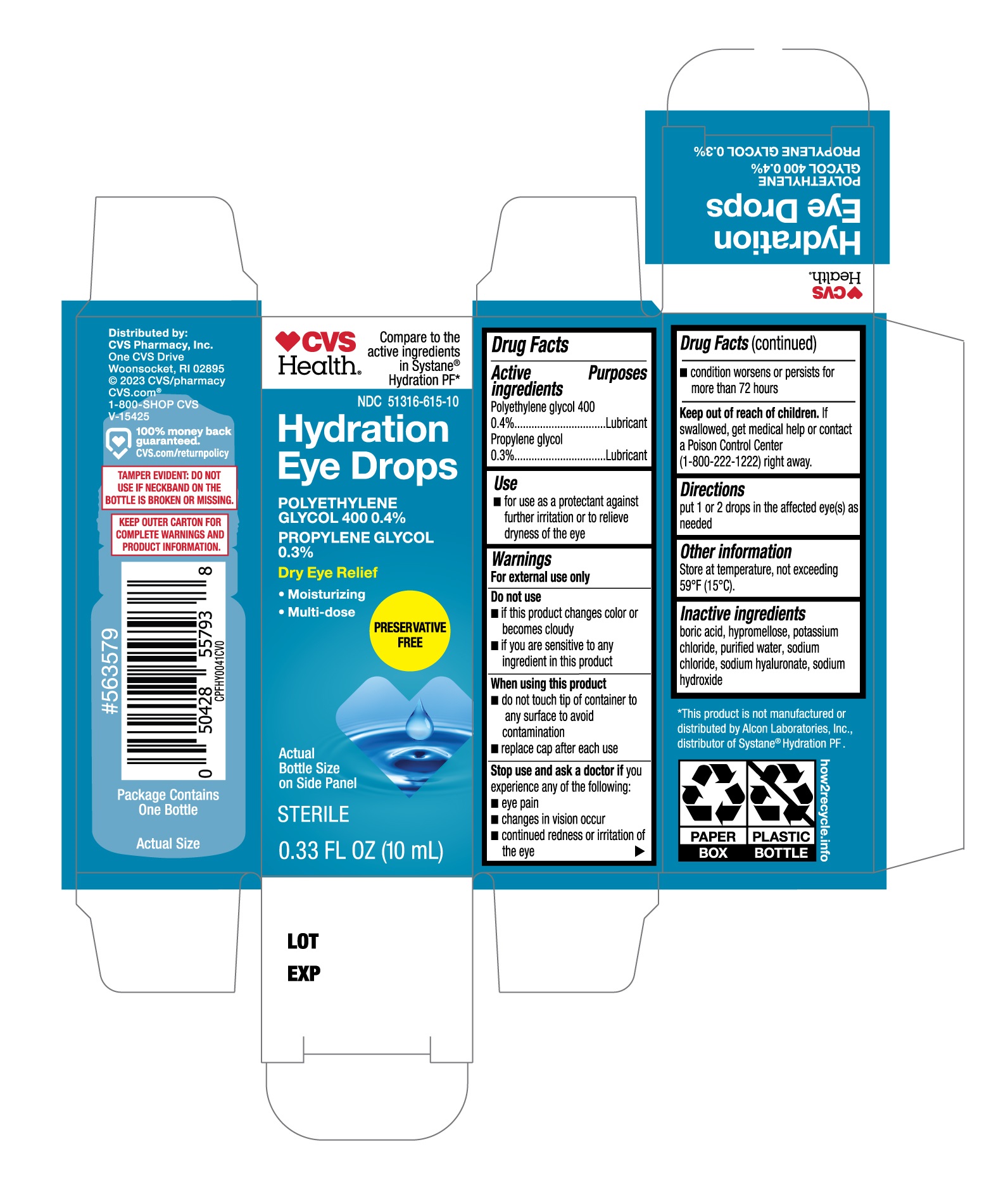
CVS Hydration Eye Drops Polyetylene glycol 400, Propylene .3 g/100mL; 400 .4 g/100mL Solution/ Drops — NDC 51316-615-10 (Billing 51316-0615-10)
This is a package of CVS Hydration Eye Drops Polyetylene glycol 400, Propylene .3 g/100mL; 400 .4 g/100mL Solution/ Drops from CVS, marketed since Jan 2023 and currently FDA-listed. It is this product's only package size.
Identity & classification
Regulatory identifiers FDA, NLM and CMS codes for this package
- RxCUI (RxNorm): 477589
Where does this data come from?
- FDA openFDA NDC Directory · synced Oct 1, 2026
- FDA label on DailyMed · label index refreshed Oct 1, 2026
- RxNorm (NLM RxNav) · catalog refreshed Oct 1, 2026
- Medi-Span GPI (licensed)
- First Databank (licensed) · refreshed Oct 1, 2026
Clinical
CVS Hydration Eye Drops is an over-the-counter liquid product applied directly to the eyes. It contains polyethylene glycol 400 and propylene glycol, which are humectant ingredients commonly used in eye drops to lubricate and moisturize the eye surface. These ingredients function as artificial tears, typically used to help temporarily relieve dry eye discomfort and add moisture to the eyes.
Patient education
Supplement & herbal interactions
Where does this data come from?
- MedlinePlus (NLM) · refreshed Oct 1, 2026
- FDA label on DailyMed · label index refreshed Oct 1, 2026
Ask a licensed pharmacist directly — free, answered by our team.
Pricing
A drug doesn't have one price. Each row is a different public payment system, and none is what you'd pay at the counter — that depends on your insurance. The ⓘ on each row explains what it measures.
| Price system | Per mL | Per package |
|---|---|---|
| Retail pharmacies payNADAC · weekly | Not in the retail survey — common for institutional, discontinued, or low-volume packs. | |
| Medicaid paysCMS SDUD · 12 mo | No recent Medicaid claims on file for this NDC — rare and low-volume NDCs are suppressed in the public data. | |
| Medicare drug plans payPart D · quarterly | No Part D plan price is available for this NDC in our data. | |
Where does this data come from?
- CMS NADAC weekly file
- CMS ASP pricing files · refreshed Sep 20, 2026
- CMS Medicaid State Drug Utilization Data · refreshed Oct 2, 2026
- CMS Part D plan pricing files · refreshed Sep 24, 2026
- VA National Acquisition Center price file
Packaging — all sizes for this product
| Package NDC | Description | Marketing start | Marketing end | Status |
|---|---|---|---|---|
| 51316-0615-10 You're viewing this Main listing | 1 BOTTLE, DROPPER in 1 BOX / 10 mL in 1 BOTTLE, DROPPER | 2023-01-19 | — | Active |
Therapeutic equivalents
Where does this data come from?
- FDA openFDA NDC Directory · synced Oct 1, 2026
- FDA Orange Book · refreshed Sep 3, 2026
- CMS NADAC weekly file
Availability & generic status
We did not find an FDA-approved generic match for this exact strength, form and route.
Where does this data come from?
- FDA Orange Book · refreshed Sep 3, 2026
Inactive Ingredients / Excipients
Inactive ingredients, also called excipients, are components of the drug product other than the active ingredient. They may include fillers, dyes, coatings, preservatives, flavors, or other formulation ingredients.
💡 Tap an ingredient (hover on desktop) to see what it is and why it’s used.
-
UNII R57ZHV85D4
Boric acid is a weak acid derived from boron. In medicines, it typically serves as a buffer to help maintain the product's pH level and may act as a preservative in certain formulations.
-
UNII YSE9PPT4TH
Hyaluronate sodium is a natural carbohydrate that holds moisture. It's used in medicines as a lubricant, thickener, and moisture-retaining agent to improve texture and delivery of the active ingredient.
-
UNII 3NXW29V3WO
Hypromellose is a plant-based thickener made from cellulose. It's used in medicines as a binder to hold ingredients together, a coating for tablets, and a thickener for liquids.
-
UNII 660YQ98I10
Potassium chloride is a mineral salt used in medicines as a buffer and to help maintain the proper pH balance and stability of the formulation during storage and use.
-
UNII 451W47IQ8X
Sodium chloride is common table salt. It's used in medicines as a buffer to maintain proper pH, as a filler to add bulk, or to adjust the osmotic balance in liquid formulations.
-
UNII 55X04QC32I
A strong alkaline chemical used to adjust and maintain the pH balance of liquid medicines. It helps keep the medicine stable and ensures it stays effective during storage.
-
UNII 059QF0KO0R
Water is a liquid solvent that dissolves and mixes ingredients together in liquid medicines, syrups, and injections. It helps distribute the active drug evenly throughout the product.
7 inactive ingredients listed in the exact product block matched to this NDC.
Label-section wording can be broader than the structured product block and may mention additional formulation ingredients.
Where does this data come from?
ingredient classCode="IACT" elements from the exact product block matched by this NDC. Label-section narrative from DailyMed / the openFDA label index is shown separately when available.- FDA label on DailyMed · label index refreshed Oct 1, 2026
- FDA openFDA NDC Directory · synced Oct 1, 2026
Inactive ingredient FAQ
Are inactive ingredients the same for every manufacturer?
Why might an inactive ingredient be missing?
Can inactive ingredients matter?
Manufacturer & labeler
Where does this data come from?
- FDA openFDA NDC Directory · synced Oct 1, 2026
- Drugs@FDA
FDA label — Drug Facts FDA SPL
🎯 Indications and Usage ▾
Use for use as a protectant against further irritation or to relieve dryness of the eye
⏱️ Dosage and Administration ▾
Directions put 1 or 2 drops in the affected eye(s) as needed
⚠️ Warnings ▾
Warnings For external use only Do not use if this product changes color or becomes cloudy if you are sensitive to any ingredient in this product When using this product do not touch the tip of container to any surface to avoid contamination replace cap after each use Stop use and ask a doctor if you experience any of the following: eye pain changes in vision occur continued redness or irritation of the eye condition worsens or persists for more than 72 hours Keep out of reach of childeren. If swallowed, get medical help or contact a Poison Control Center (1-800-222-1222) right away.
🧪 Active Ingredient ▾
Active ingredients Polyethylene glycol 400 0.4% Propylene glycol 0.3%
🧪 Inactive Ingredients ▾
Inactive ingredients boric acid, hypromellose, potassium chloride, purified water, sodium chloride, sodium hyaluronate, sodium hydroxide
🎯 Purpose ▾
Purposes Lubricant Lubricant
📄 Do Not Use ▾
Do not use if this product changes color or becomes cloudy if you are sensitive to any ingredient in this product
📄 When Using This Product ▾
When using this product do not touch the tip of container to any surface to avoid contamination replace cap after each use
📄 Stop Use and Ask a Doctor If ▾
Stop use and ask a doctor if you experience any of the following: eye pain changes in vision occur continued redness or irritation of the eye condition worsens or persists for more than 72 hours
📄 Keep Out of Reach of Children ▾
Keep out of reach of childeren. If swallowed, get medical help or contact a Poison Control Center (1-800-222-1222) right away.
📄 Other Information ▾
Other information Store at temperature, not exceeding 59°F (15°C)
📄 Package Label / Principal Display Panel ▾
CVS Hydration Eye Drops CVS Hydration Eye Drops
About this NDC listing & data coverage
What data is (and isn’t) available for this NDC — tap to expand
| NDC identity (package / product / labeler codes) | ✓ Available |
| Labeler | ✓ Available |
| Product & package description | ✓ Available |
| Marketing category & status | ✓ Available |
| Active ingredient / dosage form / route | ✓ Available |
| FDA label (SPL via DailyMed) | ✓ Available |
| Package photos | ✓ Available |
| Inactive ingredients (structured) | ✓ Available |
| NADAC pharmacy acquisition price (CMS) | — Not published for this NDC CMS publishes NADAC only for NDCs reported in its retail-pharmacy survey. |
| Orange Book / therapeutic-equivalence data | — Not published for this NDC Applies only to products approved under an NDA/ANDA; many listings are out of scope. |
| HCPCS J-code billing crosswalk | — Not published for this NDC Most self-administered / retail products have no J-code — that is normal. |
| Medicaid utilization (CMS SDUD) | — Not published for this NDC CMS reports utilization only for NDCs with Medicaid claims above its privacy threshold. |