
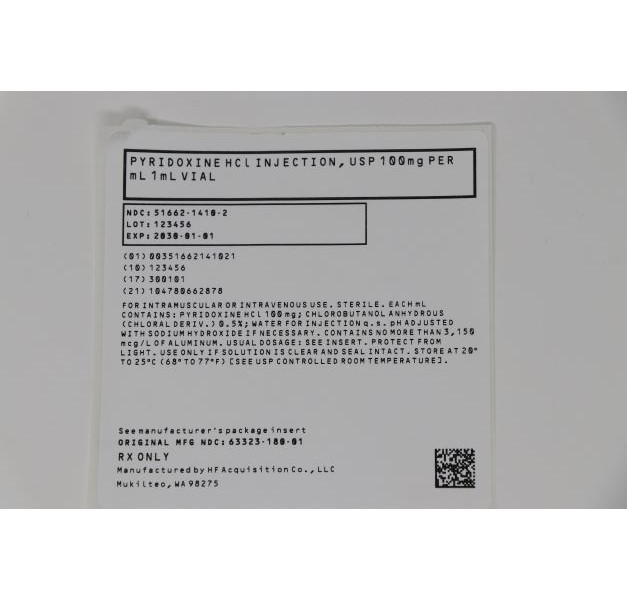
PYRIDOXINE HCI 100 mg/mL Injection, Solution, 1 mL — NDC 51662-1410-1 (Billing 51662-1410-01)
This is a package of 1 mL of PYRIDOXINE HCI 100 mg/mL Injection, Solution from HF Acquisition Co LLC, DBA HealthFirst, marketed since Oct 2019 and currently FDA-listed. It is the main listing for this product, which comes in 2 package sizes.
NDC database record
One package, one record: these facts belong to NDC 51662-1410-1 alone.
- Record
- FDA NDC Directory package listing · Human prescription drug
- Code segments
- 51662 labeler · 1410 product · 1 package
- Package marketed since
- Oct 8, 2019
- Sample package
- No — commercial package
- Listing certified through
- Dec 31, 2026
- Barcode (UPC)
- 0363323180010
- FDA record last changed
- Jul 24, 2026
Identity & classification
Regulatory identifiers FDA, NLM and CMS codes for this package
- RxCUI (RxNorm): 312736
Where does this data come from?
- FDA openFDA NDC Directory · synced Oct 1, 2026
- FDA label on DailyMed · label index refreshed Oct 6, 2026
- RxNorm (NLM RxNav) · catalog refreshed Oct 1, 2026
- Medi-Span GPI (licensed)
- First Databank (licensed) · refreshed Oct 1, 2026
RxNorm drug class
This medicine belongs to the Vitamin B6 Analog class.
Where does this data come from?
- RxClass (NLM) · catalog refreshed Oct 1, 2026
Clinical
- It treats vitamin B6 deficiency, whether from poor diet, medicines like isoniazid or oral contraceptives, or certain inherited conditions. It's also used when you can't take it by...
- A healthcare professional gives it into a muscle or a vein. It's usually daily for a few weeks, and you may then switch to an oral multivitamin with pyridoxine. Your diet should im...
- Tingling or odd sensations, sleepiness, and low folic acid levels have been reported. Tell your care team about anything that bothers you.
- Yes, levodopa. Pyridoxine can work against it, so supplements shouldn't be given with levodopa alone. It can be used with carbidopa-levodopa combinations.
Patient education
Supplement & herbal interactions
Where does this data come from?
- MedlinePlus (NLM) · refreshed Oct 1, 2026
- FDA label on DailyMed · label index refreshed Oct 6, 2026
Ask a licensed pharmacist directly — free, answered by our team.
Pricing
A drug doesn't have one price. Each row is a different public payment system, and none is what you'd pay at the counter — that depends on your insurance. The ⓘ on each row explains what it measures.
| Price system | Per mL | Per package |
|---|---|---|
| Retail pharmacies payNADAC · weekly | Not in the retail survey — common for institutional, discontinued, or low-volume packs. | |
| Medicaid paysCMS SDUD · 12 mo | No recent Medicaid claims on file for this NDC — rare and low-volume NDCs are suppressed in the public data. | |
| Medicare drug plans payPart D · quarterly | No Part D plan price is available for this NDC in our data. | |
| Medicare Part B allowsASP · J3415 | $12.941 / J3415 unit | — |
Where does this data come from?
- CMS NADAC weekly file
- CMS ASP pricing files · refreshed Sep 20, 2026
- CMS Medicaid State Drug Utilization Data · refreshed Oct 6, 2026
- CMS Part D plan pricing files · refreshed Sep 24, 2026
- VA National Acquisition Center price file
Billing & reimbursement
Where does this data come from?
- CMS ASP NDC-HCPCS crosswalk · refreshed Sep 22, 2026
- DMEPDAC NDC-HCPCS crosswalk
- openFDA NSDE billing units · refreshed Sep 7, 2026
Packaging — all sizes for this product
| Package NDC | Description | Marketing start | Marketing end | Status |
|---|---|---|---|---|
| 51662-1410-01 You're viewing this Main listing | 1 mL in 1 VIAL | 2019-10-08 | — | Active |
| 51662-1410-03 51662-1410-3 | 25 POUCH in 1 CASE / 1 VIAL in 1 POUCH / 1 mL in 1 VIAL | 2022-12-11 | — | Active |
Pack size FAQ
What quantity is in this package?
How does this package differ from NDC 51662-1410-03?
What NDC number is used to bill for this package of PYRIDOXINE HCI 100 mg/mL Injection, Solution?
Therapeutic equivalents
| Product | Labeler | Pack | NADAC/unit | TE | Status | Price vs. this |
|---|---|---|---|---|---|---|
| Pyridoxine Hci 100 mg/mLthis 51662-1410-01 | HF | 1 ml | — | — | FDA listed | — |
| Pyridoxine Hydrochloride 100 mg/mL 63323-0180-01 | Fresenius | 25 vials | — | — | FDA listed | — |
Where does this data come from?
- FDA openFDA NDC Directory · synced Oct 1, 2026
- FDA Orange Book · refreshed Oct 3, 2026
- CMS NADAC weekly file
Availability & generic status
This product is an FDA-approved generic. Other versions of the same drug are listed under Therapeutic equivalents, least expensive first.
Where does this data come from?
- FDA Orange Book · refreshed Oct 3, 2026
Inactive Ingredients / Excipients
Inactive ingredients, also called excipients, are components of the drug product other than the active ingredient. They may include fillers, dyes, coatings, preservatives, flavors, or other formulation ingredients.
🧪 Avoiding an ingredient? See Pyridoxine inactive ingredients by manufacturer: every current product's list side by side, so you can ask your pharmacy for the version that does not list it.
💡 Tap an ingredient (hover on desktop) to see what it is and why it’s used.
-
5 mg / 1 mL
UNII HM4YQM8WRC
Chlorobutanol is a colorless crystalline chemical used as a preservative in medicines. It prevents bacterial and fungal growth to maintain product safety and shelf life.
-
UNII 55X04QC32I
A strong alkaline chemical used to adjust and maintain the pH balance of liquid medicines. It helps keep the medicine stable and ensures it stays effective during storage.
2 inactive ingredients listed in the exact product block matched to this NDC.
Where does this data come from?
ingredient classCode="IACT" elements from the exact product block matched by this NDC. Label-section narrative from DailyMed / the openFDA label index is shown separately when available.- FDA label on DailyMed · label index refreshed Oct 6, 2026
- FDA openFDA NDC Directory · synced Oct 1, 2026
Inactive ingredient FAQ
Are inactive ingredients the same for every manufacturer?
Why might an inactive ingredient be missing?
Can inactive ingredients matter?
Manufacturer & labeler
More NDCs from HF Acquisition Co LLC, DBA HealthFirst labeler code 51662
- DOXAPRAM HYDROCHLORIDE 20 mg/mL Injection NDC 51662-1404-1
- XYLOCAINE(R) -MPF (LIDOCAINE HCI AND EPINEPHRINE) 10 mg/mL; .005 mg/mL Injection, Solution NDC 51662-1405-1
- CHLORPROMAZINE HCI 25 mg/mL Injection NDC 51662-1406-1
- (CHLOROPROCAINE HCI 10 mg/mL Injection, Solution NDC 51662-1407-1
- CHLOROPROCAINE HCI 20 mg/mL Injection, Solution NDC 51662-1408-1
- HEPARIN SODIUM 10000 [USP'U]/mL Injection, Solution NDC 51662-1409-1
- HEPARIN SODIUM 10000 [USP'U]/100mL Injection, Solution NDC 51662-1411-1
- LIDOCAINE HCI AND EPINEPHRINE WITH .005 mg/mL; 20 mg/mL Injection, Solution NDC 51662-1412-1
- PROTAMINE SULFATE 10 mg/mL Injection, Solution NDC 51662-1414-1
- LIDOCAINE HCI 5 mg/mL Injection, Solution NDC 51662-1416-1
- NALBUPHINE HCI 20 mg/mL Injection, Solution NDC 51662-1418-1
- LIDOCAINE HCI 10 mg/mL; 10 ug/mL Injection, Solution NDC 51662-1419-1
Where does this data come from?
- FDA openFDA NDC Directory · synced Oct 1, 2026
- Drugs@FDA
Full prescribing information FDA SPL
🎯 Indications and Usage ▾
INDICATIONS & USAGE Pyridoxine Hydrochloride Injection is effective for the treatment of pyridoxine deficiency as seen in the following: Inadequate dietary intake. Drug-induced deficiency, as from isoniazid (INH) or oral contraceptives. Inborn errors of metabolism, e.g., vitamin B6 dependent convulsions or vitamin B6 responsive anemia.
The parenteral route is indicated when oral administration is not feasible as in anorexia, nausea and vomiting, and preoperative and postoperative conditions. It is also indicated when gastrointestinal absorption is impaired.
⏱️ Dosage and Administration ▾
DOSAGE & ADMINISTRATION Pyridoxine Hydrochloride Injection may be administered intramuscularly or intravenously. In cases of dietary deficiency, the dosage is 10 to 20 mg daily for 3 weeks. Follow-up treatment is recommended daily for several weeks with an oral therapeutic multivitamin preparation containing 2 to 5 mg pyridoxine.
Poor dietary habits should be corrected, and an adequate, well balanced diet should be prescribed. The vitamin B6 dependency syndrome may require a therapeutic dosage of as much as 600 mg a day and a daily intake of 30 mg for life. In deficiencies due to INH, the dosage is 100 mg daily for 3 weeks followed by a 30 mg maintenance dose daily.
In poisoning caused by ingestion of more than 10 g of INH, an equal amount of pyridoxine should be given — 4 g intravenously followed by 1 g intramuscularly every 30 minutes. Parenteral drug products should be inspected visually for particulate matter and discoloration prior to administration, whenever solution and container permit.
⛔ Contraindications ▾
CONTRAINDICATIONS A history of sensitivity to pyridoxine or to any of the ingredients in Pyridoxine Hydrochloride Injection, USP is a contraindication.
⚠️ Warnings ▾
WARNINGS WARNING: This product contains aluminum that may be toxic. Aluminum may reach toxic levels with prolonged parenteral administration if kidney function is impaired. Premature neonates are particularly at risk because their kidneys are immature, and they require large amounts of calcium and phosphate solutions, which contain aluminum.
Research indicates that patients with impaired kidney function, including premature neonates, who receive parenteral levels of aluminum at greater than 4 to 5 mcg/kg/day accumulate aluminum at levels associated with central nervous system and bone toxicity. Tissue loading may occur at even lower rates of administration.
🤒 Adverse Reactions ▾
ADVERSE REACTIONS Paresthesia, somnolence, and low serum folic acid levels have been reported.
🆘 Overdosage ▾
OVERDOSAGE Pyridoxine given to animals in amounts of 3 to 4 g/kg of body weight produces convulsions and death. In man, a dose of 25 mg/kg of body weight is well tolerated.
🧬 Clinical Pharmacology ▾
CLINICAL PHARMACOLOGY Natural substances that have vitamin B6 activity are pyridoxine in plants and pyridoxal or pyridoxamine in animals. All 3 are converted to pyridoxal phosphate by the enzyme pyridoxal kinase. The physiologically active forms of vitamin B6 are pyridoxal phosphate (codecarboxylase) and pyridoxamine phosphate.
Riboflavin is required for the conversion of pyridoxine phosphate to pyridoxal phosphate. Vitamin B6 acts as a coenzyme in the metabolism of protein, carbohydrate, and fat. In protein metabolism, it participates in the decarboxylation of amino acids, conversion of tryptophan to niacin or to serotonin (5-hydroxtryptamine), deamination, and transamination and transulfuration of amino acids.
In carbohydrate metabolism, it is responsible for the breakdown of glycogen to glucose-1-phosphate. The total adult body pool consists of 16 to 25 mg of pyridoxine. Its half-life appears to be 15 to 20 days.
Vitamin B6 is degraded to 4-pyridoxic acid in the liver. This metabolite is excreted in the urine. The need for pyridoxine increases with the amount of protein in the diet.
The tryptophan load test appears to uncover early vitamin B6 deficiency by detecting xanthinurea. The average adult minimum daily requirement is about 1.25 mg. The ‘‘Recommended Dietary Allowance’’ of the National Academy of Sciences is estimated to be as much as 2.2 mg for adults and 2.5 mg for pregnant and lactating women.
The requirements are more in persons having certain genetic defects or those being treated with isonicotinic acid hydrazide (INHJ) or oral contraceptives.
📦 How Supplied / Storage and Handling ▾
HOW SUPPLIED PYRIDOXINE HCI INJECTION, USP is supplied in the following dosage forms. NDC 51662-1410-1 PYRIDOXINE HCI INJECTION, USP 100mg per mL 1mL VIAL NDC 51662-1410-2 PYRIDOXINE HCI INJECTION, USP 100mg per mL 1mL VIAL, 1 VIAL PER POUCH NDC 51662-1410-3 PYRIDOXINE HCI INJECTION, USP 100mg per mL 1mL VIAL, 1 VIAL PER POUCH, 25 POUCHES PER CASE HF Acquisition Co LLC, DBA HealthFirst Mukilteo, WA 98275 PROTECT FROM LIGHT. Use only if solution is clear and seal intact.
Sterile. Store at 20° to 25°C (68° to 77°F) [see USP Controlled Room Temperature].
📋 Description ▾
DESCRIPTION Pyridoxine Hydrochloride Injection, USP is a sterile solution of pyridoxine hydrochloride in Water for Injection. Each mL contains 100 mg pyridoxine hydrochloride and 0.5% chlorobutanol anhydrous (chloral deriv.). pH adjusted with sodium hydroxide if necessary (2.0 to 3.8). Pyridoxine hydrochloride is a colorless or white crystal or a white crystalline powder.
One gram dissolves in 5 mL of water. It is stable in air and is slowly affected by sunlight. The chemical name is 2-methyl-3-hydroxy-4,5-bis (hydroxymethyl) pyridine hydrochloride.
The structural formula is: STRUCTURE
⚠️ Precautions ▾
PRECAUTIONS WARNING: This product contains aluminum that may be toxic. Aluminum may reach toxic levels with prolonged parenteral administration if kidney function is impaired. Premature neonates are particularly at risk because their kidneys are immature, and they require large amounts of calcium and phosphate solutions, which contain aluminum.
Research indicates that patients with impaired kidney function, including premature neonates, who receive parenteral levels of aluminum at greater than 4 to 5 mcg/kg/day accumulate aluminum at levels associated with central nervous system and bone toxicity. Tissue loading may occur at even lower rates of administration.
🔒 Drug Abuse and Dependence ▾
DRUG ABUSE AND DEPENDENCE Symptoms of dependence have been noted in adults given only 200 mg daily, followed by withdrawal.
📄 Package Label / Principal Display Panel ▾
PRINCIPAL DISPLAY PANEL, VIAL LABEL VIAL PT1 VIAL PT 2 VIAL PT 3
PRINCIPAL DISPLAY PANEL, SERIALIZED LABELING SERIALIZED LABELING
PRINCIPAL DISPLAY PANEL - NDC 51662-1410-2 POUCH LABELING NDC 51662-1410-2 POUCH LABELING POUCH LABELING VIAL LABEL
PRINCIPAL DISPLAY PANEL - NDC 51662-1410-3 CASE LABELING NDC 51662-1410-3 CASE LABELING NDC 51662-1410-3 SERIALIZED RFID LABELING Case Labeling RFID Label
About this NDC listing & data coverage
What data is (and isn’t) available for this NDC — tap to expand
| NDC identity (package / product / labeler codes) | ✓ Available |
| Labeler | ✓ Available |
| Product & package description | ✓ Available |
| Marketing category & status | ✓ Available |
| Active ingredient / dosage form / route | ✓ Available |
| FDA label (SPL via DailyMed) | ✓ Available |
| Package photos | ✓ Available |
| Inactive ingredients (structured) | ✓ Available |
| NADAC pharmacy acquisition price (CMS) | — Not published for this NDC CMS publishes NADAC only for NDCs reported in its retail-pharmacy survey. |
| Orange Book / therapeutic-equivalence data | — Not published for this NDC Applies only to products approved under an NDA/ANDA; many listings are out of scope. |
| HCPCS J-code billing crosswalk | ✓ Available |
| Medicaid utilization (CMS SDUD) | — Not published for this NDC CMS reports utilization only for NDCs with Medicaid claims above its privacy threshold. |