
HomeNDC LookupIngredientsDiflorasone Diacetate › 51672-1295-02
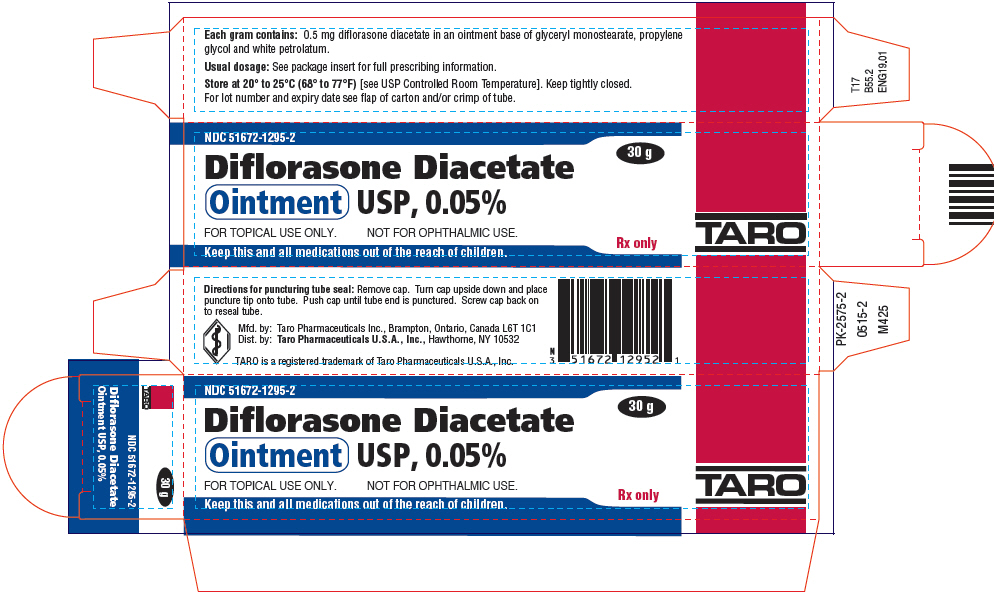
Diflorasone Diacetate .5 mg/g Ointment — NDC 51672-1295-02 package photo

Diflorasone Diacetate .5 mg/g Ointment

by Sun Pharmaceutical Industries, Inc. · 1 TUBE in 1 CARTON (51672-1295-2) / 30 g in 1 TUBE
NDC 51672-1295-02
🏷️ FDA NDC (as labeled) 51672-1295-2 billing pads the package segment with a zero
This package
Contains30 g in 1 tube Cost per g$3.25 NADAC Per package$97.50 / 30 g Pack sizes3 compare ↓
Also priced by: Medicaid pays $2.51/unit · Part D plans $7.86/unit — full pricing hub ↓
Rx only Generic On market Non-controlled
🗂️ Data synced Jul 24, 2026 · sources: openFDA · FDA label (DailyMed) · FDA Orange & Purple Book · First Databank · CMS NADAC, ASP, Medicare & Medicaid · RxNorm
📋 All sources & update times →
⚠️
Other active recalls for Diflorasone Diacetate (different manufacturers) — 1 · tap to view
These affect other manufacturers’ products for the same ingredient — not necessarily the exact NDC on this page.
Class III · Jun 24, 2024 — Failed Impurities/Degradation Specifications: The impurity results at 12 months stability testing,did not conform to the specification limit. (Rising Pharma Holding, Inc.) · FDA recall D-0599-2024
Each entry is an official FDA enforcement report — look up any recall number in the FDA recall database ↗

🆔 Identity & classification

FDA NDC (as labeled) 51672-1295-2
Product NDC 51672-1295
11-digit billing NDC 51672129502
NCPDP billing unit GM — per gram (weight)
RxCUI 966607
UNII 7W2J09SCWX
Application # ANDA075331
SPL Set ID b304dfca-e840-4c03-8217-73aaa5360277
Established class (EPC) Corticosteroid
Mechanism of action Corticosteroid Hormone Receptor Agonists
DEA schedule Non-controlled
Marketing category ANDA
Marketing status On market
FDA listing status Listed (active directory)
Marketing start 1999-05-14
Route TOPICAL
Dosage form OINTMENT
Substance DIFLORASONE DIACETATE
GPI-14 90550050104205
GPI class Diflorasone Diacetate
GCN Seq No 007630
GCN 31480
HICL code 003325
Ingredient (HICL) Diflorasone Diacetate
HIC1 code Q
Therapeutic class — broad (HIC1) Ear/Eye/Nose/Rectum/Topical/Vagina/Other
HIC2 code Q5
Therapeutic class — intermediate (HIC2) Agents Acting Principally On The Skin
HIC3 code Q5P
Therapeutic class — specific (HIC3) Topical Anti-Inflammatory Steroidal
AHFS code 84:06.08.00
AHFS class Corticosteroids (Skin, Mucous Membrane)
FDB label name DIFLORASONE 0.05% OINTMENT
FDB brand name Diflorasone Diacetate
Legend status F — Federal legend — prescription drug or device
TE code (Orange Book) AB · RLD · RS
Why two NDCs? The FDA registers this code as 51672-1295-2 — a 5-4-1 layout, and that's what's printed on the package and shown on DailyMed. For insurance claims, every NDC is standardized to a uniform 11-digit 5-4-2 format by adding a zero to the package segment → 51672-1295-02. Same drug, same package — only the format differs.
Where does this data come from?
Identifiers from the FDA openFDA NDC Directory and Structured Product Labeling; RxCUI from RxNorm (NLM); GPI from Medi-Span; GCN / HIC / AHFS / legend from First Databank.

🏷️ RxNorm drug class

This medicine belongs to the Corticosteroid class.

Pharmacologic class Corticosteroid
Drug family (ATC) Corticosteroids, potent (group III)
How it works Corticosteroid Hormone Receptor Agonists
Where does this data come from?
Therapeutic classes from RxNorm RxClass (U.S. National Library of Medicine) — Established Pharmacologic Class (FDA), ATC drug family (WHO) and mechanism of action, matched by this product’s RxCUI.

🏭 Manufacturer & labeler

LabelerSun Pharmaceutical Industries, Inc.
Application holderSUN PHARMA CANADA INC
FDA applicationANDA075331 (ANDA)
Labeler code51672
First marketedMay 1999
Product typeHuman Prescription Drug
Portfolio889 products on file
The labeler markets the product; the application holder owns the FDA approval. They’re often the same company but can differ (e.g. a repackager or an authorized generic). A mailing address / phone appears here when the manufacturer includes it in the product’s FDA label (not all do).
Where does this data come from?
Labeler, application holder and registered establishment from the FDA openFDA NDC Directory and Drugs@FDA; address/contact from the product’s FDA label.

🩺 Clinical

Label name DIFLORASONE 0.05% OINTMENT Ingredient Diflorasone Diacetate
📗 Our plain-language guide HelloPharmacist
  • Diflorasone is used to calm inflamed, itchy skin conditions that respond to corticosteroid (steroid) treatment — a category doctors sometimes call corticosteroid-responsive dermato...
  • What skin conditions does diflorasone treat?
  • Apply a thin film of diflorasone diacetate ointment to the affected skin area, usually one to three times a day depending on how serious your condition is. 'Thin film' means just e...
  • An occlusive dressing is an airtight wrap or covering placed over the treated skin after applying the medication. It helps drive more of the ointment into the skin and can be usefu...
📖 Read our full Diflorasone Topical guide →
Where does this data come from?
Plain-language summary from MedlinePlus (U.S. National Library of Medicine); supplement & herbal interactions and nutrient depletion data from the Natural Medicines database; our full guide is HelloPharmacist editorial content.

💊 What it looks like

Color white
One label can cover several strengths, so colors may be combined — always confirm a loose pill against the dispensed prescription label or a pharmacist.
Where does this data come from?
Physical description (imprint, shape, color, scoring, coating) from this product’s FDA Structured Product Labeling (SPL), mirrored from DailyMed / openFDA.

🧪 Inactive Ingredients / Excipients

Inactive ingredients, also called excipients, are components of the drug product other than the active ingredient. They may include fillers, dyes, coatings, preservatives, flavors, or other formulation ingredients.

💡 Tap an ingredient (hover on desktop) to see what it is and why it’s used.

  • UNII 230OU9XXE4
    A waxy substance made from glycerin and stearic acid that acts as an emulsifier to blend oily and watery ingredients together. It also helps thicken and stabilize the medicine's texture.
  • UNII 4T6H12BN9U
    Petrolatum is a purified mineral oil-based jelly derived from petroleum. In medicines, it acts as an emollient, lubricant, and moisture barrier to soften skin, reduce friction, and help prevent water loss from formulations.
  • UNII 6DC9Q167V3
    Propylene glycol is a clear liquid derived from petroleum or vegetable sources. It acts as a solvent, humectant, and preservative in medicines, helping dissolve active ingredients and maintain product stability.

3 inactive ingredients listed in the exact product block matched to this NDC.

Where does this data come from?
Data sourced from official FDA Structured Product Labeling (SPL) via DailyMedingredient classCode="IACT" elements from the exact product block matched by this NDC. Label-section narrative from DailyMed / the openFDA label index is shown separately when available.

Inactive ingredient FAQ

Are inactive ingredients the same for every manufacturer?
No. Inactive ingredients can differ by manufacturer, dosage form, strength, and package / product version.
Why might an inactive ingredient be missing?
Some SPLs do not provide a complete structured inactive-ingredient list, and older or unusual labels may only include the information in narrative text.
Can inactive ingredients matter?
Yes. They can matter for allergies, intolerances, dyes, gluten / lactose concerns, preservatives, and formulation differences — but confirm with a pharmacist or the manufacturer when it’s clinically important.

💲 Pricing

A drug doesn't have one price. Each row is a different public payment system, and none is what you'd pay at the counter — that depends on your insurance. The ⓘ on each row explains what it measures.

Price systemPer gPer package
Retail pharmacies payNADAC · weekly $3.250 $97.50 / 30 g
Medicaid paysCMS SDUD · 12 mo $2.51 $75.26 / 30 g
Medicare drug plans payPart D · Q2 2026 $7.86 $235.67 / 30 g
NADAC price history (per g) — tap or hover for the price & month
Dec 2025 Jan 2026 Mar 2026 May 2026 $4.344 $2.900
▲ Up 12% over the last 6 months.
Where does this data come from?
NADAC (National Average Drug Acquisition Cost) is the CMS weekly pharmacy-acquisition-cost survey — what pharmacies pay. ASP (Average Sales Price) is the CMS Medicare Part B drug-payment file, published quarterly. Medicaid pays is computed by us from CMS State Drug Utilization Data (total reimbursed ÷ units, trailing 12 months) — gross of rebates and inclusive of dispensing fees, so it reflects what Medicaid paid, not an acquisition cost. Medicare drug plans pay is the median negotiated point-of-sale unit cost across plans listing this NDC in the CMS quarterly Prescription Drug Plan pricing files, before rebates. The VA pays is the federal contract price (FSS, and the statutory Big 4 ceiling where listed) from the VA National Acquisition Center pharmaceutical price file. All are free public government data; each measures a different payer, so the figures are not directly comparable.

🔁 Therapeutic equivalents

ProductLabelerPackNADAC/unitTEStatusPrice vs. this
Diflorasone Diacetate .5 mg/gthis 51672-1295-02 Sun 1 tube $3.250 AB Availability likely
Diflorasone Diacetate .5 mg/g 64980-0124-03 Rising 1 tube $3.250 AB Availability likely
Diflorasone Diacetate .5 mg/g 51672-1296-01 Sun 1 tube BX FDA listed
About this product: this is a generic version of the medicine. FDA equivalence ratings are shown when available, and other versions are listed above, least expensive first.
Where does this data come from?
Equivalents are other NDCs of the same ingredient, form and route from the openFDA NDC Directory, ranked least-expensive-first by NADAC. Therapeutic-equivalence (AB) ratings come from the FDA Orange Book; biologics use the FDA Purple Book for biosimilar & interchangeable status.

Availability & generic status

🏛️
1999
On the market since
May 1999
📍
2026
Currently FDA-listed
27 years listed
🔓
·
Generic on the market
this product is a generic
This is a generic drug

This product is an FDA-approved generic. Other versions of the same drug are listed under Therapeutic equivalents, least expensive first.

Where does this data come from?
Patents and exclusivity from the FDA Orange Book (small-molecule drugs), refreshed from public FDA data. Generic launch timing is an estimate, not a guarantee.

🗺️ Medicaid utilization & spend

📍 This exact package only: Medicaid data is reported per full 11-digit NDC — labeler, product and pack size — so every number here is for 51672-1295-02, not the drug overall. Other pack sizes report separately.
💊 Pharmacy benefit only: These are Medicaid outpatient pharmacy claims, billed by NDC. They exclude the medical benefit — clinic- or hospital-administered drugs billed under HCPCS J-codes — so drugs used mostly that way (e.g. Avastin, Lucentis, Keytruda) can look low or missing here. That’s expected, not an error.
📅 Q1 2025 – Q4 2025 · 4 quarters of data
ⓘ The newest quarter is usually incomplete when first published; states restate recent quarters in later CMS releases, so the latest figures typically revise upward. State coverage-policy changes can also shift quarter-to-quarter totals.
Prescriptions last 4 qtrs
18
Units reimbursed last 4 qtrs
810
Gross reimbursed last 4 qtrs
$2K
Avg / prescription
$112.89
Avg / unit
$2.5086
Latest quarter Q4 2025
18Rx
Medicaid pays / g
$2.5086
gross reimbursed
vs
NADAC / g
$3.2501
acquisition cost
=
Spread
−$0.7415
-23% vs cost
What Medicaid paid per g (before rebates; includes the pharmacy’s dispensing fee) compared with NADAC — the average price pharmacies pay to buy the drug. A positive spread means Medicaid reimbursed more than the purchase price, before manufacturer rebates.
Fee-for-service vs managed care
100% MCO
Fee-for-service · 0 Rx Managed care · 18 Rx
State Medicaid map
Alaska: no data reported AK Maine: no data reported ME Washington: no data reported WA Idaho: no data reported ID Montana: no data reported MT North Dakota: no data reported ND Minnesota: no data reported MN Wisconsin: no data reported WI Michigan: no data reported MI New York: no data reported NY Vermont: no data reported VT New Hampshire: no data reported NH Oregon: no data reported OR Nevada: no data reported NV Wyoming: no data reported WY South Dakota: no data reported SD Iowa: no data reported IA Illinois: 810 units · 6.5 per 100k residents IL Indiana: no data reported IN Ohio: no data reported OH Pennsylvania: no data reported PA New Jersey: no data reported NJ Massachusetts: no data reported MA California: no data reported CA Utah: no data reported UT Colorado: no data reported CO Nebraska: no data reported NE Missouri: no data reported MO Kentucky: no data reported KY West Virginia: no data reported WV Virginia: no data reported VA Maryland: no data reported MD Connecticut: no data reported CT Rhode Island: no data reported RI Arizona: no data reported AZ New Mexico: no data reported NM Kansas: no data reported KS Arkansas: no data reported AR Tennessee: no data reported TN North Carolina: no data reported NC South Carolina: no data reported SC Delaware: no data reported DE Oklahoma: no data reported OK Louisiana: no data reported LA Mississippi: no data reported MS Alabama: no data reported AL Georgia: no data reported GA D.C.: no data reported DC Hawaii: no data reported HI Texas: no data reported TX Florida: no data reported FL
Units reimbursed · per 100k residents
6.56.5
gray = no data reported
Colors are per 100,000 residents, so big states don’t automatically dominate. Tap or hover a state for its actual totals.
Tap or hover a state
…for its Medicaid breakdown
🏆 Top states by units · per 100k residents
1 Illinois 6.5 /100k
National units — by quarter
💵 About the dollar figures: “reimbursed” is what Medicaid paid pharmacies before confidential manufacturer rebates, so the program’s real net cost is lower than these numbers. Fee-for-service and managed-care claims are combined unless split above. Source: CMS State Drug Utilization Data; per-100k rates use 2023 Census population estimates.

💊 Medicaid utilization by pack size

Medicaid (SDUD) totals over the four most recent reported quarters for every package size of this drug — handy when a specific package (e.g. a starter/titration pack) carries little or no Medicaid volume on its own.
1 tube51672-1295-03 315 Rx · $39,104
1 tube51672-1295-01 No Medicaid data
Drug total (last 4 qtrs): 333 Rx · 26,970 units · $41,136 gross reimbursed
Tap a pack size to open its page. Source: CMS State Drug Utilization Data, last 4 quarters.

📊 Medicare Part D spend CMS · PART D · 2026 (Q1)

Medicare Part D (outpatient prescription) spending for Diflorasone Diacetate — the program that covers self-administered drugs. 2 manufacturers.
⚠️ Drug-level data: CMS publishes Part D spending by drug, not by NDC — these figures combine every manufacturer, strength and package size sold under the name Diflorasone Diacetate. That’s a different level of aggregation than the Medicaid card above, which is specific to this exact 11-digit NDC (pack size included), so the two aren’t directly comparable.
Period
Total Part D spend
$3.45M
Claims incl. refills
6.1K
Beneficiaries
3.4K
Spend / beneficiary
$1,016.74
Spend / claim
$567.57
Trend by period
💵 About the dollar figures: spending is what Part D plans paid before confidential manufacturer rebates, so the program’s real net cost is lower. A blank patient count means fewer than 11 people — CMS hides counts that small to protect privacy. Source: CMS Medicare Quarterly Part D Spending by Drug (data.cms.gov), updated quarterly.

📦 Packaging — all sizes for this product

Package NDCDescription Per unit Per pack Marketing startStatus
51672-1295-01 1 TUBE in 1 CARTON (51672-1295-1) / 15 g in 1 TUBE 1999-05-14 Active
51672-1295-02 You're viewing this 1 TUBE in 1 CARTON (51672-1295-2) / 30 g in 1 TUBE $3.25 / g $97.50 1999-05-14 Active
51672-1295-03 1 TUBE in 1 CARTON (51672-1295-3) / 60 g in 1 TUBE $1.01 / g $60.30 1999-05-14 Active

Per g, this pack runs about 223% above the cheapest pack (NDC 51672-1295-03, $1.01 vs $3.25 NADAC).

This pack accounts for about 5.4% of this product's recent Medicaid fills; most go to a different pack size. See all packs ↓

Pack size FAQ

What quantity is in NDC 51672-1295-02?
NDC 51672-1295-02 is listed by the FDA — 1 tube in 1 carton / 30 g in 1 tube.
What NDC number is used to bill for this package of Diflorasone Diacetate .5 mg/g Ointment?
Bill NDC 51672-1295-02 — the 11-digit billing format is 51672129502. Pharmacy and medical claims use the 11-digit form; the FDA label may print a shorter form of the same code.

Prices are the latest CMS NADAC pharmacy acquisition cost per NDC; per-pack figures are per-unit × pack quantity, shown only when the pack is denominated in the same measure NADAC prices.

📄 Full prescribing information FDA SPL

The complete FDA label for this product — the official prescribing information, verbatim, section by section. Jump with a chip, search within the label, or expand everything.
🎯 Indications and Usage 18 words

INDICATIONS AND USAGE Topical corticosteroids are indicated for relief of the inflammatory and pruritic manifestations of corticosteroid-responsive dermatoses.

⏱️ Dosage and Administration 63 words

DOSAGE AND ADMINISTRATION Diflorasone diacetate ointment should be applied to the affected area as a thin film from one to three times daily depending on the severity or resistant nature of the condition. Occlusive dressings may be used for the management of psoriasis or recalcitrant conditions. If an infection develops, the use of occlusive dressings should be discontinued and appropriate antimicrobial therapy initiated.

Contraindications 21 words

CONTRAINDICATIONS Topical steroids are contraindicated in those patients with a history of hypersensitivity to any of the components of the preparation.

🤒 Adverse Reactions 58 words

ADVERSE REACTIONS The following local adverse reactions have been reported with topical corticosteroids, but may occur more frequently with the use of occlusive dressings. These reactions are listed in approximate decreasing order of occurrence: Burning Itching Irritation Dryness Folliculitis Hypertrichosis Acneiform eruptions Hypopigmentation Perioral dermatitis Allergic contact dermatitis Maceration of the skin Secondary infection Skin atrophy Striae Miliaria

🤰 Pregnancy 92 words

Pregnancy Category C Corticosteroids are generally teratogenic in laboratory animals when administered systemically at relatively low dosage levels. The more potent corticosteroids have been shown to be teratogenic after dermal application in laboratory animals. There are no adequate and well-controlled studies in pregnant women on teratogenic effects from topically applied corticosteroids.

Therefore, topical corticosteroids should be used during pregnancy only if the potential benefit justifies the potential risk to the fetus. Drugs of this class should not be used extensively on pregnant patients, in large amounts, or for prolonged periods of time.

🧒 Pediatric Use 138 words

Pediatric Use Safety and effectiveness of diflorasone diacetate ointment in pediatric patients have not been established. Because of a higher ratio of skin surface area to body mass, pediatric patients are at a greater risk than adults of HPA axis suppression when they are treated with topical corticosteroids. They are, therefore, also at greater risk of glucocorticosteroid insufficiency after withdrawal of treatment and of Cushing's syndrome while on treatment.

Adverse effects including striae have been reported with inappropriate use of topical corticosteroids in pediatric patients. HPA axis suppression, Cushing's syndrome, and intracranial hypertension have been reported in pediatric patients receiving topical corticosteroids. Manifestations of adrenal suppression in pediatric patients include linear growth retardation, delayed weight gain, low plasma cortisol levels, and absence of response to ACTH stimulation.

Manifestations of intracranial hypertension include bulging fontanelles, headaches, and bilateral papilledema.

🆘 Overdosage 17 words

OVERDOSAGE Topically applied corticosteroids can be absorbed in sufficient amounts to produce systemic effects. (See PRECAUTIONS .)

🧬 Clinical Pharmacology 192 words

CLINICAL PHARMACOLOGY Topical corticosteroids share anti-inflammatory, antipruritic and vasoconstrictive actions. The mechanism of anti-inflammatory activity of the topical corticosteroids is unclear. Various laboratory methods, including vasoconstrictor assays, are used to compare and predict potencies and/or clinical efficacies of the topical corticosteroids.

There is some evidence to suggest that a recognizable correlation exists between vasoconstrictor potency and therapeutic efficacy in man. Pharmacokinetics The extent of percutaneous absorption of topical corticosteroids is determined by many factors including the vehicle, the integrity of the epidermal barrier, and the use of occlusive dressings. Topical corticosteroids can be absorbed from normal intact skin.

Inflammation and/or other disease processes in the skin increase percutaneous absorption. Occlusive dressings substantially increase the percutaneous absorption of topical corticosteroids. Thus, occlusive dressings may be a valuable therapeutic adjunct for treatment of resistant dermatoses.

(See DOSAGE AND ADMINISTRATION .) Once absorbed through the skin, topical corticosteroids are handled through pharmacokinetic pathways similar to systemically administered corticosteroids. Corticosteroids are bound to plasma proteins in varying degrees. They are metabolized primarily in the liver and are then excreted by the kidneys.

Some of the topical corticosteroids and their metabolites are also excreted into the bile.

🧬 Mechanism of Action 50 words

The mechanism of anti-inflammatory activity of the topical corticosteroids is unclear. Various laboratory methods, including vasoconstrictor assays, are used to compare and predict potencies and/or clinical efficacies of the topical corticosteroids. There is some evidence to suggest that a recognizable correlation exists between vasoconstrictor potency and therapeutic efficacy in man.

📦 How Supplied / Storage and Handling 37 words

HOW SUPPLIED Diflorasone Diacetate Ointment USP, 0.05% is available in 15 gram (NDC 51672-1295-1), 30 gram (NDC 51672-1295-2) and 60 gram (NDC 51672-1295-3) tubes. Store at 20° to 25°C (68° to 77°F) [see USP Controlled Room Temperature].

📦 Storage and Handling 13 words

Store at 20° to 25°C (68° to 77°F) [see USP Controlled Room Temperature].

📋 Description 66 words

DESCRIPTION Each gram of diflorasone diacetate ointment contains 0.5 mg diflorasone diacetate in an ointment base. Chemically, diflorasone diacetate is 6α,9-difluoro-11β,17,21-trihydroxy-16β-methylpregna-1,4-diene-3,20-dione 17,21-diacetate. The structural formula is represented below: molecular formula: C 26 H 32 F 2 O 7 molecular weight: 494.54 Each gram of diflorasone diacetate ointment contains 0.5 mg diflorasone diacetate in an ointment base of glyceryl monostearate, propylene glycol and white petrolatum.

Chemical Structure

💬 Information for Patients 124 words

Information for the Patient Patients using topical corticosteroids should receive the following information and instructions: This medication is to be used as directed by the physician. It is for external use only. Avoid contact with the eyes.

Patients should be advised not to use this medication for any disorder other than for which it was prescribed. The treated skin area should not be bandaged or otherwise covered or wrapped as to be occlusive unless directed by the physician. Patients should report any signs of local adverse reactions especially under occlusive dressing.

Parents of pediatric patients should be advised not to use tight-fitting diapers or plastic pants on an infant or child being treated in the diaper area, as these garments may constitute occlusive dressings.

Source: FDA Structured Product Labeling, mirrored from DailyMed / openFDA. Prefer the government’s original formatting? View this label on DailyMed ↗
For educational and professional reference only — not medical advice. Pricing reflects published NADAC and CMS ASP (free public data) and may differ from your acquisition cost; always verify before billing or dispensing.