Compiled from public FDA, CMS, DailyMed, NADAC, and related drug data sources. Editorial policy
⚠️
Other active recalls for Clotrimazole (different manufacturers) — 2 · tap to view
These affect other manufacturers’ products for the same ingredient — not necessarily the exact NDC on this page.
Class II · Oct 31, 2025 — cGMP deviations (Blossom Pharmaceuticals)· FDA recall D-0210-2026
Class II · Oct 31, 2025 — cGMP deviations (Blossom Pharmaceuticals)· FDA recall D-0211-2026
Each entry is an official FDA enforcement report — look up any recall number in the FDA recall database ↗
🆔 Identity & classification
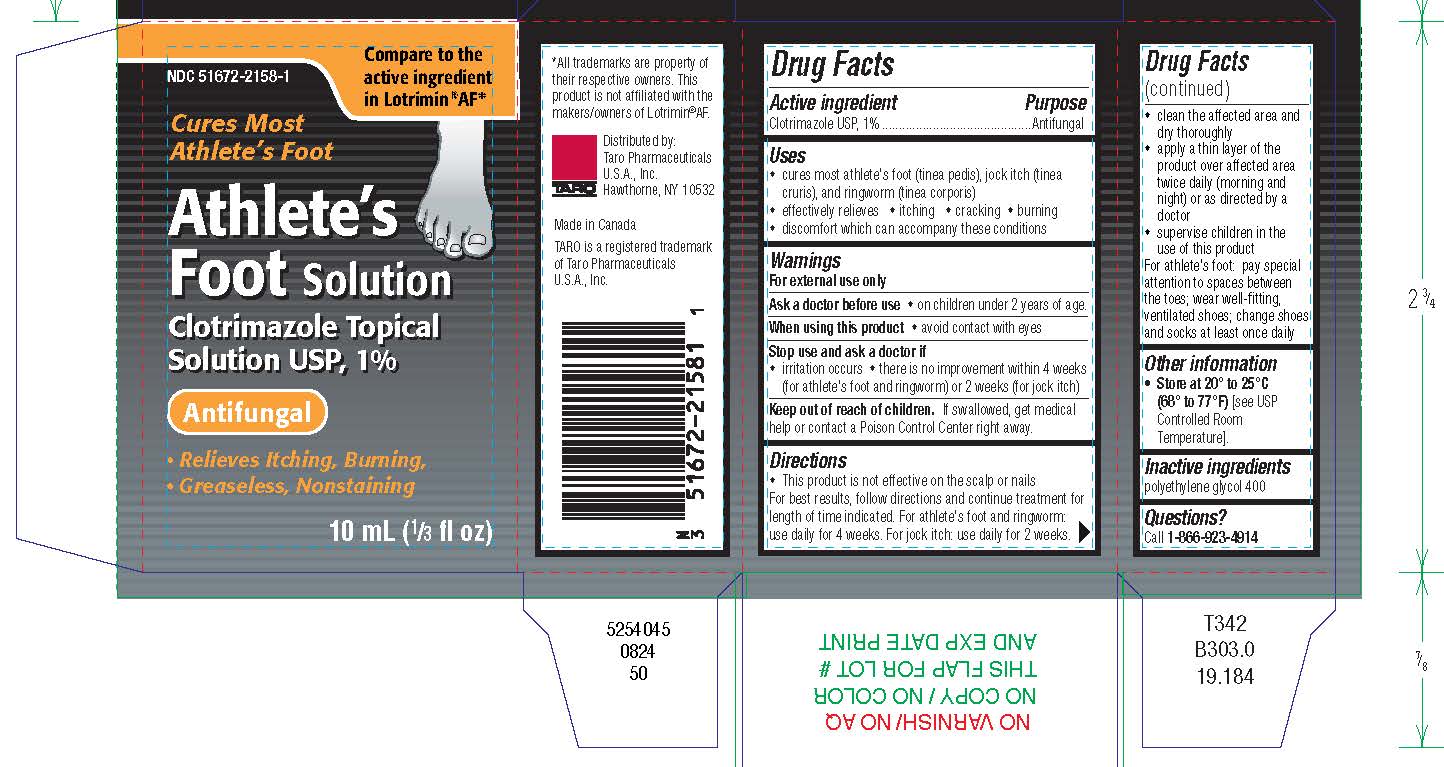
FDA NDC (as labeled)51672-2158-1
Product NDC51672-2158
11-digit billing NDC51672215801
NCPDP billing unitML — per mL (volume)
UNIIG07GZ97H65
UPC0351672215811
Application #M005
SPL Set ID13a14d3c-bfce-42b5-8463-4ec69e94774e
Established class (EPC)Azole Antifungal
Chemical classAzoles
DEA scheduleNon-controlled
Marketing categoryOTC MONOGRAPH DRUG
Marketing statusOn market
FDA listing statusListed (active directory)
Marketing start2024-09-23
RouteTOPICAL
Dosage formSOLUTION
SubstanceCLOTRIMAZOLE
GPI-1490154020002005
GCN Seq No007362
GCN30380
HICL code004137
Ingredient (HICL)Clotrimazole
HIC1 codeQ
Therapeutic class — broad (HIC1)Ear/Eye/Nose/Rectum/Topical/Vagina/Other
HIC2 codeQ5
Therapeutic class — intermediate (HIC2)Agents Acting Principally On The Skin
HIC3 codeQ5F
Therapeutic class — specific (HIC3)Topical Antifungals
AHFS code84:04.08.08
AHFS classAzoles (Skin And Mucous Membrane)
FDB label nameATHLETE'S FOOT 1% SOLUTION
FDB brand nameAthlete's Foot
Legend statusO — Over-the-counter (OTC) drug or device
Why two NDCs?
The FDA registers this code as 51672-2158-1 — a 5-4-1 layout, and that's what's printed on the package and shown on DailyMed. For insurance claims, every NDC is standardized to a uniform 11-digit 5-4-2 format by adding a zero to the package segment → 51672-2158-01. Same drug, same package — only the format differs.
Where does this data come from?
Identifiers from the FDA openFDA NDC Directory and Structured Product Labeling; RxCUI from RxNorm (NLM); GPI from Medi-Span; GCN / HIC / AHFS / legend from First Databank.
The labeler markets the product; the application holder owns the FDA approval. They’re often the same company but can differ (e.g. a repackager or an authorized generic). A mailing address / phone appears here when the manufacturer includes it in the product’s FDA label (not all do).
Where does this data come from?
Labeler, application holder and registered establishment from the FDA openFDA NDC Directory and Drugs@FDA; address/contact from the product’s FDA label.
🩺 Clinical
Label name ATHLETE'S FOOT 1% SOLUTIONIngredient Clotrimazole
📖 What it is MedlinePlus · NLM
Topical clotrimazole is used to treat tinea corporis (ringworm; fungal skin infection that causes a red scaly rash on different parts of the body), tinea cruris (jock itch; fungal infection of the skin in the groin or buttocks), and tinea pedis (athlete's foot; fungal infection of the skin on the feet and between the toes). Clotrimazole is in a class of antifungal medications called imidazoles. It works by stopping the growth of fungi that cause infection.
It depends on which product you have. The topical creams, solutions, and sprays treat common fungal skin infections — athlete's foot, jock itch, and ringworm. The CLOTIC ear drops...
What kinds of infections does clotrimazole actually treat?
You may start to notice some relief within a few days, but it's important to finish the full course. For athlete's foot and ringworm, that means using it every day for 4 weeks. For...
How long do I need to use it before it starts working?
Plain-language summary from MedlinePlus (U.S. National Library of Medicine); supplement & herbal interactions and nutrient depletion data from the Natural Medicines database; our full guide is HelloPharmacist editorial content.
💬 Questions about Clotrimazole?
Ask a licensed pharmacist directly — free, answered by our team.
Inactive ingredients, also called excipients, are components of the drug product
other than the active ingredient. They may include fillers, dyes, coatings, preservatives, flavors,
or other formulation ingredients.
💡 Tap an ingredient (hover on desktop) to see what it is and why it’s used.
UNII B697894SGQ
Polyethylene glycol 400 is a clear, thick liquid made from petroleum-derived polymers. It acts as a solvent and humectant in medicines, helping dissolve active ingredients and retain moisture in the formulation.
1 inactive ingredient listed in the exact product block matched to this NDC.
The official label also statespolyethylene glycol 400
Label-section wording can be broader than the structured product block and may mention additional formulation ingredients.
Where does this data come from?
Data sourced from official FDA Structured Product Labeling (SPL) via DailyMed — ingredient classCode="IACT" elements from the exact product block matched by this NDC. Label-section narrative from DailyMed / the openFDA label index is shown separately when available.
Inactive ingredient FAQ
Are inactive ingredients the same for every manufacturer?
No. Inactive ingredients can differ by manufacturer, dosage form, strength, and package / product version.
Why might an inactive ingredient be missing?
Some SPLs do not provide a complete structured inactive-ingredient list, and older or unusual labels may only include the information in narrative text.
Can inactive ingredients matter?
Yes. They can matter for allergies, intolerances, dyes, gluten / lactose concerns, preservatives, and formulation differences — but confirm with a pharmacist or the manufacturer when it’s clinically important.
💲 Pricing
A drug doesn't have one price. Each row is a different public payment system, and none is what you'd pay at the counter — that depends on your insurance. The ⓘ on each row explains what it measures.
Price system
Per mL
Per package
Retail pharmacies payNADAC · weekly
$2.376
$23.76 / 10 ml
Medicaid paysCMS SDUD · 12 mo
$3.87
$38.68 / 10 ml
Medicare drug plans payPart D · quarterly
No Part D plan price is available for this NDC in our data.
NADAC price history (per mL) — tap or hover for the price & month
▲ Up 2% over the last 9 months.
Where does this data come from?
NADAC (National Average Drug Acquisition Cost) is the CMS weekly pharmacy-acquisition-cost survey — what pharmacies pay. ASP (Average Sales Price) is the CMS Medicare Part B drug-payment file, published quarterly. Medicaid pays is computed by us from CMS State Drug Utilization Data (total reimbursed ÷ units, trailing 12 months) — gross of rebates and inclusive of dispensing fees, so it reflects what Medicaid paid, not an acquisition cost. Medicare drug plans pay is the median negotiated point-of-sale unit cost across plans listing this NDC in the CMS quarterly Prescription Drug Plan pricing files, before rebates. The VA pays is the federal contract price (FSS, and the statutory Big 4 ceiling where listed) from the VA National Acquisition Center pharmaceutical price file. All are free public government data; each measures a different payer, so the figures are not directly comparable.
About this product: other versions of the same ingredient, strength and form are listed above, least expensive first, with FDA equivalence ratings where available.
Where does this data come from?
Equivalents are other NDCs of the same ingredient, form and route from the openFDA NDC Directory, ranked least-expensive-first by NADAC. Therapeutic-equivalence (AB) ratings come from the FDA Orange Book; biologics use the FDA Purple Book for biosimilar & interchangeable status.
⏳ Availability & generic status
🏛️
2024
On the market since
Sep 2024
📍
2026
Currently FDA-listed
2 years listed
🔓
·
Generic versions listed
see equivalents
✅Generic appears available
FDA-approved generic versions are listed, and recent pricing/market data suggests they may be available — see Therapeutic equivalents.
Where does this data come from?
Patents and exclusivity from the FDA Orange Book (small-molecule drugs), refreshed from public FDA data. Generic launch timing is an estimate, not a guarantee.
🗺️ Medicaid utilization & spend
📍 This exact package only: Medicaid data is reported per full 11-digit NDC — labeler, product and pack size — so every number here is for 51672-2158-01, not the drug overall. Other pack sizes report separately.
💊 Pharmacy benefit only: These are Medicaid outpatient pharmacy claims, billed by NDC. They exclude the medical benefit — clinic- or hospital-administered drugs billed under HCPCS J-codes — so drugs used mostly that way (e.g. Avastin, Lucentis, Keytruda) can look low or missing here. That’s expected, not an error.
📅 Q1 2025 – Q4 2025 · 4 quarters of data
ⓘ The newest quarter is usually incomplete when first published; states restate recent quarters in later CMS releases, so the latest figures typically revise upward. State coverage-policy changes can also shift quarter-to-quarter totals.
Prescriptions last 4 qtrs
5.7K
Units reimbursed last 4 qtrs
57.7K
Gross reimbursed last 4 qtrs
$223.2K
Avg / prescription
$39.20
Avg / unit
$3.8682
Latest quarter Q4 2025
1.9KRx
Medicaid pays / mL
$3.8682
gross reimbursed
vs
NADAC / mL
$2.3761
acquisition cost
=
Spread
+$1.4921
+63% vs cost
What Medicaid paid per mL (before rebates; includes the pharmacy’s dispensing fee) compared with NADAC — the average price pharmacies pay to buy the drug. A positive spread means Medicaid reimbursed more than the purchase price, before manufacturer rebates.
Fee-for-service vs managed care ⓘ
98% FFS
Fee-for-service · 5,587 Rx Managed care · 106 Rx
State Medicaid map
Units reimbursed · per 100k residents
1.0139
gray = no data reported ⓘ
Colors are per 100,000 residents, so big states don’t automatically dominate. Tap or hover a state for its actual totals.
Tap or hover a state
…for its Medicaid breakdown
Prescriptions—
Units—
Reimbursed—
🏆 Top states by units · per 100k residents
1California139 /100k
2New York12.7 /100k
3Washington7.4 /100k
4Oregon5.7 /100k
5Michigan2.7 /100k
6Ohio1.0 /100k
National units — by quarter
💵 About the dollar figures: “reimbursed” is what Medicaid paid pharmacies before confidential manufacturer rebates, so the program’s real net cost is lower than these numbers. Fee-for-service and managed-care claims are combined unless split above. Source: CMS State Drug Utilization Data; per-100k rates use 2023 Census population estimates.
📊 Medicare Part D spend CMS · PART D · 2026 (Q1)
Medicare Part D (outpatient prescription) spending for Clotrimazole — the program that covers self-administered drugs. 13 manufacturers.
⚠️ Drug-level data: CMS publishes Part D spending by drug, not by NDC — these figures combine every manufacturer, strength and package size sold under the name Clotrimazole. That’s a different level of aggregation than the Medicaid card above, which is specific to this exact 11-digit NDC (pack size included), so the two aren’t directly comparable.
Period
Total Part D spend
$6.43M
Claims incl. refills
276K
Beneficiaries
207.9K
Spend / beneficiary
$30.91
Spend / claim
$23.28
Trend by period
💵 About the dollar figures: spending is what Part D plans paid before confidential manufacturer rebates, so the program’s real net cost is lower. A blank patient count means fewer than 11 people — CMS hides counts that small to protect privacy. Source: CMS Medicare Quarterly Part D Spending by Drug (data.cms.gov), updated quarterly.
📦 Packaging — all sizes for this product
Package NDC
Description
Marketing start
Status
51672-2158-01 You're viewing this
1 BOTTLE in 1 CARTON (51672-2158-1) / 10 mL in 1 BOTTLE
2024-09-23
Active
📄 FDA label — Drug Facts FDA SPL
The complete FDA label for this product — the official Drug Facts labeling, verbatim, section by section. Jump with a chip, search within the label, or expand everything.
Uses cures most athlete's foot (tinea pedis), jock itch (tinea cruris), and ringworm (tinea corporis) effectively relieves itching cracking burning discomfort which can accompany these conditions
⏱️Dosage and Administration101 words▾
Directions This product is not effective on the scalp or nails For best results, follow directions and continue treatment for length of time indicated. For athlete's foot and ringworm: use daily for 4 weeks. For jock itch: use daily for 2 weeks. clean the affected area and dry thoroughly apply a thin layer of the product over affected area twice daily (morning and night) or as directed by a doctor supervise children in the use of this product For athlete's foot: pay special attention to spaces between the toes; wear well-fitting, ventilated shoes; change shoes and socks at least once daily
⚠️Warnings71 words▾
Warnings For external use only Ask a doctor before use on children under 2 years of age When using this product avoid contact with eyes Stop use and ask a doctor if irritation occurs there is no improvement within 4 weeks (for athlete's foot and ringworm) or 2 weeks (for jock itch) Keep out of reach of children. If swallowed, get medical help or contact a Poison Control Center right away.
📦Storage and Handling15 words▾
Other information Store at 20° to 25°C (68° to 77°F) [see USP Controlled Room Temperature].
🧪Active Ingredient5 words▾
Active ingredient Clotrimazole USP, 1%
🧪Inactive Ingredients5 words▾
Inactive ingredient polyethylene glycol 400
🎯Purpose2 words▾
Purpose Antifungal
No label section mentions that — try another word, or open the full label on DailyMed below.
Glossary — plain-language definitions of medical terms used in this label:
Active ingredient: The part of a medicine that produces its intended effect on the body.
Inactive ingredient: A component of a medicine, such as a filler, binder, or dye, that does not produce the intended effect.
Source: FDA Structured Product Labeling, mirrored from DailyMed / openFDA.
Prefer the government’s original formatting? View this label on DailyMed ↗
For educational and professional reference only — not medical advice. Pricing reflects published
NADAC and CMS ASP (free public data) and may differ from your acquisition cost; always verify before billing or dispensing.