
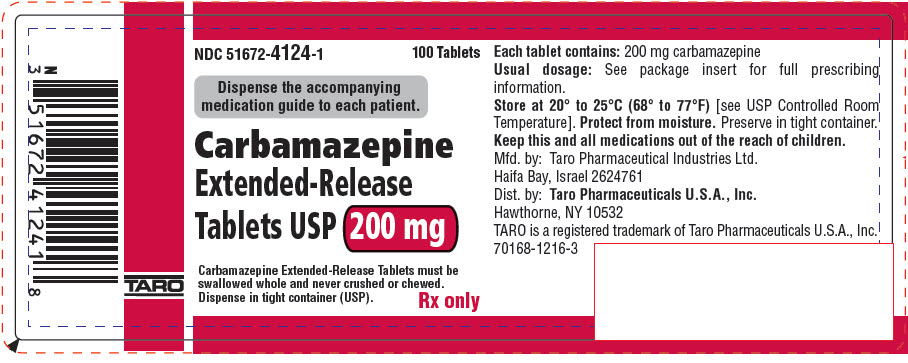
Carbamazepine 200 mg Tablet, Extended Release, 100-count — NDC 51672-4124-1 (Billing 51672-4124-01)
This is a package of 100 tablets of Carbamazepine 200 mg Tablet, Extended Release from Sun Pharmaceutical Industries, Inc., marketed since Mar 2009 and currently FDA-listed; retail pharmacies pay about $0.3989 per tablet (NADAC). It is the main listing for this product, which comes in 3 package sizes.
NDC database record
One package, one record: these facts belong to NDC 51672-4124-1 alone.
- Record
- FDA NDC Directory package listing · Human prescription drug
- Code segments
- 51672 labeler · 4124 product · 1 package
- Package marketed since
- Mar 31, 2009
- Sample package
- No — commercial package
- Listing certified through
- Dec 31, 2027
- Billing quantity
- 100 EA per package
- Barcode (UPC-A, from the NDC)
- 3 5167241241 8
- Medicaid fills, this package
- 8,197 prescriptions in the last four reported quarters
- FDA record last changed
- Oct 8, 2026
Other active recalls for Carbamazepine (different manufacturers) — 2 · tap to view
Identity & classification
Regulatory identifiers FDA, NLM and CMS codes for this package
Drug-database identifiers Medi-Span GPI and First Databank GCN / HICL / AHFS classification
- GSN (GCN sequence number): 016773
- GCN: 27821
- HICL (First Databank): 001893
- AHFS class code: 28:12.92.00
Where does this data come from?
- FDA openFDA NDC Directory · synced Oct 8, 2026
- FDA label on DailyMed · label index refreshed Oct 8, 2026
- RxNorm (NLM RxNav) · catalog refreshed Oct 8, 2026
- Medi-Span GPI (licensed)
- First Databank (licensed) · refreshed Oct 8, 2026
Clinical
Carbamazepine is used to control certain types of seizures, to treat trigeminal neuralgia (a condition that causes facial nerve pain), and to treat episodes of mania (frenzied, abnormally excited or irritated mood) or mixed episodes (symptoms of mania and depression that happen at the same time) in people with bipolar I disorder (manic-depressive disorder; a disease that causes episodes of depression, episodes of mania, and other abnormal moods). Carbamazepine is in a class of medications called anticonvulsants. It works by reducing abnormal electrical activity in the brain to treat seizures a...
Read the full MedlinePlus article ↗- It treats certain seizures in epilepsy and the severe facial nerve pain of trigeminal neuralgia. The brand Equetro is also used for manic or mixed episodes in bipolar I disorder. I...
- Take it by mouth exactly as prescribed. Many forms are taken with meals, and extended-release forms are usually twice a day. Carbatrol and Equetro capsules can be opened onto soft...
- Dizziness, drowsiness, unsteadiness, nausea and vomiting are most common, especially at the start. Be careful driving until you know how it affects you. Call your doctor if they do...
- Call for any rash, blisters or mouth sores, especially with fever. Also report fever, sore throat, easy bruising or bleeding, yellow skin or eyes, swelling of the face or lips, or...
Patient education
Supplement & herbal interactions
Some supplements/herbs that may interact with Carbamazepine — tap one for details:
Carbamazepine may be associated with lower levels of 11 nutrients — worth a chat with your pharmacist, not a cause for alarm.
Where does this data come from?
- MedlinePlus (NLM) · refreshed Oct 8, 2026
- FDA label on DailyMed · label index refreshed Oct 8, 2026
Ask a licensed pharmacist directly — free, answered by our team.
Pricing
A drug doesn't have one price. Each row is a different public payment system, and none is what you'd pay at the counter — that depends on your insurance. The ⓘ on each row explains what it measures.
| Price system | Per ea | Per package |
|---|---|---|
| Retail pharmacies payNADAC · weekly | $0.399 | $39.89 / 100 tablets |
| Medicaid paysCMS SDUD · 12 mo | $0.5245 | $52.45 / 100 tablets |
| Medicare drug plans payPart D · Q2 2026 | $0.7091 | $70.91 / 100 tablets |
Where does this data come from?
- CMS NADAC weekly file · file of Oct 7, 2026
- CMS ASP pricing files · refreshed Sep 20, 2026
- CMS Medicaid State Drug Utilization Data · through Q1 2026
- CMS Part D plan pricing files · refreshed Sep 24, 2026
- VA National Acquisition Center price file
Packaging — all sizes for this product
| Package NDC | Description | Per unit | Per pack | Marketing start | Marketing end | Status |
|---|---|---|---|---|---|---|
| 51672-4124-01 You're viewing this Main listing | 100 TABLET, EXTENDED RELEASE in 1 BOTTLE | $0.3989 / ea | $39.89 | 2009-03-31 | — | Active |
| 51672-4124-03 51672-4124-3 | 1000 TABLET, EXTENDED RELEASE in 1 BOTTLE | — | — | 2009-03-31 | — | Active |
| 51672-4124-06 51672-4124-6 | 30 TABLET, EXTENDED RELEASE in 1 BOTTLE | — | — | 2009-03-31 | — | Active |
You're viewing one of 3 pack sizes for this product.
In Medicaid, this is the most-dispensed pack of this product — about 100% of fills over the last four reported quarters. See all packs ↓
Pack size FAQ
What quantity is in this package?
How does this package differ from NDC 51672-4124-06?
What NDC number is used to bill for this package of Carbamazepine 200 mg Tablet, Extended Release?
Prices are the latest CMS NADAC pharmacy acquisition cost per NDC; per-pack figures are per-unit × pack quantity, shown only when the pack is denominated in the same measure NADAC prices.
Therapeutic equivalents
| Product | Labeler | Pack | NADAC/unit | TE | Status | Price vs. this |
|---|---|---|---|---|---|---|
| Carbamazepine ER 200 mg 42806-0275-01 | Epic | 100 tablets | $0.378 | AB | Availability likely | save 5% |
| Carbamazepin 200 mg 00832-6023-11 | Upsher-Smith | 100 tablets | $0.399 | AB | Availability likely | — |
| Carbamazepine 200 mg 13668-0285-01 | Torrent | 100 tablets | $0.399 | AB | Availability likely | — |
| Carbamazepine 200 mg 16571-0681-01 | Rising | 100 tablets | $0.399 | AB | Availability likely | — |
| carbamazepine 200 mg 16714-0064-01 | Northstar | 100 tablets | $0.399 | AB | Availability likely | — |
| Carbamazepine 200 mg 50742-0258-01 | Ingenus | 100 tablets | $0.399 | AB | Availability likely | — |
| Carbamazepine 200 mgthis 51672-4124-01 | Sun | 100 tablets | $0.399 | AB | Availability likely | — |
| Carbamazepine 200 mg 59746-0790-01 | Jubilant | 100 tablets | $0.399 | AB | Availability likely | — |
| Carbamazepine 200 mg 60687-0583-21 | American | 1 tablet | $0.399 | AB | Availability likely | — |
| Carbamazepine ER 200 mg 62135-0928-60 | Chartwell | 60 tablets | $0.399 | AB | Availability likely | — |
| Carbamazepine 200 mg 62332-0421-31 | Alembic | 100 tablets | $0.399 | AB | Availability likely | — |
| carbamazepine 200 mg 68382-0556-01 | Zydus | 100 tablets | $0.399 | AB | Availability likely | — |
| Carbamazepine ER 200 mg 72516-0020-01 | Oryza | 100 tablets | $0.399 | AB | Availability likely | — |
| Carbamazepine 200 mg 72603-0887-01 | Northstar | 100 tablets | $0.399 | AB | Availability likely | — |
| Tegretol XR 200 mg 00078-0511-05 | Novartis | 100 tablets | $3.247 | AB | Availability likely | +714% |
| Carbamazepine 200 mg 27241-0232-01 | Ajanta | 100 tablets | — | — | FDA listed | — |
| Carbamazepine Er 200 mg 35561-0356-12 | Bostal | 100 tablets | — | AB | FDA listed | — |
| Carbamazepine 200 mg 46708-0421-31 | Alembic | 100 tablets | — | AB | FDA listed | — |
| Carbamazepine 200 mg 51407-0896-01 | Golden | 100 tablets | — | AB | FDA listed | — |
| Carbamazepine 200 mg 60290-0059-01 | Umedica | 100 tablets | — | AB | FDA listed | — |
| Carbamazepine 200 mg 67877-0798-01 | Ascend | 100 tablets | — | AB | FDA listed | — |
| Carbamazepine 200 mg 70518-3699-00 | REMEDYREPACK | 1 tablet | — | AB | FDA listed | — |
| carbamazepine 200 mg 70771-1469-01 | Zydus | 100 tablets | — | AB | FDA listed | — |
Where does this data come from?
- FDA openFDA NDC Directory · synced Oct 8, 2026
- FDA Orange Book · refreshed Oct 3, 2026
- CMS NADAC weekly file · file of Oct 7, 2026
Availability & generic status
This product is an FDA-approved generic. Other versions of the same drug are listed under Therapeutic equivalents, least expensive first.
Where does this data come from?
- FDA Orange Book · refreshed Oct 3, 2026
What it looks like
Where does this data come from?
- FDA label on DailyMed · label index refreshed Oct 8, 2026
Inactive Ingredients / Excipients
Inactive ingredients, also called excipients, are components of the drug product other than the active ingredient. They may include fillers, dyes, coatings, preservatives, flavors, or other formulation ingredients.
🧪 Avoiding an ingredient? See Carbamazepine inactive ingredients by manufacturer: every current product's list side by side, so you can ask your pharmacy for the version that does not list it.
💡 Tap an ingredient (hover on desktop) to see what it is and why it’s used.
-
UNII 161H3B14U2
A synthetic plastic polymer used as an enteric coating on tablets and capsules. It dissolves in the intestines rather than the stomach, controlling where and when the medicine is released in the digestive tract.
-
UNII UF064M00AF
Diethyl phthalate is a clear, colorless liquid made from phthalic acid. It's used in medicines as a plasticizer to make tablet coatings flexible and as a solvent to help dissolve and distribute active ingredients evenly throughout the product.
-
UNII EWQ57Q8I5X
Lactose monohydrate is a natural sugar derived from milk. It serves as a filler and binder in tablets and capsules, helping create the proper size, texture, and consistency of the medicine.
-
UNII 70097M6I30
Magnesium stearate is a salt made from magnesium and stearic acid, a fatty substance. It's used in tablets and capsules as a lubricant and glidant to help ingredients flow smoothly during manufacturing and prevent sticking.
-
UNII OP1R32D61U
Microcrystalline cellulose is a purified form of cellulose, a natural fiber from plant sources. It acts as a binder and filler in tablets and capsules, helping hold ingredients together and give the medicine its shape and size.
-
UNII 5856J3G2A2
A starch-based powder made from potatoes and processed with sodium. It acts as a disintegrant, helping the tablet or capsule break apart quickly in the stomach so the medicine can be absorbed.
-
UNII O8232NY3SJ
A plant-based carbohydrate derived from corn kernels. It acts as a filler to add bulk, a binder to hold ingredients together, and a disintegrant to help the tablet break apart in your stomach for absorption.
7 inactive ingredients listed in the exact product block matched to this NDC.
Where does this data come from?
ingredient classCode="IACT" elements from the exact product block matched by this NDC. Label-section narrative from DailyMed / the openFDA label index is shown separately when available.- FDA label on DailyMed · label index refreshed Oct 8, 2026
- FDA openFDA NDC Directory · synced Oct 8, 2026
Inactive ingredient FAQ
Are inactive ingredients the same for every manufacturer?
Why might an inactive ingredient be missing?
Can inactive ingredients matter?
Manufacturer & labeler
More NDCs from Sun Pharmaceutical Industries, Inc. labeler code 51672
- Ondansetron 4 mg/5mL Solution NDC 51672-4091-3
- Phenytoin Sodium 100 mg Capsule, Extended Release NDC 51672-4111-0
- Metronidazole 7.5 mg/g Gel NDC 51672-4116-2
- Nystatin 100000 [USP'U]/mL Suspension NDC 51672-4117-0
- Fluorouracil 50 mg/g Cream NDC 51672-4118-2
- Carbamazepine 100 mg Tablet, Extended Release NDC 51672-4123-1
- Carbamazepine 400 mg Tablet, Extended Release NDC 51672-4125-1
- Lamotrigine 25 mg Tablet NDC 51672-4130-0
- Lamotrigine 100 mg Tablet NDC 51672-4131-0
- Lamotrigine 150 mg Tablet NDC 51672-4132-0
- Lamotrigine 200 mg Tablet NDC 51672-4133-0
- Levetiracetam 100 mg/mL Solution NDC 51672-4136-0
Where does this data come from?
- FDA openFDA NDC Directory · synced Oct 8, 2026
- Drugs@FDA
Full prescribing information FDA SPL
🚨 Boxed Warning ▾
WARNINGS SERIOUS DERMATOLOGIC REACTIONS AND HLA-B*1502 ALLELE SERIOUS AND SOMETIMES FATAL DERMATOLOGIC REACTIONS, INCLUDING TOXIC EPIDERMAL NECROLYSIS (TEN) AND STEVENS-JOHNSON SYNDROME (SJS), HAVE BEEN REPORTED DURING TREATMENT WITH CARBAMAZEPINE. THESE REACTIONS ARE ESTIMATED TO OCCUR IN 1 TO 6 PER 10,000 NEW USERS IN COUNTRIES WITH MAINLY CAUCASIAN POPULATIONS, BUT THE RISK IN SOME ASIAN COUNTRIES IS ESTIMATED TO BE ABOUT 10 TIMES HIGHER. STUDIES IN PATIENTS OF CHINESE ANCESTRY HAVE FOUND A STRONG ASSOCIATION BETWEEN THE RISK OF DEVELOPING SJS/TEN AND THE PRESENCE OF HLA-B*1502, AN INHERITED ALLELIC VARIANT OF THE HLA-B GENE.
HLA-B*1502 IS FOUND ALMOST EXCLUSIVELY IN PATIENTS WITH ANCESTRY ACROSS BROAD AREAS OF ASIA. PATIENTS WITH ANCESTRY IN GENETICALLY AT-RISK POPULATIONS SHOULD BE SCREENED FOR THE PRESENCE OF HLA-B*1502 PRIOR TO INITIATING TREATMENT WITH CARBAMAZEPINE. PATIENTS TESTING POSITIVE FOR THE ALLELE SHOULD NOT BE TREATED WITH CARBAMAZEPINE UNLESS THE BENEFIT CLEARLY OUTWEIGHS THE RISK (SEE WARNINGS AND PRECAUTIONS, LABORATORY TESTS ).
APLASTIC ANEMIA AND AGRANULOCYTOSIS APLASTIC ANEMIA AND AGRANULOCYTOSIS HAVE BEEN REPORTED IN ASSOCIATION WITH THE USE OF CARBAMAZEPINE. DATA FROM A POPULATION-BASED CASE CONTROL STUDY DEMONSTRATE THAT THE RISK OF DEVELOPING THESE REACTIONS IS 5 TO 8 TIMES GREATER THAN IN THE GENERAL POPULATION. HOWEVER, THE OVERALL RISK OF THESE REACTIONS IN THE UNTREATED GENERAL POPULATION IS LOW, APPROXIMATELY SIX PATIENTS PER ONE MILLION POPULATION PER YEAR FOR AGRANULOCYTOSIS AND TWO PATIENTS PER ONE MILLION POPULATION PER YEAR FOR APLASTIC ANEMIA.
ALTHOUGH REPORTS OF TRANSIENT OR PERSISTENT DECREASED PLATELET OR WHITE BLOOD CELL COUNTS ARE NOT UNCOMMON IN ASSOCIATION WITH THE USE OF CARBAMAZEPINE, DATA ARE NOT AVAILABLE TO ESTIMATE ACCURATELY THEIR INCIDENCE OR OUTCOME. HOWEVER, THE VAST MAJORITY OF THE CASES OF LEUKOPENIA HAVE NOT PROGRESSED TO THE MORE SERIOUS CONDITIONS OF APLASTIC ANEMIA OR AGRANULOCYTOSIS. BECAUSE OF THE VERY LOW INCIDENCE OF AGRANULOCYTOSIS AND APLASTIC ANEMIA, THE VAST MAJORITY OF MINOR HEMATOLOGIC CHANGES OBSERVED IN MONITORING OF PATIENTS ON CARBAMAZEPINE ARE UNLIKELY TO SIGNAL THE OCCURRENCE OF EITHER ABNORMALITY.
NONETHELESS, COMPLETE PRETREATMENT HEMATOLOGICAL TESTING SHOULD BE OBTAINED AS A BASELINE. IF A PATIENT IN THE COURSE OF TREATMENT EXHIBITS LOW OR DECREASED WHITE BLOOD CELL OR PLATELET COUNTS, THE PATIENT SHOULD BE MONITORED CLOSELY. DISCONTINUATION OF THE DRUG SHOULD BE CONSIDERED IF ANY EVIDENCE OF SIGNIFICANT BONE MARROW DEPRESSION DEVELOPS.
🎯 Indications and Usage ▾
INDICATIONS AND USAGE Epilepsy Carbamazepine is indicated for use as an anticonvulsant drug. Evidence supporting efficacy of carbamazepine as an anticonvulsant was derived from active drug-controlled studies that enrolled patients with the following seizure types: Partial seizures with complex symptomatology (psychomotor, temporal lobe). Patients with these seizures appear to show greater improvement than those with other types.
Generalized tonic-clonic seizures (grand mal). Mixed seizure patterns which include the above, or other partial or generalized seizures. Absence seizures (petit mal) do not appear to be controlled by carbamazepine (see PRECAUTIONS, General ).
Trigeminal Neuralgia Carbamazepine is indicated in the treatment of the pain associated with true trigeminal neuralgia. Beneficial results have also been reported in glossopharyngeal neuralgia. This drug is not a simple analgesic and should not be used for the relief of trivial aches or pains.
⏱️ Dosage and Administration ▾
DOSAGE AND ADMINISTRATION (SEE TABLE BELOW) Carbamazepine suspension in combination with liquid chlorpromazine or thioridazine results in precipitate formation, and, in the case of chlorpromazine, there has been a report of a patient passing an orange rubbery precipitate in the stool following coadministration of the two drugs (see PRECAUTIONS, Drug Interactions ). Because the extent to which this occurs with other liquid medications is not known, carbamazepine suspension should not be administered simultaneously with other liquid medications or diluents.
Monitoring of blood levels has increased the efficacy and safety of anticonvulsants (see PRECAUTIONS, Laboratory Tests ). Dosage should be adjusted to the needs of the individual patient. A low initial daily dosage with a gradual increase is advised.
As soon as adequate control is achieved, the dosage may be reduced very gradually to the minimum effective level. Medication should be taken with meals. Since a given dose of carbamazepine suspension will produce higher peak levels than the same dose given as the tablet, it is recommended to start with low doses (children 6 to 12 years: ½ teaspoon (four times a day) and to increase slowly to avoid unwanted side effects.
Conversion of patients from oral carbamazepine tablets to carbamazepine suspension: Patients should be converted by administering the same number of mg per day in smaller, more frequent doses (i.e., twice a day tablets to three times a day suspension). Carbamazepine extended-release tablets is an extended-release formulation for twice-a-day administration. When converting patients from carbamazepine conventional tablets to carbamazepine extended-release tablets, the same total daily mg dose of carbamazepine extended-release tablets should be administered.
Carbamazepine extended-release tablets must be swallowed whole and never crushed or chewed. Carbamazepine extended-release tablets should be inspected for chips or cracks. Damaged tablets should not be consumed.
Epilepsy (see INDICATIONS AND USAGE ) Adults and children over 12 years of age-Initial Either 200 mg twice a day for tablets and extended-release tablets, or 1 teaspoon four times a day for suspension (400 mg/day). Increase at weekly intervals by adding up to 200 mg/day using a twice a day regimen of carbamazepine extended-release tablets or a three times a day or four times a day regimen of the other formulations until the optimal response is obtained. Dosage generally should not exceed 1000 mg daily in children 12 to 15 years of age, and 1200 mg daily in patients above 15 years of age.
Doses up to 1600 mg daily have been used in adults in rare instances. Maintenance Adjust dosage to the minimum effective level, usually 800 to 1200 mg daily. Children 6 to 12 years of age-Initial Either 100 mg twice a day for tablets or extended-release tablets, or ½ teaspoon four times a day for suspension (200 mg/day).
Increase at weekly intervals by adding up to 100 mg/day using a twice a day regimen of carbamazepine extended-release tablets or a three times a day or four times a day regimen of the other formulations until the optimal response is obtained. Dosage generally should not exceed 1000 mg daily. Maintenance Adjust dosage to the minimum effective level, usually 400 to 800 mg daily.
Children under 6 years of age-Initial 10 mg/kg/day to 20 mg/kg/day twice a day or three times a day as tablets, or four times a day as suspension. Increase weekly to achieve optimal clinical response administered three times a day or four times a day Maintenance Ordinarily, optimal clinical response is achieved at daily doses below 35 mg/kg. If satisfactory clinical response has not been achieved, plasma levels should be measured to determine whether or not they are in the therapeutic range.
No recommendation regarding the safety of carbamazepine for use at doses above 35 mg/kg/24 hours can be made. Combination Therapy Carbamazepine may be used alone or with other anticonvulsants. W… [Excerpted — this section continues on DailyMed.]
💊 Dosage Forms and Strengths ▾
Dosage Information Initial Dose Subsequent Dose Maximum Daily Dose Indication Tablet Tablet = conventional tablets XR XR = carbamazepine extended-release tablets Suspension Tablet XR Suspension Tablet XR Suspension Epilepsy Under 6 yr 10 to 20 mg/kg/day twice a day or 3 times a day 10 to 20 mg/kg/day 4 times a day Increase weekly to achieve optimal clinical response, 3 times a day or 4 times a day Increase weekly to achieve optimal clinical response, 3 times a day or 4 times a day 35 mg/kg/24 hr (see Dosage and Administration section above) 35 mg/kg/24 hr (see Dosage and Administration section above) 6 to 12 yr 100 mg twice a day (200 mg/day) 100 mg twice a day (200 mg/day) ½ tsp 4 times a day (200 mg/day) Add up to 100 mg/day at weekly intervals, 3 times a day or 4 times a day Add 100 mg/day at weekly intervals, twice a day Add up to 1 tsp (100 mg)/day at weekly intervals, 3 times a day or 4 times a day 1000 mg/24 hr Over 12 yr 200 mg twice a day (400 mg/day) 200 mg twice a day (400 mg/day) 1 tsp 4 times a day (400 mg/day) Add up to 200 mg/day at weekly intervals, 3 times a day or 4 times a day Add up to 200 mg/day at weekly intervals, twice a day Add up to 2 tsp (200 mg)/day at weekly intervals, 3 times a day or 4 times a day 1000 mg/24 hr (12 to 15 yr) 1200 mg/24 hr (> 15 yr) 1600 mg/24 hr (adults, in rare instances) Trigeminal Neuralgia 100 mg twice a day (200 mg/day) 100 mg twice a day (200 mg/day) ½ tsp 4 times a day (200 mg/day) Add up to 200 mg/day in increments of 100 mg every 12 hr Add up to 200 mg/day in increments of 100 mg every 12 hr Add up to 2 tsp (200 mg)/day in increments of 50 mg (½ tsp) 4 times a day.
1200 mg/24 hr
⛔ Contraindications ▾
CONTRAINDICATIONS Carbamazepine should not be used in patients with a history of previous bone marrow depression, hypersensitivity to the drug, or known sensitivity to any of the tricyclic compounds, such as amitriptyline, desipramine, imipramine, protriptyline, nortriptyline, etc. Likewise, on theoretical grounds its use with monoamine oxidase (MAO) inhibitors is not recommended. Before administration of carbamazepine, MAO inhibitors should be discontinued for a minimum of 14 days, or longer if the clinical situation permits.
Coadministration of carbamazepine and nefazodone may result in insufficient plasma concentrations of nefazodone and its active metabolite to achieve a therapeutic effect. Coadministration of carbamazepine with nefazodone is contraindicated.
⚠️ Warnings ▾
WARNINGS Serious Dermatologic Reactions Serious and sometimes fatal dermatologic reactions, including toxic epidermal necrolysis (TEN) and Stevens-Johnson syndrome (SJS), have been reported with carbamazepine treatment. The risk of these events is estimated to be about 1 to 6 per 10,000 new users in countries with mainly Caucasian populations. However, the risk in some Asian countries is estimated to be about 10 times higher.
Carbamazepine should be discontinued at the first sign of a rash, unless the rash is clearly not drug-related. If signs or symptoms suggest SJS/TEN, use of this drug should not be resumed and alternative therapy should be considered. SJS/TEN and HLA-B*1502 Allele Retrospective case-control studies have found that in patients of Chinese ancestry there is a strong association between the risk of developing SJS/TEN with carbamazepine treatment and the presence of an inherited variant of the HLA-B gene, HLA-B*1502.
The occurrence of higher rates of these reactions in countries with higher frequencies of this allele suggests that the risk may be increased in allele-positive individuals of any ethnicity. Across Asian populations, notable variation exists in the prevalence of HLA-B*1502. Greater than 15% of the population is reported positive in Hong Kong, Thailand, Malaysia, and parts of the Philippines, compared to about 10% in Taiwan and 4% in North China.
South Asians, including Indians, appear to have intermediate prevalence of HLA-B*1502, averaging 2% to 4%, but higher in some groups. HLA-B*1502 is present in less than 1% of the population in Japan and Korea. HLA-B*1502 is largely absent in individuals not of Asian origin (e.g., Caucasians, African-Americans, Hispanics, and Native Americans).
Prior to initiating carbamazepine therapy, testing for HLA-B*1502 should be performed in patients with ancestry in populations in which HLA-B*1502 may be present. In deciding which patients to screen, the rates provided above for the prevalence of HLA-B*1502 may offer a rough guide, keeping in mind the limitations of these figures due to wide variability in rates even within ethnic groups, the difficulty in ascertaining ethnic ancestry, and the likelihood of mixed ancestry. Carbamazepine should not be used in patients positive for HLA-B*1502 unless the benefits clearly outweigh the risks.
Tested patients who are found to be negative for the allele are thought to have a low risk of SJS/TEN (see BOXED WARNING and PRECAUTIONS, Laboratory Tests ). Over 90% of carbamazepine treated patients who will experience SJS/TEN have this reaction within the first few months of treatment. This information may be taken into consideration in determining the need for screening of genetically at-risk patients currently on carbamazepine.
The HLA-B*1502 allele has not been found to predict risk of less severe adverse cutaneous reactions from carbamazepine such as maculopapular eruption (MPE) or to predict Drug Reaction with Eosinophilia and Systemic Symptoms (DRESS). Limited evidence suggests that HLA-B*1502 may be a risk factor for the development of SJS/TEN in patients of Chinese ancestry taking other antiepileptic drugs associated with SJS/TEN, including phenytoin. Consideration should be given to avoiding use of other drugs associated with SJS/TEN in HLA-B*1502 positive patients, when alternative therapies are otherwise equally acceptable.
Hypersensitivity Reactions and HLA-A*3101 Allele Retrospective case-control studies in patients of European, Korean, and Japanese ancestry have found a moderate association between the risk of developing hypersensitivity reactions and the presence of HLA-A*3101, an inherited allelic variant of the HLA-A gene, in patients using carbamazepine. These hypersensitivity reactions include SJS/TEN, maculopapular eruptions, and Drug Reaction with Eosinophilia and Systemic Symptoms (see DRESS/Multiorgan hypersensitivity below).
HLA-A*3101 is expected to be carried by more than 15% of patients of Japanese, Nati… [Excerpted — this section continues on DailyMed.]
🤒 Adverse Reactions ▾
ADVERSE REACTIONS If adverse reactions are of such severity that the drug must be discontinued, the physician must be aware that abrupt discontinuation of any anticonvulsant drug in a responsive epileptic patient may lead to seizures or even status epilepticus with its life-threatening hazards. The most severe adverse reactions have been observed in the hemopoietic system and skin (see BOXED WARNING ), the liver, and the cardiovascular system. The most frequently observed adverse reactions, particularly during the initial phases of therapy, are dizziness, drowsiness, unsteadiness, nausea, and vomiting.
To minimize the possibility of such reactions, therapy should be initiated at the lowest dosage recommended. The following additional adverse reactions have been reported: Hemopoietic System: Aplastic anemia, agranulocytosis, pancytopenia, bone marrow depression, thrombocytopenia, leukopenia, leukocytosis, eosinophilia, acute intermittent porphyria, variegate porphyria, porphyria cutanea tarda. Skin: TEN and SJS (see BOXED WARNING ), Acute Generalized Exanthematous Pustulosis (AGEP), pruritic and erythematous rashes, urticaria, photosensitivity reactions, alterations in skin pigmentation, exfoliative dermatitis, erythema multiforme and nodosum, purpura, aggravation of disseminated lupus erythematosus, alopecia, diaphoresis, onychomadesis and hirsutism.
In certain cases, discontinuation of therapy may be necessary. Cardiovascular System: Congestive heart failure, edema, aggravation of hypertension, hypotension, syncope and collapse, aggravation of coronary artery disease, arrhythmias and AV block, thrombophlebitis, thromboembolism (e.g., pulmonary embolism), and adenopathy or lymphadenopathy. Some of these cardiovascular complications have resulted in fatalities.
Myocardial infarction has been associated with other tricyclic compounds. Liver: Abnormalities in liver function tests, cholestatic and hepatocellular jaundice, hepatitis, very rare cases of hepatic failure. Pancreatic: Pancreatitis.
Respiratory System: Pulmonary hypersensitivity characterized by fever, dyspnea, pneumonitis or pneumonia. Genitourinary System: Urinary frequency, acute urinary retention, oliguria with elevated blood pressure, azotemia, renal failure, and impotence. Albuminuria, glycosuria, elevated BUN, and microscopic deposits in the urine have also been reported.
There have been rare reports of impaired male fertility and/or abnormal spermatogenesis. Testicular atrophy occurred in rats receiving carbamazepine orally from 4 to 52 weeks at dosage levels of 50 to 400 mg/kg/day. Additionally, rats receiving carbamazepine in the diet for 2 years at dosage levels of 25, 75, and 250 mg/kg/day had a dose-related incidence of testicular atrophy and aspermatogenesis.
In dogs, it produced a brownish discoloration, presumably a metabolite, in the urinary bladder at dosage levels of 50 mg/kg and higher. Relevance of these findings to humans is unknown. Nervous System: Dizziness, drowsiness, disturbances of coordination, confusion, headache, fatigue, blurred vision, visual hallucinations, transient diplopia, oculomotor disturbances, nystagmus, speech disturbances, abnormal involuntary movements, peripheral neuritis and paresthesias, depression with agitation, talkativeness, tinnitus, hyperacusis, neuroleptic malignant syndrome.
There have been reports of associated paralysis and other symptoms of cerebral arterial insufficiency, but the exact relationship of these reactions to the drug has not been established. Isolated cases of neuroleptic malignant syndrome have been reported both with and without concomitant use of psychotropic drugs. Digestive System: Nausea, vomiting, gastric distress and abdominal pain, diarrhea, constipation, anorexia, and dryness of the mouth and pharynx, including glossitis and stomatitis.
Eyes: Scattered punctate cortical lens opacities, increased intraocular pressure (see WARNINGS, General ) as well as conjunctivitis, have been reported. Al… [Excerpted — this section continues on DailyMed.]
🔄 Drug Interactions ▾
Drug Interactions There has been a report of a patient who passed an orange rubbery precipitate in his stool the day after ingesting carbamazepine suspension immediately followed by Thorazine ® * solution. Subsequent testing has shown that mixing carbamazepine suspension and chlorpromazine solution (both generic and brand name) as well as carbamazepine suspension and liquid Mellaril ® , resulted in the occurrence of this precipitate. Because the extent to which this occurs with other liquid medications is not known, carbamazepine suspension should not be administered simultaneously with other liquid medicinal agents or diluents (see DOSAGE AND ADMINISTRATION ).
Clinically meaningful drug interactions have occurred with concomitant medications and include (but are not limited to) the following: Agents That May Affect Carbamazepine Plasma Levels When carbamazepine is given with drugs that can increase or decrease carbamazepine levels, close monitoring of carbamazepine levels is indicated and dosage adjustment may be required. Agents That Increase Carbamazepine Levels CYP3A4 inhibitors inhibit carbamazepine metabolism and can thus increase plasma carbamazepine levels. Drugs that have been shown, or would be expected, to increase plasma carbamazepine levels include aprepitant, cimetidine, ciprofloxacin, danazol, diltiazem, macrolides (e.g. erythromycin, clarithromycin), fluoxetine, fluvoxamine, trazodone, omeprazole, oxybutynin, isoniazid, niacinamide (nicotinamide), azoles (e.g., ketoconazole, itraconazole, fluconazole, voriconazole), acetazolamide, verapamil, ticlopidine, grapefruit juice, and protease inhibitors.
Human microsomal epoxide hydrolase has been identified as the enzyme responsible for the formation of the 10,11-transdiol derivative from carbamazepine-10,11 epoxide. Coadministration of inhibitors of human microsomal epoxide hydrolase may result in increased carbamazepine-10,11 epoxide plasma concentrations. Accordingly, the dosage of carbamazepine should be adjusted and/or the plasma levels monitored when used concomitantly with loxapine, quetiapine, valproic acid, or brivaracetam.
Agents That Decrease Carbamazepine Levels CYP3A4 inducers can increase the rate of carbamazepine metabolism. Drugs that have been shown, or that would be expected, to decrease plasma carbamazepine levels include cisplatin, doxorubicin HCl, felbamate, fosphenytoin, rifampin, phenobarbital, phenytoin, primidone, methsuximide, theophylline, aminophylline. Effect of Carbamazepine on Plasma Levels of Concomitant Agents Decreased Levels of Concomitant Medications Carbamazepine is a potent inducer of hepatic 3A4 and is also known to be an inducer of CYP1A2, 2B6, 2C89/19 and may therefore reduce plasma concentrations of co-medications mainly metabolized by CYP 1A2, 2B6, 2C89/19 and 3A4, through induction of their metabolism.
When used concomitantly with carbamazepine, monitoring of concentrations or dosage adjustment of these agents may be necessary: When carbamazepine is added to aripiprazole, the aripiprazole dose should be doubled. Additional dose increases should be based on clinical evaluation. If carbamazepine is later withdrawn, the aripiprazole dose should be reduced.
When carbamazepine is used with tacrolimus, monitoring of tacrolimus blood concentrations and appropriate dosage adjustments are recommended. The use of concomitant strong CYP3A4 inducers, such as carbamazepine should be avoided with temsirolimus. If patients must be coadministered carbamazepine with temsirolimus, an adjustment of temsirolimus dosage should be considered.
The use of carbamazepine with lapatinib should generally be avoided. If carbamazepine is started in a patient already taking lapatinib, the dose of lapatinib should be gradually titrated up. If carbamazepine is discontinued, the lapatinib dose should be reduced.
Concomitant use of carbamazepine with nefazodone results in plasma concentrations of nefazodone and its active metabolite insufficient to achieve a… [Excerpted — this section continues on DailyMed.]
🤰 Pregnancy ▾
Usage in Pregnancy (see WARNINGS ).
🧒 Pediatric Use ▾
Pediatric Use Substantial evidence of carbamazepine's effectiveness for use in the management of children with epilepsy (see INDICATIONS AND USAGE for specific seizure types) is derived from clinical investigations performed in adults and from studies in several in vitro systems which support the conclusion that (1) the pathogenetic mechanisms underlying seizure propagation are essentially identical in adults and children, and (2) the mechanism of action of carbamazepine in treating seizures is essentially identical in adults and children.
Taken as a whole, this information supports a conclusion that the generally accepted therapeutic range of total carbamazepine in plasma (i.e., 4 to 12 mcg/mL) is the same in children and adults. The evidence assembled was primarily obtained from short-term use of carbamazepine. The safety of carbamazepine in children has been systematically studied up to 6 months.
No longer-term data from clinical trials is available. Carbamazepine oral suspension contains propylene glycol as an inactive ingredient. Patients less than 5 years of age are at the highest risk for propylene glycol toxicity due to incomplete alcohol dehydrogenase maturity.
Particularly, neonates (including full-term babies and pre-term babies less than 44 post-menstrual weeks of age). The total daily intake of propylene glycol from all sources, including concomitant drugs, should be considered in managing the risk of propylene glycol toxicity (see WARNINGS Propylene Glycol Toxicity).
🧓 Geriatric Use ▾
Geriatric Use No systematic studies in geriatric patients have been conducted.
🆘 Overdosage ▾
OVERDOSAGE Acute Toxicity Lowest known lethal dose: adults, 3.2 g (a 24-year-old woman died of a cardiac arrest and a 24-year-old man died of pneumonia and hypoxic encephalopathy); children, 4 g (a 14-year-old girl died of a cardiac arrest), 1.6 g (a 3-year-old girl died of aspiration pneumonia). Oral LD 50 in animals (mg/kg): mice, 1100 to 3750; rats, 3850 to 4025; rabbits, 1500 to 2680; guinea pigs, 920. Signs and Symptoms The first signs and symptoms appear after 1 to 3 hours.
Neuromuscular disturbances are the most prominent. Cardiovascular disorders are generally milder, and severe cardiac complications occur only when very high doses (greater than 60 g) have been ingested. Respiration: Irregular breathing, respiratory depression.
Cardiovascular System: Tachycardia, hypotension or hypertension, shock, conduction disorders. Nervous System and Muscles: Impairment of consciousness ranging in severity to deep coma. Convulsions, especially in small children.
Motor restlessness, muscular twitching, tremor, athetoid movements, opisthotonos, ataxia, drowsiness, dizziness, mydriasis, nystagmus, adiadochokinesia, ballism, psychomotor disturbances, dysmetria. Initial hyperreflexia, followed by hyporeflexia. Gastrointestinal Tract: Nausea, vomiting.
Kidneys and Bladder: Anuria or oliguria, urinary retention. Laboratory Findings: Isolated instances of overdosage have included leukocytosis, reduced leukocyte count, glycosuria, and acetonuria. EEG may show dysrhythmias.
Combined Poisoning: When alcohol, tricyclic antidepressants, barbiturates, or hydantoins are taken at the same time, the signs and symptoms of acute poisoning with carbamazepine may be aggravated or modified. Propylene Glycol Toxicity: In cases of suspected overdose with carbamazepine oral suspension, which contains 50 mg of propylene glycol per mL, monitor for signs of propylene glycol toxicity, including hemolysis, hyperosmolarity with anion gap metabolic acidosis, acute kidney injury, CNS toxicity, and multi-organ failure.
Treatment The prognosis in cases of severe poisoning is critically dependent upon prompt elimination of the drug, which may be achieved by inducing vomiting, irrigating the stomach, and by taking appropriate steps to diminish absorption. If these measures cannot be implemented without risk on the spot, the patient should be transferred at once to a hospital, while ensuring that vital functions are safeguarded. There is no specific antidote.
Elimination of the Drug: Induction of vomiting. Gastric lavage. Even when more than 4 hours have elapsed following ingestion of the drug, the stomach should be repeatedly irrigated, especially if the patient has also consumed alcohol.
Measures to Reduce Absorption: Activated charcoal, laxatives. Measures to Accelerate Elimination: Forced diuresis. Dialysis is indicated only in severe poisoning associated with renal failure.
Replacement transfusion is indicated in severe poisoning in small children. Respiratory Depression: Keep the airways free; resort, if necessary, to endotracheal intubation, artificial respiration, and administration of oxygen. Hypotension, Shock: Keep the patient's legs raised and administer a plasma expander.
If blood pressure fails to rise despite measures taken to increase plasma volume, use of vasoactive substances should be considered. Convulsions: Diazepam or barbiturates. Warning: Diazepam or barbiturates may aggravate respiratory depression (especially in children), hypotension, and coma.
However, barbiturates should not be used if drugs that inhibit monoamine oxidase have also been taken by the patient either in overdosage or in recent therapy (within 1 week). Surveillance: Respiration, cardiac function (ECG monitoring), blood pressure, body temperature, pupillary reflexes, and kidney and bladder function should be monitored for several days. Treatment of Blood Count Abnormalities: If evidence of significant bone marrow depression develops, the following recommendations are suggested:… [Excerpted — this section continues on DailyMed.]
🧬 Clinical Pharmacology ▾
CLINICAL PHARMACOLOGY In controlled clinical trials, carbamazepine has been shown to be effective in the treatment of psychomotor and grand mal seizures, as well as trigeminal neuralgia. Mechanism of Action Carbamazepine has demonstrated anticonvulsant properties in rats and mice with electrically and chemically induced seizures. It appears to act by reducing polysynaptic responses and blocking the post-tetanic potentiation.
Carbamazepine greatly reduces or abolishes pain induced by stimulation of the infraorbital nerve in cats and rats. It depresses thalamic potential and bulbar and polysynaptic reflexes, including the linguomandibular reflex in cats. Carbamazepine is chemically unrelated to other anticonvulsants or other drugs used to control the pain of trigeminal neuralgia.
The mechanism of action remains unknown. The principal metabolite of carbamazepine, carbamazepine-10,11-epoxide, has anticonvulsant activity as demonstrated in several in vivo animal models of seizures. Though clinical activity for the epoxide has been postulated, the significance of its activity with respect to the safety and efficacy of carbamazepine has not been established.
Pharmacokinetics In clinical studies, carbamazepine suspension, conventional tablets, and extended-release tablets delivered equivalent amounts of drug to the systemic circulation. However, the suspension was absorbed somewhat faster, and the extended-release tablet slightly slower, than the conventional tablet. The bioavailability of the extended-release tablet was 89% compared to suspension.
Following a twice a day dosage regimen, the suspension provides higher peak levels and lower trough levels than those obtained from the conventional tablet for the same dosage regimen. On the other hand, following a three times a day dosage regimen, carbamazepine suspension affords steady-state plasma levels comparable to carbamazepine tablets given twice a day when administered at the same total mg daily dose. Following a twice a day dosage regimen, carbamazepine extended-release tablets afford steady-state plasma levels comparable to conventional carbamazepine tablets given four times a day, when administered at the same total mg daily dose.
Carbamazepine in blood is 76% bound to plasma proteins. Plasma levels of carbamazepine are variable and may range from 0.5 to 25 mcg/mL, with no apparent relationship to the daily intake of the drug. Usual adult therapeutic levels are between 4 and 12 mcg/mL.
In polytherapy, the concentration of carbamazepine and concomitant drugs may be increased or decreased during therapy, and drug effects may be altered (see PRECAUTIONS, Drug Interactions ). Following chronic oral administration of suspension, plasma levels peak at approximately 1.5 hours compared to 4 to 5 hours after administration of conventional carbamazepine tablets, and 3 to 12 hours after administration of carbamazepine extended-release tablets. The CSF/serum ratio is 0.22, similar to the 24% unbound carbamazepine in serum.
Because carbamazepine induces its own metabolism, the half-life is also variable. Autoinduction is completed after 3 to 5 weeks of a fixed dosing regimen. Initial half-life values range from 25 to 65 hours, decreasing to 12 to 17 hours on repeated doses.
Carbamazepine is metabolized in the liver. Cytochrome P450 3A4 was identified as the major isoform responsible for the formation of carbamazepine-10,11-epoxide from carbamazepine. Human microsomal epoxide hydrolase has been identified as the enzyme responsible for the formation of the 10,11-transdiol derivative from carbamazepine-10,11 epoxide.
After oral administration of 14 C-carbamazepine, 72% of the administered radioactivity was found in the urine and 28% in the feces. This urinary radioactivity was composed largely of hydroxylated and conjugated metabolites, with only 3% of unchanged carbamazepine. The pharmacokinetic parameters of carbamazepine disposition are similar in children and in adults.
However, there is a… [Excerpted — this section continues on DailyMed.]
🧬 Mechanism of Action ▾
Mechanism of Action Carbamazepine has demonstrated anticonvulsant properties in rats and mice with electrically and chemically induced seizures. It appears to act by reducing polysynaptic responses and blocking the post-tetanic potentiation. Carbamazepine greatly reduces or abolishes pain induced by stimulation of the infraorbital nerve in cats and rats.
It depresses thalamic potential and bulbar and polysynaptic reflexes, including the linguomandibular reflex in cats. Carbamazepine is chemically unrelated to other anticonvulsants or other drugs used to control the pain of trigeminal neuralgia. The mechanism of action remains unknown.
The principal metabolite of carbamazepine, carbamazepine-10,11-epoxide, has anticonvulsant activity as demonstrated in several in vivo animal models of seizures. Though clinical activity for the epoxide has been postulated, the significance of its activity with respect to the safety and efficacy of carbamazepine has not been established.
📦 How Supplied / Storage and Handling ▾
HOW SUPPLIED Carbamazepine Tablets USP, (Chewable), 100 mg: White, flat, round tablet with pink specks, and cherry fragrance. One side scored and engraved with "TARO" above the score and "16" under the score. Other side plain.
Bottles of 100 NDC 51672-4041-1 Bottles of 500 NDC 51672-4041-2 Unit Dose of 50 NDC 51672-4041-9 Unit Dose of 100 NDC 51672-4041-0 Carbamazepine Tablets USP, (Chewable), 200 mg: White, flat, oval beveled tablet, with pink specks, and cherry fragrance. One side scored and engraved with "T" above the score and "27" under the score. Other side scored.
Bottles of 100 NDC 51672-4050-1 Bottles of 400 NDC 51672-4050-2 Store Carbamazepine Tablets USP, (Chewable) at 20° to 25°C (68° to 77°F) [see USP Controlled Room Temperature]. Protect from light and moisture. Dispense in tight, light-resistant container (USP).
Meets USP Dissolution Test 1.
Carbamazepine Tablets USP, 200 mg: White, round, flat beveled-edge, one side scored and engraved "TARO" above and "11" below the score, the other side plain. Bottles of 100 NDC 51672-4005-1 Bottles of 500 NDC 51672-4005-2 Bottles of 1000 NDC 51672-4005-3 Store Carbamazepine Tablets USP at 20° to 25°C (68° to 77°F) [see USP Controlled Room Temperature]. Protect from moisture. Dispense in tight container (USP). Meets USP Dissolution Test 2.
Carbamazepine Extended-Release Tablets USP, 100 mg: White to off-white, round bi-convexed tablets engraved with "T91" on one side and plain on the other side. Bottles of 30 NDC 51672-4123-6 Bottles of 100 NDC 51672-4123-1 Bottles of 1000 NDC 51672-4123-3 Carbamazepine Extended-Release Tablets USP, 200 mg: White to off-white, round bi-convexed tablets engraved with "T26" on one side and plain on the other side. Bottles of 30 NDC 51672-4124-6 Bottles of 100 NDC 51672-4124-1 Bottles of 1000 NDC 51672-4124-3 Carbamazepine Extended-Release Tablets USP, 400 mg: White to off-white, capsule-shaped bi-convexed tablets engraved with "T29" on one side and plain on the other side.
Bottles of 30 NDC 51672-4125-6 Bottles of 100 NDC 51672-4125-1 Bottles of 1000 NDC 51672-4125-3 Store Carbamazepine Extended-Release Tablets USP at 20° to 25°C (68° to 77°F) [see USP Controlled Room Temperature]. Protect from moisture. Dispense in tight container (USP).
Carbamazepine Oral Suspension USP, 100 mg/5 mL (teaspoonful): Orange colored and orange flavored suspension. Bottles of 450 mL NDC 51672-4047-4 1 Bottle in Carton NDC 51672-4047-4 Shake well before using. Store Carbamazepine Oral Suspension USP at 20° to 25°C (68° to 77°F) [see USP Controlled Room Temperature]. Protect from freezing and from excessive heat. Dispense in tight, light-resistant container (USP).
📦 Storage and Handling ▾
Store Carbamazepine Tablets USP, (Chewable) at 20° to 25°C (68° to 77°F) [see USP Controlled Room Temperature]. Protect from light and moisture. Dispense in tight, light-resistant container (USP). Meets USP Dissolution Test 1.
Store Carbamazepine Tablets USP at 20° to 25°C (68° to 77°F) [see USP Controlled Room Temperature]. Protect from moisture. Dispense in tight container (USP). Meets USP Dissolution Test 2.
Store Carbamazepine Extended-Release Tablets USP at 20° to 25°C (68° to 77°F) [see USP Controlled Room Temperature]. Protect from moisture. Dispense in tight container (USP).
Store Carbamazepine Oral Suspension USP at 20° to 25°C (68° to 77°F) [see USP Controlled Room Temperature]. Protect from freezing and from excessive heat. Dispense in tight, light-resistant container (USP).
📋 Description ▾
DESCRIPTION Carbamazepine USP, is an anticonvulsant and specific analgesic for trigeminal neuralgia, available for oral administration as chewable tablets of 100 and 200 mg, tablets of 200 mg, extended-release tablets of 100 mg, 200 mg, and 400 mg, and as a suspension of 100 mg/5 mL (teaspoon). Its chemical name is 5 H -dibenz[ b,f ]azepine-5-carboxamide, and its structural formula is: Carbamazepine USP is a white to off-white powder, practically insoluble in water and soluble in alcohol and in acetone. Its molecular weight is 236.27g/mol.
Inactive Ingredients: Carbamazepine Tablets USP, (Chewable), 100 mg and 200 mg – ammonio methacrylate copolymer, croscarmellose sodium, diethyl phthalate, FD&C red no. 40 lake, magnesium stearate, microcrystalline cellulose, natural cherry flavor, pregelatinized maize starch and sorbitol. Carbamazepine Tablets USP, 200 mg – ammonio methacrylate copolymer, corn starch, croscarmellose sodium, diethyl phthalate, magnesium stearate and microcrystalline cellulose.
Carbamazepine Extended-Release Tablets USP, 100 mg, 200 mg, and 400 mg – ammonio methacrylate copolymer, corn starch, diethyl phthalate, lactose monohydrate, magnesium stearate, microcrystalline cellulose and sodium starch glycolate. Carbamazepine Oral Suspension USP, 100 mg/5 mL – citric acid monohydrate, FD&C yellow no. 6, orange flavor, poloxamer 188, potassium sorbate, propylene glycol, purified water, sorbitol solution, sucrose and xanthan gum.
The amount of propylene glycol in carbamazepine oral suspension is 50 mg per mL (see WARNINGS Propylene Glycol Toxicity). Chemical Structure
💬 Information for Patients ▾
Information for Patients Patients should be informed of the availability of a Medication Guide and they should be instructed to read the Medication Guide before taking carbamazepine. Patients should be made aware of the early toxic signs and symptoms of a potential hematologic problem, as well as dermatologic, hypersensitivity or hepatic reactions. These symptoms may include, but are not limited to, fever, sore throat, rash, ulcers in the mouth, easy bruising, lymphadenopathy and petechial or purpuric hemorrhage, and in the case of liver reactions, anorexia, nausea/vomiting, or jaundice.
The patient should be advised that, because these signs and symptoms may signal a serious reaction, that they must report any occurrence immediately to a physician. In addition, the patient should be advised that these signs and symptoms should be reported even if mild or when occurring after extended use. Patients should be advised that serious skin reactions have been reported in association with carbamazepine.
In the event a skin reaction should occur while taking carbamazepine, patients should consult with their physician immediately (see WARNINGS ). Patients should be advised that anaphylactic reactions and angioedema may occur during treatment with carbamazepine (see WARNINGS ). Advise patients to immediately report signs and symptoms suggesting angioedema (swelling of the face, eyes, lips, or tongue, or difficulty in swallowing or breathing) and to stop taking the drug until they have consulted with their healthcare provider.
Patients, their caregivers, and families should be counseled that AEDs, including carbamazepine, may increase the risk of suicidal thoughts and behavior and should be advised of the need to be alert for the emergence or worsening of symptoms of depression, any unusual changes in mood or behavior, or the emergence of suicidal thoughts, behavior, or thoughts about self-harm. Behaviors of concern should be reported immediately to healthcare providers. Carbamazepine may interact with some drugs.
Therefore, patients should be advised to report to their doctors the use of any other prescription or nonprescription medications or herbal products. Caution should be exercised if alcohol is taken in combination with carbamazepine therapy, due to a possible additive sedative effect. Since dizziness and drowsiness may occur, patients should be cautioned about the hazards of operating machinery or automobiles or engaging in other potentially dangerous tasks.
Patients should be encouraged to enroll in the NAAED Pregnancy Registry if they become pregnant. This registry is collecting information about the safety of antiepileptic drugs during pregnancy. To enroll, patients can call the toll free number 1-888-233-2334 (see WARNINGS, Usage in Pregnancy subsection).
💬 Medication Guide ▾
MEDICATION GUIDE Carbamazepine (kar" ba maz' e peen) Tablets, Carbamazepine (kar" ba maz' e peen) Oral Suspension, Carbamazepine (kar" ba maz' e peen) Tablets (Chewable), and Carbamazepine (kar" ba maz' e peen) Extended-Release Tablets Read this Medication Guide before you start taking Carbamazepine Tablets, Carbamazepine Oral Suspension, Carbamazepine Tablets (Chewable), or Carbamazepine Extended-Release Tablets and each time you get a refill. There may be new information. This information does not take the place of talking to your healthcare provider about your medical condition or treatment.
What is the most important information I should know about carbamazepine? Do not stop taking carbamazepine without first talking to your healthcare provider. Stopping carbamazepine suddenly can cause serious problems.
Carbamazepine can cause serious side effects, including: Carbamazepine may cause rare but serious skin rashes that may lead to death. These serious skin reactions are more likely to happen when you begin taking carbamazepine within the first four months of treatment but may occur at later times. These reactions can happen in anyone, but are more likely in people of Asian descent.
If you are of Asian descent, you may need a genetic blood test before you take carbamazepine to see if you are at a higher risk for serious skin reactions with this medicine. Symptoms may include: skin rash hives sores in your mouth blistering or peeling of the skin Carbamazepine may cause rare but serious blood problems. Symptoms may include: fever, sore throat, or other infections that come and go or do not go away easy bruising red or purple spots on your body bleeding gums or nose bleeds severe fatigue or weakness Carbamazepine may cause allergic reactions or serious problems, which may affect organs and other parts of your body like the liver or blood cells.
You may or may not have a rash with these types of reactions. Call your healthcare provider right away if you have any of the following: swelling of your face, eyes, lips, or tongue a skin rash painful sores in the mouth or around your eyes unusual bruising or bleeding frequent infections or infections that do not go away fever, swollen glands, or sore throat that do not go away or come and go trouble swallowing or breathing hives yellowing of your skin or eyes severe fatigue or weakness severe muscle pain Carbamazepine oral suspension contains 50 mg propylene glycol in each mL.
Your healthcare provider will monitor you for side effects of propylene glycol, especially if you are younger than 5 years of age (particularly babies less than 4 weeks old), you have liver or kidney problems, or you are taking other drugs that have propylene glycol or that arebroken down by the same enzyme. 5. Like other antiepileptic drugs, carbamazepine may cause suicidal thoughts or actions in a very small number of people, about 1 in 500. thoughts about suicide or dying attempts to commit suicide new or worse depression new or worse anxiety feeling agitated or restless panic attacks trouble sleeping (insomnia) new or worse irritability acting aggressive, being angry, or violent acting on dangerous impulses an extreme increase in activity and talking (mania) other unusual changes in behavior or mood Call your healthcare provider right away if you have any of these symptoms, especially if they are new, worse, or worry you: How can I watch for early symptoms of suicidal thoughts and actions?
Pay attention to any changes, especially sudden changes, in mood, behaviors, thoughts, or feelings. Keep all follow-up visits with your healthcare provider as scheduled. Call your healthcare provider between visits as needed, especially if you are worried about symptoms.
Do not stop carbamazepine without first talking to a healthcare provider. Stopping carbamazepine suddenly can cause serious problems. You should talk to your healthcare provider before stopping.
Suicidal thoughts or actions can be caused by things other than… [Excerpted — this section continues on DailyMed.]
⚠️ Precautions ▾
PRECAUTIONS General Before initiating therapy, a detailed history and physical examination should be made. Carbamazepine should be used with caution in patients with a mixed seizure disorder that includes atypical absence seizures, since in these patients carbamazepine has been associated with increased frequency of generalized convulsions (see INDICATIONS AND USAGE ). Therapy should be prescribed only after critical benefit-to-risk appraisal in patients with a history of cardiac conduction disturbance, including second- and third-degree AV heart block; cardiac, hepatic, or renal damage; adverse hematologic or hypersensitivity reaction to other drugs, including reactions to other anticonvulsants; or interrupted courses of therapy with carbamazepine.
AV heart block, including second- and third-degree block, have been reported following carbamazepine treatment. This occurred generally, but not solely, in patients with underlying EKG abnormalities or risk factors for conduction disturbances. Hepatic effects, ranging from slight elevations in liver enzymes to rare cases of hepatic failure have been reported (see ADVERSE REACTIONS and PRECAUTIONS, Laboratory Tests ).
In some cases, hepatic effects may progress despite discontinuation of the drug. In addition rare instances of vanishing bile duct syndrome have been reported. This syndrome consists of a cholestatic process with a variable clinical course ranging from fulminant to indolent, involving the destruction and disappearance of the intrahepatic bile ducts.
Some, but not all, cases are associated with features that overlap with other immunoallergenic syndromes such as multiorgan hypersensitivity (DRESS syndrome) and serious dermatologic reactions. As an example there has been a report of vanishing bile duct syndrome associated with SJS and in another case an association with fever and eosinophilia. Since a given dose of carbamazepine suspension will produce higher peak levels than the same dose given as the tablet, it is recommended that patients given the suspension be started on lower doses and increased slowly to avoid unwanted side effects (see DOSAGE AND ADMINISTRATION ).
Carbamazepine chewable tablets and oral suspension contain sorbitol and, therefore, should not be administered to patients with rare hereditary problems of fructose intolerance. Information for Patients Patients should be informed of the availability of a Medication Guide and they should be instructed to read the Medication Guide before taking carbamazepine. Patients should be made aware of the early toxic signs and symptoms of a potential hematologic problem, as well as dermatologic, hypersensitivity or hepatic reactions.
These symptoms may include, but are not limited to, fever, sore throat, rash, ulcers in the mouth, easy bruising, lymphadenopathy and petechial or purpuric hemorrhage, and in the case of liver reactions, anorexia, nausea/vomiting, or jaundice. The patient should be advised that, because these signs and symptoms may signal a serious reaction, that they must report any occurrence immediately to a physician. In addition, the patient should be advised that these signs and symptoms should be reported even if mild or when occurring after extended use.
Patients should be advised that serious skin reactions have been reported in association with carbamazepine. In the event a skin reaction should occur while taking carbamazepine, patients should consult with their physician immediately (see WARNINGS ). Patients should be advised that anaphylactic reactions and angioedema may occur during treatment with carbamazepine (see WARNINGS ).
Advise patients to immediately report signs and symptoms suggesting angioedema (swelling of the face, eyes, lips, or tongue, or difficulty in swallowing or breathing) and to stop taking the drug until they have consulted with their healthcare provider. Patients, their caregivers, and families should be counseled that AEDs, including carbamazepine, may increase the r… [Excerpted — this section continues on DailyMed.]
🍼 Nursing Mothers ▾
Nursing Mothers Carbamazepine and its epoxide metabolite are transferred to breast milk. The ratio of the concentration in breast milk to that in maternal plasma is about 0.4 for carbamazepine and about 0.5 for the epoxide. The estimated doses given to the newborn during breastfeeding are in the range of 2 to 5 mg daily for carbamazepine and 1 to 2 mg daily for the epoxide.
Because of the potential for serious adverse reactions in nursing infants from carbamazepine, a decision should be made whether to discontinue nursing or to discontinue the drug, taking into account the importance of the drug to the mother.
🧬 Pharmacokinetics ▾
Pharmacokinetics In clinical studies, carbamazepine suspension, conventional tablets, and extended-release tablets delivered equivalent amounts of drug to the systemic circulation. However, the suspension was absorbed somewhat faster, and the extended-release tablet slightly slower, than the conventional tablet. The bioavailability of the extended-release tablet was 89% compared to suspension.
Following a twice a day dosage regimen, the suspension provides higher peak levels and lower trough levels than those obtained from the conventional tablet for the same dosage regimen. On the other hand, following a three times a day dosage regimen, carbamazepine suspension affords steady-state plasma levels comparable to carbamazepine tablets given twice a day when administered at the same total mg daily dose. Following a twice a day dosage regimen, carbamazepine extended-release tablets afford steady-state plasma levels comparable to conventional carbamazepine tablets given four times a day, when administered at the same total mg daily dose.
Carbamazepine in blood is 76% bound to plasma proteins. Plasma levels of carbamazepine are variable and may range from 0.5 to 25 mcg/mL, with no apparent relationship to the daily intake of the drug. Usual adult therapeutic levels are between 4 and 12 mcg/mL.
In polytherapy, the concentration of carbamazepine and concomitant drugs may be increased or decreased during therapy, and drug effects may be altered (see PRECAUTIONS, Drug Interactions ). Following chronic oral administration of suspension, plasma levels peak at approximately 1.5 hours compared to 4 to 5 hours after administration of conventional carbamazepine tablets, and 3 to 12 hours after administration of carbamazepine extended-release tablets. The CSF/serum ratio is 0.22, similar to the 24% unbound carbamazepine in serum.
Because carbamazepine induces its own metabolism, the half-life is also variable. Autoinduction is completed after 3 to 5 weeks of a fixed dosing regimen. Initial half-life values range from 25 to 65 hours, decreasing to 12 to 17 hours on repeated doses.
Carbamazepine is metabolized in the liver. Cytochrome P450 3A4 was identified as the major isoform responsible for the formation of carbamazepine-10,11-epoxide from carbamazepine. Human microsomal epoxide hydrolase has been identified as the enzyme responsible for the formation of the 10,11-transdiol derivative from carbamazepine-10,11 epoxide.
After oral administration of 14 C-carbamazepine, 72% of the administered radioactivity was found in the urine and 28% in the feces. This urinary radioactivity was composed largely of hydroxylated and conjugated metabolites, with only 3% of unchanged carbamazepine. The pharmacokinetic parameters of carbamazepine disposition are similar in children and in adults.
However, there is a poor correlation between plasma concentrations of carbamazepine and carbamazepine dose in children. Carbamazepine is more rapidly metabolized to carbamazepine-10,11-epoxide (a metabolite shown to be equipotent to carbamazepine as an anticonvulsant in animal screens) in the younger age groups than in adults. In children below the age of 15, there is an inverse relationship between CBZ-E/CBZ ratio and increasing age (in one report from 0.44 in children below the age of 1 year to 0.18 in children between 10 to 15 years of age).
The effects of race and gender on carbamazepine pharmacokinetics have not been systematically evaluated.
🔒 Drug Abuse and Dependence ▾
DRUG ABUSE AND DEPENDENCE No evidence of abuse potential has been associated with carbamazepine, nor is there evidence of psychological or physical dependence in humans.
📄 Carcinogenesis, Mutagenesis, Impairment of Fertility ▾
Carcinogenesis, Mutagenesis, Impairment of Fertility Carbamazepine, when administered to Sprague-Dawley rats for two years in the diet at doses of 25, 75, and 250 mg/kg/day, resulted in a dose-related increase in the incidence of hepatocellular tumors in females and of benign interstitial cell adenomas in the testes of males. Carbamazepine must, therefore, be considered to be carcinogenic in Sprague-Dawley rats. Bacterial and mammalian mutagenicity studies using carbamazepine produced negative results.
The significance of these findings relative to the use of carbamazepine in humans is, at present, unknown.
📄 Package Label / Principal Display Panel ▾
PRINCIPAL DISPLAY PANEL - 100 mg Tablet Bottle Label - Chewable NDC 51672-4041-2 500 Tablets Dispense the accompanying medication guide to each patient. Carbamazepine Tablets USP (Chewable) 100 mg TARO Keep this and all drugs out of the reach of children. Rx only PRINCIPAL DISPLAY PANEL - 100 mg Tablet Bottle Label - Chewable
PRINCIPAL DISPLAY PANEL - 200 mg Tablet Bottle Label - Chewable NDC 51672-4050-1 100 Tablets Dispense the accompanying medication guide to each patient. Carbamazepine Tablets USP (Chewable) 200 mg TARO Keep this and all drugs out of the reach of children. Rx only PRINCIPAL DISPLAY PANEL - 200 mg Tablet Bottle Label - Chewable
PRINCIPAL DISPLAY PANEL - 200 mg Tablet Bottle Label NDC 51672-4005-3 1000 Tablets Dispense the accompanying medication guide to each patient. Carbamazepine Tablets USP 200 mg TARO Keep this and all drugs out of the reach of children. Rx only PRINCIPAL DISPLAY PANEL - 200 mg Tablet Bottle Label
PRINCIPAL DISPLAY PANEL - 100 mg Tablet Bottle Label NDC 51672-4123-1 100 Tablets Dispense the accompanying medication guide to each patient. Carbamazepine Extended-Release Tablets USP 100 mg TARO Carbamazepine Extended-Release Tablets must be swallowed whole and never crushed or chewed. Dispense in tight container (USP). Rx only PRINCIPAL DISPLAY PANEL - 100 mg Tablet Bottle Label
PRINCIPAL DISPLAY PANEL - 200 mg Tablet Bottle Label - Extended-Release NDC 51672-4124-1 100 Tablets Dispense the accompanying medication guide to each patient. Carbamazepine Extended-Release Tablets USP 200 mg TARO Carbamazepine Extended-Release Tablets must be swallowed whole and never crushed or chewed. Dispense in tight container (USP). Rx only PRINCIPAL DISPLAY PANEL - 200 mg Tablet Bottle Label - Extended-Release
PRINCIPAL DISPLAY PANEL - 400 mg Tablet Bottle Label NDC 51672-4125-1 100 Tablets Dispense the accompanying medication guide to each patient. Carbamazepine Extended-Release Tablets USP 400 mg Carbamazepine Extended-Release Tablets must be swallowed whole and never crushed or chewed. Dispense in tight container (USP). TARO Rx only PRINCIPAL DISPLAY PANEL - 400 mg Tablet Bottle Label
PRINCIPAL DISPLAY PANEL - 450 mL Bottle Label Carbamazepine Oral Suspension USP, 100 mg/5 mL carton-new carton label