
Motofen difenoxin and atropine sulfate 1 mg; .025 mg Tablet, 4-count — NDC 54766-200-04 (Billing 54766-0200-04)
This is a package of 4 tablets of Motofen difenoxin and atropine sulfate 1 mg; .025 mg Tablet from Sebela Pharmaceuticals Inc., no longer marketed (first marketed Apr 2017), no longer in the FDA NDC Directory.
NDC database record
One package, one record: these facts belong to NDC 54766-200-04 alone.
- Record
- FDA NDC Directory package listing · Human prescription drug
- Code segments
- 54766 labeler · 200 product · 04 package
- Barcode (UPC)
- 0354766200106
- FDA record last changed
- Aug 27, 2026
Identity & classification
Regulatory identifiers FDA, NLM and CMS codes for this package
Drug-database identifiers Medi-Span GPI and First Databank GCN / HICL / AHFS classification
- GPI-14 (Medi-Span): 47100015100310
- RxCUI (RxNorm): 1190738
Where does this data come from?
- FDA openFDA NDC Directory · synced Oct 8, 2026
- FDA label on DailyMed · label index refreshed Oct 8, 2026
- RxNorm (NLM RxNav) · catalog refreshed Oct 1, 2026
- Medi-Span GPI (licensed)
- First Databank (licensed) · refreshed Oct 8, 2026
RxNorm drug class
This medicine belongs to the Anticholinergic class.
Where does this data come from?
- RxClass (NLM) · catalog refreshed Oct 1, 2026
Clinical
- Motofen is used to help manage two types of diarrhea: sudden-onset diarrhea with no specific known cause, and flare-ups of long-term functional diarrhea. It works as a supportive t...
- Motofen is absorbed fairly quickly — typically within an hour — and most people don't need to take it for more than 48 hours. If you're not feeling noticeably better after two days...
- How quickly does Motofen work, and how long should I take it?
- It's best to avoid alcohol completely while you're taking Motofen — combining them increases drowsiness and sedation significantly. The same goes for sleep aids, tranquilizers, and...
Patient education
Supplement & herbal interactions
Where does this data come from?
- MedlinePlus (NLM) · refreshed Oct 8, 2026
- FDA label on DailyMed · label index refreshed Oct 8, 2026
Ask a licensed pharmacist directly — free, answered by our team.
Pricing
A drug doesn't have one price. Each row is a different public payment system, and none is what you'd pay at the counter — that depends on your insurance. The ⓘ on each row explains what it measures.
| Price system | Per each | Per package |
|---|---|---|
| Retail pharmacies payNADAC · weekly | Not in the retail survey — common for institutional, discontinued, or low-volume packs. | |
| Medicaid paysCMS SDUD · 12 mo | No recent Medicaid claims on file for this NDC — rare and low-volume NDCs are suppressed in the public data. | |
| Medicare drug plans payPart D · quarterly | No Part D plan price is available for this NDC in our data. | |
Where does this data come from?
- CMS NADAC weekly file
- CMS ASP pricing files · refreshed Sep 20, 2026
- CMS Medicaid State Drug Utilization Data · refreshed Oct 8, 2026
- CMS Part D plan pricing files · refreshed Sep 24, 2026
- VA National Acquisition Center price file
Packaging — all sizes for this product
| Package NDC | Description | Per unit | Per pack | Marketing start | Marketing end | Status |
|---|---|---|---|---|---|---|
| 54766-0200-04 You're viewing this | 4 TABLET in 1 BLISTER PACK | — | — | 2017-04-11 | — | Discontinued by firm |
| 54766-0200-10 54766-200-10 Main listing | 100 TABLET in 1 BOTTLE | $6.91 / ea | $691.34 | 2017-04-11 | Aug 31, 2028 | Active |
You're viewing the smallest of 2 pack sizes for this product.
Pack size FAQ
What quantity is in this package?
How does this package differ from NDC 54766-0200-10?
What NDC number is used to bill for this package of Motofen difenoxin and atropine sulfate 1 mg; .025 mg Tablet?
Prices are the latest CMS NADAC pharmacy acquisition cost per NDC; per-pack figures are per-unit × pack quantity, shown only when the pack is denominated in the same measure NADAC prices.
Therapeutic equivalents
| Product | Labeler | Pack | NADAC/unit | TE | Status | Price vs. this |
|---|---|---|---|---|---|---|
| Motofen 1 mg/1; .025 mgthis 54766-0200-04 | Sebela | 4 tablets | — | — | Discontinued | — |
| Motofen 1 mg/1; .025 mg 83107-0011-10 | Legacy | 100 tablets | — | — | FDA listed | — |
Where does this data come from?
- FDA openFDA NDC Directory · synced Oct 8, 2026
- FDA Orange Book · refreshed Oct 3, 2026
- CMS NADAC weekly file
Availability & generic status
We did not find an FDA-approved generic match for this exact strength, form and route.
Where does this data come from?
- FDA Orange Book · refreshed Oct 3, 2026
What it looks like
Where does this data come from?
- FDA label on DailyMed · label index refreshed Oct 8, 2026
Inactive Ingredients / Excipients
Inactive ingredients, also called excipients, are components of the drug product other than the active ingredient. They may include fillers, dyes, coatings, preservatives, flavors, or other formulation ingredients.
🧪 Avoiding an ingredient? See Atropine / Difenoxin inactive ingredients by manufacturer: every current product's list side by side, so you can ask your pharmacy for the version that does not list it.
💡 Tap an ingredient (hover on desktop) to see what it is and why it’s used.
-
UNII 3SY5LH9PMK
Anhydrous lactose is a milk sugar with no water content. It acts as a filler and binder in tablets and capsules, adding bulk and helping ingredients stick together.
-
UNII 776XM7047L
Calcium stearate is a white powder derived from stearic acid and calcium. It works as a lubricant and glidant to help the medicine flow smoothly during manufacturing and prevent ingredients from sticking to equipment.
-
UNII OP1R32D61U
Microcrystalline cellulose is a purified form of cellulose, a natural fiber from plant sources. It acts as a binder and filler in tablets and capsules, helping hold ingredients together and give the medicine its shape and size.
-
UNII O8232NY3SJ
A plant-based carbohydrate derived from corn kernels. It acts as a filler to add bulk, a binder to hold ingredients together, and a disintegrant to help the tablet break apart in your stomach for absorption.
4 inactive ingredients listed in the exact product block matched to this NDC.
Where does this data come from?
ingredient classCode="IACT" elements from the exact product block matched by this NDC. Label-section narrative from DailyMed / the openFDA label index is shown separately when available.- FDA label on DailyMed · label index refreshed Oct 8, 2026
- FDA openFDA NDC Directory · synced Oct 8, 2026
Inactive ingredient FAQ
Are inactive ingredients the same for every manufacturer?
Why might an inactive ingredient be missing?
Can inactive ingredients matter?
Manufacturer & labeler
More NDCs from Sebela Pharmaceuticals Inc. labeler code 54766
- Ridaura auranofin 3 mg Capsule NDC 54766-093-06
- Imuran azathioprine 50 mg Tablet NDC 54766-590-10
- Pramosone Cream hydrocortisone acetate and pramoxine hydrochloride 10 mg/g; 10 mg/g Cream NDC 54766-716-03
- Pramosone hydrocortisone acetate and pramoxine hydrochloride 25 mg/mL; 10 mg/mL Lotion NDC 54766-726-04
- Pramosone hydrocortisone acetate and pramoxine hydrochloride 10 mg/mL; 10 mg/mL Lotion NDC 54766-729-04
- Pramosone hydrocortisone acetate and pramoxine hydrochloride 10 mg/g; 10 mg/g Ointment NDC 54766-763-04
- Naftin Naftifine Hydrochloride 2 g/100g Gel NDC 54766-772-45
Where does this data come from?
- FDA openFDA NDC Directory · synced Oct 8, 2026
- Drugs@FDA
Full prescribing information FDA SPL
🎯 Indications and Usage ▾
INDICATIONS AND USAGE MOTOFEN® is indicated as adjunctive therapy in the management of acute nonspecific diarrhea and acute exacerbations of chronic functional diarrhea.
⏱️ Dosage and Administration ▾
DOSAGE AND ADMINISTRATION The recommended starting dose of MOTOFEN® tablets in adults is 2 tablets then 1 tablet after each loose stool or 1 tablet every 3 to 4 hours as needed, but the total dosage during any 24-hour treatment period should not exceed 8 tablets. In the treatment of diarrhea, if clinical improvement is not observed in 48 hours, continued administration of this type of medication is not recommended. For acute diarrheas and acute exacerbations of functional diarrhea, treatment beyond 48 hours is usually not necessary.
Studies in children below the age of 12 have been inadequate to evaluate the safety and effectiveness of MOTOFEN® in this age group. MOTOFEN® is contraindicated in children under 2 years of age.
⛔ Contraindications ▾
CONTRAINDICATIONS MOTOFEN® is contraindicated in patients with diarrhea associated with organisms that penetrate the intestinal mucosa (toxigenic E. coli, Salmonella species, Shigella ) and pseudomembranous colitis associated with broad spectrum antibiotics. Antiperistaltic agents should not be used in the conditions because they may prolong and/or worsen diarrhea. MOTOFEN® is contraindicated in children under 2 years of age because of the decreased margin of safety of drugs in this class in younger age groups.
MOTOFEN® is contraindicated in patients with a known hypersensitivity to difenoxin, atropine, or any of the inactive ingredients, and in patients who are jaundiced.
⚠️ Warnings ▾
WARNINGS MOTOFEN® IS NOT AN INNOCUOUS DRUG AND DOSAGE RECOMMENDATIONS SHOULD BE STRICTLY ADHERED TO. MOTOFEN® IS NOT RECOMMENDED FOR CHILDREN UNDER 2 YEARS OF AGE. OVERDOSAGE MAY RESULT IN SEVERE RESPIRATORY DEPRESSION AND COMA, POSSIBLY LEADING TO PERMANENT BRAIN DAMAGE OR DEATH (SEE OVERDOSAGE ).
THEREFORE, KEEP THIS MEDICATION OUT OF THE REACH OF CHILDREN. FLUID AND ELECTROLYTE BALANCE – THE USE OF MOTOFEN® DOES NOT PRECLUDE THE ADMINISTRATION OF APPROPRIATE FLUID AND ELECTROLYTE THERAPY. DEHYDRATION, PARTICULARLY IN CHILDREN, MAY FURTHER INFLUENCE THE VARIABILITY OF RESPONSE TO MOTOFEN® AND MAY PREDISPOSE TO DELAYED DIFENOXIN INTOXICATION.
DRUG-INDUCED INHIBITION OF PERISTALSIS MAY RESULT IN FLUID RETENTION IN THE COLON, AND THIS MAY FURTHER AGGRAVATE DEHYDRATION AND ELECTROLYTE IMBALANCE. IF SEVERE DEHYDRATION OR ELECTROLYTE IMBALANCE IS MANIFESTED, MOTOFEN® SHOULD BE WITHHELD UNTIL APPROPRIATE CORRECTIVE THERAPY HAS BEEN INITIATED. Ulcerative Colitis – In some patients with acute ulcerative colitis, agents which inhibit intestinal motility or delay intestinal transit time have been reported to induce toxic megacolon.
Consequently, patients with acute ulcerative colitis should be carefully observed and MOTOFEN® therapy should be discontinued promptly if abdominal distention occurs or if other untoward symptoms develop. Liver and Kidney Disease – MOTOFEN® should be used with extreme caution in patients with advanced hepatorenal disease and in all patients with abnormal liver function tests since hepatic coma may be precipitated. Atropine – A subtherapeutic dose of atropine has been added to difenoxin hydrochloride to discourage deliberate overdosage.
Usage of MOTOFEN® in recommended doses is not likely to cause prominent anticholinergic side effects, but MOTOFEN® should be avoided in patients in whom anticholinergic drugs are contraindicated. The warnings and precautions for use of anticholinergic agents should be observed. In children, signs of atropinism may occur even with recommended doses of MOTOFEN®, particularly in patients with Down’s Syndrome.
🤒 Adverse Reactions ▾
ADVERSE REACTIONS In view of the small amount of atropine present (0.025 mg/tablet), such effects such as dryness of the skin and mucous membranes, flushing, hyperthermia, tachycardia and urinary retention are very unlikely to occur, except perhaps in children. Many of the adverse effects reported during clinical investigation of MOTOFEN® are difficult to distinguish from symptoms associated with the diarrheal syndrome. However, the following events were reported at the stated frequencies: Gastrointestinal: Nausea, 1 in 15 patients; vomiting, 1 in 30 patients; dry mouth, 1 in 30 patients; epigastric distress, 1 in 100 patients; and constipation, 1 in 300 patients.
Central Nervous System: Dizziness and light-headedness, 1 in 20 patients; drowsiness, 1 in 25 patients; and headache, 1 in 40 patients; tiredness, nervousness, insomnia and confusion ranged from 1 in 200 to 1 in 600 patients. Other less frequent reactions: Burning eyes and blurred vision occurred in a few cases. The following adverse reactions have been reported in patients receiving chemically-related drugs: numbness of extremities, euphoria, depression, sedation, anaphylaxis, angioneurotic edema, urticaria, swelling of the gums, pruritus, toxic megacolon, paralytic ileus, pancreatitis, and anorexia.
THIS MEDICATION SHOULD BE KEPT IN A CHILD-RESISTANT CONTAINER AND OUT OF THE REACH OF CHILDREN SINCE AN OVERDOSAGE MAY RESULT IN SEVERE RESPIRATORY DEPRESSION AND COMA, POSSIBLY LEADING TO PERMANENT BRAIN DAMAGE OR DEATH.
🔄 Drug Interactions ▾
Drug Interactions Since the chemical structure of difenoxin hydrochloride is similar to meperidine hydrochloride, the concurrent use of MOTOFEN® with monoamine oxidase inhibitors may, in theory, precipitate a hypertensive crisis. MOTOFEN® may potentiate the action of barbiturates, tranquilizers, narcotics, and alcohol. When these medications are used concomitantly with MOTOFEN®, the patient should be closely monitored.
Diphenoxylate hydrochloride, from which the principal active metabolite difenoxin is derived, was found to inhibit the hepatic microsomal enzyme system at a dose of 2 mg/kg/day in studies conducted with male rats. Therefore, difenoxin has the potential to prolong the biological half-lives of drugs for which the rate of elimination is dependent on the microsomal drug metabolizing enzyme system.
🤰 Pregnancy ▾
Pregnancy/Teratogenic Effects Pregnancy Category C. Reproduction studies in rats and rabbits with doses at 31 and 61 times the human therapeutic dose respectively, on a mg/kg basis, demonstrated no evidence of teratogenesis due to MOTOFEN®. Pregnant rats receiving oral doses of difenoxin hydrochloride/atropine 20 times the maximum human dose had an increase in delivery time as well as a significant increase in the percent of stillbirths.
Neonatal survival in rats was also reduced with most deaths occurring within four days of delivery. There are no well controlled studies in pregnant women. MOTOFEN® should be used during pregnancy only if the potential benefit justifies the potential risk of the fetus.
🧒 Pediatric Use ▾
Pediatric Use SAFETY AND EFFECTIVENESS IN CHILDREN BELOW THE AGE OF 12 HAVE NOT BEEN ESTABLISHED. MOTOFEN® IS CONTRAINDICATED IN CHILDREN UNDER 2 YEARS OF AGE. See OVERDOSAGE section for information on hazards from accidental poisoning in children.
🆘 Overdosage ▾
Diagnosis and Treatment In the event of overdosage (initial signs may include dryness of the skin and mucous membranes, flushing, hyperthermia and tachycardia followed by lethargy or coma, hypotonic reflexes, nystagmus, pinpoint pupils and respiratory depression) gastric lavage, establishment of a patent airway and possibly mechanically assisted respiration are advised. The narcotic antagonist naloxone may be used in the treatment of respiratory depression caused by narcotic analgesics of pharmacologically related compounds such as MOTOFEN® tablets.
When naloxone is administered intravenously, the onset of action is generally apparent within two minutes. Naloxone may be administered subcutaneously or intramuscularly providing a slightly less rapid onset of action but a more prolonged effect. To counteract respiratory depression caused by MOTOFEN® overdosage, the following dosage schedule for naloxone should be followed: Adult Dosage: The usual initial adult dose of naloxone is 0.4 mg (one mL) administered intravenously.
If respiratory function does not adequately improve after the initial dose, the same IV dose may be repeated at two-to-three minute intervals. Children: The usual adult dose of naloxone for children is 0.01 mg/kg of body weight administered intravenously and repeated at two-to-three minute intervals if necessary. Since the duration of action of difenoxin hydrochloride is longer than that of naloxone, improvement of respiration following administration may be followed by recurrent respiratory depression.
Consequently, continuous observation is necessary until the effect of difenoxin hydrochloride on respiration (which effect may persist for many hours) has passed. Supplemental intramuscular doses of naloxone may be utilized to produce a longer lasting effect. TREAT ALL POSSIBLE MOTOFEN® OVERDOSAGES AS SERIOUS AND MAINTAIN MEDICAL OBSERVATION FOR AT LEAST 48 HOURS, PREFERABLY UNDER CONTINUOUS HOSPITAL CARE.
Although signs of overdosage and respiratory depression may not be evident soon after ingestion of difenoxin hydrochloride, respiratory depression may occur from 12 to 30 hours later.
🧬 Clinical Pharmacology ▾
CLINICAL PHARMACOLOGY Animal studies have shown that difenoxin hydrochloride manifests its antidiarrheal effect by slowing intestinal motility. The mechanism of action is by a local effect on the gastrointestinal wall. Difenoxin is the principal active metabolite of diphenoxylate.
Following oral administration of MOTOFEN®, difenoxin is rapidly and extensively absorbed. Mean peak plasma levels of approximately 160 ng/mL occurred within 40 to 60 minutes in most patients following an oral dose of 2 mg. Plasma levels decline to less than 10% of their peak values within 24 hours and to less than 1% of their peak values within 72 hours.
This decline parallels the appearance of difenoxin and its metabolites in the urine. Difenoxin is metabolized to an inactive hydroxylated metabolite. Both the drug and its metabolites are excreted, mainly as conjugates, in urine and feces.
📦 How Supplied / Storage and Handling ▾
HOW SUPPLIED MOTOFEN® is available as a white, dye-free, five-sided, scored tablet with “0200” on the scored side and "M" on the other side. Each tablet contains 1 mg difenoxin and 0.025 mg atropine sulfate. Supplied in bottles of 100 tablets (NDC 54766-200-10). Store at 20°-25°C (68°-77°F) [See USP Controlled Room Temperature].
📋 Description ▾
DESCRIPTION Each five-sided dye free MOTOFEN® tablet contains: 1 mg of difenoxin (equivalent to 1.09 mg of difenoxin hydrochloride) and 0.025 mg of atropine sulfate (equivalent to 0.01 mg of atropine). Difenoxin hydrochloride, 1-(3-cyano-3,3-diphenylpropyl)-4-phenyl-4-piperidinecarboxylic acid monohydrochloride, is an orally administered antidiarrheal agent which is chemically related to the narcotic meperidine. The structural formula is: Atropine sulfate is present to discourage deliberate overdose.
Atropine sulfate, an anticholinergic, is benzeneacetic acid, α-(hydroxymethyl)-, 8-methyl-8-azabicyclo[3.2.1]oct-3-yl ester, endo-(±)-, (2:1) (salt), monohydrate and has the following structural formula: Inactive Ingredients: calcium stearate, cellulose, lactose, corn starch. Difenoxin Hydrochloride Atropine Sulfate
💬 Information for Patients ▾
PRECAUTIONS CAUTION PATIENTS TO ADHERE STRICTLY TO RECOMMENDED DOSAGE SCHEDULES. THE MEDICATION SHOULD BE KEPT OUT OF REACH OF CHILDREN SINCE ACCIDENTAL OVERDOSAGE MAY RESULT IN SEVERE, EVEN FATAL, RESPIRATORY DEPRESSION. MOTOFEN® may produce drowsiness or dizziness.
The patient should be cautioned regarding activities requiring mental alertness, such as driving or operating dangerous machinery. Drug Interactions Since the chemical structure of difenoxin hydrochloride is similar to meperidine hydrochloride, the concurrent use of MOTOFEN® with monoamine oxidase inhibitors may, in theory, precipitate a hypertensive crisis. MOTOFEN® may potentiate the action of barbiturates, tranquilizers, narcotics, and alcohol.
When these medications are used concomitantly with MOTOFEN®, the patient should be closely monitored. Diphenoxylate hydrochloride, from which the principal active metabolite difenoxin is derived, was found to inhibit the hepatic microsomal enzyme system at a dose of 2 mg/kg/day in studies conducted with male rats. Therefore, difenoxin has the potential to prolong the biological half-lives of drugs for which the rate of elimination is dependent on the microsomal drug metabolizing enzyme system.
Carcinogenesis, Mutagensis, Impairment of Fertility No evidence of carcinogenesis was found in a long-term study of difenoxin hydrochloride/atropine in the rat. In this 104 week study, rats received dietary doses of 0, 1.25, 2.5, or 5 mg/kg/day difenoxin/atropine (20:1 ratio). No experiments have been conducted to determine the mutagenic potential of MOTOFEN®.
MOTOFEN® did not significantly impair fertility in rats. Pregnancy/Teratogenic Effects Pregnancy Category C. Reproduction studies in rats and rabbits with doses at 31 and 61 times the human therapeutic dose respectively, on a mg/kg basis, demonstrated no evidence of teratogenesis due to MOTOFEN®.
Pregnant rats receiving oral doses of difenoxin hydrochloride/atropine 20 times the maximum human dose had an increase in delivery time as well as a significant increase in the percent of stillbirths. Neonatal survival in rats was also reduced with most deaths occurring within four days of delivery. There are no well controlled studies in pregnant women.
MOTOFEN® should be used during pregnancy only if the potential benefit justifies the potential risk of the fetus. Nursing Mothers Because of the potential for serious adverse reactions in nursing infants from MOTOFEN®, a decision should be made whether to discontinue nursing or to discontinue the drug, taking into account the importance of the drug to the mother. Pediatric Use SAFETY AND EFFECTIVENESS IN CHILDREN BELOW THE AGE OF 12 HAVE NOT BEEN ESTABLISHED.
MOTOFEN® IS CONTRAINDICATED IN CHILDREN UNDER 2 YEARS OF AGE. See OVERDOSAGE section for information on hazards from accidental poisoning in children.
🍼 Nursing Mothers ▾
Nursing Mothers Because of the potential for serious adverse reactions in nursing infants from MOTOFEN®, a decision should be made whether to discontinue nursing or to discontinue the drug, taking into account the importance of the drug to the mother.
🔒 Drug Abuse and Dependence ▾
DRUG ABUSE AND DEPENDENCE MOTOFEN® tablets are a Schedule IV controlled substance. Addiction to (dependence on) difenoxin hydrochloride is theoretically possible at high dosage. Therefore, the recommended dosage should not be exceeded.
Because of the structural and pharmacological similarities of difenoxin hydrochloride to drugs with a definite addiction potential, MOTOFEN® should be administered with considerable caution to patients who are receiving addicting drugs, to individuals known to be addiction prone, or to those in whom histories suggest may increase dosage on their own initiative.
📄 Carcinogenesis, Mutagenesis, Impairment of Fertility ▾
Carcinogenesis, Mutagensis, Impairment of Fertility No evidence of carcinogenesis was found in a long-term study of difenoxin hydrochloride/atropine in the rat. In this 104 week study, rats received dietary doses of 0, 1.25, 2.5, or 5 mg/kg/day difenoxin/atropine (20:1 ratio). No experiments have been conducted to determine the mutagenic potential of MOTOFEN®. MOTOFEN® did not significantly impair fertility in rats.
📄 Package Label / Principal Display Panel ▾
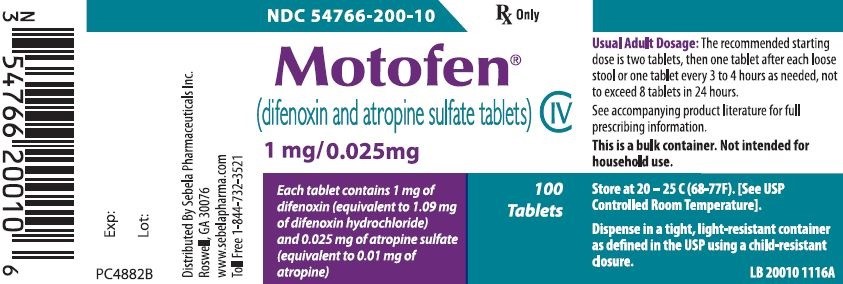
54766-200-10 Bottle Label 100 Count Bottle Label
54766-200-10 Carton Motofen 100 ct Carton
Medicare Part D spend CMS · PART D · 2026 (Q1)
About this NDC listing & data coverage
What data is (and isn’t) available for this NDC — tap to expand
| NDC identity (package / product / labeler codes) | ✓ Available |
| Labeler | ✓ Available |
| Product & package description | ✓ Available |
| Marketing category & status | ✓ Available |
| Active ingredient / dosage form / route | ✓ Available |
| FDA label (SPL via DailyMed) | ✓ Available |
| Package photos | ✓ Available |
| Inactive ingredients (structured) | ✓ Available |
| NADAC pharmacy acquisition price (CMS) | — Not published for this NDC CMS publishes NADAC only for NDCs reported in its retail-pharmacy survey. |
| Orange Book / therapeutic-equivalence data | — Not published for this NDC Applies only to products approved under an NDA/ANDA; many listings are out of scope. |
| HCPCS J-code billing crosswalk | — Not published for this NDC Most self-administered / retail products have no J-code — that is normal. |
| Medicaid utilization (CMS SDUD) | — Not published for this NDC CMS reports utilization only for NDCs with Medicaid claims above its privacy threshold. |