
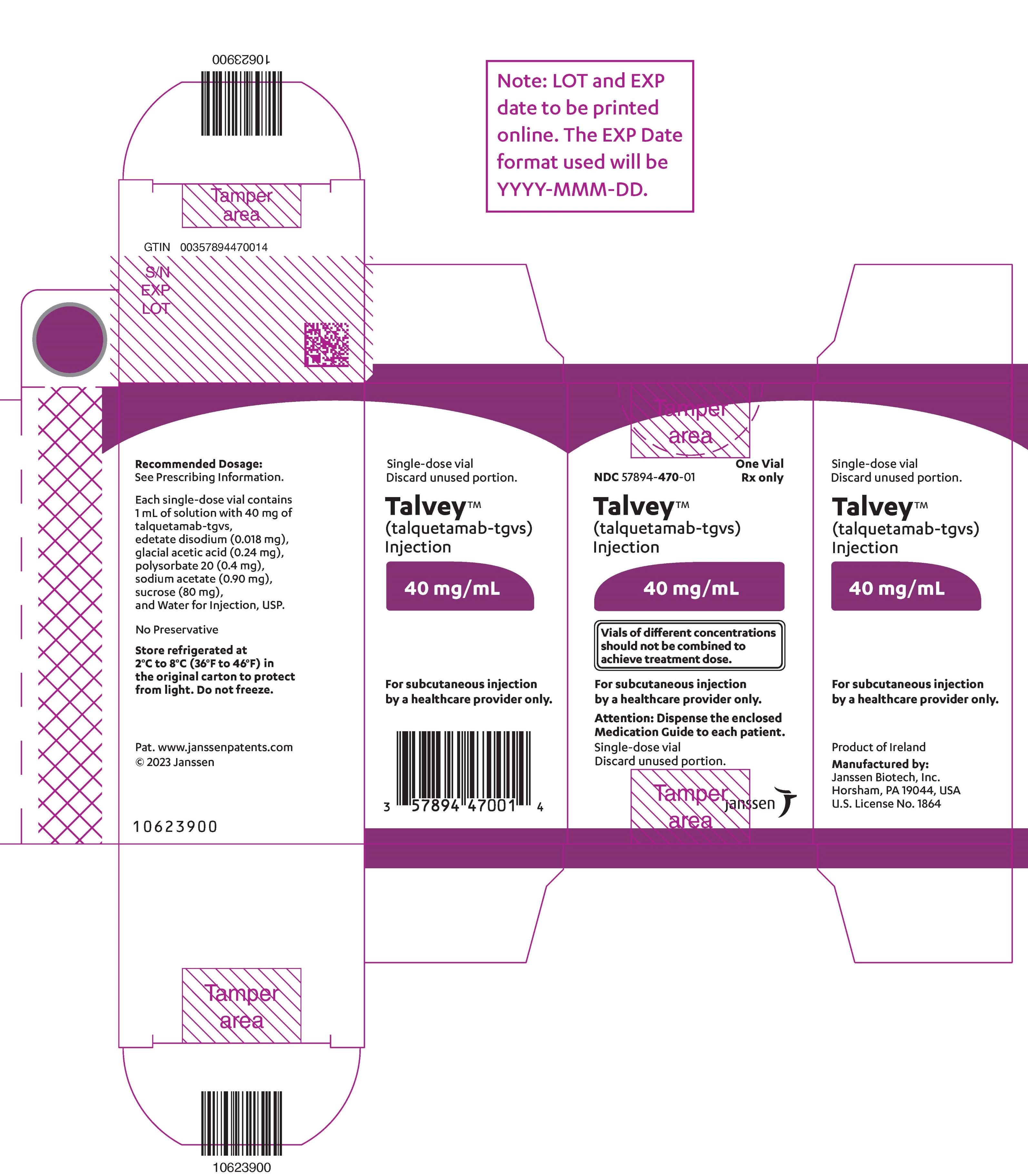
TALVEY talquetamab 40 mg/mL Injection, 1 vial — NDC 57894-470-01 (Billing 57894-0470-01)
This is a package of 1 vial of TALVEY talquetamab 40 mg/mL Injection from Janssen Biotech, Inc., marketed since Aug 2023 and currently FDA-listed. It is this product's only package size.
NDC database record
One package, one record: these facts belong to NDC 57894-470-01 alone.
- Record
- FDA NDC Directory package listing · Human prescription drug
- Code segments
- 57894 labeler · 470 product · 01 package
- Package marketed since
- Aug 9, 2023
- Sample package
- No — commercial package
- Listing certified through
- Dec 31, 2026
- Barcode (UPC)
- 0357894470014, 0357894469018
- Medicaid fills, this package
- 311 prescriptions in the last four reported quarters
- FDA record last changed
- Jul 24, 2026
Identity & classification
Regulatory identifiers FDA, NLM and CMS codes for this package
Drug-database identifiers Medi-Span GPI and First Databank GCN / HICL / AHFS classification
- GSN (GCN sequence number): 085142
- GCN: 52914
- GPI-14 (Medi-Span): 21352076802040
- HICL (First Databank): 049135
- AHFS class code: 10:00.00.00
- RxCUI (RxNorm): 2644452
Where does this data come from?
- FDA openFDA NDC Directory · synced Oct 8, 2026
- FDA label on DailyMed · label index refreshed Oct 6, 2026
- RxNorm (NLM RxNav) · catalog refreshed Oct 1, 2026
- Medi-Span GPI (licensed)
- First Databank (licensed) · refreshed Oct 8, 2026
RxNorm drug class
This medicine belongs to the Other monoclonal antibodies and antibody drug conjugates class.
Where does this data come from?
- RxClass (NLM) · catalog refreshed Oct 1, 2026
Clinical
Talquetamab-tgvs is used to treat multiple myeloma (a type of cancer of the bone marrow) that has returned or that did not respond to at least 4 other treatments. Talquetamab-tgvs is in a class of medications called bispecific T-cell engager antibodies. It works by killing cancer cells.
Read the full MedlinePlus article ↗Patient education
Supplement & herbal interactions
Where does this data come from?
- MedlinePlus (NLM) · refreshed Oct 1, 2026
- FDA label on DailyMed · label index refreshed Oct 6, 2026
Ask a licensed pharmacist directly — free, answered by our team.
Pricing
A drug doesn't have one price. Each row is a different public payment system, and none is what you'd pay at the counter — that depends on your insurance. The ⓘ on each row explains what it measures.
| Price system | Per each | Per package |
|---|---|---|
| Retail pharmacies payNADAC · weekly | Not in the retail survey — common for institutional, discontinued, or low-volume packs. | |
| Medicaid paysCMS SDUD · 12 mo | $6,830.80 | $6,830.80 / 1 vial |
| Medicare drug plans payPart D · quarterly | No Part D plan price is available for this NDC in our data. | |
| Medicare Part B allowsASP · J3055 | $76.721 / J3055 unit | — |
Where does this data come from?
- CMS NADAC weekly file
- CMS ASP pricing files · refreshed Sep 20, 2026
- CMS Medicaid State Drug Utilization Data · through Q1 2026
- CMS Part D plan pricing files · refreshed Sep 24, 2026
- VA National Acquisition Center price file
Billing & reimbursement
Where does this data come from?
- CMS ASP NDC-HCPCS crosswalk · refreshed Sep 22, 2026
- DMEPDAC NDC-HCPCS crosswalk
- openFDA NSDE billing units · refreshed Oct 7, 2026
Packaging — all sizes for this product
| Package NDC | Description | Marketing start | Marketing end | Status |
|---|---|---|---|---|
| 57894-0470-01 You're viewing this Main listing | 1 VIAL, SINGLE-DOSE in 1 CARTON / 1 mL in 1 VIAL, SINGLE-DOSE | 2023-08-09 | — | Active |
Therapeutic equivalents
| Product | Labeler | Pack | NADAC/unit | TE | Status | Price vs. this |
|---|---|---|---|---|---|---|
| Talvey 40 mg/mLthis 57894-0470-01 | Janssen | 1 vial | — | — | FDA listed | — |
Where does this data come from?
- FDA openFDA NDC Directory · synced Oct 8, 2026
- FDA Purple Book · refreshed Oct 5, 2026
- CMS NADAC weekly file
Availability & biosimilar status
Biologics have no small-molecule generics; biosimilar competition is tracked in the FDA Purple Book.
Why the date isn’t exact: Biosimilar timing can change because patents may be challenged, settled, licensed, added or removed, and litigation can move the real date earlier or later.
🛈 What do these terms mean?
- Biologic patent
- A patent the reference product’s maker has publicly listed. A biosimilar generally can’t launch until these expire — unless they’re invalidated or resolved in a settlement.
- Reference-product exclusivity
- A flat 12 years of FDA market protection from the biologic’s first licensure (the BPCIA). No biosimilar can be licensed before it ends, regardless of patents.
- Interchangeable exclusivity
- The first interchangeable biosimilar can earn a period as the only interchangeable version (pharmacists can substitute it without the prescriber).
- Earliest biosimilar (LOE)
- The latest of all the dates above — the soonest a biosimilar can realistically reach the market. Litigation and settlements can move it earlier.
Biologics have no small-molecule “generics” — competition comes from FDA-licensed biosimilars, tracked in the FDA Purple Book.
| Code | What it grants | Expires |
|---|---|---|
| RefProduct | Reference-product exclusivity (12-year, BPCIA) — no biosimilar can be licensed before this date | Aug 9, 2035 |
Is there a biosimilar for TALVEY 40 MG/ML VIAL?
Why do different websites show different biosimilar dates?
Can a biosimilar launch before the last patent expires?
What does “current Purple Book estimate” mean?
What does “FDA listed” mean?
What does a patent or protection date mean here?
Where does this data come from?
- FDA Purple Book · refreshed Oct 5, 2026
What it looks like
Where does this data come from?
- FDA label on DailyMed · label index refreshed Oct 6, 2026
Inactive Ingredients / Excipients
Inactive ingredients, also called excipients, are components of the drug product other than the active ingredient. They may include fillers, dyes, coatings, preservatives, flavors, or other formulation ingredients.
💡 Tap an ingredient (hover on desktop) to see what it is and why it’s used.
-
UNII Q40Q9N063P
Acetic acid is a weak organic acid commonly used in medicines as a buffer and pH adjuster. It helps maintain the proper acidity level to ensure the drug remains stable and effective in its formulation.
-
UNII 7FLD91C86K
Edetate disodium is a chemical compound that binds and removes certain metal ions. In medicines, it acts as a preservative and stabilizer by preventing metals like calcium from interfering with the product's shelf life and consistency.
-
UNII 7T1F30V5YH
A synthetic emulsifier derived from sorbitol and oleic acid. It helps mix oil and water-based ingredients together and keeps them from separating in liquid formulations.
-
UNII 4550K0SC9B
Sodium acetate is a salt derived from acetic acid. It acts as a buffer to help maintain the medicine's pH stability and may serve as a preservative or solubilizer in liquid formulations.
-
UNII C151H8M554
A natural sugar derived from sugar cane or sugar beets. It's used as a sweetener, filler, and binder to improve taste, add bulk, and help hold tablet or capsule ingredients together.
-
UNII 059QF0KO0R
Water is a liquid solvent that dissolves and mixes ingredients together in liquid medicines, syrups, and injections. It helps distribute the active drug evenly throughout the product.
6 inactive ingredients listed in the exact product block matched to this NDC.
Where does this data come from?
ingredient classCode="IACT" elements from the exact product block matched by this NDC. Label-section narrative from DailyMed / the openFDA label index is shown separately when available.- FDA label on DailyMed · label index refreshed Oct 6, 2026
- FDA openFDA NDC Directory · synced Oct 8, 2026
Inactive ingredient FAQ
Are inactive ingredients the same for every manufacturer?
Why might an inactive ingredient be missing?
Can inactive ingredients matter?
Manufacturer & labeler
More NDCs from Janssen Biotech, Inc. labeler code 57894
- ustekinumab 45 mg/.5mL Injection, Solution NDC 57894-440-01
- ustekinumab 90 mg/mL Injection, Solution NDC 57894-441-01
- ustekinumab 130 mg/26mL Solution NDC 57894-444-01
- TECVAYLI teclistamab-cqyv 10 mg/mL Injection NDC 57894-449-01
- TECVAYLI teclistamab-cqyv 90 mg/mL Injection NDC 57894-450-01
- TALVEY talquetamab 3 mg/1.5mL Injection NDC 57894-469-01
- Rybrevant amivantamab-vmjw 350 mg Injection NDC 57894-501-01
- DARZALEX Daratumumab 100 mg/5mL Injection, Solution, Concentrate NDC 57894-502-05
- Darzalex Faspro daratumumab and hyaluronidase-fihj (human recombinant) 1800 mg/15mL; 30000 U/15mL Injection NDC 57894-503-01
- Darzalex IV Daratumumab 100 mg/5mL Injection, Solution, Concentrate NDC 57894-505-05
- Rybrevant Faspro AMIVANTAMAB and HYALURONIDASE-lpuj (HUMAN RECOMBINANT) 1600 mg/10mL; 20000 mg/10mL Injection NDC 57894-510-01
- Rybrevant Faspro AMIVANTAMAB and HYALURONIDASE-lpuj (HUMAN RECOMBINANT) 2240 mg/14mL; 28000 mg/14mL Injection NDC 57894-514-01
Where does this data come from?
- FDA openFDA NDC Directory · synced Oct 8, 2026
- Drugs@FDA
Full prescribing information FDA SPL
🚨 Boxed Warning ▾
WARNING: CYTOKINE RELEASE SYNDROME and NEUROLOGIC TOXICITY, including IMMUNE EFFECTOR CELL-ASSOCIATED NEUROTOXICITY SYNDROME Cytokine release syndrome (CRS), including life-threatening or fatal reactions, can occur in patients receiving TALVEY. Initiate TALVEY treatment with step-up dosing to reduce the risk of CRS. Withhold TALVEY until CRS resolves or permanently discontinue based on severity [see Dosage and Administration (2.2 , 2.5 ) , Warnings and Precautions (5.1) ] .
Neurologic toxicity, including immune effector cell-associated neurotoxicity syndrome (ICANS), and serious and life threatening or fatal reactions, can occur with TALVEY. Monitor patients for signs and symptoms of neurologic toxicity including ICANS during treatment and treat promptly. Withhold or permanently discontinue TALVEY based on severity [see Dosage and Administration (2.5) , Warnings and Precautions (5.2) ] .
Because of the risk of CRS and neurologic toxicity, including ICANS, TALVEY is available only through a restricted program called the TECVAYLI and TALVEY Risk Evaluation and Mitigation Strategy (REMS) [see Warnings and Precautions (5.3) ] . WARNING: CYTOKINE RELEASE SYNDROME and NEUROLOGIC TOXICITY, including IMMUNE EFFECTOR CELL-ASSOCIATED NEUROTOXICITY SYNDROME See full prescribing information for complete boxed warning. Cytokine release syndrome (CRS), including life-threatening or fatal reactions, can occur in patients receiving TALVEY.
Initiate TALVEY treatment with step-up dosing to reduce the risk of CRS. Withhold TALVEY until CRS resolves or permanently discontinue based on severity. ( 2.2 , 2.5 , 5.1 ) Neurologic toxicity, including immune effector cell-associated neurotoxicity syndrome (ICANS), and serious and life-threatening or fatal reactions, can occur in patients receiving TALVEY.
Monitor patients for signs or symptoms of neurologic toxicity, including ICANS, during treatment. Withhold or permanently discontinue TALVEY based on severity. ( 2.5 , 5.2 ) TALVEY is available only through a restricted program called the TECVAYLI and TALVEY Risk Evaluation and Mitigation Strategy (REMS).
( 5.3 )
🎯 Indications and Usage ▾
1 INDICATIONS AND USAGE TALVEY is indicated for the treatment of adult patients with relapsed or refractory multiple myeloma who have received at least four prior lines of therapy, including a proteasome inhibitor, an immunomodulatory agent and an anti-CD38 monoclonal antibody. This indication is approved under accelerated approval based on response rate and durability of response [see Clinical Studies (14) ]. Continued approval for this indication may be contingent upon verification and description of clinical benefit in a confirmatory trial(s).
TALVEY is a bispecific GPRC5D-directed CD3 T-cell engager indicated for the treatment of adult patients with relapsed or refractory multiple myeloma who have received at least four prior lines of therapy, including a proteasome inhibitor, an immunomodulatory agent and an anti-CD38 monoclonal antibody. This indication is approved under accelerated approval based on response rate and durability of response. Continued approval for this indication may be contingent upon verification and description of clinical benefit in a confirmatory trial(s).
( 1 )
⏱️ Dosage and Administration ▾
2 DOSAGE AND ADMINISTRATION For subcutaneous injection. ( 2.2 ) Patients should be hospitalized for 48 hours after all doses within the step-up dosing schedule. ( 2.1 ) Administer pretreatment medications as recommended.
( 2.3 ) See Full Prescribing Information for instructions on preparation and administration. ( 2.6 ) TALVEY Weekly Dosing Schedule ( 2.2 ) Dosing schedule Day Dose Based on actual body weight. Step-up dosing schedule Day 1 Step-up dose 1 0.01 mg/kg Day 4 Dose may be administered between 2 to 4 days after the previous dose and may be given up to 7 days after the previous dose to allow for resolution of adverse reactions.
Step-up dose 2 0.06 mg/kg Day 7 First treatment dose 0.4 mg/kg Weekly dosing schedule One week after first treatment dose and weekly thereafter Maintain a minimum of 6 days between weekly doses. Subsequent treatment doses 0.4 mg/kg once weekly TALVEY Biweekly (Every 2 Weeks) Dosing Schedule ( 2.2 ) Dosing schedule Day Dose Based on actual body weight. Step-up dosing schedule Day 1 Step-up dose 1 0.01 mg/kg Day 4 Dose may be administered between 2 to 4 days after the previous dose and may be given up to 7 days after the previous dose to allow for resolution of adverse reactions.
Step-up dose 2 0.06 mg/kg Day 7 Step-up dose 3 0.4 mg/kg Day 10 Dose may be administered between 2 to 7 days after step-up dose 3. First treatment dose 0.8 mg/kg Biweekly (every 2 weeks) dosing schedule Two weeks after first treatment dose and every 2 weeks thereafter Maintain a minimum of 12 days between biweekly (every 2 weeks) doses. Subsequent treatment doses 0.8 mg/kg every 2 weeks
2.1Important Dosing Information Administer TALVEY subcutaneously according to the step-up dosing schedule in Tables 1 and 2 to reduce the incidence and severity of cytokine release syndrome (CRS) [see Dosage and Administration (2.2) ] . Administer pretreatment medications prior to each dose of TALVEY in the step-up dosing schedule as recommended [see Dosage and Administration (2.2 , 2.3) ]. TALVEY should only be administered by a qualified healthcare professional with appropriate medical support to manage severe reactions such as CRS and neurologic toxicity including immune effector cell-associated neurotoxicity syndrome (ICANS) [see Warnings and Precautions (5.1 , 5.2) ] .
Due to the risk of CRS and neurologic toxicity, including ICANS, patients should be hospitalized for 48 hours after administration of all doses within the TALVEY step-up dosing schedule [see Dosage and Administration (2.5) and Warnings and Precautions (5.1 , 5.2) ] .
2.2Recommended Dosage For subcutaneous injection. Administer pretreatment medications prior to each dose of TALVEY in the step-up dosing schedule [see Dosage and Administration (2.3) ] . Administer TALVEY subcutaneously on a weekly or biweekly (every 2 weeks) dosing schedule according to Table 1 or Table 2.
Continue treatment until disease progression or unacceptable toxicity. Table 1: TALVEY Weekly Dosing Schedule Dosing schedule Day Dose Based on actual body weight. Step-up dosing schedule Day 1 Step-up dose 1 0.01 mg/kg Day 4 Dose may be administered between 2 to 4 days after the previous dose and may be given up to 7 days after the previous dose to allow for resolution of adverse reactions.
Step-up dose 2 0.06 mg/kg Day 7 First treatment dose 0.4 mg/kg Weekly dosing schedule One week after first treatment dose and weekly thereafter Maintain a minimum of 6 days between weekly doses. Subsequent treatment doses 0.4 mg/kg once weekly Table 2: TALVEY Biweekly (Every 2 Weeks) Dosing Schedule Dosing schedule Day Dose Based on actual body weight. Step-up dosing schedule Day 1 Step-up dose 1 0.01 mg/kg Day 4 Dose may be administered between 2 to 4 days after the previous dose and may be given up to 7 days after the previous dose to allow for resolution of adverse reactions.
Step-up dose 2 0.06 mg/kg Day 7 Step-up dose 3 0.4 mg/kg Day 10 Dose may be administered between 2 to 7 days after step-up dose 3. First… [Excerpted — this section continues on DailyMed.]
💊 Dosage Forms and Strengths ▾
3 DOSAGE FORMS AND STRENGTHS Injection 3 mg/1.5 mL (2 mg/mL) in a single-dose vial ( 3 ) 40 mg/mL in a single-dose vial ( 3 ) Injection 3 mg/1.5 mL (2 mg/mL) colorless to light yellow solution in a single-dose vial 40 mg/mL colorless to light yellow solution in a single-dose vial
⛔ Contraindications ▾
4 CONTRAINDICATIONS None. None. ( 4 )
⚠️ Warnings and Cautions ▾
5 WARNINGS AND PRECAUTIONS Oral Toxicity and Weight Loss : Monitor for oral toxicity and weight loss. Withhold or permanently discontinue based on severity. ( 5.4 ) Infections : Can cause serious, life-threatening, or fatal infections.
Monitor for signs and symptoms of infection; treat appropriately. Withhold or consider permanent discontinuation based on severity. ( 5.5 ) Cytopenias : Monitor complete blood counts.
( 5.6 ) Skin Toxicity : Monitor for skin toxicity, including rash progression, for early intervention and treat appropriately. Withhold as recommended based on severity. ( 5.7 ) Hepatotoxicity: Monitor liver enzymes and bilirubin at baseline and during treatment as clinically indicated.
Withhold or consider permanent discontinuation based on severity. ( 5.8 ) Embryo-Fetal Toxicity : May cause fetal harm. Advise females of reproductive potential of the potential risk to the fetus and to use effective contraception.
( 5.9 , 8.1 , 8.3 )
5.1Cytokine Release Syndrome (CRS) TALVEY can cause cytokine release syndrome, including life-threatening or fatal reactions [see Adverse Reactions (6.1) ] . In the clinical trial, CRS occurred in 76% of patients who received TALVEY at the recommended dosages, with Grade 1 CRS occurring in 57% of patients, Grade 2 in 17%, and Grade 3 in 1.5%. Recurrent CRS occurred in 30% of patients.
Most events occurred following step-up dose 1 (29%) or step-up dose 2 (44%) at the recommended dosages. CRS occurred in 33% of patients with step-up dose 3 in the biweekly dosing schedule (N=153). CRS occurred in 30% of patients with the first 0.4 mg/kg treatment dose and in 12% of patients treated with the first 0.8 mg/kg treatment dose.
The CRS rate for both dosing schedules combined was less than 3% for each of the remaining doses in Cycle 1 and less than 3% cumulatively from Cycle 2 onward. The median time to onset of CRS was 27 (range: 0.1 to 167) hours from the last dose, and the median duration was 17 (range: 0 to 622) hours. Clinical signs and symptoms of CRS include but are not limited to pyrexia, hypotension, chills, hypoxia, headache, and tachycardia.
Potentially life-threatening complications of CRS may include cardiac dysfunction, acute respiratory distress syndrome, neurologic toxicity, renal and/or hepatic failure, and disseminated intravascular coagulation (DIC). Initiate TALVEY therapy with step-up dosing and administer pre-treatment medications (corticosteroids, antihistamine, and antipyretics) prior to each dose of TALVEY in the step-up dosing schedule to reduce the risk of CRS. Monitor patients following administration accordingly.
In patients who experience CRS, pre-treatment medications should be administered prior to the next TALVEY dose [see Dosage and Administration (2.2 , 2.3) ]. Counsel patients to seek medical attention should signs or symptoms of CRS occur. At the first sign of CRS, immediately evaluate patient for hospitalization and institute treatment with supportive care based on severity and consider further management per current practice guidelines.
Withhold TALVEY until CRS resolves or permanently discontinue based on severity [see Dosage and Administration (2.5) ] . TALVEY is available only through a restricted program under a REMS [see Warnings and Precautions (5.3) ] .
5.2Neurologic Toxicity including ICANS TALVEY can cause serious, life-threatening, or fatal neurologic toxicity, including ICANS [see Adverse Reactions (6.1) ] . In the clinical trial, neurologic toxicity, including ICANS, occurred in 55% of patients who received TALVEY at the recommended dosages, with Grade 3 or 4 neurologic toxicity occurring in 6% of patients. The most frequent neurologic toxicities were headache (20%), encephalopathy (15%), sensory neuropathy (14%), and motor dysfunction, including ataxia/cerebellar ataxia (10%).
ICANS was reported in 9% of 265 patients where ICANS was collected and who received TALVEY at the recommended dosages [see Adverse Reactions (6.1) ] . Recurrent ICANS o… [Excerpted — this section continues on DailyMed.]
🤒 Adverse Reactions ▾
6 ADVERSE REACTIONS The following adverse reactions are also described elsewhere in the labeling: Cytokine Release Syndrome [see Warnings and Precautions (5.1) ] Neurologic Toxicity, including ICANS [see Warnings and Precautions (5.2) ] Oral Toxicity and Weight Loss [see Warnings and Precautions (5.4) ] Infections [see Warnings and Precautions (5.5) ] Cytopenias [see Warnings and Precautions (5.6) ] Skin Toxicity [see Warnings and Precautions (5.7) ] Hepatotoxicity [see Warnings and Precautions (5.8) ] The most common adverse reactions (≥20%) are pyrexia, CRS, dysgeusia, nail disorder, musculoskeletal pain, skin disorder, rash, fatigue, weight decreased, dry mouth, xerosis, dysphagia, upper respiratory tract infection, diarrhea, hypotension, and headache.
( 6.1 ) The most common Grade 3 or 4 laboratory abnormalities (≥30%) are lymphocyte count decreased, neutrophil count decreased, white blood cell decreased, and hemoglobin decreased. ( 6.1 ) To report SUSPECTED ADVERSE REACTIONS, contact Janssen Biotech, Inc. at 1-800-JANSSEN (1-800-526-7736) or FDA at 1-800-FDA-1088 or www.fda.gov/medwatch.
6.1Clinical Trials Experience Because clinical trials are conducted under widely varying conditions, adverse reaction rates observed in the clinical trials of a drug cannot be directly compared to rates in the clinical trials of another drug and may not reflect the rates observed in practice. Relapsed/Refractory Multiple Myeloma MonumenTAL-1 The safety of TALVEY was evaluated in 339 adult patients with relapsed or refractory multiple myeloma. Patients treated with the weekly dosing schedule received step-up doses of 0.01 mg/kg and 0.06 mg/kg of TALVEY followed by TALVEY 0.4 mg/kg subcutaneously weekly thereafter.
Patients treated with the biweekly (every 2 weeks) dosing schedule received step-up doses of 0.01 mg/kg, 0.06 mg/kg, and 0.3 mg/kg (0.75 times the recommended step-up dose 3) followed by TALVEY 0.8 mg/kg subcutaneously every 2 weeks thereafter. The duration of exposure for the 0.4 mg/kg weekly regimen was 5.9 (range: 0.0 to 25.3) months (N=186) and for the 0.8 mg/kg biweekly (every 2 weeks) regimen, it was 3.7 (range: 0.0 to 17.9) months (N=153). Serious adverse reactions occurred in 47% of patients who received TALVEY.
Serious adverse reactions in ≥ 2% of patients included CRS (13%), bacterial infection (8%) including sepsis, pyrexia (4.7%), ICANS (3.8%), COVID-19 (2.7%), neutropenia (2.1%), and upper respiratory tract infection (2.1%). Fatal adverse reactions occurred in 3.2% of patients who received TALVEY, including COVID - 19 (0.6%), dyspnea (0.6%), general physical health deterioration (0.6%), bacterial infection (0.3%) including sepsis, basilar artery occlusion (0.3%), fungal infection (0.3%), infection (0.3%), and pulmonary embolism (0.3%).
Permanent discontinuation of TALVEY due to an adverse reaction occurred in 9% of patients. Adverse reactions which resulted in permanent discontinuation of TALVEY in > 1% of patients included ICANS. Dosage interruptions of TALVEY due to an adverse reaction occurred in 56% of patients.
Adverse reactions which required dosage interruption in > 5% of patients included pyrexia (15%), CRS (12%), upper respiratory tract infection (9%), COVID-19 (9%), bacterial infection (7%) including sepsis, neutropenia (6%), and rash (6%). The most common adverse reactions (≥ 20%) were pyrexia, CRS, dysgeusia, nail disorder, musculoskeletal pain, skin disorder, rash, fatigue, weight decreased, dry mouth, xerosis, dysphagia, upper respiratory tract infection, diarrhea, hypotension, and headache. The most common Grade 3 or 4 laboratory abnormalities (≥ 30%) were lymphocyte count decreased, neutrophil count decreased, white blood cell decreased, and hemoglobin decreased.
Table 13 summarizes the adverse reactions in MonumenTAL-1. Table 13: Adverse Reactions (≥10%) in Patients with Relapsed or Refractory Multiple Myeloma Who Received TALVEY in MonumenTAL-1 TALVEY N=339 System Organ Class Adverse Reaction Any G… [Excerpted — this section continues on DailyMed.]
🔄 Drug Interactions ▾
7 DRUG INTERACTIONS For certain cytochrome P450 (CYP) substrates, minimal changes in the substrate concentration may lead to serious adverse reactions. Monitor for toxicity or drug concentrations of such CYP substrates when co-administered with TALVEY. Talquetamab-tgvs causes release of cytokines [see Clinical Pharmacology (12.2) ] that may suppress activity of CYP enzymes, resulting in increased exposure of CYP substrates.
Increased exposure of CYP substrates is more likely to occur from initiation of the TALVEY step-up dosing schedule up to 14 days after the first treatment dose and during and after CRS [see Warnings and Precautions (5.1) ] .
👥 Use in Specific Populations ▾
8 USE IN SPECIFIC POPULATIONS Lactation : Advise not to breastfeed. ( 8.2 )
8.1Pregnancy Risk Summary Based on the mechanism of action, TALVEY may cause fetal harm when administered to a pregnant woman [see Clinical Pharmacology (12.1) ] . There are no available data on the use of TALVEY in pregnant women to evaluate for a drug associated risk. No animal reproductive or developmental toxicity studies have been conducted with talquetamab-tgvs.
Talquetamab-tgvs causes T-cell activation and cytokine release; immune activation may compromise pregnancy maintenance. Human immunoglobulin G (IgG) is known to cross the placenta; therefore, TALVEY has the potential to be transmitted from the mother to the developing fetus. Advise women of the potential risk to the fetus.
In the U.S. general population, the estimated background risk of major birth defects and miscarriage in clinically recognized pregnancies is 2% to 4% and 15% to 20%, respectively.
8.2Lactation Risk Summary There is no information regarding the presence of talquetamab-tgvs in human milk, the effect on the breastfed child, or the effect on milk production. Maternal IgG is known to be present in human milk. The effects of local gastrointestinal exposure and limited systemic exposure in the breastfed child to TALVEY are unknown.
Because of the potential for serious adverse reactions in a breastfed child, advise women not to breastfeed during treatment with TALVEY and for 3 months after the last dose.
8.3Females and Males of Reproductive Potential TALVEY may cause fetal harm when administered to a pregnant woman [see Use in Specific Populations (8.1) ] . Pregnancy Testing Verify pregnancy status of females of reproductive potential prior to initiating TALVEY. Contraception Females Advise females of reproductive potential to use effective contraception during treatment with TALVEY and for 3 months after the last dose.
8.4Pediatric Use The safety and efficacy of TALVEY have not been established in pediatric patients.
8.5Geriatric Use There were 339 patients in the clinical trial for relapsed or refractory multiple myeloma. Of the total number of TALVEY-treated patients in the study, 178 (53%) patients were 65 years of age and older, while 57 (17%) patients were 75 years of age and older. No overall differences in safety or effectiveness were observed in patients 65 to less than 74 years of age compared to younger patients.
There was a higher rate of fatal adverse reactions in patients 75 years of age or older compared to younger patients [see Adverse Reactions (6.1) ]. Clinical studies did not include sufficient numbers of patients 75 years of age or over to determine whether they respond differently from younger patients.
🤰 Pregnancy ▾
8.1Pregnancy Risk Summary Based on the mechanism of action, TALVEY may cause fetal harm when administered to a pregnant woman [see Clinical Pharmacology (12.1) ] . There are no available data on the use of TALVEY in pregnant women to evaluate for a drug associated risk. No animal reproductive or developmental toxicity studies have been conducted with talquetamab-tgvs.
Talquetamab-tgvs causes T-cell activation and cytokine release; immune activation may compromise pregnancy maintenance. Human immunoglobulin G (IgG) is known to cross the placenta; therefore, TALVEY has the potential to be transmitted from the mother to the developing fetus. Advise women of the potential risk to the fetus.
In the U.S. general population, the estimated background risk of major birth defects and miscarriage in clinically recognized pregnancies is 2% to 4% and 15% to 20%, respectively.
🧒 Pediatric Use ▾
8.4Pediatric Use The safety and efficacy of TALVEY have not been established in pediatric patients.
🧓 Geriatric Use ▾
8.5Geriatric Use There were 339 patients in the clinical trial for relapsed or refractory multiple myeloma. Of the total number of TALVEY-treated patients in the study, 178 (53%) patients were 65 years of age and older, while 57 (17%) patients were 75 years of age and older. No overall differences in safety or effectiveness were observed in patients 65 to less than 74 years of age compared to younger patients.
There was a higher rate of fatal adverse reactions in patients 75 years of age or older compared to younger patients [see Adverse Reactions (6.1) ]. Clinical studies did not include sufficient numbers of patients 75 years of age or over to determine whether they respond differently from younger patients.
🧬 Clinical Pharmacology ▾
12 CLINICAL PHARMACOLOGY
12.1Mechanism of Action Talquetamab-tgvs is a bispecific T-cell engaging antibody that binds to the CD3 receptor expressed on the surface of T-cells and G protein-coupled receptor class C group 5 member D (GPRC5D) expressed on the surface of multiple myeloma cells and non-malignant plasma cells, as well as healthy tissues such as epithelial cells in keratinized tissues of the skin and tongue. In vitro, talquetamab-tgvs activated T-cells caused the release of proinflammatory cytokines and resulted in the lysis of multiple myeloma cells.
Talquetamab-tgvs had anti-tumor activity in mouse models of multiple myeloma.
12.2Pharmacodynamics Serum concentrations of cytokines (IL-6, IL-10, TNF-α, and IFN-γ) and IL-2R were measured before and after administration of each step-up dose, the first three treatment doses at 0.4 mg/kg once weekly, and the first two treatment doses at 0.8 mg/kg every two weeks. Increased concentrations of IL-6, IL-10, and IL-2R were observed during this period. Higher talquetamab-tgvs exposures (i.e., AUC and C max ) are associated with higher incidence of some adverse reactions (including oral toxicity, nail toxicity, and skin reactions).
The exposure-response relationships for effectiveness and the time course of pharmacodynamic response of talquetamab-tgvs have not been fully characterized.
12.3Pharmacokinetics The C max and AUC tau of talquetamab-tgvs after subcutaneous administration increased proportionally over a dose range of 0.005 to 0.8 mg/kg weekly (0.01 to 2 times the recommended 0.4 mg/kg weekly treatment dose) and 0.8 to 1.2 mg/kg every two weeks (1 to 1.5 times the recommended 0.8 mg/kg every 2 weeks treatment dose). Ninety percent of steady state exposure was achieved 16 weeks after the first treatment dose for both regimens. The C max , C trough , C avg , and accumulation ratios of talquetamab-tgvs are presented in Table 15.
Table 15: Pharmacokinetic Parameters of Talquetamab-tgvs Following the Dose at 16 Weeks After the First Treatment Dose for the Approved Recommended Subcutaneous Dosages in Patients with Relapsed or Refractory Multiple Myeloma Talquetamab-tgvs Dosage Parameter 0.4 mg/kg every week 0.8 mg/kg every 2 weeks C avg = Average concentration over the dosing interval; : C max = Maximum serum talquetamab-tgvs concentration; C trough = Serum talquetamab-tgvs concentration prior to next dose Exposure Data are presented as geometric mean (coefficient of variation %).
C max (ng/mL) 2,940 (67%) 3,410 (63%) C trough (ng/mL) 2,410 (83%) 1,930 (103%) C avg (ng/mL) 2,730 (71%) 2,770 (72%) Accumulation Ratio For the 0.4 mg/kg every week regimen, accumulation ratios are presented as the arithmetic mean of the 17 th treatment dose / the first treatment dose. For the 0.8 mg/kg every 2 weeks regimen, accumulation ratios are presented as the arithmetic mean of the 9 th treatment dose / the first treatment dose. C max 4.4
1.8C trough 4.6
2.3C avg 5.1
2.0Absorption The geometric mean (coefficient of variation [CV] %) bioavailability of talquetamab-tgvs was 59% (22%) when administered subcutaneously. The median (range) T max of talquetamab-tgvs after the first and 17 th treatment dose of 0.4 mg/kg weekly were 3.7 (0.9 to 7) days and 2.5 (0.9 to 5.9) days, respectively. The median (range) T max of talquetamab-tgvs after the first and 9 th treatment dose of 0.8 mg/kg every 2 weeks were 3.4 (0.8 to 14) days and 3.6 (1 to 7.7) days, respectively.
Distribution The geometric mean (CV%) volume of distribution of talquetamab-tgvs was
10.1L (25%). Elimination Talquetamab-tgvs clearance decreases over time, with a mean (CV%) maximal reduction from the first treatment dose to 16 weeks after the first treatment dose of 40% (56%). The geometric mean (CV%) clearance is
0.90L/day (63%) at 16 weeks after the first treatment dose. The mean (CV%) terminal half-life was 8.4 (41%) days after the first treatment dose and 12.2 (49%) days at 16 weeks after the first treatment dose. Metabolism… [Excerpted — this section continues on DailyMed.]
🧬 Mechanism of Action ▾
12.1Mechanism of Action Talquetamab-tgvs is a bispecific T-cell engaging antibody that binds to the CD3 receptor expressed on the surface of T-cells and G protein-coupled receptor class C group 5 member D (GPRC5D) expressed on the surface of multiple myeloma cells and non-malignant plasma cells, as well as healthy tissues such as epithelial cells in keratinized tissues of the skin and tongue. In vitro, talquetamab-tgvs activated T-cells caused the release of proinflammatory cytokines and resulted in the lysis of multiple myeloma cells.
Talquetamab-tgvs had anti-tumor activity in mouse models of multiple myeloma.
📦 How Supplied / Storage and Handling ▾
16 HOW SUPPLIED/STORAGE AND HANDLING TALVEY ® (talquetamab-tgvs) injection is a sterile, preservative-free, colorless to light yellow solution supplied as follows: One 3 mg/1.5 mL (2 mg/mL) single-dose vial in a carton: NDC: 57894-469-01 One 40 mg/mL single-dose vial in a carton: NDC: 57894-470-01 Store refrigerated at 2°C to 8°C (36°F to 46°F) in original carton to protect from light. Do not freeze.
📦 Storage and Handling ▾
Store refrigerated at 2°C to 8°C (36°F to 46°F) in original carton to protect from light. Do not freeze.
📋 Description ▾
11 DESCRIPTION Talquetamab-tgvs is a bispecific GPRC5D-directed CD3 T-cell engager. It is a humanized IgG4 proline, alanine, alanine (IgG4-PAA)-based bispecific antibody produced by Chinese hamster ovary (CHO) cells using recombinant DNA technology. Talquetamab-tgvs consists of an anti-GPRC5D heavy chain and light chain and an anti-CD3 heavy chain and light chain with two interchain disulfide bonds connecting the two arms.
The molecular weight of talquetamab-tgvs is 147 kDa. TALVEY ® (talquetamab-tgvs) injection is a sterile, preservative-free colorless to light yellow solution supplied in a single-dose vial for subcutaneous administration. Each TALVEY 1.5 mL single-dose vial contains 3 mg of talquetamab-tgvs, edetate disodium (0.027 mg), glacial acetic acid (0.36 mg), polysorbate 20 (0.6 mg), sodium acetate (1.39 mg), sucrose (120 mg), and Water for Injection, USP.
The pH is 5.2. Each TALVEY 1 mL single-dose vial contains 40 mg of talquetamab-tgvs, edetate disodium (0.018 mg), glacial acetic acid (0.24 mg), polysorbate 20 (0.4 mg), sodium acetate (0.90 mg), sucrose (80 mg), and Water for Injection, USP. The pH is 5.2.
💬 Information for Patients ▾
17 PATIENT COUNSELING INFORMATION Advise the patient to read the FDA-approved patient labeling (Medication Guide). Cytokine Release Syndrome (CRS) Discuss the signs and symptoms associated with CRS including, but not limited to, pyrexia, hypotension, chills, hypoxia, headache, and tachycardia. Counsel patients to seek medical attention should signs or symptoms of CRS occur.
Advise patients that they should be hospitalized for 48 hours after administration of all doses within the TALVEY step-up dosing schedule [see Dosage and Administration (2.1 , 2.5) , Warnings and Precautions (5.1) ] . Neurologic Toxicity, including ICANS Discuss the signs and symptoms associated with neurologic toxicity, including headache, encephalopathy, sensory neuropathy, difficulty speaking and understanding speech, difficulty with coordination, uncontrolled fast eye movement, motor dysfunction including ataxia/cerebellar ataxia, and symptoms of ICANS including confusional state, depressed level of consciousness, disorientation, somnolence, lethargy, and bradyphrenia.
Counsel patients to seek medical attention should signs or symptoms of neurologic toxicity occur. Advise patients to refrain from driving or operating heavy or potentially dangerous machinery during the step-up dosing schedule and for 48 hours after completion of the step-up dosing schedule and in the event of new onset of any neurologic toxicity symptoms, until symptoms resolve [see Dosage and Administration (2.2 , 2.5) , Warnings and Precautions (5.2) ]. TECVAYLI and TALVEY REMS TALVEY is available only through a restricted program called the TECVAYLI and TALVEY REMS.
Inform patients that they will be given a Patient Wallet Card that they should carry with them at all times and show to all of their healthcare providers. This card describes signs and symptoms of CRS and neurologic toxicity, including ICANS which, if experienced, should prompt the patient to immediately seek medical attention [see Warnings and Precautions (5.3) ]. Oral Toxicity and Weight Loss Discuss the signs and symptoms of oral toxicities including dysgeusia, dry mouth, dysphagia, and stomatitis.
Counsel patients to seek medical attention should signs or symptoms of oral toxicity occur. Advise patients that they may experience weight loss and to report weight loss. Advise patients that they may be referred to a nutritionist for consultation [see Dosage and Administration (2.5) , Warnings and Precautions (5.4) ] .
Infections Discuss the signs and symptoms of serious infections [see Dosage and Administration (2.5) , Warnings and Precautions (5.5) ] . Cytopenias Discuss the signs and symptoms associated with neutropenia and thrombocytopenia [see Dosage and Administration (2.5) , Warnings and Precautions (5.6) ] . Skin Toxicity Discuss the signs and symptoms of skin reactions [see Dosage and Administration (2.5) , Warnings and Precautions (5.7) ] .
Hepatotoxicity Advise patients that liver enzyme elevations may occur and that they should report symptoms that may indicate liver toxicity, including fatigue, anorexia, right upper abdominal discomfort, dark urine, or jaundice [see Warnings and Precautions (5.8) ]. Embryo-Fetal Toxicity Advise pregnant women and females of reproductive potential of the potential risk to a fetus. Advise females of reproductive potential to inform their healthcare provider if they are pregnant or become pregnant.
Advise females of reproductive potential to use effective contraception during treatment with TALVEY and for 3 months after the last dose [see Warnings and Precautions (5.9) , Use in Specific Populations (8.1 , 8.3) ] . Lactation Advise women not to breastfeed during treatment with TALVEY and for 3 months after the last dose [see Use in Specific Populations (8.2) ] .
💬 Medication Guide ▾
MEDICATION GUIDE TALVEY ® [tal vay] (talquetamab-tgvs) injection, for subcutaneous use This Medication Guide has been approved by the U.S. Food and Drug Administration. Revised: 10/2025 What is the most important information I should know about TALVEY?
TALVEY may cause side effects that are serious, life-threatening, or lead to death, including Cytokine Release Syndrome (CRS) and neurologic problems. Call your healthcare provider or get medical help right away if you develop any of the signs or symptoms of CRS or neurologic problems listed below at any time during your treatment with TALVEY : Cytokine Release Syndrome (CRS). CRS is common during treatment with TALVEY and can also be serious, life-threatening, or lead to death.
Signs and symptoms of CRS may include: fever (100.4°F or higher) dizziness or lightheadedness chills difficulty breathing feeling anxious headache fast heartbeat Neurologic problems. Symptoms of neurologic problems with TALVEY may include: headache feeling confused being less alert or aware feeling disoriented trouble speaking or writing shaking (tremors) numbness and tingling (feeling like "pins and needles") problems with walking, or loss of balance or coordination feeling sleepy feeling very sleepy with low energy slow or difficulty thinking seizures muscle weakness memory loss burning, throbbing, or stabbing pain fast eye movements that you cannot control Due to the risk of CRS and neurologic problems, you should be hospitalized for 48 hours after all doses of TALVEY that are part of the "step-up dosing schedule".
The "step-up dosing schedule" is when you receive the first 2 or 3 doses of TALVEY, which are smaller "step-up" doses, and also the first full "treatment dose" of TALVEY. TALVEY is given weekly or every 2 weeks. Your healthcare provider will decide the number of days to wait between your doses of TALVEY as well as how many treatments you will receive.
If you receive TALVEY weekly, "Step-up dose 1" is given on day 1 of treatment. "Step-up dose 2" is usually given on day 4 of treatment. The first "treatment dose" is usually given on day 7 of treatment. If you receive TALVEY every 2 weeks, "Step-up dose 1" is given on day 1 of treatment. "Step-up dose 2" is usually given on day 4 of treatment. "Step-up dose 3" is usually given on day 7 of treatment.
The first "treatment dose" is usually given on day 10 of treatment. If your dose of TALVEY is delayed for any reason, you may need to repeat the "step-up dosing schedule" to receive TALVEY. Before each "step up" dose of TALVEY, you will receive medicines to help reduce your risk of CRS.
Your healthcare provider will decide if you need to receive medicines to help reduce your risk of CRS with future doses. Your healthcare provider will monitor you for signs and symptoms of CRS, neurologic problems, as well as other side effects and treat you as needed. TALVEY is available only through the TECVAYLI and TALVEY Risk Evaluation and Mitigation Strategy (REMS) due to the risk of CRS and neurologic problems.
You will receive a Patient Wallet Card from your healthcare provider. Carry the Patient Wallet Card with you at all times and show it to all of your healthcare providers. The Patient Wallet Card lists signs and symptoms of CRS and neurologic problems.
Get medical help right away if you develop any of the signs and symptoms listed on the Patient Wallet Card. You may need to be treated in a hospital. If you have any questions about TALVEY, ask your healthcare provider.
Your healthcare provider may temporarily stop or completely stop your treatment with TALVEY if you develop CRS, neurologic problems or any other side effects that are severe. See " What are the possible side effects of TALVEY? " for more information about side effects. What is TALVEY?
TALVEY is a prescription medicine used to treat adults with multiple myeloma who: have already received at least 4 treatment regimens, including a proteasome inhibitor, an immunomodulatory agent and an anti-C… [Excerpted — this section continues on DailyMed.]
🧬 Pharmacokinetics ▾
12.3Pharmacokinetics The C max and AUC tau of talquetamab-tgvs after subcutaneous administration increased proportionally over a dose range of 0.005 to 0.8 mg/kg weekly (0.01 to 2 times the recommended 0.4 mg/kg weekly treatment dose) and 0.8 to 1.2 mg/kg every two weeks (1 to 1.5 times the recommended 0.8 mg/kg every 2 weeks treatment dose). Ninety percent of steady state exposure was achieved 16 weeks after the first treatment dose for both regimens. The C max , C trough , C avg , and accumulation ratios of talquetamab-tgvs are presented in Table 15.
Table 15: Pharmacokinetic Parameters of Talquetamab-tgvs Following the Dose at 16 Weeks After the First Treatment Dose for the Approved Recommended Subcutaneous Dosages in Patients with Relapsed or Refractory Multiple Myeloma Talquetamab-tgvs Dosage Parameter 0.4 mg/kg every week 0.8 mg/kg every 2 weeks C avg = Average concentration over the dosing interval; : C max = Maximum serum talquetamab-tgvs concentration; C trough = Serum talquetamab-tgvs concentration prior to next dose Exposure Data are presented as geometric mean (coefficient of variation %).
C max (ng/mL) 2,940 (67%) 3,410 (63%) C trough (ng/mL) 2,410 (83%) 1,930 (103%) C avg (ng/mL) 2,730 (71%) 2,770 (72%) Accumulation Ratio For the 0.4 mg/kg every week regimen, accumulation ratios are presented as the arithmetic mean of the 17 th treatment dose / the first treatment dose. For the 0.8 mg/kg every 2 weeks regimen, accumulation ratios are presented as the arithmetic mean of the 9 th treatment dose / the first treatment dose. C max 4.4
1.8C trough 4.6
2.3C avg 5.1
2.0Absorption The geometric mean (coefficient of variation [CV] %) bioavailability of talquetamab-tgvs was 59% (22%) when administered subcutaneously. The median (range) T max of talquetamab-tgvs after the first and 17 th treatment dose of 0.4 mg/kg weekly were 3.7 (0.9 to 7) days and 2.5 (0.9 to 5.9) days, respectively. The median (range) T max of talquetamab-tgvs after the first and 9 th treatment dose of 0.8 mg/kg every 2 weeks were 3.4 (0.8 to 14) days and 3.6 (1 to 7.7) days, respectively.
Distribution The geometric mean (CV%) volume of distribution of talquetamab-tgvs was
10.1L (25%). Elimination Talquetamab-tgvs clearance decreases over time, with a mean (CV%) maximal reduction from the first treatment dose to 16 weeks after the first treatment dose of 40% (56%). The geometric mean (CV%) clearance is
0.90L/day (63%) at 16 weeks after the first treatment dose. The mean (CV%) terminal half-life was 8.4 (41%) days after the first treatment dose and 12.2 (49%) days at 16 weeks after the first treatment dose. Metabolism Talquetamab-tgvs is expected to be metabolized into small peptides by catabolic pathways.
Specific Populations The volume of distribution and clearance of talquetamab-tgvs increased with increasing bodyweight (40 kg to 143 kg). There were no clinically significant differences in the pharmacokinetics of talquetamab-tgvs based on age (33 to 86 years), sex, race (White, Black or African American), ethnicity (Not Hispanic/Latino, Hispanic/Latino), mild or moderate renal impairment (creatinine clearance [CLcr] by Cockcroft-Gault equation: 30 to 89 mL/min) or mild (total bilirubin less than or equal to upper limit of normal [ULN] with AST greater than ULN or total bilirubin greater than 1 to 1.5 times ULN with any AST) or moderate (total bilirubin greater than 1.5 to less than 3 times ULN with any AST) hepatic impairment.
The effects of severe renal impairment (CLcr less than 30 mL/min) or severe hepatic impairment (total bilirubin greater than 3 times ULN with any AST) on the pharmacokinetics of talquetamab-tgvs are unknown.
🧬 Pharmacodynamics ▾
12.2Pharmacodynamics Serum concentrations of cytokines (IL-6, IL-10, TNF-α, and IFN-γ) and IL-2R were measured before and after administration of each step-up dose, the first three treatment doses at 0.4 mg/kg once weekly, and the first two treatment doses at 0.8 mg/kg every two weeks. Increased concentrations of IL-6, IL-10, and IL-2R were observed during this period. Higher talquetamab-tgvs exposures (i.e., AUC and C max ) are associated with higher incidence of some adverse reactions (including oral toxicity, nail toxicity, and skin reactions).
The exposure-response relationships for effectiveness and the time course of pharmacodynamic response of talquetamab-tgvs have not been fully characterized.
🔬 Clinical Studies ▾
14 CLINICAL STUDIES The efficacy of TALVEY monotherapy was evaluated in patients with relapsed or refractory multiple myeloma in a single-arm, open-label, multicenter study, MMY1001 (MonumenTAL-1) (NCT03399799, NCT04634552). The study included patients who had previously received at least three prior systemic therapies, including a proteasome inhibitor, an immunomodulatory agent, and an anti-CD38 monoclonal antibody. The study excluded patients who experienced T-cell redirection therapy within 3 months, prior Grade 3 or higher CRS related to any T-cell redirection therapy, an autologous stem cell transplant within the past 12 weeks, an allogeneic stem cell transplant within the past 6 months, Eastern Cooperative Oncology Group (ECOG) performance score of 3 or higher, stroke or seizure within the past 6 months, CNS involvement or clinical signs of meningeal involvement of multiple myeloma, and plasma cell leukemia, active or documented history of autoimmune disease (exception of vitiligo, resolved childhood atopic dermatitis, resolved Grave's Disease that is euthyroid based on clinical and laboratory testing).
Patients treated with the weekly dosing schedule received step-up doses of 0.01 mg/kg and 0.06 mg/kg of TALVEY followed by TALVEY 0.4 mg/kg subcutaneously weekly thereafter. Patients treated with the biweekly (every 2 weeks) dosing schedule received step-up doses of 0.01 mg/kg, 0.06 mg/kg, and 0.3 mg/kg (0.75 times the recommended step-up dose 3) of TALVEY followed by TALVEY 0.8 mg/kg subcutaneously biweekly, thereafter. Patients on both dosing schedules were treated until disease progression or unacceptable toxicity.
The efficacy results from the 187 patients treated with TALVEY who were not exposed to prior T cell redirection therapy and who had received at least 4 prior lines of therapy are presented below; of these patients, the median age was 67 (range: 38 to 86) years, 57% were male, 90% were White, 5% were Black or African American, 3% were Asian, and 8% were Hispanic. Patients had received a median of 5 (range: 4 to 13) prior lines of therapy, and 78% had received prior autologous stem cell transplantation (ASCT). Ninety-four percent (94%) of patients were refractory to their last therapy, and 73% were refractory to a proteasome inhibitor, immunomodulatory agent, and anti-CD38 antibody.
The International Staging System (ISS) at study entry was Stage I in 44%, Stage II in 34%, and Stage III in 22% of patients. High-risk cytogenetic factors (presence of t(4:14), t(14:16), and/or del(17p)) were present in 29% of patients; baseline cytogenetic data were not available in 11% of patients. Twenty-two percent (22%) of patients had extramedullary plasmacytomas.
Efficacy was based on overall response rate (ORR) and duration of response (DOR) as assessed by an Independent Review Committee using IMWG criteria. The median duration of follow-up from first response among responders receiving TALVEY 0.4 mg/kg weekly was 13.8 (range: 0.8 to 15.4) months. Table 16: Efficacy Results for MMY1001 (MonumenTAL-1) in Patients Receiving 0.4 mg/kg Weekly TALVEY 0.4 mg/kg Weekly (N=100) CI=confidence interval; NE=not estimable Overall response rate (ORR=sCR+CR+VGPR+PR) 73 (73%) 95% CI (63.2%, 81.4%) Stringent complete response (sCR) 26% Complete response (CR) 9% Very good partial response (VGPR) 22% Partial response (PR) 16% Duration of Response (DOR) Median DOR (95% CI) (months) 9.5 (6.5, NE) The median duration of follow-up from first response among responders receiving TALVEY 0.8 mg/kg biweekly was 5.9 (range: 0 to 9.5) months; an estimated 85% of responders maintained response for at least 9 months.
Table 17: Efficacy Results for MMY1001 (MonumenTAL-1) in Patients Receiving 0.8 mg/kg Biweekly (Every 2 Weeks) TALVEY 0.8 mg/kg Biweekly (Every 2 Weeks) (N=87) CI=confidence interval; NE=not estimable Overall response rate (ORR=sCR+CR+VGPR+PR) 65 (73.6%) 95% CI (63.0%, 82.4%) Stringent complete response (sCR) 20% Complete response (CR) 13% V… [Excerpted — this section continues on DailyMed.]
🧪 Nonclinical Toxicology ▾
13 NONCLINICAL TOXICOLOGY
13.1Carcinogenesis, Mutagenesis, Impairment of Fertility No carcinogenicity or genotoxicity studies have been conducted with talquetamab-tgvs. No studies have been conducted to evaluate the effects of talquetamab-tgvs on fertility.
📄 Carcinogenesis, Mutagenesis, Impairment of Fertility ▾
13.1Carcinogenesis, Mutagenesis, Impairment of Fertility No carcinogenicity or genotoxicity studies have been conducted with talquetamab-tgvs. No studies have been conducted to evaluate the effects of talquetamab-tgvs on fertility.
📄 Recent Major Changes ▾
Dosage and Administration ( 2.5 ) 10/2025 Warnings and Precautions ( 5.2 ) 10/2025
📄 Package Label / Principal Display Panel ▾
PRINCIPAL DISPLAY PANEL - 3 mg Vial Carton NDC 57894-469-01 One Vial Rx only Talvey™ (talquetamab-tgvs) Injection 3 mg/1.5 mL (2 mg/mL) Vials of different concentrations should not be combined to achieve treatment dose. For subcutaneous injection by a healthcare provider only. Attention: Dispense the enclosed Medication Guide to each patient. Single-dose vial Discard unused portion. janssen PRINCIPAL DISPLAY PANEL - 3 mg Vial Carton
PRINCIPAL DISPLAY PANEL - 40 mg Vial Carton NDC 57894-470-01 One Vial Rx only Talvey™ (talquetamab-tgvs) Injection 40 mg/mL Vials of different concentrations should not be combined to achieve treatment dose. For subcutaneous injection by a healthcare provider only. Attention: Dispense the enclosed Medication Guide to each patient. Single-dose vial Discard unused portion. janssen PRINCIPAL DISPLAY PANEL - 40 mg Vial Carton
Medicaid utilization & spend
Medicare Part D spend CMS · PART D · 2026 (Q1)
Reported adverse events (FAERS)
Top reported reactions
Age at onset
Reporter sex
Serious outcomes
Where does this data come from?
About this NDC listing & data coverage
What data is (and isn’t) available for this NDC — tap to expand
| NDC identity (package / product / labeler codes) | ✓ Available |
| Labeler | ✓ Available |
| Product & package description | ✓ Available |
| Marketing category & status | ✓ Available |
| Active ingredient / dosage form / route | ✓ Available |
| FDA label (SPL via DailyMed) | ✓ Available |
| Package photos | ✓ Available |
| Inactive ingredients (structured) | ✓ Available |
| NADAC pharmacy acquisition price (CMS) | — Not published for this NDC CMS publishes NADAC only for NDCs reported in its retail-pharmacy survey. |
| Orange Book / therapeutic-equivalence data | ✓ Available |
| HCPCS J-code billing crosswalk | ✓ Available |
| Medicaid utilization (CMS SDUD) | ✓ Available |