
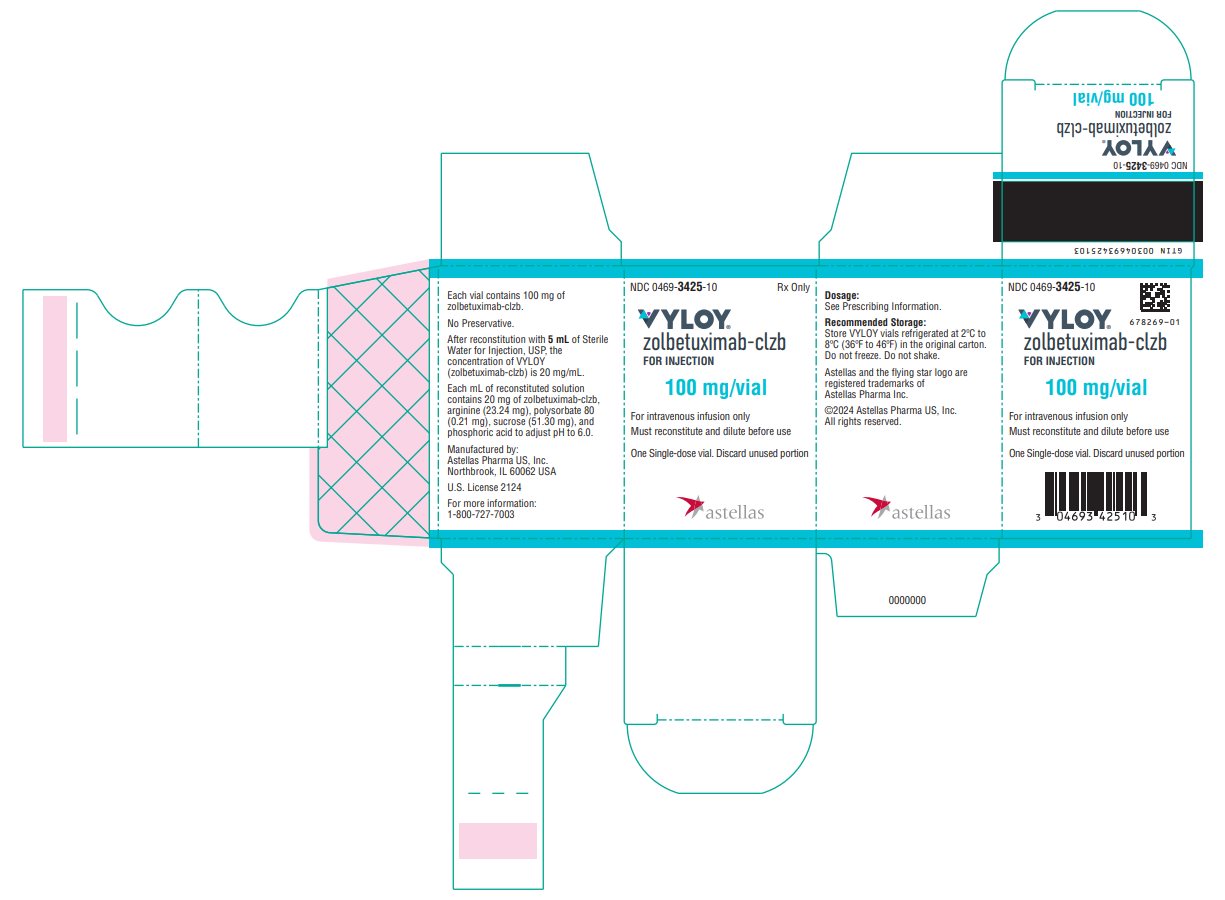
VYLOY ZOLBETUXIMAB 20 mg/mL Injection, Powder, For Suspension — NDC 0469-3425-10 (Billing 00469-3425-10)
This is a package of VYLOY ZOLBETUXIMAB 20 mg/mL Injection, Powder, For Suspension from Astellas Pharma US, Inc., marketed since Oct 2024 and currently FDA-listed. It is this product's only package size.
NDC database record
One package, one record: these facts belong to NDC 0469-3425-10 alone.
- Record
- FDA NDC Directory package listing · Human prescription drug
- Code segments
- 0469 labeler · 3425 product · 10 package
- Package marketed since
- Oct 24, 2024
- Sample package
- No — commercial package
- Listing certified through
- Dec 31, 2027
- Barcode (UPC-A, from the NDC)
- 3 0469342510 3
- Medicaid fills, this package
- 292 prescriptions in the last four reported quarters
- FDA record last changed
- Sep 17, 2026
Identity & classification
Regulatory identifiers FDA, NLM and CMS codes for this package
Drug-database identifiers Medi-Span GPI and First Databank GCN / HICL / AHFS classification
- GSN (GCN sequence number): 086655
- GCN: 56396
- HICL (First Databank): 049949
- AHFS class code: 10:00.00.00
- RxCUI (RxNorm): 2695876
Where does this data come from?
- FDA openFDA NDC Directory · synced Oct 8, 2026
- FDA label on DailyMed · label index refreshed Oct 6, 2026
- RxNorm (NLM RxNav) · catalog refreshed Oct 1, 2026
- Medi-Span GPI (licensed)
- First Databank (licensed) · refreshed Oct 8, 2026
RxNorm drug class
This medicine belongs to the Claudin 18.2-directed Cytolytic Antibody class.
Where does this data come from?
- RxClass (NLM) · catalog refreshed Oct 1, 2026
Clinical
- Vyloy is used together with chemotherapy as first-line treatment for adults with advanced stomach or gastroesophageal junction cancer that cannot be removed by surgery or has sprea...
- You get it as an IV infusion from a healthcare professional, along with your chemotherapy. It is given every 2 or 3 weeks, and the first dose is larger. The infusion starts slowly...
- Nausea and vomiting are very common, especially in the first cycle. You may also feel tired, have less appetite, diarrhea, constipation, belly pain or tingling in your hands and fe...
- Speak up during or after the infusion if you get hives, repeated coughing, wheezing, throat tightness, a change in your voice, fever, chills, chest discomfort or back pain. These c...
Patient education
Supplement & herbal interactions
Where does this data come from?
- MedlinePlus (NLM) · refreshed Oct 1, 2026
- FDA label on DailyMed · label index refreshed Oct 6, 2026
Ask a licensed pharmacist directly — free, answered by our team.
Pricing
A drug doesn't have one price. Each row is a different public payment system, and none is what you'd pay at the counter — that depends on your insurance. The ⓘ on each row explains what it measures.
| Price system | Per mL | Per package |
|---|---|---|
| Retail pharmacies payNADAC · weekly | Not in the retail survey — common for institutional, discontinued, or low-volume packs. | |
| Medicaid paysCMS SDUD · 12 mo | $287.03 | $1,435.17 / 5 ml |
| Medicare drug plans payPart D · quarterly | No Part D plan price is available for this NDC in our data. | |
| Medicare Part B allowsASP · J1326 | $33.924 / J1326 unit | — |
Where does this data come from?
- CMS NADAC weekly file
- CMS ASP pricing files · refreshed Sep 20, 2026
- CMS Medicaid State Drug Utilization Data · through Q1 2026
- CMS Part D plan pricing files · refreshed Sep 24, 2026
- VA National Acquisition Center price file
Billing & reimbursement
Where does this data come from?
- CMS ASP NDC-HCPCS crosswalk · refreshed Sep 22, 2026
- DMEPDAC NDC-HCPCS crosswalk
- openFDA NSDE billing units · refreshed Oct 7, 2026
Packaging — all sizes for this product
| Package NDC | Description | Marketing start | Marketing end | Status |
|---|---|---|---|---|
| 00469-3425-10 You're viewing this Main listing | 1 VIAL in 1 BOX / 5 mL in 1 VIAL | 2024-10-24 | — | Active |
Therapeutic equivalents
| Product | Labeler | Pack | NADAC/unit | TE | Status | Price vs. this |
|---|---|---|---|---|---|---|
| Vyloy 20 mg/mLthis 00469-3425-10 | Astellas | 1 vial | — | — | FDA listed | — |
| Vyloy 20 mg/mL 00469-4425-30 | Astellas | 1 vial | — | — | FDA listed | — |
Where does this data come from?
- FDA openFDA NDC Directory · synced Oct 8, 2026
- FDA Purple Book · refreshed Oct 5, 2026
- CMS NADAC weekly file
Availability & biosimilar status
Biologics have no small-molecule generics; biosimilar competition is tracked in the FDA Purple Book.
Why the date isn’t exact: Biosimilar timing can change because patents may be challenged, settled, licensed, added or removed, and litigation can move the real date earlier or later.
🛈 What do these terms mean?
- Biologic patent
- A patent the reference product’s maker has publicly listed. A biosimilar generally can’t launch until these expire — unless they’re invalidated or resolved in a settlement.
- Reference-product exclusivity
- A flat 12 years of FDA market protection from the biologic’s first licensure (the BPCIA). No biosimilar can be licensed before it ends, regardless of patents.
- Interchangeable exclusivity
- The first interchangeable biosimilar can earn a period as the only interchangeable version (pharmacists can substitute it without the prescriber).
- Earliest biosimilar (LOE)
- The latest of all the dates above — the soonest a biosimilar can realistically reach the market. Litigation and settlements can move it earlier.
Biologics have no small-molecule “generics” — competition comes from FDA-licensed biosimilars, tracked in the FDA Purple Book.
| Code | What it grants | Expires |
|---|---|---|
| RefProduct | Reference-product exclusivity (12-year, BPCIA) — no biosimilar can be licensed before this date | Oct 18, 2036 |
Is there a biosimilar for VYLOY 100 MG VIAL?
Why do different websites show different biosimilar dates?
Can a biosimilar launch before the last patent expires?
What does “current Purple Book estimate” mean?
What does “FDA listed” mean?
What does a patent or protection date mean here?
Where does this data come from?
- FDA Purple Book · refreshed Oct 5, 2026
Inactive Ingredients / Excipients
Inactive ingredients, also called excipients, are components of the drug product other than the active ingredient. They may include fillers, dyes, coatings, preservatives, flavors, or other formulation ingredients.
🧪 Avoiding an ingredient? See Zolbetuximab inactive ingredients by manufacturer: every current product's list side by side, so you can ask your pharmacy for the version that does not list it.
💡 Tap an ingredient (hover on desktop) to see what it is and why it’s used.
-
23.24 mg / 1 mL
UNII 94ZLA3W45F
Arginine is an amino acid used in medicines as a buffer and pH adjuster. It helps maintain the proper acidity level and stability of liquid formulations.
-
UNII E4GA8884NN
Phosphoric acid is a weak mineral acid used in medicines as a buffer and pH adjuster. It helps stabilize the product and control its acidity level.
-
0.21 mg / 1 mL
UNII 6OZP39ZG8H
Polysorbate 80 is a synthetic emulsifier derived from sorbitol and oleic acid. It helps mix oil and water-based ingredients together in medications and improves how the product disperses in the body.
-
51.30 mg / 1 mL
UNII C151H8M554
A natural sugar derived from sugar cane or sugar beets. It's used as a sweetener, filler, and binder to improve taste, add bulk, and help hold tablet or capsule ingredients together.
4 inactive ingredients listed in the exact product block matched to this NDC.
Where does this data come from?
ingredient classCode="IACT" elements from the exact product block matched by this NDC. Label-section narrative from DailyMed / the openFDA label index is shown separately when available.- FDA label on DailyMed · label index refreshed Oct 6, 2026
- FDA openFDA NDC Directory · synced Oct 8, 2026
Inactive ingredient FAQ
Are inactive ingredients the same for every manufacturer?
Why might an inactive ingredient be missing?
Can inactive ingredients matter?
Manufacturer & labeler
More NDCs from Astellas Pharma US, Inc. labeler code 00469
- Veozah fezolinetant 45 mg Tablet, Film Coated NDC 0469-2660-30
- Veozah fezolinetant 45 mg Tablet, Film Coated NDC 0469-2760-28
- Cresemba isavuconazonium sulfate 40 mg Capsule NDC 0469-2860-35
- Prograf Tacrolimus 5 mg/mL Injection, Solution NDC 0469-3016-01
- AmBisome amphotericin B 50 mg/12.5mL Injection, Powder, Lyophilized, For Solution NDC 0469-3051-30
- Mycamine Micafungin sodium 10 mg/mL Injection, Powder, Lyophilized, For Solution NDC 0469-3250-10
- VYLOY ZOLBETUXIMAB 20 mg/mL Injection, Powder, For Suspension NDC 0469-4425-30
- Myrbetriq mirabegron 8 mg/mL Granule, For Suspension, Extended Release NDC 0469-5020-99
- LEXISCAN regadenoson .08 mg/mL Injection, Solution NDC 0469-6501-89
Where does this data come from?
- FDA openFDA NDC Directory · synced Oct 8, 2026
- Drugs@FDA
Full prescribing information FDA SPL
🎯 Indications and Usage ▾
1 INDICATIONS AND USAGE VYLOY, in combination with fluoropyrimidine- and platinum-containing chemotherapy, is indicated for the first-line treatment of adults with locally advanced unresectable or metastatic human epidermal growth factor receptor 2 (HER2)‑negative gastric or gastroesophageal junction (GEJ) adenocarcinoma whose tumors are claudin (CLDN) 18.2 positive as determined by an FDA-approved test [see Dosage and Administration ( 2.1 ) and Clinical Studies ( 14 )]. VYLOY is a claudin 18.2-directed cytolytic antibody and is indicated in combination with fluoropyrimidine- and platinum-containing chemotherapy for the first-line treatment of adults with locally advanced unresectable or metastatic human epidermal growth factor receptor 2 (HER2)-negative gastric or gastroesophageal junction adenocarcinoma whose tumors are claudin (CLDN) 18.2 positive as determined by an FDA-approved test ( 1 ).
⏱️ Dosage and Administration ▾
2 DOSAGE AND ADMINISTRATION • Administer by intravenous infusion only . Do not administer VYLOY as an intravenous push or bolus. ( 2.6 ) • The recommended first dose of VYLOY is 800 mg/m 2 followed by 600 mg/m 2 every 3 weeks or 400 mg/m 2 every 2 weeks. ( 2.3 )
2.1Patient Selection Select adult patients with locally advanced unresectable or metastatic HER2-negative gastric or GEJ adenocarcinoma whose tumors are CLDN18.2 positive (defined as ≥75% of tumor cells demonstrating moderate to strong membranous CLDN18 immunohistochemical staining) for treatment with VYLOY in combination with fluoropyrimidine- and platinum-containing chemotherapy using an FDA-approved test [see Clinical Studies ( 14 )]. Information on FDA-approved tests for the detection of CLDN18.2 is available at https://www.fda.gov/CompanionDiagnostics .
2.2Prior to Administration If a patient is experiencing nausea and/or vomiting prior to administration of VYLOY, the symptoms should be resolved to Grade ≤1 before administering the first infusion. Premedication Prior to each infusion of VYLOY, premedicate patients with a combination of antiemetics (e.g., NK-1 receptor blockers and/or 5-HT3 receptor blockers, as well as other drugs as indicated) for the prevention of nausea and vomiting [see Warnings and Precautions ( 5.2 )].
2.3Recommended Dosage Administer VYLOY in combination with fluoropyrimidine- and platinum-containing chemotherapy as follows: • First dose: 800 mg/m 2 intravenously. • Subsequent doses: o 600 mg/m 2 intravenously every 3 weeks, or o 400 mg/m 2 intravenously every 2 weeks. • Continue treatment until disease progression or unacceptable toxicity.
2.4Dosage Modifications for Adverse Reactions No dose reduction for VYLOY is recommended. Adverse reactions for VYLOY are managed by reducing the infusion rate, interruption of the infusion, withholding the dose, and/or permanently discontinuing VYLOY as described in Table 1 . Table 1.
Recommended Dose Modifications for VYLOY for Adverse Reactions Adverse Reaction Severity Toxicity was graded per National Cancer Institute Common Terminology Criteria for Adverse Events Version 5.0 (NCI-CTCAE v5.0). Dose Modification Hypersensitivity or Infusion-related reactions [see Warnings and Precautions ( 5.1 )]. Grade 2 • Interrupt the infusion until Grade ≤1, then resume at a reduced infusion rate for the remaining infusion. • Premedicate and administer the next infusion per the infusion rates in Table 2.
Grade 3 Follow Grade 2 management for Grade 3 infusion-related nausea and vomiting. or 4 or anaphylaxis • Immediately stop the infusion and permanently discontinue.
2.5Preparation Reconstitution • Calculate the recommended dose based on the patient’s body surface area as described in Section 2.3 to determine the total volume and number of vials needed. • Reconstitute each vial of VYLOY to achieve a concentration of 20 mg/mL as follows: o 100 mg vial add 5 mL of Sterile Water for Injection. o 300 mg vial add 15 mL of Sterile Water for Injection. • Slowly add the Sterile Water for Injection into the VYLOY vial, and direct the stream toward the inside wall of the vial. Do not inject directly onto the lyophilized powder. • Slowly swirl each vial until the contents are completely dissolved.
Allow the reconstituted vial(s) to settle until the bubbles are gone. Do not shake the vial . • Visually inspect the reconstituted solution for particulate matter and discoloration. The reconstituted solution should be clear to slightly opalescent, colorless to slight yellow and free of visible particles.
Discard any vial with visible particles or discoloration. • Store reconstituted vial(s) at room temperature 15°C to 30°C (59°F to 86°F) for up to 5 hours if not used immediately. This product does not contain a preservative . Dilution • Withdraw the required volume of reconstituted VYLOY vial(s) and transfer into an infusion bag containing 0.9% Sodium Chloride Injection, to a final concentration of 5 mg/mL. o The diluted solut… [Excerpted — this section continues on DailyMed.]
💊 Dosage Forms and Strengths ▾
3 DOSAGE FORMS AND STRENGTHS For injection: 100 mg and 300 mg of zolbetuximab-clzb as a white to off-white lyophilized powder in a single-dose vial. For injection: 100 mg and 300 mg lyophilized powder in a single-dose vial. ( 3 )
⛔ Contraindications ▾
4 CONTRAINDICATIONS None. None. ( 4 )
⚠️ Warnings and Cautions ▾
5 WARNINGS AND PRECAUTIONS • Hypersensitivity reactions including serious anaphylaxis reactions and serious and fatal infusion-related reactions have occurred. Monitor patients during and for at least 2 hours after infusion with VYLOY. Interrupt, slow the rate of infusion or permanently discontinue VYLOY based on severity and type of reaction.
Premedicate with antihistamines for subsequent infusions after a hypersensitivity reaction. ( 2.4 , 5.1 ) • Severe nausea and vomiting: Premedicate patients with antiemetics prior to each infusion. Interrupt or permanently discontinue VYLOY based on the severity of the nausea and/or vomiting.
Manage patients during and after infusion with antiemetics or fluid replacement. ( 2.4 , 5.2 )
5.1Hypersensitivity reactions, including anaphylaxis reactions, and infusion related reactions Hypersensitivity reactions, including serious anaphylaxis reactions, and serious and fatal infusion-related reactions (IRR) have been reported in clinical studies when VYLOY has been administered. Any grade hypersensitivity reactions, including anaphylactic reactions, occurring with VYLOY in combination with mFOLFOX6 or CAPOX was 18%. Severe (Grade 3 or 4) hypersensitivity reactions, including anaphylactic reactions, occurred in 2% of patients.
Seven patients (1.3%) permanently discontinued VYLOY for hypersensitivity reactions, including two patients (0.4%) who permanently discontinued VYLOY due to anaphylactic reactions. Seventeen (3.2%) patients required dose interruption, and three patients (0.6%) required infusion rate reduction due to hypersensitivity reactions. All grade IRRs occurred in 3.2% in patients administered VYLOY in combination with mFOLFOX6 or CAPOX.
Severe (Grade 3) IRRs occurred in 2 (0.4%) patients who received VYLOY. An IRR led to permanent discontinuation of VYLOY in 2 (0.4%) patients and dose interruption in 7 (1.3%) patients. The infusion rate was reduced for VYLOY for 2 (0.4%) patients due to an IRR.
Monitor patients during infusion with VYLOY and for 2 hours after completion of infusion or longer if clinically indicated, for hypersensitivity reactions with symptoms and signs that are highly suggestive of anaphylaxis (urticaria, repetitive cough, wheeze and throat tightness/change in voice). Monitor patients for signs and symptoms of IRRs including nausea, vomiting, abdominal pain, salivary hypersecretion, pyrexia, chest discomfort, chills, back pain, cough and hypertension. If a severe or life-threatening hypersensitivity or IRR reaction occurs, discontinue VYLOY permanently, treat symptoms according to standard medical care, and monitor until symptoms resolve.
For any Grade 2 hypersensitivity or IRR, interrupt the VYLOY infusion until Grade ≤1, then resume at a reduced infusion rate for the remaining infusion. Premedicate the patient with antihistamines for the subsequent infusions, administer per the infusion rates in Table 2 and closely monitor the patient for symptoms and signs of a hypersensitivity reaction. The infusion rate may be gradually increased as tolerated [see Dosage and Administration ( 2.4 )] .
5.2Severe Nausea and Vomiting VYLOY is emetogenic. Nausea and vomiting occurred more often during the first cycle of treatment. All grade nausea and vomiting occurred in 82% and 67%, respectively, of patients treated with VYLOY in combination with mFOLFOX6 and 69% and 66% in combination with CAPOX, respectively.
Severe (Grade 3) nausea occurred in 16% and 9% of patients treated with VYLOY in combination with mFOLFOX6 or CAPOX respectively. Severe (Grade 3) vomiting occurred in 16% and 12% of patients treated with VYLOY in combination with mFOLFOX6 or CAPOX. Nausea led to permanent discontinuation of VYLOY in combination with mFOLFOX6 or CAPOX in 18 (3.4%) patients and dose interruption in 147 (28%) patients.
Vomiting led to permanent discontinuation of VYLOY in combination with mFOLFOX6 or CAPOX in 20 (3.8%) patients and dose interruption in 150 (28%) patients. Pretreat with ant… [Excerpted — this section continues on DailyMed.]
🤒 Adverse Reactions ▾
6 ADVERSE REACTIONS The following serious adverse reactions are described elsewhere in the labeling: • Hypersensitivity Reactions, including anaphylaxis, and infusion related reactions [see Warnings and Precautions ( 5.1 )] . • Severe Nausea and Vomiting [see Warnings and Precautions ( 5.2 )] . The most common adverse reactions (≥15%) for VYLOY in combination with mFOLFOX6 or CAPOX were nausea, vomiting, fatigue, decreased appetite, diarrhea, peripheral sensory neuropathy, abdominal pain, constipation, decreased weight, hypersensitivity reactions, and pyrexia.
The most common laboratory abnormalities (≥15%) for VYLOY in combination with mFOLFOX6 or CAPOX were decreased neutrophil count, decreased leucocyte count, decreased albumin, increased creatinine, decreased hemoglobin, increased glucose, decreased lymphocyte count, increased aspartate aminotransferase, decreased platelets, increased alkaline phosphatase, increased alanine aminotransferase, decreased glucose, decreased sodium, decreased phosphate, decreased potassium, and decreased magnesium ( 6.1 ). To report SUSPECTED ADVERSE REACTIONS, contact Astellas Pharma US, Inc. at 1-800-727-7003 or FDA at 1-800-FDA-1088 or www.fda.gov/medwatch.
6.1Clinical Trials Experience Because clinical trials are conducted under widely varying conditions, adverse reaction rates observed in the clinical trials of a drug cannot be directly compared to rates in the clinical trials of another drug and may not reflect the rates observed in practice. The pooled safety population described in the WARNINGS AND PRECAUTIONS reflect exposure to VYLOY in 533 patients at an 800 mg/m 2 initial dose followed by subsequent doses of 600 mg/m 2 every 3 weeks in combination with fluoropyrimidine- and platinum-containing chemotherapy in the SPOTLIGHT (279) and GLOW (254) studies.
Among 533 patients who received VYLOY in these studies, 47% were exposed for ≥6 months and 20% were exposed for ≥12 months. In this pooled population, the most common (≥15%) adverse reactions, were nausea, vomiting, fatigue, decreased appetite, diarrhea, peripheral sensory neuropathy, abdominal pain, constipation, decreased weight, hypersensitivity reactions, and pyrexia. The most common (≥15%) laboratory abnormalities in the pooled population were decreased neutrophil count, decreased leucocyte count, decreased albumin, increased creatinine, decreased hemoglobin, increased glucose, decreased lymphocyte count, increased aspartate aminotransferase, decreased platelets, increased alkaline phosphatase, increased alanine aminotransferase, decreased glucose, decreased sodium, decreased phosphate, decreased potassium, and decreased magnesium.
SPOTLIGHT The safety of VYLOY was evaluated in SPOTLIGHT in patients with locally advanced unresectable or metastatic gastric or GEJ cancer who received at least one dose of VYLOY at an 800 mg/m 2 initial dose followed by 600 mg/m 2 subsequent doses every 3 weeks in combination with mFOLFOX6 [see Clinical Studies ( 14 )] . The median duration of exposure to VYLOY in combination with mFOLFOX6 was 6.2 months (range: 1 day to 40.9 months). Serious adverse reactions occurred in 45% of patients treated with VYLOY in combination with mFOLFOX6; the most common serious adverse reactions (≥2%) were vomiting (8%), nausea (7%), neutropenia (2.9%), febrile neutropenia (2.9%), diarrhea (2.9%), intestinal obstruction (3.2%), pyrexia (2.5%), pneumonia (2.5%), respiratory failure (2.2%), pulmonary embolism (2.2%), decreased appetite (2.1%) and sepsis (2.0%).
Fatal adverse reactions occurred in 5% of patients who received VYLOY in combination with mFOLFOX6 including sepsis (1.4%), pneumonia (1.1%), respiratory failure (1.1%), intestinal obstruction (0.7%), acute hepatic failure (0.4%), acute myocardial infarction (0.4%), death (0.4%), disseminated intravascular coagulation (0.4%), encephalopathy (0.4%), and upper gastrointestinal hemorrhage (0.4%). Permanent discontinuation of VYLOY due to an adverse reaction occurred… [Excerpted — this section continues on DailyMed.]
👥 Use in Specific Populations ▾
8 USE IN SPECIFIC POPULATIONS Lactation: Advise not to breastfeed. ( 8.2 )
8.1Pregnancy Risk Summary There are no data with VYLOY use in pregnant women to inform any drug-associated risks. Embryo-fetal toxicity was not observed in pregnant mice intravenously administered zolbetuximab-clzb [see Data] . VYLOY should only be given to a pregnant woman if the benefit outweighs the potential risk.
The background risk of major birth defects and miscarriage for the indicated population is unknown. In the U.S. general population, the estimated background risk of major birth defects and miscarriage in clinically recognized pregnancies is 2%-4% and 15%-20%, respectively. Data Animal Data In an embryo-fetal development toxicity study, zolbetuximab-clzb was intravenously administered to pregnant mice during the period of organogenesis and did not result in embryo-fetal toxicity at doses up to 300 mg/kg (approximately 1.9 times the recommended clinical dose based on AUC).
Zolbetuximab-clzb crossed the placental barrier resulting in higher fetal serum concentrations on Day 18 of gestation than maternal serum concentrations on Day 16 of gestation.
8.2Lactation Risk Summary There are no data on the presence of zolbetuximab-clzb in human milk, the effects on the breastfed child, or the effects on milk production. Because antibodies may be excreted in human milk and because of the potential for adverse reactions in a breastfed child, advise a lactating woman not to breastfeed during treatment with VYLOY and for 8 months after the last dose.
8.3Females and Males of Reproductive Potential VYLOY is used in combination with fluoropyrimidine- or platinum-containing chemotherapy. Refer to the Full Prescribing Information of fluoropyrimidine- and platinum-containing chemotherapy products for pregnancy testing, contraception, and infertility information.
8.4Pediatric Use The safety and effectiveness of VYLOY in pediatric patients have not been established.
8.5Geriatric Use Of the 533 patients in clinical studies of VYLOY in combination with mFOLFOX6 or CAPOX , 34% (n=179) were over 65 years, and 5% were over 75 years (n=28) [see Clinical Studies ( 14 )] . No overall differences in safety or effectiveness were observed between patients aged 65 years or older and younger patients.
🤰 Pregnancy ▾
8.1Pregnancy Risk Summary There are no data with VYLOY use in pregnant women to inform any drug-associated risks. Embryo-fetal toxicity was not observed in pregnant mice intravenously administered zolbetuximab-clzb [see Data] . VYLOY should only be given to a pregnant woman if the benefit outweighs the potential risk.
The background risk of major birth defects and miscarriage for the indicated population is unknown. In the U.S. general population, the estimated background risk of major birth defects and miscarriage in clinically recognized pregnancies is 2%-4% and 15%-20%, respectively. Data Animal Data In an embryo-fetal development toxicity study, zolbetuximab-clzb was intravenously administered to pregnant mice during the period of organogenesis and did not result in embryo-fetal toxicity at doses up to 300 mg/kg (approximately 1.9 times the recommended clinical dose based on AUC).
Zolbetuximab-clzb crossed the placental barrier resulting in higher fetal serum concentrations on Day 18 of gestation than maternal serum concentrations on Day 16 of gestation.
🧒 Pediatric Use ▾
8.4Pediatric Use The safety and effectiveness of VYLOY in pediatric patients have not been established.
🧓 Geriatric Use ▾
8.5Geriatric Use Of the 533 patients in clinical studies of VYLOY in combination with mFOLFOX6 or CAPOX , 34% (n=179) were over 65 years, and 5% were over 75 years (n=28) [see Clinical Studies ( 14 )] . No overall differences in safety or effectiveness were observed between patients aged 65 years or older and younger patients.
🧬 Clinical Pharmacology ▾
12 CLINICAL PHARMACOLOGY
12.1Mechanism of Action Zolbetuximab-clzb is a claudin 18.2 (CLDN18.2)-directed cytolytic antibody that depletes CLDN18.2-positive cells via antibody-dependent cellular cytotoxicity (ADCC) and complement-dependent cytotoxicity (CDC). Zolbetuximab-clzb in combination with chemotherapy had increased antitumor activity in CLDN18.2-expressing mouse tumor models compared to zolbetuximab-clzb or chemotherapy alone.
12.2Pharmacodynamics The exposure-response relationships for efficacy and safety at the recommended dosages of zolbetuximab-clzb in patients with locally advanced unresectable or metastatic HER2-negative gastric or gastroesophageal junction adenocarcinoma whose tumors are CLDN18.2 positive have not been fully characterized.
12.3Pharmacokinetics Following a 2-hour intravenous infusion, zolbetuximab-clzb exhibited dose-proportional pharmacokinetics at doses ranging from 33 mg/m 2 to 1000 mg/m 2 (0.04 times to 1.25 times the recommended first dose). When administered at a first dose of 800 mg/m 2 followed by subsequent doses of 600 mg/m 2 every 3 weeks, steady state was achieved by 18 weeks with a geometric mean (coefficient of variation [CV]%) C max of 415 (22%) mcg/mL and AUC tau of 3149 (37%) day•mcg/mL. Distribution The estimated geometric mean (CV%) of the steady state volume of distribution of zolbetuximab-clzb was 14.0 (59%) L.
Metabolism Zolbetuximab-clzb is expected to be catabolized into small peptides and amino acids. Elimination The estimated geometric mean (CV%) of the clearance (CL) and t 1/2 of zolbetuximab-clzb was 0.013 (44%) L/h and 41 (62%) days, respectively. Specific Populations The following factors had no clinically important effect on the clearance of zolbetuximab-clzb: age (range: 22 to 83 years), sex, race including White (50%), Asian (42%), Black (0.8%), mild to moderate (CL cr ≥30 to <90 mL/min) renal impairment and mild hepatic impairment (total bilirubin (TB) ≤upper limit of normal (ULN) and AST >ULN, or TB >1 to 1.5 x ULN and any AST).
The effect of severe renal impairment, and moderate to severe hepatic impairment is unknown.
12.6Immunogenicity The observed incidence of anti-drug antibody (ADA) is highly dependent on the sensitivity and specificity of the assay. Differences in assay methods preclude meaningful comparisons of the incidence of ADA in the studies described below with the incidence of ADA in other studies, including those of VYLOY or of other zolbetuximab products. During the approximately 30-month period of treatment with VYLOY 800/600 mg/m 2 every 3 weeks in combination with mFOLFOX6 or CAPOX in the clinical studies SPOTLIGHT and GLOW, the incidence of anti-zolbetuximab-clzb antibody formation was 9.5% (46 of 485 ADA-evaluable patients).
Because of the low occurrence of ADAs, the effect of these antibodies on the pharmacokinetics, safety and/or effectiveness of VYLOY is unknown.
🧬 Mechanism of Action ▾
12.1Mechanism of Action Zolbetuximab-clzb is a claudin 18.2 (CLDN18.2)-directed cytolytic antibody that depletes CLDN18.2-positive cells via antibody-dependent cellular cytotoxicity (ADCC) and complement-dependent cytotoxicity (CDC). Zolbetuximab-clzb in combination with chemotherapy had increased antitumor activity in CLDN18.2-expressing mouse tumor models compared to zolbetuximab-clzb or chemotherapy alone.
📋 Description ▾
11 DESCRIPTION Zolbetuximab-clzb is a chimeric (mouse/human) antibody composed of variable regions derived from mouse anti-human claudin-18 isoform 2 monoclonal antibody and constant regions derived from human IgG1. The molecular weight is approximately 147 kDa. VYLOY (zolbetuximab-clzb) for injection is provided as a sterile, preservative-free, white to off-white lyophilized powder in single-dose vials for intravenous use.
VYLOY is supplied as 100 mg or 300 mg per vial and requires reconstitution with Sterile Water for Injection, USP, (5 mL or 15 mL) resulting in a clear to slightly opalescent, colorless to slightly yellow solution with a final concentration of 20 mg/mL . Each mL of reconstituted solution contains 20 mg of zolbetuximab-clzb, arginine (23.24 mg), polysorbate 80 (0.21 mg), sucrose (51.30 mg), and phosphoric acid to adjust pH to 6.0.
💬 Information for Patients ▾
17 PATIENT COUNSELING INFORMATION Advise the patient to read the FDA-approved patient labeling (Patient Information). Hypersensitivity reactions, including anaphylaxis and infusion-related reactions Advise patients of the risk of hypersensitivity reactions including anaphylaxis and infusion-related reactions and to contact their healthcare provider right away if they experience symptoms of a hypersensitivity or infusion-related reaction during or after the administration of VYLOY. [see Warnings and Precautions ( 5.1 )].
Severe nausea and vomiting Advise patients of the risk of severe nausea and vomiting and to immediately contact their healthcare provider if they experience persistent or worsening nausea or vomiting [see Warnings and Precautions ( 5.2 )] . Lactation Advise women not to breastfeed during treatment with VYLOY and for 8 months after the last dose of VYLOY [see Use in Specific Populations ( 8.2 )] . Manufactured by: Astellas Pharma US, Inc.
Northbrook, Illinois 60062 U.S. License 2124 All trademarks are the property of their respective owners. ©2026 Astellas Pharma US, Inc. -00087-ZOL-USA
🧬 Pharmacokinetics ▾
12.3Pharmacokinetics Following a 2-hour intravenous infusion, zolbetuximab-clzb exhibited dose-proportional pharmacokinetics at doses ranging from 33 mg/m 2 to 1000 mg/m 2 (0.04 times to 1.25 times the recommended first dose). When administered at a first dose of 800 mg/m 2 followed by subsequent doses of 600 mg/m 2 every 3 weeks, steady state was achieved by 18 weeks with a geometric mean (coefficient of variation [CV]%) C max of 415 (22%) mcg/mL and AUC tau of 3149 (37%) day•mcg/mL. Distribution The estimated geometric mean (CV%) of the steady state volume of distribution of zolbetuximab-clzb was 14.0 (59%) L.
Metabolism Zolbetuximab-clzb is expected to be catabolized into small peptides and amino acids. Elimination The estimated geometric mean (CV%) of the clearance (CL) and t 1/2 of zolbetuximab-clzb was 0.013 (44%) L/h and 41 (62%) days, respectively. Specific Populations The following factors had no clinically important effect on the clearance of zolbetuximab-clzb: age (range: 22 to 83 years), sex, race including White (50%), Asian (42%), Black (0.8%), mild to moderate (CL cr ≥30 to <90 mL/min) renal impairment and mild hepatic impairment (total bilirubin (TB) ≤upper limit of normal (ULN) and AST >ULN, or TB >1 to 1.5 x ULN and any AST).
The effect of severe renal impairment, and moderate to severe hepatic impairment is unknown.
🧬 Pharmacodynamics ▾
12.2Pharmacodynamics The exposure-response relationships for efficacy and safety at the recommended dosages of zolbetuximab-clzb in patients with locally advanced unresectable or metastatic HER2-negative gastric or gastroesophageal junction adenocarcinoma whose tumors are CLDN18.2 positive have not been fully characterized.
🔬 Clinical Studies ▾
14 CLINICAL STUDIES SPOTLIGHT The efficacy of VYLOY in combination with mFOLFOX6 was evaluated in SPOTLIGHT (NCT03504397), a double‑blind, randomized, multicenter study that enrolled 565 patients with locally advanced unresectable or metastatic HER2-negative gastric or GEJ adenocarcinoma whose tumors were CLDN18.2 positive. CLDN18.2 positivity (defined as ≥75% of tumor cells demonstrating moderate to strong membranous CLDN18 staining) was determined by immunohistochemistry on gastric or GEJ tumor tissue specimens from all patients with the VENTANA CLDN18 (43‑14A) RxDx Assay performed in a central laboratory.
Patients were excluded from the study if they had a complete or partial gastric outlet syndrome, or history of central nervous system metastases. Patients were randomized 1:1 to receive VYLOY in combination with mFOLFOX6 (n=283) or placebo in combination with mFOLFOX6 (n=282). VYLOY was administered intravenously at an initial dose of 800 mg/m 2 (Day 1 of cycle 1) followed by subsequent doses of 600 mg/m 2 every 3 weeks in combination with up to 12 treatments (4 cycles) of mFOLFOX6 (oxaliplatin 85 mg/m 2 , folinic acid (leucovorin or local equivalent) 400 mg/m 2 , fluorouracil 400 mg/m 2 given as a bolus and fluorouracil 2400 mg/m 2 given as a continuous infusion) administered on Days 1, 15 and 29 of a 42-day cycle.
After 12 treatments, patients were allowed to continue treatment with VYLOY, 5-fluorouracil and folinic acid (leucovorin or local equivalent) at the discretion of the investigator, until progression of disease or unacceptable toxicity. Treatment with VYLOY continued until RECIST v1.1-defined progression of disease as determined by an independent review committee (IRC) or a subsequent anticancer treatment was initiated. Tumor assessments were performed every 9 weeks up to and including Week 54, then every 12 weeks thereafter.
The major efficacy outcome measure was progression free survival (PFS) as assessed per RECIST v1.1 by IRC. Additional efficacy outcome measures were overall survival (OS), objective response rate (ORR) and duration of response (DOR) as assessed per RECIST v1.1 by IRC. The study population characteristics were median age of 61 (range: 20-86); 62% were male; 48% were White, 34% Asian, 3.0% American Indian or Alaska, 1.2% Black or African American, 4.1% other racial groups, and race in 9% was unknown or missing; 78% non-Hispanic or Latino, 13% Hispanic or Latino, and ethnicity in 10% was missing; 98% had ECOG performance status (PS) of 0 or 1; 76% had gastric cancer, 24% had GEJ cancer; 84% were metastatic, 16% were locally advanced; and 29% had undergone prior gastrectomy.
Subsequent anticancer therapy was received by 135 (48%) patients in the VYLOY in combination with mFOLFOX6 arm and 148 (53%) patients in the placebo in combination with mFOLFOX6 arm. VYLOY in combination with mFOLFOX6 demonstrated a statistically significant improvement in PFS and OS compared with placebo in combination with mFOLFOX6. Table 7 , Figures 1 and 2 summarize the efficacy results for the SPOTLIGHT study.
Table 7. Efficacy Results in SPOTLIGHT Endpoint VYLOY with mFOLFOX6 n=283 Placebo with mFOLFOX6 n=282 Progression Free Survival Number (%) of patients with events 146 (51.6) 167 (59.2) Median in months (95% CI) Based on Kaplan-Meier estimate. 10.6 (8.9, 12.5) 8.7 (8.2, 10.3) Hazard ratio (95% CI) Stratification factors were region, number of metastatic sites and prior gastrectomy from IRT. , Based on a stratified Cox proportional hazards model.
0.751 (0.598, 0.942) 1-sided p-value , Based on a 1-sided stratified log-rank test. 0.0066 Overall survival Number (%) of patients with events 149 (52.7) 177 (62.8) Median in months (95% CI) 18.2 (16.4, 22.9) 15.5 (13.5, 16.5) Hazard ratio (95% CI) , 0.750 (0.601, 0.936) 1-sided p-value , 0.0053 Objective Response Rate (CR + PR) Based on confirmed response. ORR (%) (95% CI) Based on binomial distribution (Clopper-Pearson).
40.3(34.5, 46.3) 39.7 (34.0, 45.7) Complete respo… [Excerpted — this section continues on DailyMed.]
🧪 Nonclinical Toxicology ▾
13 NONCLINICAL TOXICOLOGY
13.1Carcinogenesis, Mutagenesis, Impairment of Fertility No studies in animals have been performed with zolbetuximab-clzb to evaluate carcinogenicity, mutagenicity, or impairment of fertility.
📄 Carcinogenesis, Mutagenesis, Impairment of Fertility ▾
13.1Carcinogenesis, Mutagenesis, Impairment of Fertility No studies in animals have been performed with zolbetuximab-clzb to evaluate carcinogenicity, mutagenicity, or impairment of fertility.
📄 Patient Package Insert ▾
PATIENT INFORMATION VYLOY ® (vye-LOY) (zolbetuximab-clzb) for injection What is VYLOY? VYLOY is a prescription medicine used to treat adults with cancer of the stomach (gastric cancer) or cancer located where the esophagus joins the stomach (gastroesophageal junction cancer). VYLOY is used in combination with chemotherapy that contains fluoropyrimidine and platinum as the first treatment when your gastric or gastroesophageal junction cancer: • cannot be removed with surgery or has spread to other parts of the body, • is HER2-negative, and • your tumor tests positive for “claudin (CLDN) 18.2.” It is not known if VYLOY is safe and effective in children.
Before receiving VYLOY, tell your healthcare provider about all of your medical conditions, including if you: • have nausea or vomiting. • are pregnant or plan to become pregnant. It is not known if VYLOY will harm your unborn baby. • are breastfeeding or plan to breastfeed. It is not known if VYLOY passes into your breast milk.
Do not breastfeed during treatment with VYLOY and for 8 months after the last dose. Tell your healthcare provider about all the medicines you take , including prescription and over-the-counter medicines, vitamins, and herbal supplements. How will I receive VYLOY? • VYLOY will be given to you by intravenous (IV) infusion into your vein. • Your healthcare provider will decide how much VYLOY you will receive. • You will usually receive VYLOY every 2 or 3 weeks based on the chemotherapy chosen by your healthcare provider. • Your healthcare provider will decide how many treatments you need.
What are the possible side effects of VYLOY? VYLOY may cause serious side effects, including: • Allergic reactions, including anaphylaxis and infusion related reactions. Allergic reactions are common during treatment with VYLOY and can sometimes be serious.
Serious allergic reactions can happen during or after your VYLOY infusion, including life-threatening allergic reactions and serious infusion-related reactions that may lead to death. Your healthcare provider will monitor you during your infusion and for 2 hours after or longer if needed. Tell your healthcare provider or get emergency medical help right away if you get any of the following symptoms of a serious allergic reaction during or after your infusion of VYLOY: o itchy, raised bumps on the skin (hives) o coughing that does not go away o nausea or vomiting o stomach (abdominal) pain o increased saliva o breathing problems such as wheezing o throat tightness or change in voice o fever o chest discomfort o chills or shaking o back pain • Severe nausea and vomiting.
Nausea and vomiting are common during treatment with VYLOY and can sometimes be severe. Nausea and vomiting happened more often during the first treatment cycle. Before you receive each VYLOY infusion, your healthcare provider will give you medicines to help prevent nausea and vomiting.
Tell your healthcare provider right away if nausea or vomiting does not go away or gets worse. The most common side effects of VYLOY include: • tiredness • decreased appetite • diarrhea • tingling or numbness of the arms or legs • stomach (abdominal) pain • constipation • decreased weight • fever • decreased white blood cells, red blood cells and platelets • decreased protein (albumin) in the blood • changes in kidney function tests • changes in blood sugar (glucose) • changes in liver function tests • changes in body salts (electrolytes) in your blood Your healthcare provider may slow the rate of your infusion, temporarily stop, or completely stop treatment with VYLOY if you have certain side effects.
These are not all of the possible side effects of VYLOY. Call your doctor for medical advice about side effects. You may report side effects to FDA at 1-800-FDA-1088.
General information about the safe and effective use of VYLOY. Medicines are sometimes prescribed for purposes other than those listed in a Patient Information leaflet. You can ask your pharmacist or healthcare… [Excerpted — this section continues on DailyMed.]
📄 Package Label / Principal Display Panel ▾
PACKAGE/LABEL PRINCIPAL DISPLAY PANEL- 100 mg/vial NDC 0469- 3425 -10 Rx Only VYLOY ® zolbetuximab-clzb FOR INJECTION 100 mg/vial For intravenous infusion only Must reconstitute and dilute before use One Single-dose vial. Discard unused portion VYLOY (zolbetuximab) 100mg/vial Carton
PACKAGE/LABEL PRINCIPAL DISPLAY PANEL- 300 mg/vial NDC 0469- 4425 -30 Rx Only VYLOY ® zolbetuximab-clzb FOR INJECTION 300 mg/vial For intravenous infusion only Must reconstitute and dilute before use One Single-dose vial. Discard unused portion VYLOY (zolbetuximab) 300mg/vial Carton
Medicaid utilization & spend
Medicare Part D spend CMS · PART D · 2026 (Q1)
Reported adverse events (FAERS)
Top reported reactions
Age at onset
Reporter sex
Serious outcomes
Where does this data come from?
About this NDC listing & data coverage
What data is (and isn’t) available for this NDC — tap to expand
| NDC identity (package / product / labeler codes) | ✓ Available |
| Labeler | ✓ Available |
| Product & package description | ✓ Available |
| Marketing category & status | ✓ Available |
| Active ingredient / dosage form / route | ✓ Available |
| FDA label (SPL via DailyMed) | ✓ Available |
| Package photos | ✓ Available |
| Inactive ingredients (structured) | ✓ Available |
| NADAC pharmacy acquisition price (CMS) | — Not published for this NDC CMS publishes NADAC only for NDCs reported in its retail-pharmacy survey. |
| Orange Book / therapeutic-equivalence data | ✓ Available |
| HCPCS J-code billing crosswalk | ✓ Available |
| Medicaid utilization (CMS SDUD) | ✓ Available |