
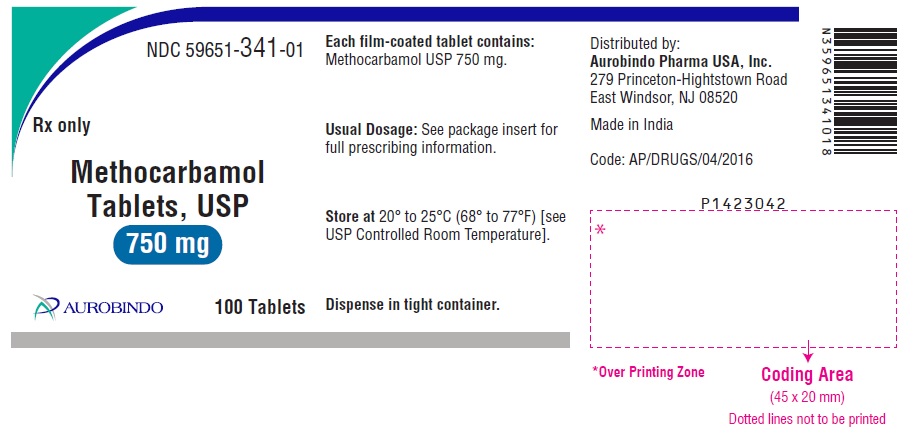
Methocarbamol 750 mg Tablet, Film Coated, 100-count — NDC 59651-341-01 (Billing 59651-0341-01)
NDC 59651-341-01 (billing 59651-0341-01) is a package of 100 tablets of Methocarbamol 750 mg Tablet, Film Coated from Aurobindo Pharma Limited, marketed since Aug 2020 and currently FDA-listed; retail pharmacies pay about $0.0431 per tablet (NADAC).
Other active recalls for Methocarbamol (different manufacturers) — 2 · tap to view
Identity & classification
Regulatory identifiers FDA, NLM and CMS codes for this package
Drug-database identifiers Medi-Span GPI and First Databank GCN / HICL / AHFS classification
- GSN (GCN sequence number): 004655
- GCN: 17893
- GPI-14 (Medi-Span): 75100070000310
- HICL (First Databank): 001938
- AHFS class code: 12:20.04.00
- RxCUI (RxNorm): 197943
- 11-digit billing NDC: 59651034101
Where does this data come from?
- FDA openFDA NDC Directory · synced Oct 1, 2026
- FDA label on DailyMed · label index refreshed Oct 1, 2026
- RxNorm (NLM RxNav) · catalog refreshed Sep 24, 2026
- Medi-Span GPI (licensed)
- First Databank (licensed) · refreshed Oct 1, 2026
RxNorm drug class
This medicine belongs to the Muscle Relaxant class.
Where does this data come from?
- RxClass (NLM) · catalog refreshed Sep 24, 2026
Clinical
Methocarbamol is used with rest, physical therapy, and other measures to relax muscles and relieve pain and discomfort caused by strains, sprains, and other muscle injuries. Methocarbamol is in a class of medications called muscle relaxants. It works by slowing activity in the nervous system to allow the body to relax
Read the full MedlinePlus article ↗- It's used along with rest and physical therapy to ease discomfort from sudden, painful muscle and bone conditions. It's an add-on, not a replacement for those other measures.
- It's best to avoid it. Methocarbamol can add to the effects of alcohol and other sedating medicines. Deaths have been reported with overdose, including when alcohol was involved.
- Be careful. It can affect your mental and physical abilities. Wait until you know how it affects you before driving or using machinery.
- Tablets and Atmeksi suspension are taken by mouth several times a day. Usually a higher amount is used for the first couple of days, then less. If you use Atmeksi, shake it well fo...
Patient education
Supplement & herbal interactions
Some supplements/herbs that may interact with Methocarbamol — tap one for details:
Where does this data come from?
- MedlinePlus (NLM) · refreshed Oct 1, 2026
- FDA label on DailyMed · label index refreshed Oct 1, 2026
Ask a licensed pharmacist directly — free, answered by our team.
Pricing
A drug doesn't have one price. Each row is a different public payment system, and none is what you'd pay at the counter — that depends on your insurance. The ⓘ on each row explains what it measures.
| Price system | Per ea | Per package |
|---|---|---|
| Retail pharmacies payNADAC · weekly | $0.043 | $4.31 / 100 tablets |
| Medicaid paysCMS SDUD · 12 mo | $0.1225 | $12.25 / 100 tablets |
| Medicare drug plans payPart D · quarterly | No Part D plan price is available for this NDC in our data. | |
Where does this data come from?
- CMS NADAC weekly file · file of Sep 30, 2026
- CMS ASP pricing files · refreshed Sep 20, 2026
- CMS Medicaid State Drug Utilization Data · through Q1 2026
- CMS Part D plan pricing files · refreshed Sep 24, 2026
- VA National Acquisition Center price file
Packaging — all sizes for this product
| Package NDC | Description | Per unit | Per pack | Marketing start | Marketing end | Status |
|---|---|---|---|---|---|---|
| 59651-0341-01 59651-341-01 You're viewing this | 100 TABLET, FILM COATED in 1 BOTTLE (59651-341-01) | $0.0431 / ea | $4.31 | 2020-08-12 | — | Active |
| 59651-0341-05 59651-341-05 Main listing | 500 TABLET, FILM COATED in 1 BOTTLE (59651-341-05) | $0.0431 / ea | $21.56 | 2020-08-12 | — | Active |
You're viewing the smallest of 2 pack sizes for this product.
This pack has the lowest per-ea cost of the 2 priced pack sizes ($0.0431 NADAC).
This pack accounts for about 3.2% of this product's recent Medicaid fills; most go to the 500 tablets pack. See all packs ↓
Pack size FAQ
What quantity is in NDC 59651-0341-01?
What is the difference between NDC 59651-0341-01 and NDC 59651-0341-05?
What NDC number is used to bill for this package of Methocarbamol 750 mg Tablet, Film Coated?
Prices are the latest CMS NADAC pharmacy acquisition cost per NDC; per-pack figures are per-unit × pack quantity, shown only when the pack is denominated in the same measure NADAC prices.
Therapeutic equivalents
| Product | Labeler | Pack | NADAC/unit | TE | Status | Price vs. this |
|---|---|---|---|---|---|---|
| Methocarbamol 750 mg 00904-7058-61 | Major | 100 tablets | $0.043 | AA | Availability likely | — |
| Methocarbamol 750 mg 31722-0534-01 | Camber | 1200 tablets | $0.043 | AA | Availability likely | — |
| Methocarbamol 750 mg 43547-0226-10 | Solco | 100 tablets | $0.043 | AA | Availability likely | — |
| Methocarbamol 750 mg 50268-0521-15 | AvPAK | 50 tablets | $0.043 | AA | Availability likely | — |
| Methocarbamol 750 mgthis 59651-0341-01 | Aurobindo | 100 tablets | $0.043 | AA | Availability likely | — |
| Methocarbamol 750 mg 60687-0568-01 | American | 100 tablets | $0.043 | AA | Availability likely | — |
| Methocarbamol Tablets, USP, 750 mg 63561-0174-01 | Granulation | 100 tablets | $0.043 | AA | Availability likely | — |
| Methocarbamol 750 mg 70010-0770-01 | Granules | 100 tablets | $0.043 | AA | Availability likely | — |
| Methocarbamol 750 mg 76385-0124-01 | UNICHEM | 100 tablets | $0.043 | AA | Availability likely | — |
| Methocarbamol 750 mg 00615-8507-39 | NCS | 30 tablets | — | AA | FDA listed | — |
| Methocarbamol Tablets, USP, 750 mg 10135-0723-01 | Marlex | 100 tablets | — | AA | FDA listed | — |
| Methocarbamol 750 mg 35561-0211-12 | Bostal | 100 tablets | — | AA | FDA listed | — |
| Methocarbamol 750 mg 43063-0905-14 | PD-Rx | 14 tablets | — | AA | FDA listed | — |
| Methocarbamol 750 mg 50090-1781-00 | A-S | 20 tablets | — | AA | FDA listed | — |
| Methocarbamol 750 mg 50090-1783-00 | A-S | 90 tablets | — | AA | FDA listed | — |
| Methocarbamol 750 mg 50090-3556-00 | A-S | 20 tablets | — | AA | FDA listed | — |
| Methocarbamol 750 mg 50090-3587-00 | A-S | 90 tablets | — | AA | FDA listed | — |
| Methocarbamol 750 mg 50090-5006-00 | A-S | 90 tablets | — | AA | FDA listed | — |
| Methocarbamol 750 mg 50090-5008-00 | A-S | 20 tablets | — | AA | FDA listed | — |
| Methocarbamol 750 mg 51407-0468-01 | Golden | 100 tablets | — | AA | FDA listed | — |
| Methocarbamol 750 mg 51655-0205-20 | Northwind | 20 tablets | — | AA | FDA listed | — |
| Methocarbamol 750 mg 51655-0575-20 | Northwind | 20 tablets | — | AA | FDA listed | — |
| Methocarbamol 750 mg 55154-2130-00 | Cardinal | 10 tablets | — | AA | FDA listed | — |
| Methocarbamol 750 mg 55154-2335-00 | Cardinal | 10 tablets | — | AA | FDA listed | — |
| Methocarbamol 750 mg 60760-0725-28 | St. | 28 tablets | — | AA | FDA listed | — |
| Methocarbamol 750 mg 60760-0770-28 | St. | 28 tablets | — | AA | FDA listed | — |
| Methocarbamol 750 mg 61919-0616-30 | DIRECT | 30 tablets | — | AA | FDA listed | — |
| Methocarbamol 750 mg 62207-0770-41 | Granules | 24 tablets | — | AA | FDA listed | — |
| Methocarbamol 750 mg 63187-0019-00 | Proficient | 100 tablets | — | AA | FDA listed | — |
| Methocarbamol 750 mg 63187-0130-30 | Proficient | 30 tablets | — | AA | FDA listed | — |
| Methocarbamol 750 mg 63629-2419-01 | Bryant | 500 tablets | — | AA | FDA listed | — |
| Methocarbamol 750 mg 63629-2420-01 | Bryant | 100 tablets | — | AA | FDA listed | — |
| Methocarbamol 750 mg 63629-8995-01 | Bryant | 30 tablets | — | AA | FDA listed | — |
| Methocarbamol 750 mg 66267-0146-12 | NuCare | 12 tablets | — | AA | FDA listed | — |
| Methocarbamol 750 mg 66267-0803-06 | NuCare | 6 tablets | — | AA | FDA listed | — |
| Methocarbamol 750 mg 67046-1147-03 | Coupler | 30 tablets | — | AA | FDA listed | — |
| Methocarbamol 750 mg 67296-2203-01 | Redpharm | 15 tablets | — | AA | FDA listed | — |
| Methocarbamol 750 mg 68071-3859-02 | NuCare | 20 tablets | — | AA | FDA listed | — |
| Methocarbamol 750 mg 68071-4505-01 | NuCare | 21 tablets | — | AA | FDA listed | — |
| Methocarbamol 750 mg 68788-7980-03 | Preferred | 30 tablets | — | AA | FDA listed | — |
| Methocarbamol 750 mg 68788-8172-03 | Preferred | 30 tablets | — | AA | FDA listed | — |
| Methocarbamol 750 mg 68788-8876-03 | Preferred | 30 tablets | — | AA | FDA listed | — |
| Methocarbamol 750 mg 69584-0612-09 | Oxford | 90 tablets | — | AA | FDA listed | — |
| Methocarbamol 750 mg 70518-1738-04 | REMEDYREPACK | 30 tablets | — | AA | FDA listed | — |
| Methocarbamol 750 mg 70518-4472-00 | REMEDYREPACK | 90 tablets | — | AA | FDA listed | — |
| Methocarbamol 750 mg 70518-4501-00 | REMEDYREPACK | 40 tablets | — | AA | FDA listed | — |
| Methocarbamol 750 mg 70868-0901-90 | Key | 90 tablets | — | AA | FDA listed | — |
| Methocarbamol 750 mg 71205-0068-20 | Proficient | 20 tablets | — | AA | FDA listed | — |
| Methocarbamol 750 mg 71205-0285-30 | Proficient | 30 tablets | — | AA | FDA listed | — |
| Methocarbamol 750 mg 71335-0251-00 | Bryant | 14 tablets | — | AA | FDA listed | — |
| Methocarbamol 750 mg 71335-0828-00 | Bryant | 14 tablets | — | AA | FDA listed | — |
| Methocarbamol 750 mg 71335-1727-00 | Bryant | 14 tablets | — | AA | FDA listed | — |
| Methocarbamol 750 mg 71335-2305-00 | Bryant | 14 tablets | — | AA | FDA listed | — |
| Methocarbamol 750 mg 71335-2795-00 | Bryant | 14 tablets | — | AA | FDA listed | — |
| Methocarbamol 750 mg 71610-0134-53 | Aphena | 60 tablets | — | AA | FDA listed | — |
| Methocarbamol 750 mg 71610-0174-53 | Aphena | 60 tablets | — | AA | FDA listed | — |
| Methocarbamol 750 mg 71610-0598-53 | Aphena | 60 tablets | — | AA | FDA listed | — |
| Methocarbamol 750 mg 71610-0833-30 | Aphena | 30 tablets | — | AA | FDA listed | — |
| Methocarbamol 750 mg 72162-1930-01 | Bryant | 100 tablets | — | AA | FDA listed | — |
| Methocarbamol Tablets, USP, 750 mg 72162-2488-01 | Bryant | 100 tablets | — | AA | FDA listed | — |
| Methocarbamol 750 mg 72789-0022-01 | PD-Rx | 100 tablets | — | AA | FDA listed | — |
| Methocarbamol 750 mg 72789-0041-20 | PD-Rx | 20 tablets | — | AA | FDA listed | — |
| Methocarbamol 750 mg 72789-0398-01 | PD-Rx | 100 tablets | — | AA | FDA listed | — |
| Methocarbamol 750 mg 72789-0429-20 | PD-Rx | 20 tablets | — | AA | FDA listed | — |
| Methocarbamol Tablets, USP, 750 mg 72789-0521-20 | PD-Rx | 20 tablets | — | AA | FDA listed | — |
| Methocarbamol 750 mg 72865-0234-01 | XLCare | 100 tablets | — | AA | FDA listed | — |
| Methocarbamol 750 mg 76420-0040-30 | Asclemed | 30 tablets | — | AA | FDA listed | — |
| Methocarbamol 750 mg 76420-0258-10 | Asclemed | 100 tablets | — | AA | FDA listed | — |
| Methocarbamol 750 mg 76420-0638-01 | Asclemed | 100 tablets | — | AA | FDA listed | — |
| Methocarbamol 750 mg 76420-0894-01 | Asclemed | 100 tablets | — | AA | FDA listed | — |
| Methocarbamol 750 mg 80425-0020-01 | Advanced | 30 tablets | — | AA | FDA listed | — |
| Methocarbamol 750 mg 80425-0021-01 | Advanced | 30 tablets | — | AA | FDA listed | — |
| Methocarbamol 750 mg 80425-0171-01 | Advanced | 30 tablets | — | AA | FDA listed | — |
| Methocarbamol 750 mg 80425-0490-01 | Advanced | 30 tablets | — | AA | FDA listed | — |
| Methocarbamol 750 mg 82804-0955-00 | Proficient | 100 tablets | — | AA | FDA listed | — |
| Methocarbamol 750 mg 82982-0038-40 | Pharmasource | 40 tablets | — | AA | FDA listed | — |
| Methocarbamol 750 mg 85509-1341-03 | PHOENIX | 30 tablets | — | AA | FDA listed | — |
| Methocarbamol 750 mg 85509-1770-03 | PHOENIX | 30 tablets | — | AA | FDA listed | — |
| Methocarbamol 750 mg 85766-0060-01 | Sportpharm | 100 tablets | — | AA | FDA listed | — |
| Methocarbamol 750 mg 87063-0041-01 | Asclemed | 100 tablets | — | AA | FDA listed | — |
| Methocarbamol 750 mg 87063-0689-12 | ASCLEMED | 120 tablets | — | AA | FDA listed | — |
| Methocarbamol 750 mg 85534-0022-00 | HAWAII | 30 tablets | — | AA | FDA listed | — |
| Methocarbamol 750 mg 60760-0875-28 | St. | 28 tablets | — | AA | FDA listed | — |
| Methocarbamol 750 mg 82461-0723-90 | Medcore | 90 tablets | — | AA | FDA listed | — |
| Methocarbamol 750 mg 53401-0035-53 | Aphena | 60 tablets | — | AA | FDA listed | — |
Where does this data come from?
- FDA openFDA NDC Directory · synced Oct 1, 2026
- FDA Orange Book · refreshed Sep 3, 2026
- CMS NADAC weekly file · file of Sep 30, 2026
Availability & generic status
This product is an FDA-approved generic. Other versions of the same drug are listed under Therapeutic equivalents, least expensive first.
Where does this data come from?
- FDA Orange Book · refreshed Sep 3, 2026
What it looks like
Where does this data come from?
- FDA label on DailyMed · label index refreshed Oct 1, 2026
Inactive Ingredients / Excipients
Inactive ingredients, also called excipients, are components of the drug product other than the active ingredient. They may include fillers, dyes, coatings, preservatives, flavors, or other formulation ingredients.
💡 Tap an ingredient (hover on desktop) to see what it is and why it’s used.
-
UNII 0WZ8WG20P6
Hypromellose 2910 is a plant-based cellulose derivative that acts as a thickener, binder, and film-coating agent. It helps control how quickly the medicine dissolves and protects the tablet or capsule from moisture and light.
-
UNII 70097M6I30
Magnesium stearate is a salt made from magnesium and stearic acid, a fatty substance. It's used in tablets and capsules as a lubricant and glidant to help ingredients flow smoothly during manufacturing and prevent sticking.
-
UNII B697894SGQ
Polyethylene glycol 400 is a clear, thick liquid made from petroleum-derived polymers. It acts as a solvent and humectant in medicines, helping dissolve active ingredients and retain moisture in the formulation.
-
UNII U725QWY32X
Povidone K30 is a synthetic polymer made from petroleum. It acts as a binder to hold tablet ingredients together and as a disintegrant to help the tablet break apart in the stomach so the medicine can be absorbed.
-
UNII 368GB5141J
A detergent and foaming agent derived from coconut or palm oil. In medications, it helps break down and mix oil and water-based ingredients, aids in tablet disintegration, and improves how the drug dissolves and spreads in the mouth or digestive system.
-
UNII 5856J3G2A2
A starch-based powder made from potatoes and processed with sodium. It acts as a disintegrant, helping the tablet or capsule break apart quickly in the stomach so the medicine can be absorbed.
-
UNII O8232NY3SJ
A plant-based carbohydrate derived from corn kernels. It acts as a filler to add bulk, a binder to hold ingredients together, and a disintegrant to help the tablet break apart in your stomach for absorption.
-
UNII 7SEV7J4R1U
A powder made from a naturally occurring mineral. In medicines, talc works as a glidant and anti-caking agent, helping tablets and capsules flow smoothly during manufacturing and preventing clumping.
-
UNII 15FIX9V2JP
Titanium dioxide is a bright white mineral powder commonly used as a colorant and opacifying agent. It makes pills and tablets white or lighter in color and helps make coatings non-transparent.
9 inactive ingredients listed in the exact product block matched to this NDC.
Where does this data come from?
ingredient classCode="IACT" elements from the exact product block matched by this NDC. Label-section narrative from DailyMed / the openFDA label index is shown separately when available.- FDA label on DailyMed · label index refreshed Oct 1, 2026
- FDA openFDA NDC Directory · synced Oct 1, 2026
Inactive ingredient FAQ
Are inactive ingredients the same for every manufacturer?
Why might an inactive ingredient be missing?
Can inactive ingredients matter?
Manufacturer & labeler
Where does this data come from?
- FDA openFDA NDC Directory · synced Oct 1, 2026
- Drugs@FDA
Full prescribing information FDA SPL
🎯 Indications and Usage ▾
INDICATIONS AND USAGE Methocarbamol tablets are indicated as an adjunct to rest, physical therapy, and other measures for the relief of discomfort associated with acute, painful musculoskeletal conditions. The mode of action of methocarbamol has not been clearly identified, but may be related to its sedative properties. Methocarbamol does not directly relax tense skeletal muscles in man.
⏱️ Dosage and Administration ▾
DOSAGE AND ADMINISTRATION Methocarbamol tablets, 500 mg - Adults: Initial dosage: 3 tablets 4 times daily. Maintenance dosage: 2 tablets 4 times daily. Methocarbamol tablets: 750 mg - Adults: Initial dosage: 2 tablets 4 times daily.
Maintenance dosage: 1 tablet q.4h. or 2 tablets 3 times daily. Six grams a day are recommended for the first 48 to 72 hours of treatment. (For severe conditions 8 grams a day may be administered.) Thereafter, the dosage can usually be reduced to approximately 4 grams a day.
⛔ Contraindications ▾
CONTRAINDICATIONS Methocarbamol tablets are contraindicated in patients hypersensitive to methocarbamol or to any of the tablet components.
⚠️ Warnings ▾
WARNINGS Since methocarbamol may possess a general CNS depressant effect, patients receiving methocarbamol should be cautioned about combined effects with alcohol and other CNS depressants. Safe use of methocarbamol has not been established with regard to possible adverse effects upon fetal development. There have been reports of fetal and congenital abnormalities following in utero exposure to methocarbamol.
Therefore, methocarbamol should not be used in women who are or may become pregnant and particularly during early pregnancy unless in the judgment of the physician the potential benefits outweigh the possible hazards (see PRECAUTIONS , Pregnancy ). Use in Activities Requiring Mental Alertness Methocarbamol may impair mental and/or physical abilities required for performance of hazardous tasks, such as operating machinery or driving a motor vehicle. Patients should be cautioned about operating machinery, including automobiles, until they are reasonably certain that methocarbamol therapy does not adversely affect their ability to engage in such activities.
🤒 Adverse Reactions ▾
ADVERSE REACTIONS Adverse reactions reported coincident with the administration of methocarbamol include: Body as a whole: Anaphylactic reaction, angioneurotic edema, fever, headache Cardiovascular system: Bradycardia, flushing, hypotension, syncope, thrombophlebitis Digestive system: Dyspepsia, jaundice (including cholestatic jaundice), nausea and vomiting Hemic and lymphatic system: Leukopenia Immune system: Hypersensitivity reactions Nervous system: Amnesia, confusion, diplopia, dizziness or lightheadedness, drowsiness, insomnia, mild muscular incoordination, nystagmus, sedation, seizures (including grand mal), vertigo Skin and special senses: Blurred vision, conjunctivitis, nasal congestion, metallic taste, pruritus, rash, urticaria
🔄 Drug Interactions ▾
Drug Interactions See WARNINGS and PRECAUTIONS for interaction with CNS drugs and alcohol. Methocarbamol may inhibit the effect of pyridostigmine bromide. Therefore, methocarbamol should be used with caution in patients with myasthenia gravis receiving anticholinesterase agents.
🔄 Drug / Laboratory Test Interactions ▾
Drug/Laboratory Test Interactions Methocarbamol may cause a color interference in certain screening tests for 5-hydroxyindoleacetic acid (5-HIAA) using nitrosonaphthol reagent and in screening tests for urinary vanillylmandelic acid (VMA) using the Gitlow method.
🤰 Pregnancy ▾
Pregnancy Teratogenic Effects Animal reproduction studies have not been conducted with methocarbamol. It is also not known whether methocarbamol can cause fetal harm when administered to a pregnant woman or can affect reproduction capacity. Methocarbamol should be given to a pregnant woman only if clearly needed.
Safe use of methocarbamol has not been established with regard to possible adverse effects upon fetal development. There have been reports of fetal and congenital abnormalities following in utero exposure to methocarbamol. Therefore, methocarbamol should not be used in women who are or may become pregnant and particularly during early pregnancy unless in the judgment of the physician the potential benefits outweigh the possible hazards (see WARNINGS ).
🧒 Pediatric Use ▾
Pediatric Use Safety and effectiveness of methocarbamol in pediatric patients below the age of 16 have not been established.
🆘 Overdosage ▾
OVERDOSAGE Limited information is available on the acute toxicity of methocarbamol. Overdose of methocarbamol is frequently in conjunction with alcohol or other CNS depressants and includes the following symptoms: nausea, drowsiness, blurred vision, hypotension, seizures, and coma. In post-marketing experience, deaths have been reported with an overdose of methocarbamol alone or in the presence of other CNS depressants, alcohol or psychotropic drugs.
Treatment Management of overdose includes symptomatic and supportive treatment. Supportive measures include maintenance of an adequate airway, monitoring urinary output and vital signs, and administration of intravenous fluids if necessary. The usefulness of hemodialysis in managing overdose is unknown.
🧬 Clinical Pharmacology ▾
CLINICAL PHARMACOLOGY The mechanism of action of methocarbamol in humans has not been established, but may be due to general CNS depression. It has no direct action on the contractile mechanism of striated muscle, the motor end plate or the nerve fiber. Pharmacokinetics In healthy volunteers, the plasma clearance of methocarbamol ranges between 0.20 and
0.80L/h/kg, the mean plasma elimination half-life ranges between 1 and 2 hours, and the plasma protein binding ranges between 46% and 50%. Methocarbamol is metabolized via dealkylation and hydroxylation. Conjugation of methocarbamol also is likely.
Essentially all methocarbamol metabolites are eliminated in the urine. Small amounts of unchanged methocarbamol also are excreted in the urine. Special populations Elderly The mean (± SD) elimination half-life of methocarbamol in elderly healthy volunteers (mean [± SD] age, 69 [± 4] years) was slightly prolonged compared to a younger (mean [± SD] age, 53.3 [± 8.8] years), healthy population (1.5 [± 0.4] hours versus 1.1 [±0.27] hours, respectively).
The fraction of bound methocarbamol was slightly decreased in the elderly versus younger volunteers (41% to 43% versus 46% to 50%, respectively). Renally impaired The clearance of methocarbamol in 8 renally-impaired patients on maintenance hemodialysis was reduced about 40% compared to 17 normal subjects, although the mean (± SD) elimination half-life in these two groups was similar: 1.2 (± 0.6) versus 1.1 (±0.3) hours, respectively. Hepatically impaired In 8 patients with cirrhosis secondary to alcohol abuse, the mean total clearance of methocarbamol was reduced approximately 70% compared to that obtained in 8 age- and weight-matched normal subjects.
The mean (± SD) elimination half-life in the cirrhotic patients and the normal subjects was 3.38 (± 1.62) hours and 1.11 (± 0.27) hours, respectively. The percent of methocarbamol bound to plasma proteins was decreased to approximately 40% to 45% compared to 46% to 50% in the normal subjects.
📦 How Supplied / Storage and Handling ▾
HOW SUPPLIED Methocarbamol Tablets USP, 500 mg are white in color, round, beveled edge, biconvex film-coated tablet debossed with “500” above the score line on one side and “METT” on the other side. They are supplied as follows: Bottles of 100 NDC 59651-340-01 Bottles of 500 NDC 59651-340-05 Methocarbamol Tablets USP, 750 mg are white in color, biconvex capsule shaped film-coated tablet, debossed with “METT” on one side and “750” on the other side. They are supplied as follows: Bottles of 100 NDC 59651-341-01 Bottles of 500 NDC 59651-341-05 Store at 20° to 25°C (68° to 77°F) [see USP Controlled Room Temperature].
Dispense in tight container. For more information, call Aurobindo Pharma USA, Inc.at 1-866-850-2876. Distributed by: Aurobindo Pharma USA, Inc.
279 Princeton-Hightstown Road East Windsor, NJ 08520 Manufactured by: Aurobindo Pharma Limited Hyderabad-500 032, India Revised: 08/2022
📋 Description ▾
DESCRIPTION Methocarbamol tablets, USP, a carbamate derivative of guaifenesin, is a central nervous system (CNS) depressant with sedative and musculoskeletal relaxant properties. The chemical name of methocarbamol is 3-(2-methoxyphenoxy)-1,2-propanediol 1-carbamate and has the empirical formula C 11 H 15 NO 5 . Its molecular weight is 241.24.
The structural formula is shown below. Methocarbamol is a white bulky powder, sparingly soluble in water and chloroform, soluble in alcohol only with heating and insoluble in benzene and n -hexane. Methocarbamol tablets USP, 500 mg are available as white in color, round, beveled edge, biconvex film-coated tablet containing 500 mg of methocarbamol USP for oral administration.
Methocarbamol tablets USP, 750 mg are available as white in color, biconvex capsule shaped film-coated tablet containing 750 mg of methocarbamol USP for oral administration. Methocarbamol tablets USP, 500 mg and 750 mg contain the following inactive ingredients: corn starch, hypromellose, magnesium stearate, polyethylene glycol, povidone, sodium lauryl sulfate, sodium starch glycolate, talc and titanium dioxide. FDA approved dissolution test specifications differ from USP for 500 mg.
Chemical Structure
💬 Information for Patients ▾
Information for Patients Patients should be cautioned that methocarbamol may cause drowsiness or dizziness, which may impair their ability to operate motor vehicles or machinery. Because methocarbamol may possess a general CNS-depressant effect, patients should be cautioned about combined effects with alcohol and other CNS depressants.
⚠️ Precautions ▾
PRECAUTIONS Information for Patients Patients should be cautioned that methocarbamol may cause drowsiness or dizziness, which may impair their ability to operate motor vehicles or machinery. Because methocarbamol may possess a general CNS-depressant effect, patients should be cautioned about combined effects with alcohol and other CNS depressants. Drug Interactions See WARNINGS and PRECAUTIONS for interaction with CNS drugs and alcohol.
Methocarbamol may inhibit the effect of pyridostigmine bromide. Therefore, methocarbamol should be used with caution in patients with myasthenia gravis receiving anticholinesterase agents. Drug/Laboratory Test Interactions Methocarbamol may cause a color interference in certain screening tests for 5-hydroxyindoleacetic acid (5-HIAA) using nitrosonaphthol reagent and in screening tests for urinary vanillylmandelic acid (VMA) using the Gitlow method.
Carcinogenesis, Mutagenesis, Impairment of Fertility Long-term studies to evaluate the carcinogenic potential of methocarbamol have not been performed. No studies have been conducted to assess the effect of methocarbamol on mutagenesis or its potential to impair fertility. Pregnancy Teratogenic Effects Animal reproduction studies have not been conducted with methocarbamol.
It is also not known whether methocarbamol can cause fetal harm when administered to a pregnant woman or can affect reproduction capacity. Methocarbamol should be given to a pregnant woman only if clearly needed. Safe use of methocarbamol has not been established with regard to possible adverse effects upon fetal development.
There have been reports of fetal and congenital abnormalities following in utero exposure to methocarbamol. Therefore, methocarbamol should not be used in women who are or may become pregnant and particularly during early pregnancy unless in the judgment of the physician the potential benefits outweigh the possible hazards (see WARNINGS ). Nursing Mothers Methocarbamol and/or its metabolites are excreted in the milk of dogs; however, it is not known whether methocarbamol or its metabolites are excreted in human milk.
Because many drugs are excreted in human milk, caution should be exercised when methocarbamol is administered to a nursing woman. Pediatric Use Safety and effectiveness of methocarbamol in pediatric patients below the age of 16 have not been established.
🍼 Nursing Mothers ▾
Nursing Mothers Methocarbamol and/or its metabolites are excreted in the milk of dogs; however, it is not known whether methocarbamol or its metabolites are excreted in human milk. Because many drugs are excreted in human milk, caution should be exercised when methocarbamol is administered to a nursing woman.
📄 Carcinogenesis, Mutagenesis, Impairment of Fertility ▾
Carcinogenesis, Mutagenesis, Impairment of Fertility Long-term studies to evaluate the carcinogenic potential of methocarbamol have not been performed. No studies have been conducted to assess the effect of methocarbamol on mutagenesis or its potential to impair fertility.
📄 Package Label / Principal Display Panel ▾
PACKAGE LABEL-PRINCIPAL DISPLAY PANEL - 500 mg (100 Tablets Bottle) NDC 59651-340-01 Rx only Methocarbamol Tablets, USP 500 mg AUROBINDO 100 Tablets PACKAGE LABEL-PRINCIPAL DISPLAY PANEL - 500 mg (100 Tablets Bottle)
PACKAGE LABEL-PRINCIPAL DISPLAY PANEL - 750 mg (100 Tablets Bottle) NDC 59651-341-01 Rx only Methocarbamol Tablets, USP 750 mg AUROBINDO 100 Tablets PACKAGE LABEL-PRINCIPAL DISPLAY PANEL - 750 mg (100 Tablets Bottle)